BY – ABHISHEK SUR
SYSTEM ID- 2019595927
ROLL NO -190134001
SUBMITTED TO – SUMAN LATA DHAR
 DATA ACQUISITION
 ROLE OF TRANSDUCERS
 ANALOG SIGNALS
 SIGNAL CONDITIONING
 PARTS OF SIGNAL CONDITIONING
 COMPONENTS OF DAQ DEVICES
 Data acquisition involves gathering signals from a
measuring sources and then digitizing the signals
for storage, analysis and presentation on a PC.
 It may come in many different PC technology
forms to offer flexibility while choosing a
system.
 The main components for building a basic DAC
system are:-
 Transducers and Sensors
 Signals
 Signal conditioning
 DAQ hardware
 Driver and Application Software
 Now, Transducer is a device that converts a
physical phenomenon into measurable
electrical signal such as voltage or current
 It has the same agreement like that of
sensors in data acquisition system.
 There are specific transducers for many
different applications such as measuring
temparature, pressure and fluid flow.
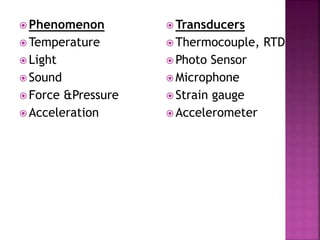
 Phenomenon
 Temperature
 Light
 Sound
 Force &Pressure
 Acceleration
 Transducers
 Thermocouple, RTD
 Photo Sensor
 Microphone
 Strain gauge
 Accelerometer
 It is a type of signals that can exist at any
value with respect to time. Examples are
voltage, temperature, pressure, load.
 The three primary characteristics of an
analog signal are level, shape and frequency.
 LEVEL:- It gives us the vital information
about the measured analog signal. As when
we measure it the signal doesn't change
quickly with time. The accuracy is also
important.
 SHAPE:- Some signals are named after
specific shapes as square, sawtooth, triangle
etc. It is important because by analyzing the
shape we can further analyse the signal.
 FREQUENCY:- All analog signals can be
categorized by their frequencies. Unlike
level or shape you cannot directly measure
frequency. But it can be analysed in a
software through Fourier Transform.
 Sometimes transducers generate signals too
difficult to measure with a data acquisition
device.
 For that reason only signal conditioning is
used as for noisy environment, extreme high
or low signals it is used.
 It also maximizes the accuracy of the system
and allows sensor to operate properly and
assures safety.
 It is important to select the right hardware
for signal conditioning. It can be both
modular and integrated type:-
 Amplification
 Linearization
 Filtering
 Multiplexing
 Improves the accuracy in the digitized signal
and reduces the effects of the noise.
 Signals should be amplified close to the
source results into high SNR.
 For highest accuracy amplify the voltage
level to maximum input range of ADC.
 Most of the transducers have non-linear
response.
 LabVIEW can linearize the voltage levels
from transducers so that you can scale the
voltages to the measured phenomenon.
 Software based.
 It is to remove unwanted signals from the
signal of interest i.e. the signal which is to
be measured.
 Noise reduces the measurement accuracy.
 For DC signals Many SCXI-
Signal Conditioning Extension for Instrumenta
tion modules uses 4Hz and 10kHz low pass
filters to eliminate the noise before the
signals are digitized by DAQ device.
 Technique for measuring several signals with
a single device.
 The ADC samples one channel, switches to
next channel samples it, switches to next
channel and so on.
 Because same ADC samples many channels
instead of one, the effective sampling rate of
the individual channel is inversely to number
of channels sampled.
 Analog I/O
 Digital I/O
 MUX
 ADC
 DAC
 Counter
 RTSI (Real Time System Integration) Bus
 The DAQ device is an external and connects
to the computer through an exiting port such
as serial port or Ethernet port .
 The computer receives the raw data through
DAQ Device.
 The application which is written in the
software presents and manipulates the raw
data so that it can be understood.
 Software also controls the DAQ system by
commanding the DAQ device and manages
when and from which channel to acquire the
data.
DATA  ACQUISITION (DAQ) IN LABVIEW

DATA ACQUISITION (DAQ) IN LABVIEW

  • 1.
    BY – ABHISHEKSUR SYSTEM ID- 2019595927 ROLL NO -190134001 SUBMITTED TO – SUMAN LATA DHAR
  • 2.
     DATA ACQUISITION ROLE OF TRANSDUCERS  ANALOG SIGNALS  SIGNAL CONDITIONING  PARTS OF SIGNAL CONDITIONING  COMPONENTS OF DAQ DEVICES
  • 3.
     Data acquisitioninvolves gathering signals from a measuring sources and then digitizing the signals for storage, analysis and presentation on a PC.  It may come in many different PC technology forms to offer flexibility while choosing a system.  The main components for building a basic DAC system are:-  Transducers and Sensors  Signals  Signal conditioning  DAQ hardware  Driver and Application Software
  • 4.
     Now, Transduceris a device that converts a physical phenomenon into measurable electrical signal such as voltage or current  It has the same agreement like that of sensors in data acquisition system.  There are specific transducers for many different applications such as measuring temparature, pressure and fluid flow.
  • 5.
     Phenomenon  Temperature Light  Sound  Force &Pressure  Acceleration  Transducers  Thermocouple, RTD  Photo Sensor  Microphone  Strain gauge  Accelerometer
  • 6.
     It isa type of signals that can exist at any value with respect to time. Examples are voltage, temperature, pressure, load.  The three primary characteristics of an analog signal are level, shape and frequency.
  • 7.
     LEVEL:- Itgives us the vital information about the measured analog signal. As when we measure it the signal doesn't change quickly with time. The accuracy is also important.  SHAPE:- Some signals are named after specific shapes as square, sawtooth, triangle etc. It is important because by analyzing the shape we can further analyse the signal.
  • 8.
     FREQUENCY:- Allanalog signals can be categorized by their frequencies. Unlike level or shape you cannot directly measure frequency. But it can be analysed in a software through Fourier Transform.
  • 9.
     Sometimes transducersgenerate signals too difficult to measure with a data acquisition device.  For that reason only signal conditioning is used as for noisy environment, extreme high or low signals it is used.  It also maximizes the accuracy of the system and allows sensor to operate properly and assures safety.
  • 10.
     It isimportant to select the right hardware for signal conditioning. It can be both modular and integrated type:-  Amplification  Linearization  Filtering  Multiplexing
  • 11.
     Improves theaccuracy in the digitized signal and reduces the effects of the noise.  Signals should be amplified close to the source results into high SNR.  For highest accuracy amplify the voltage level to maximum input range of ADC.
  • 12.
     Most ofthe transducers have non-linear response.  LabVIEW can linearize the voltage levels from transducers so that you can scale the voltages to the measured phenomenon.  Software based.
  • 13.
     It isto remove unwanted signals from the signal of interest i.e. the signal which is to be measured.  Noise reduces the measurement accuracy.  For DC signals Many SCXI- Signal Conditioning Extension for Instrumenta tion modules uses 4Hz and 10kHz low pass filters to eliminate the noise before the signals are digitized by DAQ device.
  • 14.
     Technique formeasuring several signals with a single device.  The ADC samples one channel, switches to next channel samples it, switches to next channel and so on.  Because same ADC samples many channels instead of one, the effective sampling rate of the individual channel is inversely to number of channels sampled.
  • 15.
     Analog I/O Digital I/O  MUX  ADC  DAC  Counter  RTSI (Real Time System Integration) Bus
  • 16.
     The DAQdevice is an external and connects to the computer through an exiting port such as serial port or Ethernet port .  The computer receives the raw data through DAQ Device.  The application which is written in the software presents and manipulates the raw data so that it can be understood.  Software also controls the DAQ system by commanding the DAQ device and manages when and from which channel to acquire the data.