Data Acquisition
             FO SYED INAM


                            1
Introduction


 DAQ systems capture, measure, and analyze physical
  phenomena from real world
 Light, temperature and pressure are examples of the different
  phenomena
 Data acquisition is the process of sensing and measuring
  electrical signals and sending them to a computer for
  processing

                                                          2
DAQ Components
 Transducers

 Signal Conditioning Components

 Data Acquisition and Control Hardware

 PC/µ-Controller


                                          3
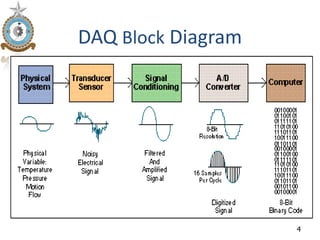
DAQ Block Diagram


                    4
Transducers

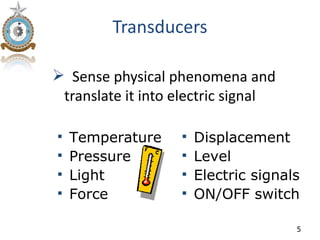
 Sense physical phenomena and
 translate it into electric signal

 Temperature       Displacement
 Pressure          Level
 Light             Electric signals
 Force             ON/OFF switch


                                     5
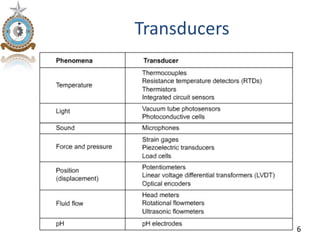
Transducers


              6
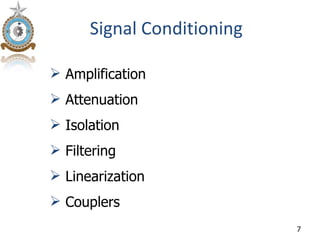
Signal Conditioning

 Amplification
 Attenuation
 Isolation
 Filtering
 Linearization
 Couplers
                            7
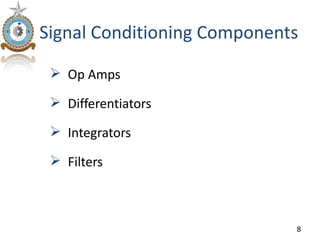
Signal Conditioning Components

  Op Amps

  Differentiators

  Integrators

  Filters


                             8
DAQ Hardware
 Data acquisition and control hardware
  generally performs one or more of the
  following functions:
  Analog Input
  Analog Output
  Digital I/O
  Counter/Timer Functions


                                          9
Analog Inputs (A/D)

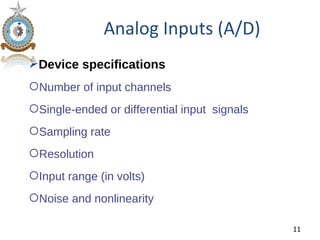
ADC converts analog signal to digital


                                         10
Analog Inputs (A/D)
Device specifications
Number of input channels
Single-ended or differential input signals
Sampling rate
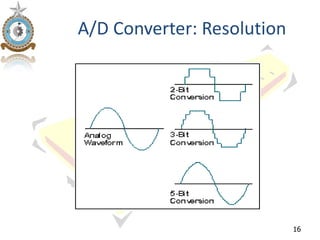
Resolution
Input range (in volts)
Noise and nonlinearity

                                              11
A/D Converter: Sampling Rate

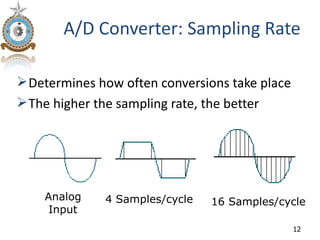
 Determines how often conversions take place
 The higher the sampling rate, the better


    Analog    4 Samples/cycle   16 Samples/cycle
     Input
                                                12
A/D Converter: Sampling Rate

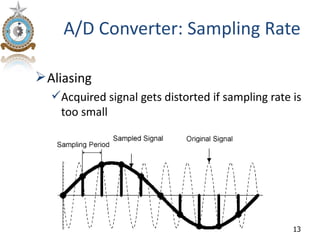
 Aliasing
  Acquired signal gets distorted if sampling rate is
   too small


                                                   13
A/D Converter: Throughput

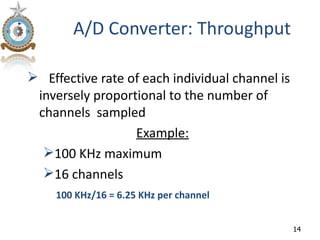
 Effective rate of each individual channel is
 inversely proportional to the number of
 channels sampled
                  Example:
  100 KHz maximum
  16 channels
     100 KHz/16 = 6.25 KHz per channel


                                                 14
A/D Converter: Range

 Minimum and maximum voltage levels

 Ranges are selectable


                                       15
A/D Converter: Resolution


                            16
Analog Outputs (D/A)
 The opposite of analog to digital conversion is digital to
  analog (D/A) conversion. This operation converts digital
  information into analog voltage or current. D/A devices
  allow the computer to control real-world events.
 Analog output signals may directly control process
  equipment. The process can give feedback in the form
  of analog input signals. This is referred to as a closed
  loop control system with PID control.
 Analog outputs can also be used to generate
  waveforms. In this case, the device behaves as a
  function generator.


                                                         17
Analog Outputs (D/A)


                       18
Data Acquisition Software

 It can be the most critical factor in obtaining reliable,
  high performance operation.
 Transforms the PC and DAQ hardware into a
  complete DAQ, analysis, and display system.
 Different alternatives:
    Programmable software.
    Data acquisition software packages.


                                                         19
Programmable Software
 Involves the use of a programming language, such as:
    C++, visual C++
    BASIC, Visual Basic + Add-on tools (such as VisuaLab with
     VTX)
    Fortran
    Pascal
 Advantage: flexibility
 Disadvantages: complexity and steep learning curve


                                                                 20
Data Acquisition Software

 Does not require programming.
 Enables developers to design the custom
  instrument best suited to their application.
  Examples: TestPoint, SnapMaster, LabView,
  DADISP, DASYLAB, etc.


                                                 21
Designing a DAQ:
         Factors to Consider
 Is it a fixed or a mobile application?
 Type of input/output signal: digital or analog?
 Frequency of input signal ?
 Resolution, range, and gain?
 Continuous operation?
 Compatibility between hardware and software. Are the
  drivers available?
 Overall price

                                                  22

Enam final

  • 1.
    Data Acquisition FO SYED INAM 1
  • 2.
    Introduction  DAQ systemscapture, measure, and analyze physical phenomena from real world  Light, temperature and pressure are examples of the different phenomena  Data acquisition is the process of sensing and measuring electrical signals and sending them to a computer for processing 2
  • 3.
    DAQ Components  Transducers Signal Conditioning Components  Data Acquisition and Control Hardware  PC/µ-Controller 3
  • 4.
  • 5.
    Transducers  Sense physicalphenomena and translate it into electric signal  Temperature  Displacement  Pressure  Level  Light  Electric signals  Force  ON/OFF switch 5
  • 6.
  • 7.
    Signal Conditioning  Amplification Attenuation  Isolation  Filtering  Linearization  Couplers 7
  • 8.
    Signal Conditioning Components  Op Amps  Differentiators  Integrators  Filters 8
  • 9.
    DAQ Hardware  Dataacquisition and control hardware generally performs one or more of the following functions: Analog Input Analog Output Digital I/O Counter/Timer Functions 9
  • 10.
    Analog Inputs (A/D) ADCconverts analog signal to digital 10
  • 11.
    Analog Inputs (A/D) Devicespecifications Number of input channels Single-ended or differential input signals Sampling rate Resolution Input range (in volts) Noise and nonlinearity 11
  • 12.
    A/D Converter: SamplingRate  Determines how often conversions take place  The higher the sampling rate, the better Analog 4 Samples/cycle 16 Samples/cycle Input 12
  • 13.
    A/D Converter: SamplingRate  Aliasing Acquired signal gets distorted if sampling rate is too small 13
  • 14.
    A/D Converter: Throughput Effective rate of each individual channel is inversely proportional to the number of channels sampled Example: 100 KHz maximum 16 channels 100 KHz/16 = 6.25 KHz per channel 14
  • 15.
    A/D Converter: Range Minimum and maximum voltage levels  Ranges are selectable 15
  • 16.
  • 17.
    Analog Outputs (D/A) The opposite of analog to digital conversion is digital to analog (D/A) conversion. This operation converts digital information into analog voltage or current. D/A devices allow the computer to control real-world events.  Analog output signals may directly control process equipment. The process can give feedback in the form of analog input signals. This is referred to as a closed loop control system with PID control.  Analog outputs can also be used to generate waveforms. In this case, the device behaves as a function generator. 17
  • 18.
  • 19.
    Data Acquisition Software It can be the most critical factor in obtaining reliable, high performance operation.  Transforms the PC and DAQ hardware into a complete DAQ, analysis, and display system.  Different alternatives:  Programmable software.  Data acquisition software packages. 19
  • 20.
    Programmable Software  Involvesthe use of a programming language, such as:  C++, visual C++  BASIC, Visual Basic + Add-on tools (such as VisuaLab with VTX)  Fortran  Pascal  Advantage: flexibility  Disadvantages: complexity and steep learning curve 20
  • 21.
    Data Acquisition Software Does not require programming.  Enables developers to design the custom instrument best suited to their application. Examples: TestPoint, SnapMaster, LabView, DADISP, DASYLAB, etc. 21
  • 22.
    Designing a DAQ: Factors to Consider  Is it a fixed or a mobile application?  Type of input/output signal: digital or analog?  Frequency of input signal ?  Resolution, range, and gain?  Continuous operation?  Compatibility between hardware and software. Are the drivers available?  Overall price 22
Editor's Notes

  • #3 Data acquisition is the process of sampling signals that measure real world physical conditions and converting the resulting samples into digital numeric values that can be manipulated by a computer.
  • #4 A data acquisition system consists of many integrated components that are Transducers: which sense the physical variables and produce proportional electrical signal Signal Conditioning Components make this signal suitable for measurement….. Data Acquisition and Control Hardware…. Convert the signal into a digital format acceptable by a computer Software …..process, analyze ,store and display
  • #6 A transducer converts temperature, pressure, level, length, position, etc. into voltage, current, frequency, pulses or other signals.
  • #7 Transducers for some of the physical variables are as flashed
  • #8 Signal conditioning circuits improve the quality of signals generated by transducers before they are converted into digital signals by the PC's data-acquisition hardware. Accuracy Effectiveness Noise removal Safety
  • #9 Signal conditioning circuits improve the quality of signals generated by transducers before they are converted into digital signals by the PC's data-acquisition hardware. Examples of signal conditioning are signal scaling, amplification, linearization, cold-junction compensation, filtering, attenuation, excitation, common-mode rejection, and so on.
  • #11 ADC changes analog voltage or current levels into digital information. The conversion is necessary to enable the computer to process or store the signals.
  • #12 The most significant criteria when selecting A/D hardware are:
  • #14 According to nyquist theorem the sampling rate should be 2 times greater than the highest frequency component of the signal…….if it is smaller than there will be distortion in the original signal……….
  • #16 Range is another important specification of AD converter………..range is the Minimum and maximum voltage levels that the A/D converter can quantize Ranges are selectable (either hardware or software) to accurately measure the signal
  • #18 The opposite of analog to digital conversion is digital to analog (D/A) conversion. This operation converts digital information into analog voltage or current. D/A devices allow the computer to control real-world events