WEARABLE BIO
SENSOR
SEMINAR PRESENTED
ON
SUBMITTED BY:-
PRITAM
FINAL YEAR ECE
16/373
SUBMITTED TO:-
DR. JANKIBALLABH SHARMA
ASSOCIATE PROFESSOR
ELECTRONICS AND COMMUNICATION ENGG
What is
Bio Sensor
1
2
3
4
The term “biosensor” is short for “biological
sensor.”
The device is made up of a transducer and a
biological element that may be an enzyme, an
antibody or a nucleic acid.
The bio element interacts with the analyte
being tested and the biological response is
converted into an electrical signal by the
transducer. Depending on their particular
application.
Every bio sensor has two part one is biological
component that acts as the sensor and
second is electronic component that detects
and transmits the signal
2
What is
Wearable
Bio Sensor
Wearable biosensor = Wearable+ Bio sensor
Wearable
Object that can be worn on
body.
E.g. wrist watches, ring,
shirts etc.
BIO-SENSOR
Biosensor is an analytical
device used for detection of
analyte.
E.g. Blood Glucose Detector
3
WEARABLE BIO SENSOR 4
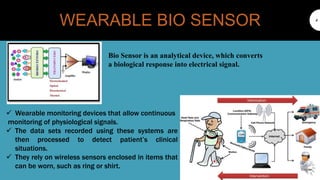
 Wearable monitoring devices that allow continuous
monitoring of physiological signals.
 The data sets recorded using these systems are
then processed to detect patient’s clinical
situations.
 They rely on wireless sensors enclosed in items that
can be worn, such as ring or shirt.
Bio Sensor is an analytical device, which converts
a biological response into electrical signal.
WEARABLE BIO SENSOR 5
 Remote monitoring of patients.
 Training support for athletes.
 Monitoring of individuals who work with hazardous elements.
 Tracking of professional truck driver’s vital signs to alert them of fatigue.
 Use of wearable monitoring devices allow continuous monitoring of physiological signals.
 Wearable systems are totally non-obtrusive devices that allow physicians to overcome the
limitations of ambulatory technology.
NEED FOR WEARABLE BIO
SENSOR
06
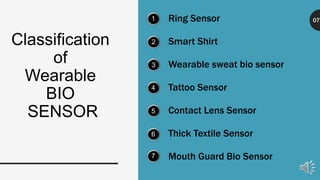
Classification
of
Wearable
BIO
SENSOR
1
2
3
4
5
6
7
Ring Sensor
Smart Shirt
Wearable sweat bio sensor
Tattoo Sensor
Contact Lens Sensor
Thick Textile Sensor
Mouth Guard Bio Sensor
07
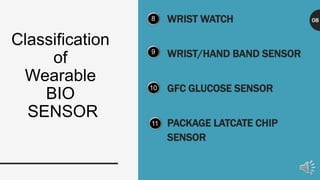
Classification
of
Wearable
BIO
SENSOR
8
9
10
WRIST WATCH
WRIST/HAND BAND SENSOR
GFC GLUCOSE SENSOR
PACKAGE LATCATE CHIP
SENSOR
11
08
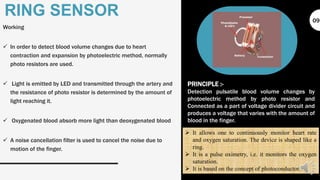
Working
 In order to detect blood volume changes due to heart
contraction and expansion by photoelectric method, normally
photo resistors are used.
 Light is emitted by LED and transmitted through the artery and
the resistance of photo resistor is determined by the amount of
light reaching it.
 Oxygenated blood absorb more light than deoxygenated blood
 A noise cancellation filter is used to cancel the noise due to
motion of the finger.
RING SENSOR
PRINCIPLE :-
Detection pulsatile blood volume changes by
photoelectric method by photo resistor and
Connected as a part of voltage divider circuit and
produces a voltage that varies with the amount of
blood in the finger.
 It allows one to continuously monitor heart rate
and oxygen saturation. The device is shaped like a
ring.
 It is a pulse oximetry, i.e. it monitors the oxygen
saturation.
 It is based on the concept of photoconductor.
09
1 2
10
Advantage
 Continuous monitoring.
 Easy to use.
 Reducing hospitalization fee
Disadvantage
 Initial cost is high.
 Limited number of physiological
parameters can be monitored.
Application:-
 Wireless supervision of people during hazardous operations.
 In an overcrowded emergency Department.
 Surveillance of abnormal heart Failure.
 In cardio-vascular disease for monitoring the hyper tension.
Working :-
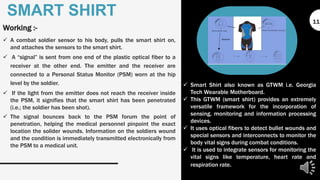
 A combat soldier sensor to his body, pulls the smart shirt on,
and attaches the sensors to the smart shirt.
 A “signal” is sent from one end of the plastic optical fiber to a
receiver at the other end. The emitter and the receiver are
connected to a Personal Status Monitor (PSM) worn at the hip
level by the soldier.
 If the light from the emitter does not reach the receiver inside
the PSM, it signifies that the smart shirt has been penetrated
(i.e.; the soldier has been shot).
 The signal bounces back to the PSM forum the point of
penetration, helping the medical personnel pinpoint the exact
location the solider wounds. Information on the soldiers wound
and the condition is immediately transmitted electronically from
the PSM to a medical unit.
SMART SHIRT
 Smart Shirt also known as GTWM i.e. Georgia
Tech Wearable Motherboard.
 This GTWM (smart shirt) provides an extremely
versatile framework for the incorporation of
sensing, monitoring and information processing
devices.
 It uses optical fibers to detect bullet wounds and
special sensors and interconnects to monitor the
body vital signs during combat conditions.
 It is used to integrate sensors for monitoring the
vital signs like temperature, heart rate and
respiration rate.
11
1 2
12
Advantage
 Continuous monitoring.
 Right Treatment at the right time
 Easy to wear and takeoff.
Disadvantage
 Initial cost is high
 Battery life is less
Application:-
 Combat casualty care.
 Medical monitoring.
 Sports/ Performance monitoring.
 Space experiments.
 Mission critical/ hazardous application.
 Fire- fighting.
WEARABLE SWEAT BIO
SENSORE
13
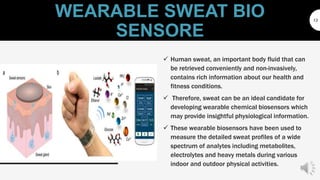
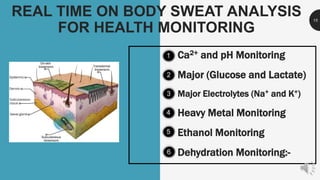
 Human sweat, an important body fluid that can
be retrieved conveniently and non-invasively,
contains rich information about our health and
fitness conditions.
 Therefore, sweat can be an ideal candidate for
developing wearable chemical biosensors which
may provide insightful physiological information.
 These wearable biosensors have been used to
measure the detailed sweat profiles of a wide
spectrum of analytes including metabolites,
electrolytes and heavy metals during various
indoor and outdoor physical activities.
System analysis of sweat bio sensor
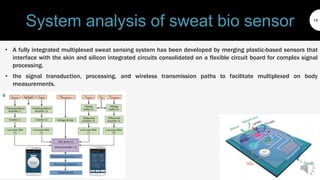
• A fully integrated multiplexed sweat sensing system has been developed by merging plastic-based sensors that
interface with the skin and silicon integrated circuits consolidated on a flexible circuit board for complex signal
processing.
• the signal transduction, processing, and wireless transmission paths to facilitate multiplexed on body
measurements.
14
REAL TIME ON BODY SWEAT ANALYSIS
FOR HEALTH MONITORING
1
2
3
4
5
Ca2+ and pH Monitoring
Major (Glucose and Lactate)
Major Electrolytes (Na+ and K+)
Heavy Metal Monitoring
Ethanol Monitoring
Dehydration Monitoring:-
15
6
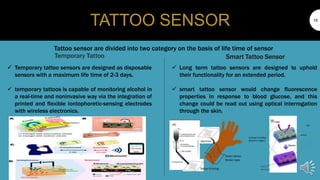
TATTOO SENSOR
Temporary Tattoo Smart Tattoo Sensor
16
Tattoo sensor are divided into two category on the basis of life time of sensor
 Temporary tattoo sensors are designed as disposable
sensors with a maximum life time of 2-3 days.
 temporary tattoos is capable of monitoring alcohol in
a real-time and noninvasive way via the integration of
printed and flexible iontophoretic-sensing electrodes
with wireless electronics.
 Long term tattoo sensors are designed to uphold
their functionality for an extended period.
 smart tattoo sensor would change fluorescence
properties in response to blood glucose, and this
change could be read out using optical interrogation
through the skin.
Contact Lens Sensor 17
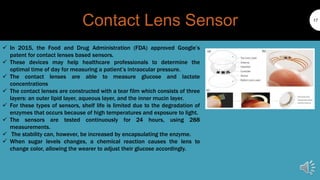
 In 2015, the Food and Drug Administration (FDA) approved Google’s
patent for contact lenses based sensors.
 These devices may help healthcare professionals to determine the
optimal time of day for measuring a patient’s intraocular pressure.
 The contact lenses are able to measure glucose and lactate
concentrations
 The contact lenses are constructed with a tear film which consists of three
layers: an outer lipid layer, aqueous layer, and the inner mucin layer.
 For these types of sensors, shelf life is limited due to the degradation of
enzymes that occurs because of high temperatures and exposure to light.
 The sensors are tested continuously for 24 hours, using 288
measurements.
 The stability can, however, be increased by encapsulating the enzyme.
 When sugar levels changes, a chemical reaction causes the lens to
change color, allowing the wearer to adjust their glucose accordingly.
Thick Film textile based sensor 18
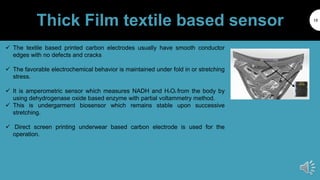
 The textile based printed carbon electrodes usually have smooth conductor
edges with no defects and cracks
 The favorable electrochemical behavior is maintained under fold in or stretching
stress.
 It is amperometric sensor which measures NADH and H2O2 from the body by
using dehydrogenase oxide based enzyme with partial voltammetry method.
 This is undergarment biosensor which remains stable upon successive
stretching.
 Direct screen printing underwear based carbon electrode is used for the
operation.
Mouth Guard Bio Sensor:- 19
 A concept of mouth guard metabolite biosensor has been reported by Kim et al.
 This is an amperometric biosensor with salivary lactate as an analyte.
 The direct measurement of lactate in saliva would be used as a diagnostic tool for in vitro monitoring as
salivary lactate concentration corresponds with the blood lactate concentration.
 This wearable oral bio-sensory system uses LOx as an enzyme with Prussian –Blue modified electrode as
transducer, acting as artificial peroxidase to offer selective detection of the H2O2. With the aim of
stabilizing the device, LOx was immobilized on the working electrode surface by the method of polymer
entrapping.
 It parades high selectivity, sensitivity and stability, so as to use them
 in getting information regarding wearer’s health, performance and stress level through Bluetooth or
wireless network
 With the intention of analyzing the stability of the sensor, the researchers have taken continuous readings
over the interval of 10 minutes for 2 hours and it has been noticed that the sensor displays high stability
with small variations of current signal, ranging between 90% and 106% of the actual response .
 The good stability shows the proactive actions of the Poly- orthophenylenediamine–LOx interaction, where
it is used to stabilize the device.
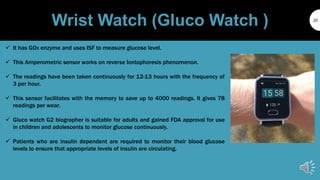
Wrist Watch (Gluco Watch ) 20
 It has GOx enzyme and uses ISF to measure glucose level.
 This Amperometric sensor works on reverse Iontophoresis phenomenon.
 The readings have been taken continuously for 12-13 hours with the frequency of
3 per hour.
 This sensor facilitates with the memory to save up to 4000 readings. It gives 78
readings per wear.
 Gluco watch G2 biographer is suitable for adults and gained FDA approval for use
in children and adolescents to monitor glucose continuously.
 Patients who are insulin dependent are required to monitor their blood glucose
levels to ensure that appropriate levels of insulin are circulating.
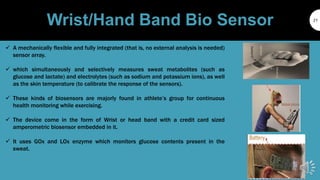
Wrist/Hand Band Bio Sensor 21
 A mechanically flexible and fully integrated (that is, no external analysis is needed)
sensor array.
 which simultaneously and selectively measures sweat metabolites (such as
glucose and lactate) and electrolytes (such as sodium and potassium ions), as well
as the skin temperature (to calibrate the response of the sensors).
 These kinds of biosensors are majorly found in athlete’s group for continuous
health monitoring while exercising.
 The device come in the form of Wrist or head band with a credit card sized
amperometric biosensor embedded in it.
 It uses GOx and LOx enzyme which monitors glucose contents present in the
sweat.
GFC GLUCOSE SENSOR 22
 To monitor blood glucose level, one method has been used where to realize a non invasive blood glucose monitor, the
Gingival Crevicular Fluid (GCF) was measured.
 The device to collect GCF was developed that was designed to be disposal, biocompatible and small enough to be
inserted in the gingival crevice for collection of micro liters sample of GCF.
 It senses glucose with the help of GOx enzyme.
 They monitored continuous responses with increased sensitivity, accuracy, repeatability and specificity.
 The electrode used is ferrocene modified gold film electrode.
 Enzyme immobilization was done with cross-linking method.
 It is a saliva based noninvasive glucose monitoring tool which is widely used for clinical diagnostics.
 As the repeatability and ultimately stability is higher, it is used in diabetes instantaneous glucose monitoring.
PACKAGED LACTATE CHIP
SENSOR
23
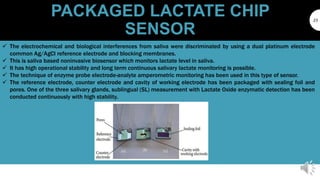
 The electrochemical and biological interferences from saliva were discriminated by using a dual platinum electrode
common Ag/AgCl reference electrode and blocking membranes.
 This is saliva based noninvasive biosensor which monitors lactate level in saliva.
 It has high operational stability and long term continuous salivary lactate monitoring is possible.
 The technique of enzyme probe electrode-analyte amperometric monitoring has been used in this type of sensor.
 The reference electrode, counter electrode and cavity of working electrode has been packaged with sealing foil and
pores. One of the three salivary glands, sublingual (SL) measurement with Lactate Oxide enzymatic detection has been
conducted continuously with high stability.
24
CONCLUSION
 The development in wearable biosensors is best example of the integration of biological and
engineering sciences.
 It includes the research of biochemical field and understanding the interaction between
biological elements with the target molecule.
 The use of Nano-transducers has been increased in separation between transducers and bio
receptors.
 The immobilization and stabilization strategies can be selected based on the application.
 For instance, while developing a sensor where durability is not an issue, (e.g. Temporary Tattoo
sensors) conventional methods of enzyme stabilization like of enzyme immobilization, cross-
linking can be used.
 For long- term sensing applications immobilization/stabilization using enzyme cloning, sol-gel
techniques, hydrogel/Nano gel incorporation would be a viable option.
25
FUTURE TRENDS
Considering future demands of biosensors, researchers are heading
towards the best possible solutions to improve the methods of
stabilization and achieve the most viable wearable biosensor.
The previous stabilization strategies have failed because of the
diffusion of key reactants and products in and out of the enzyme or
matrix surface.
some new techniques have been proposed which including cross
linking, silica sol-gel encapsulation, and molecular cloning.
Another aspect to improve the stability is to incorporate enzymes on a
hydrogel or Nano gel matrix.
REFERENCES
[1] A. Sonawane, P. Manickam, and S. Bhansali, “Stability of Enzymatic Biosensors for Wearable
Applications,” IEEE Rev. Biomed. Eng., vol. 10, pp. 174–186, 2017.
[2] Philips Healthcare, “Wearable Biosensor,” vol. 13, no. 2, pp. 1–10, 2018.
[3] K. Guk et al., “Evolution of wearable devices with real-time disease monitoring for personalized
healthcare,” Nanomaterials, vol. 9, no. 6, pp. 1–23, 2019.
[4] J. Kim, A. S. Campbell, B. E. F. de Ávila, and J. Wang, “Wearable biosensors for healthcare
monitoring,” Nat. Biotechnol., vol. 37, no. 4, pp. 389–406, 2019.
[5] R. K. Pandey, “Wearable Biosensors,” vol. 2016, no. 17, pp. 1–15, 2008.
[6] W. Gao et al., “Wearable sweat biosensors,” Tech. Dig. - Int. Electron Devices Meet. IEDM, pp.
6.6.1-6.6.4, 2017.
[7] Handbook of biomedical instrumentation ,Khandpur ,pp-138,233,238
[8] https://en.wikipedia.org/wiki/Biosensor
[9] H. H. Asada, P. Shaltis, A. Reisner, S. Rhee, and R. C. Hutchinson, “Mobile Monitoring with
Wearable Photoplethysmographic Biosensors,” IEEE Eng. Med. Biol. Mag., vol. 22, no. 3, pp. 28–
40, 2003.
[10]S. Patel, H. Park, P. Bonato, L. Chan, and M. Rodgers, “A review of wearable sensors and systems
with application in rehabilitation,” J. Neuroeng. Rehabil., vol. 9, no. 1, p. 21, 2012.
26
27

Wearable Bio Sensor PPT

  • 1.
    WEARABLE BIO SENSOR SEMINAR PRESENTED ON SUBMITTEDBY:- PRITAM FINAL YEAR ECE 16/373 SUBMITTED TO:- DR. JANKIBALLABH SHARMA ASSOCIATE PROFESSOR ELECTRONICS AND COMMUNICATION ENGG
  • 2.
    What is Bio Sensor 1 2 3 4 Theterm “biosensor” is short for “biological sensor.” The device is made up of a transducer and a biological element that may be an enzyme, an antibody or a nucleic acid. The bio element interacts with the analyte being tested and the biological response is converted into an electrical signal by the transducer. Depending on their particular application. Every bio sensor has two part one is biological component that acts as the sensor and second is electronic component that detects and transmits the signal 2
  • 3.
    What is Wearable Bio Sensor Wearablebiosensor = Wearable+ Bio sensor Wearable Object that can be worn on body. E.g. wrist watches, ring, shirts etc. BIO-SENSOR Biosensor is an analytical device used for detection of analyte. E.g. Blood Glucose Detector 3
  • 4.
    WEARABLE BIO SENSOR4  Wearable monitoring devices that allow continuous monitoring of physiological signals.  The data sets recorded using these systems are then processed to detect patient’s clinical situations.  They rely on wireless sensors enclosed in items that can be worn, such as ring or shirt. Bio Sensor is an analytical device, which converts a biological response into electrical signal.
  • 5.
  • 6.
     Remote monitoringof patients.  Training support for athletes.  Monitoring of individuals who work with hazardous elements.  Tracking of professional truck driver’s vital signs to alert them of fatigue.  Use of wearable monitoring devices allow continuous monitoring of physiological signals.  Wearable systems are totally non-obtrusive devices that allow physicians to overcome the limitations of ambulatory technology. NEED FOR WEARABLE BIO SENSOR 06
  • 7.
    Classification of Wearable BIO SENSOR 1 2 3 4 5 6 7 Ring Sensor Smart Shirt Wearablesweat bio sensor Tattoo Sensor Contact Lens Sensor Thick Textile Sensor Mouth Guard Bio Sensor 07
  • 8.
    Classification of Wearable BIO SENSOR 8 9 10 WRIST WATCH WRIST/HAND BANDSENSOR GFC GLUCOSE SENSOR PACKAGE LATCATE CHIP SENSOR 11 08
  • 9.
    Working  In orderto detect blood volume changes due to heart contraction and expansion by photoelectric method, normally photo resistors are used.  Light is emitted by LED and transmitted through the artery and the resistance of photo resistor is determined by the amount of light reaching it.  Oxygenated blood absorb more light than deoxygenated blood  A noise cancellation filter is used to cancel the noise due to motion of the finger. RING SENSOR PRINCIPLE :- Detection pulsatile blood volume changes by photoelectric method by photo resistor and Connected as a part of voltage divider circuit and produces a voltage that varies with the amount of blood in the finger.  It allows one to continuously monitor heart rate and oxygen saturation. The device is shaped like a ring.  It is a pulse oximetry, i.e. it monitors the oxygen saturation.  It is based on the concept of photoconductor. 09
  • 10.
    1 2 10 Advantage  Continuousmonitoring.  Easy to use.  Reducing hospitalization fee Disadvantage  Initial cost is high.  Limited number of physiological parameters can be monitored. Application:-  Wireless supervision of people during hazardous operations.  In an overcrowded emergency Department.  Surveillance of abnormal heart Failure.  In cardio-vascular disease for monitoring the hyper tension.
  • 11.
    Working :-  Acombat soldier sensor to his body, pulls the smart shirt on, and attaches the sensors to the smart shirt.  A “signal” is sent from one end of the plastic optical fiber to a receiver at the other end. The emitter and the receiver are connected to a Personal Status Monitor (PSM) worn at the hip level by the soldier.  If the light from the emitter does not reach the receiver inside the PSM, it signifies that the smart shirt has been penetrated (i.e.; the soldier has been shot).  The signal bounces back to the PSM forum the point of penetration, helping the medical personnel pinpoint the exact location the solider wounds. Information on the soldiers wound and the condition is immediately transmitted electronically from the PSM to a medical unit. SMART SHIRT  Smart Shirt also known as GTWM i.e. Georgia Tech Wearable Motherboard.  This GTWM (smart shirt) provides an extremely versatile framework for the incorporation of sensing, monitoring and information processing devices.  It uses optical fibers to detect bullet wounds and special sensors and interconnects to monitor the body vital signs during combat conditions.  It is used to integrate sensors for monitoring the vital signs like temperature, heart rate and respiration rate. 11
  • 12.
    1 2 12 Advantage  Continuousmonitoring.  Right Treatment at the right time  Easy to wear and takeoff. Disadvantage  Initial cost is high  Battery life is less Application:-  Combat casualty care.  Medical monitoring.  Sports/ Performance monitoring.  Space experiments.  Mission critical/ hazardous application.  Fire- fighting.
  • 13.
    WEARABLE SWEAT BIO SENSORE 13 Human sweat, an important body fluid that can be retrieved conveniently and non-invasively, contains rich information about our health and fitness conditions.  Therefore, sweat can be an ideal candidate for developing wearable chemical biosensors which may provide insightful physiological information.  These wearable biosensors have been used to measure the detailed sweat profiles of a wide spectrum of analytes including metabolites, electrolytes and heavy metals during various indoor and outdoor physical activities.
  • 14.
    System analysis ofsweat bio sensor • A fully integrated multiplexed sweat sensing system has been developed by merging plastic-based sensors that interface with the skin and silicon integrated circuits consolidated on a flexible circuit board for complex signal processing. • the signal transduction, processing, and wireless transmission paths to facilitate multiplexed on body measurements. 14
  • 15.
    REAL TIME ONBODY SWEAT ANALYSIS FOR HEALTH MONITORING 1 2 3 4 5 Ca2+ and pH Monitoring Major (Glucose and Lactate) Major Electrolytes (Na+ and K+) Heavy Metal Monitoring Ethanol Monitoring Dehydration Monitoring:- 15 6
  • 16.
    TATTOO SENSOR Temporary TattooSmart Tattoo Sensor 16 Tattoo sensor are divided into two category on the basis of life time of sensor  Temporary tattoo sensors are designed as disposable sensors with a maximum life time of 2-3 days.  temporary tattoos is capable of monitoring alcohol in a real-time and noninvasive way via the integration of printed and flexible iontophoretic-sensing electrodes with wireless electronics.  Long term tattoo sensors are designed to uphold their functionality for an extended period.  smart tattoo sensor would change fluorescence properties in response to blood glucose, and this change could be read out using optical interrogation through the skin.
  • 17.
    Contact Lens Sensor17  In 2015, the Food and Drug Administration (FDA) approved Google’s patent for contact lenses based sensors.  These devices may help healthcare professionals to determine the optimal time of day for measuring a patient’s intraocular pressure.  The contact lenses are able to measure glucose and lactate concentrations  The contact lenses are constructed with a tear film which consists of three layers: an outer lipid layer, aqueous layer, and the inner mucin layer.  For these types of sensors, shelf life is limited due to the degradation of enzymes that occurs because of high temperatures and exposure to light.  The sensors are tested continuously for 24 hours, using 288 measurements.  The stability can, however, be increased by encapsulating the enzyme.  When sugar levels changes, a chemical reaction causes the lens to change color, allowing the wearer to adjust their glucose accordingly.
  • 18.
    Thick Film textilebased sensor 18  The textile based printed carbon electrodes usually have smooth conductor edges with no defects and cracks  The favorable electrochemical behavior is maintained under fold in or stretching stress.  It is amperometric sensor which measures NADH and H2O2 from the body by using dehydrogenase oxide based enzyme with partial voltammetry method.  This is undergarment biosensor which remains stable upon successive stretching.  Direct screen printing underwear based carbon electrode is used for the operation.
  • 19.
    Mouth Guard BioSensor:- 19  A concept of mouth guard metabolite biosensor has been reported by Kim et al.  This is an amperometric biosensor with salivary lactate as an analyte.  The direct measurement of lactate in saliva would be used as a diagnostic tool for in vitro monitoring as salivary lactate concentration corresponds with the blood lactate concentration.  This wearable oral bio-sensory system uses LOx as an enzyme with Prussian –Blue modified electrode as transducer, acting as artificial peroxidase to offer selective detection of the H2O2. With the aim of stabilizing the device, LOx was immobilized on the working electrode surface by the method of polymer entrapping.  It parades high selectivity, sensitivity and stability, so as to use them  in getting information regarding wearer’s health, performance and stress level through Bluetooth or wireless network  With the intention of analyzing the stability of the sensor, the researchers have taken continuous readings over the interval of 10 minutes for 2 hours and it has been noticed that the sensor displays high stability with small variations of current signal, ranging between 90% and 106% of the actual response .  The good stability shows the proactive actions of the Poly- orthophenylenediamine–LOx interaction, where it is used to stabilize the device.
  • 20.
    Wrist Watch (GlucoWatch ) 20  It has GOx enzyme and uses ISF to measure glucose level.  This Amperometric sensor works on reverse Iontophoresis phenomenon.  The readings have been taken continuously for 12-13 hours with the frequency of 3 per hour.  This sensor facilitates with the memory to save up to 4000 readings. It gives 78 readings per wear.  Gluco watch G2 biographer is suitable for adults and gained FDA approval for use in children and adolescents to monitor glucose continuously.  Patients who are insulin dependent are required to monitor their blood glucose levels to ensure that appropriate levels of insulin are circulating.
  • 21.
    Wrist/Hand Band BioSensor 21  A mechanically flexible and fully integrated (that is, no external analysis is needed) sensor array.  which simultaneously and selectively measures sweat metabolites (such as glucose and lactate) and electrolytes (such as sodium and potassium ions), as well as the skin temperature (to calibrate the response of the sensors).  These kinds of biosensors are majorly found in athlete’s group for continuous health monitoring while exercising.  The device come in the form of Wrist or head band with a credit card sized amperometric biosensor embedded in it.  It uses GOx and LOx enzyme which monitors glucose contents present in the sweat.
  • 22.
    GFC GLUCOSE SENSOR22  To monitor blood glucose level, one method has been used where to realize a non invasive blood glucose monitor, the Gingival Crevicular Fluid (GCF) was measured.  The device to collect GCF was developed that was designed to be disposal, biocompatible and small enough to be inserted in the gingival crevice for collection of micro liters sample of GCF.  It senses glucose with the help of GOx enzyme.  They monitored continuous responses with increased sensitivity, accuracy, repeatability and specificity.  The electrode used is ferrocene modified gold film electrode.  Enzyme immobilization was done with cross-linking method.  It is a saliva based noninvasive glucose monitoring tool which is widely used for clinical diagnostics.  As the repeatability and ultimately stability is higher, it is used in diabetes instantaneous glucose monitoring.
  • 23.
    PACKAGED LACTATE CHIP SENSOR 23 The electrochemical and biological interferences from saliva were discriminated by using a dual platinum electrode common Ag/AgCl reference electrode and blocking membranes.  This is saliva based noninvasive biosensor which monitors lactate level in saliva.  It has high operational stability and long term continuous salivary lactate monitoring is possible.  The technique of enzyme probe electrode-analyte amperometric monitoring has been used in this type of sensor.  The reference electrode, counter electrode and cavity of working electrode has been packaged with sealing foil and pores. One of the three salivary glands, sublingual (SL) measurement with Lactate Oxide enzymatic detection has been conducted continuously with high stability.
  • 24.
    24 CONCLUSION  The developmentin wearable biosensors is best example of the integration of biological and engineering sciences.  It includes the research of biochemical field and understanding the interaction between biological elements with the target molecule.  The use of Nano-transducers has been increased in separation between transducers and bio receptors.  The immobilization and stabilization strategies can be selected based on the application.  For instance, while developing a sensor where durability is not an issue, (e.g. Temporary Tattoo sensors) conventional methods of enzyme stabilization like of enzyme immobilization, cross- linking can be used.  For long- term sensing applications immobilization/stabilization using enzyme cloning, sol-gel techniques, hydrogel/Nano gel incorporation would be a viable option.
  • 25.
    25 FUTURE TRENDS Considering futuredemands of biosensors, researchers are heading towards the best possible solutions to improve the methods of stabilization and achieve the most viable wearable biosensor. The previous stabilization strategies have failed because of the diffusion of key reactants and products in and out of the enzyme or matrix surface. some new techniques have been proposed which including cross linking, silica sol-gel encapsulation, and molecular cloning. Another aspect to improve the stability is to incorporate enzymes on a hydrogel or Nano gel matrix.
  • 26.
    REFERENCES [1] A. Sonawane,P. Manickam, and S. Bhansali, “Stability of Enzymatic Biosensors for Wearable Applications,” IEEE Rev. Biomed. Eng., vol. 10, pp. 174–186, 2017. [2] Philips Healthcare, “Wearable Biosensor,” vol. 13, no. 2, pp. 1–10, 2018. [3] K. Guk et al., “Evolution of wearable devices with real-time disease monitoring for personalized healthcare,” Nanomaterials, vol. 9, no. 6, pp. 1–23, 2019. [4] J. Kim, A. S. Campbell, B. E. F. de Ávila, and J. Wang, “Wearable biosensors for healthcare monitoring,” Nat. Biotechnol., vol. 37, no. 4, pp. 389–406, 2019. [5] R. K. Pandey, “Wearable Biosensors,” vol. 2016, no. 17, pp. 1–15, 2008. [6] W. Gao et al., “Wearable sweat biosensors,” Tech. Dig. - Int. Electron Devices Meet. IEDM, pp. 6.6.1-6.6.4, 2017. [7] Handbook of biomedical instrumentation ,Khandpur ,pp-138,233,238 [8] https://en.wikipedia.org/wiki/Biosensor [9] H. H. Asada, P. Shaltis, A. Reisner, S. Rhee, and R. C. Hutchinson, “Mobile Monitoring with Wearable Photoplethysmographic Biosensors,” IEEE Eng. Med. Biol. Mag., vol. 22, no. 3, pp. 28– 40, 2003. [10]S. Patel, H. Park, P. Bonato, L. Chan, and M. Rodgers, “A review of wearable sensors and systems with application in rehabilitation,” J. Neuroeng. Rehabil., vol. 9, no. 1, p. 21, 2012. 26
  • 27.