Daniel
defoe
Prepared by: Nilay Rathod
Department of English
M. K. Bhavnagar University
Who was defoe?
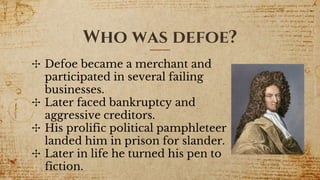
✣ Defoe became a merchant and
participated in several failing
businesses.
✣ Later faced bankruptcy and
aggressive creditors.
✣ His prolific political pamphleteer
landed him in prison for slander.
✣ Later in life he turned his pen to
fiction.
Early life
✣ Born between 1659-1661 at Fore Street in the
parish of St Giles Cripplegate, London.
✣ Daniel Foe was the son of James Foe, a tallow
chandler.
✣ Daniel later added the aristocratic-sounding
“De” to his name.
✣ In 1684, he married to Mary Tuffley and had
eight children, but two died
✣ English writer, trader journalist, pamphleteer
and spy.
✣ Best known for the novel Robinson Crusoe.
✣ Wrote more than 300 books, pamphlets, and
journals on diverse topics.
✣ Pioneer of business journalism and economic
journalism.
How did he survive?
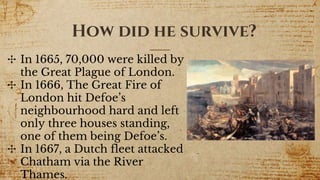
✣ In 1665, 70,000 were killed by
the Great Plague of London.
✣ In 1666, The Great Fire of
London hit Defoe’s
neighbourhood hard and left
only three houses standing,
one of them being Defoe’s.
✣ In 1667, a Dutch fleet attacked
Chatham via the River
Thames.
The unexpected
✣ Defoe’s parents were Presbyterian dissenters.
✣ He was educated in a Dissenting Academy at
Newington Green, and also went to church
there.
✣ It was expected that he would become a
dissenting minister, but instead entered the
world of business.
Business career
✣ Defoe entered the world of business as a
general merchant.
✣ He traveled often, selling such goods as wine
and wool.
✣ He was able to buy a country estate and a
ship.
✣ Though he was rarely out of debt.
Poor Decisions
✣ In 1685, he joined ill-fated Monmouth
rebellion, but gained a pardon
✣ He was arrested in 1692 for a debt of £700,
but was really in debt close to £17,000
✣ He left England upon release, and travelled to
Europe and Scotland
✣ When he came back to London, he served as a
commissioner of the glass duty
Pamphleteer and prison
✣ “An Essay upon Project” -defended the right of
King William III for his participation in ending the
Nine Years War
✣ “The True-Born Englishman” - defended the king
against the perceived xenophobia of his enemies
✣ “Legion’s Memorial” --it demanded the release of
the Kentish petitioners, who asked the Parliament
to support the king in an imminent war against
France
✣ “The Shortest Way with the
Dissenters” and “Or, Proposals for the
Church”- asking for extermination of
dissenters
✣ “Hymn to the Pillory”- caused
audience to throw flowers instead of
harmful objects, but caused him to be
imprisoned for three days
death
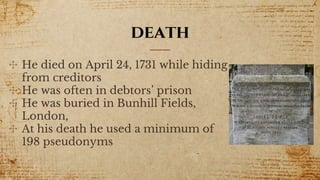
✣ He died on April 24, 1731 while hiding
from creditors
✣ He was often in debtors’ prison
✣ He was buried in Bunhill Fields,
London,
✣ At his death he used a minimum of
198 pseudonyms
references
https://www.gutenberg.org/ebooks/1060
9
https://books.google.co.in/books/about/
Daniel_Defoe.html?id=j9x8AlKeGGEC&r
edir_esc=y

Daniel defoe

  • 1.
    Daniel defoe Prepared by: NilayRathod Department of English M. K. Bhavnagar University
  • 2.
    Who was defoe? ✣Defoe became a merchant and participated in several failing businesses. ✣ Later faced bankruptcy and aggressive creditors. ✣ His prolific political pamphleteer landed him in prison for slander. ✣ Later in life he turned his pen to fiction.
  • 3.
    Early life ✣ Bornbetween 1659-1661 at Fore Street in the parish of St Giles Cripplegate, London. ✣ Daniel Foe was the son of James Foe, a tallow chandler. ✣ Daniel later added the aristocratic-sounding “De” to his name. ✣ In 1684, he married to Mary Tuffley and had eight children, but two died
  • 4.
    ✣ English writer,trader journalist, pamphleteer and spy. ✣ Best known for the novel Robinson Crusoe. ✣ Wrote more than 300 books, pamphlets, and journals on diverse topics. ✣ Pioneer of business journalism and economic journalism.
  • 5.
    How did hesurvive? ✣ In 1665, 70,000 were killed by the Great Plague of London. ✣ In 1666, The Great Fire of London hit Defoe’s neighbourhood hard and left only three houses standing, one of them being Defoe’s. ✣ In 1667, a Dutch fleet attacked Chatham via the River Thames.
  • 6.
    The unexpected ✣ Defoe’sparents were Presbyterian dissenters. ✣ He was educated in a Dissenting Academy at Newington Green, and also went to church there. ✣ It was expected that he would become a dissenting minister, but instead entered the world of business.
  • 7.
    Business career ✣ Defoeentered the world of business as a general merchant. ✣ He traveled often, selling such goods as wine and wool. ✣ He was able to buy a country estate and a ship. ✣ Though he was rarely out of debt.
  • 8.
    Poor Decisions ✣ In1685, he joined ill-fated Monmouth rebellion, but gained a pardon ✣ He was arrested in 1692 for a debt of £700, but was really in debt close to £17,000 ✣ He left England upon release, and travelled to Europe and Scotland ✣ When he came back to London, he served as a commissioner of the glass duty
  • 9.
    Pamphleteer and prison ✣“An Essay upon Project” -defended the right of King William III for his participation in ending the Nine Years War ✣ “The True-Born Englishman” - defended the king against the perceived xenophobia of his enemies ✣ “Legion’s Memorial” --it demanded the release of the Kentish petitioners, who asked the Parliament to support the king in an imminent war against France
  • 10.
    ✣ “The ShortestWay with the Dissenters” and “Or, Proposals for the Church”- asking for extermination of dissenters ✣ “Hymn to the Pillory”- caused audience to throw flowers instead of harmful objects, but caused him to be imprisoned for three days
  • 11.
    death ✣ He diedon April 24, 1731 while hiding from creditors ✣ He was often in debtors’ prison ✣ He was buried in Bunhill Fields, London, ✣ At his death he used a minimum of 198 pseudonyms
  • 12.

Editor's Notes

  • #4 Born James and Alice Foe in 1660, at fore street in the parish of st. Giles Cripplegate, London
  • #6 His mother died when he was 10.
  • #8 Even though he was very good at his job, he was always in debt