JEAN JACQUES
ROUSSEAU
By: Miriam Berry
CHILDHOOD
 Born in Geneva, Switzerland on June 28,1712
 Family was pious Calvinists and refugees from France
 His mother died shortly after childbirth
 His father was a poor watchmaker and dance master
 When he was ten his father fled Geneva
 He was then raised by his mothers sister
SCHOOLING
 He stopped traditional schooling at the age of 12
 Was apprenticed to several trades but had no success
 In 1728 he ran away from Geneva and joined the Catholic church
 Took a job as a footman to a noblewoman in Annecy
 Later became lover to a wealthy widow who provided for his education
in the classics and music
 In 1738 he journeyed to Montpellier to improve his health and when
he returned his lover had found a replacement
CAREER
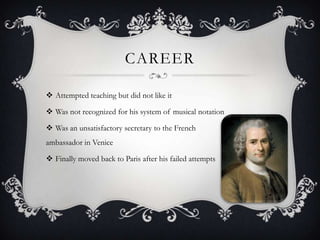
 Attempted teaching but did not like it
 Was not recognized for his system of musical notation
 Was an unsatisfactory secretary to the French
ambassador in Venice
 Finally moved back to Paris after his failed attempts
FAMILY
 In Paris in 1745 he took a mistress, Therese le Vasseur
 They had five children
 Jean took them all to the Foundling Hospital to be raised as
orphans
 He later married Therese in 1768
PUBLISHED WORKS
 Wrote an essay called “Discourse on the Arts and Sciences” and
won a literary prize from the Academy of Dijon in 1749
 This gave him literary fame and he returned to Geneva in1754
 There he rejoined the protestant church and regained his
citizenship
 He published several essays and had some different mistresses in
the next few years.
EXILE
 In 1762 he published his most famous works, “The Social
Contract” and “Emile”
 Due to the content of these books about religion and his opinion
that there should be a democratic city-state in France he was exiled by
the government.
 He did not like it so in 1770 he returned to Paris
LATER LIFE
 Back in Paris he published several more less offensive works and
an opera.
 Rousseau suffered from psychological feelings of persecution and
lived in a cottage at Ermenonville for the last few months of his life
 Due to his mental and physical health problems he died of a
stroke on July 2, 1778
EMILE
 Rousseau wrote this novel to show his beliefs on education.
 It consists of five books and the different stages of learning
 Book 1: Infancy: Goodness of men, keep children should be
kept form forming bad habits
 Book 2: “The age of Nature”: purpose of education, school
environment, self motivated learning, discipline and physical
education
EMILE (CONTINUED)
Book 3: Pre-adolescence : Intellectual education,
geography, science, history and other subjects are learned by
desire to learn them
Book 4: Puberty: social attitudes, and natural religion
Book 5: Adulthood: love, education of women
PHILOSOPHIES
 People are inherently good but they become corrupted by the evils
of society.
 He believed in liberty, equality, and fraternity
“Make the citizen good by training, and everything
else will follow.” - Jean Jacques Rousseau
SOURCES
http://www.cals.ncsu.edu/agexed/aee501/ro
usseau.html
http://www.iep.utm.edu/rousseau/#SH1a
http://www.infed.org/thinkers/et-rous.htm

Jeanjacquesrousseau 111021225255-phpapp02

  • 1.
  • 2.
    CHILDHOOD  Born inGeneva, Switzerland on June 28,1712  Family was pious Calvinists and refugees from France  His mother died shortly after childbirth  His father was a poor watchmaker and dance master  When he was ten his father fled Geneva  He was then raised by his mothers sister
  • 3.
    SCHOOLING  He stoppedtraditional schooling at the age of 12  Was apprenticed to several trades but had no success  In 1728 he ran away from Geneva and joined the Catholic church  Took a job as a footman to a noblewoman in Annecy  Later became lover to a wealthy widow who provided for his education in the classics and music  In 1738 he journeyed to Montpellier to improve his health and when he returned his lover had found a replacement
  • 4.
    CAREER  Attempted teachingbut did not like it  Was not recognized for his system of musical notation  Was an unsatisfactory secretary to the French ambassador in Venice  Finally moved back to Paris after his failed attempts
  • 5.
    FAMILY  In Parisin 1745 he took a mistress, Therese le Vasseur  They had five children  Jean took them all to the Foundling Hospital to be raised as orphans  He later married Therese in 1768
  • 6.
    PUBLISHED WORKS  Wrotean essay called “Discourse on the Arts and Sciences” and won a literary prize from the Academy of Dijon in 1749  This gave him literary fame and he returned to Geneva in1754  There he rejoined the protestant church and regained his citizenship  He published several essays and had some different mistresses in the next few years.
  • 7.
    EXILE  In 1762he published his most famous works, “The Social Contract” and “Emile”  Due to the content of these books about religion and his opinion that there should be a democratic city-state in France he was exiled by the government.  He did not like it so in 1770 he returned to Paris
  • 8.
    LATER LIFE  Backin Paris he published several more less offensive works and an opera.  Rousseau suffered from psychological feelings of persecution and lived in a cottage at Ermenonville for the last few months of his life  Due to his mental and physical health problems he died of a stroke on July 2, 1778
  • 9.
    EMILE  Rousseau wrotethis novel to show his beliefs on education.  It consists of five books and the different stages of learning  Book 1: Infancy: Goodness of men, keep children should be kept form forming bad habits  Book 2: “The age of Nature”: purpose of education, school environment, self motivated learning, discipline and physical education
  • 10.
    EMILE (CONTINUED) Book 3:Pre-adolescence : Intellectual education, geography, science, history and other subjects are learned by desire to learn them Book 4: Puberty: social attitudes, and natural religion Book 5: Adulthood: love, education of women
  • 11.
    PHILOSOPHIES  People areinherently good but they become corrupted by the evils of society.  He believed in liberty, equality, and fraternity “Make the citizen good by training, and everything else will follow.” - Jean Jacques Rousseau
  • 12.