Unit 7: People and Places You Should Know Liis Vaino 11c
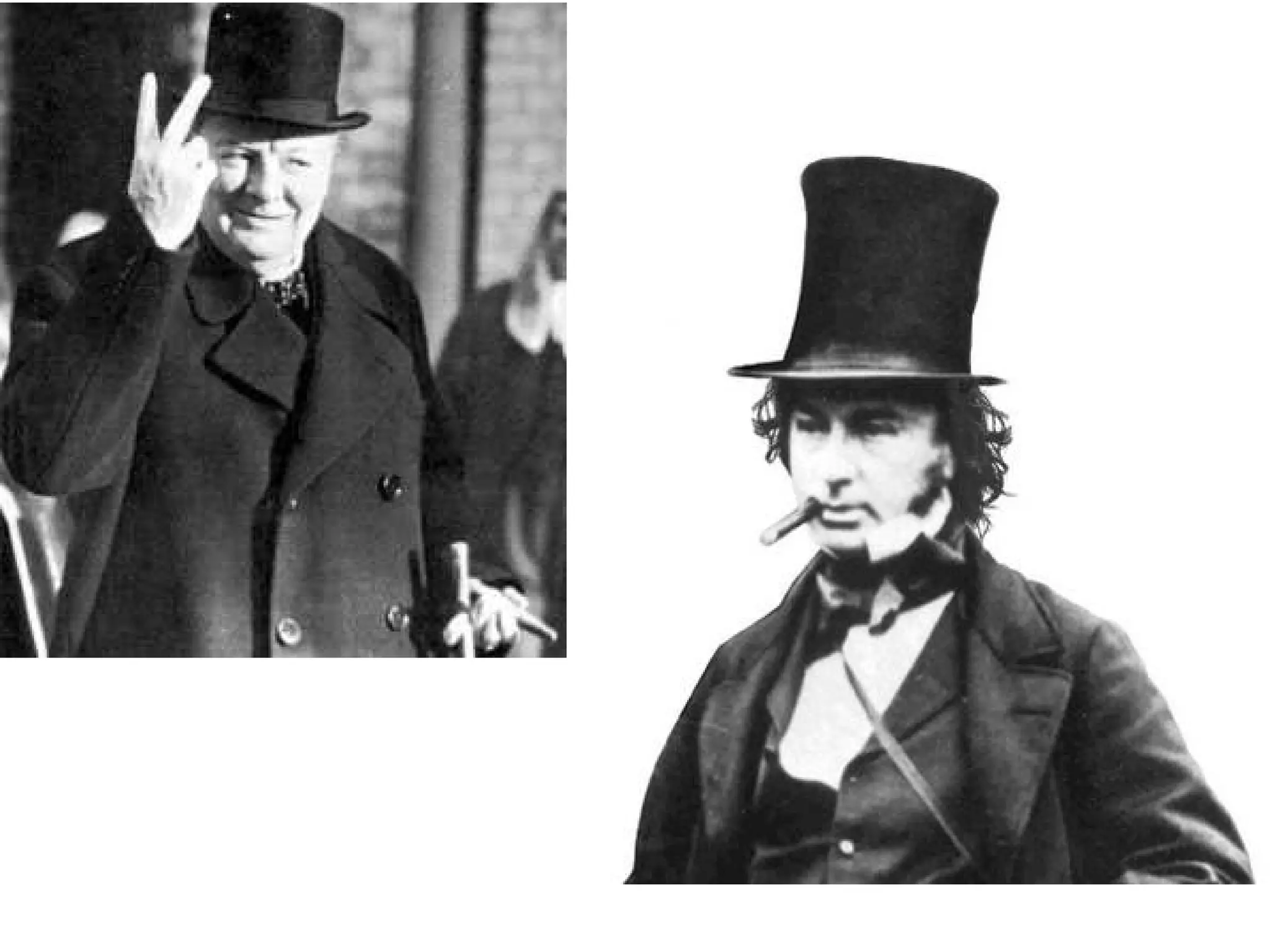
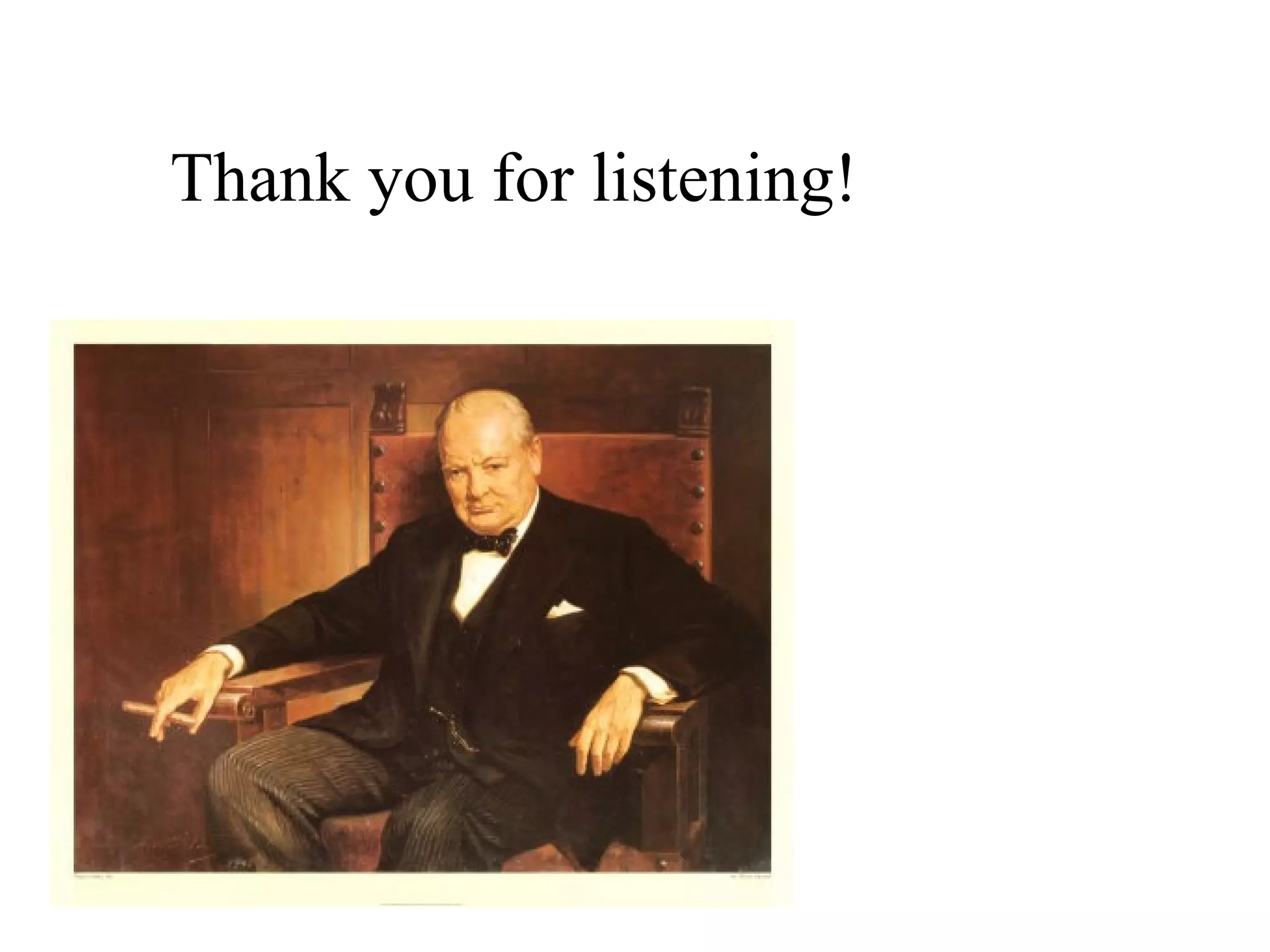
Famous People Sir Winston Churchill (1874- 1965)‏ an English statesman and one of the greatest politicians in the 20 th  century led Britain successfully through WWII, described it as his `walk with destiny`- he had been preparing for it his whole life born in Blenheim Palace in Oxfordshire, entered politics as a Conservative MP in 1900 in 1906 became a member of the Liberal party, later rejoined the Conservatives occupied many high positions: 1919 to 1921-Secretary of State and War and Air, 1924- Chancellor of the Exchequer political career peaked in the 1940s was Prime Minister twice: during WWII and from 1951 to 1955 gave world the V- sign, which showed his belief in victory
 
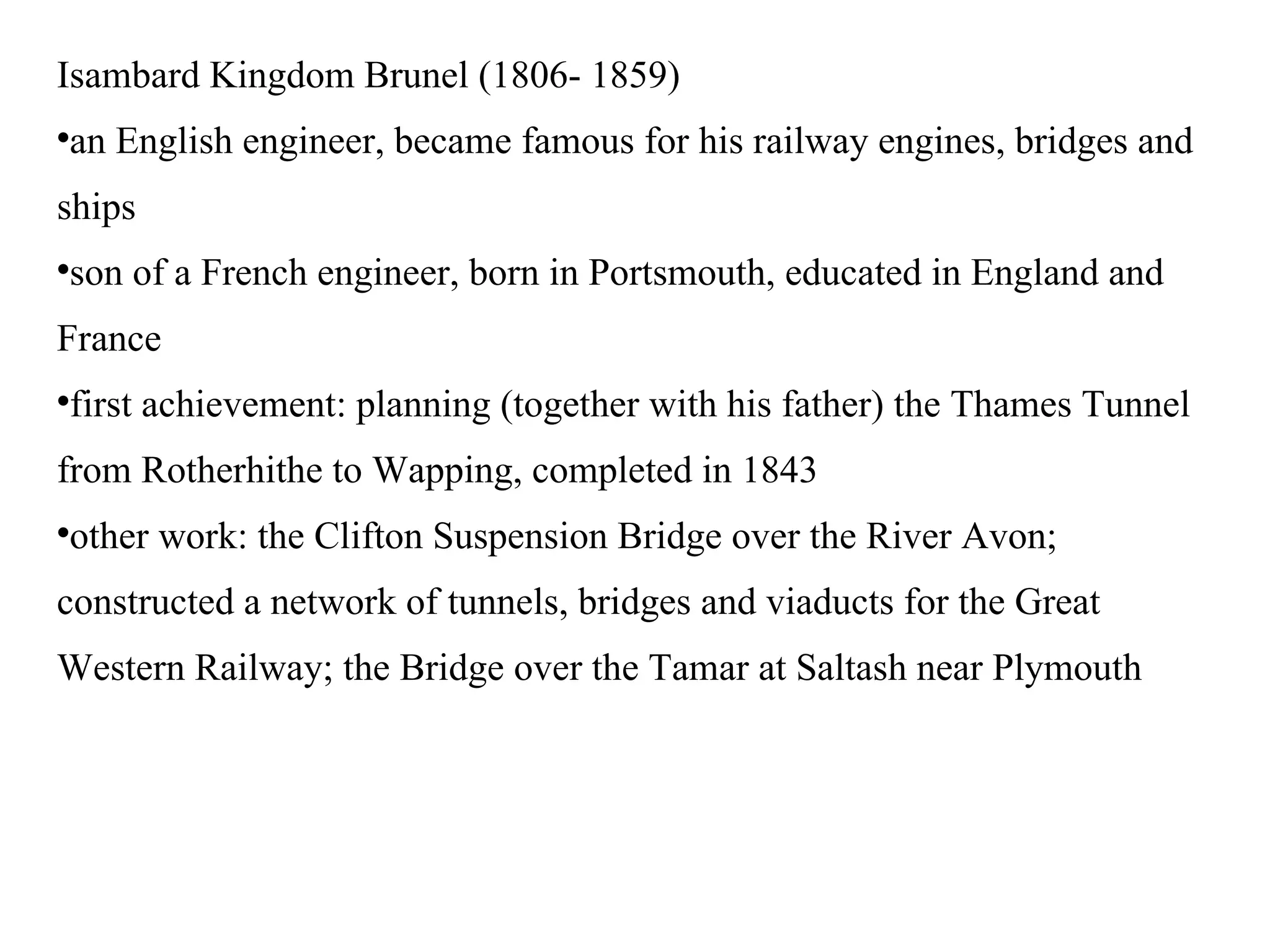
Isambard Kingdom Brunel (1806- 1859)‏ an English engineer, became famous for his railway engines, bridges and ships son of a French engineer, born in Portsmouth, educated in England and France first achievement: planning (together with his father) the Thames Tunnel from Rotherhithe to Wapping, completed in 1843 other work: the Clifton Suspension Bridge over the River Avon; constructed a network of tunnels, bridges and viaducts for the Great Western Railway; the Bridge over the Tamar at Saltash near Plymouth
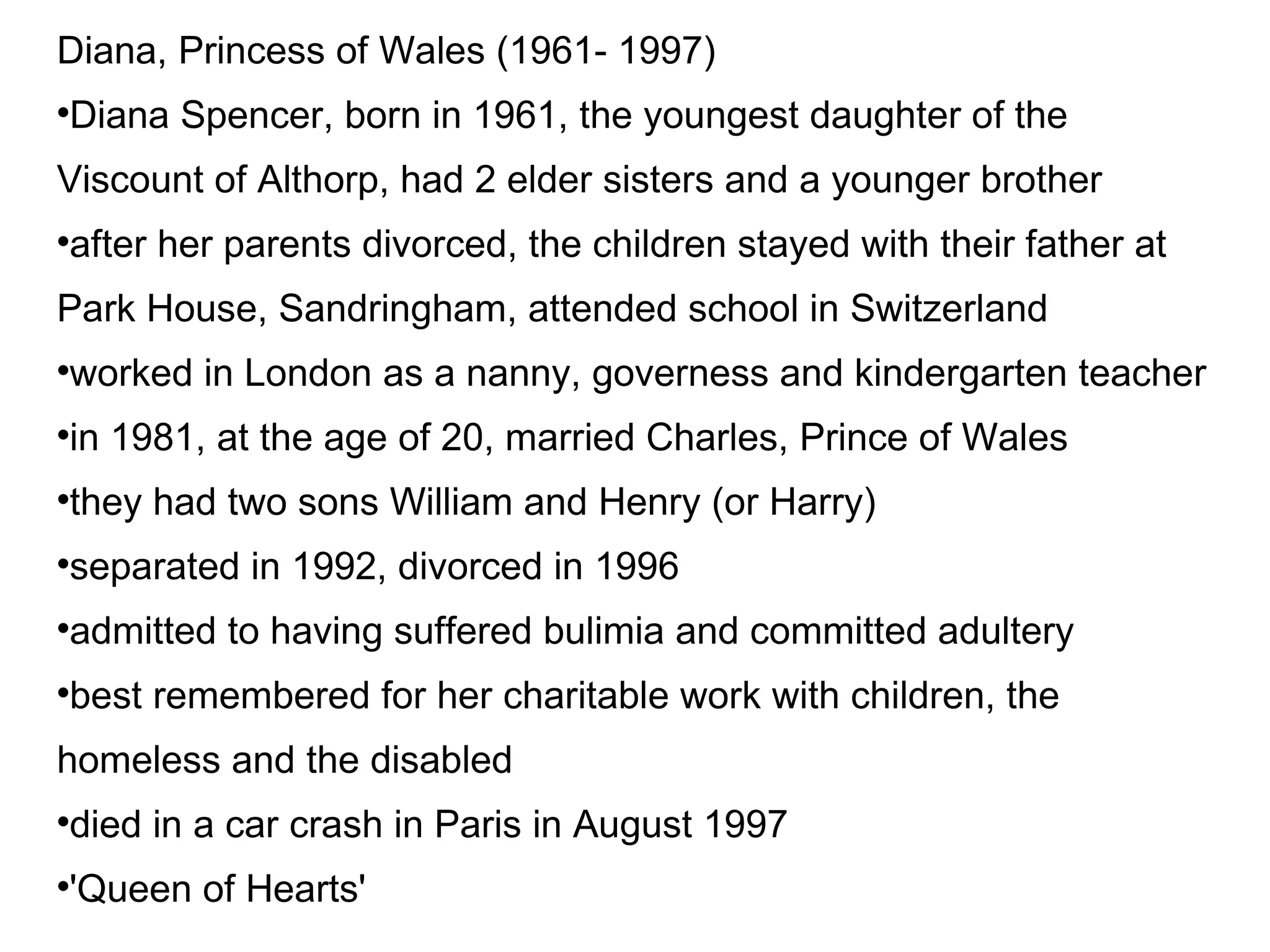
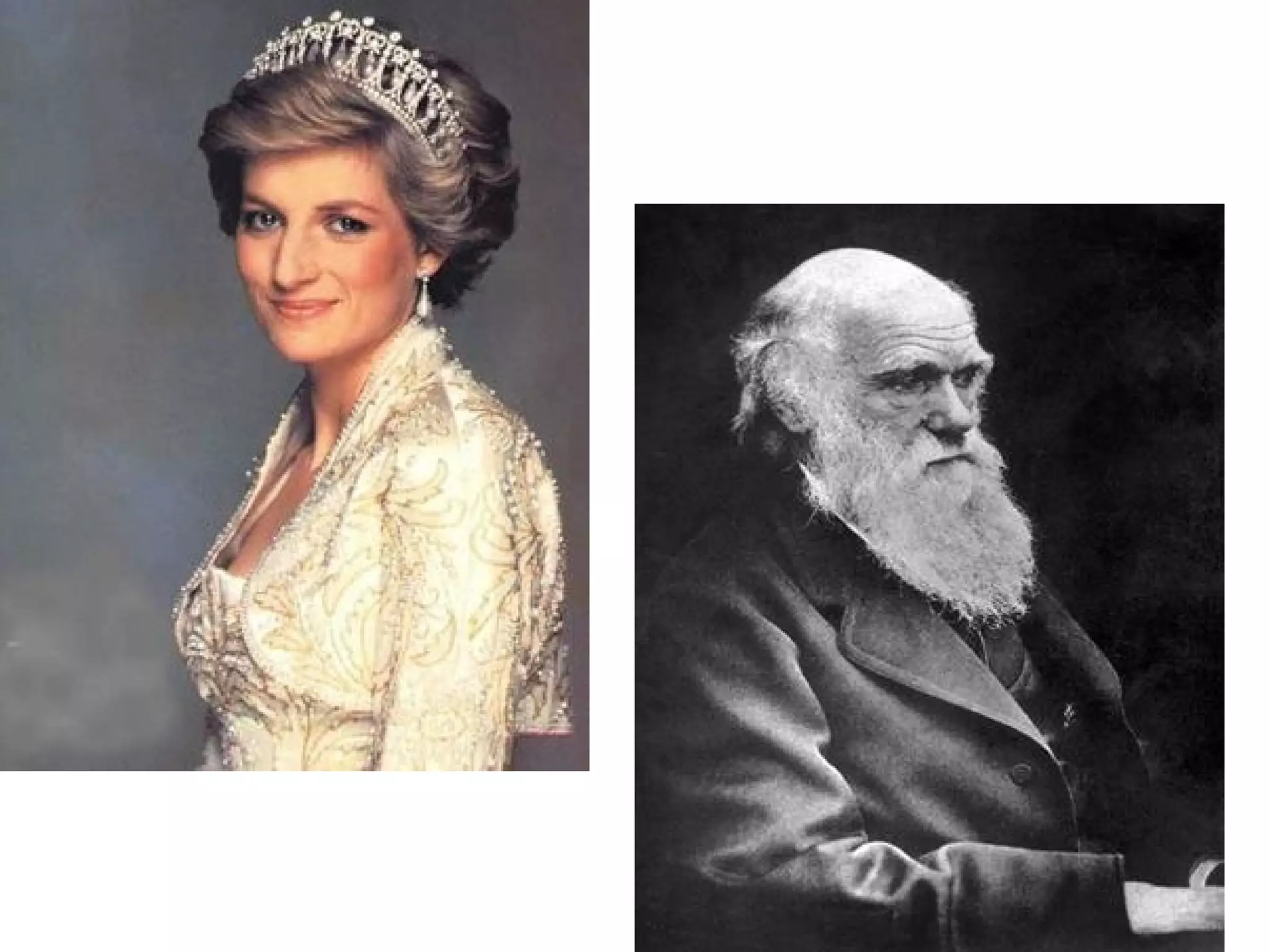
Diana, Princess of Wales (1961- 1997)‏ Diana Spencer, born in 1961, the youngest daughter of the Viscount of Althorp, had 2 elder sisters and a younger brother after her parents divorced, the children stayed with their father at Park House, Sandringham, attended school in Switzerland worked in London as a nanny, governess and kindergarten teacher in 1981, at the age of 20, married Charles, Prince of Wales they had two sons William and Henry (or Harry)‏ separated in 1992, divorced in 1996 admitted to having suffered bulimia and committed adultery best remembered for her charitable work with children, the homeless and the disabled died in a car crash in Paris in August 1997 'Queen of Hearts'
 
Charles Darwin (1809- 1882)‏ a British scientist who developed the theory of evolution, known as Darwinism explained these ideas in his book ' On the Origin of Species', published in 1859 wanted to take up medicine, but had to drop it, because he didn't stand blood studied divinity in Cambridge in 1831, joined a scientific expedition to travel the world on a ship called the Beagle worked on hie theory for 20 years, publish it as 'On the Origin of Species by Means of Natural Selection' the religious powers at the time strongly opposed to his views
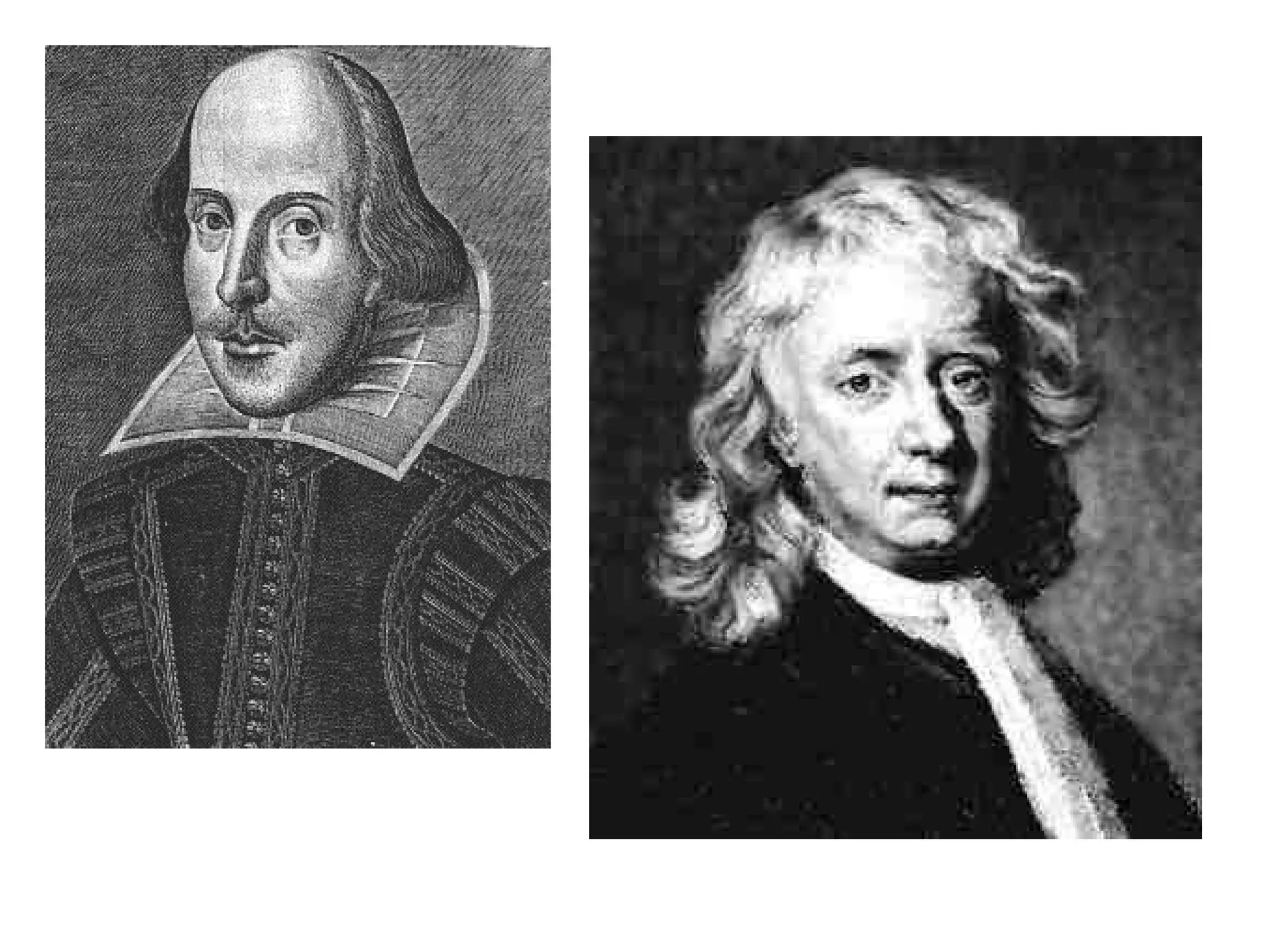
William Shakespeare (1564- 1616)‏ he was born in Stratford- upon- Avon, probably educated in the town's free grammar school his acting career started in Warwickshire, served as a resident player under the stagename 'Shakeshaft '  shortly after marrying Anne Hathaway he left for London to pursue his career wrote his first plays in the mid- 1580s from 1594- worked with the Lord Chamberlain's Company, later renamed the King's Company in 1603, when James I succeeded to the throne the group was connected to 2 theaters: the Globe and the Blackfriar's his plays fall into the categories: history, tragedy, comedy and tragi-comedy
 
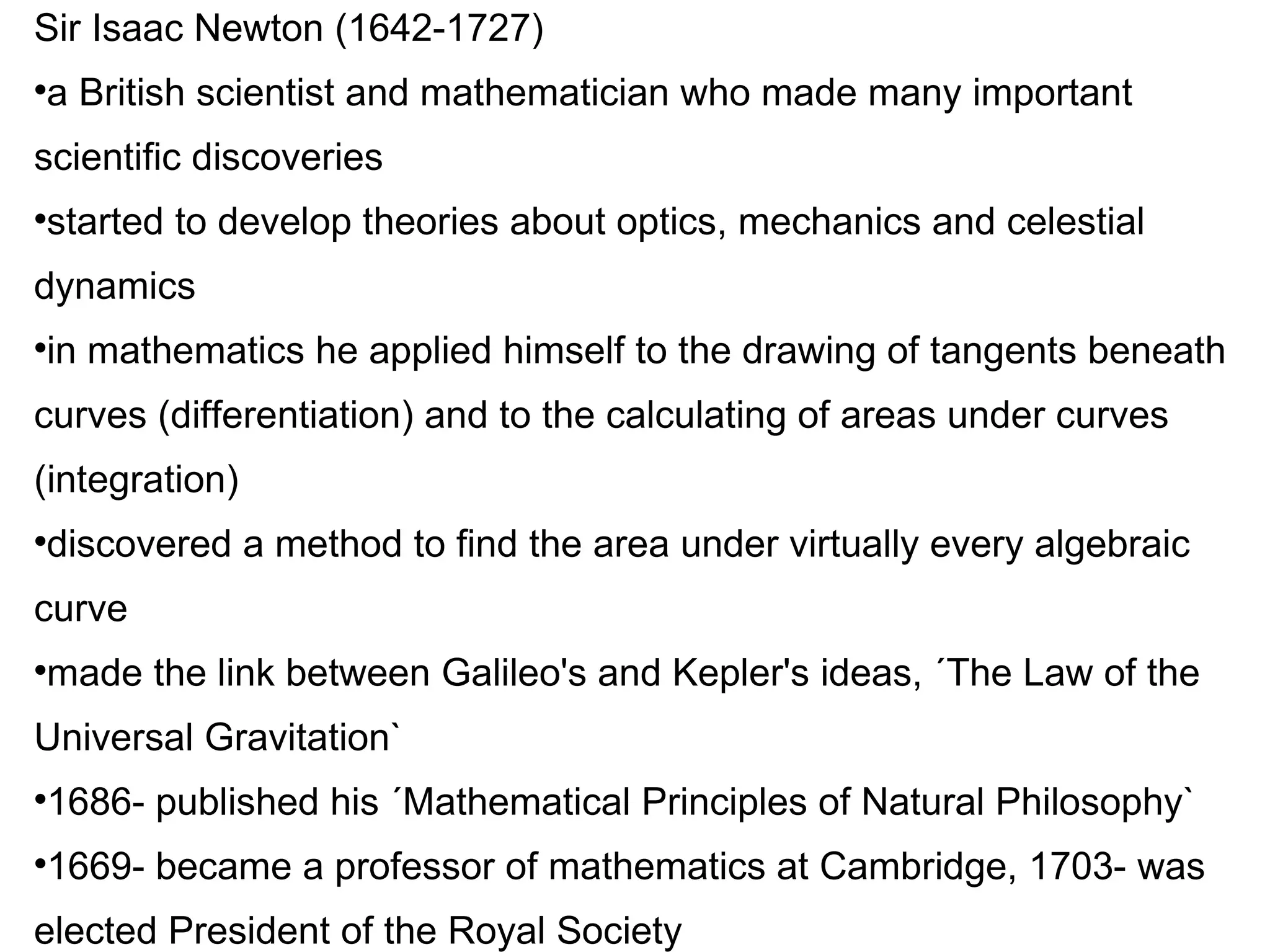
Sir Isaac Newton (1642-1727)‏ a British scientist and mathematician who made many important scientific discoveries started to develop theories about optics, mechanics and celestial dynamics in mathematics he applied himself to the drawing of tangents beneath curves (differentiation) and to the calculating of areas under curves (integration)‏ discovered a method to find the area under virtually every algebraic curve made the link between Galileo's and Kepler's ideas, ´The Law of the Universal Gravitation` 1686- published his ´Mathematical Principles of Natural Philosophy` 1669- became a professor of mathematics at Cambridge, 1703- was elected President of the Royal Society
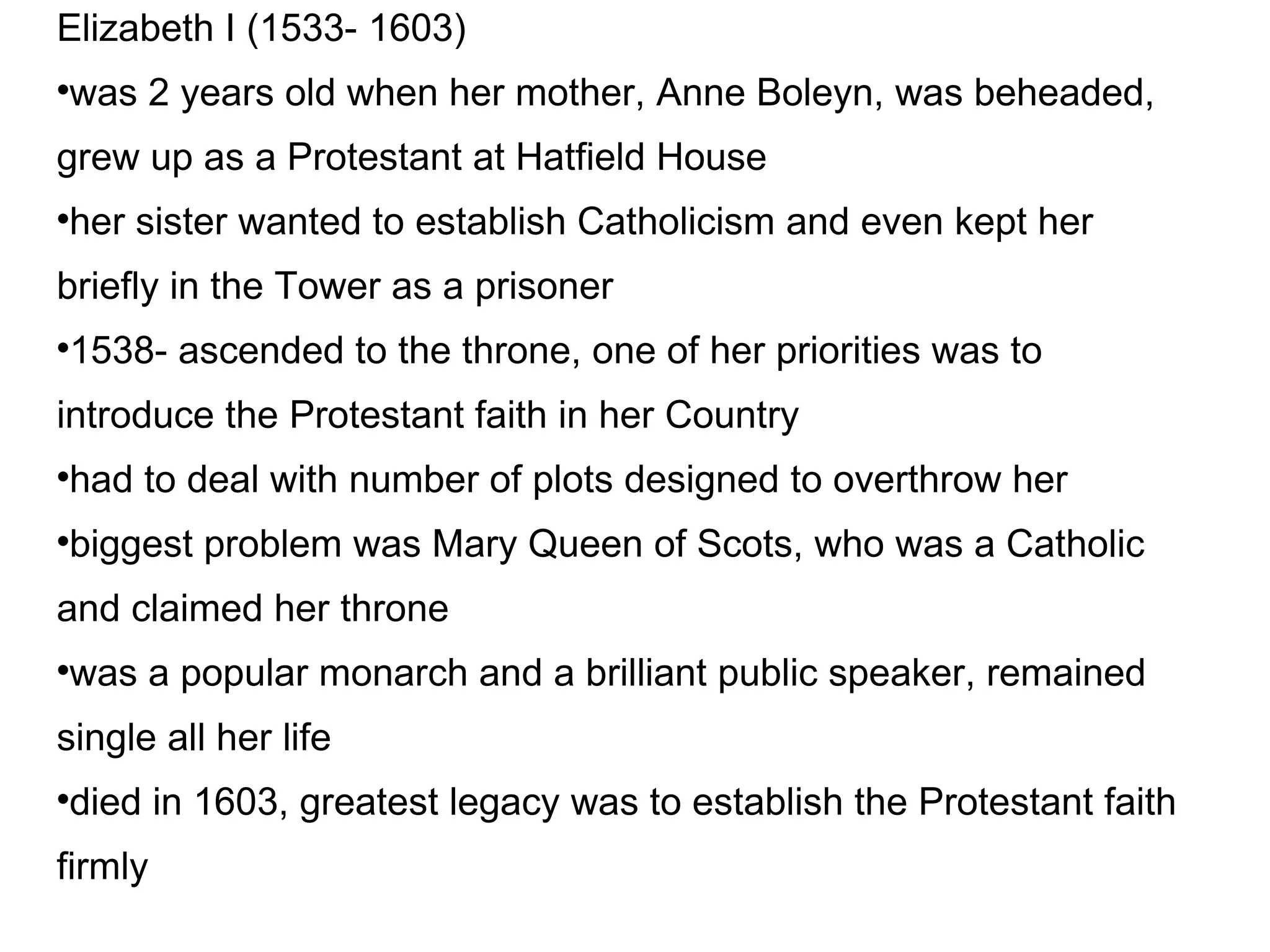
Elizabeth I (1533- 1603)‏ was 2 years old when her mother, Anne Boleyn, was beheaded, grew up as a Protestant at Hatfield House  her sister wanted to establish Catholicism and even kept her briefly in the Tower as a prisoner 1538- ascended to the throne, one of her priorities was to introduce the Protestant faith in her Country had to deal with number of plots designed to overthrow her biggest problem was Mary Queen of Scots, who was a Catholic and claimed her throne was a popular monarch and a brilliant public speaker, remained single all her life died in 1603, greatest legacy was to establish the Protestant faith firmly
 
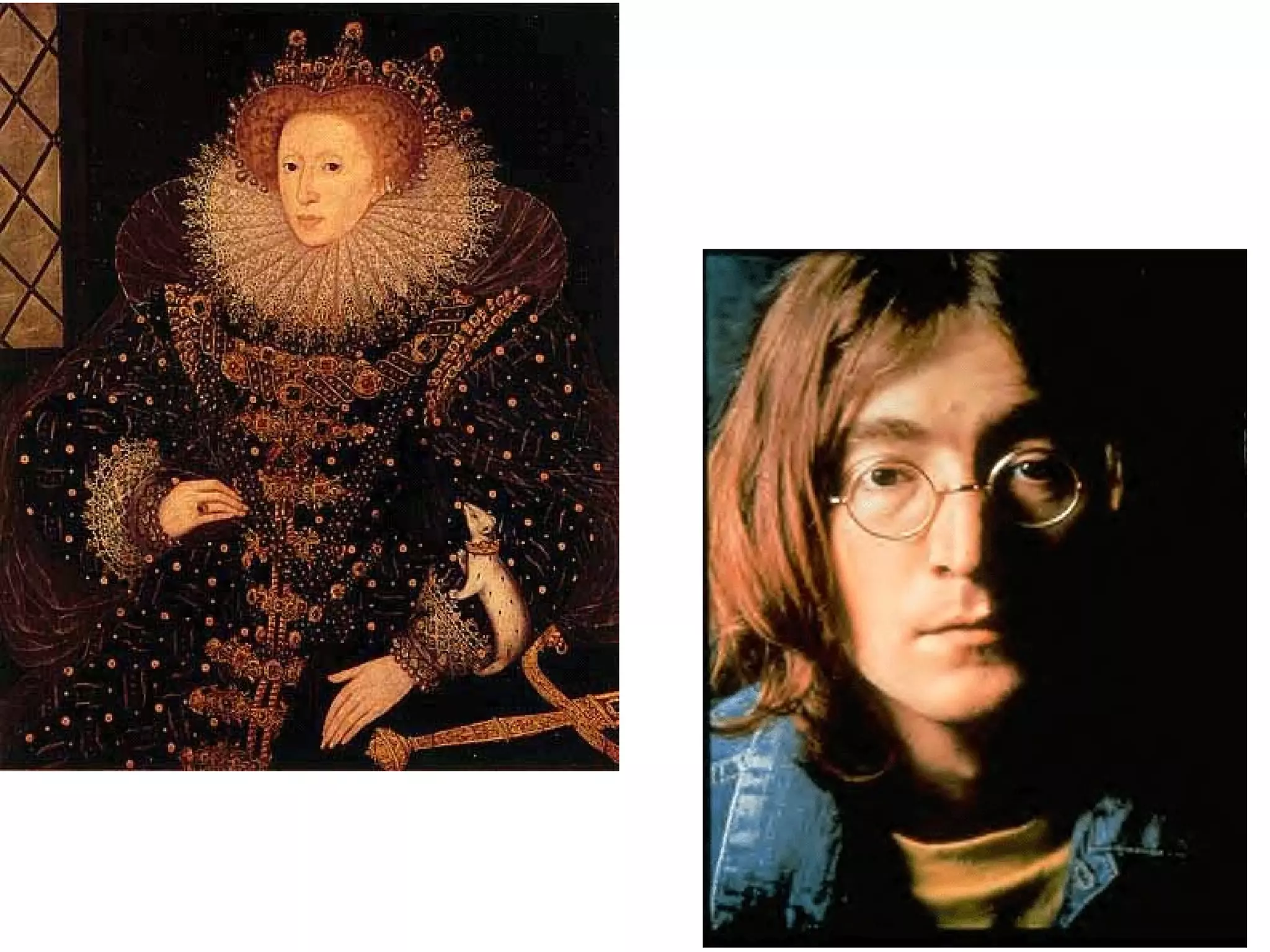
John Lennon (1940- 1980)‏ one of the 4 Beatles born in Liverpool, brought up by his aunt and uncle at school he did not do well, but later enrolled at Liverpool Art College 1955- his first band Quarrymen, produced cover versions of popular songs 1957- the Beatles came together, started to play at the Cavern, Brian Epstein- their manager 1962- married, left his wife for Yoko Ono, has sons by both of his wives 1960s became disillusioned with the Beatles, campaigned against the war in Vietnam 1970- released a solo album with the Plastic Ono Band 1980- was shot dead outside his home in NYC
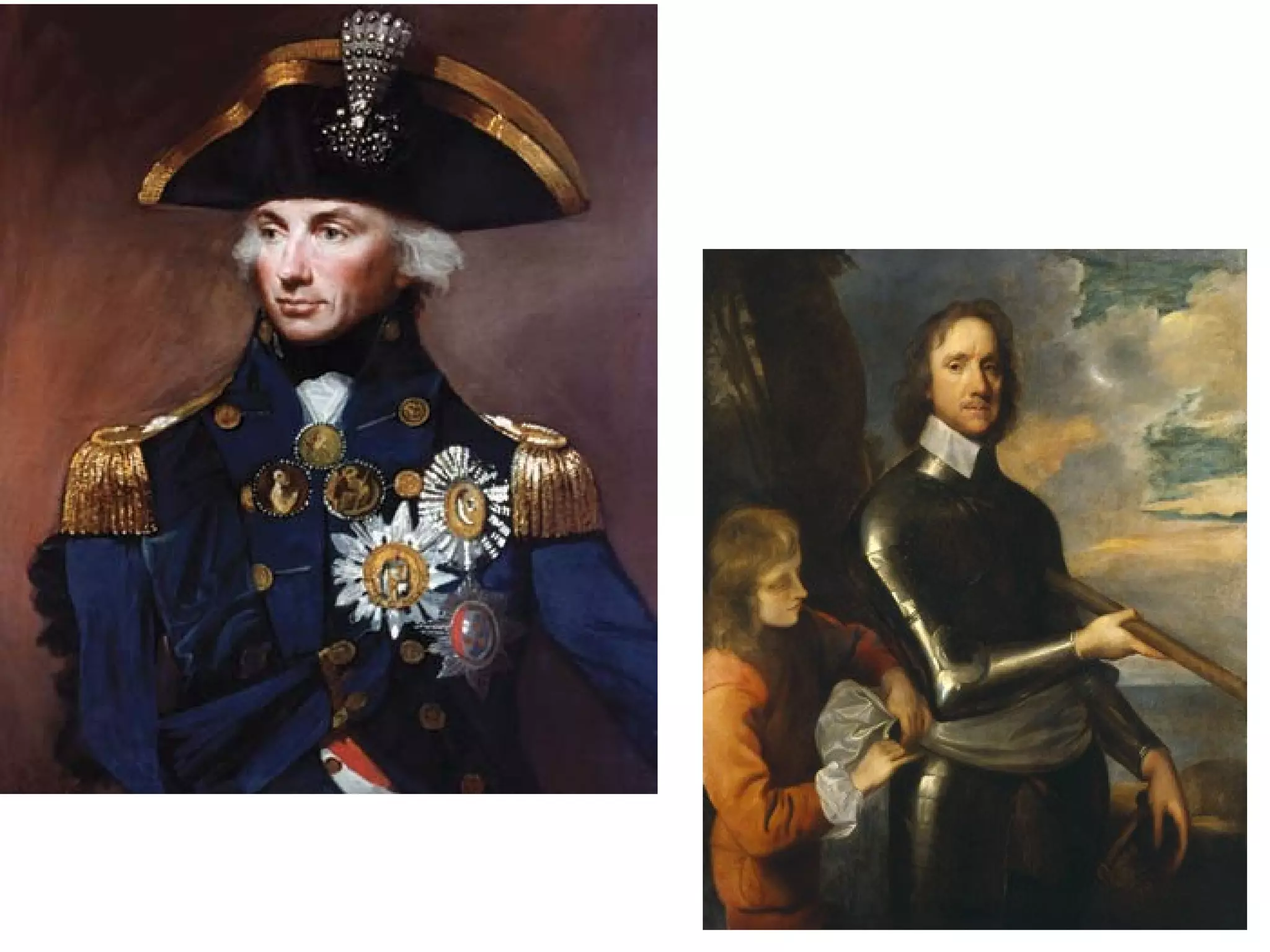
Viscount Horatio Nelson (1758- 1805)‏ a British admiral and Britain's most famous naval leader born in Norfolk, joined the Navy at 12, became a captain at 20, serving in the West Indies, the Baltics and Canada lost his arm and the sight in one eye during the wars against Napoleon was known for bold actions and sometimes ignoring orders from his seniors fell in love with Lady Emma Hamilton, but they both were married, they considered each other soulmates, had a child Horatio (Junior)‏ October 1805- his most famous battle took place at Cape Trafalgar, saved Britain from the threat of invasion of Napoleon ´England expects that every man will do his duty` died on the first day of the battle, struck by a French sniper's bullet
 
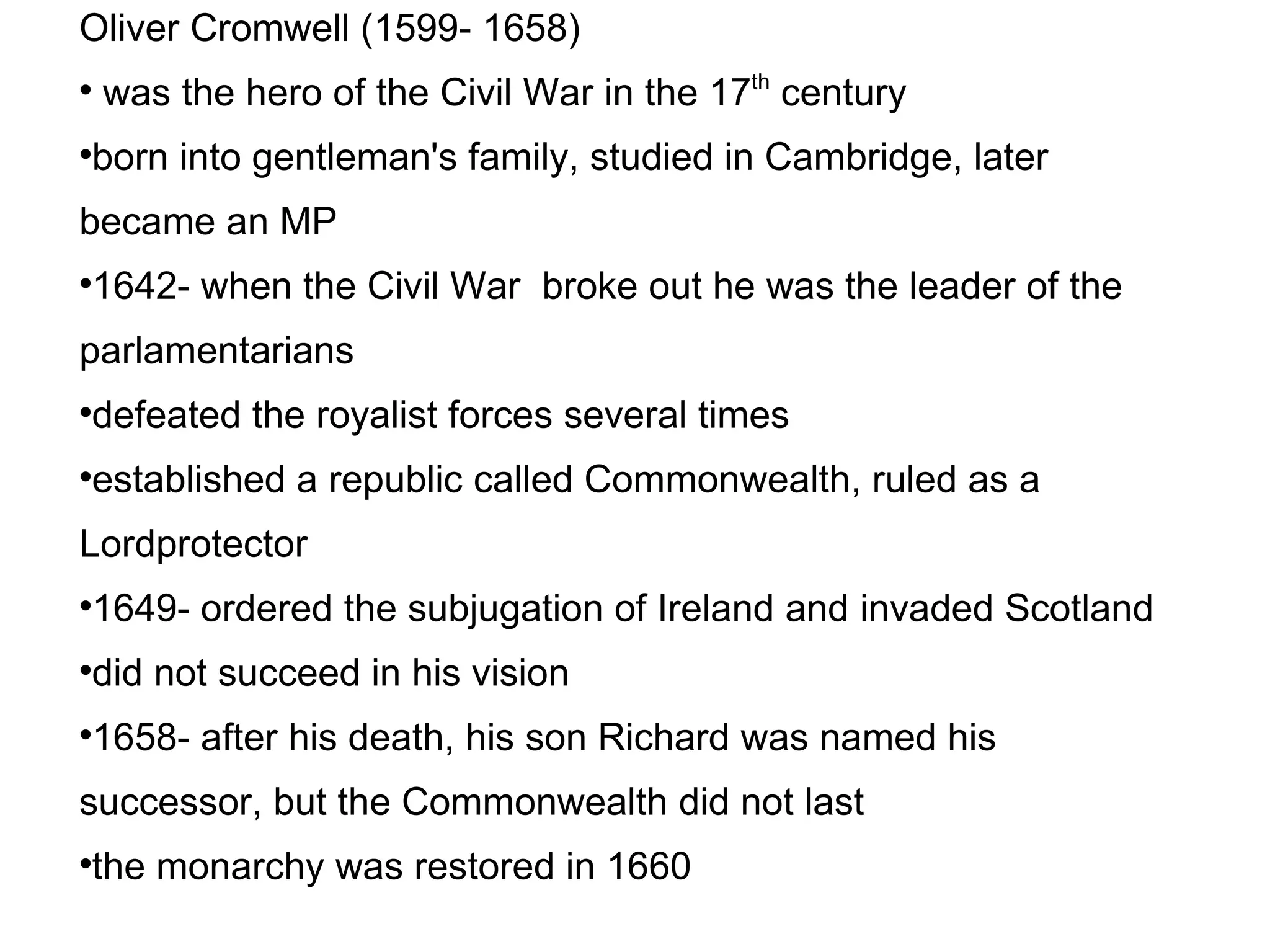
Oliver Cromwell (1599- 1658)‏ was the hero of the Civil War in the 17 th  century born into gentleman's family, studied in Cambridge, later became an MP 1642- when the Civil War  broke out he was the leader of the parlamentarians defeated the royalist forces several times established a republic called Commonwealth, ruled as a Lordprotector 1649- ordered the subjugation of Ireland and invaded Scotland did not succeed in his vision 1658- after his death, his son Richard was named his successor, but the Commonwealth did not last the monarchy was restored in 1660
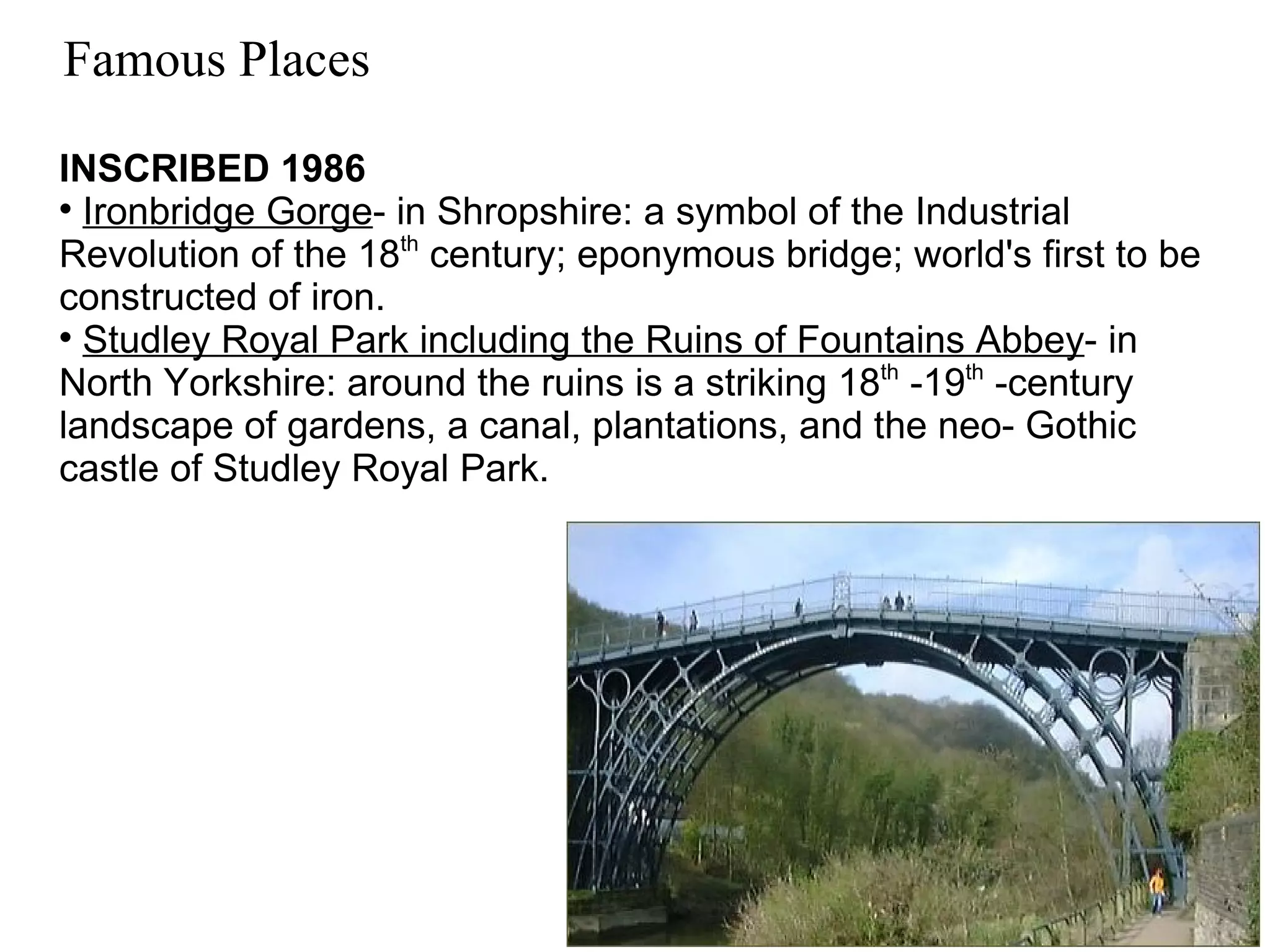
Famous Places INSCRIBED 1986 Ironbridge Gorge - in Shropshire: a symbol of the Industrial Revolution of the 18 th  century; eponymous bridge; world's first to be constructed of iron. Studley Royal Park including the Ruins of Fountains Abbey - in North Yorkshire: around the ruins is a striking 18 th  -19 th  -century landscape of gardens, a canal, plantations, and the neo- Gothic castle of Studley Royal Park.
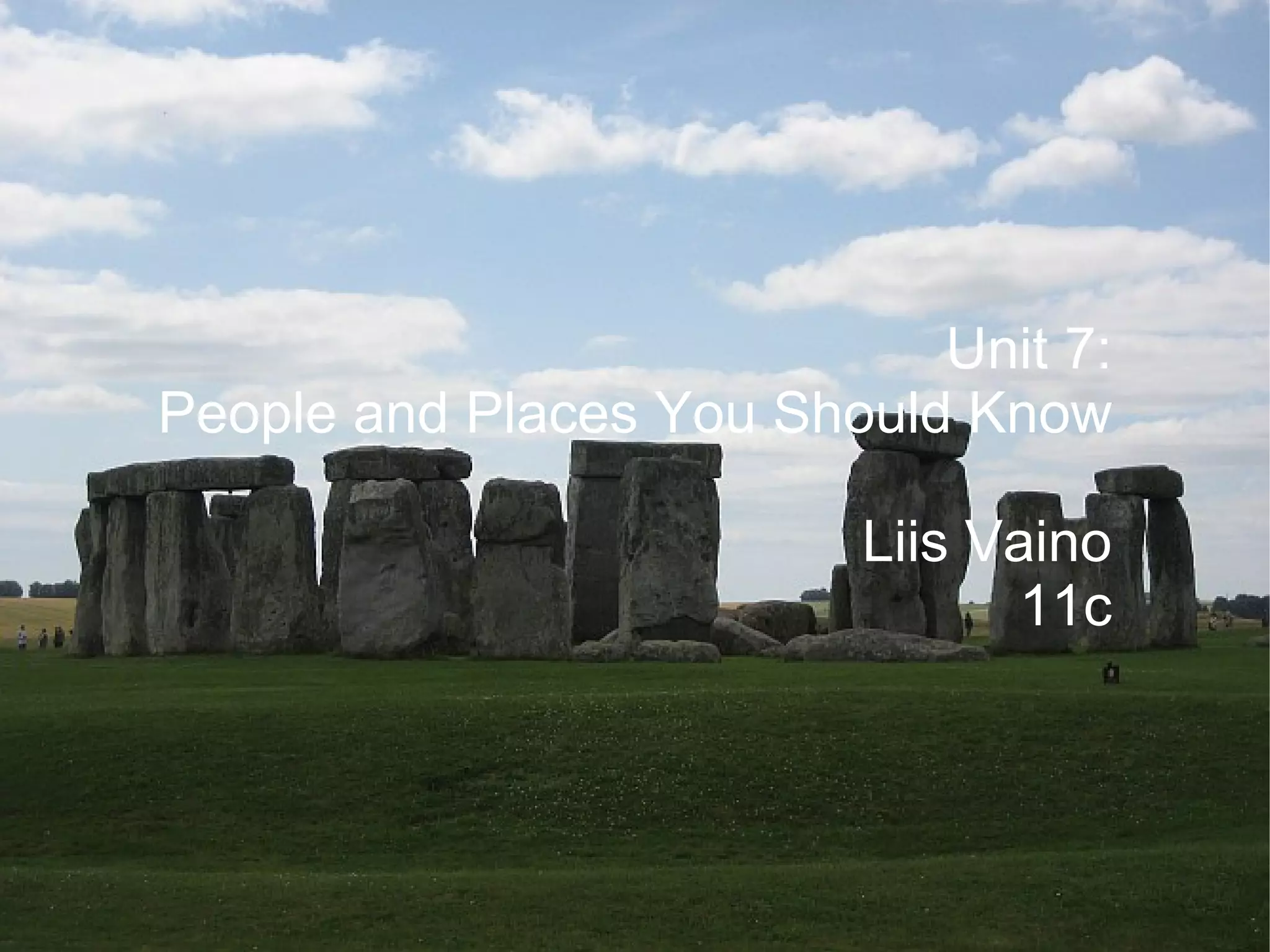
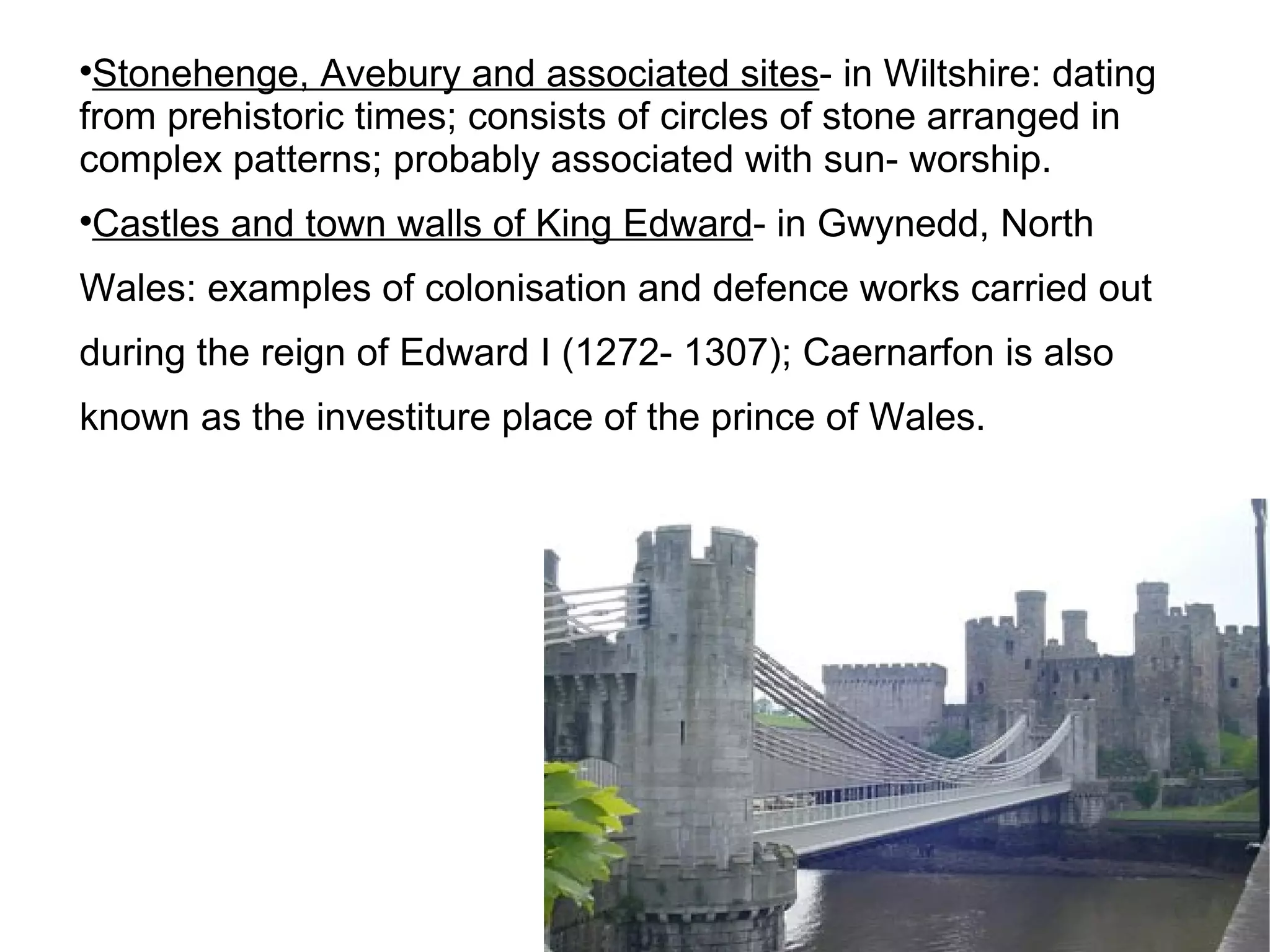
Stonehenge, Avebury and associated sites - in Wiltshire: dating from prehistoric times; consists of circles of stone arranged in complex patterns; probably associated with sun- worship. Castles and town walls of King Edward - in Gwynedd, North Wales: examples of colonisation and defence works carried out during the reign of Edward I (1272- 1307); Caernarfon is also known as the investiture place of the prince of Wales.
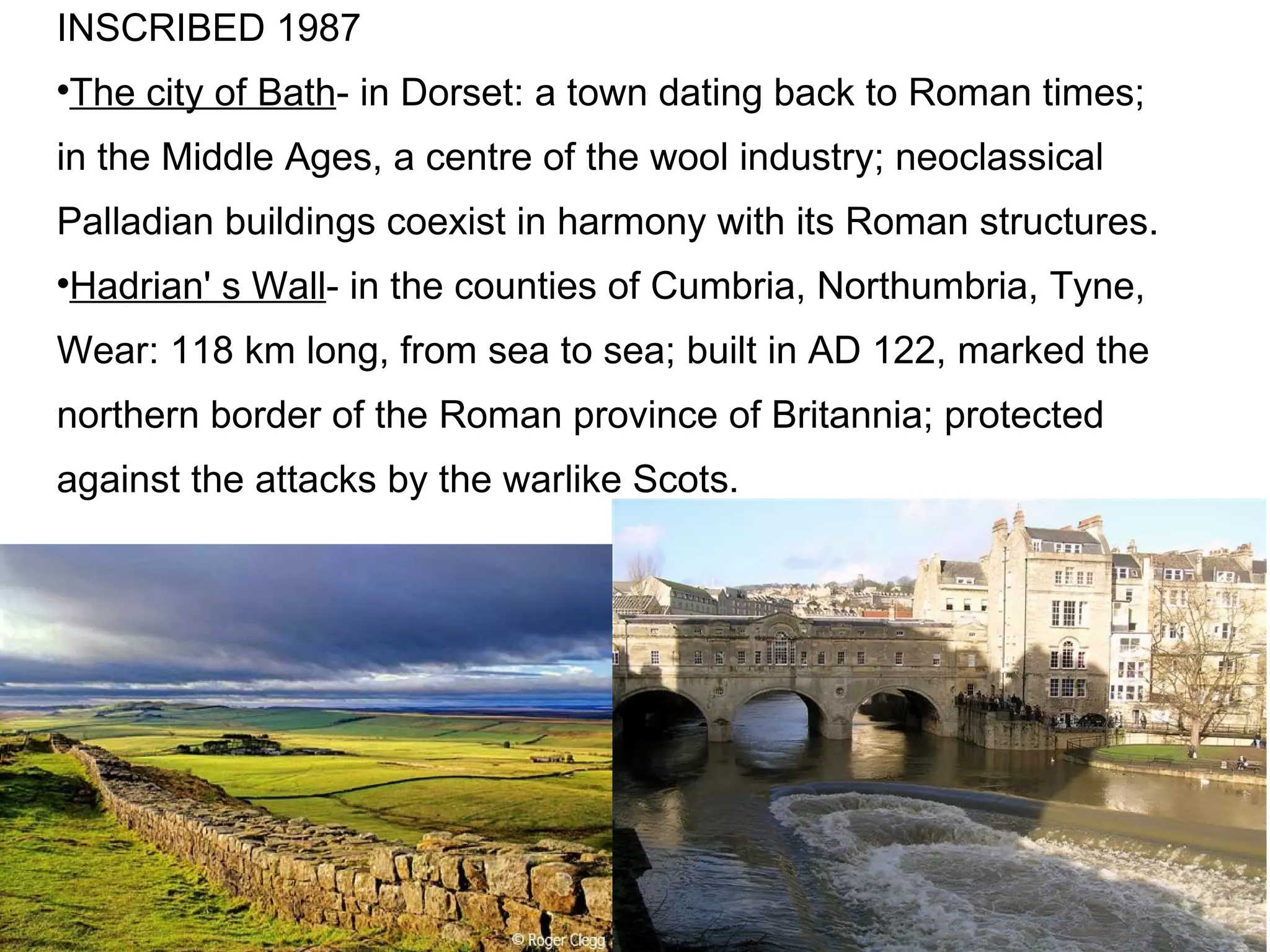
INSCRIBED 1987 The city of Bath - in Dorset: a town dating back to Roman times; in the Middle Ages, a centre of the wool industry; neoclassical Palladian buildings coexist in harmony with its Roman structures. Hadrian' s Wall - in the counties of Cumbria, Northumbria, Tyne, Wear: 118 km long, from sea to sea; built in AD 122, marked the northern border of the Roman province of Britannia; protected against the attacks by the warlike Scots.
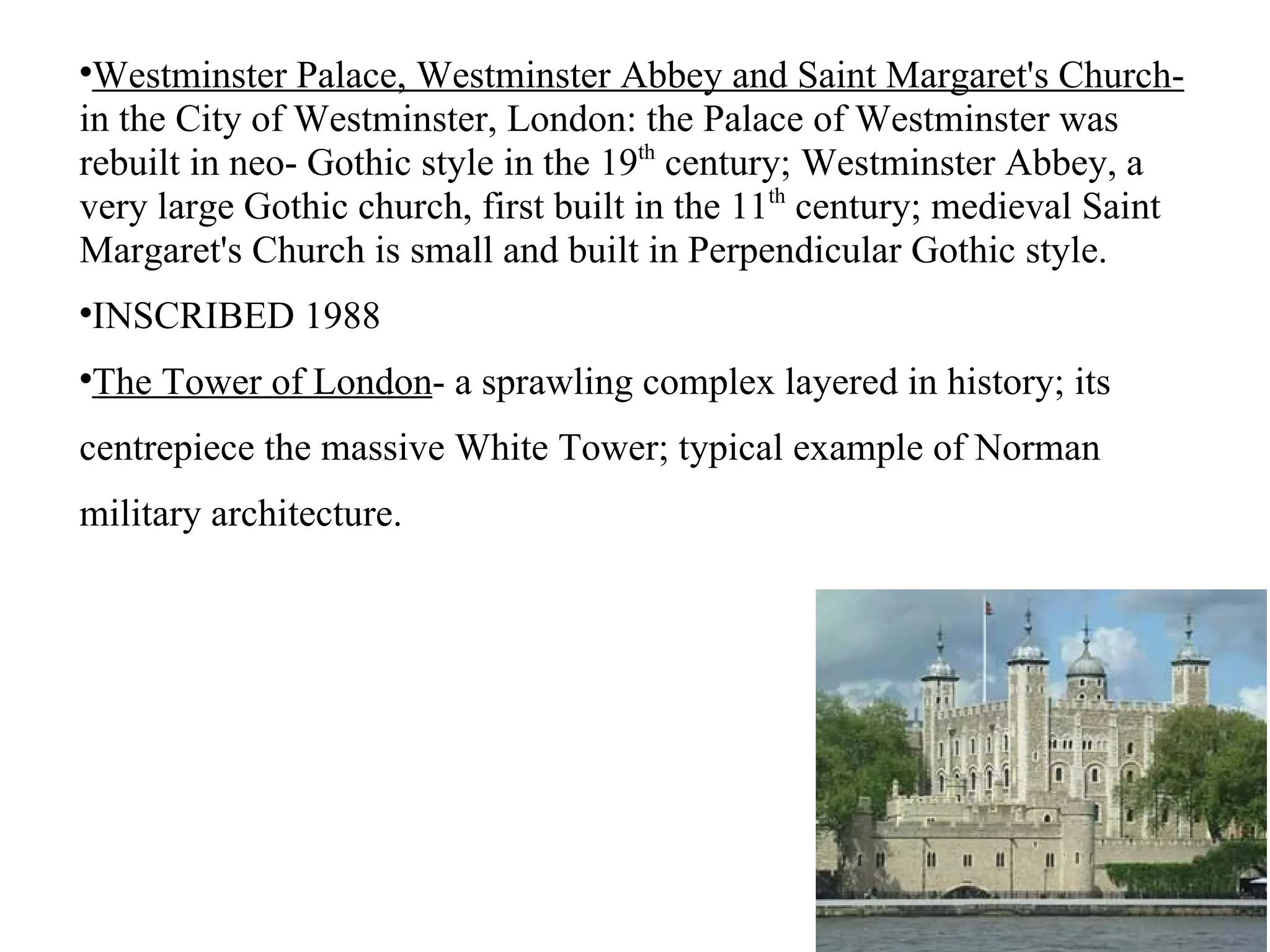
Westminster Palace, Westminster Abbey and Saint Margaret's Church-  in the City of Westminster, London: the Palace of Westminster was rebuilt in neo- Gothic style in the 19 th  century; Westminster Abbey, a very large Gothic church, first built in the 11 th  century; medieval Saint Margaret's Church is small and built in Perpendicular Gothic style. INSCRIBED 1988 The Tower of London - a sprawling complex layered in history; its centrepiece the massive White Tower; typical example of Norman military architecture.
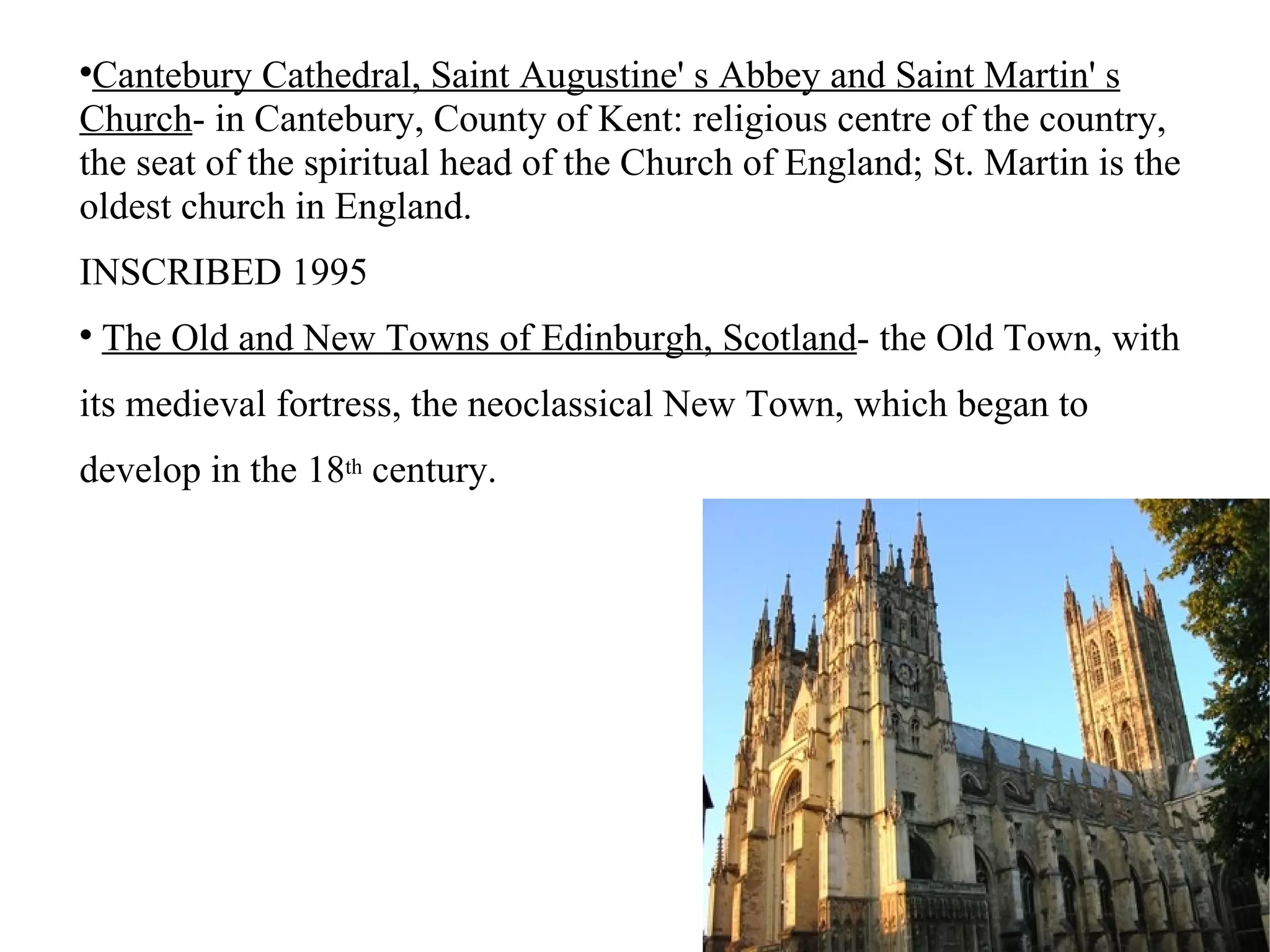
Cantebury Cathedral, Saint Augustine' s Abbey and Saint Martin' s Church - in Cantebury, County of Kent: religious centre of the country, the seat of the spiritual head of the Church of England; St. Martin is the oldest church in England. INSCRIBED 1995 The Old and New Towns of Edinburgh, Scotland - the Old Town, with its medieval fortress, the neoclassical New Town, which began to develop in the 18 th  century.
Gough Island Wildlife Reserve - Tristan da Cunha Island Group, St. Helena Dependency: lies in the South Atlantic; one of the least- disrupted island and marine ecosystems in the cool temperate zone. INSCRIBED 1997 Maritime Greenwich, London - a district in the south- east of London, best known for its 0- meridian; the ensemble of buildings symbolise English artistic and scientific endeavours in the 17 th  and 18 th  centuries. INSCRIBED 1999 The Heart of Neolithic Orkney - Mainland Orkney, Scotland: the monuments of Orkney bear- 3000- 2000 BC, include a large chambered tomb, 2 ceremonial stone circles and a settlement.
INSCRIBED 2000 The Historic Town of St. George and related fortifications - Bermuda: a remarkable example of a fortified colonial town, dating back to 17 th  century. INSCRIBED 2001 Dorset and East Devon Coast - England: exposed cliffs; continuous rock formations spanning the Mesozoic Era. INSCRIBED 2003 Royal Botanic Gardens, Kew - London: the UK's largest and most important botanical garden open to the public; created in 1759.
Thank you for listening!

Unit 7: People and Places You Should Know

  • 1.
    Unit 7: Peopleand Places You Should Know Liis Vaino 11c
  • 2.
    Famous People SirWinston Churchill (1874- 1965)‏ an English statesman and one of the greatest politicians in the 20 th century led Britain successfully through WWII, described it as his `walk with destiny`- he had been preparing for it his whole life born in Blenheim Palace in Oxfordshire, entered politics as a Conservative MP in 1900 in 1906 became a member of the Liberal party, later rejoined the Conservatives occupied many high positions: 1919 to 1921-Secretary of State and War and Air, 1924- Chancellor of the Exchequer political career peaked in the 1940s was Prime Minister twice: during WWII and from 1951 to 1955 gave world the V- sign, which showed his belief in victory
  • 3.
  • 4.
    Isambard Kingdom Brunel(1806- 1859)‏ an English engineer, became famous for his railway engines, bridges and ships son of a French engineer, born in Portsmouth, educated in England and France first achievement: planning (together with his father) the Thames Tunnel from Rotherhithe to Wapping, completed in 1843 other work: the Clifton Suspension Bridge over the River Avon; constructed a network of tunnels, bridges and viaducts for the Great Western Railway; the Bridge over the Tamar at Saltash near Plymouth
  • 5.
    Diana, Princess ofWales (1961- 1997)‏ Diana Spencer, born in 1961, the youngest daughter of the Viscount of Althorp, had 2 elder sisters and a younger brother after her parents divorced, the children stayed with their father at Park House, Sandringham, attended school in Switzerland worked in London as a nanny, governess and kindergarten teacher in 1981, at the age of 20, married Charles, Prince of Wales they had two sons William and Henry (or Harry)‏ separated in 1992, divorced in 1996 admitted to having suffered bulimia and committed adultery best remembered for her charitable work with children, the homeless and the disabled died in a car crash in Paris in August 1997 'Queen of Hearts'
  • 6.
  • 7.
    Charles Darwin (1809-1882)‏ a British scientist who developed the theory of evolution, known as Darwinism explained these ideas in his book ' On the Origin of Species', published in 1859 wanted to take up medicine, but had to drop it, because he didn't stand blood studied divinity in Cambridge in 1831, joined a scientific expedition to travel the world on a ship called the Beagle worked on hie theory for 20 years, publish it as 'On the Origin of Species by Means of Natural Selection' the religious powers at the time strongly opposed to his views
  • 8.
    William Shakespeare (1564-1616)‏ he was born in Stratford- upon- Avon, probably educated in the town's free grammar school his acting career started in Warwickshire, served as a resident player under the stagename 'Shakeshaft ' shortly after marrying Anne Hathaway he left for London to pursue his career wrote his first plays in the mid- 1580s from 1594- worked with the Lord Chamberlain's Company, later renamed the King's Company in 1603, when James I succeeded to the throne the group was connected to 2 theaters: the Globe and the Blackfriar's his plays fall into the categories: history, tragedy, comedy and tragi-comedy
  • 9.
  • 10.
    Sir Isaac Newton(1642-1727)‏ a British scientist and mathematician who made many important scientific discoveries started to develop theories about optics, mechanics and celestial dynamics in mathematics he applied himself to the drawing of tangents beneath curves (differentiation) and to the calculating of areas under curves (integration)‏ discovered a method to find the area under virtually every algebraic curve made the link between Galileo's and Kepler's ideas, ´The Law of the Universal Gravitation` 1686- published his ´Mathematical Principles of Natural Philosophy` 1669- became a professor of mathematics at Cambridge, 1703- was elected President of the Royal Society
  • 11.
    Elizabeth I (1533-1603)‏ was 2 years old when her mother, Anne Boleyn, was beheaded, grew up as a Protestant at Hatfield House her sister wanted to establish Catholicism and even kept her briefly in the Tower as a prisoner 1538- ascended to the throne, one of her priorities was to introduce the Protestant faith in her Country had to deal with number of plots designed to overthrow her biggest problem was Mary Queen of Scots, who was a Catholic and claimed her throne was a popular monarch and a brilliant public speaker, remained single all her life died in 1603, greatest legacy was to establish the Protestant faith firmly
  • 12.
  • 13.
    John Lennon (1940-1980)‏ one of the 4 Beatles born in Liverpool, brought up by his aunt and uncle at school he did not do well, but later enrolled at Liverpool Art College 1955- his first band Quarrymen, produced cover versions of popular songs 1957- the Beatles came together, started to play at the Cavern, Brian Epstein- their manager 1962- married, left his wife for Yoko Ono, has sons by both of his wives 1960s became disillusioned with the Beatles, campaigned against the war in Vietnam 1970- released a solo album with the Plastic Ono Band 1980- was shot dead outside his home in NYC
  • 14.
    Viscount Horatio Nelson(1758- 1805)‏ a British admiral and Britain's most famous naval leader born in Norfolk, joined the Navy at 12, became a captain at 20, serving in the West Indies, the Baltics and Canada lost his arm and the sight in one eye during the wars against Napoleon was known for bold actions and sometimes ignoring orders from his seniors fell in love with Lady Emma Hamilton, but they both were married, they considered each other soulmates, had a child Horatio (Junior)‏ October 1805- his most famous battle took place at Cape Trafalgar, saved Britain from the threat of invasion of Napoleon ´England expects that every man will do his duty` died on the first day of the battle, struck by a French sniper's bullet
  • 15.
  • 16.
    Oliver Cromwell (1599-1658)‏ was the hero of the Civil War in the 17 th century born into gentleman's family, studied in Cambridge, later became an MP 1642- when the Civil War broke out he was the leader of the parlamentarians defeated the royalist forces several times established a republic called Commonwealth, ruled as a Lordprotector 1649- ordered the subjugation of Ireland and invaded Scotland did not succeed in his vision 1658- after his death, his son Richard was named his successor, but the Commonwealth did not last the monarchy was restored in 1660
  • 17.
    Famous Places INSCRIBED1986 Ironbridge Gorge - in Shropshire: a symbol of the Industrial Revolution of the 18 th century; eponymous bridge; world's first to be constructed of iron. Studley Royal Park including the Ruins of Fountains Abbey - in North Yorkshire: around the ruins is a striking 18 th -19 th -century landscape of gardens, a canal, plantations, and the neo- Gothic castle of Studley Royal Park.
  • 18.
    Stonehenge, Avebury andassociated sites - in Wiltshire: dating from prehistoric times; consists of circles of stone arranged in complex patterns; probably associated with sun- worship. Castles and town walls of King Edward - in Gwynedd, North Wales: examples of colonisation and defence works carried out during the reign of Edward I (1272- 1307); Caernarfon is also known as the investiture place of the prince of Wales.
  • 19.
    INSCRIBED 1987 Thecity of Bath - in Dorset: a town dating back to Roman times; in the Middle Ages, a centre of the wool industry; neoclassical Palladian buildings coexist in harmony with its Roman structures. Hadrian' s Wall - in the counties of Cumbria, Northumbria, Tyne, Wear: 118 km long, from sea to sea; built in AD 122, marked the northern border of the Roman province of Britannia; protected against the attacks by the warlike Scots.
  • 20.
    Westminster Palace, WestminsterAbbey and Saint Margaret's Church- in the City of Westminster, London: the Palace of Westminster was rebuilt in neo- Gothic style in the 19 th century; Westminster Abbey, a very large Gothic church, first built in the 11 th century; medieval Saint Margaret's Church is small and built in Perpendicular Gothic style. INSCRIBED 1988 The Tower of London - a sprawling complex layered in history; its centrepiece the massive White Tower; typical example of Norman military architecture.
  • 21.
    Cantebury Cathedral, SaintAugustine' s Abbey and Saint Martin' s Church - in Cantebury, County of Kent: religious centre of the country, the seat of the spiritual head of the Church of England; St. Martin is the oldest church in England. INSCRIBED 1995 The Old and New Towns of Edinburgh, Scotland - the Old Town, with its medieval fortress, the neoclassical New Town, which began to develop in the 18 th century.
  • 22.
    Gough Island WildlifeReserve - Tristan da Cunha Island Group, St. Helena Dependency: lies in the South Atlantic; one of the least- disrupted island and marine ecosystems in the cool temperate zone. INSCRIBED 1997 Maritime Greenwich, London - a district in the south- east of London, best known for its 0- meridian; the ensemble of buildings symbolise English artistic and scientific endeavours in the 17 th and 18 th centuries. INSCRIBED 1999 The Heart of Neolithic Orkney - Mainland Orkney, Scotland: the monuments of Orkney bear- 3000- 2000 BC, include a large chambered tomb, 2 ceremonial stone circles and a settlement.
  • 23.
    INSCRIBED 2000 TheHistoric Town of St. George and related fortifications - Bermuda: a remarkable example of a fortified colonial town, dating back to 17 th century. INSCRIBED 2001 Dorset and East Devon Coast - England: exposed cliffs; continuous rock formations spanning the Mesozoic Era. INSCRIBED 2003 Royal Botanic Gardens, Kew - London: the UK's largest and most important botanical garden open to the public; created in 1759.
  • 24.
    Thank you forlistening!