THE FOUNDER OF THE ENGLISH NOVEL Daniel DeFoe
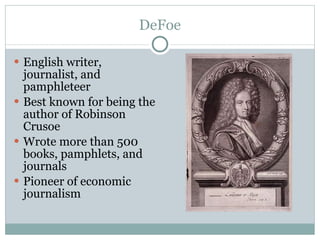
DeFoe English writer, journalist, and pamphleteer Best known for being the author of Robinson Crusoe Wrote more than 500 books, pamphlets, and journals Pioneer of economic journalism
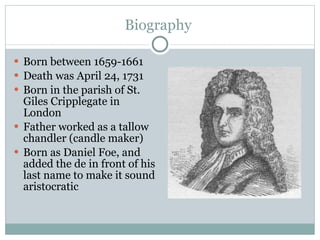
Biography  Born between 1659-1661 Death was April 24, 1731 Born in the parish of St. Giles Cripplegate in London Father worked as a tallow chandler (candle maker) Born as Daniel Foe, and added the de in front of his last name to make it sound aristocratic
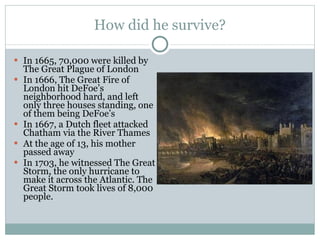
How did he survive? In 1665, 70,000 were killed by The Great Plague of London In 1666, The Great Fire of London hit DeFoe’s neighborhood hard, and left only three houses standing, one of them being DeFoe’s In 1667, a Dutch fleet attacked Chatham via the River Thames At the age of 13, his mother passed away In 1703, he witnessed The Great Storm, the only hurricane to make it across the Atlantic. The Great Storm took lives of 8,000 people.
The Unexpected DeFoe’s parents were Presbyterian dissenters (believed in separation of church and state) He was educated in a Dissenting Academy at Newington Green, and also went to church there It was expected that he would become a dissenting minister, but instead entered the world of business As an salesman, he sold hosiery, general woolen goods, and wine Even though he was very good at his job, he was always in debt
Marriages and Poor Decisions 1n 1684, DeFoe married Mary Tuffley and received a dowry of £3700 The couple had EIGHT children, but two died DeFoe joined the ill-fated Monmouth rebellion, but gained a pardon He was arrested in 1692 for a debt of £700, but was really in debt close to £17,000 He left England upon release, and travelled to Europe and Scotland When he came back to London, he served as a “commissioner of the glass duty”
Pamphleteering and Prison “ An Essay upon Projects” – defended the right of King William III for his participation in ending the Nine Years War “ The True-Born Englishman” – defended the king against the perceived xenophobia of his enemies “ Legion’s Memorial” – it demanded the release of the Kentish petitioners, who asked the Parliament to support the king in an imminent war against France
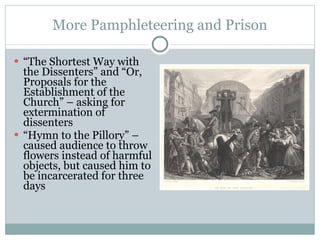
More Pamphleteering and Prison “ The Shortest Way with the Dissenters” and “Or, Proposals for the Establishment of the Church” – asking for extermination of dissenters “ Hymn to the Pillory” – caused audience to throw flowers instead of harmful objects, but caused him to be incarcerated for three days
It wasn’t all about politics… “ A True Relation of the Apparition of One Mrs. Veal the Next Day after her Death to One Mrs. Bargrave at Canterbury the 8 th  of September, 1705” – deals with interaction between the spiritual realm and the physical realm “ Appeal to Honour and Justice” – 1715 “ The Family Instructor” - 1715 “ Minutes of the Negotiations of Monsr. Mesnager” – 1717 A Continuation of the Letters Writ by a Turkish Spy” - 1718 “ Robinson Crusoe” – 1719 “ Captain Singleton” – 1720 “ Colonel Jack” – 1722 “ Religious Courtship” – 1722 The Complete English Tradesman – 1726 The New Family Instructor - 1727
More of his works The Great Law of Subordination Considered – 1724 Everybody’s Business is Nobody’s Business – 1725 The Politcal History of the Devil – 1726 A System of Magick – 1726 An Essay on the History and Reality of Appartions – 1727 A General History of Discoveries and Improvements – 1727 Atlas Maritimus and Commercialis – 1728 A tour thro’ the Whole Island of Great Britain (1724-1727)
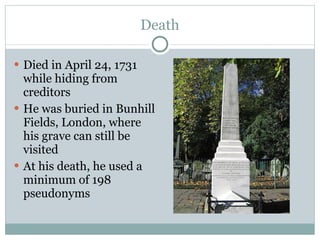
Death Died in April 24, 1731 while hiding from creditors He was buried in Bunhill Fields, London, where his grave can still be visited At his death, he used a minimum of 198 pseudonyms
Robinson Crusoe The story of Robinson Crusoe tells of a man’s shipwreck on a deserted island and his subsequent adventures The story of Robinson Crusoe is based partly on the true story of Scottish castaway Alexander Selkirk and partly on a Muslim man’s fictitious story The Crusoe’s friend, Friday, was based off a publicized case of a marooned Central American
DeFoe Inspires and Sequels Inspired a new genre called the “Robinsonade” Wyss’s The Swiss Family Robinson – 1812 J.M. Coetzee’s Foe – 1986 Tournier’s Vendredi ou les limbes du Pacifique – 1967 DeFoe’s The Farther Adventures of Robinson Crusoe and Serious Reflections of Robinson Crusoe Swift’s Gulliver’s Travels
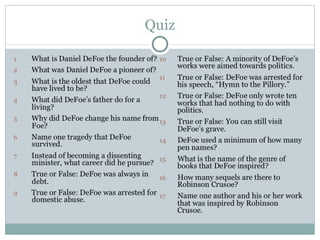
Quiz

Daniel Defoe

  • 1.
    THE FOUNDER OFTHE ENGLISH NOVEL Daniel DeFoe
  • 2.
    DeFoe English writer,journalist, and pamphleteer Best known for being the author of Robinson Crusoe Wrote more than 500 books, pamphlets, and journals Pioneer of economic journalism
  • 3.
    Biography Bornbetween 1659-1661 Death was April 24, 1731 Born in the parish of St. Giles Cripplegate in London Father worked as a tallow chandler (candle maker) Born as Daniel Foe, and added the de in front of his last name to make it sound aristocratic
  • 4.
    How did hesurvive? In 1665, 70,000 were killed by The Great Plague of London In 1666, The Great Fire of London hit DeFoe’s neighborhood hard, and left only three houses standing, one of them being DeFoe’s In 1667, a Dutch fleet attacked Chatham via the River Thames At the age of 13, his mother passed away In 1703, he witnessed The Great Storm, the only hurricane to make it across the Atlantic. The Great Storm took lives of 8,000 people.
  • 5.
    The Unexpected DeFoe’sparents were Presbyterian dissenters (believed in separation of church and state) He was educated in a Dissenting Academy at Newington Green, and also went to church there It was expected that he would become a dissenting minister, but instead entered the world of business As an salesman, he sold hosiery, general woolen goods, and wine Even though he was very good at his job, he was always in debt
  • 6.
    Marriages and PoorDecisions 1n 1684, DeFoe married Mary Tuffley and received a dowry of £3700 The couple had EIGHT children, but two died DeFoe joined the ill-fated Monmouth rebellion, but gained a pardon He was arrested in 1692 for a debt of £700, but was really in debt close to £17,000 He left England upon release, and travelled to Europe and Scotland When he came back to London, he served as a “commissioner of the glass duty”
  • 7.
    Pamphleteering and Prison“ An Essay upon Projects” – defended the right of King William III for his participation in ending the Nine Years War “ The True-Born Englishman” – defended the king against the perceived xenophobia of his enemies “ Legion’s Memorial” – it demanded the release of the Kentish petitioners, who asked the Parliament to support the king in an imminent war against France
  • 8.
    More Pamphleteering andPrison “ The Shortest Way with the Dissenters” and “Or, Proposals for the Establishment of the Church” – asking for extermination of dissenters “ Hymn to the Pillory” – caused audience to throw flowers instead of harmful objects, but caused him to be incarcerated for three days
  • 9.
    It wasn’t allabout politics… “ A True Relation of the Apparition of One Mrs. Veal the Next Day after her Death to One Mrs. Bargrave at Canterbury the 8 th of September, 1705” – deals with interaction between the spiritual realm and the physical realm “ Appeal to Honour and Justice” – 1715 “ The Family Instructor” - 1715 “ Minutes of the Negotiations of Monsr. Mesnager” – 1717 A Continuation of the Letters Writ by a Turkish Spy” - 1718 “ Robinson Crusoe” – 1719 “ Captain Singleton” – 1720 “ Colonel Jack” – 1722 “ Religious Courtship” – 1722 The Complete English Tradesman – 1726 The New Family Instructor - 1727
  • 10.
    More of hisworks The Great Law of Subordination Considered – 1724 Everybody’s Business is Nobody’s Business – 1725 The Politcal History of the Devil – 1726 A System of Magick – 1726 An Essay on the History and Reality of Appartions – 1727 A General History of Discoveries and Improvements – 1727 Atlas Maritimus and Commercialis – 1728 A tour thro’ the Whole Island of Great Britain (1724-1727)
  • 11.
    Death Died inApril 24, 1731 while hiding from creditors He was buried in Bunhill Fields, London, where his grave can still be visited At his death, he used a minimum of 198 pseudonyms
  • 12.
    Robinson Crusoe Thestory of Robinson Crusoe tells of a man’s shipwreck on a deserted island and his subsequent adventures The story of Robinson Crusoe is based partly on the true story of Scottish castaway Alexander Selkirk and partly on a Muslim man’s fictitious story The Crusoe’s friend, Friday, was based off a publicized case of a marooned Central American
  • 13.
    DeFoe Inspires andSequels Inspired a new genre called the “Robinsonade” Wyss’s The Swiss Family Robinson – 1812 J.M. Coetzee’s Foe – 1986 Tournier’s Vendredi ou les limbes du Pacifique – 1967 DeFoe’s The Farther Adventures of Robinson Crusoe and Serious Reflections of Robinson Crusoe Swift’s Gulliver’s Travels
  • 14.