To a Hero-Worshipper
By Sri Aurobindo
● Prepared by: Nilay Rathod
● MA Sem: 3
● 22406 Paper 201: Indian English Literature pre-Independence
● Roll No: 17
● Enrolment No: 4069206420210030
● Submitted to: Department of English,
Maharaja Krishnakumarsinhji Bhavnagar University
Sri Aurobindo
● Sri Aurobindo (15 August 1872 – 5 December 1950)
was an Indian philosopher, yogi, seer, poet, and
nationalist who propounded a philosophy of divine life
on earth through spiritual evolution.
● Aurobindo’s education began in a Christian convent
school in Darjeeling he was sent to England for further
schooling. He entered the University of Cambridge.
● After returning to India in 1892, he held various administrative and
professorial posts in Baroda (Vadodara) and Calcutta (Kolkata). Turning to
his native culture, he began the serious study of Yoga and Indian languages,
including classical Sanskrit.
● K. R. S. Iyengar has made a substantial and balanced contribution to
Aurobindonian criticism. He realises that a new kind of poetry like Sri
Aurobindo’s “demands a new mentality in the recipient as well as in the
writer.”
His main literary works are
1. The Life Divine, (1939 - 40)
2. The Synthesis of Yoga (1948),
3. Essays on the Gita (1922)
4. On the Veda (1956)
5. The ideal of Human Unity (1919)
6. The Human Cycle (1949)
7. The Future Poetry (1953)
8. The Foundations of Indian Culture (1953)
9. The Renaissance in India (1920)
Nature and Romanticism
● Sri Aurobindo Spent his early life in England during Victorian era.
● “As he was studying at home he got plenty of time to read books according to
his own taste. He read the Bible, Shakespeare, Shelley, Keats among other
writers. He was not only reading poetry but writing verses for the Fox Family
Magazine even at that early age.”(Purani)
● We recognize impacts of Keats in his arousing inspiration of nature and
Shelley in his utilization of natural objects as sources of inspiration.
● The First stanza is full of imagery and we find it somewhat similar to romantic
style of writing.
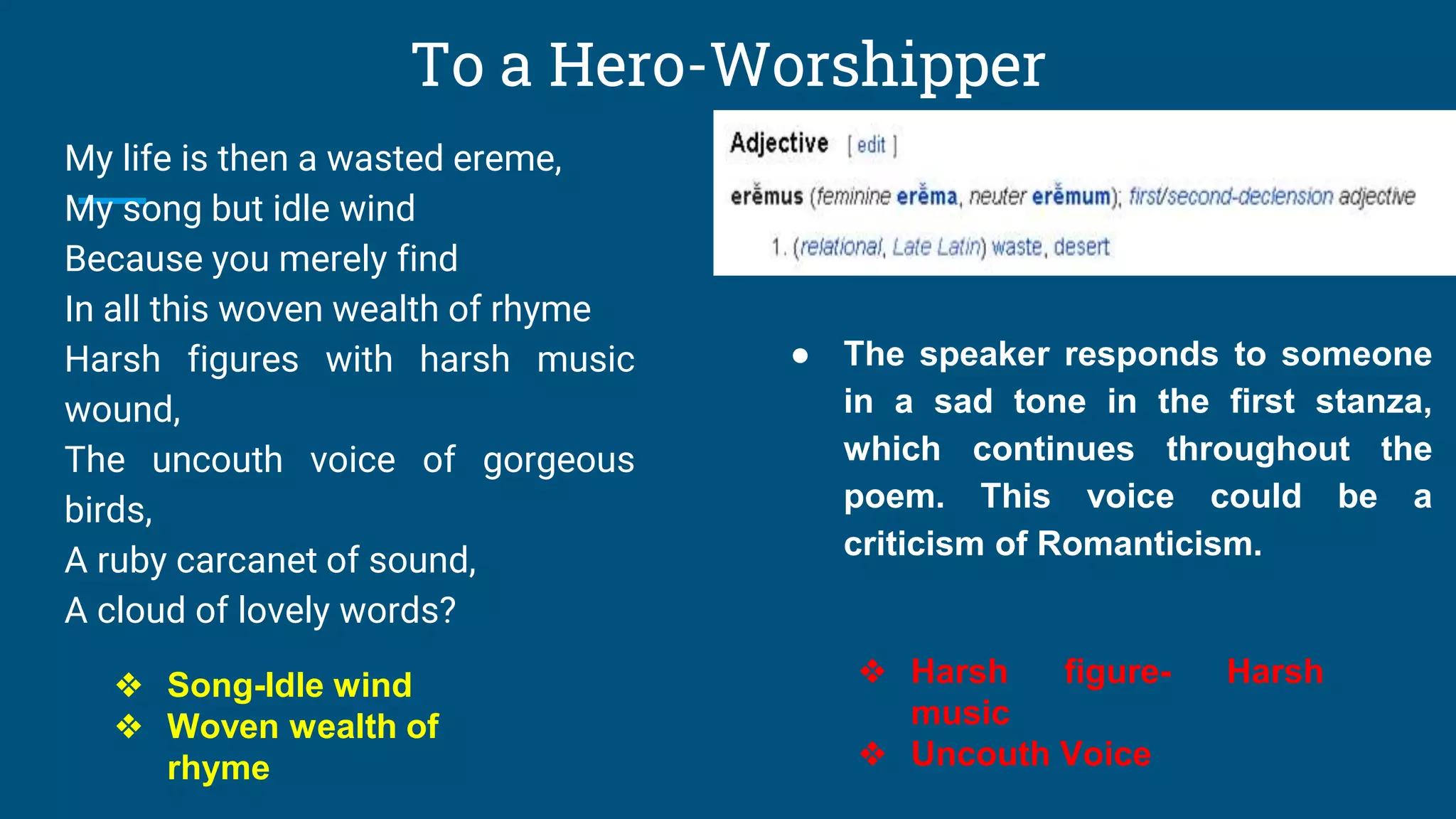
To a Hero-Worshipper
My life is then a wasted ereme,
My song but idle wind
Because you merely find
In all this woven wealth of rhyme
Harsh figures with harsh music
wound,
The uncouth voice of gorgeous
birds,
A ruby carcanet of sound,
A cloud of lovely words?
● The speaker responds to someone
in a sad tone in the first stanza,
which continues throughout the
poem. This voice could be a
criticism of Romanticism.
❖ Song-Idle wind
❖ Woven wealth of
rhyme
❖ Harsh figure- Harsh
music
❖ Uncouth Voice
Mysticism
● Mysticism is popularly known as any kind of ecstasy or altered state of
consciousness which is given a religious or spiritual meaning, but may refer
to becoming one with God or the Absolute.
● In Hinduism, various sadhanas (spiritual disciplines) aim at overcoming
ignorance (avidya) and transcending one's identification with body, mind and
ego to attain moksha, liberation from the cycle of birth and death. Hinduism
has a number of interlinked ascetic traditions and philosophical schools
which aim at moksha and the acquisition of higher powers. With the onset of
the British colonisation of India, those traditions came to be interpreted in
Western terms such as "mysticism", resulting in comparisons with Western
terms and practices.(King)
● Intrigued, he later turned to
Friedrich Max Müller' s classic
work, Sacred Books of the East, to
read the Isa Upanisad (Heehs).
● "He made a strong and very crude
mental attempt to realise what this
Self or Atman might be, to convert
the abstract idea into a concrete
and living reality in his own
consciousness, but conceiving it as
something beyond or behind this
material word" (Ghose).
I am, you say, no magic rod,
No cry oracular,
No swart and ominous star,
No Sinai thunder voicing God.
I have no burden to my song,
No smouldering word instinct with fire,
No spell to chase triumphant wrong,
No spirit-sweet desire.
.
Sinai thunder voicing God.
When morning dawned on the third day, there was
thunder, lightning, and a thick cloud on the mountain,
and a very loud blast of a horn. All the people in the
camp shook with fear. Moses brought the people out
of the camp to meet God, and they took their place at
the foot of the mountain. Mount Sinai was all in smoke
because the LORD had come down on it with lightning.
The smoke went up like the smoke of a hot furnace,
while the whole mountain shook violently. The blasts
of the horn grew louder and louder. Moses would
speak, and God would answer him with thunder.
Indian Romanticism
Mine is not Byron’s lightning spear,
Nor Wordsworth’s lucid strain
Nor Shelley’s lyric pain,
Nor Keats’, the poet without peer.
I by the Indian waters vast
Did glimpse the magic of the past,
And on the oaten pipe I play
Warped echoes of an earlier day.
Byron- Satire
Wordsworth- Nature and man
Shelley-atheism, nature, sorrow
● The trend of Indian romanticism ushered in by three great forces influenced
the destiny of modern Indian literature. These forces were Sri Aurobindo's
search for The Divine Man, Tagore's quest for the beautiful in nature and man,
and Mahatma Gandhi's experiments with truth and non-violence.
The Revolt of Islam By Shelley
● The Revolt of Islam had a decisive impact on Aurobindo.
It inspired revolutionary aims in a boy who was
withdrawn, a dreamer, a sheltered younger brother, and
helpless in a foreign country, In his words:
● “The Revolt of Islam was a great favourite with me even
when I was quite young and I used to read it again and
again - of course, without understanding everything.
Evidently it appealed to some part of the being. There
was no other effect of reading it except this that I had a
thought that I would dedicate my life to a similar World-
change and take part in it” (Purani)
Part II
My friend, when first my spirit
woke,
I trod the scented maze
Of Fancy’s myriad ways,
I studied Nature like a book
Men rack for meanings: yet I find
No rubric in the scarlet rose,
No moral in the murmuring wind,
No message in the snows.
● In this stana speaker is leaning
more towards spirituality.
● He claims to have studied
nature where human crave for
meaning but he couldn’t find
meaning in the nature.
For me the daisy shines a star,
The crocus flames a spire,
A horn of golden fire,
Narcissus glows a silver bar:
Cowslips, the golden breath of God,
I deem the poet’s heritage,
And lilies silvering the sod
Breathe fragrance from his page.
crocus
Narcissus
Cowslips
No herald of the sun am I
But in a moonlit vale
A russet nightingale
Who pours sweet song, he knows not
why,
Who pours like wine a gurgling note
Paining with sound his swarthy
throat,
Who pours sweet song he recks not
why
Nor hushes ever lest he die.
Conclusion
We get examples of a departure from the strictly sensuous treatment of nature
and man in the poem To a Hero-Worshipper, where there is a powerfully moving
first person account of a depressed man. Whether the poem was actually inspired
by a personal tragedy is unclear, but in the poem we have Sri Aurobindo evokes
the aspects of nature to build up a series of powerful contrasts between
everything that is ideal and enjoyable and his own inability to come to terms with
life. Imagery in the poem is all sourced from physical nature, and the poet
highlights his suffering and despondency through his inability to adequately
respond to the beauties of nature.
Works Cited
● Ghose, Aurobindo. Sri Aurobindo on Himself. Sri Aurobindo Ashram, 1972.
● Heehs, Peter. The lives of Sri Aurobindo. Columbia University Press, 2008.
● Iyengar, K. R. S Indian Writing in English. Sterling Publishers, 1987.
● King, Richard. Orientalism and Religion: Post-Colonial Theory, India and "The
Mystic East". Taylor & Francis, 1999.
● Purani, Ambalal Balkrishna. The Life of Sri Aurobindo. Sri Aurobindo Ashram,
1978.

To a Hero-Worshipper.pptx

  • 1.
  • 2.
    ● Prepared by:Nilay Rathod ● MA Sem: 3 ● 22406 Paper 201: Indian English Literature pre-Independence ● Roll No: 17 ● Enrolment No: 4069206420210030 ● Submitted to: Department of English, Maharaja Krishnakumarsinhji Bhavnagar University
  • 3.
    Sri Aurobindo ● SriAurobindo (15 August 1872 – 5 December 1950) was an Indian philosopher, yogi, seer, poet, and nationalist who propounded a philosophy of divine life on earth through spiritual evolution. ● Aurobindo’s education began in a Christian convent school in Darjeeling he was sent to England for further schooling. He entered the University of Cambridge.
  • 4.
    ● After returningto India in 1892, he held various administrative and professorial posts in Baroda (Vadodara) and Calcutta (Kolkata). Turning to his native culture, he began the serious study of Yoga and Indian languages, including classical Sanskrit. ● K. R. S. Iyengar has made a substantial and balanced contribution to Aurobindonian criticism. He realises that a new kind of poetry like Sri Aurobindo’s “demands a new mentality in the recipient as well as in the writer.”
  • 5.
    His main literaryworks are 1. The Life Divine, (1939 - 40) 2. The Synthesis of Yoga (1948), 3. Essays on the Gita (1922) 4. On the Veda (1956) 5. The ideal of Human Unity (1919) 6. The Human Cycle (1949) 7. The Future Poetry (1953) 8. The Foundations of Indian Culture (1953) 9. The Renaissance in India (1920)
  • 6.
    Nature and Romanticism ●Sri Aurobindo Spent his early life in England during Victorian era. ● “As he was studying at home he got plenty of time to read books according to his own taste. He read the Bible, Shakespeare, Shelley, Keats among other writers. He was not only reading poetry but writing verses for the Fox Family Magazine even at that early age.”(Purani) ● We recognize impacts of Keats in his arousing inspiration of nature and Shelley in his utilization of natural objects as sources of inspiration. ● The First stanza is full of imagery and we find it somewhat similar to romantic style of writing.
  • 7.
    To a Hero-Worshipper Mylife is then a wasted ereme, My song but idle wind Because you merely find In all this woven wealth of rhyme Harsh figures with harsh music wound, The uncouth voice of gorgeous birds, A ruby carcanet of sound, A cloud of lovely words? ● The speaker responds to someone in a sad tone in the first stanza, which continues throughout the poem. This voice could be a criticism of Romanticism. ❖ Song-Idle wind ❖ Woven wealth of rhyme ❖ Harsh figure- Harsh music ❖ Uncouth Voice
  • 8.
    Mysticism ● Mysticism ispopularly known as any kind of ecstasy or altered state of consciousness which is given a religious or spiritual meaning, but may refer to becoming one with God or the Absolute. ● In Hinduism, various sadhanas (spiritual disciplines) aim at overcoming ignorance (avidya) and transcending one's identification with body, mind and ego to attain moksha, liberation from the cycle of birth and death. Hinduism has a number of interlinked ascetic traditions and philosophical schools which aim at moksha and the acquisition of higher powers. With the onset of the British colonisation of India, those traditions came to be interpreted in Western terms such as "mysticism", resulting in comparisons with Western terms and practices.(King)
  • 9.
    ● Intrigued, helater turned to Friedrich Max Müller' s classic work, Sacred Books of the East, to read the Isa Upanisad (Heehs). ● "He made a strong and very crude mental attempt to realise what this Self or Atman might be, to convert the abstract idea into a concrete and living reality in his own consciousness, but conceiving it as something beyond or behind this material word" (Ghose). I am, you say, no magic rod, No cry oracular, No swart and ominous star, No Sinai thunder voicing God. I have no burden to my song, No smouldering word instinct with fire, No spell to chase triumphant wrong, No spirit-sweet desire. .
  • 10.
    Sinai thunder voicingGod. When morning dawned on the third day, there was thunder, lightning, and a thick cloud on the mountain, and a very loud blast of a horn. All the people in the camp shook with fear. Moses brought the people out of the camp to meet God, and they took their place at the foot of the mountain. Mount Sinai was all in smoke because the LORD had come down on it with lightning. The smoke went up like the smoke of a hot furnace, while the whole mountain shook violently. The blasts of the horn grew louder and louder. Moses would speak, and God would answer him with thunder.
  • 11.
    Indian Romanticism Mine isnot Byron’s lightning spear, Nor Wordsworth’s lucid strain Nor Shelley’s lyric pain, Nor Keats’, the poet without peer. I by the Indian waters vast Did glimpse the magic of the past, And on the oaten pipe I play Warped echoes of an earlier day. Byron- Satire Wordsworth- Nature and man Shelley-atheism, nature, sorrow ● The trend of Indian romanticism ushered in by three great forces influenced the destiny of modern Indian literature. These forces were Sri Aurobindo's search for The Divine Man, Tagore's quest for the beautiful in nature and man, and Mahatma Gandhi's experiments with truth and non-violence.
  • 12.
    The Revolt ofIslam By Shelley ● The Revolt of Islam had a decisive impact on Aurobindo. It inspired revolutionary aims in a boy who was withdrawn, a dreamer, a sheltered younger brother, and helpless in a foreign country, In his words: ● “The Revolt of Islam was a great favourite with me even when I was quite young and I used to read it again and again - of course, without understanding everything. Evidently it appealed to some part of the being. There was no other effect of reading it except this that I had a thought that I would dedicate my life to a similar World- change and take part in it” (Purani)
  • 13.
    Part II My friend,when first my spirit woke, I trod the scented maze Of Fancy’s myriad ways, I studied Nature like a book Men rack for meanings: yet I find No rubric in the scarlet rose, No moral in the murmuring wind, No message in the snows. ● In this stana speaker is leaning more towards spirituality. ● He claims to have studied nature where human crave for meaning but he couldn’t find meaning in the nature.
  • 14.
    For me thedaisy shines a star, The crocus flames a spire, A horn of golden fire, Narcissus glows a silver bar: Cowslips, the golden breath of God, I deem the poet’s heritage, And lilies silvering the sod Breathe fragrance from his page. crocus Narcissus Cowslips
  • 15.
    No herald ofthe sun am I But in a moonlit vale A russet nightingale Who pours sweet song, he knows not why, Who pours like wine a gurgling note Paining with sound his swarthy throat, Who pours sweet song he recks not why Nor hushes ever lest he die.
  • 16.
    Conclusion We get examplesof a departure from the strictly sensuous treatment of nature and man in the poem To a Hero-Worshipper, where there is a powerfully moving first person account of a depressed man. Whether the poem was actually inspired by a personal tragedy is unclear, but in the poem we have Sri Aurobindo evokes the aspects of nature to build up a series of powerful contrasts between everything that is ideal and enjoyable and his own inability to come to terms with life. Imagery in the poem is all sourced from physical nature, and the poet highlights his suffering and despondency through his inability to adequately respond to the beauties of nature.
  • 17.
    Works Cited ● Ghose,Aurobindo. Sri Aurobindo on Himself. Sri Aurobindo Ashram, 1972. ● Heehs, Peter. The lives of Sri Aurobindo. Columbia University Press, 2008. ● Iyengar, K. R. S Indian Writing in English. Sterling Publishers, 1987. ● King, Richard. Orientalism and Religion: Post-Colonial Theory, India and "The Mystic East". Taylor & Francis, 1999. ● Purani, Ambalal Balkrishna. The Life of Sri Aurobindo. Sri Aurobindo Ashram, 1978.