Positive and Effective
Parent Communication
8/26/13
D. Adam and C. Turnbull
SLIDE SHOW: http://goo.gl/yoouJ
HANDOUTS: http://goo.gl/dsafJ
Objectives:
• To identify and share methods of parent
contact
• To reinforce the components of effective
communication
• To share experiences and scenarios that will
lead to confidence in communication with
parents
SLIDE SHOW: http://goo.gl/yoouJ
HANDOUTS: http://goo.gl/dsafJ
Lightning Round:
• Brainstorm a list of responses to the following
questions. You will have 30 second each:
• What ways do you communicate with parents?
• For what reasons do you communicate with parents?
• What issues have you come across or heard about in
reference to parent communication?
• What is essential to effective, positive communication?
SLIDE SHOW: http://goo.gl/yoouJ
HANDOUTS: http://goo.gl/dsafJ
Why involve parents?
SLIDE SHOW: http://goo.gl/yoouJ
HANDOUTS: http://goo.gl/dsafJ
Parent Involvement:
• 86% of the general public believes that support from
parents is the most important way to improve
schools
• When parents are involved students have:
– Higher grades, test scores and graduation rates
– Better school attendance
– Increased motivation & better self-esteem
– Lower rates of suspension
– Decreased use of drugs and alcohol
– Fewer incidents of violent behavior
SLIDE SHOW: http://goo.gl/yoouJ
HANDOUTS: http://goo.gl/dsafJ
Parent Involvement:
• Family participation in education was TWICE as
predictive of students’ academic success as family
socioeconomic status.
SLIDE SHOW: http://goo.gl/yoouJ
HANDOUTS: http://goo.gl/dsafJ
Why do some parents
resist involvement?
SLIDE SHOW: http://goo.gl/yoouJ
HANDOUTS: http://goo.gl/dsafJ
Parents may resist
involvement because:
• Fear divulging family conflicts
• Panic over child’s possible failure
• Guilt over lack of parenting skills
• Reluctant to interfere in teacher’s work
• Belief that they would not know how to participate in school
• Illegal alien issues
• Past negative experiences as a student in school
SLIDE SHOW: http://goo.gl/yoouJ
HANDOUTS: http://goo.gl/dsafJ
Communication Strategies
• Newsletter
• Phone calls
• Emails
• Calendars
• Website/
Teacherpages
• Response journals
• Blogs
• Surveys
• Standardized forms
• Rubrics
• Twitter
SLIDE SHOW: http://goo.gl/yoouJ
HANDOUTS: http://goo.gl/dsafJ
Effective Communication:
• POSITIVE
• PERSONALIZED
• PROACTIVE
• PARTNERSHIP
SLIDE SHOW: http://goo.gl/yoouJ
HANDOUTS: http://goo.gl/dsafJ
POSITIVE
• Start communicating at the beginning of the
year before you need parents’ help.
• Begin and end every conversation with
something positive about the student.
• Remember that each parent’s child is the
most important child to him or her.
SLIDE SHOW: http://goo.gl/yoouJ
HANDOUTS: http://goo.gl/dsafJ
Personalized
• Make personalized phone calls home as soon
as possible.
• Jot quick personal notes on letters home.
• Write quick notes in students’ assignment
books, folders, etc.
SLIDE SHOW: http://goo.gl/yoouJ
HANDOUTS: http://goo.gl/dsafJ
PROACTIVE
• Keep parents informed.
• Give plenty of notice for special
assignments and events.
• Let parents know immediately when you
have concerns.
• Work together to prevent problems from
developing.
SLIDE SHOW: http://goo.gl/yoouJ
HANDOUTS: http://goo.gl/dsafJ
PARTNERSHIP
• Utilize parents as the premier expert on their
own child.
• When problems arise, ask for their
suggestions and ideas (including what works
at home).
• Encourage parents to respond to your notes
by leaving a comments/questions space.
SLIDE SHOW: http://goo.gl/yoouJ
HANDOUTS: http://goo.gl/dsafJ
COMMUNICATION DOs and
DON’Ts:
DOs:
• Send positive messages to
parents.
• Show respect in your body
language and words.
• Contact parents at the 1st sign of
problems.
• Develop contacts and identify
personnel and other community
agencies that can provide
support and services to families.
• Identify personnel who can
translate.
• Develop a class website.
DON’Ts:
• Contact parent only when there
is a problem.
• Talk down to parent.
• Contact parent only after a
problem has gotten out of hand.
• Contact parent when you do not
have a plan of action.
• Send information only in English
when parents speak other
languages.
• Blame parents .
• Expect parents to do most of the
teaching.
SLIDE SHOW: http://goo.gl/yoouJ
HANDOUTS: http://goo.gl/dsafJ
Basic Communication Skills:
• Listen Actively
– Body posture
– Eye contact
– Facial expression
• Use Verbal and Non-Verbal Encouragers
• Minimize Distractions
• Focus on CONTENT of verbal statements
• Focus on the person’s FEELINGS
– Tune into the person’s voice
– Tune into the person’s non-verbal behavior
SLIDE SHOW: http://goo.gl/yoouJ
HANDOUTS: http://goo.gl/dsafJ
Basic Communication Skills:
• REFLECTIVE STATEMENTS:
– Paraphrase speakers words
– Reflect the speakers emotions
– Pause at least 5 seconds after making a reflective statement
• ASK QUESTIONS:
– Open Ended:
» “What would you like to discuss today?”
» “What do you think about that?”
– Closed-Ended:
» “Do you agree with the proposed solution?”
» “How many times has that happened?”
SLIDE SHOW: http://goo.gl/yoouJ
HANDOUTS: http://goo.gl/dsafJ
Basic Communication Skills:
– Indirect Questions
» “I wonder how often this has happened?”
» “I wonder what might have caused this behavior?”
– Clarifying Questions
» “You’ve stated that John has a bad attitude. What does
he say or do that indicates to you that he has a bad
attitude?”
» “What’s an example of how Jane reacts when you tell her
NO?”
SLIDE SHOW: http://goo.gl/yoouJ
HANDOUTS: http://goo.gl/dsafJ
Basic Communication Skills:
• SUMMARIZING
– How To Summarize:
– Begin with a phrase that introduces the summary
» “Let’s go over what we have discussed so far.”
» “Let’s review our next-steps.”
– Make the summarizing statement
– Ask the person to confirm or reject the summarizing statement
» “Did I include everything?”
– Listen Actively
– If necessary, ask the person to correct the summarizing statement
» “What have I omitted?”
SLIDE SHOW: http://goo.gl/yoouJ
HANDOUTS: http://goo.gl/dsafJ
5 Guidelines for More
Effective Communication:
By Cathy Abraham
• Understand your intent or goal
• Say what you mean
• Use I statements
• Listen for content, feeling, and intent
• Check for understanding
SLIDE SHOW: http://goo.gl/yoouJ
HANDOUTS: http://goo.gl/dsafJ
I Statements
• I statements tend to:
– Place responsibility w/ you, the speaker
– Clarify your position, feelings or opinions
– Build trust by giving others information about yourself
– Be less threatening
• You statements tend to:
– Elicit a negative or defensive response
– Place blame or put people down
– Come off as being accusatory or preachy
“I couldn’t understand what you said.” / “You didn’t make any sense.”
“I missed having your input at the meeting.” / “You didn’t care enough to
come to the meeting.”
SLIDE SHOW: http://goo.gl/yoouJ
HANDOUTS: http://goo.gl/dsafJ
10 Guidelines for Communicating w/ Families:
1. Don’t assume that you know more about the child, his/her needs, and
how those needs should be met than his/her parents do.
2. Junk the jargon.
3. Don’t let assumptions and generalizations about parents and families
guide your efforts.
4. Be sensitive and responsive to the cultural and linguistic backgrounds
of parents and families.
5. Don’t be defensive or intimidated.
6. Refer families to other professionals when needed.
7. Help parents strive for a realistic optimism.
8. Start with something parents can be successful with.
9. Respect a parent’s right to say “No.”
10. Don’t be afraid to say “I don’t know.”
SLIDE SHOW: http://goo.gl/yoouJ
HANDOUTS: http://goo.gl/dsafJ
Don’t Forget to Listen:
“I used to want to interrupt and explain and justify or
defend – which only made people more upset. I’ve
learned that letting an upset person feel heard, not
interrupting, restating what they’ve said and
allowing them plenty of time to get it off their chest
goes a long way toward letting the problem resolve
itself. I’ve also seen that people will often accept a
decision or an outcome contrary to what they
wanted originally if they believe their point of view
was listened to respectfully and taken into
consideration.” Lolli Haws (principal)SLIDE SHOW: http://goo.gl/yoouJ
HANDOUTS: http://goo.gl/dsafJ
WHAT DO YOU DO WHEN THINGS GO WRONG?
FACTS:
• Dissatisfied customers will tell as many as 16
people about a bad experience
• Only 4% of unhappy customers bother to
complain. For every complaint we hear, 24
complaints are communicated to others, but
not to us.
• In the eyes of a customer, it takes 12 positive
incidents to make up for one negative one.
SLIDE SHOW: http://goo.gl/yoouJ
HANDOUTS: http://goo.gl/dsafJ
BUT, Goodwill can be recovered!
FACTS:
• 54-70% of customers who complain will do
business w/ you again if their complaint is
resolved
• 95% will do business w/ you again if their
complaint is resolved quickly
SLIDE SHOW: http://goo.gl/yoouJ
HANDOUTS: http://goo.gl/dsafJ
10 Tips for Handling Complaints:
1. Get into the present. Focus your attention on the customer.
2. Clear your mind of any preconceived notions or assumptions
about the customer or the problem.
3. Open your ears and listen. Don’t jump to conclusions or speak
for the customer.
4. Ask questions that focus on problem solving.
5. When responding to the customer, don’t use jargon or
language that intimidates.
6. Acknowledge that you understand what the customer is
saying and what he/she is feeling.
7. Be honest. Don’t make excuses or be defensive.
8. Work out a mutually beneficial plan of action
9. Be sure to follow through on promises in a timely manner.
10. Thank the customer for bringing the complaint to you. 2012 NSPRASLIDE SHOW: http://goo.gl/yoouJ
HANDOUTS: http://goo.gl/dsafJ
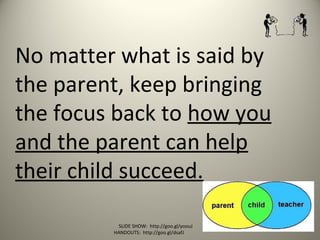
No matter what is said by
the parent, keep bringing
the focus back to how you
and the parent can help
their child succeed.
SLIDE SHOW: http://goo.gl/yoouJ
HANDOUTS: http://goo.gl/dsafJ
Final Thoughts:
• You control the flow of communication with
parents.
• Reach out early to every parent and build
goodwill by pointing out something positive. This
will give you credibility if you have to call for
something negative later.
• Call parents at work for good news.
• You are never alone; just grab me if you need me.
• Positive phone calls are a great investment.
SLIDE SHOW: http://goo.gl/yoouJ
HANDOUTS: http://goo.gl/dsafJ
Two Sculptors
I dreamed I stood in a studio and watched two sculptors there.
The clay they used was a child’s mind,
And they fashioned it with care.
One was a teacher. The tools she used were books, music and art.
One was a parent who worked with a guiding hand and a loving heart.
Day after day the teacher toiled with touch that was deft and sure,
While the parent labored by her side and polished and smoothed it o’er.
And when at last their task was done,
They were proud of what they’d wrought.
For the things they had molded into the child
Could neither be sold or bought.
And each agreed he would have failed
If he had worked alone.
For behind the teacher
Stood the school,
And behind the parent,
The home.
-Author Unknown
SLIDE SHOW: http://goo.gl/yoouJ
HANDOUTS: http://goo.gl/dsafJ

Positive and effective parent communication nto 8 26-13

  • 1.
    Positive and Effective ParentCommunication 8/26/13 D. Adam and C. Turnbull SLIDE SHOW: http://goo.gl/yoouJ HANDOUTS: http://goo.gl/dsafJ
  • 2.
    Objectives: • To identifyand share methods of parent contact • To reinforce the components of effective communication • To share experiences and scenarios that will lead to confidence in communication with parents SLIDE SHOW: http://goo.gl/yoouJ HANDOUTS: http://goo.gl/dsafJ
  • 3.
    Lightning Round: • Brainstorma list of responses to the following questions. You will have 30 second each: • What ways do you communicate with parents? • For what reasons do you communicate with parents? • What issues have you come across or heard about in reference to parent communication? • What is essential to effective, positive communication? SLIDE SHOW: http://goo.gl/yoouJ HANDOUTS: http://goo.gl/dsafJ
  • 4.
    Why involve parents? SLIDESHOW: http://goo.gl/yoouJ HANDOUTS: http://goo.gl/dsafJ
  • 5.
    Parent Involvement: • 86%of the general public believes that support from parents is the most important way to improve schools • When parents are involved students have: – Higher grades, test scores and graduation rates – Better school attendance – Increased motivation & better self-esteem – Lower rates of suspension – Decreased use of drugs and alcohol – Fewer incidents of violent behavior SLIDE SHOW: http://goo.gl/yoouJ HANDOUTS: http://goo.gl/dsafJ
  • 6.
    Parent Involvement: • Familyparticipation in education was TWICE as predictive of students’ academic success as family socioeconomic status. SLIDE SHOW: http://goo.gl/yoouJ HANDOUTS: http://goo.gl/dsafJ
  • 7.
    Why do someparents resist involvement? SLIDE SHOW: http://goo.gl/yoouJ HANDOUTS: http://goo.gl/dsafJ
  • 8.
    Parents may resist involvementbecause: • Fear divulging family conflicts • Panic over child’s possible failure • Guilt over lack of parenting skills • Reluctant to interfere in teacher’s work • Belief that they would not know how to participate in school • Illegal alien issues • Past negative experiences as a student in school SLIDE SHOW: http://goo.gl/yoouJ HANDOUTS: http://goo.gl/dsafJ
  • 9.
    Communication Strategies • Newsletter •Phone calls • Emails • Calendars • Website/ Teacherpages • Response journals • Blogs • Surveys • Standardized forms • Rubrics • Twitter SLIDE SHOW: http://goo.gl/yoouJ HANDOUTS: http://goo.gl/dsafJ
  • 10.
    Effective Communication: • POSITIVE •PERSONALIZED • PROACTIVE • PARTNERSHIP SLIDE SHOW: http://goo.gl/yoouJ HANDOUTS: http://goo.gl/dsafJ
  • 11.
    POSITIVE • Start communicatingat the beginning of the year before you need parents’ help. • Begin and end every conversation with something positive about the student. • Remember that each parent’s child is the most important child to him or her. SLIDE SHOW: http://goo.gl/yoouJ HANDOUTS: http://goo.gl/dsafJ
  • 12.
    Personalized • Make personalizedphone calls home as soon as possible. • Jot quick personal notes on letters home. • Write quick notes in students’ assignment books, folders, etc. SLIDE SHOW: http://goo.gl/yoouJ HANDOUTS: http://goo.gl/dsafJ
  • 13.
    PROACTIVE • Keep parentsinformed. • Give plenty of notice for special assignments and events. • Let parents know immediately when you have concerns. • Work together to prevent problems from developing. SLIDE SHOW: http://goo.gl/yoouJ HANDOUTS: http://goo.gl/dsafJ
  • 14.
    PARTNERSHIP • Utilize parentsas the premier expert on their own child. • When problems arise, ask for their suggestions and ideas (including what works at home). • Encourage parents to respond to your notes by leaving a comments/questions space. SLIDE SHOW: http://goo.gl/yoouJ HANDOUTS: http://goo.gl/dsafJ
  • 15.
    COMMUNICATION DOs and DON’Ts: DOs: •Send positive messages to parents. • Show respect in your body language and words. • Contact parents at the 1st sign of problems. • Develop contacts and identify personnel and other community agencies that can provide support and services to families. • Identify personnel who can translate. • Develop a class website. DON’Ts: • Contact parent only when there is a problem. • Talk down to parent. • Contact parent only after a problem has gotten out of hand. • Contact parent when you do not have a plan of action. • Send information only in English when parents speak other languages. • Blame parents . • Expect parents to do most of the teaching. SLIDE SHOW: http://goo.gl/yoouJ HANDOUTS: http://goo.gl/dsafJ
  • 16.
    Basic Communication Skills: •Listen Actively – Body posture – Eye contact – Facial expression • Use Verbal and Non-Verbal Encouragers • Minimize Distractions • Focus on CONTENT of verbal statements • Focus on the person’s FEELINGS – Tune into the person’s voice – Tune into the person’s non-verbal behavior SLIDE SHOW: http://goo.gl/yoouJ HANDOUTS: http://goo.gl/dsafJ
  • 17.
    Basic Communication Skills: •REFLECTIVE STATEMENTS: – Paraphrase speakers words – Reflect the speakers emotions – Pause at least 5 seconds after making a reflective statement • ASK QUESTIONS: – Open Ended: » “What would you like to discuss today?” » “What do you think about that?” – Closed-Ended: » “Do you agree with the proposed solution?” » “How many times has that happened?” SLIDE SHOW: http://goo.gl/yoouJ HANDOUTS: http://goo.gl/dsafJ
  • 18.
    Basic Communication Skills: –Indirect Questions » “I wonder how often this has happened?” » “I wonder what might have caused this behavior?” – Clarifying Questions » “You’ve stated that John has a bad attitude. What does he say or do that indicates to you that he has a bad attitude?” » “What’s an example of how Jane reacts when you tell her NO?” SLIDE SHOW: http://goo.gl/yoouJ HANDOUTS: http://goo.gl/dsafJ
  • 19.
    Basic Communication Skills: •SUMMARIZING – How To Summarize: – Begin with a phrase that introduces the summary » “Let’s go over what we have discussed so far.” » “Let’s review our next-steps.” – Make the summarizing statement – Ask the person to confirm or reject the summarizing statement » “Did I include everything?” – Listen Actively – If necessary, ask the person to correct the summarizing statement » “What have I omitted?” SLIDE SHOW: http://goo.gl/yoouJ HANDOUTS: http://goo.gl/dsafJ
  • 20.
    5 Guidelines forMore Effective Communication: By Cathy Abraham • Understand your intent or goal • Say what you mean • Use I statements • Listen for content, feeling, and intent • Check for understanding SLIDE SHOW: http://goo.gl/yoouJ HANDOUTS: http://goo.gl/dsafJ
  • 21.
    I Statements • Istatements tend to: – Place responsibility w/ you, the speaker – Clarify your position, feelings or opinions – Build trust by giving others information about yourself – Be less threatening • You statements tend to: – Elicit a negative or defensive response – Place blame or put people down – Come off as being accusatory or preachy “I couldn’t understand what you said.” / “You didn’t make any sense.” “I missed having your input at the meeting.” / “You didn’t care enough to come to the meeting.” SLIDE SHOW: http://goo.gl/yoouJ HANDOUTS: http://goo.gl/dsafJ
  • 22.
    10 Guidelines forCommunicating w/ Families: 1. Don’t assume that you know more about the child, his/her needs, and how those needs should be met than his/her parents do. 2. Junk the jargon. 3. Don’t let assumptions and generalizations about parents and families guide your efforts. 4. Be sensitive and responsive to the cultural and linguistic backgrounds of parents and families. 5. Don’t be defensive or intimidated. 6. Refer families to other professionals when needed. 7. Help parents strive for a realistic optimism. 8. Start with something parents can be successful with. 9. Respect a parent’s right to say “No.” 10. Don’t be afraid to say “I don’t know.” SLIDE SHOW: http://goo.gl/yoouJ HANDOUTS: http://goo.gl/dsafJ
  • 23.
    Don’t Forget toListen: “I used to want to interrupt and explain and justify or defend – which only made people more upset. I’ve learned that letting an upset person feel heard, not interrupting, restating what they’ve said and allowing them plenty of time to get it off their chest goes a long way toward letting the problem resolve itself. I’ve also seen that people will often accept a decision or an outcome contrary to what they wanted originally if they believe their point of view was listened to respectfully and taken into consideration.” Lolli Haws (principal)SLIDE SHOW: http://goo.gl/yoouJ HANDOUTS: http://goo.gl/dsafJ
  • 24.
    WHAT DO YOUDO WHEN THINGS GO WRONG? FACTS: • Dissatisfied customers will tell as many as 16 people about a bad experience • Only 4% of unhappy customers bother to complain. For every complaint we hear, 24 complaints are communicated to others, but not to us. • In the eyes of a customer, it takes 12 positive incidents to make up for one negative one. SLIDE SHOW: http://goo.gl/yoouJ HANDOUTS: http://goo.gl/dsafJ
  • 25.
    BUT, Goodwill canbe recovered! FACTS: • 54-70% of customers who complain will do business w/ you again if their complaint is resolved • 95% will do business w/ you again if their complaint is resolved quickly SLIDE SHOW: http://goo.gl/yoouJ HANDOUTS: http://goo.gl/dsafJ
  • 26.
    10 Tips forHandling Complaints: 1. Get into the present. Focus your attention on the customer. 2. Clear your mind of any preconceived notions or assumptions about the customer or the problem. 3. Open your ears and listen. Don’t jump to conclusions or speak for the customer. 4. Ask questions that focus on problem solving. 5. When responding to the customer, don’t use jargon or language that intimidates. 6. Acknowledge that you understand what the customer is saying and what he/she is feeling. 7. Be honest. Don’t make excuses or be defensive. 8. Work out a mutually beneficial plan of action 9. Be sure to follow through on promises in a timely manner. 10. Thank the customer for bringing the complaint to you. 2012 NSPRASLIDE SHOW: http://goo.gl/yoouJ HANDOUTS: http://goo.gl/dsafJ
  • 27.
    No matter whatis said by the parent, keep bringing the focus back to how you and the parent can help their child succeed. SLIDE SHOW: http://goo.gl/yoouJ HANDOUTS: http://goo.gl/dsafJ
  • 28.
    Final Thoughts: • Youcontrol the flow of communication with parents. • Reach out early to every parent and build goodwill by pointing out something positive. This will give you credibility if you have to call for something negative later. • Call parents at work for good news. • You are never alone; just grab me if you need me. • Positive phone calls are a great investment. SLIDE SHOW: http://goo.gl/yoouJ HANDOUTS: http://goo.gl/dsafJ
  • 29.
    Two Sculptors I dreamedI stood in a studio and watched two sculptors there. The clay they used was a child’s mind, And they fashioned it with care. One was a teacher. The tools she used were books, music and art. One was a parent who worked with a guiding hand and a loving heart. Day after day the teacher toiled with touch that was deft and sure, While the parent labored by her side and polished and smoothed it o’er. And when at last their task was done, They were proud of what they’d wrought. For the things they had molded into the child Could neither be sold or bought. And each agreed he would have failed If he had worked alone. For behind the teacher Stood the school, And behind the parent, The home. -Author Unknown SLIDE SHOW: http://goo.gl/yoouJ HANDOUTS: http://goo.gl/dsafJ

Editor's Notes

  • #2 http://goo.gl/yoouJ
  • #3 http://goo.gl/yoouJ