CYTOGENETICS
BIOT – 852
MEDICAL BIOTECHNOLOGY
TOPIC
INTRODUCTION TO CYTOGENETICS
ORGANIZATION OF THE LECTURE
Definition and
principles
•Tools
•Applications of
cytogenetic analyses
–Diagnostic
–Prognostic
–Pathogenetic and
Therapeutic
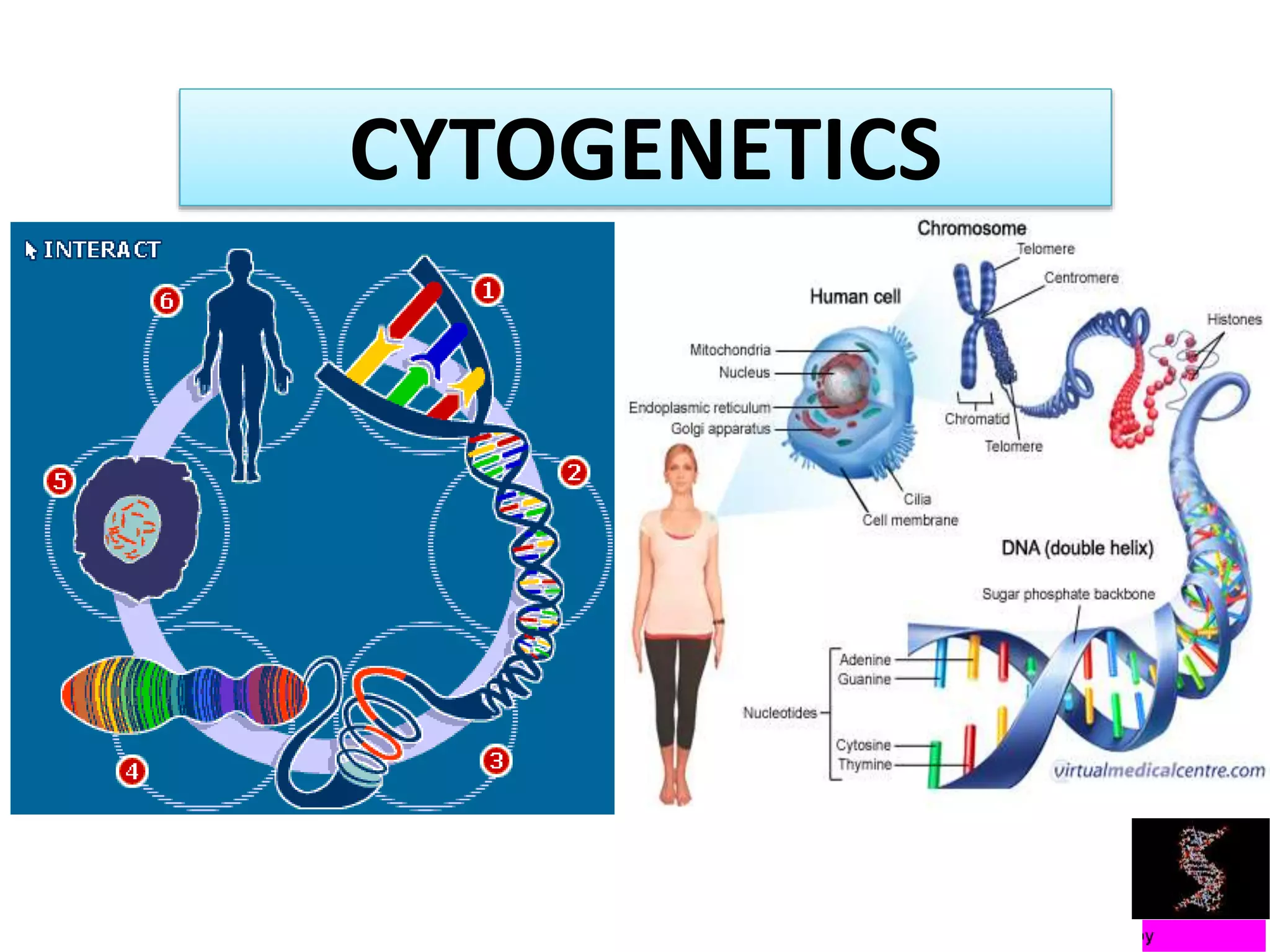
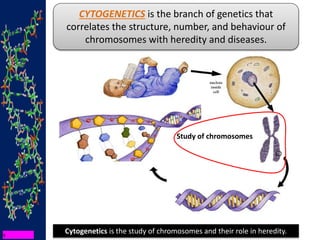
Cytogenetics is the study of chromosomes and their role in heredity.
CYTOGENETICS is the branch of genetics that
correlates the structure, number, and behaviour of
chromosomes with heredity and diseases.
Study of chromosomes
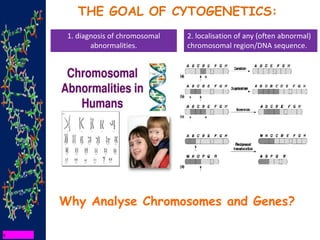
THE GOAL OF CYTOGENETICS:
1. diagnosis of chromosomal
abnormalities.
2. localisation of any (often abnormal)
chromosomal region/DNA sequence.
Why Analyse Chromosomes and Genes?
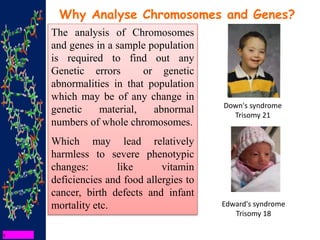
The analysis of Chromosomes
and genes in a sample population
is required to find out any
Genetic errors or genetic
abnormalities in that population
which may be of any change in
genetic material, abnormal
numbers of whole chromosomes.
Which may lead relatively
harmless to severe phenotypic
changes: like vitamin
deficiencies and food allergies to
cancer, birth defects and infant
mortality etc.
Why Analyse Chromosomes and Genes?
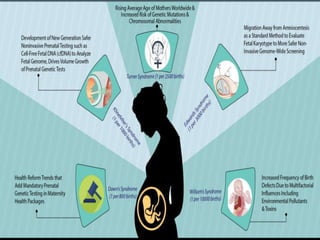
Down's syndrome
Trisomy 21
Edward's syndrome
Trisomy 18
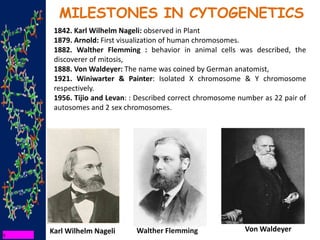
MILESTONES IN CYTOGENETICS
1842. Karl Wilhelm Nageli: observed in Plant
1879. Arnold: First visualization of human chromosomes.
1882. Walther Flemming : behavior in animal cells was described, the
discoverer of mitosis,
1888. Von Waldeyer: The name was coined by German anatomist,
1921. Winiwarter & Painter: Isolated X chromosome & Y chromosome
respectively.
1956. Tijio and Levan: : Described correct chromosome number as 22 pair of
autosomes and 2 sex chromosomes.
Karl Wilhelm Nageli Walther Flemming Von Waldeyer
BASIC CYTOGENETIC TERMS
CHROMOSOME:
CHROMATIN
KARYOTYPE
IDEOGRAMS
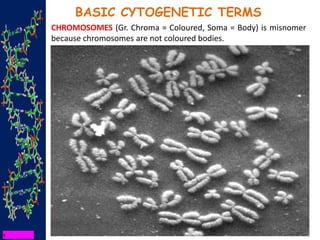
BASIC CYTOGENETIC TERMS
CHROMOSOMES (Gr. Chroma = Coloured, Soma = Body) is misnomer
because chromosomes are not coloured bodies.
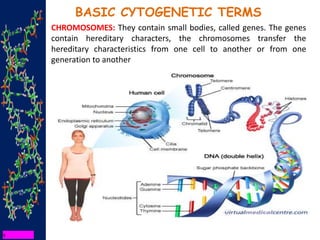
BASIC CYTOGENETIC TERMS
CHROMOSOMES: They contain small bodies, called genes. The genes
contain hereditary characters, the chromosomes transfer the
hereditary characteristics from one cell to another or from one
generation to another
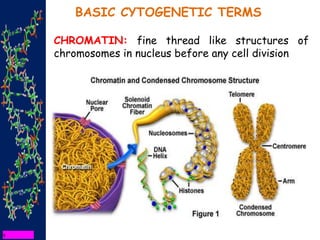
CHROMATIN: fine thread like structures of
chromosomes in nucleus before any cell division
BASIC CYTOGENETIC TERMS
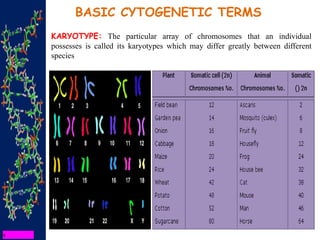
KARYOTYPE: The particular array of chromosomes that an individual
possesses is called its karyotypes which may differ greatly between different
species
BASIC CYTOGENETIC TERMS
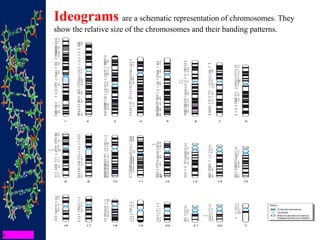
Ideograms are a schematic representation of chromosomes. They
show the relative size of the chromosomes and their banding patterns.
CHROMOSOMES
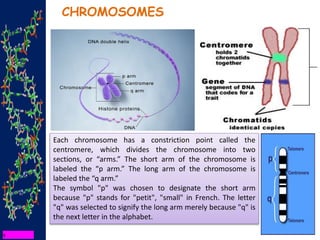
Each chromosome has a constriction point called the
centromere, which divides the chromosome into two
sections, or “arms.” The short arm of the chromosome is
labeled the “p arm.” The long arm of the chromosome is
labeled the “q arm.”
The symbol "p" was chosen to designate the short arm
because "p" stands for "petit", "small" in French. The letter
"q" was selected to signify the long arm merely because "q" is
the next letter in the alphabet.
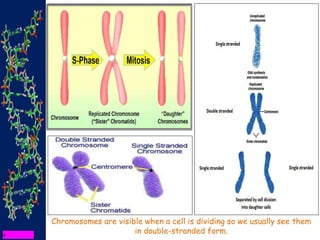
Chromosomes are visible when a cell is dividing so we usually see them
in double-stranded form.
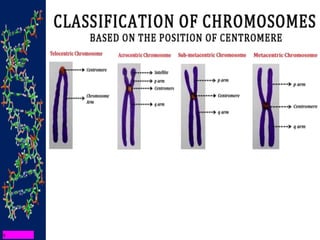
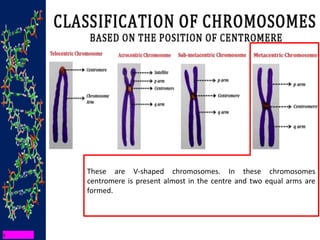
These are V-shaped chromosomes. In these chromosomes
centromere is present almost in the centre and two equal arms are
formed.
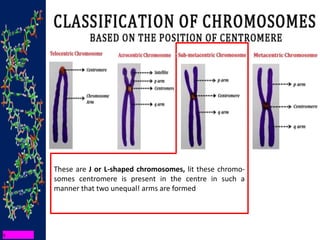
These are J or L-shaped chromosomes, lit these chromo-
somes centromere is present in the centre in such a
manner that two unequal! arms are formed
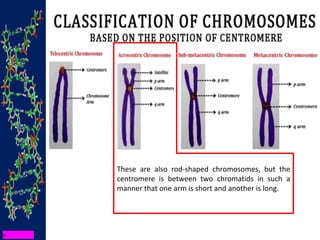
These are also rod-shaped chromosomes, but the
centromere is between two chromatids in such a
manner that one arm is short and another is long.
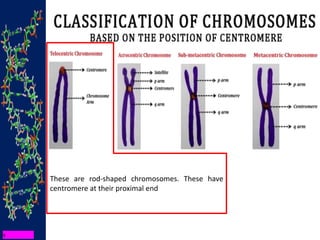
These are rod-shaped chromosomes. These have
centromere at their proximal end
KINDS OF CHROMOSOMES
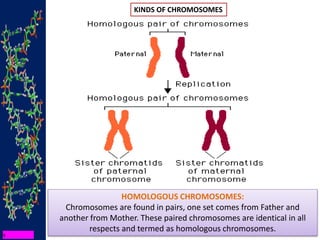
HOMOLOGOUS CHROMOSOMES:
Chromosomes are found in pairs, one set comes from Father and
another from Mother. These paired chromosomes are identical in all
respects and termed as homologous chromosomes.
KINDS OF CHROMOSOMES
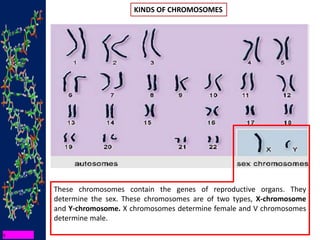
These chromosomes contain the genes of reproductive organs. They
determine the sex. These chromosomes are of two types, X-chromosome
and Y-chromosome. X chromosomes determine female and V chromosomes
determine male.
KINDS OF CHROMOSOMES
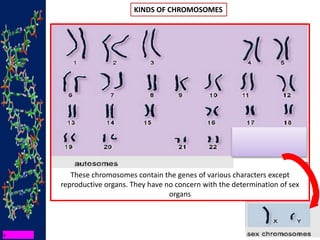
These chromosomes contain the genes of various characters except
reproductive organs. They have no concern with the determination of sex
organs
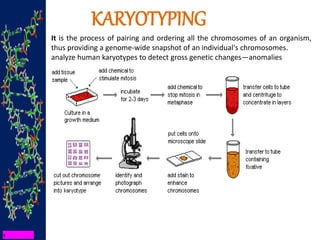
KARYOTYPING
It is the process of pairing and ordering all the chromosomes of an organism,
thus providing a genome-wide snapshot of an individual's chromosomes.
analyze human karyotypes to detect gross genetic changes—anomalies
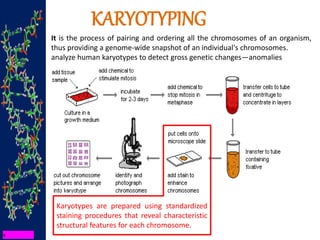
KARYOTYPING
It is the process of pairing and ordering all the chromosomes of an organism,
thus providing a genome-wide snapshot of an individual's chromosomes.
analyze human karyotypes to detect gross genetic changes—anomalies
Karyotypes are prepared using standardized
staining procedures that reveal characteristic
structural features for each chromosome.
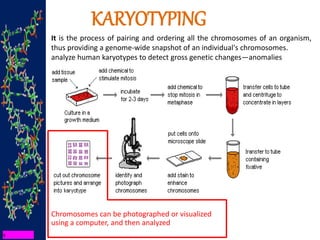
KARYOTYPING
It is the process of pairing and ordering all the chromosomes of an organism,
thus providing a genome-wide snapshot of an individual's chromosomes.
analyze human karyotypes to detect gross genetic changes—anomalies
Chromosomes can be photographed or visualized
using a computer, and then analyzed
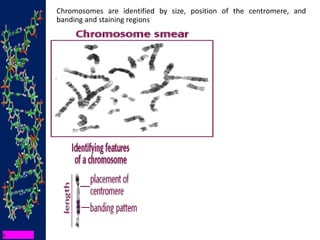
Chromosomes are identified by size, position of the centromere, and
banding and staining regions
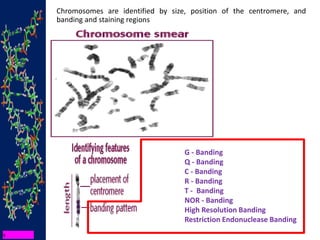
Chromosomes are identified by size, position of the centromere, and
banding and staining regions
G - Banding
Q - Banding
C - Banding
R - Banding
T - Banding
NOR - Banding
High Resolution Banding
Restriction Endonuclease Banding
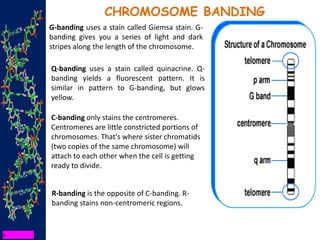
CHROMOSOME BANDING
G-banding uses a stain called Giemsa stain. G-
banding gives you a series of light and dark
stripes along the length of the chromosome.
Q-banding uses a stain called quinacrine. Q-
banding yields a fluorescent pattern. It is
similar in pattern to G-banding, but glows
yellow.
C-banding only stains the centromeres.
Centromeres are little constricted portions of
chromosomes. That's where sister chromatids
(two copies of the same chromosome) will
attach to each other when the cell is getting
ready to divide.
R-banding is the opposite of C-banding. R-
banding stains non-centromeric regions.
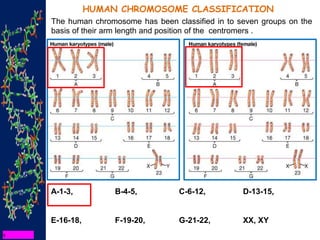
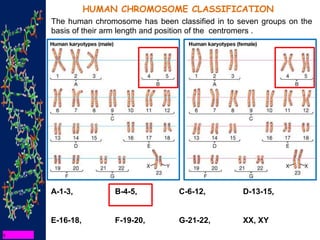
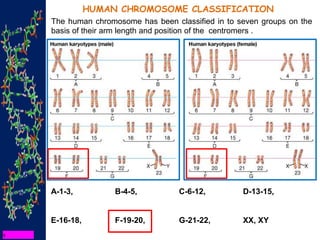
HUMAN CHROMOSOME CLASSIFICATION
The human chromosome has been classified in to seven groups on the
basis of their arm length and position of the centromers .
A-1-3, B-4-5, C-6-12, D-13-15,
E-16-18, F-19-20, G-21-22, XX, XY
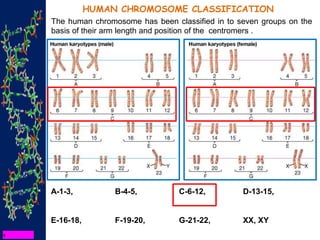
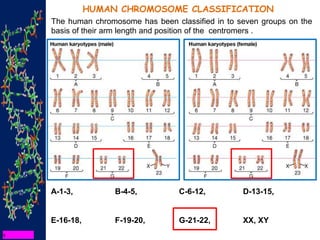
HUMAN CHROMOSOME CLASSIFICATION
The human chromosome has been classified in to seven groups on the
basis of their arm length and position of the centromers .
A-1-3, B-4-5, C-6-12, D-13-15,
E-16-18, F-19-20, G-21-22, XX, XY
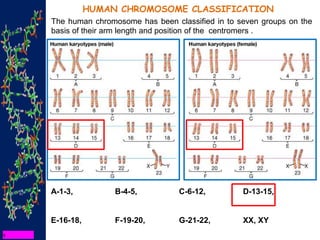
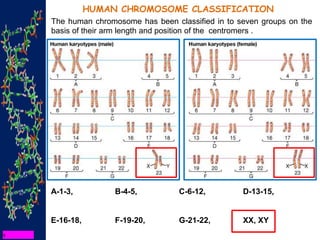
HUMAN CHROMOSOME CLASSIFICATION
The human chromosome has been classified in to seven groups on the
basis of their arm length and position of the centromers .
A-1-3, B-4-5, C-6-12, D-13-15,
E-16-18, F-19-20, G-21-22, XX, XY
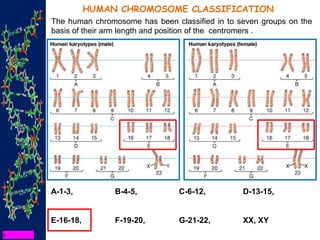
HUMAN CHROMOSOME CLASSIFICATION
The human chromosome has been classified in to seven groups on the
basis of their arm length and position of the centromers .
A-1-3, B-4-5, C-6-12, D-13-15,
E-16-18, F-19-20, G-21-22, XX, XY
HUMAN CHROMOSOME CLASSIFICATION
The human chromosome has been classified in to seven groups on the
basis of their arm length and position of the centromers .
A-1-3, B-4-5, C-6-12, D-13-15,
E-16-18, F-19-20, G-21-22, XX, XY
HUMAN CHROMOSOME CLASSIFICATION
The human chromosome has been classified in to seven groups on the
basis of their arm length and position of the centromers .
A-1-3, B-4-5, C-6-12, D-13-15,
E-16-18, F-19-20, G-21-22, XX, XY
HUMAN CHROMOSOME CLASSIFICATION
The human chromosome has been classified in to seven groups on the
basis of their arm length and position of the centromers .
A-1-3, B-4-5, C-6-12, D-13-15,
E-16-18, F-19-20, G-21-22, XX, XY
HUMAN CHROMOSOME CLASSIFICATION
The human chromosome has been classified in to seven groups on the
basis of their arm length and position of the centromers .
A-1-3, B-4-5, C-6-12, D-13-15,
E-16-18, F-19-20, G-21-22, XX, XY
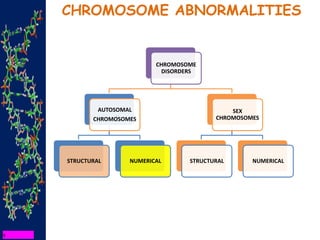
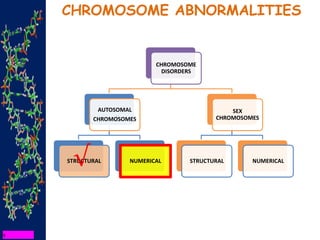
CHROMOSOME ABNORMALITIES
CHROMOSOME
DISORDERS
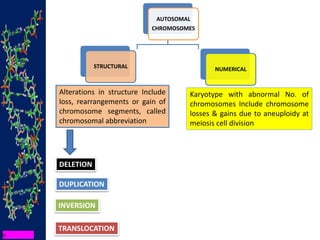
AUTOSOMAL
CHROMOSOMES
STRUCTURAL NUMERICAL
SEX
CHROMOSOMES
STRUCTURAL NUMERICAL
AUTOSOMAL
CHROMOSOMES
STRUCTURAL NUMERICAL
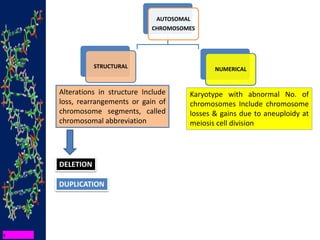
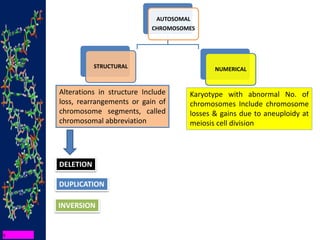
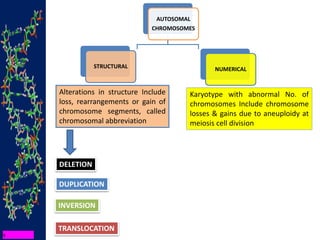
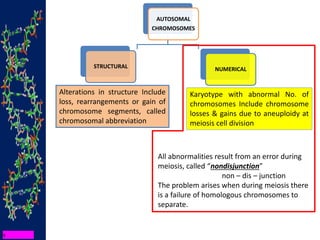
Alterations in structure Include
loss, rearrangements or gain of
chromosome segments, called
chromosomal abbreviation
Karyotype with abnormal No. of
chromosomes Include chromosome
losses & gains due to aneuploidy at
meiosis cell division
DELETION
DUPLICATION
TRANSLOCATION
INVERSION
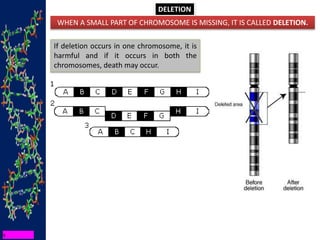
DELETION
WHEN A SMALL PART OF CHROMOSOME IS MISSING, IT IS CALLED DELETION.
If deletion occurs in one chromosome, it is
harmful and if it occurs in both the
chromosomes, death may occur.
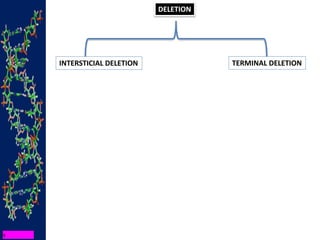
DELETION
INTERSTICIAL DELETION TERMINAL DELETION
DELETION
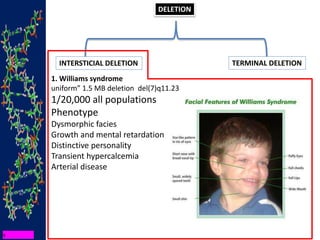
INTERSTICIAL DELETION TERMINAL DELETION
1. Williams syndrome
uniform” 1.5 MB deletion del(7)q11.23
1/20,000 all populations
Phenotype
Dysmorphic facies
Growth and mental retardation
Distinctive personality
Transient hypercalcemia
Arterial disease
DELETION
INTERSTICIAL DELETION TERMINAL DELETION
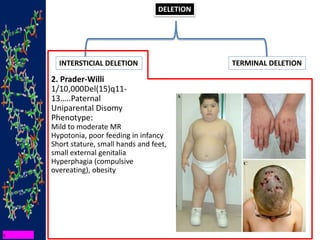
2. Prader-Willi
1/10,000Del(15)q11-
13…..Paternal
Uniparental Disomy
Phenotype:
Mild to moderate MR
Hypotonia, poor feeding in infancy
Short stature, small hands and feet,
small external genitalia
Hyperphagia (compulsive
overeating), obesity
DELETION
INTERSTICIAL DELETION TERMINAL DELETION
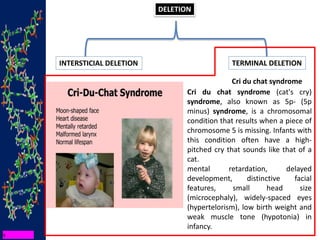
Cri du chat syndrome
Cri du chat syndrome (cat's cry)
syndrome, also known as 5p- (5p
minus) syndrome, is a chromosomal
condition that results when a piece of
chromosome 5 is missing. Infants with
this condition often have a high-
pitched cry that sounds like that of a
cat.
mental retardation, delayed
development, distinctive facial
features, small head size
(microcephaly), widely-spaced eyes
(hypertelorism), low birth weight and
weak muscle tone (hypotonia) in
infancy.
AUTOSOMAL
CHROMOSOMES
STRUCTURAL NUMERICAL
Alterations in structure Include
loss, rearrangements or gain of
chromosome segments, called
chromosomal abbreviation
Karyotype with abnormal No. of
chromosomes Include chromosome
losses & gains due to aneuploidy at
meiosis cell division
DELETION
DUPLICATION
DUPLICATION
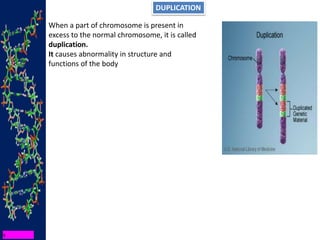
When a part of chromosome is present in
excess to the normal chromosome, it is called
duplication.
It causes abnormality in structure and
functions of the body
AUTOSOMAL
CHROMOSOMES
STRUCTURAL NUMERICAL
Alterations in structure Include
loss, rearrangements or gain of
chromosome segments, called
chromosomal abbreviation
Karyotype with abnormal No. of
chromosomes Include chromosome
losses & gains due to aneuploidy at
meiosis cell division
DELETION
DUPLICATION
INVERSION
INVERSION
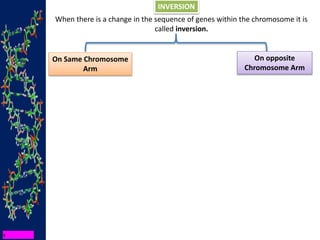
When there is a change in the sequence of genes within the chromosome it is
called inversion.
On Same Chromosome
Arm
On opposite
Chromosome Arm
INVERSION
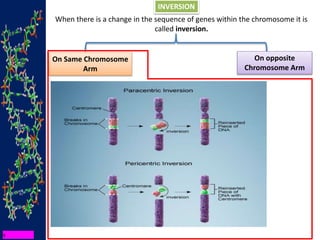
When there is a change in the sequence of genes within the chromosome it is
called inversion.
On Same Chromosome
Arm
On opposite
Chromosome Arm
INVERSION
When there is a change in the sequence of genes within the chromosome it is
called inversion.
On Same Chromosome
Arm
On opposite
Chromosomal Arm
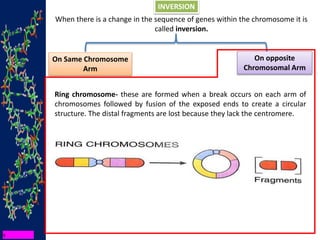
Ring chromosome- these are formed when a break occurs on each arm of
chromosomes followed by fusion of the exposed ends to create a circular
structure. The distal fragments are lost because they lack the centromere.
INVERSION
When there is a change in the sequence of genes within the chromosome it is
called inversion.
On Same Chromosome
Arm
On opposite
Chromosome Arm
AUTOSOMAL
CHROMOSOMES
STRUCTURAL NUMERICAL
Alterations in structure Include
loss, rearrangements or gain of
chromosome segments, called
chromosomal abbreviation
Karyotype with abnormal No. of
chromosomes Include chromosome
losses & gains due to aneuploidy at
meiosis cell division
DELETION
DUPLICATION
TRANSLOCATION
INVERSION
TRANSLOCATION
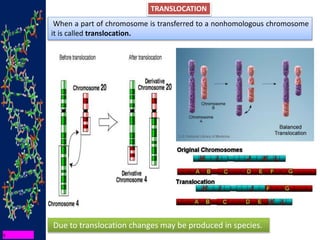
Due to translocation changes may be produced in species.
When a part of chromosome is transferred to a nonhomologous chromosome
it is called translocation.
TRANSLOCATION
Reciprocal
Translocation
Robertson
Translocation
CHROMOSOME ABNORMALITIES
CHROMOSOME
DISORDERS
AUTOSOMAL
CHROMOSOMES
STRUCTURAL NUMERICAL
SEX
CHROMOSOMES
STRUCTURAL NUMERICAL
√
AUTOSOMAL
CHROMOSOMES
STRUCTURAL NUMERICAL
Alterations in structure Include
loss, rearrangements or gain of
chromosome segments, called
chromosomal abbreviation
Karyotype with abnormal No. of
chromosomes Include chromosome
losses & gains due to aneuploidy at
meiosis cell division
All abnormalities result from an error during
meiosis, called “nondisjunction”
non – dis – junction
The problem arises when during meiosis there
is a failure of homologous chromosomes to
separate.
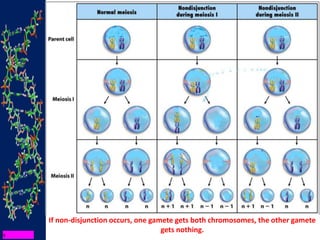
If non-disjunction occurs, one gamete gets both chromosomes, the other gamete
gets nothing.
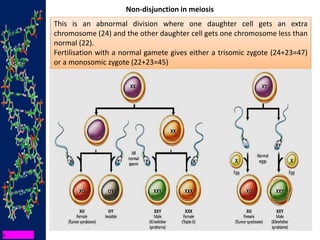
Non-disjunction in meiosis
This is an abnormal division where one daughter cell gets an extra
chromosome (24) and the other daughter cell gets one chromosome less than
normal (22).
Fertilisation with a normal gamete gives either a trisomic zygote (24+23=47)
or a monosomic zygote (22+23=45)
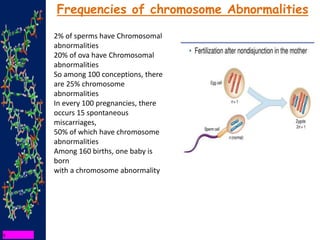
2% of sperms have Chromosomal
abnormalities
20% of ova have Chromosomal
abnormalities
So among 100 conceptions, there
are 25% chromosome
abnormalities
In every 100 pregnancies, there
occurs 15 spontaneous
miscarriages,
50% of which have chromosome
abnormalities
Among 160 births, one baby is
born
with a chromosome abnormality
Frequencies of chromosome Abnormalities
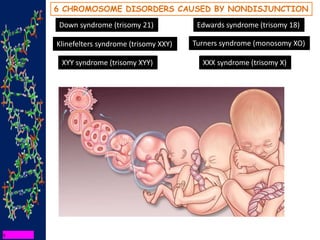
6 CHROMOSOME DISORDERS CAUSED BY NONDISJUNCTION
Down syndrome (trisomy 21) Edwards syndrome (trisomy 18)
Klinefelters syndrome (trisomy XXY)
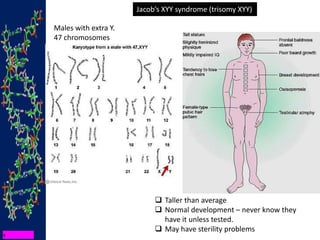
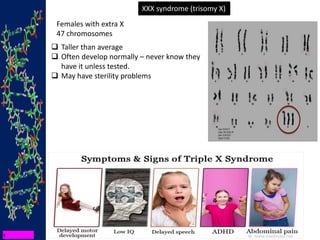
XYY syndrome (trisomy XYY) XXX syndrome (trisomy X)
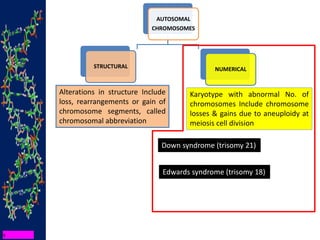
Turners syndrome (monosomy XO)
AUTOSOMAL
CHROMOSOMES
STRUCTURAL NUMERICAL
Alterations in structure Include
loss, rearrangements or gain of
chromosome segments, called
chromosomal abbreviation
Karyotype with abnormal No. of
chromosomes Include chromosome
losses & gains due to aneuploidy at
meiosis cell division
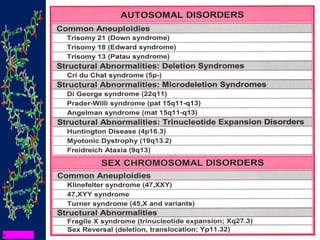
Down syndrome (trisomy 21)
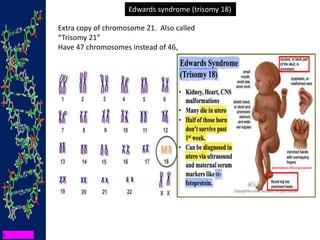
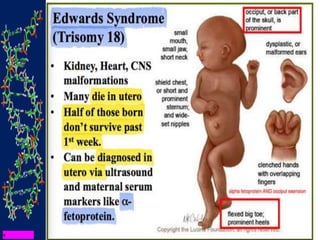
Edwards syndrome (trisomy 18)
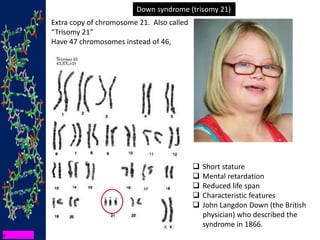
Extra copy of chromosome 21. Also called
“Trisomy 21”
Have 47 chromosomes instead of 46,
Down syndrome (trisomy 21)
 Short stature
 Mental retardation
 Reduced life span
 Characteristic features
 John Langdon Down (the British
physician) who described the
syndrome in 1866.
Edwards syndrome (trisomy 18)
Extra copy of chromosome 21. Also called
“Trisomy 21”
Have 47 chromosomes instead of 46,
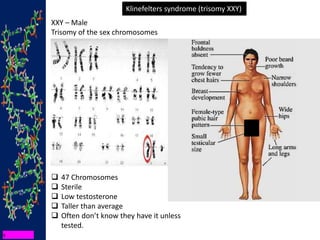
Klinefelters syndrome (trisomy XXY)
XXY – Male
Trisomy of the sex chromosomes
 47 Chromosomes
 Sterile
 Low testosterone
 Taller than average
 Often don’t know they have it unless
tested.
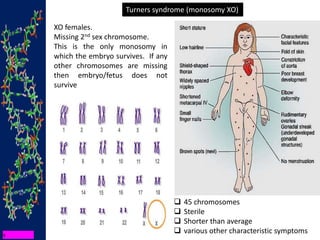
Turners syndrome (monosomy XO)
 45 chromosomes
 Sterile
 Shorter than average
 various other characteristic symptoms
XO females.
Missing 2nd sex chromosome.
This is the only monosomy in
which the embryo survives. If any
other chromosomes are missing
then embryo/fetus does not
survive
Jacob’s XYY syndrome (trisomy XYY)
 Taller than average
 Normal development – never know they
have it unless tested.
 May have sterility problems
Males with extra Y.
47 chromosomes
XXX syndrome (trisomy X)
 Taller than average
 Often develop normally – never know they
have it unless tested.
 May have sterility problems
Females with extra X
47 chromosomes
CHAPTER 6
COMPLETED
THANK YOU VERY MUCH

Introduction to Basic Cytogenetics by Tanzeel Rehman

  • 1.
  • 2.
    BIOT – 852 MEDICALBIOTECHNOLOGY TOPIC INTRODUCTION TO CYTOGENETICS
  • 3.
    ORGANIZATION OF THELECTURE Definition and principles •Tools •Applications of cytogenetic analyses –Diagnostic –Prognostic –Pathogenetic and Therapeutic
  • 4.
    Cytogenetics is thestudy of chromosomes and their role in heredity. CYTOGENETICS is the branch of genetics that correlates the structure, number, and behaviour of chromosomes with heredity and diseases. Study of chromosomes
  • 5.
    THE GOAL OFCYTOGENETICS: 1. diagnosis of chromosomal abnormalities. 2. localisation of any (often abnormal) chromosomal region/DNA sequence. Why Analyse Chromosomes and Genes?
  • 6.
    The analysis ofChromosomes and genes in a sample population is required to find out any Genetic errors or genetic abnormalities in that population which may be of any change in genetic material, abnormal numbers of whole chromosomes. Which may lead relatively harmless to severe phenotypic changes: like vitamin deficiencies and food allergies to cancer, birth defects and infant mortality etc. Why Analyse Chromosomes and Genes? Down's syndrome Trisomy 21 Edward's syndrome Trisomy 18
  • 8.
    MILESTONES IN CYTOGENETICS 1842.Karl Wilhelm Nageli: observed in Plant 1879. Arnold: First visualization of human chromosomes. 1882. Walther Flemming : behavior in animal cells was described, the discoverer of mitosis, 1888. Von Waldeyer: The name was coined by German anatomist, 1921. Winiwarter & Painter: Isolated X chromosome & Y chromosome respectively. 1956. Tijio and Levan: : Described correct chromosome number as 22 pair of autosomes and 2 sex chromosomes. Karl Wilhelm Nageli Walther Flemming Von Waldeyer
  • 9.
  • 10.
    BASIC CYTOGENETIC TERMS CHROMOSOMES(Gr. Chroma = Coloured, Soma = Body) is misnomer because chromosomes are not coloured bodies.
  • 11.
    BASIC CYTOGENETIC TERMS CHROMOSOMES:They contain small bodies, called genes. The genes contain hereditary characters, the chromosomes transfer the hereditary characteristics from one cell to another or from one generation to another
  • 12.
    CHROMATIN: fine threadlike structures of chromosomes in nucleus before any cell division BASIC CYTOGENETIC TERMS
  • 13.
    KARYOTYPE: The particulararray of chromosomes that an individual possesses is called its karyotypes which may differ greatly between different species BASIC CYTOGENETIC TERMS
  • 14.
    Ideograms are aschematic representation of chromosomes. They show the relative size of the chromosomes and their banding patterns.
  • 15.
    CHROMOSOMES Each chromosome hasa constriction point called the centromere, which divides the chromosome into two sections, or “arms.” The short arm of the chromosome is labeled the “p arm.” The long arm of the chromosome is labeled the “q arm.” The symbol "p" was chosen to designate the short arm because "p" stands for "petit", "small" in French. The letter "q" was selected to signify the long arm merely because "q" is the next letter in the alphabet.
  • 16.
    Chromosomes are visiblewhen a cell is dividing so we usually see them in double-stranded form.
  • 18.
    These are V-shapedchromosomes. In these chromosomes centromere is present almost in the centre and two equal arms are formed.
  • 19.
    These are Jor L-shaped chromosomes, lit these chromo- somes centromere is present in the centre in such a manner that two unequal! arms are formed
  • 20.
    These are alsorod-shaped chromosomes, but the centromere is between two chromatids in such a manner that one arm is short and another is long.
  • 21.
    These are rod-shapedchromosomes. These have centromere at their proximal end
  • 22.
    KINDS OF CHROMOSOMES HOMOLOGOUSCHROMOSOMES: Chromosomes are found in pairs, one set comes from Father and another from Mother. These paired chromosomes are identical in all respects and termed as homologous chromosomes.
  • 23.
    KINDS OF CHROMOSOMES Thesechromosomes contain the genes of reproductive organs. They determine the sex. These chromosomes are of two types, X-chromosome and Y-chromosome. X chromosomes determine female and V chromosomes determine male.
  • 24.
    KINDS OF CHROMOSOMES Thesechromosomes contain the genes of various characters except reproductive organs. They have no concern with the determination of sex organs
  • 25.
    KARYOTYPING It is theprocess of pairing and ordering all the chromosomes of an organism, thus providing a genome-wide snapshot of an individual's chromosomes. analyze human karyotypes to detect gross genetic changes—anomalies
  • 26.
    KARYOTYPING It is theprocess of pairing and ordering all the chromosomes of an organism, thus providing a genome-wide snapshot of an individual's chromosomes. analyze human karyotypes to detect gross genetic changes—anomalies Karyotypes are prepared using standardized staining procedures that reveal characteristic structural features for each chromosome.
  • 27.
    KARYOTYPING It is theprocess of pairing and ordering all the chromosomes of an organism, thus providing a genome-wide snapshot of an individual's chromosomes. analyze human karyotypes to detect gross genetic changes—anomalies Chromosomes can be photographed or visualized using a computer, and then analyzed
  • 28.
    Chromosomes are identifiedby size, position of the centromere, and banding and staining regions
  • 29.
    Chromosomes are identifiedby size, position of the centromere, and banding and staining regions G - Banding Q - Banding C - Banding R - Banding T - Banding NOR - Banding High Resolution Banding Restriction Endonuclease Banding
  • 30.
    CHROMOSOME BANDING G-banding usesa stain called Giemsa stain. G- banding gives you a series of light and dark stripes along the length of the chromosome. Q-banding uses a stain called quinacrine. Q- banding yields a fluorescent pattern. It is similar in pattern to G-banding, but glows yellow. C-banding only stains the centromeres. Centromeres are little constricted portions of chromosomes. That's where sister chromatids (two copies of the same chromosome) will attach to each other when the cell is getting ready to divide. R-banding is the opposite of C-banding. R- banding stains non-centromeric regions.
  • 31.
    HUMAN CHROMOSOME CLASSIFICATION Thehuman chromosome has been classified in to seven groups on the basis of their arm length and position of the centromers . A-1-3, B-4-5, C-6-12, D-13-15, E-16-18, F-19-20, G-21-22, XX, XY
  • 32.
    HUMAN CHROMOSOME CLASSIFICATION Thehuman chromosome has been classified in to seven groups on the basis of their arm length and position of the centromers . A-1-3, B-4-5, C-6-12, D-13-15, E-16-18, F-19-20, G-21-22, XX, XY
  • 33.
    HUMAN CHROMOSOME CLASSIFICATION Thehuman chromosome has been classified in to seven groups on the basis of their arm length and position of the centromers . A-1-3, B-4-5, C-6-12, D-13-15, E-16-18, F-19-20, G-21-22, XX, XY
  • 34.
    HUMAN CHROMOSOME CLASSIFICATION Thehuman chromosome has been classified in to seven groups on the basis of their arm length and position of the centromers . A-1-3, B-4-5, C-6-12, D-13-15, E-16-18, F-19-20, G-21-22, XX, XY
  • 35.
    HUMAN CHROMOSOME CLASSIFICATION Thehuman chromosome has been classified in to seven groups on the basis of their arm length and position of the centromers . A-1-3, B-4-5, C-6-12, D-13-15, E-16-18, F-19-20, G-21-22, XX, XY
  • 36.
    HUMAN CHROMOSOME CLASSIFICATION Thehuman chromosome has been classified in to seven groups on the basis of their arm length and position of the centromers . A-1-3, B-4-5, C-6-12, D-13-15, E-16-18, F-19-20, G-21-22, XX, XY
  • 37.
    HUMAN CHROMOSOME CLASSIFICATION Thehuman chromosome has been classified in to seven groups on the basis of their arm length and position of the centromers . A-1-3, B-4-5, C-6-12, D-13-15, E-16-18, F-19-20, G-21-22, XX, XY
  • 38.
    HUMAN CHROMOSOME CLASSIFICATION Thehuman chromosome has been classified in to seven groups on the basis of their arm length and position of the centromers . A-1-3, B-4-5, C-6-12, D-13-15, E-16-18, F-19-20, G-21-22, XX, XY
  • 39.
  • 40.
    AUTOSOMAL CHROMOSOMES STRUCTURAL NUMERICAL Alterations instructure Include loss, rearrangements or gain of chromosome segments, called chromosomal abbreviation Karyotype with abnormal No. of chromosomes Include chromosome losses & gains due to aneuploidy at meiosis cell division DELETION DUPLICATION TRANSLOCATION INVERSION
  • 41.
    DELETION WHEN A SMALLPART OF CHROMOSOME IS MISSING, IT IS CALLED DELETION. If deletion occurs in one chromosome, it is harmful and if it occurs in both the chromosomes, death may occur.
  • 42.
  • 43.
    DELETION INTERSTICIAL DELETION TERMINALDELETION 1. Williams syndrome uniform” 1.5 MB deletion del(7)q11.23 1/20,000 all populations Phenotype Dysmorphic facies Growth and mental retardation Distinctive personality Transient hypercalcemia Arterial disease
  • 44.
    DELETION INTERSTICIAL DELETION TERMINALDELETION 2. Prader-Willi 1/10,000Del(15)q11- 13…..Paternal Uniparental Disomy Phenotype: Mild to moderate MR Hypotonia, poor feeding in infancy Short stature, small hands and feet, small external genitalia Hyperphagia (compulsive overeating), obesity
  • 45.
    DELETION INTERSTICIAL DELETION TERMINALDELETION Cri du chat syndrome Cri du chat syndrome (cat's cry) syndrome, also known as 5p- (5p minus) syndrome, is a chromosomal condition that results when a piece of chromosome 5 is missing. Infants with this condition often have a high- pitched cry that sounds like that of a cat. mental retardation, delayed development, distinctive facial features, small head size (microcephaly), widely-spaced eyes (hypertelorism), low birth weight and weak muscle tone (hypotonia) in infancy.
  • 46.
    AUTOSOMAL CHROMOSOMES STRUCTURAL NUMERICAL Alterations instructure Include loss, rearrangements or gain of chromosome segments, called chromosomal abbreviation Karyotype with abnormal No. of chromosomes Include chromosome losses & gains due to aneuploidy at meiosis cell division DELETION DUPLICATION
  • 47.
    DUPLICATION When a partof chromosome is present in excess to the normal chromosome, it is called duplication. It causes abnormality in structure and functions of the body
  • 48.
    AUTOSOMAL CHROMOSOMES STRUCTURAL NUMERICAL Alterations instructure Include loss, rearrangements or gain of chromosome segments, called chromosomal abbreviation Karyotype with abnormal No. of chromosomes Include chromosome losses & gains due to aneuploidy at meiosis cell division DELETION DUPLICATION INVERSION
  • 49.
    INVERSION When there isa change in the sequence of genes within the chromosome it is called inversion. On Same Chromosome Arm On opposite Chromosome Arm
  • 50.
    INVERSION When there isa change in the sequence of genes within the chromosome it is called inversion. On Same Chromosome Arm On opposite Chromosome Arm
  • 51.
    INVERSION When there isa change in the sequence of genes within the chromosome it is called inversion. On Same Chromosome Arm On opposite Chromosomal Arm Ring chromosome- these are formed when a break occurs on each arm of chromosomes followed by fusion of the exposed ends to create a circular structure. The distal fragments are lost because they lack the centromere.
  • 52.
    INVERSION When there isa change in the sequence of genes within the chromosome it is called inversion. On Same Chromosome Arm On opposite Chromosome Arm
  • 53.
    AUTOSOMAL CHROMOSOMES STRUCTURAL NUMERICAL Alterations instructure Include loss, rearrangements or gain of chromosome segments, called chromosomal abbreviation Karyotype with abnormal No. of chromosomes Include chromosome losses & gains due to aneuploidy at meiosis cell division DELETION DUPLICATION TRANSLOCATION INVERSION
  • 54.
    TRANSLOCATION Due to translocationchanges may be produced in species. When a part of chromosome is transferred to a nonhomologous chromosome it is called translocation.
  • 55.
  • 56.
  • 57.
    AUTOSOMAL CHROMOSOMES STRUCTURAL NUMERICAL Alterations instructure Include loss, rearrangements or gain of chromosome segments, called chromosomal abbreviation Karyotype with abnormal No. of chromosomes Include chromosome losses & gains due to aneuploidy at meiosis cell division All abnormalities result from an error during meiosis, called “nondisjunction” non – dis – junction The problem arises when during meiosis there is a failure of homologous chromosomes to separate.
  • 58.
    If non-disjunction occurs,one gamete gets both chromosomes, the other gamete gets nothing.
  • 59.
    Non-disjunction in meiosis Thisis an abnormal division where one daughter cell gets an extra chromosome (24) and the other daughter cell gets one chromosome less than normal (22). Fertilisation with a normal gamete gives either a trisomic zygote (24+23=47) or a monosomic zygote (22+23=45)
  • 60.
    2% of spermshave Chromosomal abnormalities 20% of ova have Chromosomal abnormalities So among 100 conceptions, there are 25% chromosome abnormalities In every 100 pregnancies, there occurs 15 spontaneous miscarriages, 50% of which have chromosome abnormalities Among 160 births, one baby is born with a chromosome abnormality Frequencies of chromosome Abnormalities
  • 61.
    6 CHROMOSOME DISORDERSCAUSED BY NONDISJUNCTION Down syndrome (trisomy 21) Edwards syndrome (trisomy 18) Klinefelters syndrome (trisomy XXY) XYY syndrome (trisomy XYY) XXX syndrome (trisomy X) Turners syndrome (monosomy XO)
  • 62.
    AUTOSOMAL CHROMOSOMES STRUCTURAL NUMERICAL Alterations instructure Include loss, rearrangements or gain of chromosome segments, called chromosomal abbreviation Karyotype with abnormal No. of chromosomes Include chromosome losses & gains due to aneuploidy at meiosis cell division Down syndrome (trisomy 21) Edwards syndrome (trisomy 18)
  • 63.
    Extra copy ofchromosome 21. Also called “Trisomy 21” Have 47 chromosomes instead of 46, Down syndrome (trisomy 21)  Short stature  Mental retardation  Reduced life span  Characteristic features  John Langdon Down (the British physician) who described the syndrome in 1866.
  • 64.
    Edwards syndrome (trisomy18) Extra copy of chromosome 21. Also called “Trisomy 21” Have 47 chromosomes instead of 46,
  • 66.
    Klinefelters syndrome (trisomyXXY) XXY – Male Trisomy of the sex chromosomes  47 Chromosomes  Sterile  Low testosterone  Taller than average  Often don’t know they have it unless tested.
  • 67.
    Turners syndrome (monosomyXO)  45 chromosomes  Sterile  Shorter than average  various other characteristic symptoms XO females. Missing 2nd sex chromosome. This is the only monosomy in which the embryo survives. If any other chromosomes are missing then embryo/fetus does not survive
  • 68.
    Jacob’s XYY syndrome(trisomy XYY)  Taller than average  Normal development – never know they have it unless tested.  May have sterility problems Males with extra Y. 47 chromosomes
  • 69.
    XXX syndrome (trisomyX)  Taller than average  Often develop normally – never know they have it unless tested.  May have sterility problems Females with extra X 47 chromosomes
  • 74.