DC and Circular Acc_Chapter-2_Classification of Accelerators.pdf
1.
Subject: ACCELERATOR PHYSICS& TECHNOLOGY
Topic: DC & CIRCULAR ACCELERATORS
PHYSICS TRAINEES OCES 2021 (65th Batch) + Ph. D. Students
Lecturer
Dhruva Bhattacharjee
1
2.
2
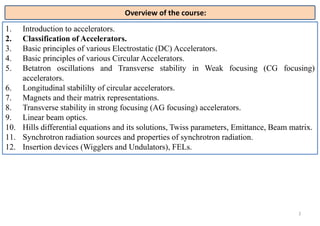
1. Introduction toaccelerators.
2. Classification of Accelerators.
3. Basic principles of various Electrostatic (DC) Accelerators.
4. Basic principles of various Circular Accelerators.
5. Betatron oscillations and Transverse stability in Weak focusing (CG focusing)
accelerators.
6. Longitudinal stabililty of circular accelerators.
7. Magnets and their matrix representations.
8. Transverse stability in strong focusing (AG focusing) accelerators.
9. Linear beam optics.
10. Hills differential equations and its solutions, Twiss parameters, Emittance, Beam matrix.
11. Synchrotron radiation sources and properties of synchrotron radiation.
12. Insertion devices (Wigglers and Undulators), FELs.
Overview of the course:
3.
3
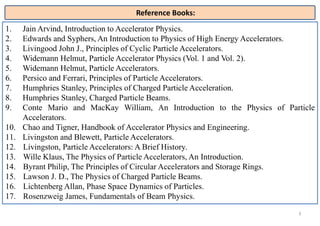
1. Jain Arvind,Introduction to Accelerator Physics.
2. Edwards and Syphers, An Introduction to Physics of High Energy Accelerators.
3. Livingood John J., Principles of Cyclic Particle Accelerators.
4. Widemann Helmut, Particle Accelerator Physics (Vol. 1 and Vol. 2).
5. Widemann Helmut, Particle Accelerators.
6. Persico and Ferrari, Principles of Particle Accelerators.
7. Humphries Stanley, Principles of Charged Particle Acceleration.
8. Humphries Stanley, Charged Particle Beams.
9. Conte Mario and MacKay William, An Introduction to the Physics of Particle
Accelerators.
10. Chao and Tigner, Handbook of Accelerator Physics and Engineering.
11. Livingston and Blewett, Particle Accelerators.
12. Livingston, Particle Accelerators: A Brief History.
13. Wille Klaus, The Physics of Particle Accelerators, An Introduction.
14. Byrant Philip, The Principles of Circular Accelerators and Storage Rings.
15. Lawson J. D., The Physics of Charged Particle Beams.
16. Lichtenberg Allan, Phase Space Dynamics of Particles.
17. Rosenzweig James, Fundamentals of Beam Physics.
Reference Books:
4.
4
18. Wilson E.J. N., An Introduction to Particle Accelerators.
19. Chao and Chou, Reviews of Accelerator Science and Technology (Vol. 1 and Vol. 2).
20. Wangler Thomas, Principles of RF Linear Accelerators.
21. Lee S. Y., Accelerator Physics.
22. Ratner B. S., Accelerators of Charged Particles.
23. Kolomensky and Lebedev, Theory of Cyclic Accelerators.
24. Reiser Martin, Theory and Design of Charged Particle Beams.
25. Hellborg, Electrostatic Accelerators.
26. Padamsee Hasan, RF Superconductivity for Accelerators.
27. Padamsee Hasan, RF Superconductivity
28. Wiedemann Helmut, Synchrotron Radiation.
29. Hoffmann Albert, The Physics of Synchrotron Radiation.
30. Webpage: CAS (CERN Accelerator School) Lecture Notes/ CERN Yellow reports.
31. Webpage: USPAS (US Particle Accelerator School) Lecture Notes.
5.
2.1 Classification ofaccelerators based on DC and RF.
2.2 Classification of DC/ Electrostatic Accelerators based on single shot acceleration
(conservative field) (Cockroft-Walton, Van-de-Graaff/ Pelletron, Dynamitron, Tandem).
2.3 Classification of RF Accelerators based on principle of successive acceleration and
principle of synchronism (non-conservative field).
2.4 RF accelerators with straight trajectory- linacs (RFQ, Wideroe linac, Alvarez/ DTL,
CCL, Induction linac, Linear collider).
2.5 RF accelerators with circular/ spiral trajectory- Circular Accelerators [Fixed Frequency
Cyclotron, Isochronous cyclotron (B as r), Synchro-cyclotron, Synchrotron,
Mictrotron, Betatron, Storage Ring, Circular collider].
2.6 Technologies used in Accelerators.
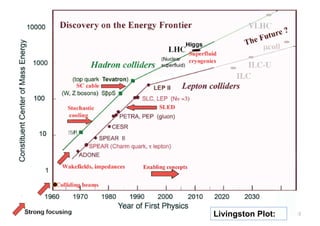
2.7 How far have accelerating gradients gone?
5
Chapter 2. Classification of accelerators:
6.
6
2.1 Classification ofaccelerators:
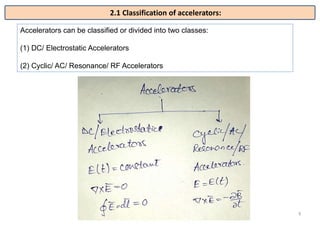
Accelerators can be classified or divided into two classes:
(1) DC/ Electrostatic Accelerators
(2) Cyclic/ AC/ Resonance/ RF Accelerators
7.
7
2.2 Classification ofDC / Electrostatic Accelerators:
Particles accelerated: electrons, protons, positive and negative ions.
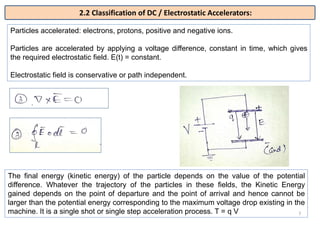
Particles are accelerated by applying a voltage difference, constant in time, which gives
the required electrostatic field. E(t) = constant.
Electrostatic field is conservative or path independent.
The final energy (kinetic energy) of the particle depends on the value of the potential
difference. Whatever the trajectory of the particles in these fields, the Kinetic Energy
gained depends on the point of departure and the point of arrival and hence cannot be
larger than the potential energy corresponding to the maximum voltage drop existing in the
machine. It is a single shot or single step acceleration process. T = q V
8.
8
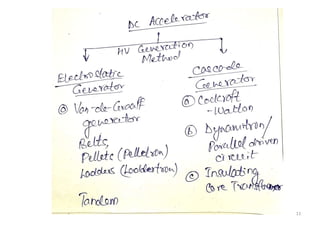
The devices forproducing this high voltage are categorized as two types:
(1) Electrostatic charging: High Voltage generated by electrostatic charging.
(a) Van-de-Graaff Generator (Charging Belt, Pellets, ladders)
(2) Cascade Generators: High voltage is generated by rectifying an AC voltage.
(a) Cockroft-Walton
(b) Dynamitron / Parallel-driven circuit.
(c) Insulating core transformer (ICT)
Max. HV < 25 MV, Typical 15 MV.
Typical energy gain in DC accelerators is 1 MeV/ m.
The electrostatic accelerator consists of an evacuated tube (known as the accelerating
tube), a fraction of meter or a few meters in length, with two electrodes, one at each end.
One electrode is at ground potential and the other electrode is maintained at a very high
voltage and the electron/ ion source is placed inside it.
9.
9
Tandem Accelerator: positiveions
Two-stage accelerator, where the HV is utilized twice.
Source at ground potential generates negative ions which is injected into the fist stage,
where acceleration to the positive HV terminal takes place.
In the stripper system in the HV terminal, the negative ions loose a few electrons and
change charge to the positive ions.
In the second stage, the positive ions once more gain energy.
Marx Generator: HV generator for ns pulse duration (MV, ns, kA)
10.
10
Advantages:
(1) High beamintensity (hundreds of mA for electrons, microamps for protons).
(2) High beam stability.
(3) Good beam collimation.
(4) DC operation, hence less troublesome.
Disadvantages:
The maximum energy obtainable cannot exceed the product of the charge times the
potential difference that can be maintained.
T = q V
In practice, due to the electrical breakdown (discharges) occurring (outside the tube)
between the two electrodes, i.e., between the HV electrode and earth or walls of the
accelerator chamber, the potential difference cannot exceed the order of MV.
12
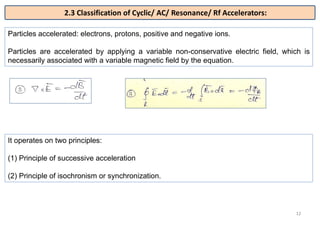
Particles accelerated: electrons,protons, positive and negative ions.
Particles are accelerated by applying a variable non-conservative electric field, which is
necessarily associated with a variable magnetic field by the equation.
It operates on two principles:
(1) Principle of successive acceleration
(2) Principle of isochronism or synchronization.
2.3 Classification of Cyclic/ AC/ Resonance/ Rf Accelerators:
13.
13
The kinetic energygained by the particle depends on the path it traverses. Here it is
possible to find some closed paths along which x E = 0. The particles are made to follow
such a path many times thus obtaining a process of gradual acceleration which is not limited
by the maximum voltage drop existing in the machine.
The accelerating voltage corresponds to a small fraction of the value of the final energy
attained by the particles and the accelerating voltage is applied to the same particle a large
number of times.
Thus a small amount of energy is successively supplied to the particles for a large number
of times.
This is known as principle of successive acceleration.
The time variation of the field removes the restriction that the energy gain is limited by a
fixed potential difference.
The acceleration is provided by a time-varying electric field localized at a particular point of
the particle trajectory, .e.g., dees in a cyclotron and synchrocyclotron, resonant cavity in
synchrotron, microtron, linacs.
Make an electric field along the direction of particle motion with RF cavities.
14.
14
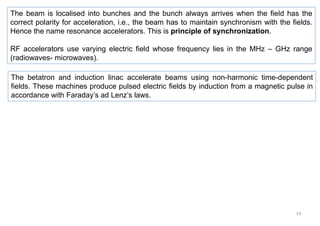
The beam islocalised into bunches and the bunch always arrives when the field has the
correct polarity for acceleration, i.e., the beam has to maintain synchronism with the fields.
Hence the name resonance accelerators. This is principle of synchronization.
RF accelerators use varying electric field whose frequency lies in the MHz – GHz range
(radiowaves- microwaves).
The betatron and induction linac accelerate beams using non-harmonic time-dependent
fields. These machines produce pulsed electric fields by induction from a magnetic pulse in
accordance with Faraday’s ad Lenz’s laws.
15.
15
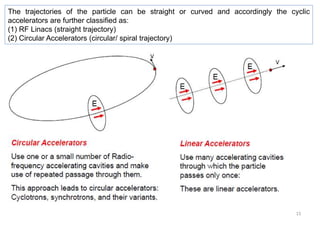
The trajectories ofthe particle can be straight or curved and accordingly the cyclic
accelerators are further classified as:
(1) RF Linacs (straight trajectory)
(2) Circular Accelerators (circular/ spiral trajectory)
17
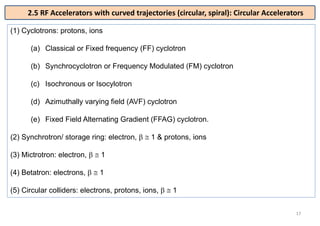
(1) Cyclotrons: protons,ions
(a) Classical or Fixed frequency (FF) cyclotron
(b) Synchrocyclotron or Frequency Modulated (FM) cyclotron
(c) Isochronous or Isocylotron
(d) Azimuthally varying field (AVF) cyclotron
(e) Fixed Field Alternating Gradient (FFAG) cyclotron.
(2) Synchrotron/ storage ring: electron, 1 & protons, ions
(3) Mictrotron: electron, 1
(4) Betatron: electrons, 1
(5) Circular colliders: electrons, protons, ions, 1
2.5 RF Accelerators with curved trajectories (circular, spiral): Circular Accelerators
18.
18
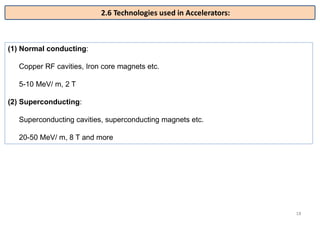
(1) Normal conducting:
CopperRF cavities, Iron core magnets etc.
5-10 MeV/ m, 2 T
(2) Superconducting:
Superconducting cavities, superconducting magnets etc.
20-50 MeV/ m, 8 T and more
2.6 Technologies used in Accelerators:

![2.1 Classification of accelerators based on DC and RF.
2.2 Classification of DC/ Electrostatic Accelerators based on single shot acceleration
(conservative field) (Cockroft-Walton, Van-de-Graaff/ Pelletron, Dynamitron, Tandem).
2.3 Classification of RF Accelerators based on principle of successive acceleration and
principle of synchronism (non-conservative field).
2.4 RF accelerators with straight trajectory- linacs (RFQ, Wideroe linac, Alvarez/ DTL,
CCL, Induction linac, Linear collider).
2.5 RF accelerators with circular/ spiral trajectory- Circular Accelerators [Fixed Frequency
Cyclotron, Isochronous cyclotron (B as r), Synchro-cyclotron, Synchrotron,
Mictrotron, Betatron, Storage Ring, Circular collider].
2.6 Technologies used in Accelerators.
2.7 How far have accelerating gradients gone?
5
Chapter 2. Classification of accelerators:](https://image.slidesharecdn.com/dcandcircularaccchapter-2classificationofaccelerators-251229062102-2ea733ae/85/DC-and-Circular-Acc_Chapter-2_Classification-of-Accelerators-pdf-5-320.jpg)