Semiconductor
Topic :- solid state
12th std
Presented by
Shubhangi V. Meshram
( M. Sc chemistry )
Contents
► Semiconductors
► Intrinsic semiconductors
► Extrinsic semiconductors
► Dopping
► N-type semiconductor
► P- type semiconductors
What is semiconductor ?
A semiconductor is a material which has electrical
conductivity between the conductor and insulator.
The conductivity of a semiconductor
increases with increasing temperature, behaviour
opposite to metal.
Example:-metalloids silicon (si) and geramanium (Ge)
are semiconductors.
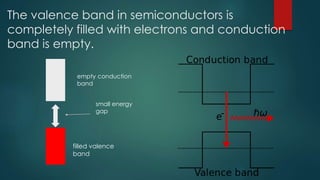
The valence band in semiconductors is
completely filled with electrons and conduction
band is empty.
empty conduction
band
filled valence
band
small energy
gap
► The electons in conduction band are free to move.
► when electric potential is applied to a
semiconductors, it conducts a small amount of
electricity.
► The energy gap between the two bands is smaller
than that in an insulator
Intrinsic semiconductors:-
► It is a pure semiconductors material which has a very low but
finite electrical conductivity is called intrinsic semiconductors.
► it is free from impurities.
► it has equal no. negative carriers (electrons) and positive
carriers (holes).
► impurities does not affect its electrical behaviour.
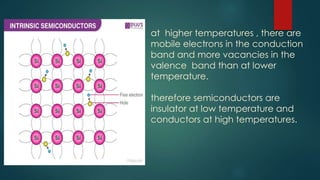
at higher temperatures , there are
mobile electrons in the conduction
band and more vacancies in the
valence band than at lower
temperature.
therefore semiconductors are
insulator at low temperature and
conductors at high temperatures.
Extrinsic semiconductors and dopping:-
► Semiconductors formed after adding impurities are called extrinsic
semiconductors.
► In extrinsic semiconductors without breaking the covalent bonds
can increase the charge carriers.
► The conductivity of a semiconductor can be increased by
dopping.
► A doped semiconductor having higher conductivity than pure
intrinsic semiconductor is an extrinsic semiconductor.
Dopping:- The process of addition of minute quantity of impurities
to a semiconductors to increase its conductivity is called dopping.
The added impurity is known as dopant.
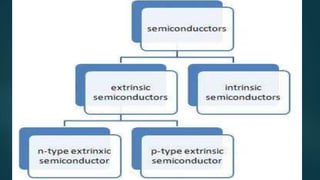
There are two types of extrinsic semiconductors.
1) n- type semiconductors
2) p- type semiconductors
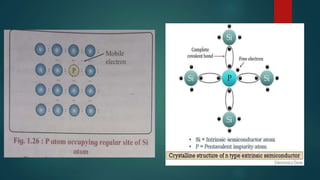
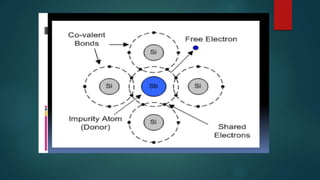
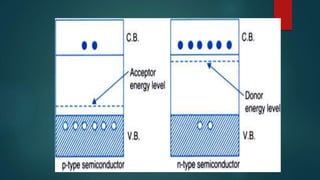
1)n- type semiconductors
n-type of semiconductors contains increased number
of electrons in the conduction band.
An n-type of semiconductors is obtained by adding
group 15 element to intrinsic semiconductor which
belongs to group 14.
for example doping of si with phosphorous.
si has a crystal structure in which each si atom is
linked tetrahedrally to four other si atoms.
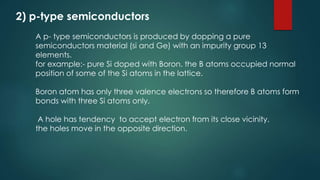
2) p-type semiconductors
A p- type semiconductors is produced by dopping a pure
semiconductors material (si and Ge) with an impurity group 13
elements.
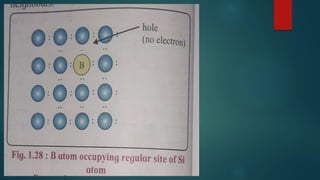
for example:- pure Si doped with Boron. the B atoms occupied normal
position of some of the Si atoms in the lattice.
Boron atom has only three valence electrons so therefore B atoms form
bonds with three Si atoms only.
A hole has tendency to accept electron from its close vicinity.
the holes move in the opposite direction.
Thank you

'12th semiconductors'

  • 1.
    Semiconductor Topic :- solidstate 12th std Presented by Shubhangi V. Meshram ( M. Sc chemistry )
  • 2.
    Contents ► Semiconductors ► Intrinsicsemiconductors ► Extrinsic semiconductors ► Dopping ► N-type semiconductor ► P- type semiconductors
  • 3.
    What is semiconductor? A semiconductor is a material which has electrical conductivity between the conductor and insulator. The conductivity of a semiconductor increases with increasing temperature, behaviour opposite to metal. Example:-metalloids silicon (si) and geramanium (Ge) are semiconductors.
  • 4.
    The valence bandin semiconductors is completely filled with electrons and conduction band is empty. empty conduction band filled valence band small energy gap
  • 5.
    ► The electonsin conduction band are free to move. ► when electric potential is applied to a semiconductors, it conducts a small amount of electricity. ► The energy gap between the two bands is smaller than that in an insulator
  • 7.
    Intrinsic semiconductors:- ► Itis a pure semiconductors material which has a very low but finite electrical conductivity is called intrinsic semiconductors. ► it is free from impurities. ► it has equal no. negative carriers (electrons) and positive carriers (holes). ► impurities does not affect its electrical behaviour.
  • 8.
    at higher temperatures, there are mobile electrons in the conduction band and more vacancies in the valence band than at lower temperature. therefore semiconductors are insulator at low temperature and conductors at high temperatures.
  • 9.
    Extrinsic semiconductors anddopping:- ► Semiconductors formed after adding impurities are called extrinsic semiconductors. ► In extrinsic semiconductors without breaking the covalent bonds can increase the charge carriers. ► The conductivity of a semiconductor can be increased by dopping. ► A doped semiconductor having higher conductivity than pure intrinsic semiconductor is an extrinsic semiconductor.
  • 10.
    Dopping:- The processof addition of minute quantity of impurities to a semiconductors to increase its conductivity is called dopping. The added impurity is known as dopant. There are two types of extrinsic semiconductors. 1) n- type semiconductors 2) p- type semiconductors
  • 11.
    1)n- type semiconductors n-typeof semiconductors contains increased number of electrons in the conduction band. An n-type of semiconductors is obtained by adding group 15 element to intrinsic semiconductor which belongs to group 14. for example doping of si with phosphorous. si has a crystal structure in which each si atom is linked tetrahedrally to four other si atoms.
  • 13.
    2) p-type semiconductors Ap- type semiconductors is produced by dopping a pure semiconductors material (si and Ge) with an impurity group 13 elements. for example:- pure Si doped with Boron. the B atoms occupied normal position of some of the Si atoms in the lattice. Boron atom has only three valence electrons so therefore B atoms form bonds with three Si atoms only. A hole has tendency to accept electron from its close vicinity. the holes move in the opposite direction.
  • 17.