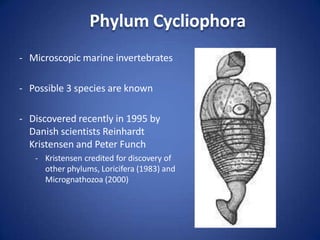
Phylum Cycliophora
- Microscopic marine invertebrates
- Possible 3 species are known
- Discovered recently in 1995 by
Danish scientists Reinhardt
Kristensen and Peter Funch
- Kristensen credited for discovery of
other phylums, Loricifera (1983) and
Micrognathozoa (2000)
General Body Form
• Multicellular
• Bilateral Symmetry
• Acoelomate
• Protostomes
• Microscopic
• Only hundreds of micrometers in length
General Body Form
• Mircovillous cellular epidermis
• Well defined cuticle
– Secreted by epidermis
• Individual muscles, not sheaths
• Brain
– Location unknown
– Nervous system not well understood
• Found living commensally on the setae of the mouth parts of
lobsters.
• Found on maxillae and maxillipads
• Mouthparts can have thousands of individuals
• Filter feed on the leftovers of host.
• Symbion americanus found on the American lobster -Commercially
important species of lobster
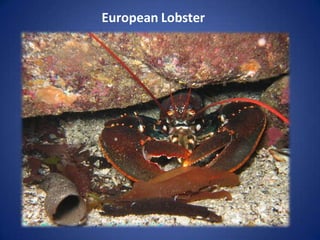
• Not presently described species found on the European lobster
European Lobster
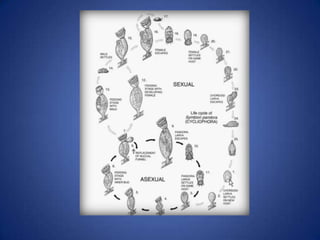
Multiple Life Stages
• Feeding Sessile Stage
– Asexual or sexual
• Multiple Motile Larval stages
– Pandora larva
– Chordoid larva
– Prometheus larva
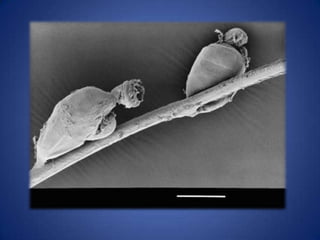
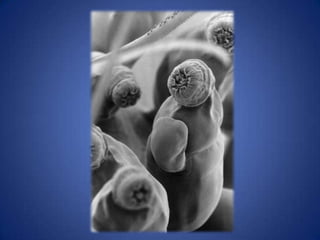
Feeding Sessile Stage
• Circular buccal funnel
-Ciliated for feeding on bacteria and food particles.
• U-shaped Gut
• Anus located outside of feed apparatus
• Attaches to mouthparts with adhesive disc and
stalk
Asexual Inner Budding
• Loses buccal funnel and digestive tract
• New bud arises from embryonic cells producing
only a new buccal funnel and digestive tract
• Process repeated multiple times
Asexual Reproduction
• Pandora larva is formed much the same way as
asexual inner budding
• Free-swimming larva settle close to parent
individual to form new feeding stage.
– Allows for quick replication over mouthparts
Sexual Reproduction
• Primary male (Prometheus larva) or female
housed inside the body of the feeding stage.
• Primary male hatches and settles on a feeding
stage.
• Primary male lacks penis or testis therefore
forms secondary male itself with penis and
spermatozoa.
Sexual Reproduction
• Secondary male swims to another feeding
stage with female.
• Fertilization occurs inside female with oocyte.
• Female releases from feeding stage and
settles close by.
Sexual Reproduction
• Chordoid larva forms inside settled female.
– Chordoid larva has stacked muscle cells
• Larva ingests entire female and hatches
– Good swimmer
• Represents dispersal stage
• Larva settles on new host and forms a new
feeding stage.
Cycliophores invertebrates

Cycliophores invertebrates

  • 1.
    Phylum Cycliophora - Microscopicmarine invertebrates - Possible 3 species are known - Discovered recently in 1995 by Danish scientists Reinhardt Kristensen and Peter Funch - Kristensen credited for discovery of other phylums, Loricifera (1983) and Micrognathozoa (2000)
  • 2.
    General Body Form •Multicellular • Bilateral Symmetry • Acoelomate • Protostomes • Microscopic • Only hundreds of micrometers in length
  • 3.
    General Body Form •Mircovillous cellular epidermis • Well defined cuticle – Secreted by epidermis • Individual muscles, not sheaths • Brain – Location unknown – Nervous system not well understood
  • 4.
    • Found livingcommensally on the setae of the mouth parts of lobsters. • Found on maxillae and maxillipads • Mouthparts can have thousands of individuals • Filter feed on the leftovers of host. • Symbion americanus found on the American lobster -Commercially important species of lobster • Not presently described species found on the European lobster
  • 5.
  • 6.
    Multiple Life Stages •Feeding Sessile Stage – Asexual or sexual • Multiple Motile Larval stages – Pandora larva – Chordoid larva – Prometheus larva
  • 7.
    Feeding Sessile Stage •Circular buccal funnel -Ciliated for feeding on bacteria and food particles. • U-shaped Gut • Anus located outside of feed apparatus • Attaches to mouthparts with adhesive disc and stalk
  • 9.
    Asexual Inner Budding •Loses buccal funnel and digestive tract • New bud arises from embryonic cells producing only a new buccal funnel and digestive tract • Process repeated multiple times
  • 10.
    Asexual Reproduction • Pandoralarva is formed much the same way as asexual inner budding • Free-swimming larva settle close to parent individual to form new feeding stage. – Allows for quick replication over mouthparts
  • 12.
    Sexual Reproduction • Primarymale (Prometheus larva) or female housed inside the body of the feeding stage. • Primary male hatches and settles on a feeding stage. • Primary male lacks penis or testis therefore forms secondary male itself with penis and spermatozoa.
  • 13.
    Sexual Reproduction • Secondarymale swims to another feeding stage with female. • Fertilization occurs inside female with oocyte. • Female releases from feeding stage and settles close by.
  • 14.
    Sexual Reproduction • Chordoidlarva forms inside settled female. – Chordoid larva has stacked muscle cells • Larva ingests entire female and hatches – Good swimmer • Represents dispersal stage • Larva settles on new host and forms a new feeding stage.