Copyright © 2016 ScottMadden, Inc. All rights reserved.
Cybersecurity in Shared Services
Organizations
June 2016
Copyright © 2016 by ScottMadden, Inc. All rights reserved.
Contents
■ Introduction to Shared Services Cybersecurity
■ What’s at Risk?
■ Cyber Attack Trends
■ Key Shared Services Organization (SSO) Risk Factors
■ Building Blocks of an SSO Cybersecurity Program
• Data Security
• Education and Awareness
• Governance and Compliance
■ SSO Cybersecurity Leading Practices
■ How ScottMadden Can Help
1
Copyright © 2016 by ScottMadden, Inc. All rights reserved.
Introduction to Shared Services Cybersecurity
Shared Service Organizations (SSOs) control much of an organization’s confidential and restricted personal information. While
handling and using this data is routine for SSOs, it is exactly the kind of information that is highly prized by cyber criminals. A
robust cybersecurity program is imperative to protect the organization, employees, and customers.
Cyber threats can materialize in a number of ways but can be broken down into two main types:
2
Type Description Examples
External ■ Cyber criminals use offensive maneuvers with the intent of
stealing, altering, or destroying data, networks,
infrastructure assets, and/or personal devices
■ Denial of service attacks designed to make network
resources unavailable to its users
■ Unauthorized users gaining physical access to a
computer and downloading sensitive data
■ Attempts to acquire usernames, passwords, and
credit card details directly from users (e.g., phishing)
Internal ■ Employees unintentionally compromise sensitive data or
systems, potentially exposing the organization to cyber
attacks
■ Employees maliciously circumvent data security protocols
and/or willingly aid cyber criminals
■ Sending documents containing sensitive information
via standard email rather than through secure email
programs
■ Purposefully opening email attachments from
external senders known to contain malicious code
Many organizations have dedicated Information Security (InfoSec) groups that manage security programs enterprise wide.
However, accountability for protecting sensitive shared services and employee information ultimately falls to the SSO.
Copyright © 2016 by ScottMadden, Inc. All rights reserved.
Personal Data/PII Business/Organization
Examples of
Confidential
Information
 Name
 Email address
 Physical address
 Phone number
 Job title
 Work experience
 Evaluations
 Gender
 Marital status
 Age
 M&A or transactional
activity
 Ongoing lawsuits
 Internal investigations
 Proprietary content
 Advance SEC filings
 Press releases
 Emails
 Internal memos
 Company presentations
Examples of
Restricted
Information
 SSN
 Passport
 Driver’s license
 Ethnicity
 Nationality
 Sexual orientation
 Medical history
 Salary/compensation
 Bank account information
 Background checks
 Credit reports
 Criminal history
 Strategic plans
 Budgets
 Reports
 Legal materials
 Audits and assessments
 P-card numbers
What’s At Risk?
Confidential Information refers to data/information for which unauthorized access or disclosure could result in an adverse effect
on the organization, an individual, or both. This information could either be personally identifiable information (PII) or
confidential business information. Restricted Information includes the most sensitive Confidential Information and is typically
protected by law or policy.
3
Copyright © 2016 by ScottMadden, Inc. All rights reserved.
Cyber Attack Trends
The number of cyber attacks against organizations continues to grow in complexity, frequency, and severity. Significant data
breaches in 2015 included1:
■ VTech (children’s technology maker) – personal data compromised for 5 million parents and 6 million children
■ Kaspersky Lab (security vendor) – 13 million account records exposed
■ Experian (credit service provider) – personal data compromised for 15 million customers
■ US Office of Personnel Management (federal government) – PII and restricted data exposed for 21.5 million federal employees
■ Anthem Blue Cross Blue Shield (health insurer) – PII and restricted data exposed for 80 million patients and employees
4
0.0
0.5
1.0
1.5
2.0
2.5
3.0
$0.0
$2.0
$4.0
$6.0
$8.0
$10.0
$12.0
$14.0
$16.0
$18.0
2010 2011 2012 2013 2014 2015
AttacksperWeek
AverageRemediation
Cost($millions)
2015 Cyber Attack Trends2
Annual Cost of Attacks per Company No. of Attacks per Week
42%
36%
19%
2% 1%
2015 Cyber Attack Cost Breakdown2
Information Loss
Business Disruption
Revenue Loss
Other Costs
Equipment Damages
Highest Reported
Remediation Costs $51.9M $36.5M $46.2M $58.1M $60.5M $65.0M
2. Source: 2015 Cost of Cyber Crime Study, Ponemon Institute
1. CRN, 10 Biggest Data Breaches of 2015
In 2015, the average organization spent more than $15 million remediating the effects of cyber attacks. To mitigate
potential costs, SSOs must take action to understand and protect the flow of their sensitive information.
Copyright © 2016 by ScottMadden, Inc. All rights reserved.
■ SSOs enhance their efficacy by integrating their
primary systems with third-party systems for benefits
management, time and attendance, etc. Each of these
integrations typically transmits sensitive data over
myriad secured and unsecured channels
■ Business process complexities, policies, and
exceptions increase along with the amount of sensitive
data flowing through the SSO
■ Email, chat, and open service tickets are common
modes of sending communications in and out of
SSOs. These regularly include sensitive information
that can inadvertently fall into the wrong hands
■ Some SSO departments (e.g., workforce
administration, call centers) can experience low
employee engagement, especially for data security
initiatives
■ These departments can also experience high turnover,
opening the SSO up further to potential malicious
insider activity
The volume of sensitive data makes SSOs a target. While a high volume of data tends to correlate to increased operational
efficiency, it also increases the risk that this data may be compromised. Despite this, data security is often overlooked in favor of
gains in operational efficiency and customer service.
Key SSO Risk Factors
5
SSO Risk Factors Complexity of an HR SSO Information Ecosystem
SSO data is constantly moving through countless systems, applications, and individuals. Only
a robust cybersecurity program can mitigate the complexities of the information ecosystem.
Copyright © 2016 by ScottMadden, Inc. All rights reserved.
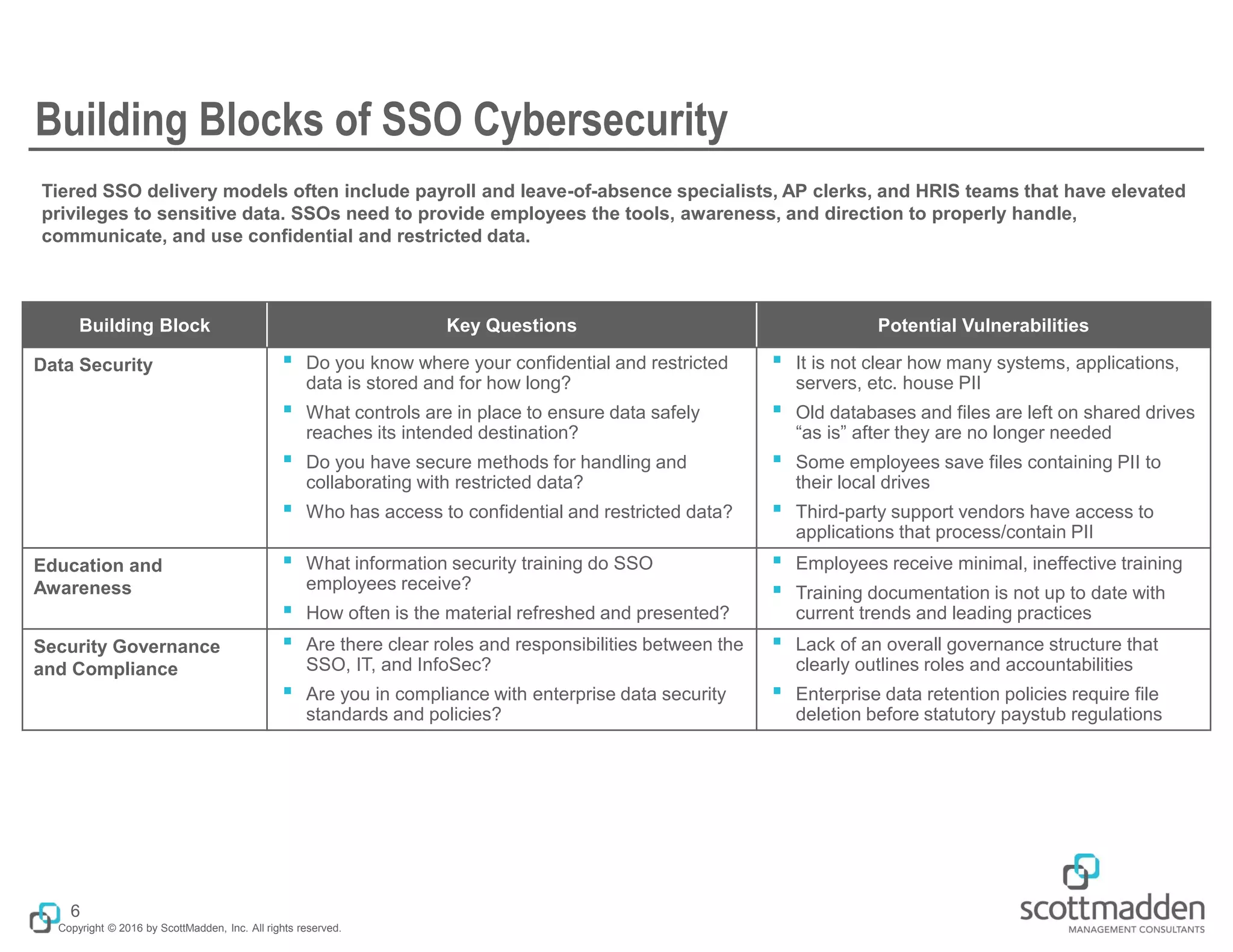
Building Blocks of SSO Cybersecurity
Tiered SSO delivery models often include payroll and leave-of-absence specialists, AP clerks, and HRIS teams that have elevated
privileges to sensitive data. SSOs need to provide employees the tools, awareness, and direction to properly handle,
communicate, and use confidential and restricted data.
6
Building Block Key Questions Potential Vulnerabilities
Data Security ■ Do you know where your confidential and restricted
data is stored and for how long?
■ What controls are in place to ensure data safely
reaches its intended destination?
■ Do you have secure methods for handling and
collaborating with restricted data?
■ Who has access to confidential and restricted data?
■ It is not clear how many systems, applications,
servers, etc. house PII
■ Old databases and files are left on shared drives
“as is” after they are no longer needed
■ Some employees save files containing PII to
their local drives
■ Third-party support vendors have access to
applications that process/contain PII
Education and
Awareness
■ What information security training do SSO
employees receive?
■ How often is the material refreshed and presented?
■ Employees receive minimal, ineffective training
■ Training documentation is not up to date with
current trends and leading practices
Security Governance
and Compliance
■ Are there clear roles and responsibilities between the
SSO, IT, and InfoSec?
■ Are you in compliance with enterprise data security
standards and policies?
■ Lack of an overall governance structure that
clearly outlines roles and accountabilities
■ Enterprise data retention policies require file
deletion before statutory paystub regulations
Copyright © 2016 by ScottMadden, Inc. All rights reserved.
Time and Attendance
System
Payroll Audit
Check Print Database
and System
HR and Payroll System
SSO Data Security
SSO data is stored in and moves through countless on-premises and cloud applications and systems. Understanding where
sensitive data is stored and how it is used and shared are essential to developing and implementing effective security controls.
Data can be classified in three categories:
■ Data at rest: Anything that holds data in a static state, such as file shares, databases, servers, etc.
■ Data in motion: Data in transit (“on a wire”) between applications, systems, individuals, etc. via email, web, or other Internet protocols
■ Data in use: Data that resides on the end-user workstation and needs to be protected from being leaked through removable media
devices like USBs, DVDs, CDs etc.
The graphic below depicts a sample flow of data through an SSO’s payroll process:
7
Data in Use
The payroll audit team
uses computers and
shared drives to audit
payroll files prior to
releasing for final
printing. Key concerns
include:
 Frequency that drives
and computers are
wiped for sensitive
information
 Access restrictions to
shared drives
 Standards for sharing
sensitive data
Data in Motion
Key concerns:
 Level of encryption on data as it moves
 Encryption key management/policies
Data at Rest
Data is stored in multiple locations in this diagram – the T&A
database, the cloud HR/payroll solution, and the check printing
software database. Key concerns include:
 Level of encryption (e.g., full disk, file level)
 Consistent use of encryption
 Access restrictions to databases and servers
Copyright © 2016 by ScottMadden, Inc. All rights reserved.
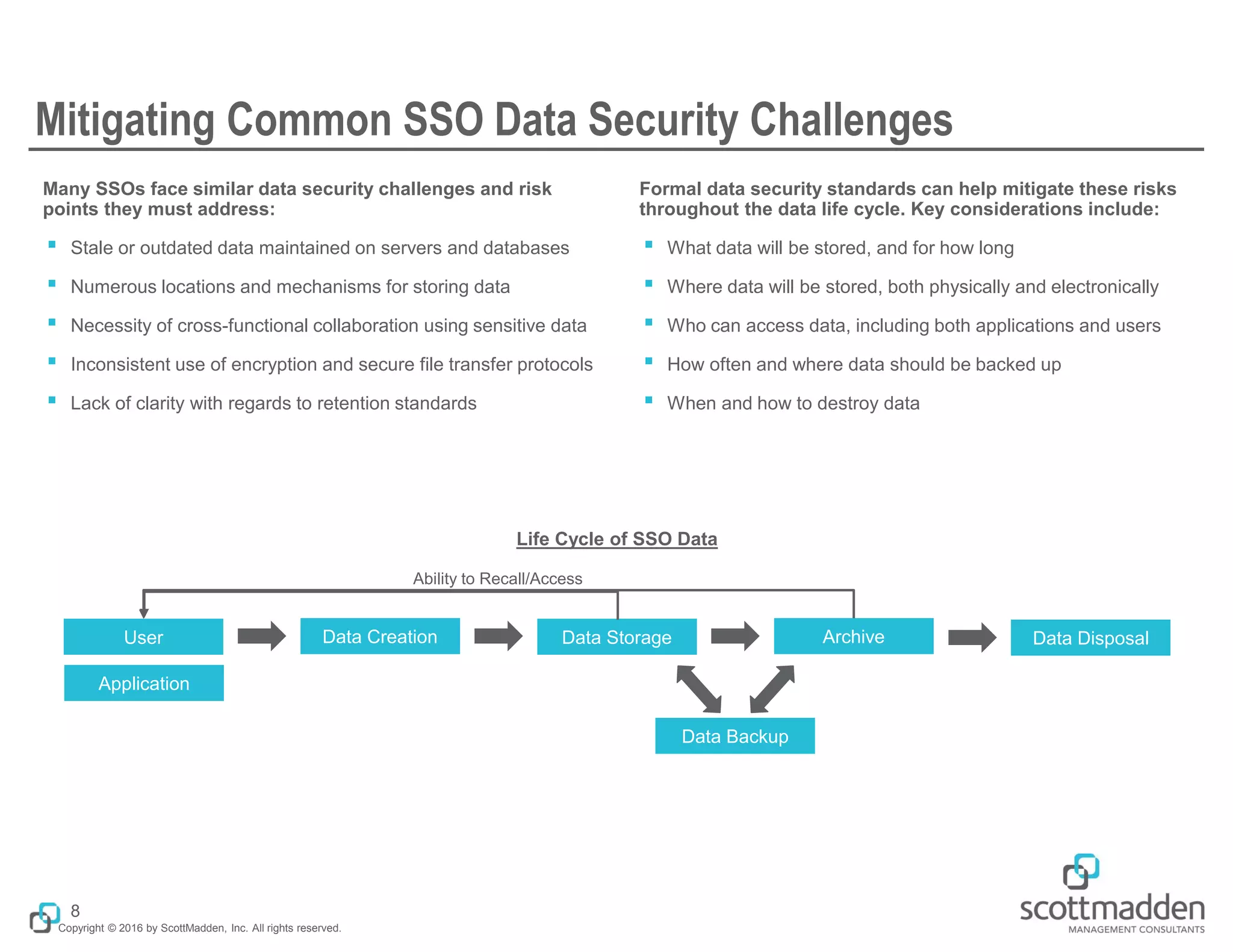
Mitigating Common SSO Data Security Challenges
Many SSOs face similar data security challenges and risk
points they must address:
■ Stale or outdated data maintained on servers and databases
■ Numerous locations and mechanisms for storing data
■ Necessity of cross-functional collaboration using sensitive data
■ Inconsistent use of encryption and secure file transfer protocols
■ Lack of clarity with regards to retention standards
Formal data security standards can help mitigate these risks
throughout the data life cycle. Key considerations include:
■ What data will be stored, and for how long
■ Where data will be stored, both physically and electronically
■ Who can access data, including both applications and users
■ How often and where data should be backed up
■ When and how to destroy data
8
User Data Creation Data Storage Archive
Data Backup
Data Disposal
Ability to Recall/Access
Application
Life Cycle of SSO Data
Copyright © 2016 by ScottMadden, Inc. All rights reserved.
Education and Awareness
Cyber crimes are not the only sources of risk for SSOs—the action or inaction of employees can also lead to security incidents. It
is vital SSOs maintain a security awareness program to ensure employees understand the importance of protecting sensitive
information, how to handle it securely, and the risks of mishandling such information.
9
Source: PCI Security Standards Council
Qualities of an effective and sustainable awareness program include:
■ Information is provided in a way that relates to the SSO culture (i.e., how employees think and behave)
■ Information is delivered in different formats to affect change and is consistently reinforced and repeated
■ Management is on-board and understands the holistic security risks (e.g., financial, reputational, legal)
■ Presentations are personal – “bring the message home,” “security is everyone’s job”
■ Information is relevant to current events and trends and is consistently updated with lessons learned
Copyright © 2016 by ScottMadden, Inc. All rights reserved.
■ Identify a clear set of roles and responsibilities for which each
group is accountable
■ Leverage the insight of each group to determine risk points
■ Ensure communication between all groups is timely, efficient,
and ongoing
■ Work together on policy creation to ensure the alignment on
data security priorities and standards
In addition to securing sensitive data and educating employees, SSOs must work with other parts of the organization to clearly
define security roles and responsibilities. Establishing a governance model creates a structure that enables the SSO to operate
with clear role definition, fosters appropriate accountabilities, and ensures compliance with corporate standards.
10
Establish Enterprise Data Security Standards
Foster Collaboration between the SSO, IT, Legal and InfoSec
Governance and Compliance
■ Conduct analysis to understand where the SSO is in relation to
existing enterprise data security policies and identify highest
priority gaps
■ Collaborate to establish overall data security standards taking
into account special SSO situations and laws/regulations
■ Document policy and process documentation
■ Establish a process and standards audit cycle
Copyright © 2016 by ScottMadden, Inc. All rights reserved.
SSO Cybersecurity Leading Practices
11
Building Block Leading Practice Benefit Description Impact
Implementation
Level
Data Security
Secure sensitive
information that is
not encrypted
■ Reduces the likelihood of a successful breach
■ Enhances the defense in depth through multiple avenues of layered
security
■ Supports secure business processes
High Enterprise/SSO
Enhance physical
security practices
■ Protects employees, hardware, programs, network, data, and other
assets from physical intrusions and events that could cause loss or
damage to an organization or individual
High SSO
Develop information
sharing standards
■ Provides clarity of expectations, increases accountability, and
ensures the most effective tools at the organization’s disposal are
being used
■ Ensures the applications and tools used to share information meet
organizational security and business requirements
High Enterprise/SSO
Develop information
storage standards
■ Determines how SSOs will comply with the organization’s data
retention policy High SSO
Inventory information
at rest, in motion,
and in use
■ Allows an organization to:
• Create policies and standards aligned with business needs
• Secure data via encryption or other appropriate methods
• Develop an effective defense in depth strategy
High Enterprise/SSO
Isolate restricted
information and
confidential
information
■ Creates and designates repositories for the storage of sensitive
information
■ Allows the organization to better understand where its data resides
■ Ensures security solutions and resources are prioritized and aligned
with protecting the organization’s most valuable information
High Enterprise/SSO
Education and
Awareness
Develop a security
awareness program
■ Regularly reminds and reinforces the need to keep sensitive
information secure
■ Continuously promotes awareness
High Enterprise/SSO
Copyright © 2016 by ScottMadden, Inc. All rights reserved.
SSO Cybersecurity Leading Practices (Cont’d)
12
Building Block Leading Practice Benefit Description Impact
Implementation
Level
Governance and
Compliance
Develop a data
retention policy
■ Helps organizations manage data, comply with laws and regulations,
and prepare for business continuity in case of a disaster High Enterprise/SSO
Define security
governance
■ Creates a structure that enables the organization to operate with
clear role definition and accountabilities High Enterprise
Develop policy and
process
documentation
■ Allows senior leadership to communicate philosophies, strategy, and
broad requirements to the organization
■ Allows leadership to define and standardize how the requirements
set forth in the policies will be accomplished
High Enterprise/SSO
Measure process
effectiveness
■ Allows an organization to assess the effectiveness of its security
controls
■ Facilitates decision making, improves performance, and increases
accountability
Medium Enterprise/SSO
Audit processes,
protocols, and
standards
■ Instills a sense of confidence that the business is functioning well
and is prepared to meet potential challenges
■ Encourages continuous improvement
Medium Enterprise/SSO
Perform risk
assessments
■ Highlights the cybersecurity risk to organizational operations, assets,
and individuals
■ Serves as a foundation for prioritizing improvement efforts and
decision making
Medium Enterprise
Develop system
requirements
■ Describes functions which systems, applications, and other tools
should fulfill to meet security and business requirements Low Enterprise
Develop a formal
data loss prevention
program
■ Improves data classification schemes
■ Provides an understanding of the data life cycle
■ Enhances controls over access to sensitive data
Low Enterprise
Copyright © 2016 by ScottMadden, Inc. All rights reserved.
Putting It All Together
A programmatic approach is required to secure SSOs. Attempts to build and improve cybersecurity capabilities through
individual or disjointed projects are expensive and ineffective. SSOs must pursue a programmatic approach that mitigates SSO-
wide risks.
13
Engaging SSO leadership and stakeholders in cybersecurity decision making is the single most important
factor in creating a successful cybersecurity program—more than technology or funding.
In a formal cybersecurity program:
■ A roadmap is created to identify critical risks, take immediate action, and achieve long-term capabilities. Many leading practices can be
implemented quickly with significant impact on SSO cybersecurity
■ Priorities are risk informed
■ Project management and organizational change management enable a successful implementation
■ Monitoring of indicators drives corrective actions and continuous improvement
Cybersecurity
Policies and
Controls
Technology and
Automation
Capabilities
Business
Processes and
Employee
Behaviors
Changes
SSO Mission and
Strategic
Objectives
SSO Risks
Governance: Evaluate, Direct, MonitorManagement: Plan, Do, Check, Act
Program and Organizational Change Management
Copyright © 2016 by ScottMadden, Inc. All rights reserved.
How ScottMadden Can Help
14
■ Strategic planning support
■ Security program
management
■ Design and
implementation
■ Security policy alignment
■ Program assessments
■ Sensitive data inventories
■ Transformation
■ Policy framework design
■ Business policy and
process assessments
■ Data security standards
creation
■ Cybersecurity metric
design and implementation
■ Access management
strategy development
■ OCM support of
implementation efforts
■ Cybersecurity awareness
plan – design and
implementation
■ Process design
■ Implementation project
management
■ Cybersecurity threat-
based risk assessments
■ Vendor selection
Cybersecurity Program
Services
Cybersecurity
Governance Design and
Implementation
Cybersecurity
Organizational Change
Management (OCM)
Cybersecurity Capability
Design and
Implementation
Copyright © 2016 by ScottMadden, Inc. All rights reserved.
Jon Kerner
Partner and Information
Technology Practice Lead
ScottMadden, Inc.
3495 Piedmont Road
Building 10, Suite 805
Atlanta, GA 30305
jkerner@scottmadden.com
O: 678-702-8346
To learn more about SSO Cybersecurity, contact us.
Contact Us
15

Cybersecurity in Shared Services Organizations

  • 1.
    Copyright © 2016ScottMadden, Inc. All rights reserved. Cybersecurity in Shared Services Organizations June 2016
  • 2.
    Copyright © 2016by ScottMadden, Inc. All rights reserved. Contents ■ Introduction to Shared Services Cybersecurity ■ What’s at Risk? ■ Cyber Attack Trends ■ Key Shared Services Organization (SSO) Risk Factors ■ Building Blocks of an SSO Cybersecurity Program • Data Security • Education and Awareness • Governance and Compliance ■ SSO Cybersecurity Leading Practices ■ How ScottMadden Can Help 1
  • 3.
    Copyright © 2016by ScottMadden, Inc. All rights reserved. Introduction to Shared Services Cybersecurity Shared Service Organizations (SSOs) control much of an organization’s confidential and restricted personal information. While handling and using this data is routine for SSOs, it is exactly the kind of information that is highly prized by cyber criminals. A robust cybersecurity program is imperative to protect the organization, employees, and customers. Cyber threats can materialize in a number of ways but can be broken down into two main types: 2 Type Description Examples External ■ Cyber criminals use offensive maneuvers with the intent of stealing, altering, or destroying data, networks, infrastructure assets, and/or personal devices ■ Denial of service attacks designed to make network resources unavailable to its users ■ Unauthorized users gaining physical access to a computer and downloading sensitive data ■ Attempts to acquire usernames, passwords, and credit card details directly from users (e.g., phishing) Internal ■ Employees unintentionally compromise sensitive data or systems, potentially exposing the organization to cyber attacks ■ Employees maliciously circumvent data security protocols and/or willingly aid cyber criminals ■ Sending documents containing sensitive information via standard email rather than through secure email programs ■ Purposefully opening email attachments from external senders known to contain malicious code Many organizations have dedicated Information Security (InfoSec) groups that manage security programs enterprise wide. However, accountability for protecting sensitive shared services and employee information ultimately falls to the SSO.
  • 4.
    Copyright © 2016by ScottMadden, Inc. All rights reserved. Personal Data/PII Business/Organization Examples of Confidential Information  Name  Email address  Physical address  Phone number  Job title  Work experience  Evaluations  Gender  Marital status  Age  M&A or transactional activity  Ongoing lawsuits  Internal investigations  Proprietary content  Advance SEC filings  Press releases  Emails  Internal memos  Company presentations Examples of Restricted Information  SSN  Passport  Driver’s license  Ethnicity  Nationality  Sexual orientation  Medical history  Salary/compensation  Bank account information  Background checks  Credit reports  Criminal history  Strategic plans  Budgets  Reports  Legal materials  Audits and assessments  P-card numbers What’s At Risk? Confidential Information refers to data/information for which unauthorized access or disclosure could result in an adverse effect on the organization, an individual, or both. This information could either be personally identifiable information (PII) or confidential business information. Restricted Information includes the most sensitive Confidential Information and is typically protected by law or policy. 3
  • 5.
    Copyright © 2016by ScottMadden, Inc. All rights reserved. Cyber Attack Trends The number of cyber attacks against organizations continues to grow in complexity, frequency, and severity. Significant data breaches in 2015 included1: ■ VTech (children’s technology maker) – personal data compromised for 5 million parents and 6 million children ■ Kaspersky Lab (security vendor) – 13 million account records exposed ■ Experian (credit service provider) – personal data compromised for 15 million customers ■ US Office of Personnel Management (federal government) – PII and restricted data exposed for 21.5 million federal employees ■ Anthem Blue Cross Blue Shield (health insurer) – PII and restricted data exposed for 80 million patients and employees 4 0.0 0.5 1.0 1.5 2.0 2.5 3.0 $0.0 $2.0 $4.0 $6.0 $8.0 $10.0 $12.0 $14.0 $16.0 $18.0 2010 2011 2012 2013 2014 2015 AttacksperWeek AverageRemediation Cost($millions) 2015 Cyber Attack Trends2 Annual Cost of Attacks per Company No. of Attacks per Week 42% 36% 19% 2% 1% 2015 Cyber Attack Cost Breakdown2 Information Loss Business Disruption Revenue Loss Other Costs Equipment Damages Highest Reported Remediation Costs $51.9M $36.5M $46.2M $58.1M $60.5M $65.0M 2. Source: 2015 Cost of Cyber Crime Study, Ponemon Institute 1. CRN, 10 Biggest Data Breaches of 2015 In 2015, the average organization spent more than $15 million remediating the effects of cyber attacks. To mitigate potential costs, SSOs must take action to understand and protect the flow of their sensitive information.
  • 6.
    Copyright © 2016by ScottMadden, Inc. All rights reserved. ■ SSOs enhance their efficacy by integrating their primary systems with third-party systems for benefits management, time and attendance, etc. Each of these integrations typically transmits sensitive data over myriad secured and unsecured channels ■ Business process complexities, policies, and exceptions increase along with the amount of sensitive data flowing through the SSO ■ Email, chat, and open service tickets are common modes of sending communications in and out of SSOs. These regularly include sensitive information that can inadvertently fall into the wrong hands ■ Some SSO departments (e.g., workforce administration, call centers) can experience low employee engagement, especially for data security initiatives ■ These departments can also experience high turnover, opening the SSO up further to potential malicious insider activity The volume of sensitive data makes SSOs a target. While a high volume of data tends to correlate to increased operational efficiency, it also increases the risk that this data may be compromised. Despite this, data security is often overlooked in favor of gains in operational efficiency and customer service. Key SSO Risk Factors 5 SSO Risk Factors Complexity of an HR SSO Information Ecosystem SSO data is constantly moving through countless systems, applications, and individuals. Only a robust cybersecurity program can mitigate the complexities of the information ecosystem.
  • 7.
    Copyright © 2016by ScottMadden, Inc. All rights reserved. Building Blocks of SSO Cybersecurity Tiered SSO delivery models often include payroll and leave-of-absence specialists, AP clerks, and HRIS teams that have elevated privileges to sensitive data. SSOs need to provide employees the tools, awareness, and direction to properly handle, communicate, and use confidential and restricted data. 6 Building Block Key Questions Potential Vulnerabilities Data Security ■ Do you know where your confidential and restricted data is stored and for how long? ■ What controls are in place to ensure data safely reaches its intended destination? ■ Do you have secure methods for handling and collaborating with restricted data? ■ Who has access to confidential and restricted data? ■ It is not clear how many systems, applications, servers, etc. house PII ■ Old databases and files are left on shared drives “as is” after they are no longer needed ■ Some employees save files containing PII to their local drives ■ Third-party support vendors have access to applications that process/contain PII Education and Awareness ■ What information security training do SSO employees receive? ■ How often is the material refreshed and presented? ■ Employees receive minimal, ineffective training ■ Training documentation is not up to date with current trends and leading practices Security Governance and Compliance ■ Are there clear roles and responsibilities between the SSO, IT, and InfoSec? ■ Are you in compliance with enterprise data security standards and policies? ■ Lack of an overall governance structure that clearly outlines roles and accountabilities ■ Enterprise data retention policies require file deletion before statutory paystub regulations
  • 8.
    Copyright © 2016by ScottMadden, Inc. All rights reserved. Time and Attendance System Payroll Audit Check Print Database and System HR and Payroll System SSO Data Security SSO data is stored in and moves through countless on-premises and cloud applications and systems. Understanding where sensitive data is stored and how it is used and shared are essential to developing and implementing effective security controls. Data can be classified in three categories: ■ Data at rest: Anything that holds data in a static state, such as file shares, databases, servers, etc. ■ Data in motion: Data in transit (“on a wire”) between applications, systems, individuals, etc. via email, web, or other Internet protocols ■ Data in use: Data that resides on the end-user workstation and needs to be protected from being leaked through removable media devices like USBs, DVDs, CDs etc. The graphic below depicts a sample flow of data through an SSO’s payroll process: 7 Data in Use The payroll audit team uses computers and shared drives to audit payroll files prior to releasing for final printing. Key concerns include:  Frequency that drives and computers are wiped for sensitive information  Access restrictions to shared drives  Standards for sharing sensitive data Data in Motion Key concerns:  Level of encryption on data as it moves  Encryption key management/policies Data at Rest Data is stored in multiple locations in this diagram – the T&A database, the cloud HR/payroll solution, and the check printing software database. Key concerns include:  Level of encryption (e.g., full disk, file level)  Consistent use of encryption  Access restrictions to databases and servers
  • 9.
    Copyright © 2016by ScottMadden, Inc. All rights reserved. Mitigating Common SSO Data Security Challenges Many SSOs face similar data security challenges and risk points they must address: ■ Stale or outdated data maintained on servers and databases ■ Numerous locations and mechanisms for storing data ■ Necessity of cross-functional collaboration using sensitive data ■ Inconsistent use of encryption and secure file transfer protocols ■ Lack of clarity with regards to retention standards Formal data security standards can help mitigate these risks throughout the data life cycle. Key considerations include: ■ What data will be stored, and for how long ■ Where data will be stored, both physically and electronically ■ Who can access data, including both applications and users ■ How often and where data should be backed up ■ When and how to destroy data 8 User Data Creation Data Storage Archive Data Backup Data Disposal Ability to Recall/Access Application Life Cycle of SSO Data
  • 10.
    Copyright © 2016by ScottMadden, Inc. All rights reserved. Education and Awareness Cyber crimes are not the only sources of risk for SSOs—the action or inaction of employees can also lead to security incidents. It is vital SSOs maintain a security awareness program to ensure employees understand the importance of protecting sensitive information, how to handle it securely, and the risks of mishandling such information. 9 Source: PCI Security Standards Council Qualities of an effective and sustainable awareness program include: ■ Information is provided in a way that relates to the SSO culture (i.e., how employees think and behave) ■ Information is delivered in different formats to affect change and is consistently reinforced and repeated ■ Management is on-board and understands the holistic security risks (e.g., financial, reputational, legal) ■ Presentations are personal – “bring the message home,” “security is everyone’s job” ■ Information is relevant to current events and trends and is consistently updated with lessons learned
  • 11.
    Copyright © 2016by ScottMadden, Inc. All rights reserved. ■ Identify a clear set of roles and responsibilities for which each group is accountable ■ Leverage the insight of each group to determine risk points ■ Ensure communication between all groups is timely, efficient, and ongoing ■ Work together on policy creation to ensure the alignment on data security priorities and standards In addition to securing sensitive data and educating employees, SSOs must work with other parts of the organization to clearly define security roles and responsibilities. Establishing a governance model creates a structure that enables the SSO to operate with clear role definition, fosters appropriate accountabilities, and ensures compliance with corporate standards. 10 Establish Enterprise Data Security Standards Foster Collaboration between the SSO, IT, Legal and InfoSec Governance and Compliance ■ Conduct analysis to understand where the SSO is in relation to existing enterprise data security policies and identify highest priority gaps ■ Collaborate to establish overall data security standards taking into account special SSO situations and laws/regulations ■ Document policy and process documentation ■ Establish a process and standards audit cycle
  • 12.
    Copyright © 2016by ScottMadden, Inc. All rights reserved. SSO Cybersecurity Leading Practices 11 Building Block Leading Practice Benefit Description Impact Implementation Level Data Security Secure sensitive information that is not encrypted ■ Reduces the likelihood of a successful breach ■ Enhances the defense in depth through multiple avenues of layered security ■ Supports secure business processes High Enterprise/SSO Enhance physical security practices ■ Protects employees, hardware, programs, network, data, and other assets from physical intrusions and events that could cause loss or damage to an organization or individual High SSO Develop information sharing standards ■ Provides clarity of expectations, increases accountability, and ensures the most effective tools at the organization’s disposal are being used ■ Ensures the applications and tools used to share information meet organizational security and business requirements High Enterprise/SSO Develop information storage standards ■ Determines how SSOs will comply with the organization’s data retention policy High SSO Inventory information at rest, in motion, and in use ■ Allows an organization to: • Create policies and standards aligned with business needs • Secure data via encryption or other appropriate methods • Develop an effective defense in depth strategy High Enterprise/SSO Isolate restricted information and confidential information ■ Creates and designates repositories for the storage of sensitive information ■ Allows the organization to better understand where its data resides ■ Ensures security solutions and resources are prioritized and aligned with protecting the organization’s most valuable information High Enterprise/SSO Education and Awareness Develop a security awareness program ■ Regularly reminds and reinforces the need to keep sensitive information secure ■ Continuously promotes awareness High Enterprise/SSO
  • 13.
    Copyright © 2016by ScottMadden, Inc. All rights reserved. SSO Cybersecurity Leading Practices (Cont’d) 12 Building Block Leading Practice Benefit Description Impact Implementation Level Governance and Compliance Develop a data retention policy ■ Helps organizations manage data, comply with laws and regulations, and prepare for business continuity in case of a disaster High Enterprise/SSO Define security governance ■ Creates a structure that enables the organization to operate with clear role definition and accountabilities High Enterprise Develop policy and process documentation ■ Allows senior leadership to communicate philosophies, strategy, and broad requirements to the organization ■ Allows leadership to define and standardize how the requirements set forth in the policies will be accomplished High Enterprise/SSO Measure process effectiveness ■ Allows an organization to assess the effectiveness of its security controls ■ Facilitates decision making, improves performance, and increases accountability Medium Enterprise/SSO Audit processes, protocols, and standards ■ Instills a sense of confidence that the business is functioning well and is prepared to meet potential challenges ■ Encourages continuous improvement Medium Enterprise/SSO Perform risk assessments ■ Highlights the cybersecurity risk to organizational operations, assets, and individuals ■ Serves as a foundation for prioritizing improvement efforts and decision making Medium Enterprise Develop system requirements ■ Describes functions which systems, applications, and other tools should fulfill to meet security and business requirements Low Enterprise Develop a formal data loss prevention program ■ Improves data classification schemes ■ Provides an understanding of the data life cycle ■ Enhances controls over access to sensitive data Low Enterprise
  • 14.
    Copyright © 2016by ScottMadden, Inc. All rights reserved. Putting It All Together A programmatic approach is required to secure SSOs. Attempts to build and improve cybersecurity capabilities through individual or disjointed projects are expensive and ineffective. SSOs must pursue a programmatic approach that mitigates SSO- wide risks. 13 Engaging SSO leadership and stakeholders in cybersecurity decision making is the single most important factor in creating a successful cybersecurity program—more than technology or funding. In a formal cybersecurity program: ■ A roadmap is created to identify critical risks, take immediate action, and achieve long-term capabilities. Many leading practices can be implemented quickly with significant impact on SSO cybersecurity ■ Priorities are risk informed ■ Project management and organizational change management enable a successful implementation ■ Monitoring of indicators drives corrective actions and continuous improvement Cybersecurity Policies and Controls Technology and Automation Capabilities Business Processes and Employee Behaviors Changes SSO Mission and Strategic Objectives SSO Risks Governance: Evaluate, Direct, MonitorManagement: Plan, Do, Check, Act Program and Organizational Change Management
  • 15.
    Copyright © 2016by ScottMadden, Inc. All rights reserved. How ScottMadden Can Help 14 ■ Strategic planning support ■ Security program management ■ Design and implementation ■ Security policy alignment ■ Program assessments ■ Sensitive data inventories ■ Transformation ■ Policy framework design ■ Business policy and process assessments ■ Data security standards creation ■ Cybersecurity metric design and implementation ■ Access management strategy development ■ OCM support of implementation efforts ■ Cybersecurity awareness plan – design and implementation ■ Process design ■ Implementation project management ■ Cybersecurity threat- based risk assessments ■ Vendor selection Cybersecurity Program Services Cybersecurity Governance Design and Implementation Cybersecurity Organizational Change Management (OCM) Cybersecurity Capability Design and Implementation
  • 16.
    Copyright © 2016by ScottMadden, Inc. All rights reserved. Jon Kerner Partner and Information Technology Practice Lead ScottMadden, Inc. 3495 Piedmont Road Building 10, Suite 805 Atlanta, GA 30305 jkerner@scottmadden.com O: 678-702-8346 To learn more about SSO Cybersecurity, contact us. Contact Us 15