Too Small to Get
Hacked? Think Again.
Actionable Strategies to Protect your SMB
Agenda
• Introductions
• The Current Security Landscape
• Most Common Types of Threats &
Cyberattacks
• How to Prevent the Most Common Types of
Threats (at any budget)
• Why and How Engage with Vendors
• Q&A
Meet the Speakers
Nikola Todev
Head of Info Sec
OnRamp
Nemi George
Sr. Director of Info Sec
& Service Operations,
Pacific Dental Services
Terry McDaniel
Vice President of IT &
Executive
Source Power and Gas
About OnRamp
OnRamp, a LightEdge company, offers
HITRUST-certified data center
services with a focus on delivering
highly available and secure hybrid
hosting.
The combination of OnRamp and
LightEdge creates the strongest
compliance and security solutions
portfolio on the market.
Together, they operate 7 enterprise-class data centers to deploy cloud computing,
colocation, disaster recovery and managed services.
About Source
Power & Gas
Source Power & Gas is a Texas-based retail energy provider with
retail operations in the Texas, Illinois, Ohio, Maryland and New Jersey
markets. We pride ourselves on providing both competitive rates and
exceptional customer service to all our customers - from residential
consumers to the largest commercial and industrial clients.
More at www.spgenergy.com
About Pacific
Dental Services
Founded in 1994, Pacific Dental Services® (PDS®) is
one of the country’s leading dental support
organizations, providing supported autonomy that
enables dentists to concentrate on clinical excellence
and the highest levels of cost-effective comprehensive
patient care. PDS originated the PRIVATE PRACTICE+®
model to enable dentists to focus on their passion:
serving patients.
More at www.pacificdentalservices.com
POLL
58% all cyberattacks target small businesses
2018 Verizon Data Breach Investigations Report (DBIR)
2018 Cost of a Data Breach Study by Ponemon
The average total cost of a data breach
reached $3.86 million in 2018
27.9%
$4M
2018
Likelihood of a recurring material breach
over the next two years:
The Current Landscape
What is a Cyberthreat?
• External Threats – I.e. Social Engineering
• Insider Threats – I.e. Employee maliciously sells login credentials
to access valuable info
Types of Cyberthreats
The possibility of a malicious attempt to damage or disrupt a
computer network or system with the intention to access files or
steal data.
Most Common Types of
Cyberattacks
1. Denial-of-service (DoS) and distributed denial-of-service (DDoS) attacks
2. Man-in-the-middle (MitM) attack
3. Phishing and spear phishing attacks
4. Drive-by attack
5. Password attack
6. SQL injection attack
7. Cross-site scripting (XSS) attack
8. Eavesdropping attack
9. Birthday attack
10. Malware attack
netwrix.com 2018
thebestvpn.com
1 in 131
emails
contains a
malware
POLL
How Can You Protect Your
Business?
• Perform analysis of the value of your assets. Which
assets are worth protecting?
• Understand how your business services interact with
the customers
• Develop goals for managing risks, security and
compliance
• Implement an Information Security Management
Program and Governance
• Determine what resources are available to achieve
goals. Will you need the assistance of outside vendors?
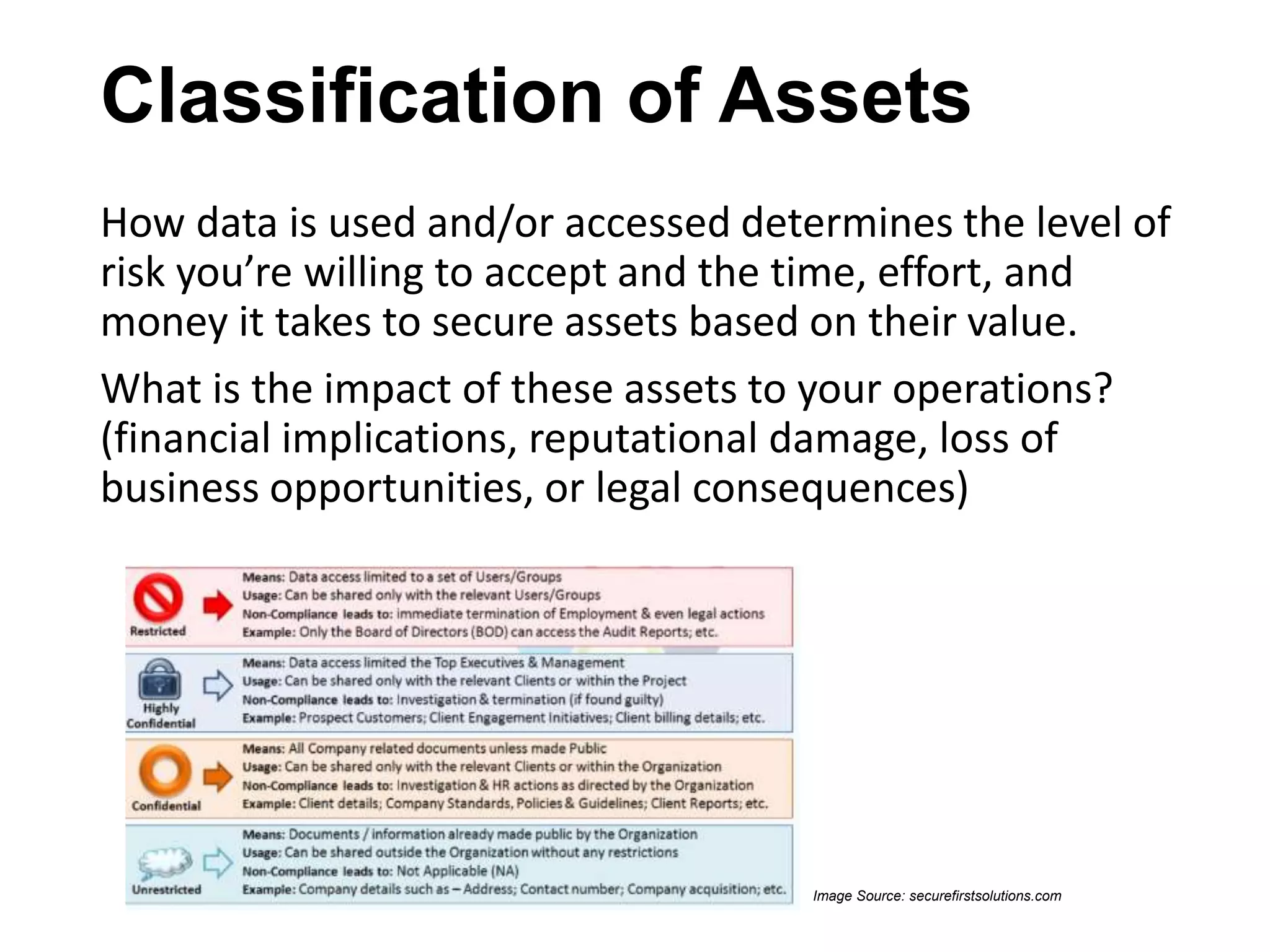
Classification of Assets
How data is used and/or accessed determines the level of
risk you’re willing to accept and the time, effort, and
money it takes to secure assets based on their value.
What is the impact of these assets to your operations?
(financial implications, reputational damage, loss of
business opportunities, or legal consequences)
Image Source: securefirstsolutions.com
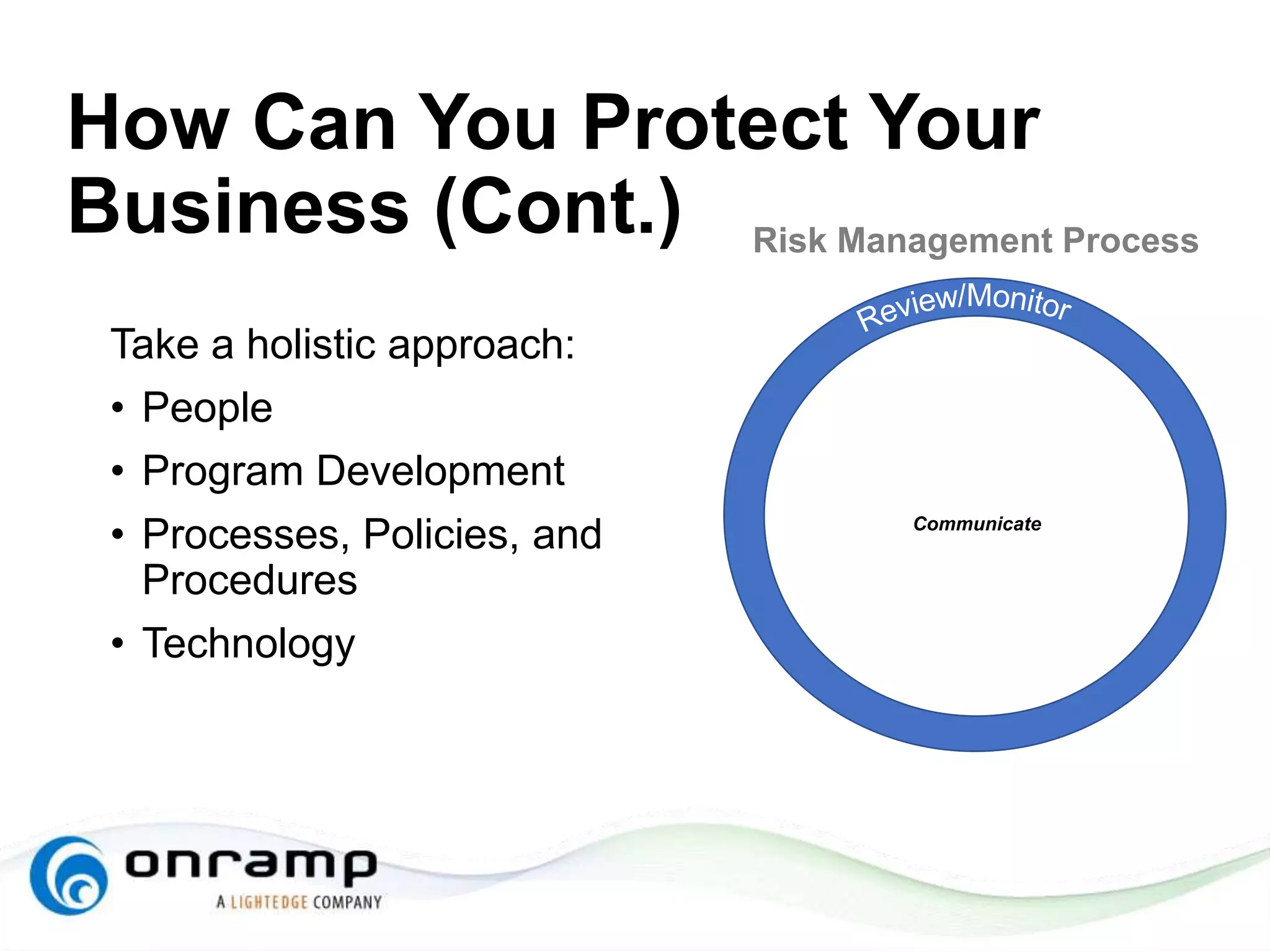
How Can You Protect Your
Business (Cont.)
Take a holistic approach:
• People
• Program Development
• Processes, Policies, and
Procedures
• Technology
Risk Management Process
Communicate
People
• Conduct Employee Training (at least once per year)
• General Training
• Group-Specific Training
• Manage roles and identities
• Use gamification of security awareness to develop a culture of
security
Your employees are either your greatest asset or weakest
link! 47% of data breaches are caused by employee
negligence. For example, weak, stolen or reused passwords
cause 81% of breaches.
SecuirtyMagazine.com
InfoSecurityMagazine.com
Develop an Information Security
Management Program
• System with built in maturity assessment and
measurement of control effectiveness. SANS top 20,
ISO 27001, are a good place to start.
• Creates a minimum bench mark for operation and also
sets a target for compliance and remediation. The
program must be backed up with a minimum
technology security baseline program.
• Create a security score card
Processes, Policies, &
Procedures
Focus on user centric security and audit operational and business
processes. Be sure to enforce policies once they’re developed:
• I.e. Data Classification Policy, DLP, Acceptable Use Policy,
Change Management Policy, Remote Access Policy,
Remote Access Policy, Password Policy
• Implement controls that prevent issues before they occur:
• I.e. Network Segmentation, Access Control
• Perform periodic security assessments/audits with penetration
testing
• Be prepared for incidents: Conduct simulations, including
incident response
Technology
Choose tools that assist in managing
the risks of your business services -
defense, monitoring, threat awareness,
visibility and automation.
Detection
Response
Prevention
Redundancy is also key. Use data backups and implement
a disaster recovery plan
•Data encryption in transit and at rest
•Firewalls
•Identity and access management
•Multi-factor authentication
•Cloud encryption
•Audit logs showing access to data
•Vulnerability scanning, intrusion
detection/prevention
•Hardware and OS patching
•Security Audits
•Security Information & Event Management
(SIEM)
SMB Case Studies
Code Spaces: a former SaaS provider
Attacked via DDoS through its Amazon Cloud control panel. Hackers erased data,
backups, offsite backups, & configurations before extorting the business by claiming
a fee to resolve their issues. Code Spaces was unable to resolve the issue and repay
customers. Code Spaces was unable to continue operations and closed.
Medium-sized Retail Organization
Organization had a very robust Cyber-security plan with a tested DR
plan. A key vendor of the organization, while going through integration
work, was successfully attacked with ransomware. The security
posturing of ABC Company prevented the attack from entering ABC’s
systems, the vendor attack took out operations for over two weeks. The
final cost to the vendor is still being determined but ABC company lost
close to half a million dollars because of the impact to the day to day
operations
Nearly 60% of small businesses that fail within six months of being hacked.
Vendor Assessment
Security
Understands
Your Business
Goals
Credentials &
Certifications
Service Level
Agreements (SLAs)
Meets Your BAA
Requirements (If
applicable)
Expertise in Your
Industry
Availability &
Scalability
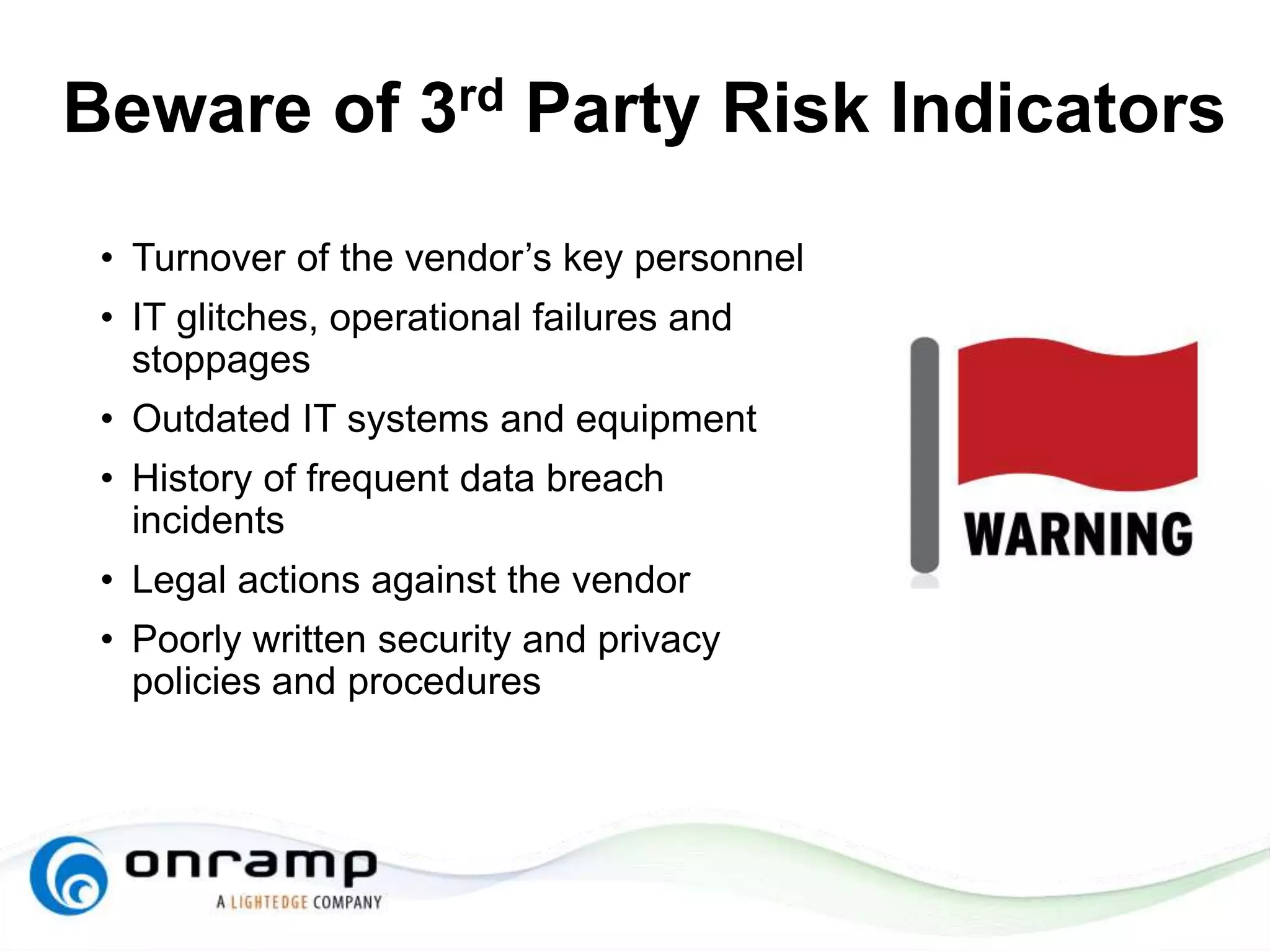
Beware of 3rd Party Risk Indicators
• Turnover of the vendor’s key personnel
• IT glitches, operational failures and
stoppages
• Outdated IT systems and equipment
• History of frequent data breach
incidents
• Legal actions against the vendor
• Poorly written security and privacy
policies and procedures
Thank you! Questions?
Contact Us
Nikola Todev
Head of Info Sec
OnRamp
Ntodev@lightedge.com
Nemi George
Sr. Director of Info Sec
& Service Operations,
Pacific Dental Services
Nemi.George@pacden.
com
Terry McDaniel
Vice President of IT &
Executive
Source Power and Gas
tmcdaniel@spgenergy.com

Too Small to Get Hacked? Think Again (Webinar)

  • 1.
    Too Small toGet Hacked? Think Again. Actionable Strategies to Protect your SMB
  • 2.
    Agenda • Introductions • TheCurrent Security Landscape • Most Common Types of Threats & Cyberattacks • How to Prevent the Most Common Types of Threats (at any budget) • Why and How Engage with Vendors • Q&A
  • 3.
    Meet the Speakers NikolaTodev Head of Info Sec OnRamp Nemi George Sr. Director of Info Sec & Service Operations, Pacific Dental Services Terry McDaniel Vice President of IT & Executive Source Power and Gas
  • 4.
    About OnRamp OnRamp, aLightEdge company, offers HITRUST-certified data center services with a focus on delivering highly available and secure hybrid hosting. The combination of OnRamp and LightEdge creates the strongest compliance and security solutions portfolio on the market. Together, they operate 7 enterprise-class data centers to deploy cloud computing, colocation, disaster recovery and managed services.
  • 5.
    About Source Power &Gas Source Power & Gas is a Texas-based retail energy provider with retail operations in the Texas, Illinois, Ohio, Maryland and New Jersey markets. We pride ourselves on providing both competitive rates and exceptional customer service to all our customers - from residential consumers to the largest commercial and industrial clients. More at www.spgenergy.com
  • 6.
    About Pacific Dental Services Foundedin 1994, Pacific Dental Services® (PDS®) is one of the country’s leading dental support organizations, providing supported autonomy that enables dentists to concentrate on clinical excellence and the highest levels of cost-effective comprehensive patient care. PDS originated the PRIVATE PRACTICE+® model to enable dentists to focus on their passion: serving patients. More at www.pacificdentalservices.com
  • 7.
  • 8.
    58% all cyberattackstarget small businesses 2018 Verizon Data Breach Investigations Report (DBIR) 2018 Cost of a Data Breach Study by Ponemon The average total cost of a data breach reached $3.86 million in 2018 27.9% $4M 2018 Likelihood of a recurring material breach over the next two years: The Current Landscape
  • 9.
    What is aCyberthreat? • External Threats – I.e. Social Engineering • Insider Threats – I.e. Employee maliciously sells login credentials to access valuable info Types of Cyberthreats The possibility of a malicious attempt to damage or disrupt a computer network or system with the intention to access files or steal data.
  • 10.
    Most Common Typesof Cyberattacks 1. Denial-of-service (DoS) and distributed denial-of-service (DDoS) attacks 2. Man-in-the-middle (MitM) attack 3. Phishing and spear phishing attacks 4. Drive-by attack 5. Password attack 6. SQL injection attack 7. Cross-site scripting (XSS) attack 8. Eavesdropping attack 9. Birthday attack 10. Malware attack netwrix.com 2018 thebestvpn.com 1 in 131 emails contains a malware
  • 11.
  • 12.
    How Can YouProtect Your Business? • Perform analysis of the value of your assets. Which assets are worth protecting? • Understand how your business services interact with the customers • Develop goals for managing risks, security and compliance • Implement an Information Security Management Program and Governance • Determine what resources are available to achieve goals. Will you need the assistance of outside vendors?
  • 13.
    Classification of Assets Howdata is used and/or accessed determines the level of risk you’re willing to accept and the time, effort, and money it takes to secure assets based on their value. What is the impact of these assets to your operations? (financial implications, reputational damage, loss of business opportunities, or legal consequences) Image Source: securefirstsolutions.com
  • 14.
    How Can YouProtect Your Business (Cont.) Take a holistic approach: • People • Program Development • Processes, Policies, and Procedures • Technology Risk Management Process Communicate
  • 15.
    People • Conduct EmployeeTraining (at least once per year) • General Training • Group-Specific Training • Manage roles and identities • Use gamification of security awareness to develop a culture of security Your employees are either your greatest asset or weakest link! 47% of data breaches are caused by employee negligence. For example, weak, stolen or reused passwords cause 81% of breaches. SecuirtyMagazine.com InfoSecurityMagazine.com
  • 16.
    Develop an InformationSecurity Management Program • System with built in maturity assessment and measurement of control effectiveness. SANS top 20, ISO 27001, are a good place to start. • Creates a minimum bench mark for operation and also sets a target for compliance and remediation. The program must be backed up with a minimum technology security baseline program. • Create a security score card
  • 17.
    Processes, Policies, & Procedures Focuson user centric security and audit operational and business processes. Be sure to enforce policies once they’re developed: • I.e. Data Classification Policy, DLP, Acceptable Use Policy, Change Management Policy, Remote Access Policy, Remote Access Policy, Password Policy • Implement controls that prevent issues before they occur: • I.e. Network Segmentation, Access Control • Perform periodic security assessments/audits with penetration testing • Be prepared for incidents: Conduct simulations, including incident response
  • 18.
    Technology Choose tools thatassist in managing the risks of your business services - defense, monitoring, threat awareness, visibility and automation. Detection Response Prevention Redundancy is also key. Use data backups and implement a disaster recovery plan •Data encryption in transit and at rest •Firewalls •Identity and access management •Multi-factor authentication •Cloud encryption •Audit logs showing access to data •Vulnerability scanning, intrusion detection/prevention •Hardware and OS patching •Security Audits •Security Information & Event Management (SIEM)
  • 19.
    SMB Case Studies CodeSpaces: a former SaaS provider Attacked via DDoS through its Amazon Cloud control panel. Hackers erased data, backups, offsite backups, & configurations before extorting the business by claiming a fee to resolve their issues. Code Spaces was unable to resolve the issue and repay customers. Code Spaces was unable to continue operations and closed. Medium-sized Retail Organization Organization had a very robust Cyber-security plan with a tested DR plan. A key vendor of the organization, while going through integration work, was successfully attacked with ransomware. The security posturing of ABC Company prevented the attack from entering ABC’s systems, the vendor attack took out operations for over two weeks. The final cost to the vendor is still being determined but ABC company lost close to half a million dollars because of the impact to the day to day operations Nearly 60% of small businesses that fail within six months of being hacked.
  • 20.
    Vendor Assessment Security Understands Your Business Goals Credentials& Certifications Service Level Agreements (SLAs) Meets Your BAA Requirements (If applicable) Expertise in Your Industry Availability & Scalability
  • 21.
    Beware of 3rdParty Risk Indicators • Turnover of the vendor’s key personnel • IT glitches, operational failures and stoppages • Outdated IT systems and equipment • History of frequent data breach incidents • Legal actions against the vendor • Poorly written security and privacy policies and procedures
  • 22.
  • 23.
    Contact Us Nikola Todev Headof Info Sec OnRamp Ntodev@lightedge.com Nemi George Sr. Director of Info Sec & Service Operations, Pacific Dental Services Nemi.George@pacden. com Terry McDaniel Vice President of IT & Executive Source Power and Gas tmcdaniel@spgenergy.com

Editor's Notes

  • #8 Do you currently have a plan in place to mitigate and contain an attack?
  • #9 How much time have you spent thinking about or how much money have you spent on Cyber-security. How many have a plan in place if they were hacked today What would happen if they were fined $100k by the government (use any number here). How would it impact your operations or would it force your business to close?
  • #10 Discuss the different between incident vs breach External – Give Examples Examples: Mass emails to employees posing as trusted persons or companies User clicks on a link and the malicious code is in the system Social engineering Attacker calls posing as IT to get you to give your login information Thumb drives left in public places with malicious code installed that auto-runs when plugged in to a computer Insider - Give Examples Employee maliciously gives/sells login information Employee loads code into system
  • #11 Denial of Service Attacks are the most common types of attacks, largely as they are performed externally and most times organizations do not realize they are under attack and put performance hits down to slow speeds, congestion, or end point issues. They are also the hardest to prevent, although once in action, they are fairly easy to address with the right tools and personnel. Man in the Middle (MitM) attacks are the 2nd most common, when a hijacker inserts itself between client – server communication. Phishing & Spear Phishing is the 3rd most common, but the 2nd most difficult to prevent as it relies on employee and user behavior. Phishing and other social engineering attacks are still the easiest and least expensive way to attack most organizations, and it is especially effective due to its scatter gun approach especially when it is used to distribute malware. How often do these occur?
  • #12 What barriers are keeping you from protecting your business and its assets?
  • #13 What is the value of assets, what are the threats to those assets (value, ownership, availability) Terry regarding goals: Deciding what industry standard to implement like ISO 27001, NIST, etc. Our goals in the most basic terms were, 1. Plan, (decide standard) 2. Assessment, 3. Fix critical, 4. Identify data criticality, 5. Develop and implement DR plan, 6. Implement SIEM with automation. Nikola regarding goals: Sample goals for managing risks, security and compliance include: Definition of levels of criticality above which we must act with a sense of urgency, authorization for risks above certain levels etc. Ability to control access to different level of assets Ability to monitor access to and usage of assets Ability to exchange sensitive assets with partners in a secure and confidential manner Ability to dispose of sensitive assets in a safe, unrecoverable manner Compliance with requirements of specific frameworks to enable business with specific entities
  • #14 This goes back to poll – if you said yes, but haven’t identified and classified your assets, you have a faulty cybersecurity plan!
  • #16 Employee negligence is the main cause of data breaches, according to a state of the industry report by Shred-it, an information security company. The report found that 47 percent of business leaders said human error such as accidental loss of a device or document by an employee had caused a data breach at their organization. Gamification: Running social campaigns such as USB drops, phishing simulation, are good practices to raise awareness and turn your greatest asset \ weakest link into security agents. Produce dashboards on outcomes of exercises – most phish prone department to least prone department; first 5 people to report phish mail, etc. reward with prices – can be a $25 voucher, a T Shirt, or just a mention in the weekly office memo / newsletter.
  • #18 Highlight a few of these policies
  • #21 Do you know where your data is being stored, processed or transmitted to? Who has access to your data? Do they work onshore / offshore? Is their organization regulated? Do they have logical and physical security controls? Do they have a named individual responsible for information security?, etc.
  • #22 Discuss the warning signs of a 3rd party that is struggling with their own security measures, and will likely put you at risk, too. It’s not impossible to determine like some organizations indicate across studies.