CYBER INCIDENT
TABLETOP
EXERCISE
Facilitated by: <insert name here>
FACILITATOR
• Tell about yourself
• Credentials
• Experiences
• Knowledge
• Notable achievements
• Something interesting about you
EXERCISE OBJECTIVES
• Increase cybersecurity awareness to senior officials of cyber risk management, cyber related
planning, and other issues related to cyber incident prevention, protection, response, and
recovery of critical systems.
• Assess cybersecurity integration into an organization’s all hazards preparedness.
• Examine cybersecurity incident information sharing, escalation criteria, and related courses of
action.
• Examine cybersecurity incident management structures.
• Review cyber resource request and management processes.
• The primary goal is to identify gaps in cybersecurity.
ASSUMPTIONS AND ARTIFICIALITIES
• This exercise will be conducted in a no-fault environment and will evaluate the existing plans,
policies, and procedure as if players were responding to a real-world emergency.
• Earnest effort has been made to create a plausible and realistic scenario to evaluate and validate
identified objectives.
• The exercise is not to be viewed as a test of inspections of individual performance.
• There is no hidden agenda and there are no trick questions.
• The timeline here does not reflect actual times – ransomware is known to start extremely quickly
as low as three seconds after the file has been executed.
• Realistically once the IT department has been notified the majority of the data has already
been encrypted.
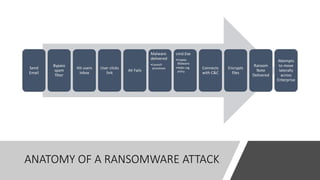
ANATOMY OF A RANSOMWARE ATTACK
Send
Email
Bypass
spam
filter
Hit users
inbox
User clicks
link
AV Fails
Malware
delivered
•Launch
processes
cmd.Exe
•Copies
Malware
•Adds reg
entry
Connects
with C&C
Encrypts
files
Ransom
Note
Delivered
Attempts
to move
laterally
across
Enterprise
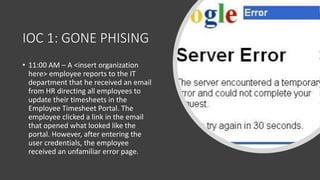
IOC 1: GONE PHISING
• 11:00 AM – A <insert organization
here> employee reports to the IT
department that he received an email
from HR directing all employees to
update their timesheets in the
Employee Timesheet Portal. The
employee clicked a link in the email
that opened what looked like the
portal. However, after entering the
user credentials, the employee
received an unfamiliar error page.
INCIDENT DISCUSSION QUESTIONS
• Do employees know what constitutes
suspicious cybersecurity activities or
incidents?
• Do they know what actions to take
when one arises?
• What established processes exist for
employees to report cybersecurity
incidents?
• Would any additional reports or
notifications be made? If so, are designated
points of contact identified?
• What incident severity level or tier is a
suspicious email?
ADDITIONAL QUESTIONS
• What training do you provide in support of your cybersecurity incident response plan, business
continuity plan, disaster recovery plan, emergency operations plan incident annex, or other
related plans?
• Does your organization provide basic cybersecurity and/or IT security awareness training to all IT
users (including managers and senior executives)?
• How often is training provided?
• Does it cover:
• General jurisdiction, department, and/or agency policy review
• Roles and responsibilities
• Password procedure
• Whom to contact and how to report suspected or suspicious activities?
…CONTINUED
• What security-related training does your organization provide to, or contractually require of:
• IT Managers
• System and Network Admins
• Vendors
• Other IT personnel having access to system-level software
• Discuss your organizations reporting mechanism.
• Discuss your organization’s intrusion detection capabilities and analytics that alert you to a cyber
incident.
THINGS TO CONSIDER
• User training – do users know what suspicious emails look like? Are you sure?
• User reporting – do users know how to report an email? Are you sure?
• Alerting and analysis – are there systems in place to notify IT of impending doom?
• Know your network – do you know what is accessible from each device?
• Inventory, heuristics
• ADKAR – five tangible and concrete outcomes that people need to achieve for lasting change
• AWARENESS of the need for change
• DESIRE to support the change
• KNOWLEDGE of how to change
• ABILITY to demonstrate skills and behaviors
• REINFORCEMENT to make the change stick
IOC 2: NOTICABLE
MASS MAILINGS
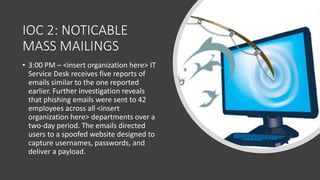
• 3:00 PM – <insert organization here> IT
Service Desk receives five reports of
emails similar to the one reported
earlier. Further investigation reveals
that phishing emails were sent to 42
employees across all <insert
organization here> departments over a
two-day period. The emails directed
users to a spoofed website designed to
capture usernames, passwords, and
deliver a payload.
INCIDENT DISCUSSION QUESTIONS
• What is the incident severity level or tier of
this incident once multiple spoofed emails
are reported? What would prompt a
change in tiers?
• What immediate remediation and
protective actions would be taken at your
organization?
• Who is responsible for those actions?
• Have these options been documented
in plans?
• How are they activated?
• Would any additional reports or
notifications be made? If so, are the
primary, secondary, and tertiary points of
contact identified?
ADDITIONAL QUESTIONS
• What are the requirements and/or processes to notify organization leadership of a cyber incident
at each severity tier?
• Are these criteria the same across the organization?
• What resources and capabilities are available to analyze the intrusions?
• Internally?
• Externally through government partners?
• Through the private sector?
…CONTINUED
• What is the role of cybersecurity in contracts with third-party support vendors and crucial
suppliers.
• Have you discussed these types of concerns and risks with them?
• What mechanisms and products are used to share cyber threat information within your
organization and external to your organization (e.g. distribution lists, information sharing portals,
broadcast messaging)?
THINGS TO CONSIDER
• Does your IT team have an offline disaster recovery plan?
• Do you have a cybersecurity strategic plan?
• Cybersecurity policies
• Do you conduct regular internal security meetings?
• Do you conduct regular cybersecurity awareness trainings?
• Do you have an incident response plan?
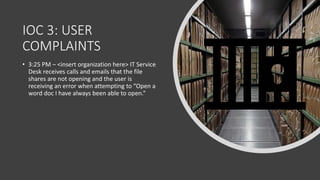
IOC 3: USER
COMPLAINTS
• 3:25 PM – <insert organization here> IT Service
Desk receives calls and emails that the file
shares are not opening and the user is
receiving an error when attempting to “Open a
word doc I have always been able to open.”
INCIDENT DISCUSSION QUESTIONS
• What immediate remediation actions
would be taken?
• Who is responsible for those actions?
• Are redundant systems in place if the
impacted system is compromised?
• What is the incident severity tier of this
event?
ADDITIONAL QUESTIONS
• Do you have defined cybersecurity incident escalation criteria, notifications, activations, and/or
courses of action?
• If so, what actions would be taken at this point? By who?
• Who would this incident be reported to?
• Would any additional reports or notifications be made (e.g., to law enforcement for reasons
related to public safety)?
• Are points of contact identified?
• Would leadership be notified?
• Does the organization report cybersecurity incidents to outside organizations? If so, to
whom?
• What, if any, mandatory reporting requirements do you have?
• Are these criteria the same across the organization?
…CONTINUED
• What immediate protection and mitigation actions would be taken? Who is responsible for those
actions?
• What, if any, mandatory reporting requirements do you have? Are additional reporting
requirements in place for the loss of personally identifiable information (PII)?
• At what point in the scenario would you contact law enforcement?
• Law enforcement relationships
• What are your expectations of state and federal government?
• Are processes and resources in place for evidence preservation and collection?
THINGS TO CONSIDER
• Be prepared, an incident can happen at any time.
• Test your backups
• Test your response plan – being ready for the event know knowing the actions you need to take are key
to restoration efforts
• Do a simulation event
• There are no surefire ways to defend, only ways of mitigation
• Assess your vulnerabilities
• Know your risks
• Risks can be taken, have a plan for each risk you accept.
• Business continuity plan
• How will you sustain while systems are being restored?
• What is your mean time to repair?
• Identify CRITICAL systems
HOT WASH REPORT
• List the top three organizational strengths.
• List the top three organizational items requiring improvement.
• Set a plan to meet to discuss improvement strategies
• Develop highest needs
• Create a completable list of all improvements needed.
• Assign tasks and set expectations, goals, and timelines.
• Consider funding needed, funding sources
• Hot wash remarks/comments.

cyber security incident exercises TTX .ppt

  • 1.
  • 2.
    FACILITATOR • Tell aboutyourself • Credentials • Experiences • Knowledge • Notable achievements • Something interesting about you
  • 3.
    EXERCISE OBJECTIVES • Increasecybersecurity awareness to senior officials of cyber risk management, cyber related planning, and other issues related to cyber incident prevention, protection, response, and recovery of critical systems. • Assess cybersecurity integration into an organization’s all hazards preparedness. • Examine cybersecurity incident information sharing, escalation criteria, and related courses of action. • Examine cybersecurity incident management structures. • Review cyber resource request and management processes. • The primary goal is to identify gaps in cybersecurity.
  • 4.
    ASSUMPTIONS AND ARTIFICIALITIES •This exercise will be conducted in a no-fault environment and will evaluate the existing plans, policies, and procedure as if players were responding to a real-world emergency. • Earnest effort has been made to create a plausible and realistic scenario to evaluate and validate identified objectives. • The exercise is not to be viewed as a test of inspections of individual performance. • There is no hidden agenda and there are no trick questions. • The timeline here does not reflect actual times – ransomware is known to start extremely quickly as low as three seconds after the file has been executed. • Realistically once the IT department has been notified the majority of the data has already been encrypted.
  • 5.
    ANATOMY OF ARANSOMWARE ATTACK Send Email Bypass spam filter Hit users inbox User clicks link AV Fails Malware delivered •Launch processes cmd.Exe •Copies Malware •Adds reg entry Connects with C&C Encrypts files Ransom Note Delivered Attempts to move laterally across Enterprise
  • 6.
    IOC 1: GONEPHISING • 11:00 AM – A <insert organization here> employee reports to the IT department that he received an email from HR directing all employees to update their timesheets in the Employee Timesheet Portal. The employee clicked a link in the email that opened what looked like the portal. However, after entering the user credentials, the employee received an unfamiliar error page.
  • 7.
    INCIDENT DISCUSSION QUESTIONS •Do employees know what constitutes suspicious cybersecurity activities or incidents? • Do they know what actions to take when one arises? • What established processes exist for employees to report cybersecurity incidents? • Would any additional reports or notifications be made? If so, are designated points of contact identified? • What incident severity level or tier is a suspicious email?
  • 8.
    ADDITIONAL QUESTIONS • Whattraining do you provide in support of your cybersecurity incident response plan, business continuity plan, disaster recovery plan, emergency operations plan incident annex, or other related plans? • Does your organization provide basic cybersecurity and/or IT security awareness training to all IT users (including managers and senior executives)? • How often is training provided? • Does it cover: • General jurisdiction, department, and/or agency policy review • Roles and responsibilities • Password procedure • Whom to contact and how to report suspected or suspicious activities?
  • 9.
    …CONTINUED • What security-relatedtraining does your organization provide to, or contractually require of: • IT Managers • System and Network Admins • Vendors • Other IT personnel having access to system-level software • Discuss your organizations reporting mechanism. • Discuss your organization’s intrusion detection capabilities and analytics that alert you to a cyber incident.
  • 10.
    THINGS TO CONSIDER •User training – do users know what suspicious emails look like? Are you sure? • User reporting – do users know how to report an email? Are you sure? • Alerting and analysis – are there systems in place to notify IT of impending doom? • Know your network – do you know what is accessible from each device? • Inventory, heuristics • ADKAR – five tangible and concrete outcomes that people need to achieve for lasting change • AWARENESS of the need for change • DESIRE to support the change • KNOWLEDGE of how to change • ABILITY to demonstrate skills and behaviors • REINFORCEMENT to make the change stick
  • 11.
    IOC 2: NOTICABLE MASSMAILINGS • 3:00 PM – <insert organization here> IT Service Desk receives five reports of emails similar to the one reported earlier. Further investigation reveals that phishing emails were sent to 42 employees across all <insert organization here> departments over a two-day period. The emails directed users to a spoofed website designed to capture usernames, passwords, and deliver a payload.
  • 12.
    INCIDENT DISCUSSION QUESTIONS •What is the incident severity level or tier of this incident once multiple spoofed emails are reported? What would prompt a change in tiers? • What immediate remediation and protective actions would be taken at your organization? • Who is responsible for those actions? • Have these options been documented in plans? • How are they activated? • Would any additional reports or notifications be made? If so, are the primary, secondary, and tertiary points of contact identified?
  • 13.
    ADDITIONAL QUESTIONS • Whatare the requirements and/or processes to notify organization leadership of a cyber incident at each severity tier? • Are these criteria the same across the organization? • What resources and capabilities are available to analyze the intrusions? • Internally? • Externally through government partners? • Through the private sector?
  • 14.
    …CONTINUED • What isthe role of cybersecurity in contracts with third-party support vendors and crucial suppliers. • Have you discussed these types of concerns and risks with them? • What mechanisms and products are used to share cyber threat information within your organization and external to your organization (e.g. distribution lists, information sharing portals, broadcast messaging)?
  • 15.
    THINGS TO CONSIDER •Does your IT team have an offline disaster recovery plan? • Do you have a cybersecurity strategic plan? • Cybersecurity policies • Do you conduct regular internal security meetings? • Do you conduct regular cybersecurity awareness trainings? • Do you have an incident response plan?
  • 16.
    IOC 3: USER COMPLAINTS •3:25 PM – <insert organization here> IT Service Desk receives calls and emails that the file shares are not opening and the user is receiving an error when attempting to “Open a word doc I have always been able to open.”
  • 17.
    INCIDENT DISCUSSION QUESTIONS •What immediate remediation actions would be taken? • Who is responsible for those actions? • Are redundant systems in place if the impacted system is compromised? • What is the incident severity tier of this event?
  • 18.
    ADDITIONAL QUESTIONS • Doyou have defined cybersecurity incident escalation criteria, notifications, activations, and/or courses of action? • If so, what actions would be taken at this point? By who? • Who would this incident be reported to? • Would any additional reports or notifications be made (e.g., to law enforcement for reasons related to public safety)? • Are points of contact identified? • Would leadership be notified? • Does the organization report cybersecurity incidents to outside organizations? If so, to whom? • What, if any, mandatory reporting requirements do you have? • Are these criteria the same across the organization?
  • 19.
    …CONTINUED • What immediateprotection and mitigation actions would be taken? Who is responsible for those actions? • What, if any, mandatory reporting requirements do you have? Are additional reporting requirements in place for the loss of personally identifiable information (PII)? • At what point in the scenario would you contact law enforcement? • Law enforcement relationships • What are your expectations of state and federal government? • Are processes and resources in place for evidence preservation and collection?
  • 20.
    THINGS TO CONSIDER •Be prepared, an incident can happen at any time. • Test your backups • Test your response plan – being ready for the event know knowing the actions you need to take are key to restoration efforts • Do a simulation event • There are no surefire ways to defend, only ways of mitigation • Assess your vulnerabilities • Know your risks • Risks can be taken, have a plan for each risk you accept. • Business continuity plan • How will you sustain while systems are being restored? • What is your mean time to repair? • Identify CRITICAL systems
  • 21.
    HOT WASH REPORT •List the top three organizational strengths. • List the top three organizational items requiring improvement. • Set a plan to meet to discuss improvement strategies • Develop highest needs • Create a completable list of all improvements needed. • Assign tasks and set expectations, goals, and timelines. • Consider funding needed, funding sources • Hot wash remarks/comments.