© Copyright Red Tiger Security – Do not print or distribute without consent.web: redtigersecurity.com 1
Implementing a Strategic
Roadmap for Securing Critical
Infrastructure Levering NIST CSF
Jonathan Pollet and Mark Heard
Red Tiger Security
S4x15
© Copyright Red Tiger Security – Do not print or distribute without consent.web: redtigersecurity.com
Jonathan Pollet – CISSP, PCIP, CAP
2
•  15 Years of Electrical Engineering, SCADA, Industrial Controls, and IT
Experience
•  PLC Programming and SCADA System Design and Commissioning
•  Wireless RF and Telecommunications Design and Startup
•  Front-end Web Development for SCADA data
•  Backend Database design for SCADA data
•  Acting CIO for Major Oil Company for 2 years – Enterprise IT Management
•  Last 12 Years Focused on SCADA and IT Security
•  Published White Papers on SCADA Security early in 2001
•  Focused research and standards development for SCADA Security since 2002
•  Conducted over 250 security assessments on Critical Infrastructure systems
•  Conducted over 150 International conferences and workshops on CIP
•  Developed safe security assessment methodology for live SCADA Systems
•  Co-developed the SCADA Security Advanced 5-day training course
•  Trained over 2500 Professionals Globally
•  Featured presenter on Fox News Live, Vanity Fair, Popular Mechanics, CIO Magazine, and several security
publications
© Copyright Red Tiger Security – Do not print or distribute without consent.web: redtigersecurity.com
Mark Heard
3
•  30+ Years of Electrical Engineering, SCADA, Industrial Controls, and
IT Experience
•  Control System Engineer and IT Security work for Eastman Chemical
Company
•  Experience with several kinds of automation systems, especially
networking with other plant systems
•  General interest in security and admin issues for ICS
•  Last 10+ Years Focused on Industrial Control Systems Security
•  ISA 99 Working Group
•  ACC Cyber Security Program (formerly through ChemITC and CIDX)
•  DHS Process Control Systems Forum and ICS Joint Working Group
•  Chemical Sector Roadmap Implementation Working Group
© Copyright Red Tiger Security – Do not print or distribute without consent.web: redtigersecurity.com
Outline
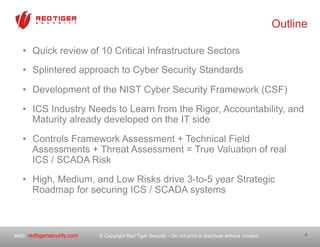
•  Quick review of 10 Critical Infrastructure Sectors
•  Splintered approach to Cyber Security Standards
•  Development of the NIST Cyber Security Framework (CSF)
•  ICS Industry Needs to Learn from the Rigor, Accountability, and
Maturity already developed on the IT side
•  Controls Framework Assessment + Technical Field
Assessments + Threat Assessment = True Valuation of real
ICS / SCADA Risk
•  High, Medium, and Low Risks drive 3-to-5 year Strategic
Roadmap for securing ICS / SCADA systems
4
© Copyright Red Tiger Security – Do not print or distribute without consent.web: redtigersecurity.com
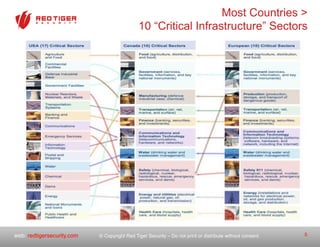
Most Countries >
10 “Critical Infrastructure” Sectors
5
!
© Copyright Red Tiger Security – Do not print or distribute without consent.web: redtigersecurity.com
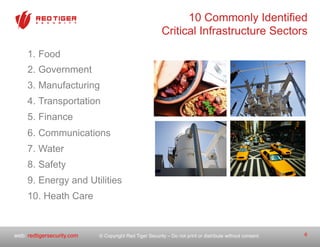
10 Commonly Identified
Critical Infrastructure Sectors
1.  Food
2.  Government
3.  Manufacturing
4.  Transportation
5.  Finance
6.  Communications
7.  Water
8.  Safety
9.  Energy and Utilities
10. Heath Care
6
© Copyright Red Tiger Security – Do not print or distribute without consent.web: redtigersecurity.com
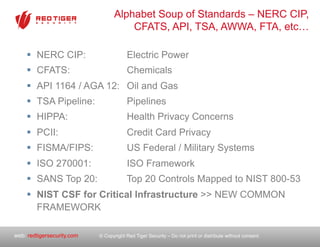
Alphabet Soup of Standards – NERC CIP,
CFATS, API, TSA, AWWA, FTA, etc…
§  NERC CIP: Electric Power
§  CFATS: Chemicals
§  API 1164 / AGA 12: Oil and Gas
§  TSA Pipeline: Pipelines
§  HIPPA: Health Privacy Concerns
§  PCII: Credit Card Privacy
§  FISMA/FIPS: US Federal / Military Systems
§  ISO 270001: ISO Framework
§  SANS Top 20: Top 20 Controls Mapped to NIST 800-53
§  NIST CSF for Critical Infrastructure >> NEW COMMON
FRAMEWORK
© Copyright Red Tiger Security – Do not print or distribute without consent.web: redtigersecurity.com
NIST CSF for Critical Infrastructure
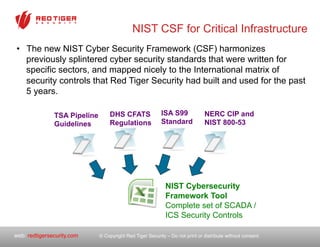
•  The new NIST Cyber Security Framework (CSF) harmonizes
previously splintered cyber security standards that were written for
specific sectors, and mapped nicely to the International matrix of
security controls that Red Tiger Security had built and used for the past
5 years.
TSA Pipeline
Guidelines
DHS CFATS
Regulations
ISA S99
Standard
NERC CIP and
NIST 800-53
NIST Cybersecurity
Framework Tool
Complete set of SCADA /
ICS Security Controls
© Copyright Red Tiger Security – Do not print or distribute without consent.web: redtigersecurity.com
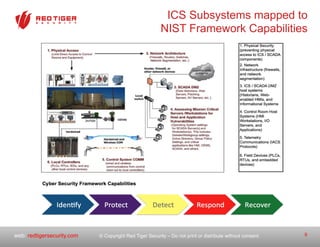
ICS Subsystems mapped to
NIST Framework Capabilities
9
© Copyright Red Tiger Security – Do not print or distribute without consent.web: redtigersecurity.com
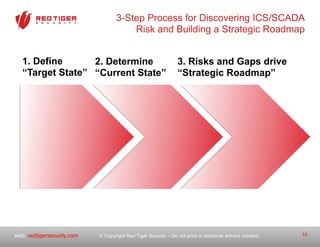
3-Step Process for Discovering ICS/SCADA
Risk and Building a Strategic Roadmap
10
1. Define
“Target State”
2. Determine
“Current State”
3. Risks and Gaps drive
“Strategic Roadmap”
© Copyright Red Tiger Security – Do not print or distribute without consent.web: redtigersecurity.com 11
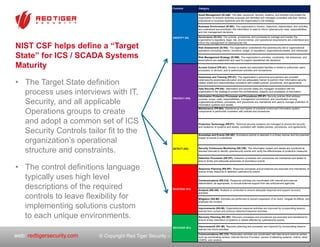
NIST CSF helps define a “Target
State” for ICS / SCADA Systems
Maturity
•  The Target State definition
process uses interviews with IT,
Security, and all applicable
Operations groups to create
and adopt a common set of ICS
Security Controls tailor fit to the
organization’s operational
structure and constraints.
•  The control definitions language
typically uses high level
descriptions of the required
controls to leave flexibility for
implementing solutions custom
to each unique environments.
Function Category
IDENTIFY (ID)
Asset Management (ID.AM): The data, personnel, devices, systems, and facilities that enable the
organization to achieve business purposes are identified and managed consistent with their relative
importance to business objectives and the organization’s risk strategy.
IDENTIFY (ID)
Business Environment (ID.BE): The organization’s mission, objectives, stakeholders, and activities
are understood and prioritized; this information is used to inform cybersecurity roles, responsibilities,
and risk management decisions.
IDENTIFY (ID) Governance (ID.GV): The policies, procedures, and processes to manage and monitor the
organization’s regulatory, legal, risk, environmental, and operational requirements are understood and
inform the management of cybersecurity risk.
Risk Assessment (ID.RA): The organization understands the cybersecurity risk to organizational
operations (including mission, functions, image, or reputation), organizational assets, and individuals.
IDENTIFY (ID)
Risk Management Strategy (ID.RM): The organization’s priorities, constraints, risk tolerances, and
assumptions are established and used to support operational risk decisions.
IDENTIFY (ID)
Access Control (PR.AC): Access to assets and associated facilities is limited to authorized users,
processes, or devices, and to authorized activities and transactions.
PROTECT (PR)
Access Control (PR.AC): Access to assets and associated facilities is limited to authorized users,
processes, or devices, and to authorized activities and transactions.
PROTECT (PR)
Awareness and Training (PR.AT): The organization’s personnel and partners are provided
cybersecurity awareness education and are adequately trained to perform their information security-
related duties and responsibilities consistent with related policies, procedures, and agreements.
PROTECT (PR)
Data Security (PR.DS): Information and records (data) are managed consistent with the
organization’s risk strategy to protect the confidentiality, integrity, and availability of information.
PROTECT (PR)
Information Protection Processes and Procedures (PR.IP): Security policies (that address
purpose, scope, roles, responsibilities, management commitment, and coordination among
organizational entities), processes, and procedures are maintained and used to manage protection of
information systems and assets.
PROTECT (PR)
Maintenance (PR.MA): Maintenance and repairs of industrial control and information system
components is performed consistent with policies and procedures.
PROTECT (PR)
Protective Technology (PR.PT): Technical security solutions are managed to ensure the security
and resilience of systems and assets, consistent with related policies, procedures, and agreements.
PROTECT (PR)PROTECT (PR)
Anomalies and Events (DE.AE): Anomalous activity is detected in a timely manner and the potential
impact of events is understood.
DETECT (DE) Security Continuous Monitoring (DE.CM): The information system and assets are monitored at
discrete intervals to identify cybersecurity events and verify the effectiveness of protective measures.
DETECT (DE)
Detection Processes (DE.DP): Detection processes and procedures are maintained and tested to
ensure timely and adequate awareness of anomalous events.
DETECT (DE)
Response Planning (RS.RP): Response processes and procedures are executed and maintained, to
ensure timely response to detected cybersecurity events.
RESPOND (RS)
Communications (RS.CO): Response activities are coordinated with internal and external
stakeholders, as appropriate, to include external support from law enforcement agencies.
RESPOND (RS) Analysis (RS.AN): Analysis is conducted to ensure adequate response and support recovery
activities.
RESPOND (RS)
Mitigation (RS.MI): Activities are performed to prevent expansion of an event, mitigate its effects, and
eradicate the incident.
RESPOND (RS)
Improvements (RS.IM): Organizational response activities are improved by incorporating lessons
learned from current and previous detection/response activities.
RESPOND (RS)
Improvements (RS.IM): Organizational response activities are improved by incorporating lessons
learned from current and previous detection/response activities.
RESPOND (RS)
Recovery Planning (RC.RP): Recovery processes and procedures are executed and maintained to
ensure timely restoration of systems or assets affected by cybersecurity events.
RECOVER (RC)
Improvements (RC.IM): Recovery planning and processes are improved by incorporating lessons
learned into future activities.
RECOVER (RC)
Communications (RC.CO): Restoration activities are coordinated with internal and external parties,
such as coordinating centers, Internet Service Providers, owners of attacking systems, victims, other
CSIRTs, and vendors.
RECOVER (RC)
© Copyright Red Tiger Security – Do not print or distribute without consent.web: redtigersecurity.com
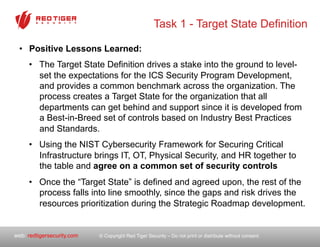
Task 1 - Target State Definition
•  Positive Lessons Learned:
•  The Target State Definition drives a stake into the ground to level-
set the expectations for the ICS Security Program Development,
and provides a common benchmark across the organization. The
process creates a Target State for the organization that all
departments can get behind and support since it is developed from
a Best-in-Breed set of controls based on Industry Best Practices
and Standards.
•  Using the NIST Cybersecurity Framework for Securing Critical
Infrastructure brings IT, OT, Physical Security, and HR together to
the table and agree on a common set of security controls
•  Once the “Target State” is defined and agreed upon, the rest of the
process falls into line smoothly, since the gaps and risk drives the
resources prioritization during the Strategic Roadmap development.
© Copyright Red Tiger Security – Do not print or distribute without consent.web: redtigersecurity.com
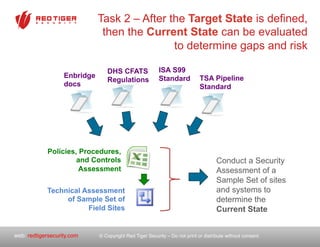
Task 2 – After the Target State is defined,
then the Current State can be evaluated
to determine gaps and risk
Technical Assessment
of Sample Set of
Field Sites
Conduct a Security
Assessment of a
Sample Set of sites
and systems to
determine the
Current State
Enbridge
docs
DHS CFATS
Regulations
ISA S99
Standard TSA Pipeline
Standard
Policies, Procedures,
and Controls
Assessment
© Copyright Red Tiger Security – Do not print or distribute without consent.web: redtigersecurity.com
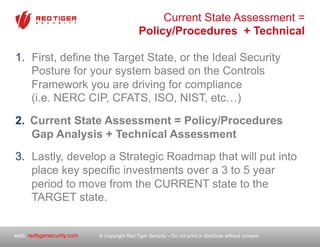
Current State Assessment =
Policy/Procedures + Technical
1.  First, define the Target State, or the Ideal Security
Posture for your system based on the Controls
Framework you are driving for compliance
(i.e. NERC CIP, CFATS, ISO, NIST, etc…)
2.  Current State Assessment = Policy/Procedures
Gap Analysis + Technical Assessment
3.  Lastly, develop a Strategic Roadmap that will put into
place key specific investments over a 3 to 5 year
period to move from the CURRENT state to the
TARGET state.
© Copyright Red Tiger Security – Do not print or distribute without consent.web: redtigersecurity.com
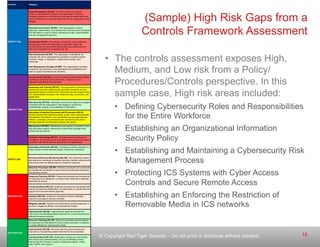
(Sample) High Risk Gaps from a
Controls Framework Assessment
15
Function Category
IDENTIFY (ID)
Asset Management (ID.AM): The data, personnel, devices,
systems, and facilities that enable the organization to achieve
business purposes are identified and managed consistent with their
relative importance to business objectives and the organization’s risk
strategy.
IDENTIFY (ID)
Business Environment (ID.BE): The organization’s mission,
objectives, stakeholders, and activities are understood and prioritized;
this information is used to inform cybersecurity roles, responsibilities,
and risk management decisions.
IDENTIFY (ID) Governance (ID.GV): The policies, procedures, and processes to
manage and monitor the organization’s regulatory, legal, risk,
environmental, and operational requirements are understood and
inform the management of cybersecurity risk.
Risk Assessment (ID.RA): The organization understands the
cybersecurity risk to organizational operations (including mission,
functions, image, or reputation), organizational assets, and
individuals.
IDENTIFY (ID)
Risk Management Strategy (ID.RM): The organization’s priorities,
constraints, risk tolerances, and assumptions are established and
used to support operational risk decisions.
IDENTIFY (ID)
Access Control (PR.AC): Access to assets and associated facilities
is limited to authorized users, processes, or devices, and to
authorized activities and transactions.
PROTECT (PR)
Access Control (PR.AC): Access to assets and associated facilities
is limited to authorized users, processes, or devices, and to
authorized activities and transactions.
Awareness and Training (PR.AT): The organization’s personnel and
partners are provided cybersecurity awareness education and are
adequately trained to perform their information security-related duties
and responsibilities consistent with related policies, procedures, and
agreements.
PROTECT (PR)
Data Security (PR.DS): Information and records (data) are managed
consistent with the organization’s risk strategy to protect the
confidentiality, integrity, and availability of information.
PROTECT (PR)
Data Security (PR.DS): Information and records (data) are managed
consistent with the organization’s risk strategy to protect the
confidentiality, integrity, and availability of information.
Information Protection Processes and Procedures (PR.IP):
Security policies (that address purpose, scope, roles, responsibilities,
management commitment, and coordination among organizational
entities), processes, and procedures are maintained and used to
manage protection of information systems and assets.
PROTECT (PR)
Maintenance (PR.MA): Maintenance and repairs of industrial control
and information system components is performed consistent with
policies and procedures.
PROTECT (PR)
Protective Technology (PR.PT): Technical security solutions are
managed to ensure the security and resilience of systems and assets,
consistent with related policies, procedures, and agreements.
PROTECT (PR)PROTECT (PR)
Anomalies and Events (DE.AE): Anomalous activity is detected in a
timely manner and the potential impact of events is understood.
DETECT (DE)DETECT (DE)
Security Continuous Monitoring (DE.CM): The information system
and assets are monitored at discrete intervals to identify cybersecurity
events and verify the effectiveness of protective measures.
DETECT (DE)
Detection Processes (DE.DP): Detection processes and procedures
are maintained and tested to ensure timely and adequate awareness
of anomalous events.
Security Continuous Monitoring (DE.CM): The information system
and assets are monitored at discrete intervals to identify cybersecurity
events and verify the effectiveness of protective measures.
DETECT (DE)
Response Planning (RS.RP): Response processes and procedures
are executed and maintained, to ensure timely response to detected
cybersecurity events.
RESPOND (RS)
Communications (RS.CO): Response activities are coordinated with
internal and external stakeholders, as appropriate, to include external
support from law enforcement agencies.
RESPOND (RS) Analysis (RS.AN): Analysis is conducted to ensure adequate
response and support recovery activities.
RESPOND (RS)
Mitigation (RS.MI): Activities are performed to prevent expansion of
an event, mitigate its effects, and eradicate the incident.
RESPOND (RS)
Improvements (RS.IM): Organizational response activities are
improved by incorporating lessons learned from current and previous
detection/response activities.
RESPOND (RS)
Improvements (RS.IM): Organizational response activities are
improved by incorporating lessons learned from current and previous
detection/response activities.
RESPOND (RS)
Recovery Planning (RC.RP): Recovery processes and procedures
are executed and maintained to ensure timely restoration of systems
or assets affected by cybersecurity events.
RECOVER (RC)
Improvements (RC.IM): Recovery planning and processes are
improved by incorporating lessons learned into future activities.
RECOVER (RC)
Communications (RC.CO): Restoration activities are coordinated
with internal and external parties, such as coordinating centers,
Internet Service Providers, owners of attacking systems, victims,
other CSIRTs, and vendors.
RECOVER (RC)
•  The controls assessment exposes High,
Medium, and Low risk from a Policy/
Procedures/Controls perspective. In this
sample case, High risk areas included:
•  Defining Cybersecurity Roles and Responsibilities
for the Entire Workforce
•  Establishing an Organizational Information
Security Policy
•  Establishing and Maintaining a Cybersecurity Risk
Management Process
•  Protecting ICS Systems with Cyber Access
Controls and Secure Remote Access
•  Establishing an Enforcing the Restriction of
Removable Media in ICS networks
© Copyright Red Tiger Security – Do not print or distribute without consent.web: redtigersecurity.com
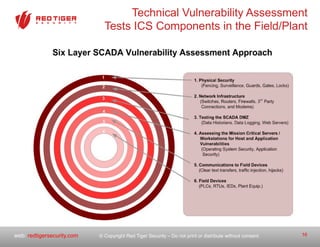
Technical Vulnerability Assessment
Tests ICS Components in the Field/Plant
16
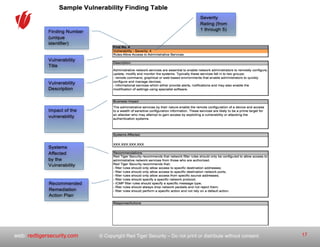
© Copyright Red Tiger Security – Do not print or distribute without consent.web: redtigersecurity.com 17
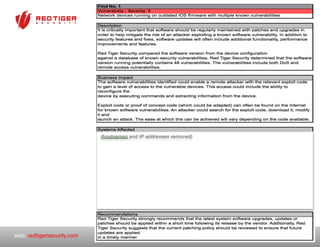
© Copyright Red Tiger Security – Do not print or distribute without consent.web: redtigersecurity.com 18
© Copyright Red Tiger Security – Do not print or distribute without consent.web: redtigersecurity.com
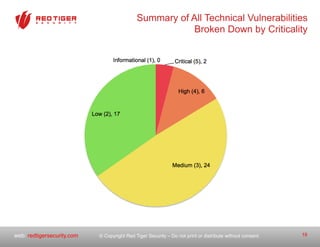
Summary of All Technical Vulnerabilities
Broken Down by Criticality
19
© Copyright Red Tiger Security – Do not print or distribute without consent.web: redtigersecurity.com
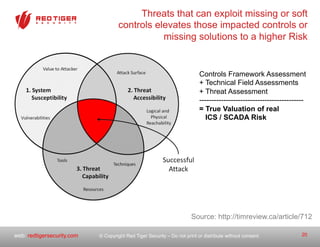
Threats that can exploit missing or soft
controls elevates those impacted controls or
missing solutions to a higher Risk
20
Source: http://timreview.ca/article/712
Controls Framework Assessment
+ Technical Field Assessments
+ Threat Assessment
-------------------------------------------
= True Valuation of real
ICS / SCADA Risk
© Copyright Red Tiger Security – Do not print or distribute without consent.web: redtigersecurity.com
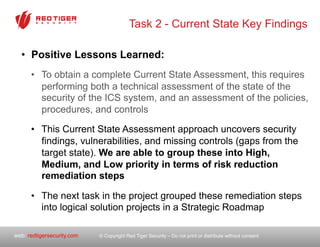
Task 2 - Current State Key Findings
•  Positive Lessons Learned:
•  To obtain a complete Current State Assessment, this requires
performing both a technical assessment of the state of the
security of the ICS system, and an assessment of the policies,
procedures, and controls
•  This Current State Assessment approach uncovers security
findings, vulnerabilities, and missing controls (gaps from the
target state). We are able to group these into High,
Medium, and Low priority in terms of risk reduction
remediation steps
•  The next task in the project grouped these remediation steps
into logical solution projects in a Strategic Roadmap
© Copyright Red Tiger Security – Do not print or distribute without consent.web: redtigersecurity.com
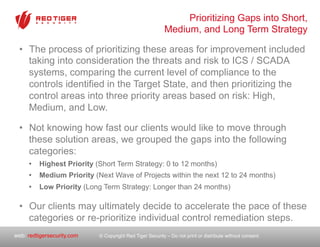
Prioritizing Gaps into Short,
Medium, and Long Term Strategy
•  The process of prioritizing these areas for improvement included
taking into consideration the threats and risk to ICS / SCADA
systems, comparing the current level of compliance to the
controls identified in the Target State, and then prioritizing the
control areas into three priority areas based on risk: High,
Medium, and Low.
•  Not knowing how fast our clients would like to move through
these solution areas, we grouped the gaps into the following
categories:
•  Highest Priority (Short Term Strategy: 0 to 12 months)
•  Medium Priority (Next Wave of Projects within the next 12 to 24 months)
•  Low Priority (Long Term Strategy: Longer than 24 months)
•  Our clients may ultimately decide to accelerate the pace of these
categories or re-prioritize individual control remediation steps.
© Copyright Red Tiger Security – Do not print or distribute without consent.web: redtigersecurity.com
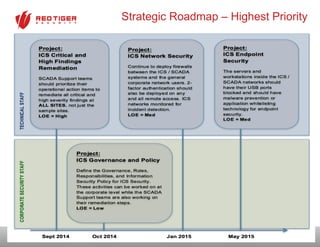
Strategic Roadmap – Highest Priority
23
© Copyright Red Tiger Security – Do not print or distribute without consent.web: redtigersecurity.com
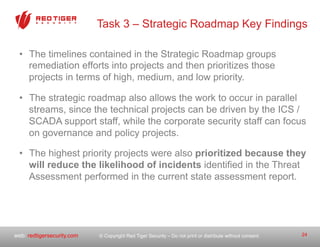
Task 3 – Strategic Roadmap Key Findings
•  The timelines contained in the Strategic Roadmap groups
remediation efforts into projects and then prioritizes those
projects in terms of high, medium, and low priority.
•  The strategic roadmap also allows the work to occur in parallel
streams, since the technical projects can be driven by the ICS /
SCADA support staff, while the corporate security staff can focus
on governance and policy projects.
•  The highest priority projects were also prioritized because they
will reduce the likelihood of incidents identified in the Threat
Assessment performed in the current state assessment report.
24
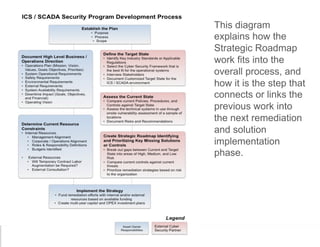
© Copyright Red Tiger Security – Do not print or distribute without consent.web: redtigersecurity.com 25
This diagram
explains how the
Strategic Roadmap
work fits into the
overall process, and
how it is the step that
connects or links the
previous work into
the next remediation
and solution
implementation
phase.
!
© Copyright Red Tiger Security – Do not print or distribute without consent.web: redtigersecurity.com
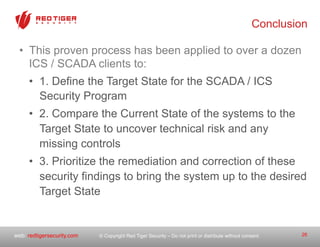
Conclusion
•  This proven process has been applied to over a dozen
ICS / SCADA clients to:
•  1. Define the Target State for the SCADA / ICS
Security Program
•  2. Compare the Current State of the systems to the
Target State to uncover technical risk and any
missing controls
•  3. Prioritize the remediation and correction of these
security findings to bring the system up to the desired
Target State
26
© Copyright Red Tiger Security – Do not print or distribute without consent.web: redtigersecurity.com
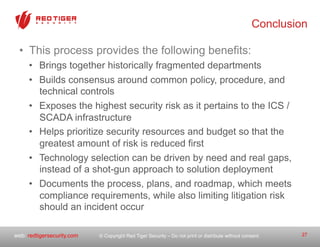
Conclusion
•  This process provides the following benefits:
•  Brings together historically fragmented departments
•  Builds consensus around common policy, procedure, and
technical controls
•  Exposes the highest security risk as it pertains to the ICS /
SCADA infrastructure
•  Helps prioritize security resources and budget so that the
greatest amount of risk is reduced first
•  Technology selection can be driven by need and real gaps,
instead of a shot-gun approach to solution deployment
•  Documents the process, plans, and roadmap, which meets
compliance requirements, while also limiting litigation risk
should an incident occur
27
© Copyright Red Tiger Security – Do not print or distribute without consent.web: redtigersecurity.com
Get More
Training and
Awareness
28
© Copyright Red Tiger Security – Do not print or distribute without consent.web: redtigersecurity.com 29
Contact Information:
Jonathan Pollet, CAP, CISSP, PCIP
Founder, Executive Director
Red Tiger Security
Mobile: +1.281.748.6401
Email: jpollet@redtigersecurity.com
Twitter: @jonpollet
Follow and link to us for industry updates and briefings:
www.redtigersecurity.com
www.twitter.com/redtigersec
www.facebook.com/redtigersec
www.linkedin.com/company/red-tiger-security

Lessons Learned from the NIST CSF

  • 1.
    © Copyright RedTiger Security – Do not print or distribute without consent.web: redtigersecurity.com 1 Implementing a Strategic Roadmap for Securing Critical Infrastructure Levering NIST CSF Jonathan Pollet and Mark Heard Red Tiger Security S4x15
  • 2.
    © Copyright RedTiger Security – Do not print or distribute without consent.web: redtigersecurity.com Jonathan Pollet – CISSP, PCIP, CAP 2 •  15 Years of Electrical Engineering, SCADA, Industrial Controls, and IT Experience •  PLC Programming and SCADA System Design and Commissioning •  Wireless RF and Telecommunications Design and Startup •  Front-end Web Development for SCADA data •  Backend Database design for SCADA data •  Acting CIO for Major Oil Company for 2 years – Enterprise IT Management •  Last 12 Years Focused on SCADA and IT Security •  Published White Papers on SCADA Security early in 2001 •  Focused research and standards development for SCADA Security since 2002 •  Conducted over 250 security assessments on Critical Infrastructure systems •  Conducted over 150 International conferences and workshops on CIP •  Developed safe security assessment methodology for live SCADA Systems •  Co-developed the SCADA Security Advanced 5-day training course •  Trained over 2500 Professionals Globally •  Featured presenter on Fox News Live, Vanity Fair, Popular Mechanics, CIO Magazine, and several security publications
  • 3.
    © Copyright RedTiger Security – Do not print or distribute without consent.web: redtigersecurity.com Mark Heard 3 •  30+ Years of Electrical Engineering, SCADA, Industrial Controls, and IT Experience •  Control System Engineer and IT Security work for Eastman Chemical Company •  Experience with several kinds of automation systems, especially networking with other plant systems •  General interest in security and admin issues for ICS •  Last 10+ Years Focused on Industrial Control Systems Security •  ISA 99 Working Group •  ACC Cyber Security Program (formerly through ChemITC and CIDX) •  DHS Process Control Systems Forum and ICS Joint Working Group •  Chemical Sector Roadmap Implementation Working Group
  • 4.
    © Copyright RedTiger Security – Do not print or distribute without consent.web: redtigersecurity.com Outline •  Quick review of 10 Critical Infrastructure Sectors •  Splintered approach to Cyber Security Standards •  Development of the NIST Cyber Security Framework (CSF) •  ICS Industry Needs to Learn from the Rigor, Accountability, and Maturity already developed on the IT side •  Controls Framework Assessment + Technical Field Assessments + Threat Assessment = True Valuation of real ICS / SCADA Risk •  High, Medium, and Low Risks drive 3-to-5 year Strategic Roadmap for securing ICS / SCADA systems 4
  • 5.
    © Copyright RedTiger Security – Do not print or distribute without consent.web: redtigersecurity.com Most Countries > 10 “Critical Infrastructure” Sectors 5 !
  • 6.
    © Copyright RedTiger Security – Do not print or distribute without consent.web: redtigersecurity.com 10 Commonly Identified Critical Infrastructure Sectors 1.  Food 2.  Government 3.  Manufacturing 4.  Transportation 5.  Finance 6.  Communications 7.  Water 8.  Safety 9.  Energy and Utilities 10. Heath Care 6
  • 7.
    © Copyright RedTiger Security – Do not print or distribute without consent.web: redtigersecurity.com Alphabet Soup of Standards – NERC CIP, CFATS, API, TSA, AWWA, FTA, etc… §  NERC CIP: Electric Power §  CFATS: Chemicals §  API 1164 / AGA 12: Oil and Gas §  TSA Pipeline: Pipelines §  HIPPA: Health Privacy Concerns §  PCII: Credit Card Privacy §  FISMA/FIPS: US Federal / Military Systems §  ISO 270001: ISO Framework §  SANS Top 20: Top 20 Controls Mapped to NIST 800-53 §  NIST CSF for Critical Infrastructure >> NEW COMMON FRAMEWORK
  • 8.
    © Copyright RedTiger Security – Do not print or distribute without consent.web: redtigersecurity.com NIST CSF for Critical Infrastructure •  The new NIST Cyber Security Framework (CSF) harmonizes previously splintered cyber security standards that were written for specific sectors, and mapped nicely to the International matrix of security controls that Red Tiger Security had built and used for the past 5 years. TSA Pipeline Guidelines DHS CFATS Regulations ISA S99 Standard NERC CIP and NIST 800-53 NIST Cybersecurity Framework Tool Complete set of SCADA / ICS Security Controls
  • 9.
    © Copyright RedTiger Security – Do not print or distribute without consent.web: redtigersecurity.com ICS Subsystems mapped to NIST Framework Capabilities 9
  • 10.
    © Copyright RedTiger Security – Do not print or distribute without consent.web: redtigersecurity.com 3-Step Process for Discovering ICS/SCADA Risk and Building a Strategic Roadmap 10 1. Define “Target State” 2. Determine “Current State” 3. Risks and Gaps drive “Strategic Roadmap”
  • 11.
    © Copyright RedTiger Security – Do not print or distribute without consent.web: redtigersecurity.com 11 NIST CSF helps define a “Target State” for ICS / SCADA Systems Maturity •  The Target State definition process uses interviews with IT, Security, and all applicable Operations groups to create and adopt a common set of ICS Security Controls tailor fit to the organization’s operational structure and constraints. •  The control definitions language typically uses high level descriptions of the required controls to leave flexibility for implementing solutions custom to each unique environments. Function Category IDENTIFY (ID) Asset Management (ID.AM): The data, personnel, devices, systems, and facilities that enable the organization to achieve business purposes are identified and managed consistent with their relative importance to business objectives and the organization’s risk strategy. IDENTIFY (ID) Business Environment (ID.BE): The organization’s mission, objectives, stakeholders, and activities are understood and prioritized; this information is used to inform cybersecurity roles, responsibilities, and risk management decisions. IDENTIFY (ID) Governance (ID.GV): The policies, procedures, and processes to manage and monitor the organization’s regulatory, legal, risk, environmental, and operational requirements are understood and inform the management of cybersecurity risk. Risk Assessment (ID.RA): The organization understands the cybersecurity risk to organizational operations (including mission, functions, image, or reputation), organizational assets, and individuals. IDENTIFY (ID) Risk Management Strategy (ID.RM): The organization’s priorities, constraints, risk tolerances, and assumptions are established and used to support operational risk decisions. IDENTIFY (ID) Access Control (PR.AC): Access to assets and associated facilities is limited to authorized users, processes, or devices, and to authorized activities and transactions. PROTECT (PR) Access Control (PR.AC): Access to assets and associated facilities is limited to authorized users, processes, or devices, and to authorized activities and transactions. PROTECT (PR) Awareness and Training (PR.AT): The organization’s personnel and partners are provided cybersecurity awareness education and are adequately trained to perform their information security- related duties and responsibilities consistent with related policies, procedures, and agreements. PROTECT (PR) Data Security (PR.DS): Information and records (data) are managed consistent with the organization’s risk strategy to protect the confidentiality, integrity, and availability of information. PROTECT (PR) Information Protection Processes and Procedures (PR.IP): Security policies (that address purpose, scope, roles, responsibilities, management commitment, and coordination among organizational entities), processes, and procedures are maintained and used to manage protection of information systems and assets. PROTECT (PR) Maintenance (PR.MA): Maintenance and repairs of industrial control and information system components is performed consistent with policies and procedures. PROTECT (PR) Protective Technology (PR.PT): Technical security solutions are managed to ensure the security and resilience of systems and assets, consistent with related policies, procedures, and agreements. PROTECT (PR)PROTECT (PR) Anomalies and Events (DE.AE): Anomalous activity is detected in a timely manner and the potential impact of events is understood. DETECT (DE) Security Continuous Monitoring (DE.CM): The information system and assets are monitored at discrete intervals to identify cybersecurity events and verify the effectiveness of protective measures. DETECT (DE) Detection Processes (DE.DP): Detection processes and procedures are maintained and tested to ensure timely and adequate awareness of anomalous events. DETECT (DE) Response Planning (RS.RP): Response processes and procedures are executed and maintained, to ensure timely response to detected cybersecurity events. RESPOND (RS) Communications (RS.CO): Response activities are coordinated with internal and external stakeholders, as appropriate, to include external support from law enforcement agencies. RESPOND (RS) Analysis (RS.AN): Analysis is conducted to ensure adequate response and support recovery activities. RESPOND (RS) Mitigation (RS.MI): Activities are performed to prevent expansion of an event, mitigate its effects, and eradicate the incident. RESPOND (RS) Improvements (RS.IM): Organizational response activities are improved by incorporating lessons learned from current and previous detection/response activities. RESPOND (RS) Improvements (RS.IM): Organizational response activities are improved by incorporating lessons learned from current and previous detection/response activities. RESPOND (RS) Recovery Planning (RC.RP): Recovery processes and procedures are executed and maintained to ensure timely restoration of systems or assets affected by cybersecurity events. RECOVER (RC) Improvements (RC.IM): Recovery planning and processes are improved by incorporating lessons learned into future activities. RECOVER (RC) Communications (RC.CO): Restoration activities are coordinated with internal and external parties, such as coordinating centers, Internet Service Providers, owners of attacking systems, victims, other CSIRTs, and vendors. RECOVER (RC)
  • 12.
    © Copyright RedTiger Security – Do not print or distribute without consent.web: redtigersecurity.com Task 1 - Target State Definition •  Positive Lessons Learned: •  The Target State Definition drives a stake into the ground to level- set the expectations for the ICS Security Program Development, and provides a common benchmark across the organization. The process creates a Target State for the organization that all departments can get behind and support since it is developed from a Best-in-Breed set of controls based on Industry Best Practices and Standards. •  Using the NIST Cybersecurity Framework for Securing Critical Infrastructure brings IT, OT, Physical Security, and HR together to the table and agree on a common set of security controls •  Once the “Target State” is defined and agreed upon, the rest of the process falls into line smoothly, since the gaps and risk drives the resources prioritization during the Strategic Roadmap development.
  • 13.
    © Copyright RedTiger Security – Do not print or distribute without consent.web: redtigersecurity.com Task 2 – After the Target State is defined, then the Current State can be evaluated to determine gaps and risk Technical Assessment of Sample Set of Field Sites Conduct a Security Assessment of a Sample Set of sites and systems to determine the Current State Enbridge docs DHS CFATS Regulations ISA S99 Standard TSA Pipeline Standard Policies, Procedures, and Controls Assessment
  • 14.
    © Copyright RedTiger Security – Do not print or distribute without consent.web: redtigersecurity.com Current State Assessment = Policy/Procedures + Technical 1.  First, define the Target State, or the Ideal Security Posture for your system based on the Controls Framework you are driving for compliance (i.e. NERC CIP, CFATS, ISO, NIST, etc…) 2.  Current State Assessment = Policy/Procedures Gap Analysis + Technical Assessment 3.  Lastly, develop a Strategic Roadmap that will put into place key specific investments over a 3 to 5 year period to move from the CURRENT state to the TARGET state.
  • 15.
    © Copyright RedTiger Security – Do not print or distribute without consent.web: redtigersecurity.com (Sample) High Risk Gaps from a Controls Framework Assessment 15 Function Category IDENTIFY (ID) Asset Management (ID.AM): The data, personnel, devices, systems, and facilities that enable the organization to achieve business purposes are identified and managed consistent with their relative importance to business objectives and the organization’s risk strategy. IDENTIFY (ID) Business Environment (ID.BE): The organization’s mission, objectives, stakeholders, and activities are understood and prioritized; this information is used to inform cybersecurity roles, responsibilities, and risk management decisions. IDENTIFY (ID) Governance (ID.GV): The policies, procedures, and processes to manage and monitor the organization’s regulatory, legal, risk, environmental, and operational requirements are understood and inform the management of cybersecurity risk. Risk Assessment (ID.RA): The organization understands the cybersecurity risk to organizational operations (including mission, functions, image, or reputation), organizational assets, and individuals. IDENTIFY (ID) Risk Management Strategy (ID.RM): The organization’s priorities, constraints, risk tolerances, and assumptions are established and used to support operational risk decisions. IDENTIFY (ID) Access Control (PR.AC): Access to assets and associated facilities is limited to authorized users, processes, or devices, and to authorized activities and transactions. PROTECT (PR) Access Control (PR.AC): Access to assets and associated facilities is limited to authorized users, processes, or devices, and to authorized activities and transactions. Awareness and Training (PR.AT): The organization’s personnel and partners are provided cybersecurity awareness education and are adequately trained to perform their information security-related duties and responsibilities consistent with related policies, procedures, and agreements. PROTECT (PR) Data Security (PR.DS): Information and records (data) are managed consistent with the organization’s risk strategy to protect the confidentiality, integrity, and availability of information. PROTECT (PR) Data Security (PR.DS): Information and records (data) are managed consistent with the organization’s risk strategy to protect the confidentiality, integrity, and availability of information. Information Protection Processes and Procedures (PR.IP): Security policies (that address purpose, scope, roles, responsibilities, management commitment, and coordination among organizational entities), processes, and procedures are maintained and used to manage protection of information systems and assets. PROTECT (PR) Maintenance (PR.MA): Maintenance and repairs of industrial control and information system components is performed consistent with policies and procedures. PROTECT (PR) Protective Technology (PR.PT): Technical security solutions are managed to ensure the security and resilience of systems and assets, consistent with related policies, procedures, and agreements. PROTECT (PR)PROTECT (PR) Anomalies and Events (DE.AE): Anomalous activity is detected in a timely manner and the potential impact of events is understood. DETECT (DE)DETECT (DE) Security Continuous Monitoring (DE.CM): The information system and assets are monitored at discrete intervals to identify cybersecurity events and verify the effectiveness of protective measures. DETECT (DE) Detection Processes (DE.DP): Detection processes and procedures are maintained and tested to ensure timely and adequate awareness of anomalous events. Security Continuous Monitoring (DE.CM): The information system and assets are monitored at discrete intervals to identify cybersecurity events and verify the effectiveness of protective measures. DETECT (DE) Response Planning (RS.RP): Response processes and procedures are executed and maintained, to ensure timely response to detected cybersecurity events. RESPOND (RS) Communications (RS.CO): Response activities are coordinated with internal and external stakeholders, as appropriate, to include external support from law enforcement agencies. RESPOND (RS) Analysis (RS.AN): Analysis is conducted to ensure adequate response and support recovery activities. RESPOND (RS) Mitigation (RS.MI): Activities are performed to prevent expansion of an event, mitigate its effects, and eradicate the incident. RESPOND (RS) Improvements (RS.IM): Organizational response activities are improved by incorporating lessons learned from current and previous detection/response activities. RESPOND (RS) Improvements (RS.IM): Organizational response activities are improved by incorporating lessons learned from current and previous detection/response activities. RESPOND (RS) Recovery Planning (RC.RP): Recovery processes and procedures are executed and maintained to ensure timely restoration of systems or assets affected by cybersecurity events. RECOVER (RC) Improvements (RC.IM): Recovery planning and processes are improved by incorporating lessons learned into future activities. RECOVER (RC) Communications (RC.CO): Restoration activities are coordinated with internal and external parties, such as coordinating centers, Internet Service Providers, owners of attacking systems, victims, other CSIRTs, and vendors. RECOVER (RC) •  The controls assessment exposes High, Medium, and Low risk from a Policy/ Procedures/Controls perspective. In this sample case, High risk areas included: •  Defining Cybersecurity Roles and Responsibilities for the Entire Workforce •  Establishing an Organizational Information Security Policy •  Establishing and Maintaining a Cybersecurity Risk Management Process •  Protecting ICS Systems with Cyber Access Controls and Secure Remote Access •  Establishing an Enforcing the Restriction of Removable Media in ICS networks
  • 16.
    © Copyright RedTiger Security – Do not print or distribute without consent.web: redtigersecurity.com Technical Vulnerability Assessment Tests ICS Components in the Field/Plant 16
  • 17.
    © Copyright RedTiger Security – Do not print or distribute without consent.web: redtigersecurity.com 17
  • 18.
    © Copyright RedTiger Security – Do not print or distribute without consent.web: redtigersecurity.com 18
  • 19.
    © Copyright RedTiger Security – Do not print or distribute without consent.web: redtigersecurity.com Summary of All Technical Vulnerabilities Broken Down by Criticality 19
  • 20.
    © Copyright RedTiger Security – Do not print or distribute without consent.web: redtigersecurity.com Threats that can exploit missing or soft controls elevates those impacted controls or missing solutions to a higher Risk 20 Source: http://timreview.ca/article/712 Controls Framework Assessment + Technical Field Assessments + Threat Assessment ------------------------------------------- = True Valuation of real ICS / SCADA Risk
  • 21.
    © Copyright RedTiger Security – Do not print or distribute without consent.web: redtigersecurity.com Task 2 - Current State Key Findings •  Positive Lessons Learned: •  To obtain a complete Current State Assessment, this requires performing both a technical assessment of the state of the security of the ICS system, and an assessment of the policies, procedures, and controls •  This Current State Assessment approach uncovers security findings, vulnerabilities, and missing controls (gaps from the target state). We are able to group these into High, Medium, and Low priority in terms of risk reduction remediation steps •  The next task in the project grouped these remediation steps into logical solution projects in a Strategic Roadmap
  • 22.
    © Copyright RedTiger Security – Do not print or distribute without consent.web: redtigersecurity.com Prioritizing Gaps into Short, Medium, and Long Term Strategy •  The process of prioritizing these areas for improvement included taking into consideration the threats and risk to ICS / SCADA systems, comparing the current level of compliance to the controls identified in the Target State, and then prioritizing the control areas into three priority areas based on risk: High, Medium, and Low. •  Not knowing how fast our clients would like to move through these solution areas, we grouped the gaps into the following categories: •  Highest Priority (Short Term Strategy: 0 to 12 months) •  Medium Priority (Next Wave of Projects within the next 12 to 24 months) •  Low Priority (Long Term Strategy: Longer than 24 months) •  Our clients may ultimately decide to accelerate the pace of these categories or re-prioritize individual control remediation steps.
  • 23.
    © Copyright RedTiger Security – Do not print or distribute without consent.web: redtigersecurity.com Strategic Roadmap – Highest Priority 23
  • 24.
    © Copyright RedTiger Security – Do not print or distribute without consent.web: redtigersecurity.com Task 3 – Strategic Roadmap Key Findings •  The timelines contained in the Strategic Roadmap groups remediation efforts into projects and then prioritizes those projects in terms of high, medium, and low priority. •  The strategic roadmap also allows the work to occur in parallel streams, since the technical projects can be driven by the ICS / SCADA support staff, while the corporate security staff can focus on governance and policy projects. •  The highest priority projects were also prioritized because they will reduce the likelihood of incidents identified in the Threat Assessment performed in the current state assessment report. 24
  • 25.
    © Copyright RedTiger Security – Do not print or distribute without consent.web: redtigersecurity.com 25 This diagram explains how the Strategic Roadmap work fits into the overall process, and how it is the step that connects or links the previous work into the next remediation and solution implementation phase. !
  • 26.
    © Copyright RedTiger Security – Do not print or distribute without consent.web: redtigersecurity.com Conclusion •  This proven process has been applied to over a dozen ICS / SCADA clients to: •  1. Define the Target State for the SCADA / ICS Security Program •  2. Compare the Current State of the systems to the Target State to uncover technical risk and any missing controls •  3. Prioritize the remediation and correction of these security findings to bring the system up to the desired Target State 26
  • 27.
    © Copyright RedTiger Security – Do not print or distribute without consent.web: redtigersecurity.com Conclusion •  This process provides the following benefits: •  Brings together historically fragmented departments •  Builds consensus around common policy, procedure, and technical controls •  Exposes the highest security risk as it pertains to the ICS / SCADA infrastructure •  Helps prioritize security resources and budget so that the greatest amount of risk is reduced first •  Technology selection can be driven by need and real gaps, instead of a shot-gun approach to solution deployment •  Documents the process, plans, and roadmap, which meets compliance requirements, while also limiting litigation risk should an incident occur 27
  • 28.
    © Copyright RedTiger Security – Do not print or distribute without consent.web: redtigersecurity.com Get More Training and Awareness 28
  • 29.
    © Copyright RedTiger Security – Do not print or distribute without consent.web: redtigersecurity.com 29 Contact Information: Jonathan Pollet, CAP, CISSP, PCIP Founder, Executive Director Red Tiger Security Mobile: +1.281.748.6401 Email: jpollet@redtigersecurity.com Twitter: @jonpollet Follow and link to us for industry updates and briefings: www.redtigersecurity.com www.twitter.com/redtigersec www.facebook.com/redtigersec www.linkedin.com/company/red-tiger-security