CYBER SECURITY
Compute
r Security
Fingerpri
nt
CCTV
Global
Security
Secure
Payment
Device
Security
SUBMITTED BY
MILTON BISWAS
TABLE OF CONTENT
 Introduction
 Importance of Cyber Security
 Various type of Cyber Security
 Cyber Security Domains
 What is Secured System
 Threats and Vulnerabilities
 Type of Threats in Cyber Security
 Exploitation kit
 Identity theft
 Denial of Service Attack
 Covid-19 Cyber Threats
 Cyber Crime
 Footprinting
 Vulnerabilities Scanner
 Hacking
INTRODUCTION
The method of preventing damaging intrusions on computers, servers,
mobile devices, electronic systems, networks, and data is known as
cybersecurity.
The protection provided by internet services to safeguard your online
information is referred to as cybersecurity.
With more individuals connecting to the internet, there are also more
security risks that can do enormous harm.
Cyber security is defined as the collection of methods, technologies, and
processes used to protect the confidentiality, integrity, and availability of
computer systems, networks, and data from cyber-attacks or unauthorised
access.
INTRODUCTION
Implementing effective cybersecurity measures is especially difficult
today due to the fact that there are more devices than people, and
attackers are becoming more creative.
Cybersecurity is the practise of safeguarding critical systems and sensitive
data against digital attacks. Cybersecurity measures, also known as
information technology (IT) security, are intended to combat threats to
networked systems and applications, whether they originate within or
outside of an organisation.
IMPORTANCE OF CYBER SECURITY
Everyone benefits from advanced cyberdefense programmes in
today's connected world. A cybersecurity attack on an individual
can result in everything from identity theft to extortion attempts
to the loss of important data such as family photos. Everyone is
reliant on critical infrastructure such as power plants, hospitals,
and financial institutions. Securing these and other organisations
is critical to the functioning of our society.
THE VARIOUS TYPES OF CYBERSECURITY
1. Network Security
2. Cloud Security
3. Endpoint Security
4. Mobile Security
5. IoT Security
6. Application Security
THE VARIOUS TYPES OF CYBERSECURITY
1. Network Security
 The majority of attacks take place over the network, and network security solutions
are designed to detect and prevent these attacks. Data and access controls such as
Data Loss Prevention (DLP), IAM (Identity Access Management), NAC (Network
Access Control), and NGFW (Next-Generation Firewall) application controls are
included in these solutions to enforce safe web use policies.
 IPS (Intrusion Prevention System), NGAV (Next-Gen Antivirus), Sandboxing, and
CDR are examples of advanced and multi-layered network threat prevention
technologies (Content Disarm and Reconstruction). Network analytics, threat
hunting, and automated SOAR (Security Orchestration and Response) technologies
are also important.
THE VARIOUS TYPES OF CYBERSECURITY
2. Cloud Security
 As more businesses adopt cloud computing, cloud security becomes a
top priority. A cloud security strategy includes cyber security solutions,
controls, policies, and services that aid in the defence of an
organization's entire cloud deployment (applications, data,
infrastructure, and so on).
 While many cloud providers provide security solutions, these are
frequently insufficient for achieving enterprise-grade security in the
cloud. To protect against data breaches and targeted attacks in cloud
environments, additional third-party solutions are required.
THE VARIOUS TYPES OF CYBERSECURITY
3. Endpoint Security
 The zero-trust security model recommends creating micro-segments
around data in any location. Endpoint security is one method for
accomplishing this with a mobile workforce.
 Endpoint security allows businesses to protect end-user devices such as
desktops and laptops by implementing data and network security
controls, advanced threat prevention such as anti-phishing and anti-
ransomware, and forensic technologies such as endpoint detection and
response (EDR) solutions.
THE VARIOUS TYPES OF CYBERSECURITY
4. Mobile Security
 Mobile security protects operating systems and devices from rooting
and jailbreaking by preventing these attacks. This, when combined with
an MDM (Mobile Device Management) solution, allows businesses to
ensure that only compliant mobile devices have access to corporate
assets.
THE VARIOUS TYPES OF CYBERSECURITY
5. IoT Security
 IoT security protects these devices through device discovery and
classification, auto-segmentation to control network activities, and the
use of IPS as a virtual patch to prevent exploits against vulnerable IoT
devices. In some cases, the device's firmware can be supplemented with
small agents to prevent exploits and runtime attacks.
THE VARIOUS TYPES OF CYBERSECURITY
6. Application security
 Application security is concerned with keeping software and devices
safe from threats. A compromised application may allow access to the
data it is supposed to protect. Security starts in the design stage, long
before a programme or device is deployed.
IMPORTANCE OF CYBER SECURITY
 An attacker can work from anywhere on the planet thanks to the
Internet.
 Risks posed by inadequate security knowledge and practise:
• Theft of Identity
• Legal Consequences of Financial Theft (for yourself and your
organization)
• If policies are not followed, sanctions or termination may be
imposed.
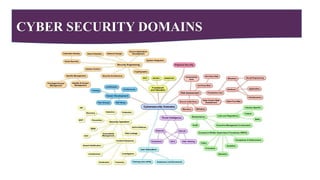
CYBER SECURITY DOMAINS
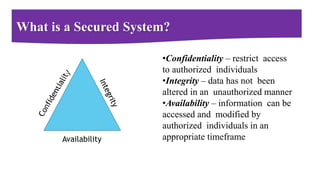
What is a Secured System?
•Confidentiality – restrict access
to authorized individuals
•Integrity – data has not been
altered in an unauthorized manner
•Availability – information can be
accessed and modified by
authorized individuals in an
appropriate timeframe
Availability
THREATS AND VULNERABILITIES
What are we protecting our and our stakeholders information from?
• Threats: Any circumstances or events that can potentially harm an
information system by destroying it, disclosing the information stored
on the system, adversely modifying data, or making the system
unavailable
• Vulnerabilities: Weakness in an information system or its
components that could be exploited.
TYPES OF THREATS IN CYBER SECURITY
• Phishing and Spear- phishing Attacks: A technique for attempting to acquire sensitive data,
such as bank account numbers, through a fraudulent solicitation in email or on a web site, in which the perpetrator
masquerades as a legitimate business or reputable person.
• Social Engineering Scams: Social engineering uses psychological manipulation to trick users into
making security mistakes or giving away sensitive information.
• Common Malware and Ransomware: The most common types of malware include viruses,
keyloggers, worms, trojans, ransomware / crypto-malware, logic bombs, bots/botnets, adware & spyware, and
rootkits.
• Business Email Compromise
• Fake websites that steal data or infect devices
• And much more
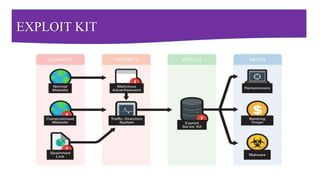
EXPLOIT KIT
IDENTITY THEFT
Loss of privacy
• Personal information is stored electronically
• Purchases are stored in a database
• Data is sold to other companies
• Public records on the Internet
• Internet use is monitored and logged
• None of these techniques are illegal
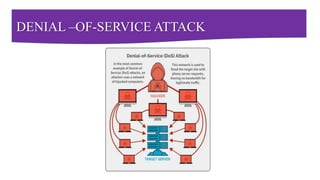
DENIAL –OF-SERVICE ATTACK
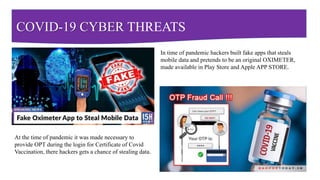
COVID-19 CYBER THREATS
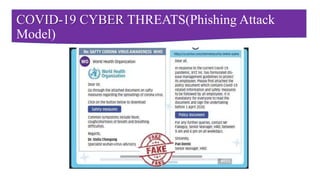
In time of pandemic hackers built fake apps that steals
mobile data and pretends to be an original OXIMETER,
made available in Play Store and Apple APP STORE.
At the time of pandemic it was made necessary to
provide OPT during the login for Certificate of Covid
Vaccination, there hackers gets a chance of stealing data.
COVID-19 CYBER THREATS(Phishing Attack
Model)
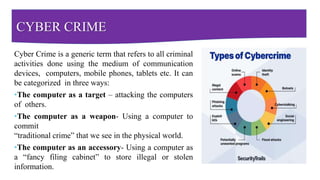
CYBER CRIME
Cyber Crime is a generic term that refers to all criminal
activities done using the medium of communication
devices, computers, mobile phones, tablets etc. It can
be categorized in three ways:
•The computer as a target – attacking the computers
of others.
•The computer as a weapon- Using a computer to
commit
“traditional crime” that we see in the physical world.
•The computer as an accessory- Using a computer as
a “fancy filing cabinet” to store illegal or stolen
information.
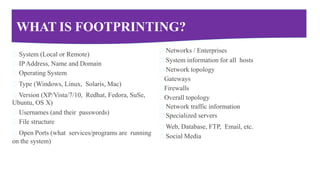
WHAT IS FOOTPRINTING?
System (Local or Remote)
IP Address, Name and Domain
Operating System
Type (Windows, Linux, Solaris, Mac)
Version (XP/Vista/7/10, Redhat, Fedora, SuSe,
Ubuntu, OS X)
Usernames (and their passwords)
File structure
Open Ports (what services/programs are running
on the system)
Networks / Enterprises
System information for all hosts
Network topology
Gateways
Firewalls
Overall topology
Network traffic information
Specialized servers
Web, Database, FTP, Email, etc.
Social Media
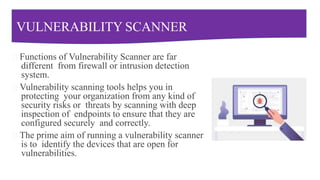
VULNERABILITY SCANNER
Functions of Vulnerability Scanner are far
different from firewall or intrusion detection
system.
Vulnerability scanning tools helps you in
protecting your organization from any kind of
security risks or threats by scanning with deep
inspection of endpoints to ensure that they are
configured securely and correctly.
The prime aim of running a vulnerability scanner
is to identify the devices that are open for
vulnerabilities.
TYPES OF VULNERABILITY SCANNER
Portscanner
Network vulnerabilityscanner
Web application security scanner
Database securityscanner.
Host based vulnerabilityscanner
ERP securityscanner.
Single vulnerabilitytests.
WHAT IS HACKING??
 Another term that is included with cyber security is HACKING.
So what does Hacking means?
 The act of identifying and then exploiting weaknesses in a computer
system or network, usually to gain unauthorised access to personal or
organisational data, is known as hacking. Hacking is not always a
malicious activity, but because of its association with cybercrime, the
term has mostly negative connotations.
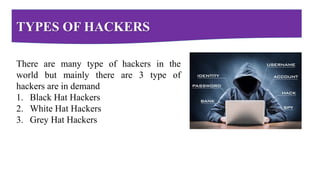
TYPES OF HACKERS
There are many type of hackers in the
world but mainly there are 3 type of
hackers are in demand
1. Black Hat Hackers
2. White Hat Hackers
3. Grey Hat Hackers
TYPES OF HACKERS
Black Hat Hackers:
Black Hat hackers are criminals
who break into computer networks
with malicious intent. They may
also release malware that destroys
files, holds computers hostage, or
steals passwords, credit card
numbers, and other personal
information.
White Hat Hackers:
White Hat hacker, the good guy
who uses his (or her) capabilities to
damage your organization — but
only hypothetically. Instead, the
real purpose is to uncover security
failings in your system in order to
help you safeguard your business
from the dangerous hackers.
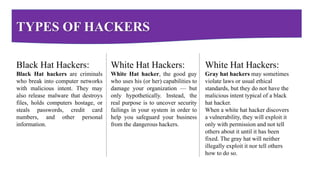
White Hat Hackers:
Gray hat hackers may sometimes
violate laws or usual ethical
standards, but they do not have the
malicious intent typical of a black
hat hacker.
When a white hat hacker discovers
a vulnerability, they will exploit it
only with permission and not tell
others about it until it has been
fixed. The gray hat will neither
illegally exploit it nor tell others
how to do so.
CONCLUSION
To conclude, we can say that Cyber Crime
is a dangerous offense to someone's
privacy or any material. Also, we can
avoid Cyber Crime by following some
basic logical things and using our common
sense. Above all, Cyber Crime is a violation
of not only law but of human rights too.
Cyber Security: A Hands on review

Cyber Security: A Hands on review

  • 1.
  • 2.
    TABLE OF CONTENT Introduction  Importance of Cyber Security  Various type of Cyber Security  Cyber Security Domains  What is Secured System  Threats and Vulnerabilities  Type of Threats in Cyber Security  Exploitation kit  Identity theft  Denial of Service Attack  Covid-19 Cyber Threats  Cyber Crime  Footprinting  Vulnerabilities Scanner  Hacking
  • 3.
    INTRODUCTION The method ofpreventing damaging intrusions on computers, servers, mobile devices, electronic systems, networks, and data is known as cybersecurity. The protection provided by internet services to safeguard your online information is referred to as cybersecurity. With more individuals connecting to the internet, there are also more security risks that can do enormous harm. Cyber security is defined as the collection of methods, technologies, and processes used to protect the confidentiality, integrity, and availability of computer systems, networks, and data from cyber-attacks or unauthorised access.
  • 4.
    INTRODUCTION Implementing effective cybersecuritymeasures is especially difficult today due to the fact that there are more devices than people, and attackers are becoming more creative. Cybersecurity is the practise of safeguarding critical systems and sensitive data against digital attacks. Cybersecurity measures, also known as information technology (IT) security, are intended to combat threats to networked systems and applications, whether they originate within or outside of an organisation.
  • 5.
    IMPORTANCE OF CYBERSECURITY Everyone benefits from advanced cyberdefense programmes in today's connected world. A cybersecurity attack on an individual can result in everything from identity theft to extortion attempts to the loss of important data such as family photos. Everyone is reliant on critical infrastructure such as power plants, hospitals, and financial institutions. Securing these and other organisations is critical to the functioning of our society.
  • 6.
    THE VARIOUS TYPESOF CYBERSECURITY 1. Network Security 2. Cloud Security 3. Endpoint Security 4. Mobile Security 5. IoT Security 6. Application Security
  • 7.
    THE VARIOUS TYPESOF CYBERSECURITY 1. Network Security  The majority of attacks take place over the network, and network security solutions are designed to detect and prevent these attacks. Data and access controls such as Data Loss Prevention (DLP), IAM (Identity Access Management), NAC (Network Access Control), and NGFW (Next-Generation Firewall) application controls are included in these solutions to enforce safe web use policies.  IPS (Intrusion Prevention System), NGAV (Next-Gen Antivirus), Sandboxing, and CDR are examples of advanced and multi-layered network threat prevention technologies (Content Disarm and Reconstruction). Network analytics, threat hunting, and automated SOAR (Security Orchestration and Response) technologies are also important.
  • 8.
    THE VARIOUS TYPESOF CYBERSECURITY 2. Cloud Security  As more businesses adopt cloud computing, cloud security becomes a top priority. A cloud security strategy includes cyber security solutions, controls, policies, and services that aid in the defence of an organization's entire cloud deployment (applications, data, infrastructure, and so on).  While many cloud providers provide security solutions, these are frequently insufficient for achieving enterprise-grade security in the cloud. To protect against data breaches and targeted attacks in cloud environments, additional third-party solutions are required.
  • 9.
    THE VARIOUS TYPESOF CYBERSECURITY 3. Endpoint Security  The zero-trust security model recommends creating micro-segments around data in any location. Endpoint security is one method for accomplishing this with a mobile workforce.  Endpoint security allows businesses to protect end-user devices such as desktops and laptops by implementing data and network security controls, advanced threat prevention such as anti-phishing and anti- ransomware, and forensic technologies such as endpoint detection and response (EDR) solutions.
  • 10.
    THE VARIOUS TYPESOF CYBERSECURITY 4. Mobile Security  Mobile security protects operating systems and devices from rooting and jailbreaking by preventing these attacks. This, when combined with an MDM (Mobile Device Management) solution, allows businesses to ensure that only compliant mobile devices have access to corporate assets.
  • 11.
    THE VARIOUS TYPESOF CYBERSECURITY 5. IoT Security  IoT security protects these devices through device discovery and classification, auto-segmentation to control network activities, and the use of IPS as a virtual patch to prevent exploits against vulnerable IoT devices. In some cases, the device's firmware can be supplemented with small agents to prevent exploits and runtime attacks.
  • 12.
    THE VARIOUS TYPESOF CYBERSECURITY 6. Application security  Application security is concerned with keeping software and devices safe from threats. A compromised application may allow access to the data it is supposed to protect. Security starts in the design stage, long before a programme or device is deployed.
  • 13.
    IMPORTANCE OF CYBERSECURITY  An attacker can work from anywhere on the planet thanks to the Internet.  Risks posed by inadequate security knowledge and practise: • Theft of Identity • Legal Consequences of Financial Theft (for yourself and your organization) • If policies are not followed, sanctions or termination may be imposed.
  • 15.
  • 16.
    What is aSecured System? •Confidentiality – restrict access to authorized individuals •Integrity – data has not been altered in an unauthorized manner •Availability – information can be accessed and modified by authorized individuals in an appropriate timeframe Availability
  • 17.
    THREATS AND VULNERABILITIES Whatare we protecting our and our stakeholders information from? • Threats: Any circumstances or events that can potentially harm an information system by destroying it, disclosing the information stored on the system, adversely modifying data, or making the system unavailable • Vulnerabilities: Weakness in an information system or its components that could be exploited.
  • 18.
    TYPES OF THREATSIN CYBER SECURITY • Phishing and Spear- phishing Attacks: A technique for attempting to acquire sensitive data, such as bank account numbers, through a fraudulent solicitation in email or on a web site, in which the perpetrator masquerades as a legitimate business or reputable person. • Social Engineering Scams: Social engineering uses psychological manipulation to trick users into making security mistakes or giving away sensitive information. • Common Malware and Ransomware: The most common types of malware include viruses, keyloggers, worms, trojans, ransomware / crypto-malware, logic bombs, bots/botnets, adware & spyware, and rootkits. • Business Email Compromise • Fake websites that steal data or infect devices • And much more
  • 19.
  • 20.
    IDENTITY THEFT Loss ofprivacy • Personal information is stored electronically • Purchases are stored in a database • Data is sold to other companies • Public records on the Internet • Internet use is monitored and logged • None of these techniques are illegal
  • 21.
  • 22.
    COVID-19 CYBER THREATS Intime of pandemic hackers built fake apps that steals mobile data and pretends to be an original OXIMETER, made available in Play Store and Apple APP STORE. At the time of pandemic it was made necessary to provide OPT during the login for Certificate of Covid Vaccination, there hackers gets a chance of stealing data.
  • 23.
  • 24.
    CYBER CRIME Cyber Crimeis a generic term that refers to all criminal activities done using the medium of communication devices, computers, mobile phones, tablets etc. It can be categorized in three ways: •The computer as a target – attacking the computers of others. •The computer as a weapon- Using a computer to commit “traditional crime” that we see in the physical world. •The computer as an accessory- Using a computer as a “fancy filing cabinet” to store illegal or stolen information.
  • 26.
    WHAT IS FOOTPRINTING? System(Local or Remote) IP Address, Name and Domain Operating System Type (Windows, Linux, Solaris, Mac) Version (XP/Vista/7/10, Redhat, Fedora, SuSe, Ubuntu, OS X) Usernames (and their passwords) File structure Open Ports (what services/programs are running on the system) Networks / Enterprises System information for all hosts Network topology Gateways Firewalls Overall topology Network traffic information Specialized servers Web, Database, FTP, Email, etc. Social Media
  • 27.
    VULNERABILITY SCANNER Functions ofVulnerability Scanner are far different from firewall or intrusion detection system. Vulnerability scanning tools helps you in protecting your organization from any kind of security risks or threats by scanning with deep inspection of endpoints to ensure that they are configured securely and correctly. The prime aim of running a vulnerability scanner is to identify the devices that are open for vulnerabilities.
  • 28.
    TYPES OF VULNERABILITYSCANNER Portscanner Network vulnerabilityscanner Web application security scanner Database securityscanner. Host based vulnerabilityscanner ERP securityscanner. Single vulnerabilitytests.
  • 29.
    WHAT IS HACKING?? Another term that is included with cyber security is HACKING. So what does Hacking means?  The act of identifying and then exploiting weaknesses in a computer system or network, usually to gain unauthorised access to personal or organisational data, is known as hacking. Hacking is not always a malicious activity, but because of its association with cybercrime, the term has mostly negative connotations.
  • 30.
    TYPES OF HACKERS Thereare many type of hackers in the world but mainly there are 3 type of hackers are in demand 1. Black Hat Hackers 2. White Hat Hackers 3. Grey Hat Hackers
  • 31.
    TYPES OF HACKERS BlackHat Hackers: Black Hat hackers are criminals who break into computer networks with malicious intent. They may also release malware that destroys files, holds computers hostage, or steals passwords, credit card numbers, and other personal information. White Hat Hackers: White Hat hacker, the good guy who uses his (or her) capabilities to damage your organization — but only hypothetically. Instead, the real purpose is to uncover security failings in your system in order to help you safeguard your business from the dangerous hackers. White Hat Hackers: Gray hat hackers may sometimes violate laws or usual ethical standards, but they do not have the malicious intent typical of a black hat hacker. When a white hat hacker discovers a vulnerability, they will exploit it only with permission and not tell others about it until it has been fixed. The gray hat will neither illegally exploit it nor tell others how to do so.
  • 32.
    CONCLUSION To conclude, wecan say that Cyber Crime is a dangerous offense to someone's privacy or any material. Also, we can avoid Cyber Crime by following some basic logical things and using our common sense. Above all, Cyber Crime is a violation of not only law but of human rights too.