


Breach Stats
Paul Fletcher – Cyber Security Evangelist
@_PaulFletcher
Cyber Resiliency
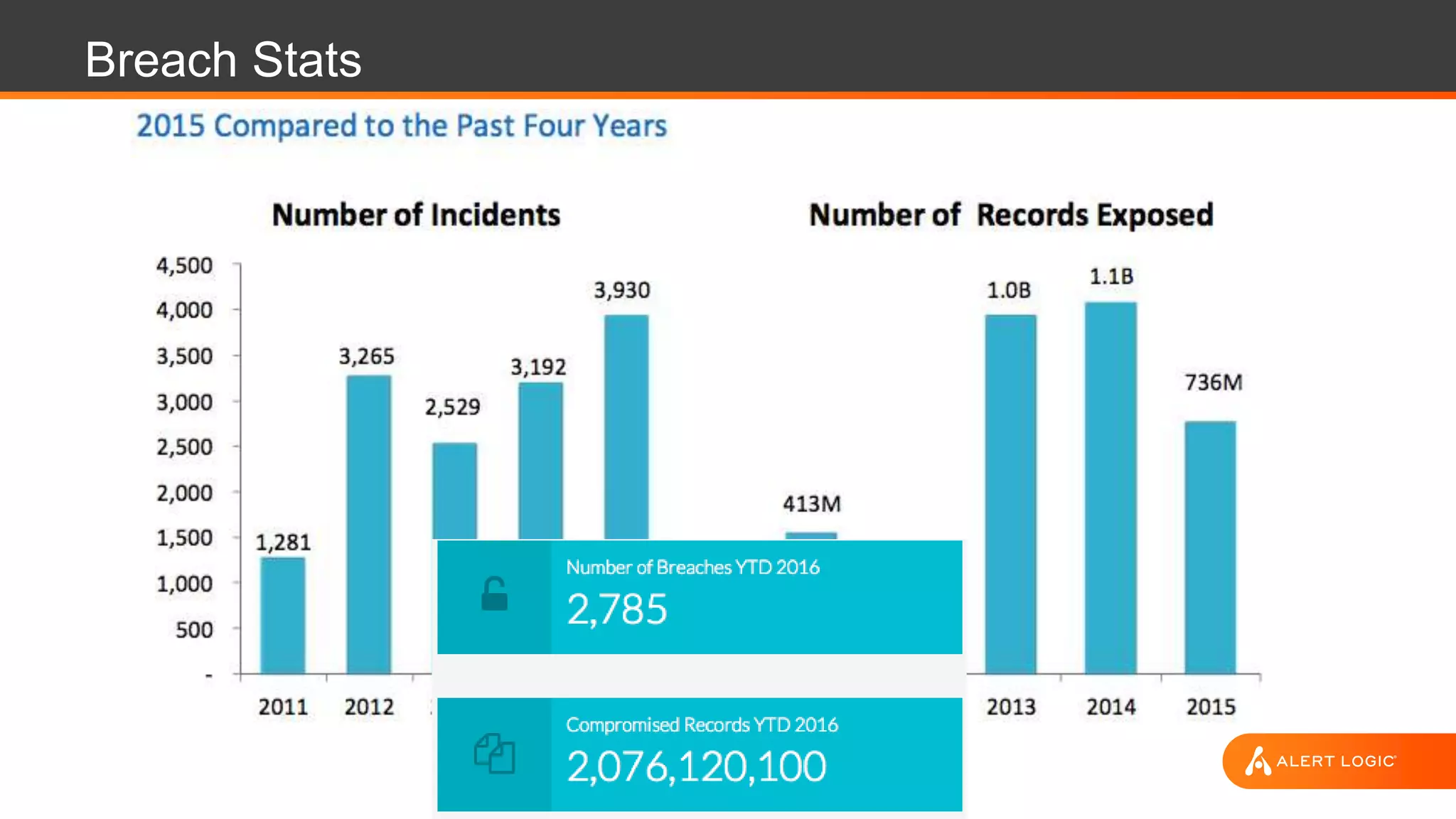
Breach Stats
Step 1: Cut the cord as soon as possible
well… maybe…
Actually, Give It a Minute or Two
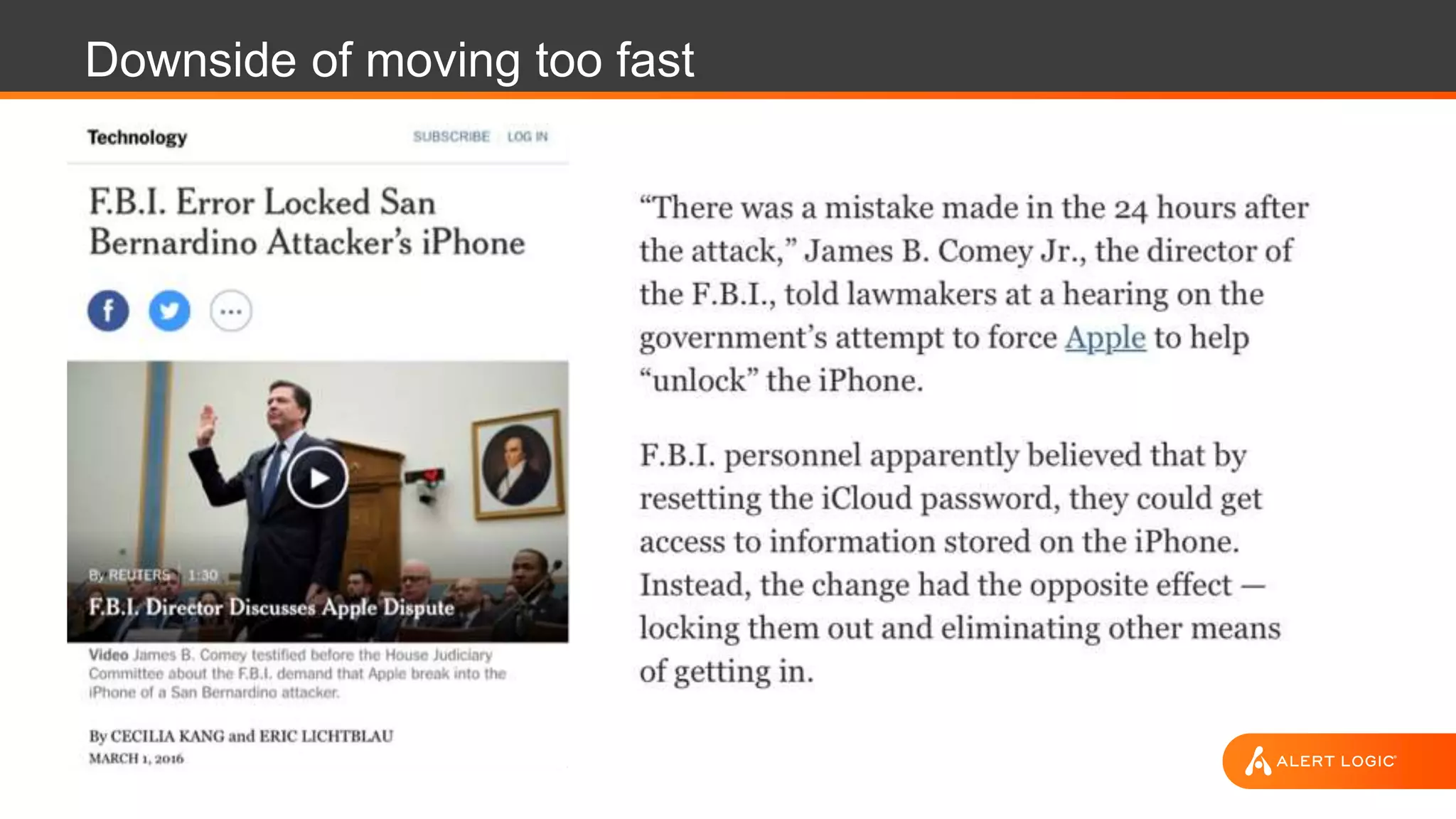
Downside of moving too fast
Before you act, ask yourself:
• What is your primary objective?
• What about the Cyber Security
Incident Response plan?
• Is there a downside to quietly
observing the actions of the
attacker?
Types of Cyber Security Incidents
• Application Vulnerabilities
- Word Press
- MySql
- Web Server (IIS or Apache)
• Operating System Attacks
- Linux Kernel
• Malicious Software
- Worm
- Trojan
- Other
• Denial of Service (DoS or DDoS)
• Ransomware
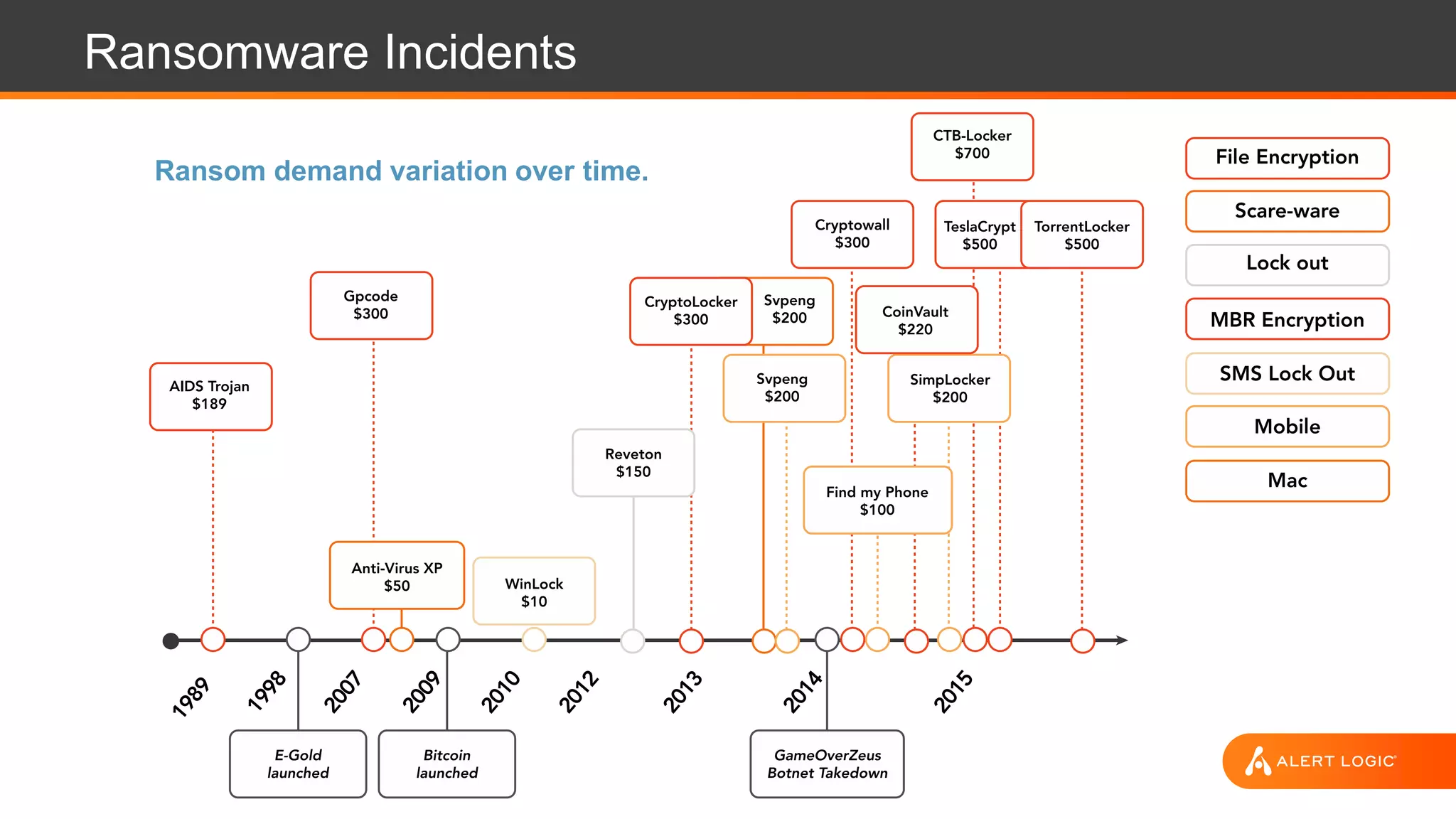
Ransomware Incidents
Ransom demand variation over time.
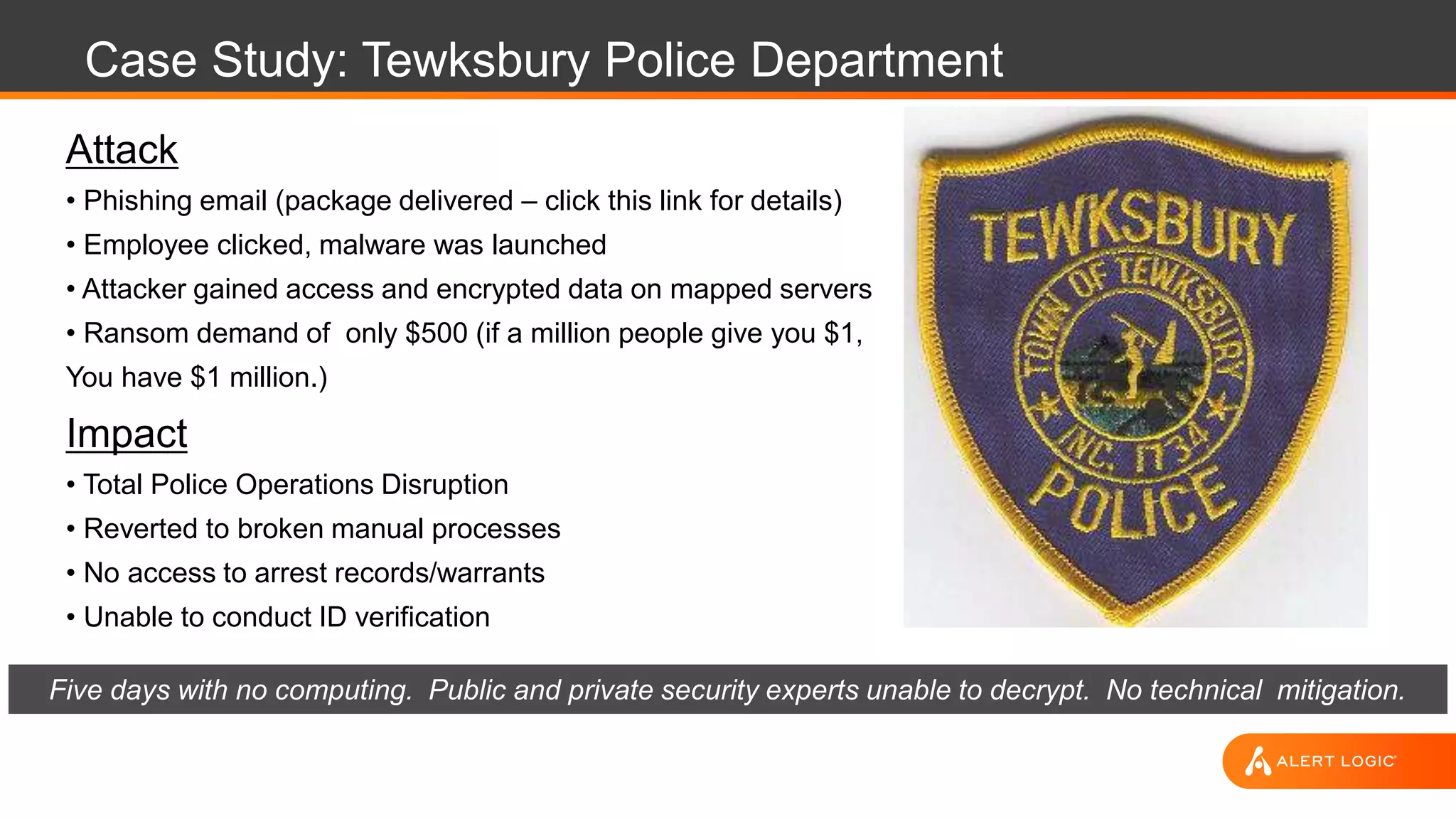
Case Study: Tewksbury Police Department
Attack
• Phishing email (package delivered – click this link for details)
• Employee clicked, malware was launched
• Attacker gained access and encrypted data on mapped servers
• Ransom demand of only $500 (if a million people give you $1,
You have $1 million.)
Impact
• Total Police Operations Disruption
• Reverted to broken manual processes
• No access to arrest records/warrants
• Unable to conduct ID verification
Five days with no computing. Public and private security experts unable to decrypt. No technical mitigation.
If Ransomware Hits – Haggle!
• Act quickly before they pack up
• Most attackers happy
with smaller pay day
• In larger cases, FBI recommends
professional negotiators be hired
Cyber Incident Response Plans
Cyber Incident Response
• The Plan is the Thing
- Preparation
- Identification
- Notification
- Mitigation Strategy
- Containment
- Eradication
- Recovery
- Lessons Learned
• Templates
Roles and responsibilities
• Incident notification
• Help desk
• Technical team
• Triage team
• Forensics team
• Network Security
• Malware analysis
• Communications
• Executive team
• Legal/Marketing/HR
Roles and responsibilities
Incident Notification
• Employees
• Contractors/Consultants
• Vendors
• Customers
• Competitors
• Law Enforcement
Notification Method
• Should be easy
• Have multiple options
Roles and responsibilities
• Help desk
• Properly trained
• Escalation
• Pre-triage
• Technical team
• Triage – fix known issues, return system to normal
• Forensics – root cause analysis, chain of custody
• Network and systems – infrastructure assessment
• Malware analysis – reverse engineer, zero days
Roles and responsibilities
• Communications
• Within the incident response team
• Internally
• Decision makers
• Externally
• Designated role
• Notes
• Timelines
• Next steps
• Executive team
• Legal/Marketing/HR
Cyber Incident Response
• Cloud considerations
- Robust log solution
- Understand your cloud service providers security model
- Understand the shared security responsibility
- Clearly defined resources
- Include when testing the plan
- Have pristine content ready to re-deploy
- Test this capability
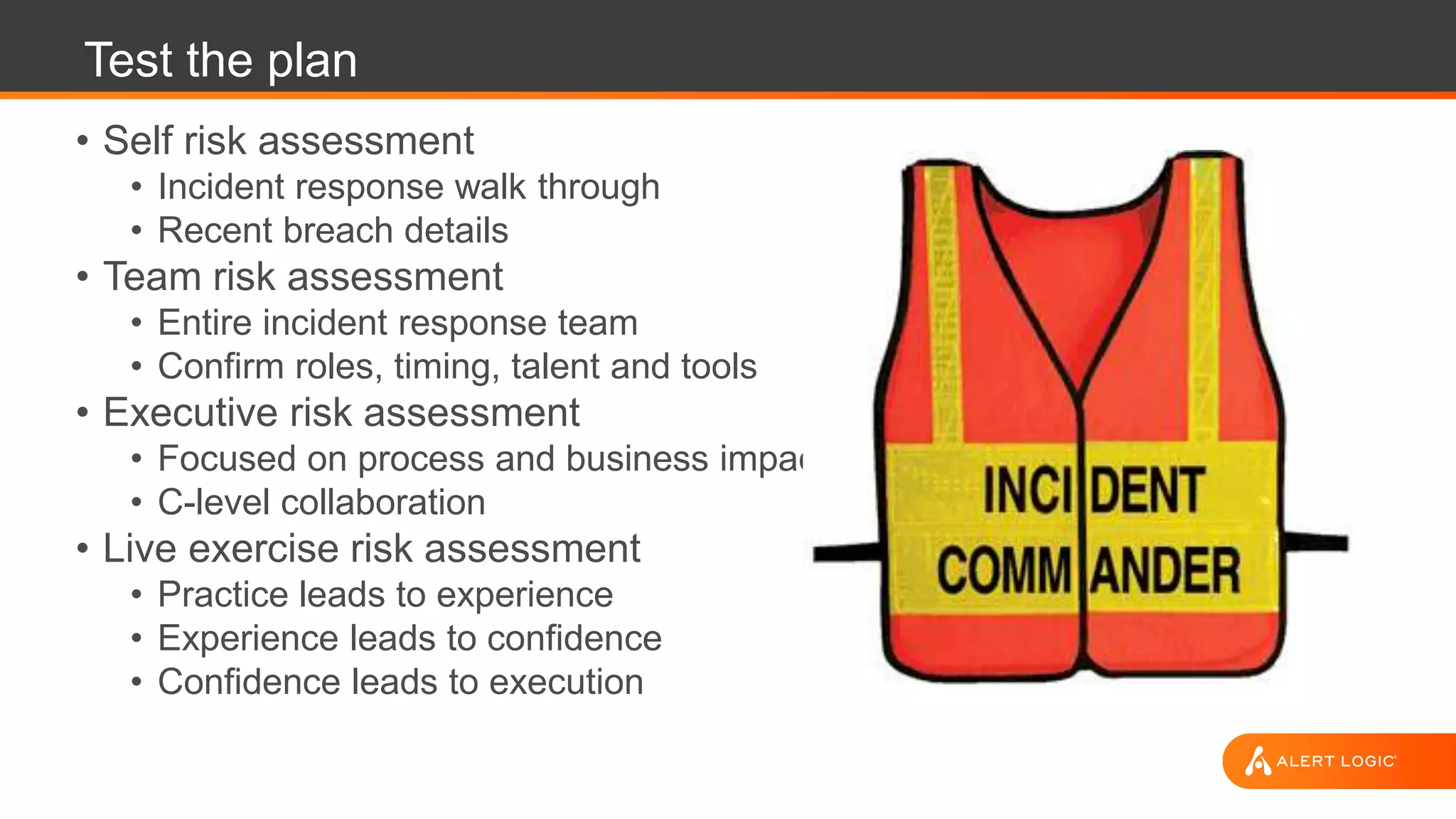
Test the plan
• Self risk assessment
• Incident response walk through
• Recent breach details
• Team risk assessment
• Entire incident response team
• Confirm roles, timing, talent and tools
• Executive risk assessment
• Focused on process and business impact
• C-level collaboration
• Live exercise risk assessment
• Practice leads to experience
• Experience leads to confidence
• Confidence leads to execution
Cyber Incident Response
• Test the plan
• Roles and responsibilities
• Cloud considerations
• The plan is the thing
• Test the plan…again
No Substitution for Preparation
• Assume that at some point you will be breached
• Make actionable
• Consider observing the adversary without tipping them off to
understand full extent of the breach and attacker intent
• Use cloud networking tools to isolate compromised infrastructure and
orchestrate recovery efforts
• Run your incident response team through regularly scheduled and
surprise exercises
• Engage cloud provider during exercises
• Utilize hybrid infrastructure
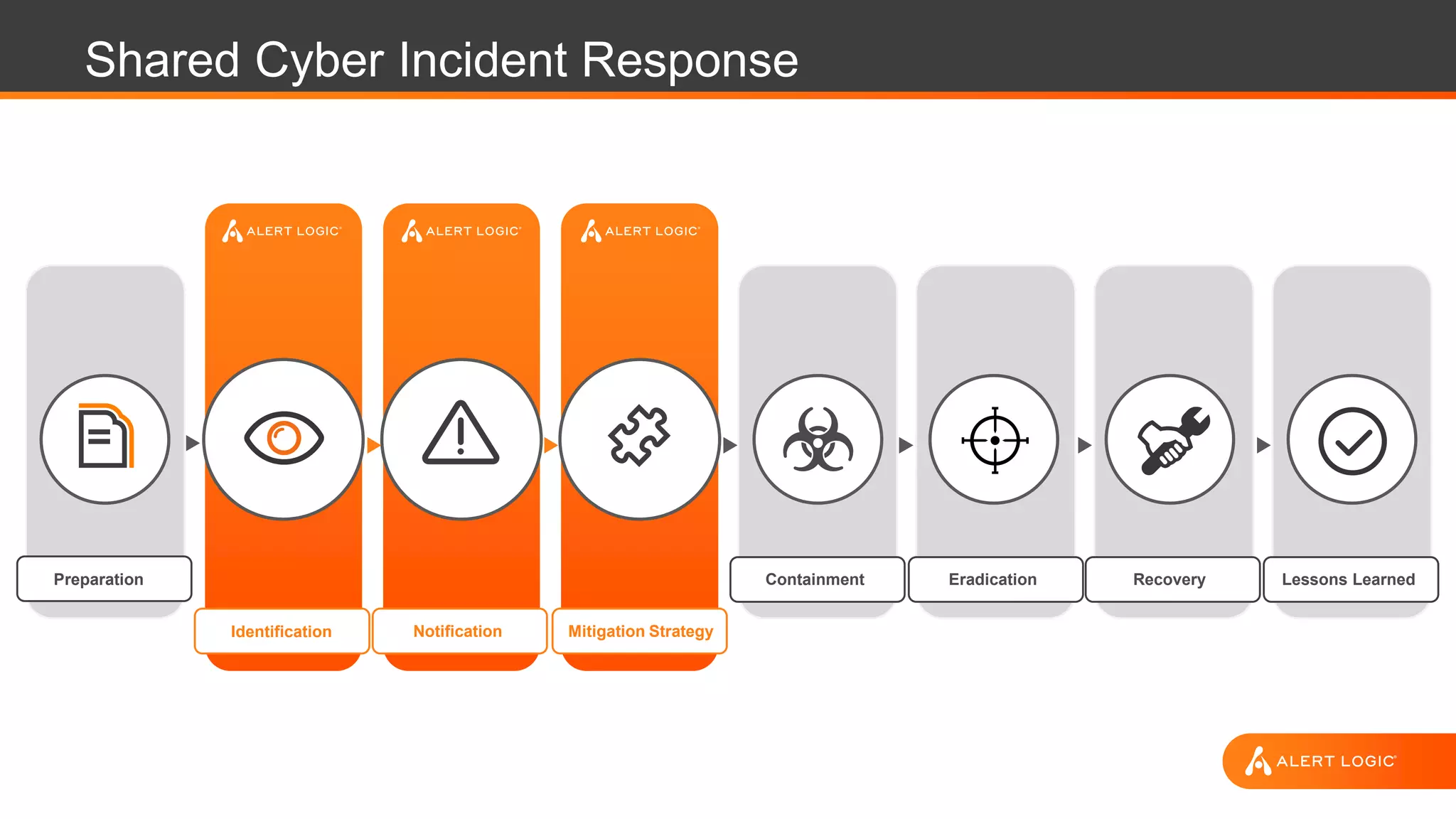
Shared Cyber Incident Response
Preparation
Identification Notification Mitigation Strategy
Containment Eradication Recovery Lessons Learned
Thank you.

Cyber Resiliency

  • 1.
  • 2.
    Paul Fletcher –Cyber Security Evangelist @_PaulFletcher Cyber Resiliency
  • 3.
  • 4.
    Step 1: Cutthe cord as soon as possible well… maybe… Actually, Give It a Minute or Two
  • 5.
  • 6.
  • 7.
    Before you act,ask yourself: • What is your primary objective? • What about the Cyber Security Incident Response plan? • Is there a downside to quietly observing the actions of the attacker?
  • 8.
    Types of CyberSecurity Incidents • Application Vulnerabilities - Word Press - MySql - Web Server (IIS or Apache) • Operating System Attacks - Linux Kernel • Malicious Software - Worm - Trojan - Other • Denial of Service (DoS or DDoS) • Ransomware
  • 9.
  • 10.
    Case Study: TewksburyPolice Department Attack • Phishing email (package delivered – click this link for details) • Employee clicked, malware was launched • Attacker gained access and encrypted data on mapped servers • Ransom demand of only $500 (if a million people give you $1, You have $1 million.) Impact • Total Police Operations Disruption • Reverted to broken manual processes • No access to arrest records/warrants • Unable to conduct ID verification Five days with no computing. Public and private security experts unable to decrypt. No technical mitigation.
  • 11.
    If Ransomware Hits– Haggle! • Act quickly before they pack up • Most attackers happy with smaller pay day • In larger cases, FBI recommends professional negotiators be hired
  • 12.
  • 13.
    Cyber Incident Response •The Plan is the Thing - Preparation - Identification - Notification - Mitigation Strategy - Containment - Eradication - Recovery - Lessons Learned • Templates
  • 14.
    Roles and responsibilities •Incident notification • Help desk • Technical team • Triage team • Forensics team • Network Security • Malware analysis • Communications • Executive team • Legal/Marketing/HR
  • 15.
    Roles and responsibilities IncidentNotification • Employees • Contractors/Consultants • Vendors • Customers • Competitors • Law Enforcement Notification Method • Should be easy • Have multiple options
  • 16.
    Roles and responsibilities •Help desk • Properly trained • Escalation • Pre-triage • Technical team • Triage – fix known issues, return system to normal • Forensics – root cause analysis, chain of custody • Network and systems – infrastructure assessment • Malware analysis – reverse engineer, zero days
  • 17.
    Roles and responsibilities •Communications • Within the incident response team • Internally • Decision makers • Externally • Designated role • Notes • Timelines • Next steps • Executive team • Legal/Marketing/HR
  • 18.
    Cyber Incident Response •Cloud considerations - Robust log solution - Understand your cloud service providers security model - Understand the shared security responsibility - Clearly defined resources - Include when testing the plan - Have pristine content ready to re-deploy - Test this capability
  • 19.
    Test the plan •Self risk assessment • Incident response walk through • Recent breach details • Team risk assessment • Entire incident response team • Confirm roles, timing, talent and tools • Executive risk assessment • Focused on process and business impact • C-level collaboration • Live exercise risk assessment • Practice leads to experience • Experience leads to confidence • Confidence leads to execution
  • 20.
    Cyber Incident Response •Test the plan • Roles and responsibilities • Cloud considerations • The plan is the thing • Test the plan…again
  • 21.
    No Substitution forPreparation • Assume that at some point you will be breached • Make actionable • Consider observing the adversary without tipping them off to understand full extent of the breach and attacker intent • Use cloud networking tools to isolate compromised infrastructure and orchestrate recovery efforts • Run your incident response team through regularly scheduled and surprise exercises • Engage cloud provider during exercises • Utilize hybrid infrastructure
  • 22.
    Shared Cyber IncidentResponse Preparation Identification Notification Mitigation Strategy Containment Eradication Recovery Lessons Learned
  • 23.

Editor's Notes

  • #4 Reasons to be targeted Source: datalossdb.org
  • #5 Story of malware that self-destructs if “phone home” unsuccessful after X amount of attempts.
  • #7 Cambridge University security researcher Sergei Skorobogatov has published a new research paper detailing a technique that would have helped the FBI bypass the iOS passcode limit on the shooter's iPhone 5C
  • #9 Different attack vectors may need to be handled differently and documented accordingly in your Cyber Incident Response Plan.
  • #16 An incident could be reported by any of these
  • #17 Help desk – pre-triage means that help desk analysis should be able to understand enough about the reported incident to prepare the user and their system for next steps. As an example, if a user reports malware, the help desk should be able to know the next step (is your policy to unplug the network cable or shut off the system or keep it up and running for forensics) and communicate that to the user.
  • #20 C-level collaboration – a chance to discuss each executive’s biggest concerns and priorities. External facilitator - This external source can bring a scenario to work through, ask compelling questions (without corporate knowledge), facilitate discussion and be a source for independent review of your plan
  • #23 Regarding cyber incident response, Alert Logic can identify the threat and notify our customer with a mitigation strategy.  Once the customer knows there is an active threat, they can use our recommendation to contain the threat to keep it from spreading, eradicate the threat from their systems and recover to normal operations.  It’s highly recommended that organizations have a prepared cyber incident response plan and document the lessons learned from each incident to enhance their plan as cyber incident handling experience increases. Preparation Identification Notification Mitigation Strategy Containment Eradication Recovery Lessons Learned