Unit II: Introduction about the cyber space, cyber law, regulation of cyber space, scope of cyber laws: ecommerce; online contracts; IPRs
(copyright, trademarks and software patenting), e taxation; e-governance and cyber-crimes, cyber law in India with special reference to
Information Technology Act, 2000.
Introduction about the cyber space
Cyberspace is "the notional environment in which communication over computer networks occurs." The word became popular in the
1990s when the uses of the internet, networking, and digital communication were all growing dramatically and the term "cyberspace"
was able to represent the many new ideas and phenomena that were emerging. The parent term of cyberspace is "cybernetics",
derived from the Ancient Greek word which means steersman, governor, pilot, or rudder, “cyberspace” is introduced by William
Gibson a science fiction writer.
As a social experience, individuals can interact, exchange ideas, share information, provide social support, conduct business, direct
actions, create artistic media, play games, engage in political discussion, and so on, using this global network. They are sometimes
referred to as cybernauts.
Unlike most computer terms, "cyberspace" does not have a standard, objective definition. Instead, it is used to describe the virtual world
of computers. For example, an object in cyberspace refers to a block of data floating around a computer system or network. With the
advent of the Internet, cyberspace now extends to the global network of computers. So, after sending an e-mail to your friend, you could
say you sent the message to her through cyberspace.
We often send emails in place of paper letters, we leave electronic messages on bulletin boards rather than pinning slips of card to
wooden notice boards, and more and more frequently we are able to read texts on-line—in e-journals, for instance—rather than on good
old-fashioned wood pulp. The physical objects of traditional communication (letters, books and so on) are being superseded by new
electronic objects. And, just as physical objects exist in physical space, so these cyber objects exist in cyberspace.
There are in fact two spurs of cyberspace. On the one hand, we have virtual reality—a 3-D cyber spatial environment which humans can
‘enter’ and ‘move through’, interacting with both the computer and other human beings, as depicted in films like The Lawnmower
Man and Disclosure. On the other hand, we have the slightly less dramatic, but more utilitarian, world of networks of computers linked via
cables and routers (similar to telephone connections) which enable us to communicate, store and retrieve information. By far the largest
and most well-known of these is the Internet—originally used for email, ftp (file transfer), bulletin boards and newsgroups, and telnet
(remote computer access), and now even more of a household name courtesy of the World Wide Web, which allows simple stress-free
navigation of the network. This second spur of cyberspace encompasses not only the connections between computers, but also the
browser and email software which transmits information, plus the internal space of the microchip and other electronic storage
technologies—the places in which information actually resides.
Cyberspace, like physical space, comprises (at least) the four sub-concepts: place, distance, size and route. And the formula remains the
same as for physical space. Place prompts us to ask "where-type" questions. On which server is a particular website located? To which
email address should we send our message? And the chat room of IRC represents a cyber place. Such ways of speaking reflect the
importance of locating specific targets in cyberspace. Distance has us asking "how far-type" questions. How many transmissions between
how many different computers will it take for information to reach the desired destination? In this way we can calculate how long it might
take for a corporate website or a personal homepage to reach our screens—calculations which become important for people with dial-up
connections from home, where time really is money. 2
With size we ask "how big-type" questions. We might wonder how extensive a
website is, meaning how much information it contains and how many links to other sites it includes. Size is also a relevant factor for ftp –
how large a file is will (partially) determine how long it takes to download from the host computer to your own. And finally, route involves
"navigation-type" issues. My email lands up in someone else’s mailbox by following a specified route or set of connections, while Web
browsers enable us to reach out from our own computers and explore the electronic universe, as we follow links, moving from site to site.
It appears, then, that space and cyberspace can count as roughly equivalent conceptual entities, at least in the sense of sharing the four
common sub-concepts of place, distance, size and route.
Information in its many forms—email messages, websites, files, notices on bulletin boards—all of these comprise the cyber objects of
cyberspace.
Cyber law
Cyber Law or Internet law is a term that encapsulates the legal issues related to use of the Internet. It is less a distinct field of law
than intellectual property or contract law, as it is a domain covering many areas of law and regulation. Some leading topics include
internet access and usage, privacy, freedom of expression, and jurisdiction.
Cyber Law is the law governing cyber space.
Law encompasses the rules of conduct:
1. That have been Approved by the government, and
2. Which are in Force over a certain territory, and
3. Which must be obeyed by all persons on that territory.
Violation of these rules could lead to government action such as imprisonment or fine or an order to pay compensation.
Cyber law encompasses laws relating to:
1. Cyber Crimes
2. Electronic and Digital Signatures
3. Intellectual Property
4. Data Protection and Privacy
Cybercrimes are unlawful acts where the computer is used either as a tool or a target or both. The enormous growth in electronic
commerce (e-commerce) and online share trading has led to a phenomenal spurt in incidents of cyber-crime. To prevent these crimes
and to maintain the fair usage of the internet cyber laws are designed.
Cyber law includes some of the major laws:
1. Copyright law
2. Software and source code Licenses
3. Trademark law
4. Semiconductor law
5. Patent law
Cyber law is important because it touches almost all aspects of transactions and activities concerning the Internet, the World Wide Web
and Cyberspace.
Data protection and privacy laws aim to achieve a fair balance between the privacy rights of the individual and the interests of data
controllers such as banks, hospitals, email service providers etc. These laws seek to address the challenges to privacy caused by
collecting, storing and transmitting data using new technologies.
In early times, there was no statute in India for governing Cyber Laws involving privacy issues, jurisdiction issues, intellectual property
rights issues and a number of other legal questions. With the tendency of misusing of technology, there arisen a need of strict statutory
laws to regulate the criminal activities in the cyber world and to protect the true sense of technology "INFORMATION TECHNOLOGY ACT,
2000" [ITA- 2000] was enacted by Parliament of India to protect the field of e-commerce, e-governance, e-banking as well as penalties
and punishments in the field of cyber-crimes. The above Act was further amended
in the form of IT Amendment Act, 2008 [ITAA-2008]
Need for Cyber Law
There are various reasons why it is extremely difficult for conventional law to cope with cyberspace. Some of these are discussed
below.
1. Cyberspace is an intangible dimension that is impossible to govern and regulate using conventional law.
2. Cyberspace has complete disrespect for jurisdictional boundaries. A person in India could break into a bank’s electronic vault hosted
on a computer in USA and transfer millions of Rupees to another bank in Switzerland, all within minutes. All he would need is a laptop
computer and a cell phone.
3. Cyberspace handles gigantic traffic volumes every second. Billions of emails are crisscrossing the globe even as we read this, millions
of websites are being accessed every minute and billions of dollars are electronically transferred around the world by banks every day.
4. Cyberspace is absolutely open to participation by all. A ten-year-old in Bhutan can have a live chat session with an eight-year-old in
Bali without any regard for the distance or the anonymity between them.
5. Cyberspace offers enormous potential for anonymity to its members. Readily available encryption software and stenographic tools
that seamlessly hide information within image and sound files ensure the confidentiality of information exchanged between cyber-
citizens.
6. Cyberspace offers never-seen-before economic efficiency. Billions of dollars’ worth of software can be traded over the Internet
without the need for any government licenses, shipping and handling charges and without paying any customs duty.
7. Electronic information has become the main object of cyber-crime. It is characterized by extreme mobility, which exceeds by far
the mobility of persons, goods or other services. International computer networks can transfer huge amounts of data around the
globe in a matter of seconds.
8. A software source code worth crores of rupees or a movie can be pirated across the globe within hours of their release.
9. Theft of corporeal information (e.g. books, papers, CD ROMs, floppy disks) is easily covered by traditional penal provisions.
However, the problem begins when electronic records are copied quickly, inconspicuously and often via telecommunication facilities.
Here the “original” information, so to say, remains in the “possession” of the “owner” and yet information gets stolen.
Regulation of cyber space
As electronic transactions over the Internet become important the question arises whether they will be controlled on the national and
international levels.
FOUR MODES OF REGULATION IN CYBERSPACE
Norms / Education
In order to function and be accepted in a society, a person will live by its norms. You believe in the role of educating people so that new
norms may develop as new technology is used.
As an example of the change of attitudes that result from education programs you might look back on smoking ads that once portrayed
cigarette smokers as beautiful, sophisticated, sexy people with the ads of today, where a blackened sponge is wrung out to show the
impact of smoking on the lungs.
Once education creates a new norm, community behaviour it is regulated by peer and social pressure. Norms can involve the adoption
of “rules” for regulating behaviour. These rules may not have the force of law but they create a level of behaviour that anyone wanting
to be accepted in that group ought to adopt.
People that breach norms may incur sanctions. These sanctions do not have the force that penalties or custodial sentences might
have in a legal setting. The sanction when imposed may result in an infringer being placed outside a norm group. On showing
contrition, particularly where their contrition is matched by entry into a re-education program about the norm, the infringer may be
readmitted. Usually a body or entity that is a part of the group will make findings about any infringements and the sanction that ought
to apply.
The norms that come about as a result of education may need to be put into writing. In a technological era, this writing might take the
form of Acceptable Use Policies, Terms of Engagement and other polices that act as a norm but may not be legally enforceable like a
contract.
Over time norms, can be made into law through legislation or litigation (case law).
Law
You believe in parliament’s capacity to make laws to regulate the behaviour of its citizens. Where parliaments are silent, the courts will
make precedents.
People who break the law suffer sanctions - these can be civil penalties of loss of money when an infringing party is ordered to pay
damages to another. There is also criminal law through which you believe society establishes what constitutes acceptable and
unacceptable behaviour. Unacceptable behaviour is regulated through a sentencing regime – lesser offences might incur fines and
bonds, more serious ones some form of custodial sentence.
You are satisfied that if parliament makes a law then it is made by the people. What is parliament if nothing other than a representative
body of the people as expressed at elections?
Once a matter becomes law the law itself ought to be black letter – it ought to be clearly understood, free from doubt and dispute.
Breaches should result in similar punishments.
Architecture
You believe in the power of human to design systems that regulate behaviour. To control speeding in a back street you would design
and build speed humps. In a digital world you believe in the power of software code to be able to create a form of regulation. For
example, you might design a technological protection measure in your software that prevents a program with a license of ten users
from allowing an eleventh user to open it over a network.
You find education / norms too slow to bring about change. You find law too expensive. You can design the world you want and have
people regulate their behaviour because such restrictions in behaviour are inherent in what you have created. You consider yourself a
geek and technological master of non-technical people who use other forms of regulation.
You also realize that if you can regulate behaviour through design then your product will be more valuable. You usually work in the
private sector though increasingly your skills might be sought in publicly owned entities wanting to develop monitoring and surveillance
systems.
Market Forces
You are convinced that market forces regulate behaviour. If a manufacturer creates an unsafe product this will become known to the
market and consumers will not purchase these products. If a software designer wants to copyright and license his or her work, then the
market will determine if the software is worth buying as compared with that of competitors. Markets will determine what survives and
what doesn't in the market place. Market forces also use price as a form of regulation. It is said consumers regulate their behaviour
based on a cost/benefit analysis. For example, at least theoretically, as the price of petrol rises, consumers will travel less in their cars
and take public transport, or push for its installation. In its purest form, you believe that free markets, rather than government, will best
regulate human activity.
Scope of cyber laws:
Cyber law is that stream of law where all the cyber-crimes such as theft, fraud, etc. all of which are subject to the Indian Penal Code are
addressed by the Information Technology Act, 2000. With advanced technology and changing times, almost all the processes are now
going on IT platform. This is giving rise to increase of cyber-crimes in India as well as abroad.
Cyber-crimes are broadly categorized in two different categories:
(1) Using a computer to target other computer – for e.g. Virus attacks, hacking, etc.
(2) Using a computer to commit crimes – for e.g. Credit card frauds, cyber terrorism, etc.
Cyber-crime is a criminal exploitation of the internet. A misconduct that is committed against an individual or groups of individuals with
an unlawful intention to hurt the position of the victim or cause any mental or physical harm to the victim directly or indirectly by using
advanced IT and related sources such as Internet and mobile phones is termed as cyber-crime. Such crimes may be harmful for a country.
All these activities leading to crimes have given rise to a relatively new field in law for protecting the interests of an individual which is
called cyber law. Cyber law is important because it touches almost all aspects of transactions and activities on and concerning the
Internet, the World Wide Web and Cyberspace.
There are several advantages of Cyber Law to protect the individuals from getting trapped in any cyber violations. The IT Act 2000
provides several guidelines in this regard.
 Organizations shall now be able to carry out e-commerce using the legal infrastructure provided by the Act.
 The Act throws open the doors for the entry of corporate companies in the business of being Certifying Authorities for issuing
Digital Signatures Certificates.
 Under the IT Act, 2000, it shall now be possible for corporates to have a statutory remedy in case if anyone breaks into their
computer systems or network and cause loss.
 The Act now allows Government to issue notification on the web thus indicating e-governance.
 The IT Act also addresses the important issues of security, which are so critical to the success of electronic transactions.
It is to be noted that since cyber law cannot be restricted to a geographical area, therefore, a single transaction may involve the laws
of at least three authorities: (1) the laws of the state/nation in which the user resides, (2) the laws of the state/nation that apply
where the server hosting the transaction is located, and 3) the laws of the state/nation which apply to the person or business with
whom the transaction takes place.
1. Requirement of Cyber Law
There are many grounds why it is difficult for conventional law to manage with cyberspace. The first reason is that Cyberspace is an
intangible dimension that is unfeasible to govern and regulate using conventional law. Secondly, cyberspace has complete disregard for
jurisdictional boundaries. Another reason is that cyberspace handles huge traffic volumes every second. Billions of emails are
crisscrossing the globe even as we read this, millions of websites are being accessed every minute and billions of dollars are electronically
transferred around the world by banks every day. Cyberspace is absolutely open to sharing by all. Cyberspace offers enormous potential
for secrecy to its members. Readily available encryption software and stenographic tools that flawlessly hide information within image
and sound files ensure the confidentiality of information exchanged between cyber-citizens. Electronic information has become the main
aim of cyber-crime. It is considered by extreme mobility, which exceeds by far the mobility of persons, goods or other services.
International computer networks can transfer huge amounts of data around the globe within seconds. A software source code worth
crores of rupees or a movie can be pirated across the globe within hours of their release. Theft of corporeal information such as books,
papers, CD ROMs, floppy disks is easily covered by conventional penal provisions. Nevertheless, the difficulty begins when electronic
records are copied quickly, inconspicuously and often via telecommunication facilities.
To control cyber-crime, Electronic signatures are used to validate electronic records. Digital signatures are one type of electronic
signature. Digital signatures satisfy three major legal requirements – signer authentication, message authentication and message integrity.
The following Act, Rules and Regulations are included under cyber laws:
1. Information Technology Act, 2000
2. Information Technology (Certifying Authorities) Rules, 2000
3. Information Technology (Security Procedure) Rules, 2004
4. Information Technology (Certifying Authority) Regulations, 2001
2. Scope of Cyber Laws
Cyber laws have broad scope in current complex situation and eruption of cyber-crime. These laws cover other areas of law having a
technology component. Laws related to ecommerce, online contracts, copyright, trademark, business software patenting, e-taxation, e-
governance and cyber-crimes fall within the meaning and scope of cyber laws.
To, summarize, cyber laws offers the vital mechanism to impeach any person, who is realistically suspected of having committed or of
committing or of being about to carry out any offence using any computer, computer system or computer network. Cyber law is an
important field of law which represents all the legal issues linked with the internet, and governs all the aspects of the internet and
cyberspace, along with dealing in legal cases regarding software patents, net banking and others. Cyber legal representatives perform
regular investigations on the major cyber-crimes that are widespread across the internet. With the growing increase in cyber-crimes
against individuals, organizations and the government via the internet today, there is a need for strict cyber laws in the global society.
Cyber laws which battles cyber-crimes have a dominant effect on any other laws for the time being in force. In India, it was observed that
there is drastic increase in the number of cyber-crimes therefore the field of cyber law in India is gaining huge recognition.
Ecommerce
Electronic commerce, commonly known as e-commerce or ecommerce, or e-business consists of the buying and selling of products or
services over electronic systems such as the Internet and other computer networks. The amount of trade conducted electronically has
grown extraordinarily with widespread Internet usage. The use of commerce is conducted in this way, spurring and drawing on
innovations in electronic funds transfer, supply chain management, Internet marketing, online transaction processing, electronic data
interchange (EDI), inventory management systems, and automated data collection systems. Modern electronic commerce typically uses
the World Wide Web at least at some point in the transaction's lifecycle, although it can encompass a wider range of technologies such as
e-mail as well.
The benefits of e-commerce include its around-the-clock availability, the speed of access, a wider selection of goods and services,
accessibility, and international reach. Its perceived downsides include sometimes-limited customer service, not being able to see or
touch a product prior to purchase, and the necessitated wait time for product shipping.
To ensure the security, privacy and effectiveness of e-commerce, businesses should authenticate business transactions, control
access to resources such as webpages for registered or selected users, encrypt communications and implement security
technologies such as the Secure Sockets Layer.
E-Tailing
While e-commerce can take on many forms, one of the most common practices related to electronic commerce is the practice of "e-
tailing." Also known as "virtual storefronts," this is the practice of listing products for sale in a catalog format on a website. Some e-tail
sites (perhaps most notably Amazon.com) take this a step further and aggregate numerous smaller stores into a unified system like a
"virtual mall."
Other Forms of E-Commerce
Other examples of e-commerce include subscription sites, mobile application sales, electronic book purchases, online auctions, and the
procurement of various services via the web.
3. Ecommerce Legal and Law
Ecommerce transactions should be legally straightforward. You get money up front for the sale, in return for delivery of a product as
described within the timeframe specified. A standard set of terms and conditions should cover the vast majority of transactions.
Your terms and conditions should outline that buyers are entering into a contract to when they purchase goods from your website.
Outline the terms of delivery, shipping, refunds and payments, exclusions of liability and terms of use for your website. Finally, specify the
choice of law and jurisdiction of wherever you’re based – this will shift the case to your own legal system, so you don’t find yourself
negotiating some unknown foreign law interpreting your terms in the event of legal issues.
3.1. Shipping and Delivery Policy
A clear, defined delivery policy is a must-have, so that customers know when to expect their products and how their packages will be
delivered. You will need to specify the expected delivery timeframes and costs, as well as detailed terms on any shipping promotions. A
number of merchants use shipping discounts and promotions to encourage a higher average spend – for example, free shipping on orders
over £200. Policies like this can help squeeze extra revenue into the bargain.
3.2. Refunds Policy
Refunds are an important part of building trust with customers, and you will hamper conversions if you don’t recognise that refunds will
sometimes be required. It is wise to be liberal in your refunds policy, and you must refund cancelled purchases within the statutory
‘cooling off’ period – 14 days. You can ask the customer to pay the cost of returns, and you are entitled to expect goods to be returned to
you in a merchantable condition.
Accepting that refunds are a natural part of the business, and responding promptly in handling refund requests will help assure customers
that you care, while ensuring you don’t end up shy of consumer selling regulation.
3.3. Protecting Your Interests
Terms and conditions are essential for protecting your business, and possibly your personal, interests when selling online. In an ideal
world, you would never encounter disputes or difficulties in ecommerce. In the real world, it’s an absolute guarantee with scale. By taking
care over drafting your terms and conditions, and consulting a lawyer where the budget allows, you can clearly set out the terms of
business, and secure agreement from your customers at the point the contract of sale is created.
3.4. Data Protection
Data protection is an area of the law all website owners should be mindful of. If you intend to collect personal information about your
website visitors, you will need to be registered under the Data Protection Act, and to handle your data in compliance with the law at all
times.
3.5. Protecting Your Customer’s Privacy Online
Online privacy is a big issue as many ecommerce sites collect and retain personal information about customers. Some of the personal data
you will likely obtain would include a customer’s name, address, email address, and possibly their credit card and other types of financial
information. As the ecommerce site owner it is your responsibility to ensure this personally identifiable information is protected, and that
when you collect such data you comply with federal and state privacy laws.
3.6. Online Advertising Compliance
Ecommerce site owners must know about the applicable laws for online advertising. Like traditional advertising for brick-and-mortar
stores, online retailers must also comply with regulations when advertising online. The FTC regulations for advertising are designed to
protect consumers and to prevent deceptive and unfair acts or practices.
3.7. Standard Ecommerce Terms and Conditions
There are a number of clauses that can be found in most terms and conditions, either by virtue of legal necessity or to protect the
merchant in the selling process. The following is a non-exhaustive list of some of the things you might want to include within your
ecommerce terms and conditions:
 Information Commensurate with latest Consumer Contract Regulations: The latest Consumer Contract Regulations stipulate
information that must be made clear to consumers purchasing online via your terms and conditions. These include your contact details,
including clarification of your business identity, the products you sell, and how you can be contacted by your customers. This is not
optional, so it pays to do your homework on what must be included when drafting up your terms and conditions.
 Liability Limitations: Limited liability is a standard practice across most contracts, in a bid to limit any future claims that may arise
from the transaction. There are some claims to liability you can’t contract away from – such as those causing death or personal injury –
but broad exclusions of other types of damages can be effective in reducing your future obligations (and keeping legal costs to an
absolute minimum).
 What Happens and Who Pays for Returns? Returns are a fact of life in ecommerce, and it’s useful to be upfront about how your
returns process works, and who bares the costs of return shipping. Specify this within your terms and conditions, even if you have an
external refunds policy in place.
 Jurisdiction/Choice of Law: Under which laws will the contract of sale be interpreted? This matters particularly in ecommerce,
where you may end up resorting to the lottery of legal systems when selling across the EU, or indeed the world, if you don’t seize the
initiative.
 Delivery Terms: It’s also useful to take into account your delivery terms, or to directly reference your shipping policy if you have
one in place. When your customers accept these terms, you can solve so many support issues or refund requests, simply by referring to
the terms and processes laid down in your delivery terms. Provided they are fair and reasonable, as you must be at all times in drafting
terms relating to consumers, you will likely cover your back for more situations.
Online contracts
A contract is a voluntary arrangement between two or more parties that is enforceable at law as a binding legal agreement. Contract is a
branch of the law of obligations in jurisdictions of the civil law tradition.
A contract arises when the parties agree that there is an agreement. Formation of a contract generally requires an offer,
acceptance, consideration, and a mutual intent to be bound. Each party to a contract must have capacity to enter the agreement. Minors,
intoxicated persons, and those under a mental affliction may have insufficient capacity to enter a contract. Some types of contracts
may require formalities, such as a memorialization in writing.
E-contract is a contract modeled, specified, executed and deployed by a software system. E-contracts are conceptually very similar to
traditional (paper based) commercial contracts. Vendors present their products, prices and terms to prospective buyers. Buyers consider
their options, negotiate prices and terms (where possible), place orders and make payments. Then, the vendors deliver the purchased
products. Nevertheless, because of the ways in which it differs from traditional commerce, electronic commerce raises some new and
interesting technical and legal challenges.
For recognition of e-contracts following questions are needed to be considered:
# Whether e-contract is a valid contract?
# Would a supplier making details of goods and services with prices available on a website be deemed to have made an offer?
# Whether e-contracts satisfy the legal requirements of reduction of agreements to signed documents.
# Whether e-contracts interpret, adopt and compile the other existing legal standards in the context of electronic transactions?
Recognition E-contracts
Offer:
The law already recognizes contracts formed using facsimile, telex and other similar technology. An agreement between parties is legally
valid if it satisfies the requirements of the law regarding its formation, i.e. that the parties intended to create a contract primarily. This
intention is evidenced by their compliance with 3 classical cornerstones i.e. offer, acceptance and consideration. One of the early steps in
the formation of a contract lies in arriving at an agreement between the contracting parties by means of an offer and acceptance.
Advertisement on website may or may not constitute an offer as offer and invitation to treat are two distinct concepts. Being an offer to
unspecified person, it is probably an invitation to treat, unless a contrary intention is clearly expressed. The test is of intention whether by
supplying the information, the person intends to be legally bound or not. When consumers respond through an e-mail or by filling in an
online form, built into the web page, they make an Offer. The seller can accept this offer either by express confirmation or by conduct.
Acceptance:
Unequivocal unconditional communication of acceptance is required to be made in terms of the offer, to create a valid e-contract. The
critical issue is when acceptance takes effect, to determine where and when the contract comes into existence. The general receipt rule is
that acceptance is effective when received. For contracting no conclusive rule is settled. The applicable rule of communication depends
upon reasonable certainty of the message being received. When parties connect directly, without a server, they will be aware of failure or
partial receipt of a message. Such party realizing the fault must request re-transmission, as acceptance is only effective when received.
When there is a common server, the actual point of receipt of the acceptance is crucial in deciding the jurisdiction in which the e-contract
is concluded. If the server is trusted, the postal rule may apply, if however, the server is not trusted or there is uncertainty concerning the
e-mail’s route, it is best not to apply the postal rule. When arrival at the server is presumed insufficient, the ‘receipt at the mail box’ rule
is preferred.
Consideration and Performance:
Contracts result only when one promise is made in exchange for something in return. This something in return is called ‘consideration’.
The present rules of consideration apply to e-contracts. There is concern among consumers regarding Transitional Security over the
Internet. The e-directive on Distance Selling tries to generate confidence by minimizing abuse by purchasers and suppliers. It specifies---
# A list of key points, must be supplied to the consumer in ‘a clear and comprehensible manner.’
# Written confirmation, or confirmation in another durable medium available and accessible to the consumer, of the principle points.
# The right of withdrawal enabling consumers to avoid deals entered into inadvertently or without sufficient knowledge, providing for
seven-day cooling-off period free from penalty or reason to return the goods or reimburse the cost of services.
# Performance should be delivered within thirty days of order unless otherwise expressly agreed.
# Reimbursement of sums lost to fraudulent use of credit cards. It places the risk of fraud on the credit card Company, requiring them to
take steps to protect their position.
# On the other hand, there is also need to protect sellers from rogue purchasers. For this, the provision of ‘charge-back clauses’ and
encouragement of pre-payment by buyers is recommended.
# Thus, this Directive adequately protects rights of consumers against unknown sellers and sellers against unknown buyers.
Liability and Damages:
A party that commits breach of an agreement may face various types of liability under contract law. Due to the nature of the systems and
the networks that business employ to conduct e-commerce, parties may find themselves liable for contracts which technically originated
with them but, due to programming error, employee mistake or deliberate misconduct were executed, released without the actual intent
or authority of the party. Sound policies dictate that parties receiving messages be able to rely on the legal expressions of the authority
from the sender’s computer and this legally be able to attribute these messages to the sender.
In addition to employing information security mechanisms and other controls, techniques for limiting exposure to liability include:
1. Trading partner and legal technical arguments
2. Compliance with recognized procedures, guidelines and practices
3. Audit and control programmers and reviews
4. Technical competence and accreditation
5. Proper human resource management
6. Insurance
7. Enhance notice and disclosure mechanisms and
8. Legislation and regulation addressing relevant secure electronic commerce issuing.
Digital Signatures:
Section 2(p) of The Information Technology Act, 2000 defines digital signatures as authentication of any electronic record by a subscriber
by means of an electronic method or procedure
There are three main types of electronic contracting:
i. contracts for physical goods-goods are ordered over the internet with payment via the internet but delivery occurs in the usual
way,
ii. contracts for services, such as electronic banking services, financial advice or consumer advise, and
iii. contracts for electronic or digitized products, such as software, music etc. which can be ordered, paid for and delivered online.
In any of the above case the contract may be formed either through an exchange of email or by completion of a document on an internet
website which is submitted to another party electronically. Therefore, a distinction can be drawn between contracts made via emails and
contracts made through the websites. Contracts concluded via websites are commonly referred to as click-wrap contracts.
In both cases, it is legally and also commercially important to be able to specify whether, how, when and where such contracts are formed
over the internet.
IPRs (copyright, trademarks and software patenting)
1. Intellectual property law is that area of law, which concern legal rights associated with creative effort or commercial reputation and
goodwill. The subject matter of intellectual property is very wide and includes literary and artistic works, films, computer programs,
inventions, design and marks used by traders for their goods or services. The law deters other from copying or taking unfair advantage of
the work or reputation of another and provides remedies should this happen. There are different forms of rights and areas of law giving
rise to these rights that together make up intellectual property. The traditional pillars of the subject have been the laws of patent and of
copyright
2. An Overview of Intellectual Property Law
In the TRIPS Agreement the following rights are treated as part of intellectual property:
(a) Patent (b) Copyright (c) Trademark (d) Industrial Design (e) Confidential Information (f) Layout-designs of integrated circuits
This list is not exhaustive and there are other rights, for example passing off, rights associated with plant and seed varieties protection.
There are many similarities and differences between the various rights that make up intellectual property law. For example, there is
common ground between patents and registered designs, as there is between copyright and rights in performances. Some rights give rise
to monopolies whilst others merely prevent the unfair use by other of an existing work or article. The various rights are not necessarily
mutually exclusive and two or more of the rights can co-exist in relation to a certain "thing". Sometimes, the fights will progressively give
protection, one right taking over from another over a period of time during the development of an inventions, design or work of
copyright.
A practical distinction that can be used to subdivide the various rights is whether there is a requirement for registration, that whether the
right is dependent upon the completion of formalities, or whether it automatically springs into life at a specified time. Another
distinguishing feature is the nature of the right, whether it applies to something which is primarily creative or has to do with goodwill in a
wide commercial sense. Creative things can be further subdivided into those that are creative in an artistic or aesthetic sense, such as an
oil painting, music or literature, or those that are inventive in an industrial context such as a new type of machine or engine or a new way
of making a particular product.
3. Patent Law
3.1 Genesis of Patent of Law
The origins of patent can be traced back to the fourteenth century. A Flemish weaver who wanted to practice his trade in England was
granted a patent in 1331, one of the earliest recorded instances of a patent. The regulation of trade was deemed to fall within the
provenance of the Crown and letters patent proved to be a useful method of encouraging the establishment of new forms of industry and
commerce, giving the Crown powerful control over trade. In this early form, there was no need for anything inventive; it had more to do
with the practice of a trade and the granting of favors by the Crown. However, some letters patent was granted for inventions - for
example, a patent was granted to John of Utyman in 1449 for his new method of making stained glass. Eventually, there was strong need
for an effective system that prevented unfair competition where, for example, one person had made some novel invention and wanted to
stop other from simply copying it. A monopoly system developed in the reign of Elizabeth I and many letter patent were granted.
3.2 Patent Law
The salient features of the Patent Act are as follows:
(a) the subject matter of a patent should be a "manner of new manufacture;
(b) the inventor or his legal representative or his assignee should be a party to the application for a patent;
(c) the application for a patent may be made along with either a Provisional Specification or a Complete Specification;
(d) every application in respect of which a Complete Specification has been filed is examined before it is finally accepted;
(e) on the acceptance of an application, the specification or the specification in respect of it, become open to public inspection;
(f) the grant of a patent on an application may be opposed by any person within 4 months from the date of the advertisement of its
acceptance;
(g) every patent should be confined to one invention only, but the specification may contain more than one claim;
(h) the normal term of a patent is 20 years from its date; but in special circumstances the term may be extended for a further period not
exceeding 10 years;
(i) the continuance of a patent other than a patent of addition is subject to payment of certain renewal fees;
(j) the patentee can be compelled by the Government to grant licenses in public interest;
(k) a patent can be revoked by the Controller, the Government or the High Court, in certain circumstances.
3.3 Characteristics to be Patentable
In order to be patentable an invention should have the following characteristics:
(a) the invention should relate to a manner of manufacture;
(b) the manner of manufacture should be novel;
(c) it should be the outcome of inventive ingenuity;
(d) it should have utility;
(e) it should not be contrary to law or morality.
3.4 What cannot be patented: -
Patents are open to most areas of science and technology but some areas are excluded from patentability. These are: -
 Ideas, hypotheses, discoveries (of things already existing in nature), scientific theories and mathematical methods.
 Rules of games, lottery systems, methods for performing mental acts, teaching methods and organizational
procedures.
 Diagnostic, therapeutic and surgical methods used on the human and animal body.
 Literary, dramatic, musical or artistic works or any aesthetic creation whatsoever.
 The presentation of information.
 Inventions, the exploitation of which would be contrary to public order or morality, also cannot be patented.
4. Copyright Law
4.1 Copyright Law: An Overview
Copyright is a property right that subsists in certain specified types of works as provided for by the Copyright Ordinance, 1962. Examples
of the works in which copyright subsists are original literary works, films and sound recordings. The owner of the copyright subsisting in a
works has the exclusive right to do certain acts in relation to the work such as making a copy, broadcasting or selling copies to the public.
These are examples of the acts restricted by copyright. The owners of the copyright can control the exploitation of the work, for example
by making or selling copies to the public or by granting permission to another to do this in return for a payment. If a person performs one
of the acts restricted by copyright without the permission or license of the copyright owner, the latter can sue for infringement of his
copyright and obtain remedies, for example damages and an injunction.
4.2 Rules:
(1) copyright shall subsist in the following classes of works–
(i) original literary, dramatic, musical and artistic works;
(ii) cinematographic works;
(iii) records; and
(iv) broadcasts;
4. (2) Duration of copyright protection under the Copyright Act 1957
 Literary
 dramatic,
 musical and
 artistic works
lifetime of the author + sixty years from the beginning of the calendar year next following the
year in which the author dies.
 Anonymous and pseudonymous
works
 Posthumous work
 Cinematograph films
 Sound records
 Government work
 Public undertakings
 International Agencies
 photographs
until sixty years from the beginning of the calendar years next following the year in which the
work is first published
(3) Copyright shall not subsist, –
(a) in any cinematographic work, if a substantial part of the work is an infringement of the copyright in any other work;
(b) in any record made in respect of a literary, dramatic or musical work, if, in making the record, copyright in such work has been
infringed; and
(c) in any broadcast, if a substantial part of the broadcast, is an infringement of the copyright in any other work;
(d) The copyright or the lack of copyright in a cinematographic work or a broadcast or a record shall not affect the separate copyright in
any work in respect of which or a substantial part of which the work or the broadcast, or as the case may be, the record is made.
(e) in the case of a work of an architectural work of art, copyright shall subsist only in the artistic character and design and shall not
extend to the process or methods of construction.
5. Trademarks Law
5.1 An Introduction to Trademarks Law
A trade mark is a visual symbol in the form of a word, a device, or a label applied to articles of commerce with a view to indicate the
origin of the goods as distinguished from similar goods manufactured or dealt by other persons. By virtue of this, the person who sells his
goods or services under a particular mark acquires a sort of limited exclusive right to the use of the mark in relation to those goods or
services.
Marks are a very valuable form of intellectual property because marks become associated with quality and consumer expectations in a
product or service. Some goods become almost synonymous with their trade name, for example Coca-Cola, Levi jeans. Coupled with
intensive campaigns, the utility of marks to their owners as marketing weapons is plain to see and trademarks usually will be vigorously
defended.
5.2 Trademark Law
The main features of the Trade Marks Act, 1940 are as follows:
(a) A trademark may be registered only in respect of particular goods or classes of goods.
(b) A trademark shall not be registered unless it contains or consists of distinctive character in respect of the name of a company,
individual, or firm, or one or more invented words or one or more words having no direct reference to the character or quality of the
goods, a geographical name or surname or the name of a sect, caste or tribe in Bangladesh, or any other distinctive mark, provided that
the name, signature, or any word, other than such as fall within the descriptions of the above unless evidence of its distinctiveness is
produced before the Registrar of Trade Marks.
(c) A trademark may be limited wholly to or in part to one or more specified colors, and unless a trademark is registered without
limitation as to colors it shall be deemed that it is registered for all colors.
(d) A trademark registration would not be granted if the design is scandalous.
(e) A design which is likely to deceive or to cause confusion or likely to hurt the religious susceptibilities of any class of the citizen of
Bangladesh would not be granted registration.
(f) Usage of words which is commonly used and accepted name of any single chemical element or single chemical compound is barred
from registration.
(g) Registration of similar or identical trademark belonging to a different person is prohibited.
(h) Subject to satisfaction of certain conditions a registered owner of trademark may obtain registration of associated marks which nearly
resembles to the extent that it likely to deceive or cause confusion if used by a person other than the proprietor of the trademark.
(i) Unless and until a person becomes a registered owner of a trademark he is not entitled to institute a suit for infringement of
registration.
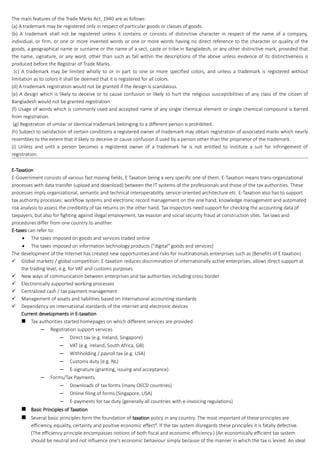
E-Taxation
E-Government consists of various fast moving fields, E Taxation being a very specific one of them. E-Taxation means trans-organizational
processes with data transfer (upload and download) between the IT systems of the professionals and those of the tax authorities. These
processes imply organizational, semantic and technical interoperability, service-oriented architecture etc. E-Taxation also has to support
tax authority processes: workflow systems and electronic record management on the one hand, knowledge management and automated
risk analysis to assess the credibility of tax returns on the other hand. Tax inspectors need support for checking the accounting data of
taxpayers, but also for fighting against illegal employment, tax evasion and social security fraud at construction sites. Tax laws and
procedures differ from one country to another.
E-taxes can refer to:
 The taxes imposed on goods and services traded online
 The taxes imposed on information technology products ("digital" goods and services)
The development of the Internet has created new opportunities and risks for multinationals enterprises such as (Benefits of E taxation)
 Global markets / global competition: E-taxation reduces discrimination of internationally active enterprises, allows direct support at
the trading level, e.g. for VAT and customs purposes
 New ways of communication between enterprises and tax authorities including cross border
 Electronically supported working processes
 Centralized cash / tax payment management
 Management of assets and liabilities based on international accounting standards
 Dependency on international standards of the internet and electronic devices
Current developments in E-taxation
 Tax authorities started homepages on which different services are provided
– Registration support services
– Direct tax (e.g. Ireland, Singapore)
– VAT (e.g. Ireland, South Africa, GB)
– Withholding / payroll tax (e.g. USA)
– Customs duty (e.g. NL)
– E-signature (granting, issuing and acceptance)
– Forms/Tax Payments
– Downloads of tax forms (many OECD countries)
– Online filing of forms (Singapore, USA)
– E-payments for tax duty (generally all countries with e-invoicing regulations)
 Basic Principles of Taxation
 Several basic principles form the foundation of taxation policy in any country. The most important of these principles are
efficiency, equality, certainty and positive economic effect8
. If the tax system disregards these principles it is fatally defective.
(The efficiency principle encompasses notions of both fiscal and economic efficiency.) (An economically efficient tax system
should be neutral and not influence one's economic behaviour simply because of the manner in which the tax is levied. An ideal
tax system is also equitable in its application. Not only does it treat taxpayers in similar economic circumstances9
similarly but
also it makes suitable distinctions in its treatment of those in different economic situations.) (It necessarily raises questions of
"similar economic circumstances", certainty in the tax laws is a fundamental principle in the establishment of ideal tax structure
because predictability of tax consequences is an essential component of other basic tax principles. Finally, taxation has always
been a mechanism for stabilization and regulation of the economy10
. Recognizing this fact, legislature has emphasized the
economic effects of the principle of taxation, with a particular focus on encouraging economic growth.)
Challenges Before Tax authorities
The general perceived wisdom to which tax authorities universally appear to subscribe, is that their major challenges regarding e-
commerce are:
(i) Identifying the tax payer, especially when an Internet user is involved.
(ii) Identifying audit risks and developing audit trials to ensure compliance.
(iii) Obtaining access to verifiable information and documents.
(iv) Obtaining access to encrypted data
(v) Developing a response to the advent of electronic money (e-cash) and ensuring efficient mechanism for collecting tax
especially from non-resident tax payers.
 Points to remember in e taxation(Limitations):
 There is a need for initial inter-government and multi-jurisdictional co-operation and agreement to synchronize
the taxation treatment.
 Taxation authorities need to modernize their operation radically.
 There is a need to monitor cross-border business activities on the Internet.
 Authorities need to upgrade their technological knowledge.
 Tax authorities need better data mining techniques database management took and an audit policy indeed towards thoroughly
examining the various models of e-business.
 Tax treatment need to match electronic reality.
 Privileges such an extended filing dates for tax returns could be granted to tax payers who conduct their dealings with the tax
authorities electronically.
 Many tax authorities urgently need to co-ordinate better with other Government departments to obtain information on matters
such as customs duty clearances.
 General legislations and domain registration requirements and investment attraction.
 Tax policy makers need to strike a balance between providing incentives to promote the new e-business economy. Simplicity of
rules and case of compliance are obvious legislative and administrative goals yet these must be balanced by regulatory controls
preventing crime and tax fraud ensuring personal data protection.
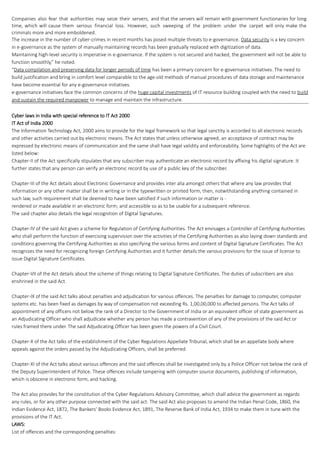
E governance and Cyber-crime
E-governance or Electronic Governance is dealt with under Sections 4 to 10A of the IT Act, 2000. It provides for legal recognition of
electronic records and Electronic signature and also provides for legal recognition of contracts formed through electronic means.
Filing of any form, application or other documents, creation, retention or preservation of records, issue or grant of any license or permit
or receipt or payment in Government offices and its agencies may be done through the means of electronic form.
Through e-governance, government services will be made available to citizens in a convenient, efficient and transparent manner. The
three main target groups that can be distinguished in governance concepts are government, citizens and businesses/interest groups. In
e-governance there are no distinct boundaries.
[2]
Generally, four basic models are available – government-to-citizen (customer), government- to-employees, government-to-
government and government-to-business.
In cyber-crime, ICT devices are either the target or the means of the crime, or are incidental to it. Most cyber-crimes are not new
crimes. Often the only difference is that the evidences are in electronic form or that the tools used to commit the crimes are ICT
tools. Indeed, most of the crimes committed today involve some amount of evidence in the electronic form such as phone calls,
messages, emails, electronic files etc. Most cyber-crime cases are booked in India under the provisions of the Indian Penal Code (IPC)
and laws on economic offenses, and only very few under the Information Technology Act 2000. However, the Information Technology
Act 2000 has enabling provisions for admissibility of electronic evidences in the courts of law.
Unlike traditional crime, cyber-crime is not restricted by geographical boundaries. Indeed, often cyber criminals operate from other
countries.
Information warfare is now a recognized national threat. Indeed, “IT disaster” is among is the newest additions to the man-made
disasters. This brings out the need of strong international cooperation on real-time basis to tackle cyber-crimes. Many companies do
not report to authorities about attacks on their networks out of fear of adverse publicity and losing the confidence of the clients.
Companies also fear that authorities may seize their servers, and that the servers will remain with government functionaries for long
time, which will cause them serious financial loss. However, such sweeping of the problem under the carpet will only make the
criminals more and more emboldened.
The increase in the number of cyber-crimes in recent months has posed multiple threats to e-governance. Data security is a key concern
in e-governance as the system of manually maintaining records has been gradually replaced with digitization of data.
Maintaining high-level security is imperative in e-governance. If the system is not secured and hacked, the government will not be able to
function smoothly,” he noted.
“Data compilation and preserving data for longer periods of time has been a primary concern for e-governance initiatives. The need to
build justification and bring in comfort level comparable to the age-old methods of manual procedures of data storage and maintenance
have become essential for any e-governance initiatives.
e-governance initiatives face the common concerns of the huge capital investments of IT resource building coupled with the need to build
and sustain the required manpower to manage and maintain the infrastructure.
Cyber laws in India with special reference to IT Act 2000
IT Act of India 2000
The Information Technology Act, 2000 aims to provide for the legal framework so that legal sanctity is accorded to all electronic records
and other activities carried out by electronic means. The Act states that unless otherwise agreed, an acceptance of contract may be
expressed by electronic means of communication and the same shall have legal validity and enforceability. Some highlights of the Act are
listed below:
Chapter-II of the Act specifically stipulates that any subscriber may authenticate an electronic record by affixing his digital signature. It
further states that any person can verify an electronic record by use of a public key of the subscriber.
Chapter-III of the Act details about Electronic Governance and provides inter alia amongst others that where any law provides that
information or any other matter shall be in writing or in the typewritten or printed form, then, notwithstanding anything contained in
such law, such requirement shall be deemed to have been satisfied if such information or matter is -
rendered or made available in an electronic form; and accessible so as to be usable for a subsequent reference.
The said chapter also details the legal recognition of Digital Signatures.
Chapter-IV of the said Act gives a scheme for Regulation of Certifying Authorities. The Act envisages a Controller of Certifying Authorities
who shall perform the function of exercising supervision over the activities of the Certifying Authorities as also laying down standards and
conditions governing the Certifying Authorities as also specifying the various forms and content of Digital Signature Certificates. The Act
recognizes the need for recognizing foreign Certifying Authorities and it further details the various provisions for the issue of license to
issue Digital Signature Certificates.
Chapter-VII of the Act details about the scheme of things relating to Digital Signature Certificates. The duties of subscribers are also
enshrined in the said Act.
Chapter-IX of the said Act talks about penalties and adjudication for various offences. The penalties for damage to computer, computer
systems etc. has been fixed as damages by way of compensation not exceeding Rs. 1,00,00,000 to affected persons. The Act talks of
appointment of any officers not below the rank of a Director to the Government of India or an equivalent officer of state government as
an Adjudicating Officer who shall adjudicate whether any person has made a contravention of any of the provisions of the said Act or
rules framed there under. The said Adjudicating Officer has been given the powers of a Civil Court.
Chapter-X of the Act talks of the establishment of the Cyber Regulations Appellate Tribunal, which shall be an appellate body where
appeals against the orders passed by the Adjudicating Officers, shall be preferred.
Chapter-XI of the Act talks about various offences and the said offences shall be investigated only by a Police Officer not below the rank of
the Deputy Superintendent of Police. These offences include tampering with computer source documents, publishing of information,
which is obscene in electronic form, and hacking.
The Act also provides for the constitution of the Cyber Regulations Advisory Committee, which shall advice the government as regards
any rules, or for any other purpose connected with the said act. The said Act also proposes to amend the Indian Penal Code, 1860, the
Indian Evidence Act, 1872, The Bankers' Books Evidence Act, 1891, The Reserve Bank of India Act, 1934 to make them in tune with the
provisions of the IT Act.
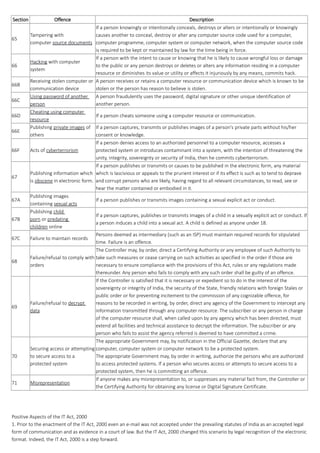
LAWS:
List of offences and the corresponding penalties:
Section Offence Description
65
Tampering with
computer source documents
If a person knowingly or intentionally conceals, destroys or alters or intentionally or knowingly
causes another to conceal, destroy or alter any computer source code used for a computer,
computer programme, computer system or computer network, when the computer source code
is required to be kept or maintained by law for the time being in force.
66
Hacking with computer
system
If a person with the intent to cause or knowing that he is likely to cause wrongful loss or damage
to the public or any person destroys or deletes or alters any information residing in a computer
resource or diminishes its value or utility or affects it injuriously by any means, commits hack.
66B
Receiving stolen computer or
communication device
A person receives or retains a computer resource or communication device which is known to be
stolen or the person has reason to believe is stolen.
66C
Using password of another
person
A person fraudulently uses the password, digital signature or other unique identification of
another person.
66D
Cheating using computer
resource
If a person cheats someone using a computer resource or communication.
66E
Publishing private images of
others
If a person captures, transmits or publishes images of a person's private parts without his/her
consent or knowledge.
66F Acts of cyberterrorism
If a person denies access to an authorized personnel to a computer resource, accesses a
protected system or introduces contaminant into a system, with the intention of threatening the
unity, integrity, sovereignty or security of India, then he commits cyberterrorism.
67
Publishing information which
is obscene in electronic form.
If a person publishes or transmits or causes to be published in the electronic form, any material
which is lascivious or appeals to the prurient interest or if its effect is such as to tend to deprave
and corrupt persons who are likely, having regard to all relevant circumstances, to read, see or
hear the matter contained or embodied in it.
67A
Publishing images
containing sexual acts
If a person publishes or transmits images containing a sexual explicit act or conduct.
67B
Publishing child
porn or predating
children online
If a person captures, publishes or transmits images of a child in a sexually explicit act or conduct. If
a person induces a child into a sexual act. A child is defined as anyone under 18.
67C Failure to maintain records
Persons deemed as intermediary (such as an ISP) must maintain required records for stipulated
time. Failure is an offence.
68
Failure/refusal to comply with
orders
The Controller may, by order, direct a Certifying Authority or any employee of such Authority to
take such measures or cease carrying on such activities as specified in the order if those are
necessary to ensure compliance with the provisions of this Act, rules or any regulations made
thereunder. Any person who fails to comply with any such order shall be guilty of an offence.
69
Failure/refusal to decrypt
data
If the Controller is satisfied that it is necessary or expedient so to do in the interest of the
sovereignty or integrity of India, the security of the State, friendly relations with foreign Stales or
public order or for preventing incitement to the commission of any cognizable offence, for
reasons to be recorded in writing, by order, direct any agency of the Government to intercept any
information transmitted through any computer resource. The subscriber or any person in charge
of the computer resource shall, when called upon by any agency which has been directed, must
extend all facilities and technical assistance to decrypt the information. The subscriber or any
person who fails to assist the agency referred is deemed to have committed a crime.
70
Securing access or attempting
to secure access to a
protected system
The appropriate Government may, by notification in the Official Gazette, declare that any
computer, computer system or computer network to be a protected system.
The appropriate Government may, by order in writing, authorize the persons who are authorized
to access protected systems. If a person who secures access or attempts to secure access to a
protected system, then he is committing an offence.
71 Misrepresentation
If anyone makes any misrepresentation to, or suppresses any material fact from, the Controller or
the Certifying Authority for obtaining any license or Digital Signature Certificate.
Positive Aspects of the IT Act, 2000
1. Prior to the enactment of the IT Act, 2000 even an e-mail was not accepted under the prevailing statutes of India as an accepted legal
form of communication and as evidence in a court of law. But the IT Act, 2000 changed this scenario by legal recognition of the electronic
format. Indeed, the IT Act, 2000 is a step forward.
2. From the perspective of the corporate sector, companies shall be able to carry out electronic commerce using the legal infrastructure
provided by the IT Act, 2000. Till the coming into effect of the Indian Cyber law, the growth of electronic commerce was impeded in our
country basically because there was no legal infrastructure to regulate commercial transactions online.
3. Corporate will now be able to use digital signatures to carry out their transactions online. These digital signatures have been given legal
validity and sanction under the IT Act, 2000.
4. In today’s scenario, information is stored by the companies on their respective computer system, apart from maintaining a backup.
Under the IT Act, 2000, it shall now be possible for corporate to have a statutory remedy if any one breaks into their computer systems or
networks and causes damages or copies data. The remedy provided by the IT Act, 2000 is in the form of monetary damages, by the way of
compensation, not exceeding Rs. 1, 00, 00,000.
5. IT Act, 2000 has defined various cyber-crimes which includes hacking and damage to the computer code. Prior to the coming into
effect of the Indian Cyber law, the corporate were helpless as there was no legal redress for such issues. But the IT Act, 2000 changes the
scene altogether.
The Grey Areas of the IT Act, 2000[4]:
1. The IT Act, 2000 is likely to cause a conflict of jurisdiction.
2. Electronic commerce is based on the system of domain names. The IT Act, 2000 does not even touch the issues relating to domain
names. Even domain names have not been defined and the rights and liabilities of domain name owners do not find any mention in the
law.
3. The IT Act, 2000 does not deal with any issues concerning the protection of Intellectual Property Rights I the context of the online
environment. Contentious yet very important issues concerning online copyrights, trademarks and patents have been left untouched by
the law, thereby leaving many loopholes.
4. As the cyber law is growing, so are the new forms and manifestations of cybercrimes. The offences defined in the IT Act, 2000 are by no
means exhaustive. However, the drafting of the relevant provisions of the IT Act, 2000 makes it appear as if the offences detailed therein
are the only cyber offences possible and existing. The IT Act, 2000 does not cove various kinds of cybercrimes and Internet related crimes.
These Include: -
a) Theft of Internet hours
b) Cyber theft
c) Cyber stalking
d) Cyber harassment
e) Cyber defamation
f) Cyber fraud
g) Misuse of credit card numbers
h) Chat room abuse
5. The IT Act, 2000 has not tackled several vital issues pertaining to e-commerce sphere like privacy and content regulation to name a few.
Privacy issues have not been touched at all.
6. Another grey area of the IT Act is that the same does not touch upon any anti- trust issues.
7. The most serious concern about the Indian Cyber law relates to its implementation. The IT Act, 2000 does not lay down parameters for
its implementation. Also, when internet penetration in India is extremely low and government and police officials, in general are not very
computer savvy, the new Indian cyber law raises more questions than it answers. It seems that the Parliament would be required to
amend the IT Act, 2000 to remove the grey areas mentioned above.

Cyber Law & Forensics

  • 1.
    Unit II: Introductionabout the cyber space, cyber law, regulation of cyber space, scope of cyber laws: ecommerce; online contracts; IPRs (copyright, trademarks and software patenting), e taxation; e-governance and cyber-crimes, cyber law in India with special reference to Information Technology Act, 2000. Introduction about the cyber space Cyberspace is "the notional environment in which communication over computer networks occurs." The word became popular in the 1990s when the uses of the internet, networking, and digital communication were all growing dramatically and the term "cyberspace" was able to represent the many new ideas and phenomena that were emerging. The parent term of cyberspace is "cybernetics", derived from the Ancient Greek word which means steersman, governor, pilot, or rudder, “cyberspace” is introduced by William Gibson a science fiction writer. As a social experience, individuals can interact, exchange ideas, share information, provide social support, conduct business, direct actions, create artistic media, play games, engage in political discussion, and so on, using this global network. They are sometimes referred to as cybernauts. Unlike most computer terms, "cyberspace" does not have a standard, objective definition. Instead, it is used to describe the virtual world of computers. For example, an object in cyberspace refers to a block of data floating around a computer system or network. With the advent of the Internet, cyberspace now extends to the global network of computers. So, after sending an e-mail to your friend, you could say you sent the message to her through cyberspace. We often send emails in place of paper letters, we leave electronic messages on bulletin boards rather than pinning slips of card to wooden notice boards, and more and more frequently we are able to read texts on-line—in e-journals, for instance—rather than on good old-fashioned wood pulp. The physical objects of traditional communication (letters, books and so on) are being superseded by new electronic objects. And, just as physical objects exist in physical space, so these cyber objects exist in cyberspace. There are in fact two spurs of cyberspace. On the one hand, we have virtual reality—a 3-D cyber spatial environment which humans can ‘enter’ and ‘move through’, interacting with both the computer and other human beings, as depicted in films like The Lawnmower Man and Disclosure. On the other hand, we have the slightly less dramatic, but more utilitarian, world of networks of computers linked via cables and routers (similar to telephone connections) which enable us to communicate, store and retrieve information. By far the largest and most well-known of these is the Internet—originally used for email, ftp (file transfer), bulletin boards and newsgroups, and telnet (remote computer access), and now even more of a household name courtesy of the World Wide Web, which allows simple stress-free navigation of the network. This second spur of cyberspace encompasses not only the connections between computers, but also the browser and email software which transmits information, plus the internal space of the microchip and other electronic storage technologies—the places in which information actually resides. Cyberspace, like physical space, comprises (at least) the four sub-concepts: place, distance, size and route. And the formula remains the same as for physical space. Place prompts us to ask "where-type" questions. On which server is a particular website located? To which email address should we send our message? And the chat room of IRC represents a cyber place. Such ways of speaking reflect the importance of locating specific targets in cyberspace. Distance has us asking "how far-type" questions. How many transmissions between how many different computers will it take for information to reach the desired destination? In this way we can calculate how long it might take for a corporate website or a personal homepage to reach our screens—calculations which become important for people with dial-up connections from home, where time really is money. 2 With size we ask "how big-type" questions. We might wonder how extensive a website is, meaning how much information it contains and how many links to other sites it includes. Size is also a relevant factor for ftp – how large a file is will (partially) determine how long it takes to download from the host computer to your own. And finally, route involves "navigation-type" issues. My email lands up in someone else’s mailbox by following a specified route or set of connections, while Web browsers enable us to reach out from our own computers and explore the electronic universe, as we follow links, moving from site to site. It appears, then, that space and cyberspace can count as roughly equivalent conceptual entities, at least in the sense of sharing the four common sub-concepts of place, distance, size and route. Information in its many forms—email messages, websites, files, notices on bulletin boards—all of these comprise the cyber objects of cyberspace. Cyber law Cyber Law or Internet law is a term that encapsulates the legal issues related to use of the Internet. It is less a distinct field of law than intellectual property or contract law, as it is a domain covering many areas of law and regulation. Some leading topics include internet access and usage, privacy, freedom of expression, and jurisdiction. Cyber Law is the law governing cyber space. Law encompasses the rules of conduct: 1. That have been Approved by the government, and 2. Which are in Force over a certain territory, and 3. Which must be obeyed by all persons on that territory. Violation of these rules could lead to government action such as imprisonment or fine or an order to pay compensation. Cyber law encompasses laws relating to: 1. Cyber Crimes
  • 2.
    2. Electronic andDigital Signatures 3. Intellectual Property 4. Data Protection and Privacy Cybercrimes are unlawful acts where the computer is used either as a tool or a target or both. The enormous growth in electronic commerce (e-commerce) and online share trading has led to a phenomenal spurt in incidents of cyber-crime. To prevent these crimes and to maintain the fair usage of the internet cyber laws are designed. Cyber law includes some of the major laws: 1. Copyright law 2. Software and source code Licenses 3. Trademark law 4. Semiconductor law 5. Patent law Cyber law is important because it touches almost all aspects of transactions and activities concerning the Internet, the World Wide Web and Cyberspace. Data protection and privacy laws aim to achieve a fair balance between the privacy rights of the individual and the interests of data controllers such as banks, hospitals, email service providers etc. These laws seek to address the challenges to privacy caused by collecting, storing and transmitting data using new technologies. In early times, there was no statute in India for governing Cyber Laws involving privacy issues, jurisdiction issues, intellectual property rights issues and a number of other legal questions. With the tendency of misusing of technology, there arisen a need of strict statutory laws to regulate the criminal activities in the cyber world and to protect the true sense of technology "INFORMATION TECHNOLOGY ACT, 2000" [ITA- 2000] was enacted by Parliament of India to protect the field of e-commerce, e-governance, e-banking as well as penalties and punishments in the field of cyber-crimes. The above Act was further amended in the form of IT Amendment Act, 2008 [ITAA-2008] Need for Cyber Law There are various reasons why it is extremely difficult for conventional law to cope with cyberspace. Some of these are discussed below. 1. Cyberspace is an intangible dimension that is impossible to govern and regulate using conventional law. 2. Cyberspace has complete disrespect for jurisdictional boundaries. A person in India could break into a bank’s electronic vault hosted on a computer in USA and transfer millions of Rupees to another bank in Switzerland, all within minutes. All he would need is a laptop computer and a cell phone. 3. Cyberspace handles gigantic traffic volumes every second. Billions of emails are crisscrossing the globe even as we read this, millions of websites are being accessed every minute and billions of dollars are electronically transferred around the world by banks every day. 4. Cyberspace is absolutely open to participation by all. A ten-year-old in Bhutan can have a live chat session with an eight-year-old in Bali without any regard for the distance or the anonymity between them. 5. Cyberspace offers enormous potential for anonymity to its members. Readily available encryption software and stenographic tools that seamlessly hide information within image and sound files ensure the confidentiality of information exchanged between cyber- citizens. 6. Cyberspace offers never-seen-before economic efficiency. Billions of dollars’ worth of software can be traded over the Internet without the need for any government licenses, shipping and handling charges and without paying any customs duty. 7. Electronic information has become the main object of cyber-crime. It is characterized by extreme mobility, which exceeds by far the mobility of persons, goods or other services. International computer networks can transfer huge amounts of data around the globe in a matter of seconds. 8. A software source code worth crores of rupees or a movie can be pirated across the globe within hours of their release. 9. Theft of corporeal information (e.g. books, papers, CD ROMs, floppy disks) is easily covered by traditional penal provisions. However, the problem begins when electronic records are copied quickly, inconspicuously and often via telecommunication facilities. Here the “original” information, so to say, remains in the “possession” of the “owner” and yet information gets stolen. Regulation of cyber space As electronic transactions over the Internet become important the question arises whether they will be controlled on the national and international levels.
  • 3.
    FOUR MODES OFREGULATION IN CYBERSPACE Norms / Education In order to function and be accepted in a society, a person will live by its norms. You believe in the role of educating people so that new norms may develop as new technology is used. As an example of the change of attitudes that result from education programs you might look back on smoking ads that once portrayed cigarette smokers as beautiful, sophisticated, sexy people with the ads of today, where a blackened sponge is wrung out to show the impact of smoking on the lungs. Once education creates a new norm, community behaviour it is regulated by peer and social pressure. Norms can involve the adoption of “rules” for regulating behaviour. These rules may not have the force of law but they create a level of behaviour that anyone wanting to be accepted in that group ought to adopt. People that breach norms may incur sanctions. These sanctions do not have the force that penalties or custodial sentences might have in a legal setting. The sanction when imposed may result in an infringer being placed outside a norm group. On showing contrition, particularly where their contrition is matched by entry into a re-education program about the norm, the infringer may be readmitted. Usually a body or entity that is a part of the group will make findings about any infringements and the sanction that ought to apply. The norms that come about as a result of education may need to be put into writing. In a technological era, this writing might take the form of Acceptable Use Policies, Terms of Engagement and other polices that act as a norm but may not be legally enforceable like a contract. Over time norms, can be made into law through legislation or litigation (case law). Law You believe in parliament’s capacity to make laws to regulate the behaviour of its citizens. Where parliaments are silent, the courts will make precedents. People who break the law suffer sanctions - these can be civil penalties of loss of money when an infringing party is ordered to pay damages to another. There is also criminal law through which you believe society establishes what constitutes acceptable and unacceptable behaviour. Unacceptable behaviour is regulated through a sentencing regime – lesser offences might incur fines and bonds, more serious ones some form of custodial sentence. You are satisfied that if parliament makes a law then it is made by the people. What is parliament if nothing other than a representative body of the people as expressed at elections? Once a matter becomes law the law itself ought to be black letter – it ought to be clearly understood, free from doubt and dispute. Breaches should result in similar punishments. Architecture You believe in the power of human to design systems that regulate behaviour. To control speeding in a back street you would design and build speed humps. In a digital world you believe in the power of software code to be able to create a form of regulation. For example, you might design a technological protection measure in your software that prevents a program with a license of ten users from allowing an eleventh user to open it over a network. You find education / norms too slow to bring about change. You find law too expensive. You can design the world you want and have people regulate their behaviour because such restrictions in behaviour are inherent in what you have created. You consider yourself a geek and technological master of non-technical people who use other forms of regulation. You also realize that if you can regulate behaviour through design then your product will be more valuable. You usually work in the private sector though increasingly your skills might be sought in publicly owned entities wanting to develop monitoring and surveillance systems. Market Forces You are convinced that market forces regulate behaviour. If a manufacturer creates an unsafe product this will become known to the market and consumers will not purchase these products. If a software designer wants to copyright and license his or her work, then the market will determine if the software is worth buying as compared with that of competitors. Markets will determine what survives and what doesn't in the market place. Market forces also use price as a form of regulation. It is said consumers regulate their behaviour based on a cost/benefit analysis. For example, at least theoretically, as the price of petrol rises, consumers will travel less in their cars and take public transport, or push for its installation. In its purest form, you believe that free markets, rather than government, will best regulate human activity. Scope of cyber laws: Cyber law is that stream of law where all the cyber-crimes such as theft, fraud, etc. all of which are subject to the Indian Penal Code are addressed by the Information Technology Act, 2000. With advanced technology and changing times, almost all the processes are now going on IT platform. This is giving rise to increase of cyber-crimes in India as well as abroad. Cyber-crimes are broadly categorized in two different categories: (1) Using a computer to target other computer – for e.g. Virus attacks, hacking, etc.
  • 4.
    (2) Using acomputer to commit crimes – for e.g. Credit card frauds, cyber terrorism, etc. Cyber-crime is a criminal exploitation of the internet. A misconduct that is committed against an individual or groups of individuals with an unlawful intention to hurt the position of the victim or cause any mental or physical harm to the victim directly or indirectly by using advanced IT and related sources such as Internet and mobile phones is termed as cyber-crime. Such crimes may be harmful for a country. All these activities leading to crimes have given rise to a relatively new field in law for protecting the interests of an individual which is called cyber law. Cyber law is important because it touches almost all aspects of transactions and activities on and concerning the Internet, the World Wide Web and Cyberspace. There are several advantages of Cyber Law to protect the individuals from getting trapped in any cyber violations. The IT Act 2000 provides several guidelines in this regard.  Organizations shall now be able to carry out e-commerce using the legal infrastructure provided by the Act.  The Act throws open the doors for the entry of corporate companies in the business of being Certifying Authorities for issuing Digital Signatures Certificates.  Under the IT Act, 2000, it shall now be possible for corporates to have a statutory remedy in case if anyone breaks into their computer systems or network and cause loss.  The Act now allows Government to issue notification on the web thus indicating e-governance.  The IT Act also addresses the important issues of security, which are so critical to the success of electronic transactions. It is to be noted that since cyber law cannot be restricted to a geographical area, therefore, a single transaction may involve the laws of at least three authorities: (1) the laws of the state/nation in which the user resides, (2) the laws of the state/nation that apply where the server hosting the transaction is located, and 3) the laws of the state/nation which apply to the person or business with whom the transaction takes place. 1. Requirement of Cyber Law There are many grounds why it is difficult for conventional law to manage with cyberspace. The first reason is that Cyberspace is an intangible dimension that is unfeasible to govern and regulate using conventional law. Secondly, cyberspace has complete disregard for jurisdictional boundaries. Another reason is that cyberspace handles huge traffic volumes every second. Billions of emails are crisscrossing the globe even as we read this, millions of websites are being accessed every minute and billions of dollars are electronically transferred around the world by banks every day. Cyberspace is absolutely open to sharing by all. Cyberspace offers enormous potential for secrecy to its members. Readily available encryption software and stenographic tools that flawlessly hide information within image and sound files ensure the confidentiality of information exchanged between cyber-citizens. Electronic information has become the main aim of cyber-crime. It is considered by extreme mobility, which exceeds by far the mobility of persons, goods or other services. International computer networks can transfer huge amounts of data around the globe within seconds. A software source code worth crores of rupees or a movie can be pirated across the globe within hours of their release. Theft of corporeal information such as books, papers, CD ROMs, floppy disks is easily covered by conventional penal provisions. Nevertheless, the difficulty begins when electronic records are copied quickly, inconspicuously and often via telecommunication facilities. To control cyber-crime, Electronic signatures are used to validate electronic records. Digital signatures are one type of electronic signature. Digital signatures satisfy three major legal requirements – signer authentication, message authentication and message integrity. The following Act, Rules and Regulations are included under cyber laws: 1. Information Technology Act, 2000 2. Information Technology (Certifying Authorities) Rules, 2000 3. Information Technology (Security Procedure) Rules, 2004 4. Information Technology (Certifying Authority) Regulations, 2001 2. Scope of Cyber Laws Cyber laws have broad scope in current complex situation and eruption of cyber-crime. These laws cover other areas of law having a technology component. Laws related to ecommerce, online contracts, copyright, trademark, business software patenting, e-taxation, e- governance and cyber-crimes fall within the meaning and scope of cyber laws. To, summarize, cyber laws offers the vital mechanism to impeach any person, who is realistically suspected of having committed or of committing or of being about to carry out any offence using any computer, computer system or computer network. Cyber law is an important field of law which represents all the legal issues linked with the internet, and governs all the aspects of the internet and cyberspace, along with dealing in legal cases regarding software patents, net banking and others. Cyber legal representatives perform regular investigations on the major cyber-crimes that are widespread across the internet. With the growing increase in cyber-crimes against individuals, organizations and the government via the internet today, there is a need for strict cyber laws in the global society. Cyber laws which battles cyber-crimes have a dominant effect on any other laws for the time being in force. In India, it was observed that there is drastic increase in the number of cyber-crimes therefore the field of cyber law in India is gaining huge recognition. Ecommerce
  • 5.
    Electronic commerce, commonlyknown as e-commerce or ecommerce, or e-business consists of the buying and selling of products or services over electronic systems such as the Internet and other computer networks. The amount of trade conducted electronically has grown extraordinarily with widespread Internet usage. The use of commerce is conducted in this way, spurring and drawing on innovations in electronic funds transfer, supply chain management, Internet marketing, online transaction processing, electronic data interchange (EDI), inventory management systems, and automated data collection systems. Modern electronic commerce typically uses the World Wide Web at least at some point in the transaction's lifecycle, although it can encompass a wider range of technologies such as e-mail as well. The benefits of e-commerce include its around-the-clock availability, the speed of access, a wider selection of goods and services, accessibility, and international reach. Its perceived downsides include sometimes-limited customer service, not being able to see or touch a product prior to purchase, and the necessitated wait time for product shipping. To ensure the security, privacy and effectiveness of e-commerce, businesses should authenticate business transactions, control access to resources such as webpages for registered or selected users, encrypt communications and implement security technologies such as the Secure Sockets Layer. E-Tailing While e-commerce can take on many forms, one of the most common practices related to electronic commerce is the practice of "e- tailing." Also known as "virtual storefronts," this is the practice of listing products for sale in a catalog format on a website. Some e-tail sites (perhaps most notably Amazon.com) take this a step further and aggregate numerous smaller stores into a unified system like a "virtual mall." Other Forms of E-Commerce Other examples of e-commerce include subscription sites, mobile application sales, electronic book purchases, online auctions, and the procurement of various services via the web. 3. Ecommerce Legal and Law Ecommerce transactions should be legally straightforward. You get money up front for the sale, in return for delivery of a product as described within the timeframe specified. A standard set of terms and conditions should cover the vast majority of transactions. Your terms and conditions should outline that buyers are entering into a contract to when they purchase goods from your website. Outline the terms of delivery, shipping, refunds and payments, exclusions of liability and terms of use for your website. Finally, specify the choice of law and jurisdiction of wherever you’re based – this will shift the case to your own legal system, so you don’t find yourself negotiating some unknown foreign law interpreting your terms in the event of legal issues. 3.1. Shipping and Delivery Policy A clear, defined delivery policy is a must-have, so that customers know when to expect their products and how their packages will be delivered. You will need to specify the expected delivery timeframes and costs, as well as detailed terms on any shipping promotions. A number of merchants use shipping discounts and promotions to encourage a higher average spend – for example, free shipping on orders over £200. Policies like this can help squeeze extra revenue into the bargain. 3.2. Refunds Policy Refunds are an important part of building trust with customers, and you will hamper conversions if you don’t recognise that refunds will sometimes be required. It is wise to be liberal in your refunds policy, and you must refund cancelled purchases within the statutory ‘cooling off’ period – 14 days. You can ask the customer to pay the cost of returns, and you are entitled to expect goods to be returned to you in a merchantable condition. Accepting that refunds are a natural part of the business, and responding promptly in handling refund requests will help assure customers that you care, while ensuring you don’t end up shy of consumer selling regulation. 3.3. Protecting Your Interests Terms and conditions are essential for protecting your business, and possibly your personal, interests when selling online. In an ideal world, you would never encounter disputes or difficulties in ecommerce. In the real world, it’s an absolute guarantee with scale. By taking care over drafting your terms and conditions, and consulting a lawyer where the budget allows, you can clearly set out the terms of business, and secure agreement from your customers at the point the contract of sale is created. 3.4. Data Protection Data protection is an area of the law all website owners should be mindful of. If you intend to collect personal information about your website visitors, you will need to be registered under the Data Protection Act, and to handle your data in compliance with the law at all times. 3.5. Protecting Your Customer’s Privacy Online Online privacy is a big issue as many ecommerce sites collect and retain personal information about customers. Some of the personal data you will likely obtain would include a customer’s name, address, email address, and possibly their credit card and other types of financial information. As the ecommerce site owner it is your responsibility to ensure this personally identifiable information is protected, and that when you collect such data you comply with federal and state privacy laws.
  • 6.
    3.6. Online AdvertisingCompliance Ecommerce site owners must know about the applicable laws for online advertising. Like traditional advertising for brick-and-mortar stores, online retailers must also comply with regulations when advertising online. The FTC regulations for advertising are designed to protect consumers and to prevent deceptive and unfair acts or practices. 3.7. Standard Ecommerce Terms and Conditions There are a number of clauses that can be found in most terms and conditions, either by virtue of legal necessity or to protect the merchant in the selling process. The following is a non-exhaustive list of some of the things you might want to include within your ecommerce terms and conditions:  Information Commensurate with latest Consumer Contract Regulations: The latest Consumer Contract Regulations stipulate information that must be made clear to consumers purchasing online via your terms and conditions. These include your contact details, including clarification of your business identity, the products you sell, and how you can be contacted by your customers. This is not optional, so it pays to do your homework on what must be included when drafting up your terms and conditions.  Liability Limitations: Limited liability is a standard practice across most contracts, in a bid to limit any future claims that may arise from the transaction. There are some claims to liability you can’t contract away from – such as those causing death or personal injury – but broad exclusions of other types of damages can be effective in reducing your future obligations (and keeping legal costs to an absolute minimum).  What Happens and Who Pays for Returns? Returns are a fact of life in ecommerce, and it’s useful to be upfront about how your returns process works, and who bares the costs of return shipping. Specify this within your terms and conditions, even if you have an external refunds policy in place.  Jurisdiction/Choice of Law: Under which laws will the contract of sale be interpreted? This matters particularly in ecommerce, where you may end up resorting to the lottery of legal systems when selling across the EU, or indeed the world, if you don’t seize the initiative.  Delivery Terms: It’s also useful to take into account your delivery terms, or to directly reference your shipping policy if you have one in place. When your customers accept these terms, you can solve so many support issues or refund requests, simply by referring to the terms and processes laid down in your delivery terms. Provided they are fair and reasonable, as you must be at all times in drafting terms relating to consumers, you will likely cover your back for more situations. Online contracts A contract is a voluntary arrangement between two or more parties that is enforceable at law as a binding legal agreement. Contract is a branch of the law of obligations in jurisdictions of the civil law tradition. A contract arises when the parties agree that there is an agreement. Formation of a contract generally requires an offer, acceptance, consideration, and a mutual intent to be bound. Each party to a contract must have capacity to enter the agreement. Minors, intoxicated persons, and those under a mental affliction may have insufficient capacity to enter a contract. Some types of contracts may require formalities, such as a memorialization in writing. E-contract is a contract modeled, specified, executed and deployed by a software system. E-contracts are conceptually very similar to traditional (paper based) commercial contracts. Vendors present their products, prices and terms to prospective buyers. Buyers consider their options, negotiate prices and terms (where possible), place orders and make payments. Then, the vendors deliver the purchased products. Nevertheless, because of the ways in which it differs from traditional commerce, electronic commerce raises some new and interesting technical and legal challenges. For recognition of e-contracts following questions are needed to be considered: # Whether e-contract is a valid contract? # Would a supplier making details of goods and services with prices available on a website be deemed to have made an offer? # Whether e-contracts satisfy the legal requirements of reduction of agreements to signed documents. # Whether e-contracts interpret, adopt and compile the other existing legal standards in the context of electronic transactions? Recognition E-contracts Offer: The law already recognizes contracts formed using facsimile, telex and other similar technology. An agreement between parties is legally valid if it satisfies the requirements of the law regarding its formation, i.e. that the parties intended to create a contract primarily. This intention is evidenced by their compliance with 3 classical cornerstones i.e. offer, acceptance and consideration. One of the early steps in the formation of a contract lies in arriving at an agreement between the contracting parties by means of an offer and acceptance. Advertisement on website may or may not constitute an offer as offer and invitation to treat are two distinct concepts. Being an offer to unspecified person, it is probably an invitation to treat, unless a contrary intention is clearly expressed. The test is of intention whether by supplying the information, the person intends to be legally bound or not. When consumers respond through an e-mail or by filling in an online form, built into the web page, they make an Offer. The seller can accept this offer either by express confirmation or by conduct. Acceptance:
  • 7.
    Unequivocal unconditional communicationof acceptance is required to be made in terms of the offer, to create a valid e-contract. The critical issue is when acceptance takes effect, to determine where and when the contract comes into existence. The general receipt rule is that acceptance is effective when received. For contracting no conclusive rule is settled. The applicable rule of communication depends upon reasonable certainty of the message being received. When parties connect directly, without a server, they will be aware of failure or partial receipt of a message. Such party realizing the fault must request re-transmission, as acceptance is only effective when received. When there is a common server, the actual point of receipt of the acceptance is crucial in deciding the jurisdiction in which the e-contract is concluded. If the server is trusted, the postal rule may apply, if however, the server is not trusted or there is uncertainty concerning the e-mail’s route, it is best not to apply the postal rule. When arrival at the server is presumed insufficient, the ‘receipt at the mail box’ rule is preferred. Consideration and Performance: Contracts result only when one promise is made in exchange for something in return. This something in return is called ‘consideration’. The present rules of consideration apply to e-contracts. There is concern among consumers regarding Transitional Security over the Internet. The e-directive on Distance Selling tries to generate confidence by minimizing abuse by purchasers and suppliers. It specifies--- # A list of key points, must be supplied to the consumer in ‘a clear and comprehensible manner.’ # Written confirmation, or confirmation in another durable medium available and accessible to the consumer, of the principle points. # The right of withdrawal enabling consumers to avoid deals entered into inadvertently or without sufficient knowledge, providing for seven-day cooling-off period free from penalty or reason to return the goods or reimburse the cost of services. # Performance should be delivered within thirty days of order unless otherwise expressly agreed. # Reimbursement of sums lost to fraudulent use of credit cards. It places the risk of fraud on the credit card Company, requiring them to take steps to protect their position. # On the other hand, there is also need to protect sellers from rogue purchasers. For this, the provision of ‘charge-back clauses’ and encouragement of pre-payment by buyers is recommended. # Thus, this Directive adequately protects rights of consumers against unknown sellers and sellers against unknown buyers. Liability and Damages: A party that commits breach of an agreement may face various types of liability under contract law. Due to the nature of the systems and the networks that business employ to conduct e-commerce, parties may find themselves liable for contracts which technically originated with them but, due to programming error, employee mistake or deliberate misconduct were executed, released without the actual intent or authority of the party. Sound policies dictate that parties receiving messages be able to rely on the legal expressions of the authority from the sender’s computer and this legally be able to attribute these messages to the sender. In addition to employing information security mechanisms and other controls, techniques for limiting exposure to liability include: 1. Trading partner and legal technical arguments 2. Compliance with recognized procedures, guidelines and practices 3. Audit and control programmers and reviews 4. Technical competence and accreditation 5. Proper human resource management 6. Insurance 7. Enhance notice and disclosure mechanisms and 8. Legislation and regulation addressing relevant secure electronic commerce issuing. Digital Signatures: Section 2(p) of The Information Technology Act, 2000 defines digital signatures as authentication of any electronic record by a subscriber by means of an electronic method or procedure There are three main types of electronic contracting: i. contracts for physical goods-goods are ordered over the internet with payment via the internet but delivery occurs in the usual way, ii. contracts for services, such as electronic banking services, financial advice or consumer advise, and iii. contracts for electronic or digitized products, such as software, music etc. which can be ordered, paid for and delivered online. In any of the above case the contract may be formed either through an exchange of email or by completion of a document on an internet website which is submitted to another party electronically. Therefore, a distinction can be drawn between contracts made via emails and contracts made through the websites. Contracts concluded via websites are commonly referred to as click-wrap contracts. In both cases, it is legally and also commercially important to be able to specify whether, how, when and where such contracts are formed over the internet. IPRs (copyright, trademarks and software patenting) 1. Intellectual property law is that area of law, which concern legal rights associated with creative effort or commercial reputation and goodwill. The subject matter of intellectual property is very wide and includes literary and artistic works, films, computer programs,
  • 8.
    inventions, design andmarks used by traders for their goods or services. The law deters other from copying or taking unfair advantage of the work or reputation of another and provides remedies should this happen. There are different forms of rights and areas of law giving rise to these rights that together make up intellectual property. The traditional pillars of the subject have been the laws of patent and of copyright 2. An Overview of Intellectual Property Law In the TRIPS Agreement the following rights are treated as part of intellectual property: (a) Patent (b) Copyright (c) Trademark (d) Industrial Design (e) Confidential Information (f) Layout-designs of integrated circuits This list is not exhaustive and there are other rights, for example passing off, rights associated with plant and seed varieties protection. There are many similarities and differences between the various rights that make up intellectual property law. For example, there is common ground between patents and registered designs, as there is between copyright and rights in performances. Some rights give rise to monopolies whilst others merely prevent the unfair use by other of an existing work or article. The various rights are not necessarily mutually exclusive and two or more of the rights can co-exist in relation to a certain "thing". Sometimes, the fights will progressively give protection, one right taking over from another over a period of time during the development of an inventions, design or work of copyright. A practical distinction that can be used to subdivide the various rights is whether there is a requirement for registration, that whether the right is dependent upon the completion of formalities, or whether it automatically springs into life at a specified time. Another distinguishing feature is the nature of the right, whether it applies to something which is primarily creative or has to do with goodwill in a wide commercial sense. Creative things can be further subdivided into those that are creative in an artistic or aesthetic sense, such as an oil painting, music or literature, or those that are inventive in an industrial context such as a new type of machine or engine or a new way of making a particular product. 3. Patent Law 3.1 Genesis of Patent of Law The origins of patent can be traced back to the fourteenth century. A Flemish weaver who wanted to practice his trade in England was granted a patent in 1331, one of the earliest recorded instances of a patent. The regulation of trade was deemed to fall within the provenance of the Crown and letters patent proved to be a useful method of encouraging the establishment of new forms of industry and commerce, giving the Crown powerful control over trade. In this early form, there was no need for anything inventive; it had more to do with the practice of a trade and the granting of favors by the Crown. However, some letters patent was granted for inventions - for example, a patent was granted to John of Utyman in 1449 for his new method of making stained glass. Eventually, there was strong need for an effective system that prevented unfair competition where, for example, one person had made some novel invention and wanted to stop other from simply copying it. A monopoly system developed in the reign of Elizabeth I and many letter patent were granted. 3.2 Patent Law The salient features of the Patent Act are as follows: (a) the subject matter of a patent should be a "manner of new manufacture; (b) the inventor or his legal representative or his assignee should be a party to the application for a patent; (c) the application for a patent may be made along with either a Provisional Specification or a Complete Specification; (d) every application in respect of which a Complete Specification has been filed is examined before it is finally accepted; (e) on the acceptance of an application, the specification or the specification in respect of it, become open to public inspection; (f) the grant of a patent on an application may be opposed by any person within 4 months from the date of the advertisement of its acceptance; (g) every patent should be confined to one invention only, but the specification may contain more than one claim; (h) the normal term of a patent is 20 years from its date; but in special circumstances the term may be extended for a further period not exceeding 10 years; (i) the continuance of a patent other than a patent of addition is subject to payment of certain renewal fees; (j) the patentee can be compelled by the Government to grant licenses in public interest; (k) a patent can be revoked by the Controller, the Government or the High Court, in certain circumstances. 3.3 Characteristics to be Patentable In order to be patentable an invention should have the following characteristics: (a) the invention should relate to a manner of manufacture; (b) the manner of manufacture should be novel; (c) it should be the outcome of inventive ingenuity; (d) it should have utility; (e) it should not be contrary to law or morality. 3.4 What cannot be patented: - Patents are open to most areas of science and technology but some areas are excluded from patentability. These are: -
  • 9.
     Ideas, hypotheses,discoveries (of things already existing in nature), scientific theories and mathematical methods.  Rules of games, lottery systems, methods for performing mental acts, teaching methods and organizational procedures.  Diagnostic, therapeutic and surgical methods used on the human and animal body.  Literary, dramatic, musical or artistic works or any aesthetic creation whatsoever.  The presentation of information.  Inventions, the exploitation of which would be contrary to public order or morality, also cannot be patented. 4. Copyright Law 4.1 Copyright Law: An Overview Copyright is a property right that subsists in certain specified types of works as provided for by the Copyright Ordinance, 1962. Examples of the works in which copyright subsists are original literary works, films and sound recordings. The owner of the copyright subsisting in a works has the exclusive right to do certain acts in relation to the work such as making a copy, broadcasting or selling copies to the public. These are examples of the acts restricted by copyright. The owners of the copyright can control the exploitation of the work, for example by making or selling copies to the public or by granting permission to another to do this in return for a payment. If a person performs one of the acts restricted by copyright without the permission or license of the copyright owner, the latter can sue for infringement of his copyright and obtain remedies, for example damages and an injunction. 4.2 Rules: (1) copyright shall subsist in the following classes of works– (i) original literary, dramatic, musical and artistic works; (ii) cinematographic works; (iii) records; and (iv) broadcasts; 4. (2) Duration of copyright protection under the Copyright Act 1957  Literary  dramatic,  musical and  artistic works lifetime of the author + sixty years from the beginning of the calendar year next following the year in which the author dies.  Anonymous and pseudonymous works  Posthumous work  Cinematograph films  Sound records  Government work  Public undertakings  International Agencies  photographs until sixty years from the beginning of the calendar years next following the year in which the work is first published (3) Copyright shall not subsist, – (a) in any cinematographic work, if a substantial part of the work is an infringement of the copyright in any other work; (b) in any record made in respect of a literary, dramatic or musical work, if, in making the record, copyright in such work has been infringed; and (c) in any broadcast, if a substantial part of the broadcast, is an infringement of the copyright in any other work; (d) The copyright or the lack of copyright in a cinematographic work or a broadcast or a record shall not affect the separate copyright in any work in respect of which or a substantial part of which the work or the broadcast, or as the case may be, the record is made. (e) in the case of a work of an architectural work of art, copyright shall subsist only in the artistic character and design and shall not extend to the process or methods of construction. 5. Trademarks Law 5.1 An Introduction to Trademarks Law A trade mark is a visual symbol in the form of a word, a device, or a label applied to articles of commerce with a view to indicate the origin of the goods as distinguished from similar goods manufactured or dealt by other persons. By virtue of this, the person who sells his goods or services under a particular mark acquires a sort of limited exclusive right to the use of the mark in relation to those goods or services. Marks are a very valuable form of intellectual property because marks become associated with quality and consumer expectations in a product or service. Some goods become almost synonymous with their trade name, for example Coca-Cola, Levi jeans. Coupled with intensive campaigns, the utility of marks to their owners as marketing weapons is plain to see and trademarks usually will be vigorously defended. 5.2 Trademark Law
  • 10.
    The main featuresof the Trade Marks Act, 1940 are as follows: (a) A trademark may be registered only in respect of particular goods or classes of goods. (b) A trademark shall not be registered unless it contains or consists of distinctive character in respect of the name of a company, individual, or firm, or one or more invented words or one or more words having no direct reference to the character or quality of the goods, a geographical name or surname or the name of a sect, caste or tribe in Bangladesh, or any other distinctive mark, provided that the name, signature, or any word, other than such as fall within the descriptions of the above unless evidence of its distinctiveness is produced before the Registrar of Trade Marks. (c) A trademark may be limited wholly to or in part to one or more specified colors, and unless a trademark is registered without limitation as to colors it shall be deemed that it is registered for all colors. (d) A trademark registration would not be granted if the design is scandalous. (e) A design which is likely to deceive or to cause confusion or likely to hurt the religious susceptibilities of any class of the citizen of Bangladesh would not be granted registration. (f) Usage of words which is commonly used and accepted name of any single chemical element or single chemical compound is barred from registration. (g) Registration of similar or identical trademark belonging to a different person is prohibited. (h) Subject to satisfaction of certain conditions a registered owner of trademark may obtain registration of associated marks which nearly resembles to the extent that it likely to deceive or cause confusion if used by a person other than the proprietor of the trademark. (i) Unless and until a person becomes a registered owner of a trademark he is not entitled to institute a suit for infringement of registration. E-Taxation E-Government consists of various fast moving fields, E Taxation being a very specific one of them. E-Taxation means trans-organizational processes with data transfer (upload and download) between the IT systems of the professionals and those of the tax authorities. These processes imply organizational, semantic and technical interoperability, service-oriented architecture etc. E-Taxation also has to support tax authority processes: workflow systems and electronic record management on the one hand, knowledge management and automated risk analysis to assess the credibility of tax returns on the other hand. Tax inspectors need support for checking the accounting data of taxpayers, but also for fighting against illegal employment, tax evasion and social security fraud at construction sites. Tax laws and procedures differ from one country to another. E-taxes can refer to:  The taxes imposed on goods and services traded online  The taxes imposed on information technology products ("digital" goods and services) The development of the Internet has created new opportunities and risks for multinationals enterprises such as (Benefits of E taxation)  Global markets / global competition: E-taxation reduces discrimination of internationally active enterprises, allows direct support at the trading level, e.g. for VAT and customs purposes  New ways of communication between enterprises and tax authorities including cross border  Electronically supported working processes  Centralized cash / tax payment management  Management of assets and liabilities based on international accounting standards  Dependency on international standards of the internet and electronic devices Current developments in E-taxation  Tax authorities started homepages on which different services are provided – Registration support services – Direct tax (e.g. Ireland, Singapore) – VAT (e.g. Ireland, South Africa, GB) – Withholding / payroll tax (e.g. USA) – Customs duty (e.g. NL) – E-signature (granting, issuing and acceptance) – Forms/Tax Payments – Downloads of tax forms (many OECD countries) – Online filing of forms (Singapore, USA) – E-payments for tax duty (generally all countries with e-invoicing regulations)  Basic Principles of Taxation  Several basic principles form the foundation of taxation policy in any country. The most important of these principles are efficiency, equality, certainty and positive economic effect8 . If the tax system disregards these principles it is fatally defective. (The efficiency principle encompasses notions of both fiscal and economic efficiency.) (An economically efficient tax system should be neutral and not influence one's economic behaviour simply because of the manner in which the tax is levied. An ideal
  • 11.
    tax system isalso equitable in its application. Not only does it treat taxpayers in similar economic circumstances9 similarly but also it makes suitable distinctions in its treatment of those in different economic situations.) (It necessarily raises questions of "similar economic circumstances", certainty in the tax laws is a fundamental principle in the establishment of ideal tax structure because predictability of tax consequences is an essential component of other basic tax principles. Finally, taxation has always been a mechanism for stabilization and regulation of the economy10 . Recognizing this fact, legislature has emphasized the economic effects of the principle of taxation, with a particular focus on encouraging economic growth.) Challenges Before Tax authorities The general perceived wisdom to which tax authorities universally appear to subscribe, is that their major challenges regarding e- commerce are: (i) Identifying the tax payer, especially when an Internet user is involved. (ii) Identifying audit risks and developing audit trials to ensure compliance. (iii) Obtaining access to verifiable information and documents. (iv) Obtaining access to encrypted data (v) Developing a response to the advent of electronic money (e-cash) and ensuring efficient mechanism for collecting tax especially from non-resident tax payers.  Points to remember in e taxation(Limitations):  There is a need for initial inter-government and multi-jurisdictional co-operation and agreement to synchronize the taxation treatment.  Taxation authorities need to modernize their operation radically.  There is a need to monitor cross-border business activities on the Internet.  Authorities need to upgrade their technological knowledge.  Tax authorities need better data mining techniques database management took and an audit policy indeed towards thoroughly examining the various models of e-business.  Tax treatment need to match electronic reality.  Privileges such an extended filing dates for tax returns could be granted to tax payers who conduct their dealings with the tax authorities electronically.  Many tax authorities urgently need to co-ordinate better with other Government departments to obtain information on matters such as customs duty clearances.  General legislations and domain registration requirements and investment attraction.  Tax policy makers need to strike a balance between providing incentives to promote the new e-business economy. Simplicity of rules and case of compliance are obvious legislative and administrative goals yet these must be balanced by regulatory controls preventing crime and tax fraud ensuring personal data protection. E governance and Cyber-crime E-governance or Electronic Governance is dealt with under Sections 4 to 10A of the IT Act, 2000. It provides for legal recognition of electronic records and Electronic signature and also provides for legal recognition of contracts formed through electronic means. Filing of any form, application or other documents, creation, retention or preservation of records, issue or grant of any license or permit or receipt or payment in Government offices and its agencies may be done through the means of electronic form. Through e-governance, government services will be made available to citizens in a convenient, efficient and transparent manner. The three main target groups that can be distinguished in governance concepts are government, citizens and businesses/interest groups. In e-governance there are no distinct boundaries. [2] Generally, four basic models are available – government-to-citizen (customer), government- to-employees, government-to- government and government-to-business. In cyber-crime, ICT devices are either the target or the means of the crime, or are incidental to it. Most cyber-crimes are not new crimes. Often the only difference is that the evidences are in electronic form or that the tools used to commit the crimes are ICT tools. Indeed, most of the crimes committed today involve some amount of evidence in the electronic form such as phone calls, messages, emails, electronic files etc. Most cyber-crime cases are booked in India under the provisions of the Indian Penal Code (IPC) and laws on economic offenses, and only very few under the Information Technology Act 2000. However, the Information Technology Act 2000 has enabling provisions for admissibility of electronic evidences in the courts of law. Unlike traditional crime, cyber-crime is not restricted by geographical boundaries. Indeed, often cyber criminals operate from other countries. Information warfare is now a recognized national threat. Indeed, “IT disaster” is among is the newest additions to the man-made disasters. This brings out the need of strong international cooperation on real-time basis to tackle cyber-crimes. Many companies do not report to authorities about attacks on their networks out of fear of adverse publicity and losing the confidence of the clients.
  • 12.
    Companies also fearthat authorities may seize their servers, and that the servers will remain with government functionaries for long time, which will cause them serious financial loss. However, such sweeping of the problem under the carpet will only make the criminals more and more emboldened. The increase in the number of cyber-crimes in recent months has posed multiple threats to e-governance. Data security is a key concern in e-governance as the system of manually maintaining records has been gradually replaced with digitization of data. Maintaining high-level security is imperative in e-governance. If the system is not secured and hacked, the government will not be able to function smoothly,” he noted. “Data compilation and preserving data for longer periods of time has been a primary concern for e-governance initiatives. The need to build justification and bring in comfort level comparable to the age-old methods of manual procedures of data storage and maintenance have become essential for any e-governance initiatives. e-governance initiatives face the common concerns of the huge capital investments of IT resource building coupled with the need to build and sustain the required manpower to manage and maintain the infrastructure. Cyber laws in India with special reference to IT Act 2000 IT Act of India 2000 The Information Technology Act, 2000 aims to provide for the legal framework so that legal sanctity is accorded to all electronic records and other activities carried out by electronic means. The Act states that unless otherwise agreed, an acceptance of contract may be expressed by electronic means of communication and the same shall have legal validity and enforceability. Some highlights of the Act are listed below: Chapter-II of the Act specifically stipulates that any subscriber may authenticate an electronic record by affixing his digital signature. It further states that any person can verify an electronic record by use of a public key of the subscriber. Chapter-III of the Act details about Electronic Governance and provides inter alia amongst others that where any law provides that information or any other matter shall be in writing or in the typewritten or printed form, then, notwithstanding anything contained in such law, such requirement shall be deemed to have been satisfied if such information or matter is - rendered or made available in an electronic form; and accessible so as to be usable for a subsequent reference. The said chapter also details the legal recognition of Digital Signatures. Chapter-IV of the said Act gives a scheme for Regulation of Certifying Authorities. The Act envisages a Controller of Certifying Authorities who shall perform the function of exercising supervision over the activities of the Certifying Authorities as also laying down standards and conditions governing the Certifying Authorities as also specifying the various forms and content of Digital Signature Certificates. The Act recognizes the need for recognizing foreign Certifying Authorities and it further details the various provisions for the issue of license to issue Digital Signature Certificates. Chapter-VII of the Act details about the scheme of things relating to Digital Signature Certificates. The duties of subscribers are also enshrined in the said Act. Chapter-IX of the said Act talks about penalties and adjudication for various offences. The penalties for damage to computer, computer systems etc. has been fixed as damages by way of compensation not exceeding Rs. 1,00,00,000 to affected persons. The Act talks of appointment of any officers not below the rank of a Director to the Government of India or an equivalent officer of state government as an Adjudicating Officer who shall adjudicate whether any person has made a contravention of any of the provisions of the said Act or rules framed there under. The said Adjudicating Officer has been given the powers of a Civil Court. Chapter-X of the Act talks of the establishment of the Cyber Regulations Appellate Tribunal, which shall be an appellate body where appeals against the orders passed by the Adjudicating Officers, shall be preferred. Chapter-XI of the Act talks about various offences and the said offences shall be investigated only by a Police Officer not below the rank of the Deputy Superintendent of Police. These offences include tampering with computer source documents, publishing of information, which is obscene in electronic form, and hacking. The Act also provides for the constitution of the Cyber Regulations Advisory Committee, which shall advice the government as regards any rules, or for any other purpose connected with the said act. The said Act also proposes to amend the Indian Penal Code, 1860, the Indian Evidence Act, 1872, The Bankers' Books Evidence Act, 1891, The Reserve Bank of India Act, 1934 to make them in tune with the provisions of the IT Act. LAWS: List of offences and the corresponding penalties:
  • 13.
    Section Offence Description 65 Tamperingwith computer source documents If a person knowingly or intentionally conceals, destroys or alters or intentionally or knowingly causes another to conceal, destroy or alter any computer source code used for a computer, computer programme, computer system or computer network, when the computer source code is required to be kept or maintained by law for the time being in force. 66 Hacking with computer system If a person with the intent to cause or knowing that he is likely to cause wrongful loss or damage to the public or any person destroys or deletes or alters any information residing in a computer resource or diminishes its value or utility or affects it injuriously by any means, commits hack. 66B Receiving stolen computer or communication device A person receives or retains a computer resource or communication device which is known to be stolen or the person has reason to believe is stolen. 66C Using password of another person A person fraudulently uses the password, digital signature or other unique identification of another person. 66D Cheating using computer resource If a person cheats someone using a computer resource or communication. 66E Publishing private images of others If a person captures, transmits or publishes images of a person's private parts without his/her consent or knowledge. 66F Acts of cyberterrorism If a person denies access to an authorized personnel to a computer resource, accesses a protected system or introduces contaminant into a system, with the intention of threatening the unity, integrity, sovereignty or security of India, then he commits cyberterrorism. 67 Publishing information which is obscene in electronic form. If a person publishes or transmits or causes to be published in the electronic form, any material which is lascivious or appeals to the prurient interest or if its effect is such as to tend to deprave and corrupt persons who are likely, having regard to all relevant circumstances, to read, see or hear the matter contained or embodied in it. 67A Publishing images containing sexual acts If a person publishes or transmits images containing a sexual explicit act or conduct. 67B Publishing child porn or predating children online If a person captures, publishes or transmits images of a child in a sexually explicit act or conduct. If a person induces a child into a sexual act. A child is defined as anyone under 18. 67C Failure to maintain records Persons deemed as intermediary (such as an ISP) must maintain required records for stipulated time. Failure is an offence. 68 Failure/refusal to comply with orders The Controller may, by order, direct a Certifying Authority or any employee of such Authority to take such measures or cease carrying on such activities as specified in the order if those are necessary to ensure compliance with the provisions of this Act, rules or any regulations made thereunder. Any person who fails to comply with any such order shall be guilty of an offence. 69 Failure/refusal to decrypt data If the Controller is satisfied that it is necessary or expedient so to do in the interest of the sovereignty or integrity of India, the security of the State, friendly relations with foreign Stales or public order or for preventing incitement to the commission of any cognizable offence, for reasons to be recorded in writing, by order, direct any agency of the Government to intercept any information transmitted through any computer resource. The subscriber or any person in charge of the computer resource shall, when called upon by any agency which has been directed, must extend all facilities and technical assistance to decrypt the information. The subscriber or any person who fails to assist the agency referred is deemed to have committed a crime. 70 Securing access or attempting to secure access to a protected system The appropriate Government may, by notification in the Official Gazette, declare that any computer, computer system or computer network to be a protected system. The appropriate Government may, by order in writing, authorize the persons who are authorized to access protected systems. If a person who secures access or attempts to secure access to a protected system, then he is committing an offence. 71 Misrepresentation If anyone makes any misrepresentation to, or suppresses any material fact from, the Controller or the Certifying Authority for obtaining any license or Digital Signature Certificate. Positive Aspects of the IT Act, 2000 1. Prior to the enactment of the IT Act, 2000 even an e-mail was not accepted under the prevailing statutes of India as an accepted legal form of communication and as evidence in a court of law. But the IT Act, 2000 changed this scenario by legal recognition of the electronic format. Indeed, the IT Act, 2000 is a step forward.
  • 14.
    2. From theperspective of the corporate sector, companies shall be able to carry out electronic commerce using the legal infrastructure provided by the IT Act, 2000. Till the coming into effect of the Indian Cyber law, the growth of electronic commerce was impeded in our country basically because there was no legal infrastructure to regulate commercial transactions online. 3. Corporate will now be able to use digital signatures to carry out their transactions online. These digital signatures have been given legal validity and sanction under the IT Act, 2000. 4. In today’s scenario, information is stored by the companies on their respective computer system, apart from maintaining a backup. Under the IT Act, 2000, it shall now be possible for corporate to have a statutory remedy if any one breaks into their computer systems or networks and causes damages or copies data. The remedy provided by the IT Act, 2000 is in the form of monetary damages, by the way of compensation, not exceeding Rs. 1, 00, 00,000. 5. IT Act, 2000 has defined various cyber-crimes which includes hacking and damage to the computer code. Prior to the coming into effect of the Indian Cyber law, the corporate were helpless as there was no legal redress for such issues. But the IT Act, 2000 changes the scene altogether. The Grey Areas of the IT Act, 2000[4]: 1. The IT Act, 2000 is likely to cause a conflict of jurisdiction. 2. Electronic commerce is based on the system of domain names. The IT Act, 2000 does not even touch the issues relating to domain names. Even domain names have not been defined and the rights and liabilities of domain name owners do not find any mention in the law. 3. The IT Act, 2000 does not deal with any issues concerning the protection of Intellectual Property Rights I the context of the online environment. Contentious yet very important issues concerning online copyrights, trademarks and patents have been left untouched by the law, thereby leaving many loopholes. 4. As the cyber law is growing, so are the new forms and manifestations of cybercrimes. The offences defined in the IT Act, 2000 are by no means exhaustive. However, the drafting of the relevant provisions of the IT Act, 2000 makes it appear as if the offences detailed therein are the only cyber offences possible and existing. The IT Act, 2000 does not cove various kinds of cybercrimes and Internet related crimes. These Include: - a) Theft of Internet hours b) Cyber theft c) Cyber stalking d) Cyber harassment e) Cyber defamation f) Cyber fraud g) Misuse of credit card numbers h) Chat room abuse 5. The IT Act, 2000 has not tackled several vital issues pertaining to e-commerce sphere like privacy and content regulation to name a few. Privacy issues have not been touched at all. 6. Another grey area of the IT Act is that the same does not touch upon any anti- trust issues. 7. The most serious concern about the Indian Cyber law relates to its implementation. The IT Act, 2000 does not lay down parameters for its implementation. Also, when internet penetration in India is extremely low and government and police officials, in general are not very computer savvy, the new Indian cyber law raises more questions than it answers. It seems that the Parliament would be required to amend the IT Act, 2000 to remove the grey areas mentioned above.