Cyber Forensic Operating Procedures
Introduction to  Forensic General Terms Information  is the quantity required for preservation/collection. Information is an element of an organization’s regular operations Records  are a form of information, regardless of the medium or format, that have value to an organization. The term is used to describe both documents and recorded data. Evidence  can be anything (testimony, documents, tangible objects) that tends to prove or disprove the existence of an alleged fact  . E-discovery is  eDiscovery is a related term that has gained use to incorporate electronically stored information (ESI) into the  discovery process  which is compulsory disclosure, at a party's request, of information that relates to the litigation.
Authenticity is  “the act of proving that something (as a document) is true or genuine, especially so that it may be admitted as evidence. Chain of custody  is a process of handling evidence which creates and maintains a transaction record for each individual who assumes or releases possession of the evidence. The chain of custody record provides both a continuity of custody from acquisition to presentation and a list of individuals who have had possession of the evidence.
Integrity   of data is defined as “ a requirement that information and programs are changed only in a specified and authorized manner” . The unauthorized alteration of data occur intentionally or unintentionally, can affect the weight of the evidence in court Hashing   is defined as the process of taking an amount of data (such as a file or the image of a hard drive) and applying a “complex mathematical algorithm to generate a relatively compact numerical identifier (the hash value)unique to that data”.  Two non-identical pieces of data generating the same hash value are remote C-DAC All Rights Reserved
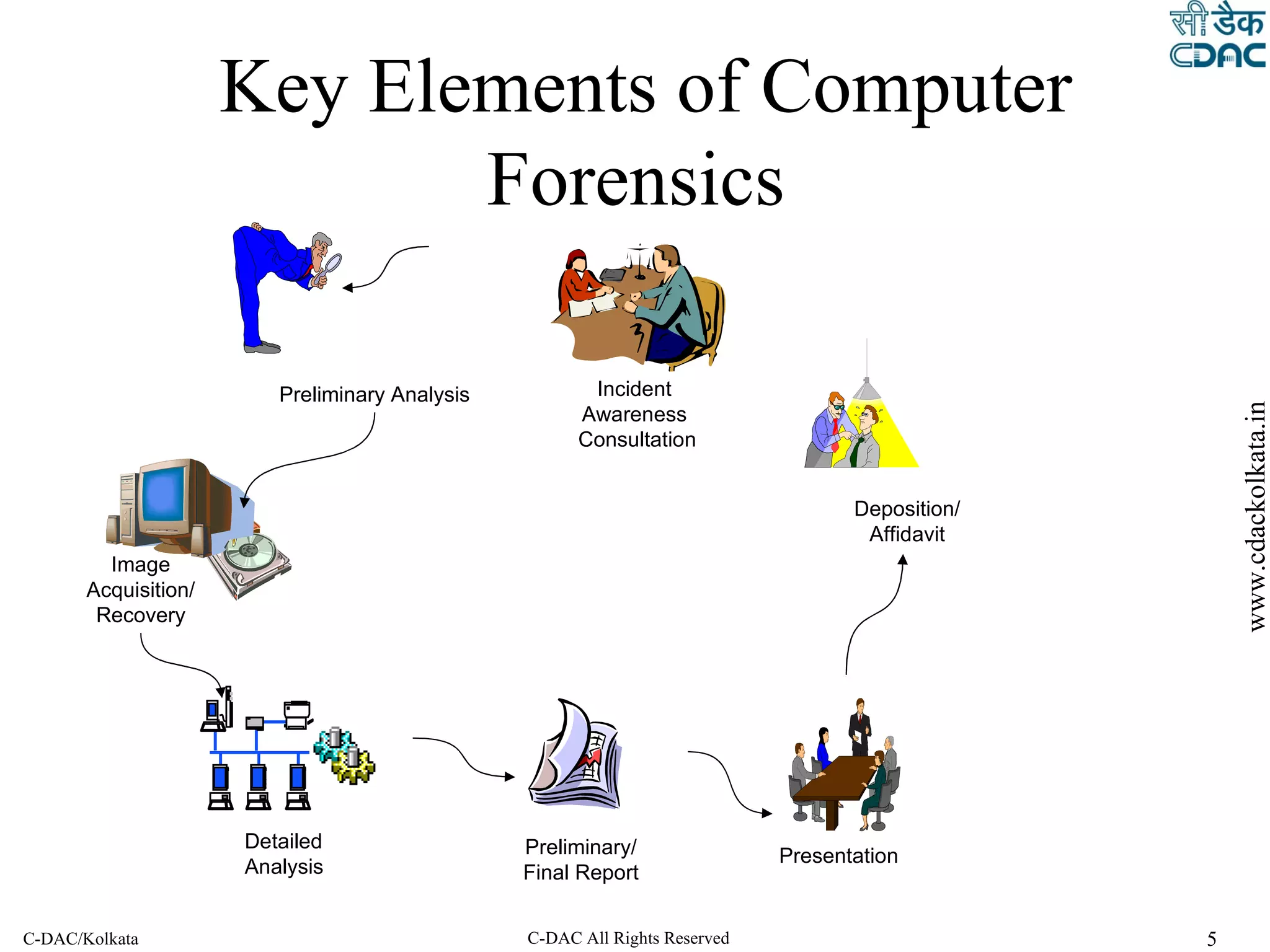
Key Elements of Computer Forensics  Incident  Awareness  Consultation Preliminary Analysis Presentation Preliminary/ Final Report Deposition/ Affidavit Detailed  Analysis Image Acquisition/ Recovery
Various Data Types Volatile data,  which is in use by a system but not written to media  data in memory, network status, and connections and running processes.  Semi-volatile data : Data that are overwritten after a period Temporary files, program logs System and data backups  generated as part of an organization’s regular operations C-DAC All Rights Reserved
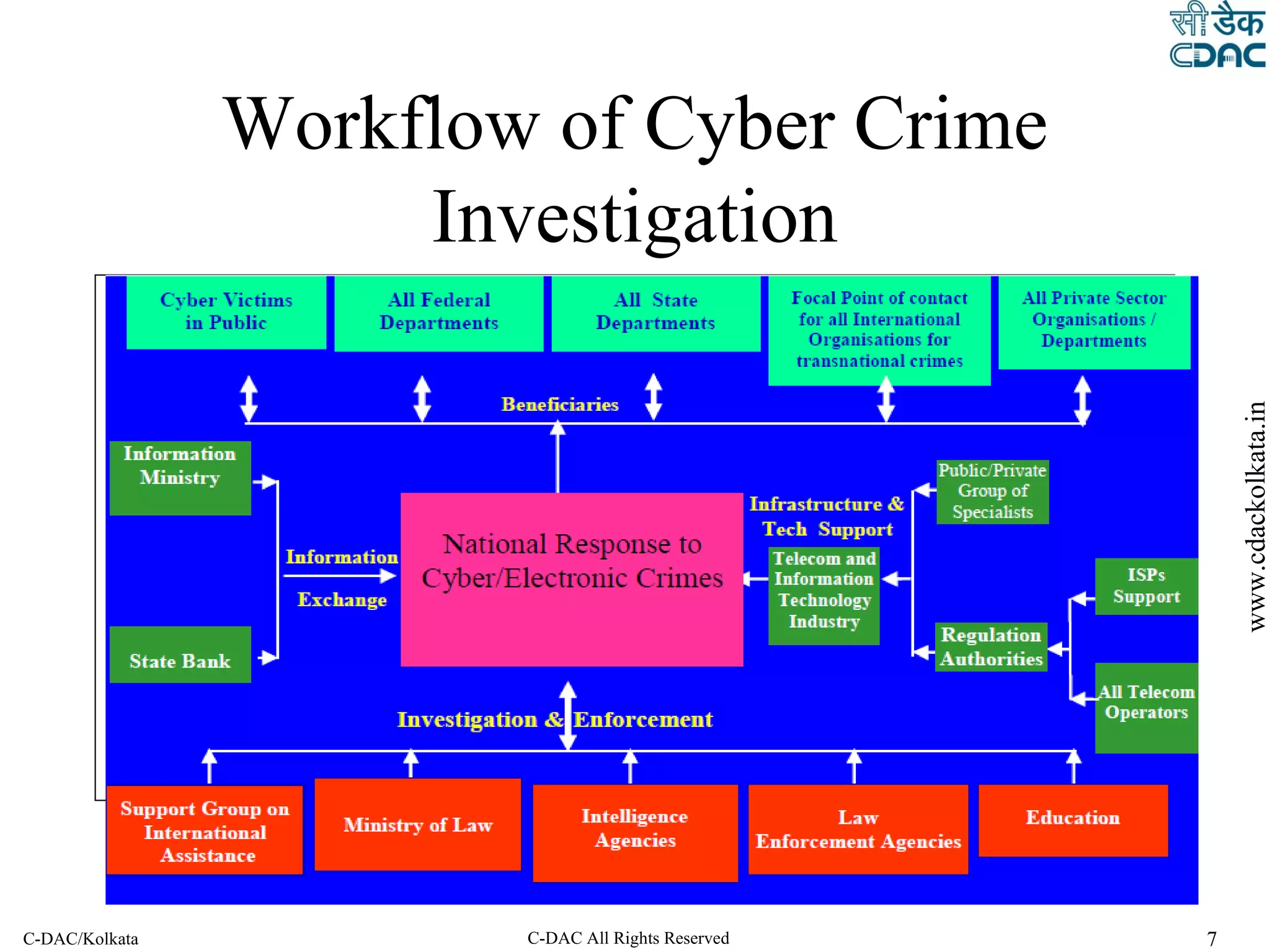
Workflow of Cyber Crime Investigation
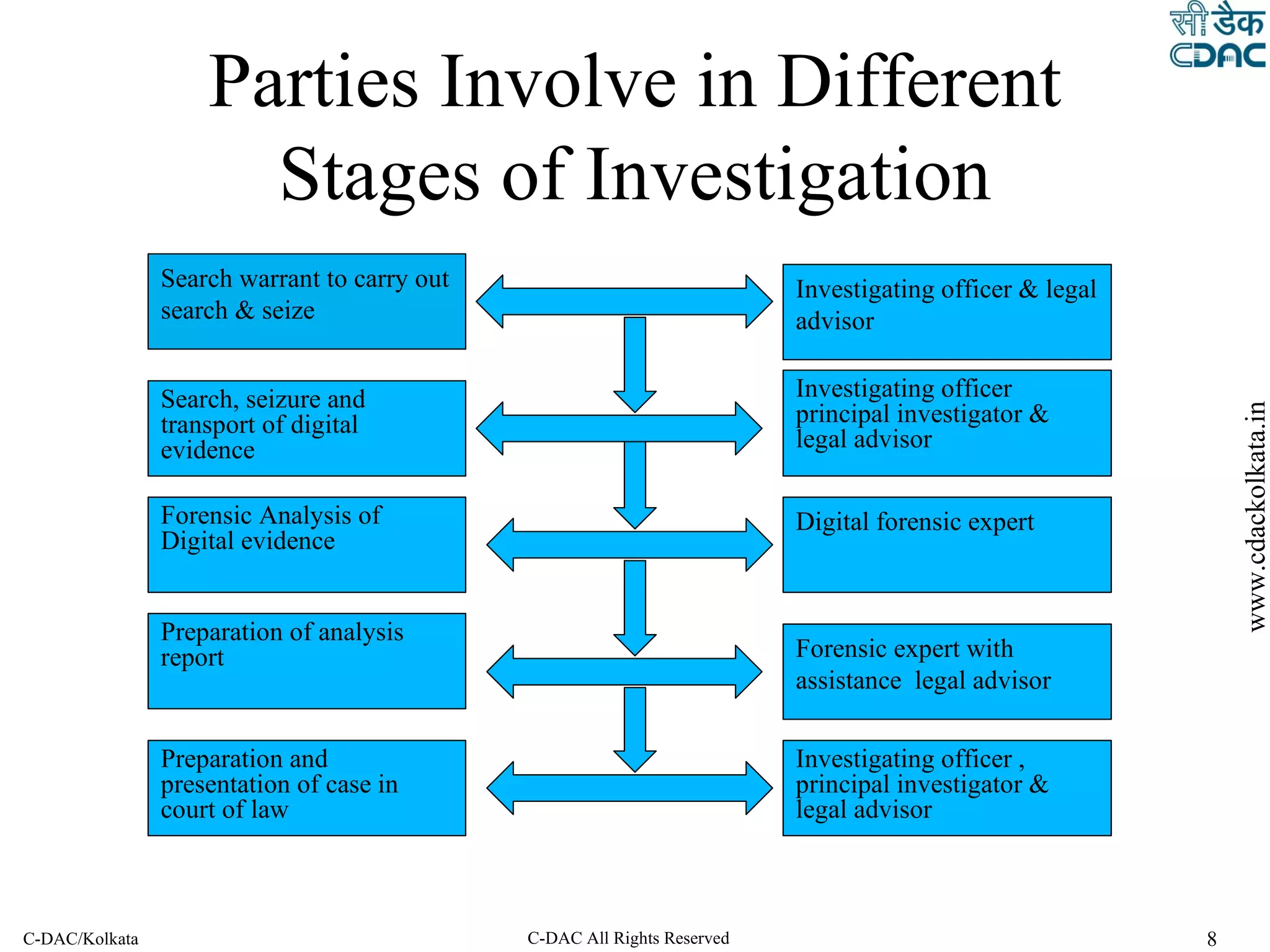
Parties Involve in Different Stages of Investigation Search warrant to carry out search & seize Search, seizure and transport of digital evidence Forensic Analysis of Digital evidence Preparation of analysis report Preparation and presentation of case in court of law Investigating officer  principal investigator & legal advisor Digital forensic expert Forensic expert with assistance  legal advisor Investigating officer , principal investigator & legal advisor Investigating officer & legal advisor
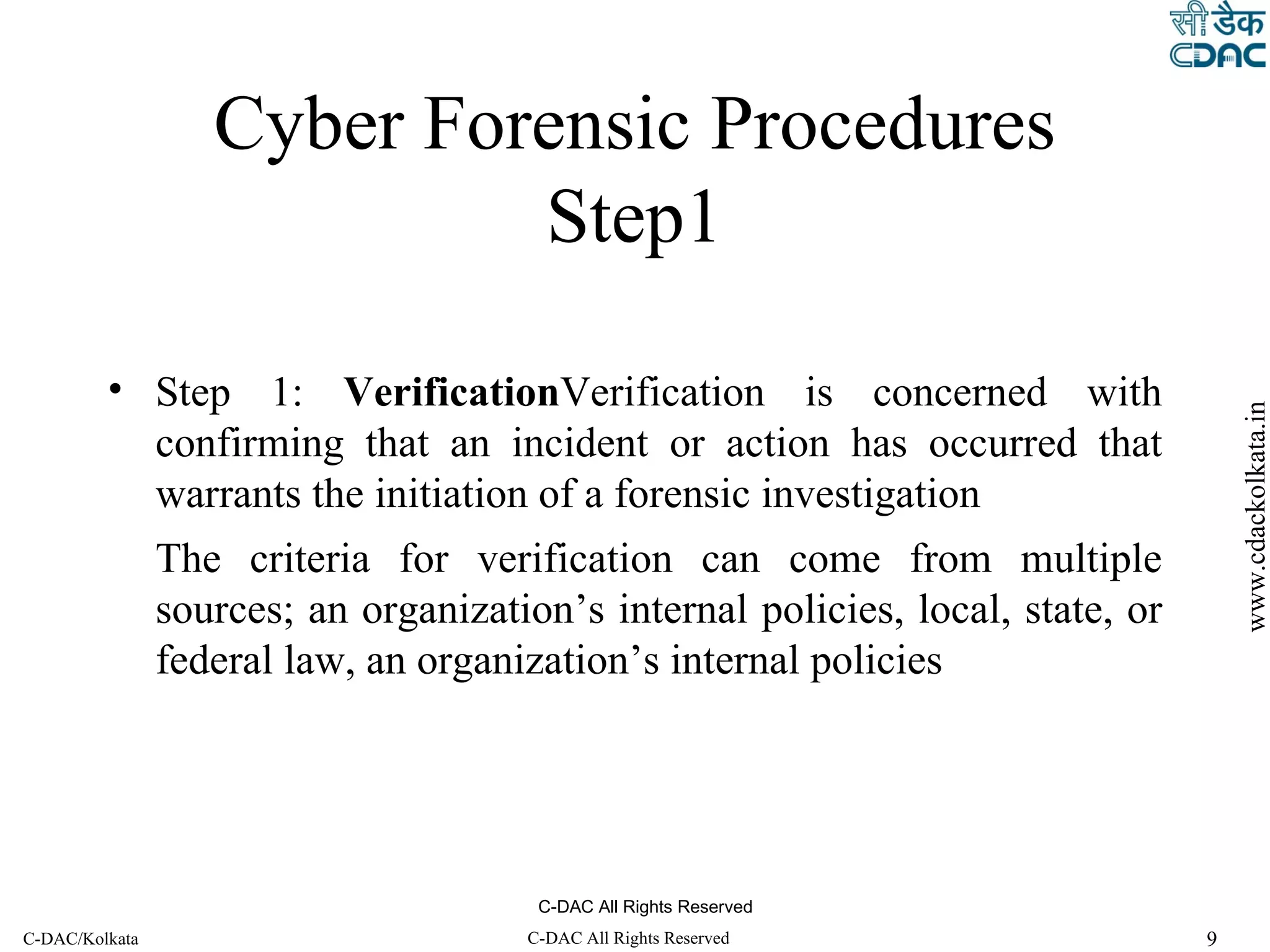
Cyber Forensic Procedures Step1 Step 1:  Verification Verification is concerned with confirming that an incident or action has occurred that warrants the initiation of a forensic investigation The criteria for verification can come from multiple sources; an organization’s internal policies, local, state, or federal law, an organization’s internal policies C-DAC All Rights Reserved
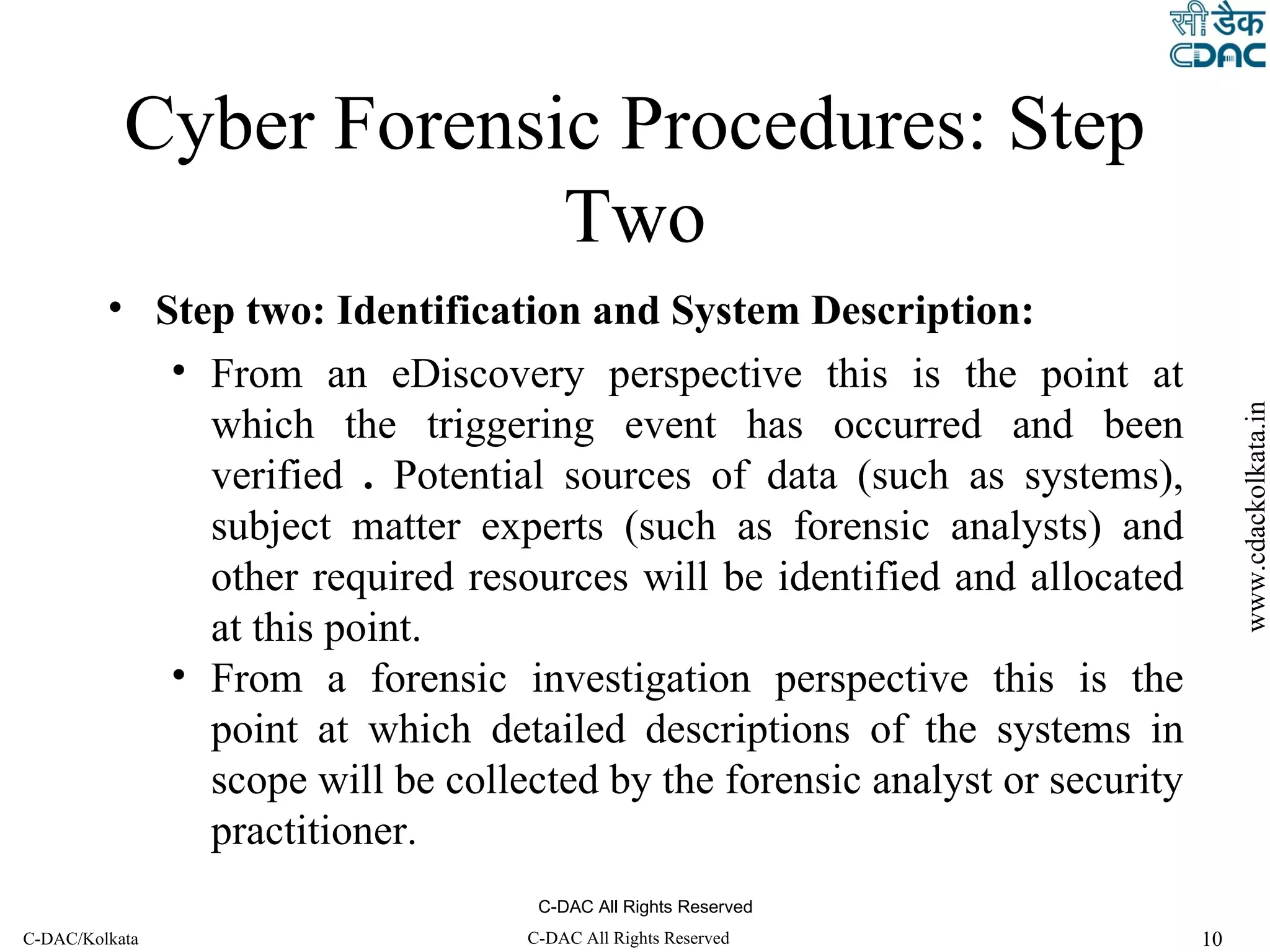
Cyber Forensic Procedures: Step Two Step two: Identification and System Description: From an eDiscovery perspective this is the point at which the triggering event has occurred and been verified  .  Potential sources of data (such as systems), subject matter experts (such as forensic analysts) and other required resources will be identified and allocated at this point. From a forensic investigation perspective this is the point at which detailed descriptions of the systems in scope will be collected by the forensic analyst or security practitioner. C-DAC All Rights Reserved
Cyber Forensic Procedures: Step Three Step3 :  Preservation, Collection and Evidence Acquisition:  concerned with acquiring relevant data in scope in a manner that minimizes data loss in a manner that is legally defensible, auditable, proportionate, reasonable and efficient. Forensic investigation is primarily concerned with the following four principles; the minimization of data loss, the recording of detailed notes, the analysis of collected data and reporting findings Systems and data in scope should be handled in such a way to avoid data destruction and a preservation plan should be developed prior to execution
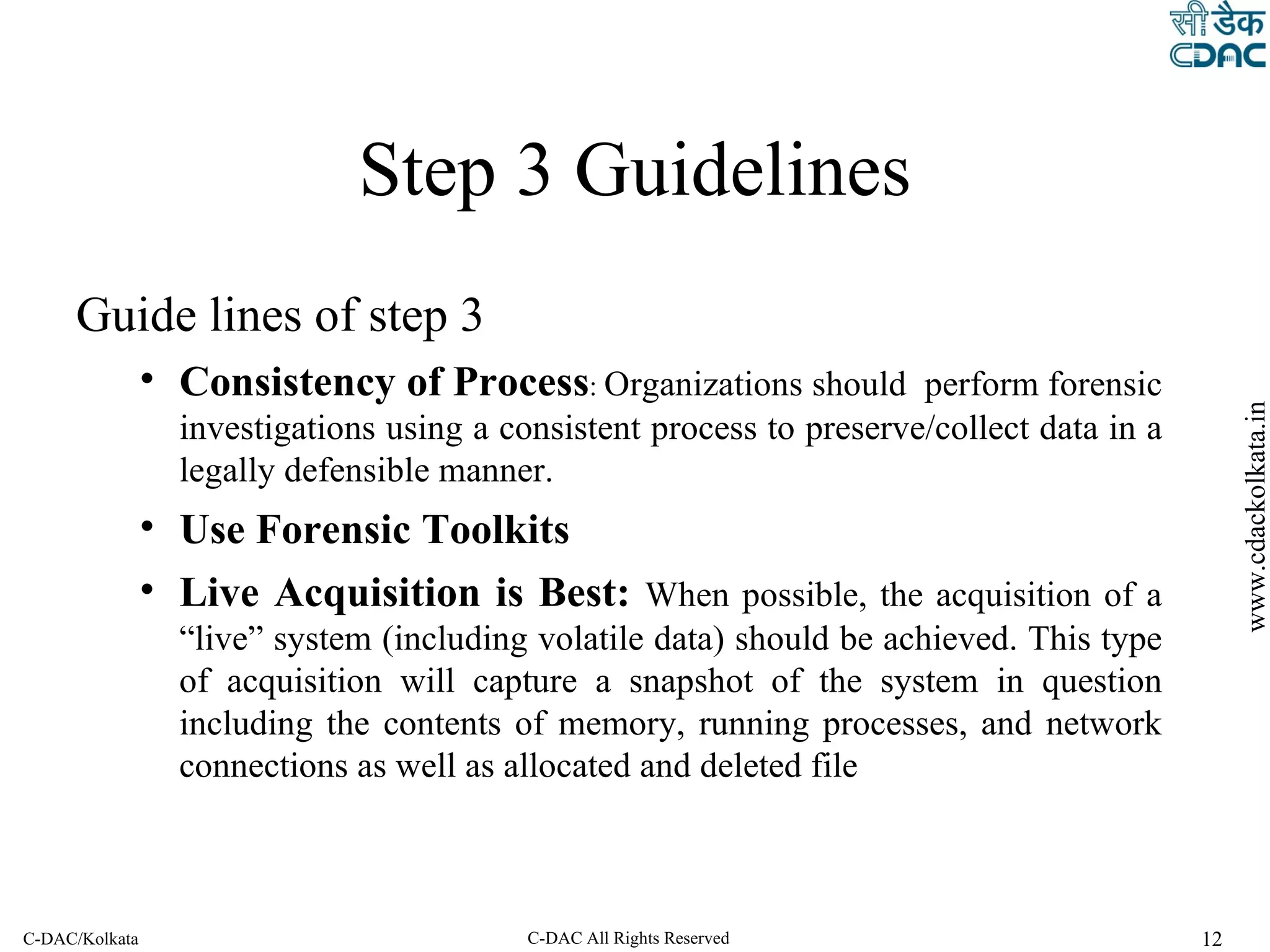
Step 3 Guidelines Guide lines of step 3 Consistency of Process :  Organizations should  perform forensic investigations using a consistent process to preserve/collect data in a legally defensible manner. Use Forensic Toolkits Live Acquisition is Best:  When possible, the acquisition of a “live” system (including volatile data) should be achieved. This type of acquisition will capture a snapshot of the system in question including the contents of memory, running processes, and network connections as well as allocated and deleted file
Step 3 Guidelines Bit Stream Imaging:  Bit stream imaging (a.k.a. disk imaging) generates a bit-for-bit copy of the original media including unallocated (deleted) data. Bit stream imaging requires access to the entire volume, a requirement more easily accomplished with low-capacity systems. Logical backups copy the directories and files from a volume .This process does not capture additional data from the media, such as deleted files or residual data stored in slack space. Make No Changes:  During the preservation/collection process do not alter, delete or add data within reason. The use of forensic toolkits will help reduce the impact of acquisition and collection on the target media in read only mood.
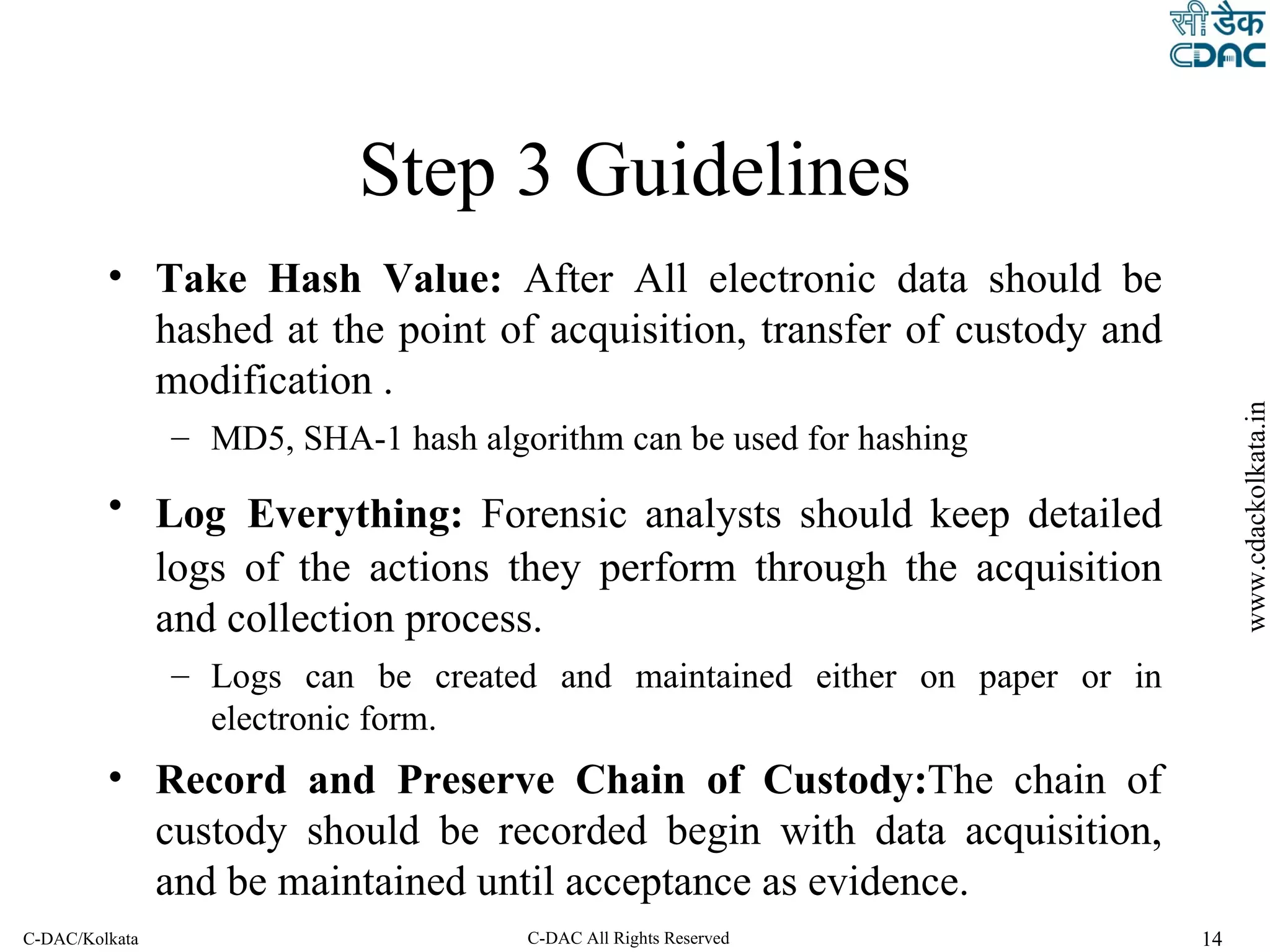
Step 3 Guidelines Take Hash Value:  After All electronic data should be hashed at the point of acquisition, transfer of custody and modification . MD5, SHA-1 hash algorithm can be used for hashing Log   Everything:  Forensic analysts should keep detailed logs of the actions they perform through the acquisition and collection process. Logs can be created and maintained either on paper or in electronic form. Record and Preserve Chain of Custody: The chain of custody should be recorded begin with data acquisition, and be maintained until acceptance as evidence.
Cyber Forensic Procedures: Step Four Processing/Review/Analysis and   Media Analysis, String/Byte Search, Timeline Analysis, Data Recovery:  This stage involves analyzing the data that has been collected during  step3.  Processing this data is the most time consuming portion of the eDiscovery/Forensic Investigation process. This involves applying the details of the incident, the verification and system description information and making educated decisions when examining this “snapshot” of data for relevant evidence
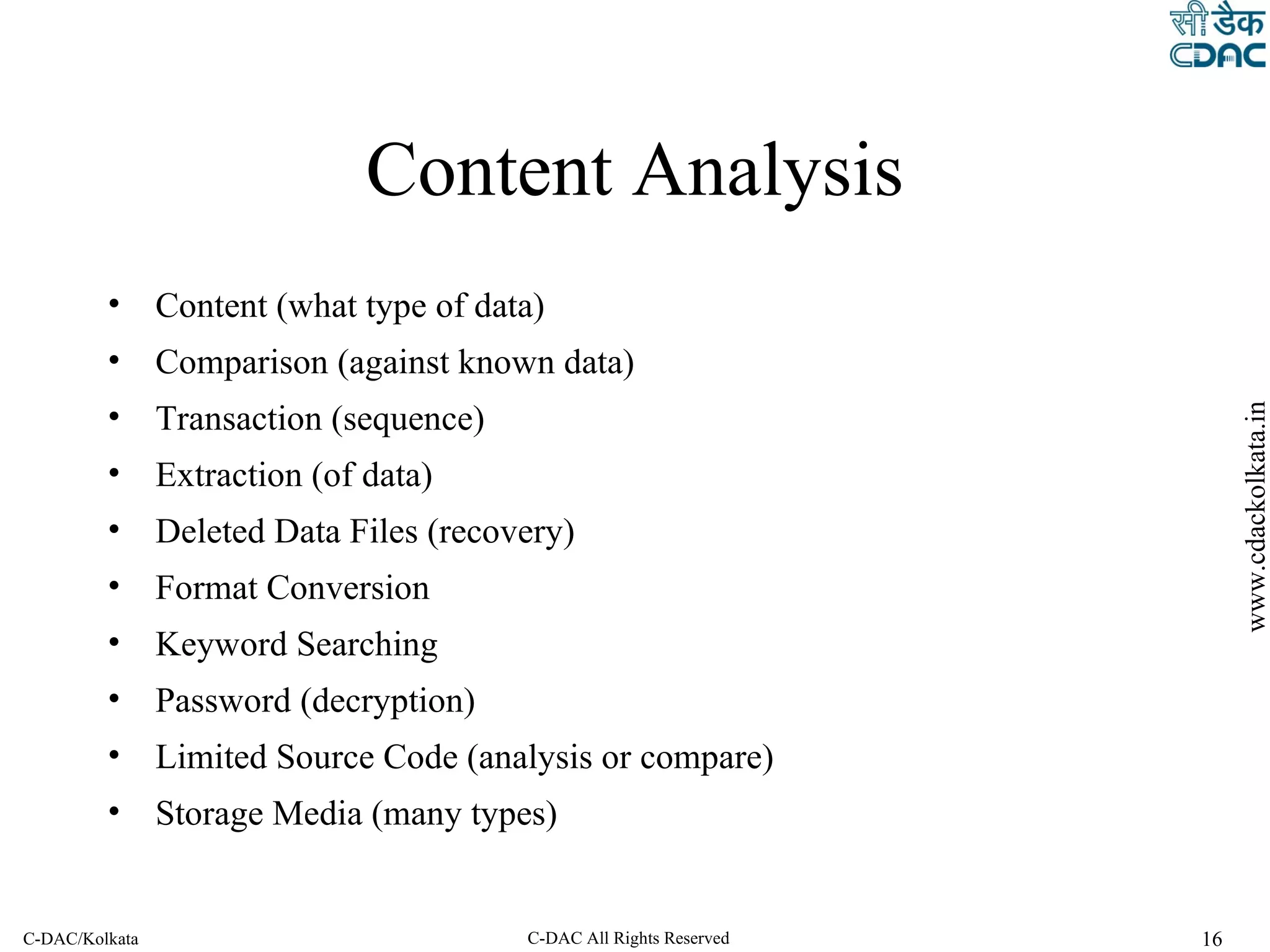
Content Analysis Content (what type of data) Comparison (against known data) Transaction (sequence) Extraction (of data) Deleted Data Files (recovery) Format Conversion Keyword Searching Password (decryption) Limited Source Code (analysis or compare) Storage Media (many types)
Content Analysis Flow Diagram  Is there more data for analysis  Who/What Who/What application created , modified, sent, received the file Who is this item  linked to and  identified with Where Where was it found/where did it came from Does it show where relevant event took place When When was it created, accessed, modified, deleted, sent Time Analysis: what else happened on the system at the same time How How did it originated in the media How was it created, transmitted, modified, used Does it show how relevant events occurred Use timeline or other methods to document findings  on  “Analysis Results List ” If item or discovered information can generate new Data Search Leads, document new leads to “Data search Lead List” If  item or discovered information can generate “New Source of Data” , document lead on “ new source of data lead list ” Mark “Relevent Data” item processed on “Relevent Data List” If new Data Search Leads generated start Preparation/Extraction  If new source of  data lead” generated start  “Obtaining Imaging  Forensic Data” Start “Forensic Reporting ”  to  Document findings No Yes Associated artifacts/ Metadata Registry entry Application/System logs analysis
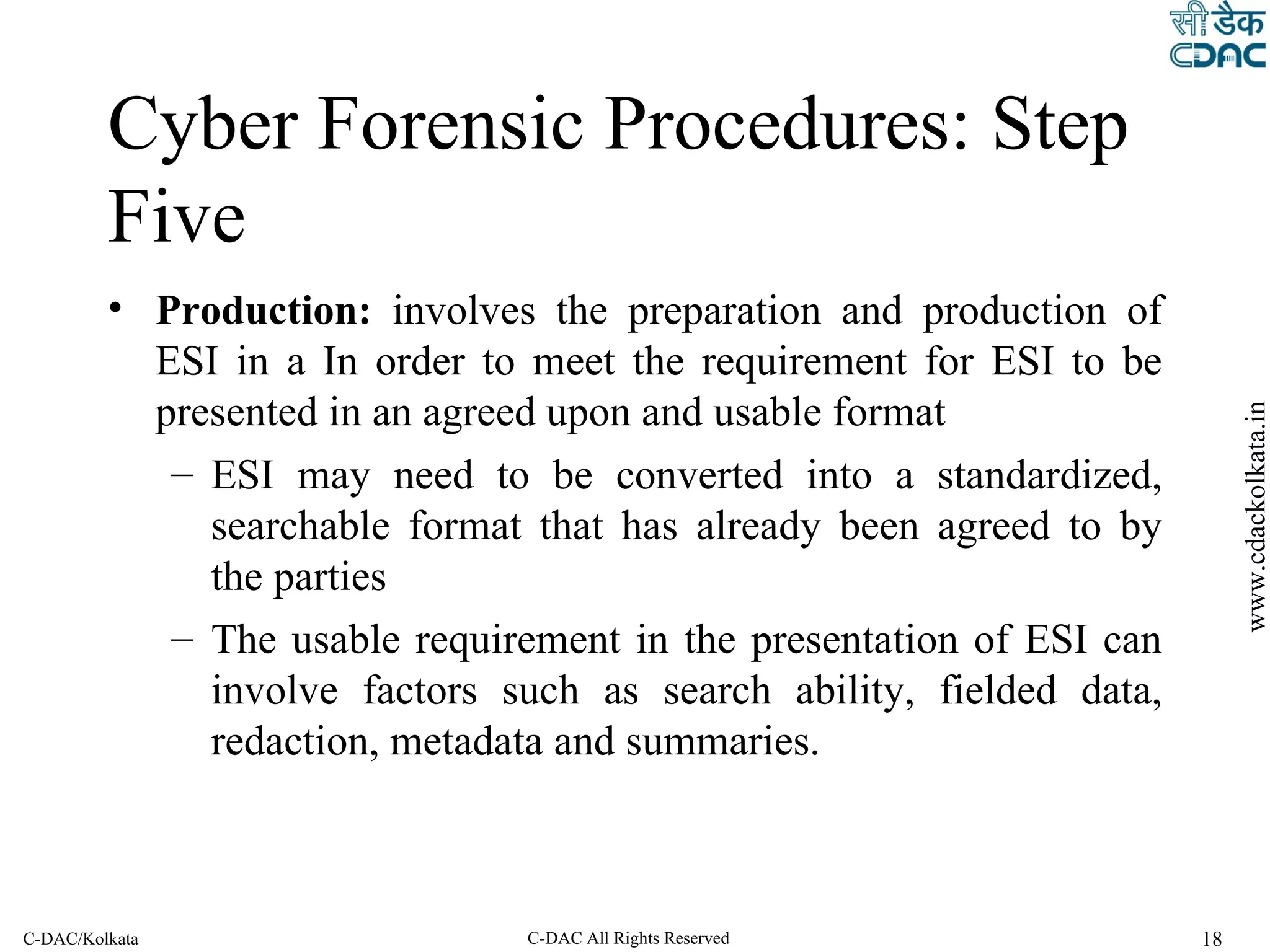
Cyber Forensic Procedures: Step Five Production:  involves the preparation and production of ESI in a In order to meet the requirement for ESI to be presented in an agreed upon and usable format ESI may need to be converted into a standardized, searchable format that has already been agreed to by the parties The usable requirement in the presentation of ESI can involve factors such as search ability, fielded data, redaction, metadata and summaries.
Cyber Forensic Procedures: Step Six Presentation and Reporting Results :  At   this final stage the ESI that has been identified, acquired, analyzed and prepared will be displayed to an audience. The goal of this stage is to provide targeted evidence to prove or disprove statement of facts in the overall context of eliciting further information, validate existing facts or positions, or persuade an audience
 

Cyber forensic standard operating procedures

  • 1.
  • 2.
    Introduction to Forensic General Terms Information is the quantity required for preservation/collection. Information is an element of an organization’s regular operations Records are a form of information, regardless of the medium or format, that have value to an organization. The term is used to describe both documents and recorded data. Evidence can be anything (testimony, documents, tangible objects) that tends to prove or disprove the existence of an alleged fact . E-discovery is eDiscovery is a related term that has gained use to incorporate electronically stored information (ESI) into the discovery process which is compulsory disclosure, at a party's request, of information that relates to the litigation.
  • 3.
    Authenticity is “the act of proving that something (as a document) is true or genuine, especially so that it may be admitted as evidence. Chain of custody is a process of handling evidence which creates and maintains a transaction record for each individual who assumes or releases possession of the evidence. The chain of custody record provides both a continuity of custody from acquisition to presentation and a list of individuals who have had possession of the evidence.
  • 4.
    Integrity of data is defined as “ a requirement that information and programs are changed only in a specified and authorized manner” . The unauthorized alteration of data occur intentionally or unintentionally, can affect the weight of the evidence in court Hashing is defined as the process of taking an amount of data (such as a file or the image of a hard drive) and applying a “complex mathematical algorithm to generate a relatively compact numerical identifier (the hash value)unique to that data”. Two non-identical pieces of data generating the same hash value are remote C-DAC All Rights Reserved
  • 5.
    Key Elements ofComputer Forensics Incident Awareness Consultation Preliminary Analysis Presentation Preliminary/ Final Report Deposition/ Affidavit Detailed Analysis Image Acquisition/ Recovery
  • 6.
    Various Data TypesVolatile data, which is in use by a system but not written to media data in memory, network status, and connections and running processes. Semi-volatile data : Data that are overwritten after a period Temporary files, program logs System and data backups generated as part of an organization’s regular operations C-DAC All Rights Reserved
  • 7.
    Workflow of CyberCrime Investigation
  • 8.
    Parties Involve inDifferent Stages of Investigation Search warrant to carry out search & seize Search, seizure and transport of digital evidence Forensic Analysis of Digital evidence Preparation of analysis report Preparation and presentation of case in court of law Investigating officer principal investigator & legal advisor Digital forensic expert Forensic expert with assistance legal advisor Investigating officer , principal investigator & legal advisor Investigating officer & legal advisor
  • 9.
    Cyber Forensic ProceduresStep1 Step 1: Verification Verification is concerned with confirming that an incident or action has occurred that warrants the initiation of a forensic investigation The criteria for verification can come from multiple sources; an organization’s internal policies, local, state, or federal law, an organization’s internal policies C-DAC All Rights Reserved
  • 10.
    Cyber Forensic Procedures:Step Two Step two: Identification and System Description: From an eDiscovery perspective this is the point at which the triggering event has occurred and been verified . Potential sources of data (such as systems), subject matter experts (such as forensic analysts) and other required resources will be identified and allocated at this point. From a forensic investigation perspective this is the point at which detailed descriptions of the systems in scope will be collected by the forensic analyst or security practitioner. C-DAC All Rights Reserved
  • 11.
    Cyber Forensic Procedures:Step Three Step3 : Preservation, Collection and Evidence Acquisition: concerned with acquiring relevant data in scope in a manner that minimizes data loss in a manner that is legally defensible, auditable, proportionate, reasonable and efficient. Forensic investigation is primarily concerned with the following four principles; the minimization of data loss, the recording of detailed notes, the analysis of collected data and reporting findings Systems and data in scope should be handled in such a way to avoid data destruction and a preservation plan should be developed prior to execution
  • 12.
    Step 3 GuidelinesGuide lines of step 3 Consistency of Process : Organizations should perform forensic investigations using a consistent process to preserve/collect data in a legally defensible manner. Use Forensic Toolkits Live Acquisition is Best: When possible, the acquisition of a “live” system (including volatile data) should be achieved. This type of acquisition will capture a snapshot of the system in question including the contents of memory, running processes, and network connections as well as allocated and deleted file
  • 13.
    Step 3 GuidelinesBit Stream Imaging: Bit stream imaging (a.k.a. disk imaging) generates a bit-for-bit copy of the original media including unallocated (deleted) data. Bit stream imaging requires access to the entire volume, a requirement more easily accomplished with low-capacity systems. Logical backups copy the directories and files from a volume .This process does not capture additional data from the media, such as deleted files or residual data stored in slack space. Make No Changes: During the preservation/collection process do not alter, delete or add data within reason. The use of forensic toolkits will help reduce the impact of acquisition and collection on the target media in read only mood.
  • 14.
    Step 3 GuidelinesTake Hash Value: After All electronic data should be hashed at the point of acquisition, transfer of custody and modification . MD5, SHA-1 hash algorithm can be used for hashing Log Everything: Forensic analysts should keep detailed logs of the actions they perform through the acquisition and collection process. Logs can be created and maintained either on paper or in electronic form. Record and Preserve Chain of Custody: The chain of custody should be recorded begin with data acquisition, and be maintained until acceptance as evidence.
  • 15.
    Cyber Forensic Procedures:Step Four Processing/Review/Analysis and Media Analysis, String/Byte Search, Timeline Analysis, Data Recovery: This stage involves analyzing the data that has been collected during step3. Processing this data is the most time consuming portion of the eDiscovery/Forensic Investigation process. This involves applying the details of the incident, the verification and system description information and making educated decisions when examining this “snapshot” of data for relevant evidence
  • 16.
    Content Analysis Content(what type of data) Comparison (against known data) Transaction (sequence) Extraction (of data) Deleted Data Files (recovery) Format Conversion Keyword Searching Password (decryption) Limited Source Code (analysis or compare) Storage Media (many types)
  • 17.
    Content Analysis FlowDiagram Is there more data for analysis Who/What Who/What application created , modified, sent, received the file Who is this item linked to and identified with Where Where was it found/where did it came from Does it show where relevant event took place When When was it created, accessed, modified, deleted, sent Time Analysis: what else happened on the system at the same time How How did it originated in the media How was it created, transmitted, modified, used Does it show how relevant events occurred Use timeline or other methods to document findings on “Analysis Results List ” If item or discovered information can generate new Data Search Leads, document new leads to “Data search Lead List” If item or discovered information can generate “New Source of Data” , document lead on “ new source of data lead list ” Mark “Relevent Data” item processed on “Relevent Data List” If new Data Search Leads generated start Preparation/Extraction If new source of data lead” generated start “Obtaining Imaging Forensic Data” Start “Forensic Reporting ” to Document findings No Yes Associated artifacts/ Metadata Registry entry Application/System logs analysis
  • 18.
    Cyber Forensic Procedures:Step Five Production: involves the preparation and production of ESI in a In order to meet the requirement for ESI to be presented in an agreed upon and usable format ESI may need to be converted into a standardized, searchable format that has already been agreed to by the parties The usable requirement in the presentation of ESI can involve factors such as search ability, fielded data, redaction, metadata and summaries.
  • 19.
    Cyber Forensic Procedures:Step Six Presentation and Reporting Results : At this final stage the ESI that has been identified, acquired, analyzed and prepared will be displayed to an audience. The goal of this stage is to provide targeted evidence to prove or disprove statement of facts in the overall context of eliciting further information, validate existing facts or positions, or persuade an audience
  • 20.