 Challenges Facing Digital Forensics
 Challenges Facing Cybersecurity
 Where Data Analytics Can Help
 [Sample Current Research Projects]
Agenda 2
Data Analytics for Digital Forensics
3
Digital Forensic Challenges
 The consistency and correlation problem
 Results from the fact that existing tools are designed to find fragments
of evidence, but not to otherwise assist in investigations.
 The unified time lining problem
 Multiple sources present different time zone references, timestamp
interpretations, clock skew/drift issues, and the syntax aspects involved
in generating a unified timeline.
 The diversity problem
 Results from ever-increasing volumes of data
 Lack of standard techniques to examine and analyse the increasing
numbers and types of sources, which bring a plurality of operating
systems, file formats, etc.
4
 The number of cases whereby digital evidence is
deemed pertinent is ever increasing.
 An increase in the number of devices that are seized
for analysis per case.
 The volume of potentially evidence-rich data stored on
each item seized is also increasing.
Digital Forensics:
The Volume Challenge
5
Digital Forensic Backlog
 Backlogs have become commonplace in recent years
 Commonly exceeds 18 months
 Often exceeds 2 years
 According to a report by An Garda Síochána, delays of up
to four years
 ``Seriously impacted on the timeliness of criminal investigations'' in
recent years.
 In some cases, these delays have resulted in prosecutions being
dismissed in courts.
6
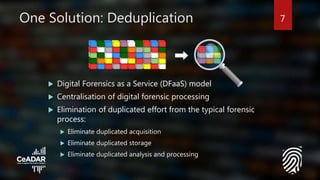
One Solution: Deduplication
 Digital Forensics as a Service (DFaaS) model
 Centralisation of digital forensic processing
 Elimination of duplicated effort from the typical forensic
process:
 Eliminate duplicated acquisition
 Eliminate duplicated storage
 Eliminate duplicated analysis and processing
7
8Intelligent Automated Evidence
Processing
 Research towards automated evidence processing
 Leverages centralised record of evidence analysis
 Learns what makes evidence pertinent/non-pertinent
 Photographic and Video Human/Object Identification
 Biometric estimation; ageing, height, weight, etc.
 Location determination
Data Analytics for Cybersecurity
9
Information Overload 10
 Information overload facing cybersecurity professionals
 False positive alert rate is too high
 Attack Sophistication
 Difficult to identify anomalies
 Data Analytics can enable behavioural anomaly detection
 Similar premise to what antivirus systems followed to combat
polymorphic and metamorphic malware
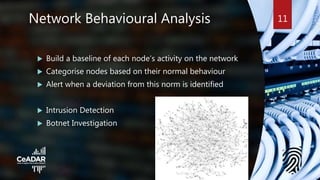
Network Behavioural Analysis
 Build a baseline of each node’s activity on the network
 Categorise nodes based on their normal behaviour
 Alert when a deviation from this norm is identified
 Intrusion Detection
 Botnet Investigation
11
 Effectively the same idea! Includes:
 Network Traffic
 Device Utilisation
 Correlation between devices
 Can identify specific users in multiuser environments
User Behavioural Analysis 12
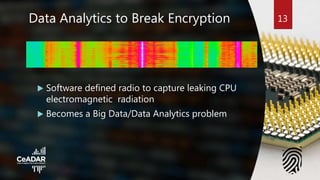
Data Analytics to Break Encryption
 Software defined radio to capture leaking CPU
electromagnetic radiation
 Becomes a Big Data/Data Analytics problem
13
MARK.SCANLON@UCD.IE
WWW.FORENSICSANDSECURITY.COM
@MRKSCN / @FORSECRESEARCH
14

Predict Conference: Data Analytics for Digital Forensics and Cybersecurity

  • 2.
     Challenges FacingDigital Forensics  Challenges Facing Cybersecurity  Where Data Analytics Can Help  [Sample Current Research Projects] Agenda 2
  • 3.
    Data Analytics forDigital Forensics 3
  • 4.
    Digital Forensic Challenges The consistency and correlation problem  Results from the fact that existing tools are designed to find fragments of evidence, but not to otherwise assist in investigations.  The unified time lining problem  Multiple sources present different time zone references, timestamp interpretations, clock skew/drift issues, and the syntax aspects involved in generating a unified timeline.  The diversity problem  Results from ever-increasing volumes of data  Lack of standard techniques to examine and analyse the increasing numbers and types of sources, which bring a plurality of operating systems, file formats, etc. 4
  • 5.
     The numberof cases whereby digital evidence is deemed pertinent is ever increasing.  An increase in the number of devices that are seized for analysis per case.  The volume of potentially evidence-rich data stored on each item seized is also increasing. Digital Forensics: The Volume Challenge 5
  • 6.
    Digital Forensic Backlog Backlogs have become commonplace in recent years  Commonly exceeds 18 months  Often exceeds 2 years  According to a report by An Garda Síochána, delays of up to four years  ``Seriously impacted on the timeliness of criminal investigations'' in recent years.  In some cases, these delays have resulted in prosecutions being dismissed in courts. 6
  • 7.
    One Solution: Deduplication Digital Forensics as a Service (DFaaS) model  Centralisation of digital forensic processing  Elimination of duplicated effort from the typical forensic process:  Eliminate duplicated acquisition  Eliminate duplicated storage  Eliminate duplicated analysis and processing 7
  • 8.
    8Intelligent Automated Evidence Processing Research towards automated evidence processing  Leverages centralised record of evidence analysis  Learns what makes evidence pertinent/non-pertinent  Photographic and Video Human/Object Identification  Biometric estimation; ageing, height, weight, etc.  Location determination
  • 9.
    Data Analytics forCybersecurity 9
  • 10.
    Information Overload 10 Information overload facing cybersecurity professionals  False positive alert rate is too high  Attack Sophistication  Difficult to identify anomalies  Data Analytics can enable behavioural anomaly detection  Similar premise to what antivirus systems followed to combat polymorphic and metamorphic malware
  • 11.
    Network Behavioural Analysis Build a baseline of each node’s activity on the network  Categorise nodes based on their normal behaviour  Alert when a deviation from this norm is identified  Intrusion Detection  Botnet Investigation 11
  • 12.
     Effectively thesame idea! Includes:  Network Traffic  Device Utilisation  Correlation between devices  Can identify specific users in multiuser environments User Behavioural Analysis 12
  • 13.
    Data Analytics toBreak Encryption  Software defined radio to capture leaking CPU electromagnetic radiation  Becomes a Big Data/Data Analytics problem 13
  • 14.