COMPARATIVE EDUCATION
BETWEEN CUBA AND PHILIPPINES
DANTE R. WAGAN
Assist Prof. II
FLORA H. SALANDANAN
Assist Prof. IV
Laguna State Polytechnic University-Los Baños Campus
BASIS OF COMPARISON
POPULATION 11,227,978
Male – 5,647,083 ( 50.3%)
Female – 5,580,894 (49.7 %)
103,566,016
Male – 51,936,606 (50.1)
Female – 51,629,411 (49.9)
GEOGRAPHICAL LOCATION Haiti, Bahamas, Mexico
Florida , Jamaica
Southeast Asia
LAND AREA 110,860 km²
Largest Country by Land
Area in Caribbean
298,171 km²
CLIMATE Subtropical Humid
Winter (Dry) – Nov- April
Rainy (Summer) – May -
Oct
Tropical
Rainy
Dry (Summer)
PRIMARY RESOURCES Agriculture Agriculture
STAPLE FOOD Rice Rice
CURRENCY Cuban Peso
Cuban Convertible Peso
Peso
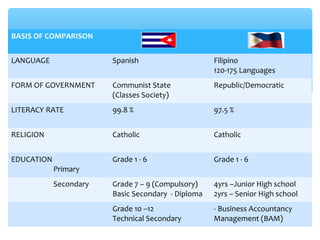
BASIS OF COMPARISON
LANGUAGE Spanish Filipino
120-175 Languages
FORM OF GOVERNMENT Communist State
(Classes Society)
Republic/Democratic
LITERACY RATE 99.8 % 97.5 %
RELIGION Catholic Catholic
EDUCATION
Primary
Grade 1 - 6 Grade 1 - 6
Secondary Grade 7 – 9 (Compulsory)
Basic Secondary - Diploma
4yrs –Junior High school
2yrs – Senior High school
Grade 10 –12
Technical Secondary
- Business Accountancy
Management (BAM)
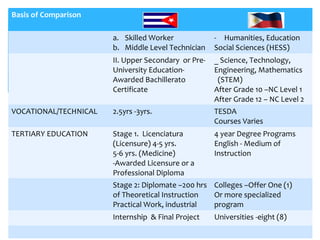
Basis of Comparison
a. Skilled Worker
b. Middle Level Technician
- Humanities, Education
Social Sciences (HESS)
II. Upper Secondary or Pre-
University Education-
Awarded Bachillerato
Certificate
_ Science, Technology,
Engineering, Mathematics
(STEM)
After Grade 10 –NC Level 1
After Grade 12 – NC Level 2
VOCATIONAL/TECHNICAL 2.5yrs -3yrs. TESDA
Courses Varies
TERTIARY EDUCATION Stage 1. Licenciatura
(Licensure) 4-5 yrs.
5-6 yrs. (Medicine)
-Awarded Licensure or a
Professional Diploma
4 year Degree Programs
English - Medium of
Instruction
Stage 2: Diplomate –200 hrs
of Theoretical Instruction
Practical Work, industrial
Colleges –Offer One (1)
Or more specialized
program
Internship & Final Project Universities -eight (8)
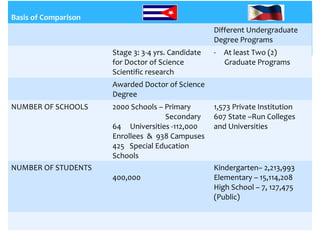
Basis of Comparison
Different Undergraduate
Degree Programs
Stage 3: 3-4 yrs. Candidate
for Doctor of Science
Scientific research
- At least Two (2)
Graduate Programs
Awarded Doctor of Science
Degree
NUMBER OF SCHOOLS 2000 Schools – Primary
Secondary
64 Universities -112,000
Enrollees & 938 Campuses
425 Special Education
Schools
1,573 Private Institution
607 State –Run Colleges
and Universities
NUMBER OF STUDENTS
400,000
Kindergarten– 2,213,993
Elementary – 15,114,208
High School – 7, 127,475
(Public)
Basis of Comparison
TEACHER – STUDENT RATIO 1:20 Basic Education
1:25 Tertiary Level
1:65 Basic Education
SCHOOL YEAR September - June June - March
EDUCATION BUDGET 12.9% GDP
$ 2752 M P 309.43 Billion
NUMBER OF TEACHERS 150,000
On-Going Masters Degree
SCHOOL HOURS 12 Hours 8 Hours
GENERAL INFORMATION ABOUT CUBAN
HIGHER EDUCATION
64 Universities
938 Campuses, in all the Municipalities
Distribution of Students
In Campuses
61%
Distance
Learning
5%
At University
34%
Professors
Part Time
Professors
81%
Staff
19%
GENERAL INFORMATION....
THE UNDERGRADUATE PROGRAMS:
Are approved by the Ministry of Higher
Education
Are implemented nationwide
Are subordinate to different Ministries
depending on the field of study
Programmes subordinate to MES
 Agricultural Sciences (5)
 Natural Sciences and Mathematics (10)
 Social Sciences and Humanities (16)
 Technical Sciences and Architecture (14)
 Economics (3)
PROGRAMMES SUBORDINATE TO OTHER MINISTRIES
Medical Sciences (4 programmes; 5 universities)
Educational Sciences (28 programmes; 16
universities)
Arts (5 programmes; 1 university)
Sports (1 programme; 2 universities)
Design (2 programmes; 1 universities)
Nuclear Sciences (4 programmes; 1 university)
There are also other programmes related to
higher education military centres
What are the Main Characteristics Of Cuban
Higher Education?
Society and universities share the same interests
Universities work in close alliance with
enterprises, organizations and other social
institutions
The Ministry of Higher Education has full
capacity of rallying and convening all universities
towards common goals
THE TRAINING OF PROFESSIONALS IN CUBA
Undergraduate education
(5-year programmes with diploma thesis)
On-the-job training (2 years)
Postgraduate education
Different Types of Courses in Undergraduate
Education
Regular courses (face to face):
- Daytime (full time students): five years
- For workers (part time students): six years
Distance learning courses
New social programmes
The Educational Model of Cuban Higher
Education
Main feature:
Broad Profile
Which strikes a balance between general
professional training and the training of
specialists
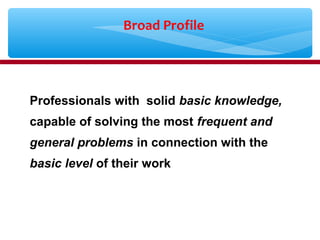
Broad Profile
Professionals with solid basic knowledge,
capable of solving the most frequent and
general problems in connection with the
basic level of their work
Dimensions of the Formation Process
Instructional (knowledge and skills)
Educational (values)
Developmental (competences)
Principal Ideas of the Educational Model
Unity between Education and
Instruction
Link between Study and Work
Link between Study and Work in the curriculum
The corner stone of the entire Cuban
system of education is the link between study
and work. At university level, this link is
expressed in the work-training component in
the curriculum and is carried out in off-
campus Teaching Units.
Link of Study and Work….
About 1 500 or 2 000 hours in each curriculum
(30 % )
More than 2 000 work places are in connection
with the university
453 are “Off-campus Teaching Units”
An academic discipline that integrates the work
component with the rest of the curriculum
General information about curriculum
Average time
5 700 hours
Distribution of curriculum activities
Lectures
25%
Practical
Activities
45%
Research
Work
30%
Disciplines (14)
Subjects (60)
Final Evaluation (28)
Course Projects (6)
Final Project or State Test (1)
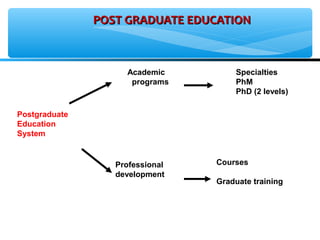
POSTPOST GRADUATE EDUCATIONGRADUATE EDUCATION
Postgraduate
Education
System
Academic
programs
Specialties
PhM
PhD (2 levels)
Professional
development
Courses
Graduate training
RESEARCH, DEVELOPMENT AND INNOVATIONRESEARCH, DEVELOPMENT AND INNOVATION
IN HIGHER EDUCATIONIN HIGHER EDUCATION
It’s oriented to:
• The development of human resources
• The orientation of scientific research to satisfy the social,
economic and cultural development needs of the country
• The use of international knowledge and technologies
• Generation of technologies
• Creation of high tech products as exports goods
• Collaboration with other countries
RESEARCH, DEVELOPMENT AND INNOVATION
IN HIGHER EDUCATION
More than 50% of all research work in Cuba is
developed and conducted in universities and their
research centres.
100% of university faculty actively participate in
national and local projects.
100% of senior students in undergraduate courses
participate in curricular scientific research activities
(52% in extracurricular.
15% of all the students enrolled in undergraduate
courses belong to the movement of high-achievement
students and take part in top-priority research work.Cuban universities are increasingly turning into research centresCuban universities are increasingly turning into research centres

Comparative education

  • 1.
    COMPARATIVE EDUCATION BETWEEN CUBAAND PHILIPPINES DANTE R. WAGAN Assist Prof. II FLORA H. SALANDANAN Assist Prof. IV Laguna State Polytechnic University-Los Baños Campus
  • 2.
    BASIS OF COMPARISON POPULATION11,227,978 Male – 5,647,083 ( 50.3%) Female – 5,580,894 (49.7 %) 103,566,016 Male – 51,936,606 (50.1) Female – 51,629,411 (49.9) GEOGRAPHICAL LOCATION Haiti, Bahamas, Mexico Florida , Jamaica Southeast Asia LAND AREA 110,860 km² Largest Country by Land Area in Caribbean 298,171 km² CLIMATE Subtropical Humid Winter (Dry) – Nov- April Rainy (Summer) – May - Oct Tropical Rainy Dry (Summer) PRIMARY RESOURCES Agriculture Agriculture STAPLE FOOD Rice Rice CURRENCY Cuban Peso Cuban Convertible Peso Peso
  • 3.
    BASIS OF COMPARISON LANGUAGESpanish Filipino 120-175 Languages FORM OF GOVERNMENT Communist State (Classes Society) Republic/Democratic LITERACY RATE 99.8 % 97.5 % RELIGION Catholic Catholic EDUCATION Primary Grade 1 - 6 Grade 1 - 6 Secondary Grade 7 – 9 (Compulsory) Basic Secondary - Diploma 4yrs –Junior High school 2yrs – Senior High school Grade 10 –12 Technical Secondary - Business Accountancy Management (BAM)
  • 4.
    Basis of Comparison a.Skilled Worker b. Middle Level Technician - Humanities, Education Social Sciences (HESS) II. Upper Secondary or Pre- University Education- Awarded Bachillerato Certificate _ Science, Technology, Engineering, Mathematics (STEM) After Grade 10 –NC Level 1 After Grade 12 – NC Level 2 VOCATIONAL/TECHNICAL 2.5yrs -3yrs. TESDA Courses Varies TERTIARY EDUCATION Stage 1. Licenciatura (Licensure) 4-5 yrs. 5-6 yrs. (Medicine) -Awarded Licensure or a Professional Diploma 4 year Degree Programs English - Medium of Instruction Stage 2: Diplomate –200 hrs of Theoretical Instruction Practical Work, industrial Colleges –Offer One (1) Or more specialized program Internship & Final Project Universities -eight (8)
  • 5.
    Basis of Comparison DifferentUndergraduate Degree Programs Stage 3: 3-4 yrs. Candidate for Doctor of Science Scientific research - At least Two (2) Graduate Programs Awarded Doctor of Science Degree NUMBER OF SCHOOLS 2000 Schools – Primary Secondary 64 Universities -112,000 Enrollees & 938 Campuses 425 Special Education Schools 1,573 Private Institution 607 State –Run Colleges and Universities NUMBER OF STUDENTS 400,000 Kindergarten– 2,213,993 Elementary – 15,114,208 High School – 7, 127,475 (Public)
  • 6.
    Basis of Comparison TEACHER– STUDENT RATIO 1:20 Basic Education 1:25 Tertiary Level 1:65 Basic Education SCHOOL YEAR September - June June - March EDUCATION BUDGET 12.9% GDP $ 2752 M P 309.43 Billion NUMBER OF TEACHERS 150,000 On-Going Masters Degree SCHOOL HOURS 12 Hours 8 Hours
  • 7.
    GENERAL INFORMATION ABOUTCUBAN HIGHER EDUCATION 64 Universities 938 Campuses, in all the Municipalities Distribution of Students In Campuses 61% Distance Learning 5% At University 34% Professors Part Time Professors 81% Staff 19%
  • 8.
    GENERAL INFORMATION.... THE UNDERGRADUATEPROGRAMS: Are approved by the Ministry of Higher Education Are implemented nationwide Are subordinate to different Ministries depending on the field of study
  • 9.
    Programmes subordinate toMES  Agricultural Sciences (5)  Natural Sciences and Mathematics (10)  Social Sciences and Humanities (16)  Technical Sciences and Architecture (14)  Economics (3)
  • 10.
    PROGRAMMES SUBORDINATE TOOTHER MINISTRIES Medical Sciences (4 programmes; 5 universities) Educational Sciences (28 programmes; 16 universities) Arts (5 programmes; 1 university) Sports (1 programme; 2 universities) Design (2 programmes; 1 universities) Nuclear Sciences (4 programmes; 1 university) There are also other programmes related to higher education military centres
  • 11.
    What are theMain Characteristics Of Cuban Higher Education? Society and universities share the same interests Universities work in close alliance with enterprises, organizations and other social institutions The Ministry of Higher Education has full capacity of rallying and convening all universities towards common goals
  • 12.
    THE TRAINING OFPROFESSIONALS IN CUBA Undergraduate education (5-year programmes with diploma thesis) On-the-job training (2 years) Postgraduate education
  • 13.
    Different Types ofCourses in Undergraduate Education Regular courses (face to face): - Daytime (full time students): five years - For workers (part time students): six years Distance learning courses New social programmes
  • 14.
    The Educational Modelof Cuban Higher Education Main feature: Broad Profile Which strikes a balance between general professional training and the training of specialists
  • 15.
    Broad Profile Professionals withsolid basic knowledge, capable of solving the most frequent and general problems in connection with the basic level of their work
  • 16.
    Dimensions of theFormation Process Instructional (knowledge and skills) Educational (values) Developmental (competences)
  • 17.
    Principal Ideas ofthe Educational Model Unity between Education and Instruction Link between Study and Work
  • 18.
    Link between Studyand Work in the curriculum The corner stone of the entire Cuban system of education is the link between study and work. At university level, this link is expressed in the work-training component in the curriculum and is carried out in off- campus Teaching Units.
  • 19.
    Link of Studyand Work…. About 1 500 or 2 000 hours in each curriculum (30 % ) More than 2 000 work places are in connection with the university 453 are “Off-campus Teaching Units” An academic discipline that integrates the work component with the rest of the curriculum
  • 20.
    General information aboutcurriculum Average time 5 700 hours Distribution of curriculum activities Lectures 25% Practical Activities 45% Research Work 30% Disciplines (14) Subjects (60) Final Evaluation (28) Course Projects (6) Final Project or State Test (1)
  • 21.
    POSTPOST GRADUATE EDUCATIONGRADUATEEDUCATION Postgraduate Education System Academic programs Specialties PhM PhD (2 levels) Professional development Courses Graduate training
  • 22.
    RESEARCH, DEVELOPMENT ANDINNOVATIONRESEARCH, DEVELOPMENT AND INNOVATION IN HIGHER EDUCATIONIN HIGHER EDUCATION It’s oriented to: • The development of human resources • The orientation of scientific research to satisfy the social, economic and cultural development needs of the country • The use of international knowledge and technologies • Generation of technologies • Creation of high tech products as exports goods • Collaboration with other countries
  • 23.
    RESEARCH, DEVELOPMENT ANDINNOVATION IN HIGHER EDUCATION More than 50% of all research work in Cuba is developed and conducted in universities and their research centres. 100% of university faculty actively participate in national and local projects. 100% of senior students in undergraduate courses participate in curricular scientific research activities (52% in extracurricular. 15% of all the students enrolled in undergraduate courses belong to the movement of high-achievement students and take part in top-priority research work.Cuban universities are increasingly turning into research centresCuban universities are increasingly turning into research centres