Current and Future Trends How STEM fits in….. STEM On Line Module: Basic 2011
5 Factors To Consider Changing Labour Market Ageing Population STEM Skills Shortages Climate Change World Economics STEM On Line Module: Basic 2011
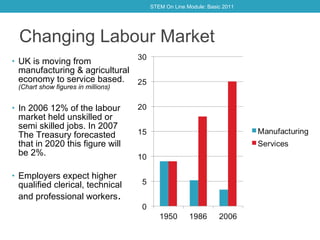
Changing Labour Market UK is moving from manufacturing & agricultural economy to service based.  (Chart show figures in millions) In 2006 12% of the labour market held unskilled or semi skilled jobs. In 2007 The Treasury forecasted that in 2020 this figure will be 2%. Employers expect higher qualified clerical, technical and professional workers . STEM On Line Module: Basic 2011
Ageing Population Pressure on health and medical services will increase meaning  greater demand  for STEM skills Opportunities will be in: Biomedical Engineering  ( replacement joints , heart valves) Bioinformatics & Computational Biology  (molecular biology – DNA, cancer cells ) Pharmaceutical research  (cancer drugs, mental health, insulin) Biotechnology   (using living cells in medicine (stem cells) & industry ( enzymes, bacteria, yeast) In the UK, the number of over 65s is predicted to increase from 8.5 million in 2000 to 15 million in 2050. STEM On Line Module: Basic 2011
STEM Skills Shortage 45% of UK employers currently have difficulty recruiting STEM staff, this is expected to rise to 59% by 2013 CBI 2010 Increased demand for skilled technicians and associated professionals will hit crisis point in 2017 when technician/non graduate inflow is expected to fall due to the lowest known numbers of 16-18 year olds in the population UK CES  “ Working Futures 2007-2017 STEM On Line Module: Basic 2011
Climate Change The main challenge need STEM skills to develop: •  Clean coal technology  – building new coal-fired power stations with lower carbon emissions Renewable energy technology  – generating electricity from renewable sources  •  Nuclear engineering  – needed to decommission old plants and build new nuclear power stations •  Fuel cell technology  – fuel cells combine hydrogen and oxygen to produce water, electricity and heat, a potential alternative energy source. 2008 Climate Change Act set a target for 2050 of reducing carbon emissions to 90% of 1990 levels STEM On Line Module: Basic 2011
World Economics Growth of BRIC (Brazil, Russia, India, China) nations is challenging 200 year dominance by Europe and the U.S. Chinese economy will overtake U.S. by 2025 and be twice as big by 2050 China and India together make up 36% of the world ’ s population and will dominate the world ’ s economy For UK to meet global economic challenge, more people with STEM skills are needed STEM On Line Module: Basic 2011
The future “ A strong supply of people with science, technology, engineering and maths skills is important to promote innovation, exploit new technologies, produce world class scientists and for the UK to compete internationally. ” Educating the next generation of scientists DfE November 2010 STEM On Line Module: Basic 2011

Current and future trends

  • 1.
    Current and FutureTrends How STEM fits in….. STEM On Line Module: Basic 2011
  • 2.
    5 Factors ToConsider Changing Labour Market Ageing Population STEM Skills Shortages Climate Change World Economics STEM On Line Module: Basic 2011
  • 3.
    Changing Labour MarketUK is moving from manufacturing & agricultural economy to service based. (Chart show figures in millions) In 2006 12% of the labour market held unskilled or semi skilled jobs. In 2007 The Treasury forecasted that in 2020 this figure will be 2%. Employers expect higher qualified clerical, technical and professional workers . STEM On Line Module: Basic 2011
  • 4.
    Ageing Population Pressureon health and medical services will increase meaning greater demand for STEM skills Opportunities will be in: Biomedical Engineering ( replacement joints , heart valves) Bioinformatics & Computational Biology (molecular biology – DNA, cancer cells ) Pharmaceutical research (cancer drugs, mental health, insulin) Biotechnology (using living cells in medicine (stem cells) & industry ( enzymes, bacteria, yeast) In the UK, the number of over 65s is predicted to increase from 8.5 million in 2000 to 15 million in 2050. STEM On Line Module: Basic 2011
  • 5.
    STEM Skills Shortage45% of UK employers currently have difficulty recruiting STEM staff, this is expected to rise to 59% by 2013 CBI 2010 Increased demand for skilled technicians and associated professionals will hit crisis point in 2017 when technician/non graduate inflow is expected to fall due to the lowest known numbers of 16-18 year olds in the population UK CES “ Working Futures 2007-2017 STEM On Line Module: Basic 2011
  • 6.
    Climate Change Themain challenge need STEM skills to develop: • Clean coal technology – building new coal-fired power stations with lower carbon emissions Renewable energy technology – generating electricity from renewable sources • Nuclear engineering – needed to decommission old plants and build new nuclear power stations • Fuel cell technology – fuel cells combine hydrogen and oxygen to produce water, electricity and heat, a potential alternative energy source. 2008 Climate Change Act set a target for 2050 of reducing carbon emissions to 90% of 1990 levels STEM On Line Module: Basic 2011
  • 7.
    World Economics Growthof BRIC (Brazil, Russia, India, China) nations is challenging 200 year dominance by Europe and the U.S. Chinese economy will overtake U.S. by 2025 and be twice as big by 2050 China and India together make up 36% of the world ’ s population and will dominate the world ’ s economy For UK to meet global economic challenge, more people with STEM skills are needed STEM On Line Module: Basic 2011
  • 8.
    The future “A strong supply of people with science, technology, engineering and maths skills is important to promote innovation, exploit new technologies, produce world class scientists and for the UK to compete internationally. ” Educating the next generation of scientists DfE November 2010 STEM On Line Module: Basic 2011