Download to read offline
![International Research Journal of Engineering and Technology (IRJET) e-ISSN: 2395-0056
Volume: 09 Issue: 07 | July 2022 www.irjet.net p-ISSN: 2395-0072
© 2022, IRJET | Impact Factor value: 7.529 | ISO 9001:2008 Certified Journal | Page 974
EYE DISEASE IDENTIFICATION USING DEEP LEARNING
Sushma K Sattigeri1, Harshith N2, Dhanush Gowda N3, K A Ullas4, Aditya M S5
1Assistant Professor, Dept. of ECE, Global Academy of Technology, Bengaluru, India
2345Student, ECE, Global Academy of Technology, Bengaluru, India
---------------------------------------------------------------------***---------------------------------------------------------------------
Abstract - There are around 15 million blind people in
India, and the unfortunate fact is that 75% of thesecaseswere
curable at certain point of time. In India, there are 10,000
patients for every doctor. Numerous eye conditions, including
trachoma, corneal ulcers, and cataracts, among others, can
impair vision. According to studies, early-stage disorders that
go untreated are the main causes of blindness in India. The
advancement of these eye diseases can only be stopped if they
are appropriately diagnosed at an early stage. These eye
diseases have a wide range of visually discernible symptoms.
To accurately diagnose eye diseases, it is requiredtoanalyzea
wide range of symptoms. Utilizing digital image processing
methods like segmentation and morphology as well as deep
learning methods like convolutionneuralnetwork, we propose
a unique method to give an automated eye disease
identification model using visuallyobservablesymptoms. Four
eye diseases, namely crossed eyes, bulging eyes, cataracts,
uveitis and conjunctivitis are analyzed and categorized using
the proposed method. The suggested deep neural network
model aids in the early detection of the existence of eye
disorders. If required, the model prompts patients to seek out
an ophthalmologist for screening purposes.
Key Words: Deep Learning, Convolutional Neural
Network, Deep Neural Network, Cataracts, Bulged eyes,
Crossed eyes, Uveitis and Conjunctivitis.
1. INTRODUCTION
Eyes are essential part of human life, each and every
person rely on the eyes to see and sense the world around
them. One of the most vital senses is sight because it
accounts for 80% of all information, we take in. By taking
proper care of eyes, we will lower the risk of becoming blind
and losing vision, while also keeping an eye out for any
developing eye-conditions likeglaucoma andcataracts.Most
people experience eye issues at some point of time. Some of
the eye issues are minor and simple to cure at home which
will go away on their own, other major eye issues need
assistance from the expert doctors. When these eyediseases
are accurately diagnosed at an early stage, only then the
progression of these eye diseases can be stopped. These eye
diseases have a wide rangeofvisuallydiscerniblesymptoms.
To accurately diagnose eye illnesses, it isrequiredtoanalyse
a wide range of symptoms. In this paper, our proposed
model analyses and classifies eye diseases namely cataracts,
crossed eyes, bulging eyes, uveitis and conjunctivitis.
2. LITERATURE SURVEY
Many eye conditions, including trachoma, cataracts, and
corneal ulcers, can impair vision. Only when these eye
illnesses are effectively diagnosed at an early stage can
progression be stopped. These eye illnesses have a wide
range of visually discernible symptoms. To accurately
diagnose eye illnesses, it is required to analyze a wide range
of symptoms. Therefore, utilizing machine learning
techniqueslikedeepconvolutionneuralnetwork(DCNN)and
support vector machine, paper [1] suggestedanovelstrategy
in to create an automated eye illness recognition system
using visually observable symptoms, from experimental
findings it is observed that the DCNN model performs better
than SVM models. In paper [2] the author have used a deep
neural network model to discriminate between different
diseases like diabetic retinopathy, which aids in the early
detection of glaucoma and diabetic retinopathy, and high-
resolution retina images taken under a variety of imaging
settings. In terms of screening Eye Disease Identification
using Deep Learning, it may prompt patients to contact an
ophthalmologist. The created model has a lower level of
complexity and achieved an accuracy of 80%. The author of
the paper [3] developed a method for automatically
classifying any retinal fundusimage as healthyorsickusinga
deep learning model. They created a system named LCD Net
using CNN that was able to do the binary classification.
Two sources of retinal fundus pictures were used to
construct a total of eight testing datasets. Using existing
datasets, image preprocessing methods, deep learning
models, and performance evaluation criteria, the author of
the paper [4] developed a model for the automated
identification of diabetic eye illness. It includes works that
used TL, built DL network architecture, and used a combined
DL and ML approach in terms of classification algorithms.
From medical photos, we may deduce that CNN is now the
most popular deep neural network, especially for the
identification of diabeticeyeillnessandthediagnosisofother
pathological indications. The effectiveness of different
current models, includingneuralnetworksanddeeplearning
algorithms, in detecting eye disease has been examined in
the research work [5]. The processofidentifyingeyediseases
using retinal images is broken down into several smaller
processes, including feature extraction, classification, and
picture pre-processing. This study provides an overview of
deep learning, its algorithms, the operation of convolution
neural networks, and its applications to image processing,
machine learning, and deep learning techniques that are
utilized for retinal image-based eye disease identification.](https://image.slidesharecdn.com/irjet-v9i7185-221022090841-9eb6baee/85/EYE-DISEASE-IDENTIFICATION-USING-DEEP-LEARNING-1-320.jpg)
![International Research Journal of Engineering and Technology (IRJET) e-ISSN: 2395-0056
Volume: 09 Issue: 07 | July 2022 www.irjet.net p-ISSN: 2395-0072
© 2022, IRJET | Impact Factor value: 7.529 | ISO 9001:2008 Certified Journal | Page 974
EYE DISEASE IDENTIFICATION USING DEEP LEARNING
Sushma K Sattigeri1, Harshith N2, Dhanush Gowda N3, K A Ullas4, Aditya M S5
1Assistant Professor, Dept. of ECE, Global Academy of Technology, Bengaluru, India
2345Student, ECE, Global Academy of Technology, Bengaluru, India
---------------------------------------------------------------------***---------------------------------------------------------------------
Abstract - There are around 15 million blind people in
India, and the unfortunate fact is that 75% of thesecaseswere
curable at certain point of time. In India, there are 10,000
patients for every doctor. Numerous eye conditions, including
trachoma, corneal ulcers, and cataracts, among others, can
impair vision. According to studies, early-stage disorders that
go untreated are the main causes of blindness in India. The
advancement of these eye diseases can only be stopped if they
are appropriately diagnosed at an early stage. These eye
diseases have a wide range of visually discernible symptoms.
To accurately diagnose eye diseases, it is requiredtoanalyzea
wide range of symptoms. Utilizing digital image processing
methods like segmentation and morphology as well as deep
learning methods like convolutionneuralnetwork, we propose
a unique method to give an automated eye disease
identification model using visuallyobservablesymptoms. Four
eye diseases, namely crossed eyes, bulging eyes, cataracts,
uveitis and conjunctivitis are analyzed and categorized using
the proposed method. The suggested deep neural network
model aids in the early detection of the existence of eye
disorders. If required, the model prompts patients to seek out
an ophthalmologist for screening purposes.
Key Words: Deep Learning, Convolutional Neural
Network, Deep Neural Network, Cataracts, Bulged eyes,
Crossed eyes, Uveitis and Conjunctivitis.
1. INTRODUCTION
Eyes are essential part of human life, each and every
person rely on the eyes to see and sense the world around
them. One of the most vital senses is sight because it
accounts for 80% of all information, we take in. By taking
proper care of eyes, we will lower the risk of becoming blind
and losing vision, while also keeping an eye out for any
developing eye-conditions likeglaucoma andcataracts.Most
people experience eye issues at some point of time. Some of
the eye issues are minor and simple to cure at home which
will go away on their own, other major eye issues need
assistance from the expert doctors. When these eyediseases
are accurately diagnosed at an early stage, only then the
progression of these eye diseases can be stopped. These eye
diseases have a wide rangeofvisuallydiscerniblesymptoms.
To accurately diagnose eye illnesses, it isrequiredtoanalyse
a wide range of symptoms. In this paper, our proposed
model analyses and classifies eye diseases namely cataracts,
crossed eyes, bulging eyes, uveitis and conjunctivitis.
2. LITERATURE SURVEY
Many eye conditions, including trachoma, cataracts, and
corneal ulcers, can impair vision. Only when these eye
illnesses are effectively diagnosed at an early stage can
progression be stopped. These eye illnesses have a wide
range of visually discernible symptoms. To accurately
diagnose eye illnesses, it is required to analyze a wide range
of symptoms. Therefore, utilizing machine learning
techniqueslikedeepconvolutionneuralnetwork(DCNN)and
support vector machine, paper [1] suggestedanovelstrategy
in to create an automated eye illness recognition system
using visually observable symptoms, from experimental
findings it is observed that the DCNN model performs better
than SVM models. In paper [2] the author have used a deep
neural network model to discriminate between different
diseases like diabetic retinopathy, which aids in the early
detection of glaucoma and diabetic retinopathy, and high-
resolution retina images taken under a variety of imaging
settings. In terms of screening Eye Disease Identification
using Deep Learning, it may prompt patients to contact an
ophthalmologist. The created model has a lower level of
complexity and achieved an accuracy of 80%. The author of
the paper [3] developed a method for automatically
classifying any retinal fundusimage as healthyorsickusinga
deep learning model. They created a system named LCD Net
using CNN that was able to do the binary classification.
Two sources of retinal fundus pictures were used to
construct a total of eight testing datasets. Using existing
datasets, image preprocessing methods, deep learning
models, and performance evaluation criteria, the author of
the paper [4] developed a model for the automated
identification of diabetic eye illness. It includes works that
used TL, built DL network architecture, and used a combined
DL and ML approach in terms of classification algorithms.
From medical photos, we may deduce that CNN is now the
most popular deep neural network, especially for the
identification of diabeticeyeillnessandthediagnosisofother
pathological indications. The effectiveness of different
current models, includingneuralnetworksanddeeplearning
algorithms, in detecting eye disease has been examined in
the research work [5]. The processofidentifyingeyediseases
using retinal images is broken down into several smaller
processes, including feature extraction, classification, and
picture pre-processing. This study provides an overview of
deep learning, its algorithms, the operation of convolution
neural networks, and its applications to image processing,
machine learning, and deep learning techniques that are
utilized for retinal image-based eye disease identification.](https://image.slidesharecdn.com/irjet-v9i7185-221022090841-9eb6baee/75/EYE-DISEASE-IDENTIFICATION-USING-DEEP-LEARNING-1-2048.jpg)
![International Research Journal of Engineering and Technology (IRJET) e-ISSN: 2395-0056
Volume: 09 Issue: 07 | July 2022 www.irjet.net p-ISSN: 2395-0072
© 2022, IRJET | Impact Factor value: 7.529 | ISO 9001:2008 Certified Journal | Page 975
For quick diagnosis, medical health systems have been
focusing on artificial intelligence solutions.Tomakemachine
learning more accurate and dependable by taking into
account different features, health data must still be recorded
in a consistent format. In order to make it easier for machine
learning algorithms to anticipate the diagnosis of diseases
based on symptoms, a generic framework for recording
diagnostic data in an international standard format must be
developed. [6] The author has developedaworkablesolution
for thisand taken attempts toassureerror-freedataentering
by creating a user-friendly interface. In addition, a variety of
machinelearning techniques,such as DecisionTree,Random
Forest, Naive Bayes, and Neural Network algorithms, were
used to analyze patient data based on a variety of variables,
such as age, medical history, and clinical observations. When
compared to more sophisticated techniques like neural
networks and the naive Bayes algorithm, the random forest
and decision tree algorithms' prediction rate is more than
90% because of a structured data arrangement. Intelligent
machine learning techniques are employed in the proposed
study [7] to categorize the varioustypesofeyediseasesusing
ophthalmology data gathered from patients of the Mecca
hospital in Sudan. The severity of the eye that occurred
during the research is predicted using three machine-
learning techniques: Nave Bayesian, SVM, and J48 decision
tree. J48decisiontreemodeloutperformsNaiveBayesianand
SVM in classifying new eye disease patients with anaccuracy
of 98.75 percent. The applicationofvariousimageprocessing
(Image Acquisition, Image Segmentation, Image
Normalization, Feature Extraction and Matching) and
machine learning (NB, KNN, SVM, DCT, HMM, AUC and PCA
approaches) techniques for the detection of eye diseases is
described in the author's review [8] on ImageProcessingand
Machine Learning Techniques for Eye Disease Detection and
Classification using a system. With the use of image
processingand dataminingtechniques,thesuggestedsystem
can detect and recognize eye diseases. The authors of the
report have focused their research on applying AI to screen
for diabetic eye disease. They have provided an overview of
the development and progress of usingAI and DL technology
for diabetic eye disease screening, as well as the difficulties
currently facing DL implementation in screening
programmes and the conversionofDLresearchintopractical
clinical screening applications in a community setting. They
have cometo the conclusion that using AI andDLtechnology,
human intelligence can be supplemented to enhance
decision-making and operational procedures. Nearly the
perfect task for AI in healthcare is screening for DR. With the
hope of increasing the effectiveness and accessibility of
screening programmes and so preventing sight loss and
blindness from this deadly disease, AI will inevitablybecome
pervasive and vital for screening in the future.
3. PROBLEM DEFINITION
Data shows that, since the current century people around
the world have a higher likelihood of having diabetesasthey
age, which ultimately plays a bigger role in causing eye
issues and diseases.
In the present scenario, any type of irritations in any part
of the body can be described to get instant details regarding
it from google (basically for non- medical purposes) but,
when it comes to the human eye unless there is a vision
problem, people tend to neglect other irritation or changes
in the eye until it becomes an emergency. Probable reason
for this is mainly due to the non-availability of a particular
application made solely to detect the early stages of eye
diseases and warn the user with the complete details
regarding the same. Our model resolves this issue by
guiding the end user to test his own eye to get the details of
the eye disease and the present condition of his eye.
4. OBJECTIVES
To build a deep learning model which classifies
between normal eye and a diseased eye.
To inform the user about eye-related problems and
disorders via a simple interface.
The proposed model would be able to guide the users
to know their eye condition (for specified eye
diseases namely crossed eye, bulged eye, cataracts,
uveitis and conjunctivitis)
The model shares the details of the nearby eye
doctors to the use to get their eye check-up.
5. DESIGN AND IMPLEMENTATION
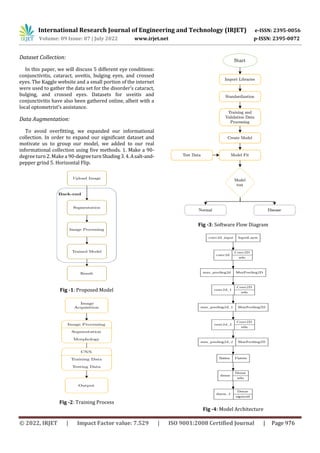
Image processing can be divided into several classes,
including "image compression," "image upgrade," and
"reclamationandmeasurementextraction."Ithelpstoreduce
the amount of memoryneededtostoreasophisticatedimage.
The image can be stolen. The photographs may be discarded
due to issues with the digitizing process and other factors.
Image enhancement techniques can beusedtofixaneglected
image. After testing and approving the information, we next
utilized this model's preparation method after doing an
informational collection assortment, information resizing,
information planning, and information expansion. In this
study, wecombined our owndesignedCNNarchitecturewith
the image processing capability.
Background of CNN:
Convolutional networks are a type ofsophisticatedneural
network. It was calculated using deep learning. The way this
computation is done is that the model can initially take an
input image and then assign significance to various
arguments or points of viewinthatimagesothatthemachine
can choose to divide one class from the other. Prepossessing
is this model's main requirement. CNN's layout includes
network representations of neurons found in the human
brain. Additionally, 2D structures of information pictures
have specific desirable positions. Here, slope-based
augmentation is used. There are several layers in this model,
including convolutional and subsampling layers.](https://image.slidesharecdn.com/irjet-v9i7185-221022090841-9eb6baee/85/EYE-DISEASE-IDENTIFICATION-USING-DEEP-LEARNING-2-320.jpg)
![International Research Journal of Engineering and Technology (IRJET) e-ISSN: 2395-0056
Volume: 09 Issue: 07 | July 2022 www.irjet.net p-ISSN: 2395-0072
© 2022, IRJET | Impact Factor value: 7.529 | ISO 9001:2008 Certified Journal | Page 978
• The model will be able to guide the users to know their
eye condition (for specified eye diseases namely
crossed eye, bulged eye, conjunctivitis and cataract).
• The model is cost effective and has simple interface.
• The model shares the details of the nearby eye doctors
to the use to get their eye check-up.
8. FUTURE SCOPE
In future, we can create a App and web based application
for a customized Deep Learning model that diagnoses
externally observable eye issues/diseases fromanuploaded
eye picture.
REFERENCES
[1] Akram A, & Debnath, R. (2020). “An automated eye
disease recognition system fromvisualcontent of facial
images using machine learning techniques” Turkish
Journal of Electrical Engineering and Computer
Science, 28(2), 917-932.
[2] Prasad, K., Sajith, P. S., Neema, M., Madhu, L., &
Priya, P. N. (2019, October). “Multiple eye disease
detection using Deep Neural Network”. In TENCON
2019-2019 IEEE Region 10 Conference (TENCON)
(pp. 2148-2153). IEEE.
[3] Jain, L., Murthy, H. S., Patel, C., & Bansal, D. (2018,
December). “Retinal eyedisease detection using deep
learning” In 2018 Fourteenth International
Conference on Information Processing (ICINPRO)
(pp. 1-6). IEEE.
[4] Sarki, R., Ahmed, K., Wang, H., & Zhang, Y. (2020).
“Automatic detection of diabetic eye disease through
deep learning using fundus images: A survey”.IEEE
Access, 8, 151133-151149.
[5] Rajyaguru, V., Vithalani, C., & Thanki, R. (2020). “A
literature review:various learning techniques and its
applications for eye disease identification using
retinalimages”.InternationalJournalofInformation
Technology, 1-12.
[6] Malik, S., Kanwal, N., Asghar, M. N., Sadiq, M. A. A.,
Karamat, I., & Fleury, M. (2019). “ Data driven
approach for eye disease classification with machine
learning” 9(14), 2789.
[7] Fageeri, S. O., Ahmed, S. M. M., Almubarak, S. A., &
Mu'azu, A. A. (2017, January). “Eye refractive error
classification using machine learning techniques” In
2017 International Conference on Communication,
Control, Computing and Electronics Engineering
(ICCCCEE) (pp. 1-6). IEEE.
[8] Umesh, L., Mrunalini, M., & Shinde, S. (2016).
“ Review of image processingand machine learning
techniques for eye disease detection and classification”
International Research Journal of Engineering and
Technology, 3(3), 547-551.
[9] Cheung, C. Y., Tang, F., Ting, D. S. W., Tan, G. S. W., &
Wong, T. Y. (2019). “Artificial intelligence in
diabetic eye disease screening” The Asia- Pacific
Journal of Ophthalmology, 8(2), 158-164.](https://image.slidesharecdn.com/irjet-v9i7185-221022090841-9eb6baee/85/EYE-DISEASE-IDENTIFICATION-USING-DEEP-LEARNING-5-320.jpg)

This document presents a deep learning model for identifying eye diseases from images. The model was trained on datasets of five different eye conditions - conjunctivitis, cataracts, uveitis, bulging eyes, and crossed eyes. The model uses a convolutional neural network architecture with several convolutional and pooling layers. It achieves 96% accuracy on single-eye images and 92.31% accuracy on two-eye images. The authors conclude the model is effective and cost-efficient at classifying common eye diseases and recommending users seek treatment from ophthalmologists when needed.


