Curitiba, Brazil By  Rick Bailey
 
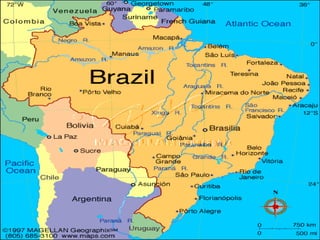
Curitiba, Brazil Southern Brazil 2.3 million people 7 th  Largest city in Brazil Latin America’s Cleanest City GDP in 2007 was 17 billion dollars 3057 feet above sea level ‘ A cidade sorriso’ (The Smiling City)
History of Curitiba, Brazil Capital of Paran á Mainly an agricultural state  Later half of 19 th  century saw an influx of European immigrants that created new economic frontiers Post World War II, leaders anticipate building boom in Curitiba Fear of uncontrollable sprawl like in Rio de Janeiro and Sao Paolo
Urban Planning Early Years Public Transit in early days Tramway built by Boaventura Clapp 1887
Comprehensive Urban Planning 1943 first urban plan drafted Created by Alfred Agache Followed the French Haussman tradition Massive infrastructure investment, monumental public works projects and a sprawling overpass in the central core that would destroy large sections of historical  buildings
Change in Plans 1964- Mayor Ivo Arzua solicited proposals for urban design Architect Jaime Lerner and a team from the university submitted a plan that: Strict control on urban sprawl Reduction in traffic congestion downtown Preservation of historic sector Convenient and affordable public transit system
1965 Curitiba Master Plan Downtown became the hub and terminus for traffic Overcrowding and congestion became serious issue in the early 1960’s Focused on meeting mobility needs of people instead of automobiles Funneled development along structural axis from the central city
1965 Curitiba Master Plan (cont.) Developed to establish a balanced, bi-directional traffic pattern more suited to sustain a municipal transit system Preserved the city’s core by giving pedestrians the right of way on downtown streets Relegated automobiles to second tier status in the city
 
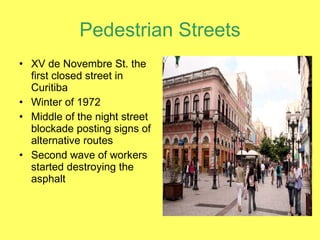
Pedestrian Streets XV de Novembre St. the first closed street in Curitiba Winter of 1972 Middle of the night street blockade posting signs of alternative routes Second wave of workers started destroying the asphalt
Master Plan (cont.) Initial response  Protest from shop owners Noticed sharp increases in retail sales Other sections of downtown demanded streets be closed to traffic Automobile protest Motorized invasion of pedestrian streets City responded with passive resistance When cars arrived the streets were full of children drawing an immense ecological mural that spanned the entire street
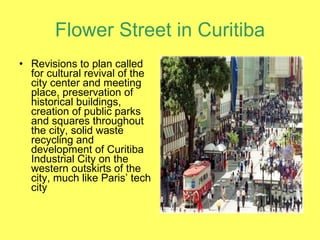
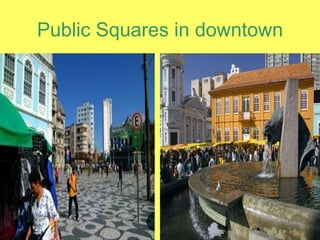
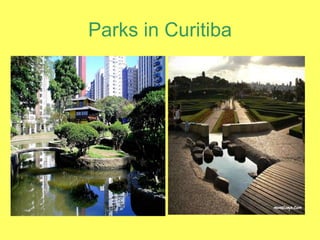
Flower Street in Curitiba Revisions to plan called for cultural revival of the city center and meeting place, preservation of historical buildings, creation of public parks and squares throughout the city, solid waste recycling and development of Curitiba Industrial City on the western outskirts of the city, much like Paris’ tech city
Public Squares in downtown
Parks in Curitiba
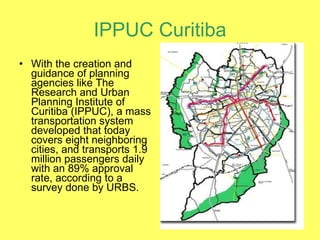
Public Transit Bus dominated system Copenhagen “hand” model of service  Twenty inter-modal stations along five corridors 1980 created Integrated Transportation Network Anywhere in city for one fare Single fare for users, change frequently due to Brazil’s currency inflation Prepaid tokens 10 private bus companies all turn a profit Efficient and convenient transfers
Buses in Curitiba
IPPUC Curitiba With the creation and guidance of planning agencies like The Research and Urban Planning Institute of Curitiba (IPPUC), a mass transportation system developed that today covers eight neighboring cities, and transports 1.9 million passengers daily with an 89% approval rate, according to a survey done by URBS.
Policies of Change Zoning regulations have created “wedding cake” densities in the city Transferable Development Rights Owners of historical buildings can sell or transfer development rights to property owners elsewhere in city. Transit Supportive Housing Policies 20,000 low-income housing built over 20 years along transportation corridors Municipal Housing Fund Act, developers can “buy up” two extra floors of residential buildings by contributing to low-income housing fund COHAB- funnels the money as housing assistance to poor famalies
Policies of Change (cont.) IPPUC has only allowed large scale shopping malls to be built within the structural axis Rejected the American-style shopping malls on outskirts of city
Old Style Architecture in Curitiba
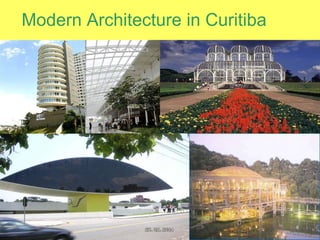
Modern Architecture in Curitiba
Agents of Change 1980 (Lighthouses of Knowledge ). These Lighthouses are free educational centers which include libraries, internet access, and other cultural resources.  Job training and educational programs. Supply workers for city services and amenities.
Summary One of the highest median household incomes 2 nd  highest car ownership rate in Brazil Integrated transportation and land use Transit Ridership grew 15% annually from 1974-1994, 3 to 4 times faster than population growth in same time period Government leaders that steered the city in right direction

Curitiba, Brazil

  • 1.
    Curitiba, Brazil By Rick Bailey
  • 2.
  • 3.
    Curitiba, Brazil SouthernBrazil 2.3 million people 7 th Largest city in Brazil Latin America’s Cleanest City GDP in 2007 was 17 billion dollars 3057 feet above sea level ‘ A cidade sorriso’ (The Smiling City)
  • 4.
    History of Curitiba,Brazil Capital of Paran á Mainly an agricultural state Later half of 19 th century saw an influx of European immigrants that created new economic frontiers Post World War II, leaders anticipate building boom in Curitiba Fear of uncontrollable sprawl like in Rio de Janeiro and Sao Paolo
  • 5.
    Urban Planning EarlyYears Public Transit in early days Tramway built by Boaventura Clapp 1887
  • 6.
    Comprehensive Urban Planning1943 first urban plan drafted Created by Alfred Agache Followed the French Haussman tradition Massive infrastructure investment, monumental public works projects and a sprawling overpass in the central core that would destroy large sections of historical buildings
  • 7.
    Change in Plans1964- Mayor Ivo Arzua solicited proposals for urban design Architect Jaime Lerner and a team from the university submitted a plan that: Strict control on urban sprawl Reduction in traffic congestion downtown Preservation of historic sector Convenient and affordable public transit system
  • 8.
    1965 Curitiba MasterPlan Downtown became the hub and terminus for traffic Overcrowding and congestion became serious issue in the early 1960’s Focused on meeting mobility needs of people instead of automobiles Funneled development along structural axis from the central city
  • 9.
    1965 Curitiba MasterPlan (cont.) Developed to establish a balanced, bi-directional traffic pattern more suited to sustain a municipal transit system Preserved the city’s core by giving pedestrians the right of way on downtown streets Relegated automobiles to second tier status in the city
  • 10.
  • 11.
    Pedestrian Streets XVde Novembre St. the first closed street in Curitiba Winter of 1972 Middle of the night street blockade posting signs of alternative routes Second wave of workers started destroying the asphalt
  • 12.
    Master Plan (cont.)Initial response Protest from shop owners Noticed sharp increases in retail sales Other sections of downtown demanded streets be closed to traffic Automobile protest Motorized invasion of pedestrian streets City responded with passive resistance When cars arrived the streets were full of children drawing an immense ecological mural that spanned the entire street
  • 13.
    Flower Street inCuritiba Revisions to plan called for cultural revival of the city center and meeting place, preservation of historical buildings, creation of public parks and squares throughout the city, solid waste recycling and development of Curitiba Industrial City on the western outskirts of the city, much like Paris’ tech city
  • 14.
  • 15.
  • 16.
    Public Transit Busdominated system Copenhagen “hand” model of service Twenty inter-modal stations along five corridors 1980 created Integrated Transportation Network Anywhere in city for one fare Single fare for users, change frequently due to Brazil’s currency inflation Prepaid tokens 10 private bus companies all turn a profit Efficient and convenient transfers
  • 17.
  • 18.
    IPPUC Curitiba Withthe creation and guidance of planning agencies like The Research and Urban Planning Institute of Curitiba (IPPUC), a mass transportation system developed that today covers eight neighboring cities, and transports 1.9 million passengers daily with an 89% approval rate, according to a survey done by URBS.
  • 19.
    Policies of ChangeZoning regulations have created “wedding cake” densities in the city Transferable Development Rights Owners of historical buildings can sell or transfer development rights to property owners elsewhere in city. Transit Supportive Housing Policies 20,000 low-income housing built over 20 years along transportation corridors Municipal Housing Fund Act, developers can “buy up” two extra floors of residential buildings by contributing to low-income housing fund COHAB- funnels the money as housing assistance to poor famalies
  • 20.
    Policies of Change(cont.) IPPUC has only allowed large scale shopping malls to be built within the structural axis Rejected the American-style shopping malls on outskirts of city
  • 21.
  • 22.
  • 23.
    Agents of Change1980 (Lighthouses of Knowledge ). These Lighthouses are free educational centers which include libraries, internet access, and other cultural resources. Job training and educational programs. Supply workers for city services and amenities.
  • 24.
    Summary One ofthe highest median household incomes 2 nd highest car ownership rate in Brazil Integrated transportation and land use Transit Ridership grew 15% annually from 1974-1994, 3 to 4 times faster than population growth in same time period Government leaders that steered the city in right direction

Editor's Notes

  • #5 mainly Germans , Italians , Poles and Ukrainians contributing to the economic and cultural development of the city.
  • #8 Lerner would later become mayor of Curitiba.
  • #9 Lerner’s plan was quick and relatively low cost.
  • #11 Curitiba in 1971.
  • #12 Tri-nary Road System’s goal was to minimize traffic.
  • #17 Fares ranged between 30 and 40 cents U.S. Currency. Companies by in bulk and distribute to workers as monthly travel allowance.
  • #18 Modern bus stops with 9 different bus sizes feeding the city. Bi articulated buses, articulated buses, feeder buses etc.
  • #19 Exclusive bus way is the core of the system. Instituto de Pesquisa e Plnejamento Urbano de Curitiba
  • #20 The farther away from the downtown the less dense the population becomes. This has helped to transfer population along the structural axes, creating mixed-use development. Companhia de Habitacao Popular Curitiba
  • #22 Federal University of Parana, old sections of downtown, Mormon Temple, and the palacio avenado building curitiba
  • #23 Oscar-Niermeyer architecture museum. Botanical Gardens in Curitiba. Rotating Apartment building. Shopping mall in Curitiba