
Comparative Urban Planning
Law
By: James A. Kushner
Chapter 1
Voula Mega, The Concept and Civilization of
an Eco-society: Dilemmas, Innovations, and
Urban Dramas.
In Cities and the Environment: New Approaches for Eco-societies, edited by Takashi Inoguchi, Edward
Newman, and Glen Paoletto 1999
The Concept and Civilization of
an Eco-society
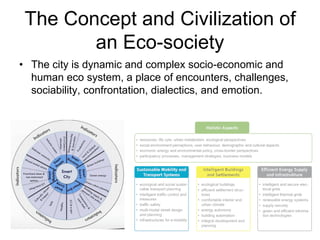
• The city is dynamic and complex socio-economic and
human eco system, a place of encounters, challenges,
sociability, confrontation, dialectics, and emotion.
The Concept and Civilization of
an Eco-society
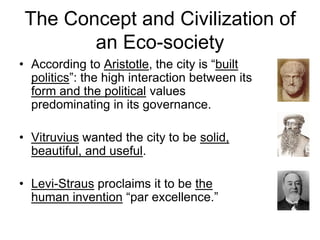
• According to Aristotle, the city is “built
politics”: the high interaction between its
form and the political values
predominating in its governance.
• Vitruvius wanted the city to be solid,
beautiful, and useful.
• Levi-Straus proclaims it to be the
human invention “par excellence.”
The Concept and Civilization of
an Eco-society
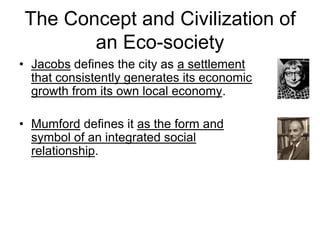
• Jacobs defines the city as a settlement
that consistently generates its economic
growth from its own local economy.
• Mumford defines it as the form and
symbol of an integrated social
relationship.
The Concept and Civilization of
an Eco-society
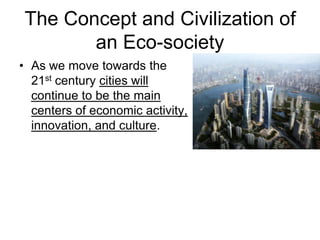
• As we move towards the
21st century cities will
continue to be the main
centers of economic activity,
innovation, and culture.
The Concept and Civilization of
an Eco-society
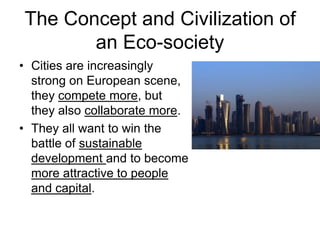
• Cities are increasingly
strong on European scene,
they compete more, but
they also collaborate more.
• They all want to win the
battle of sustainable
development and to become
more attractive to people
and capital.
The Concept and Civilization of
an Eco-society
• But cities are becoming more ambivalent.
• There are cities that:
– Include but also exclude
– Assemble but also divide
– Integrate but also disintegrate
– Enrich but also impoverish
– Fulfill but also drain
The Concept and Civilization of
an Eco-society
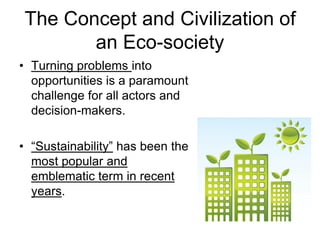
• Turning problems into
opportunities is a paramount
challenge for all actors and
decision-makers.
• “Sustainability” has been the
most popular and
emblematic term in recent
years.
The Concept and Civilization of
an Eco-society
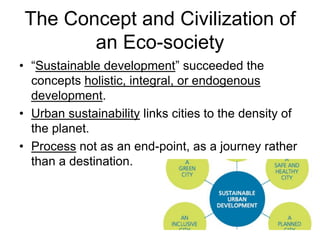
• “Sustainable development” succeeded the
concepts holistic, integral, or endogenous
development.
• Urban sustainability links cities to the density of
the planet.
• Process not as an end-point, as a journey rather
than a destination.
The Concept and Civilization of
an Eco-society
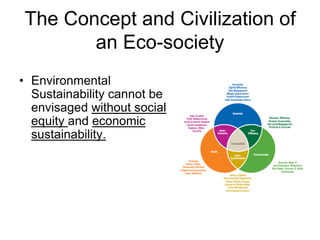
• Environmental
Sustainability cannot be
envisaged without social
equity and economic
sustainability.
The Concept and Civilization of
an Eco-society
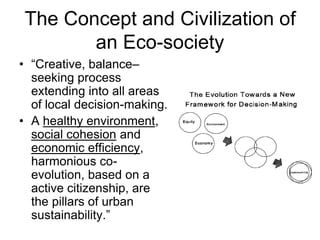
• “Creative, balance–
seeking process
extending into all areas
of local decision-making.
• A healthy environment,
social cohesion and
economic efficiency,
harmonious co-
evolution, based on a
active citizenship, are
the pillars of urban
sustainability.”
The Concept and Civilization of
an Eco-society
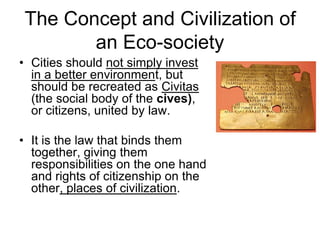
• Cities should not simply invest
in a better environment, but
should be recreated as Civitas
(the social body of the cives),
or citizens, united by law.
• It is the law that binds them
together, giving them
responsibilities on the one hand
and rights of citizenship on the
other, places of civilization.
The Concept and Civilization of
an Eco-society
• The city at least has the
capacity to renew itself.
• The renaissance cannot be
perceived without as overall
rethinking of the city, its form,
and its function.
The Concept and Civilization of
an Eco-society
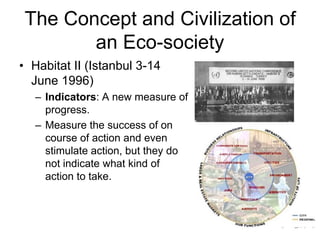
• Habitat II (Istanbul 3-14
June 1996)
– Indicators: A new measure of
progress.
– Measure the success of on
course of action and even
stimulate action, but they do
not indicate what kind of
action to take.
The Concept and Civilization of
an Eco-society
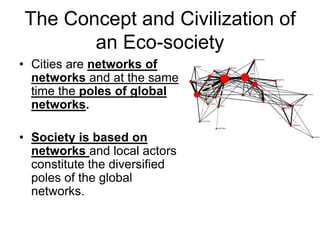
• Cities are networks of
networks and at the same
time the poles of global
networks.
• Society is based on
networks and local actors
constitute the diversified
poles of the global
networks.
The Concept and Civilization of
an Eco-society
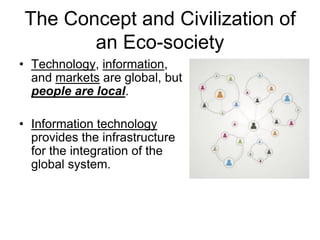
• Technology, information,
and markets are global, but
people are local.
• Information technology
provides the infrastructure
for the integration of the
global system.
The Concept and Civilization of
an Eco-society
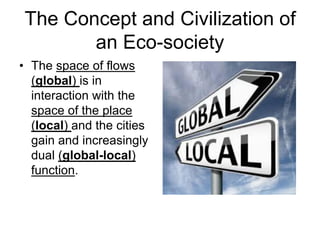
• The space of flows
(global) is in
interaction with the
space of the place
(local) and the cities
gain and increasingly
dual (global-local)
function.
The Concept and Civilization of
an Eco-society
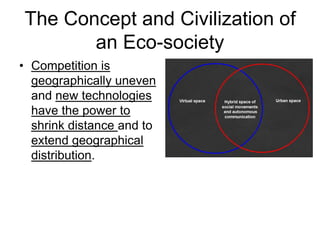
• Competition is
geographically uneven
and new technologies
have the power to
shrink distance and to
extend geographical
distribution.
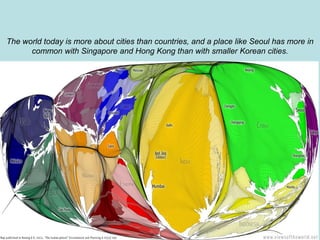
The world today is more about cities than countries, and a place like Seoul has more in
common with Singapore and Hong Kong than with smaller Korean cities.
City Life in Developing
Nations
Bill McKibben, Curitiba, in Hope,
Human and Wild:
True Stories of Living Lightly on the
Earth (Ch2. 1995)
Curitiba
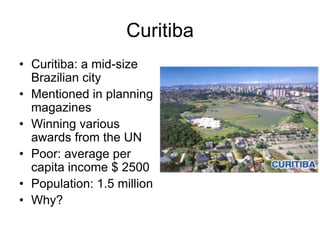
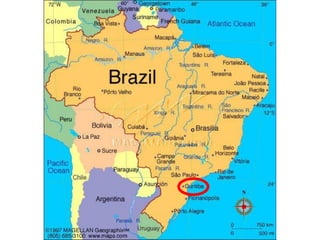
• Curitiba: a mid-size
Brazilian city
• Mentioned in planning
magazines
• Winning various
awards from the UN
• Poor: average per
capita income $ 2500
• Population: 1.5 million
• Why?
Curitiba
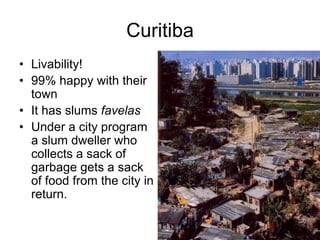
• Livability!
• 99% happy with their
town
• It has slums favelas
• Under a city program
a slum dweller who
collects a sack of
garbage gets a sack
of food from the city in
return.
Curitiba
• “Decent lives helping produce a decent
environment.”
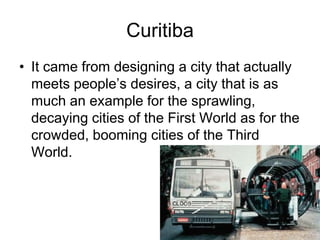
• Fine transit system.
• Its inhabitants are attracted toward the city
center instead of repelled out to a sprawl
of suburbs.
• 25% less fuel per capita than other
Brazilians.
Curitiba
• It came from designing a city that actually
meets people’s desires, a city that is as
much an example for the sprawling,
decaying cities of the First World as for the
crowded, booming cities of the Third
World.
Curitiba
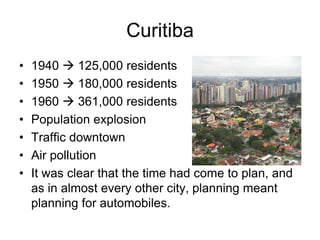
• 1940  125,000 residents
• 1950  180,000 residents
• 1960  361,000 residents
• Population explosion
• Traffic downtown
• Air pollution
• It was clear that the time had come to plan, and
as in almost every other city, planning meant
planning for automobiles.
Curitiba
• The scheme called for widening the main
streets of the city to add more lanes.
• Knocking down the turn-of-the-century
buildings that lined the downtown
• Building overpass that would link two of
the city’s main squares.
Curitiba
• Any American living in a city that has
undergone urban renewal or been cut off
from its waterfront by a belt of highway
would recognize the plan in an instant.
• It’s how urban areas around the globe
have been reconfigured for the auto age.
Curitiba
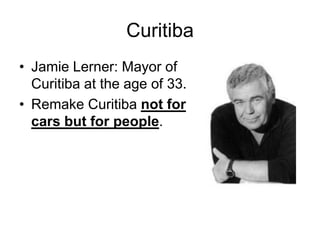
• Jamie Lerner: Mayor of
Curitiba at the age of 33.
• Remake Curitiba not for
cars but for people.
Curitiba
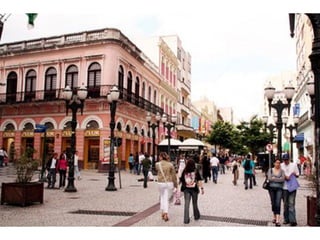
• Pedestrian mall
• A human-scale city
• Jackhammering up the pavement, putting
down cobblestones, erecting streetlights
and kiosks, and putting in tens of
thousands of flowers.
• Children sitting in the former street
painting pictures.
Curitiba
• Instead of buying up buildings and tearing
them down to widen streets, planners
stared at the maps long enough to see
that the existing streets would do just fine.
• No highways in the city – three streets still
scaled to human beings.
Curitiba
“Every city has its hidden designs old roads, old
streetcar ways. You’re not going to invent a new
city. Instead, you’re doing a strange
archaeology, trying to enhance the old, hidden
design. You can’t go wrong if the city is growing
along the trail of memory and of transport.
Memory is the identity of the city, and transport
is the future.”
Jaime Lerner (Curitiba mayor)
Curitiba
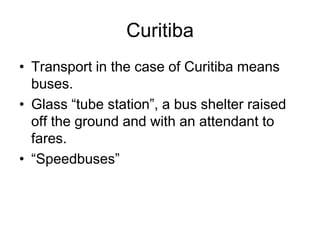
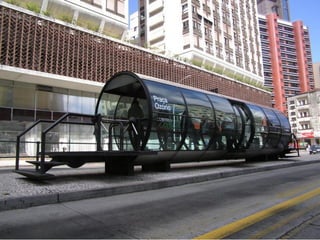
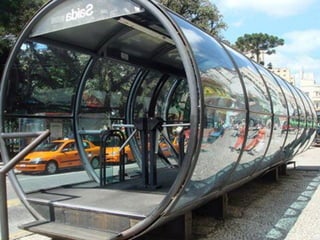
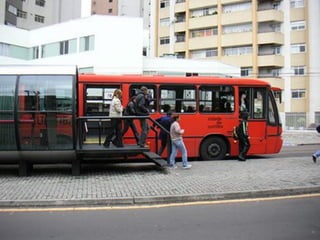
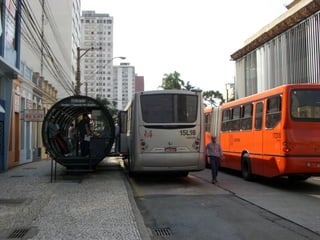
• Transport in the case of Curitiba means
buses.
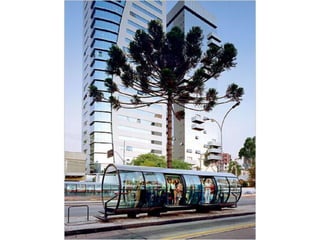
• Glass “tube station”, a bus shelter raised
off the ground and with an attendant to
fares.
• “Speedbuses”
Curitiba
• “Cheapness” is one of the cardinal dictates
of Curitiban planning.
• Many of the city’s buildings are “recycled”.
– Old furniture factory  Planning headquarters
– Gunpowder depot  Furniture factory
– Glue plant  children’s center
• “Simple is brother to cheap.”
Curitiba
“It’s very hard to understand simplicity.
Simplicity needs a kind of commitment.
You have to be sure of yourself.”
Jaime Lerner (Curitiba mayor)
Curitiba
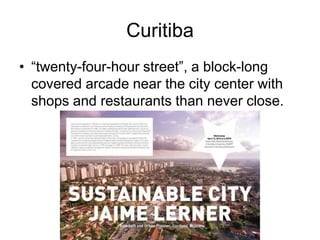
• “twenty-four-hour street”, a block-long
covered arcade near the city center with
shops and restaurants than never close.
Curitiba
“You have to begin the game. You don’t
have to have all the answers before you
start – you can’t be such smart guys. To
start is important.”
Jaime Lerner (Curitiba mayor)
Curitiba
• Ideology in the name of constructive
pragmatism. Building things to human
scale may be an ideology of sorts.
• It gave buses priorities over cars.
• Many streets are totally canopied, tunnels
of green.
Curitiba
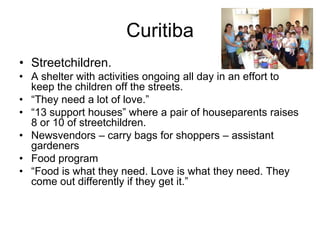
• Streetchildren.
• A shelter with activities ongoing all day in an effort to
keep the children off the streets.
• “They need a lot of love.”
• “13 support houses” where a pair of houseparents raises
8 or 10 of streetchildren.
• Newsvendors – carry bags for shoppers – assistant
gardeners
• Food program
• “Food is what they need. Love is what they need. They
come out differently if they get it.”
Curitiba
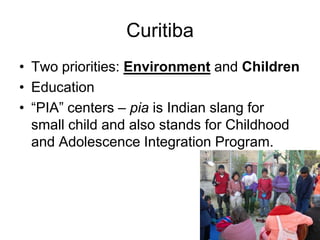
• Two priorities: Environment and Children
• Education
• “PIA” centers – pia is Indian slang for
small child and also stands for Childhood
and Adolescence Integration Program.
Curitiba
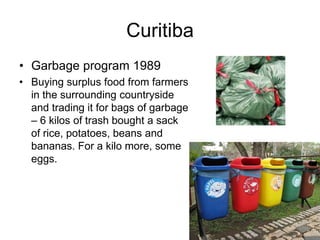
• Garbage program 1989
• Buying surplus food from farmers
in the surrounding countryside
and trading it for bags of garbage
– 6 kilos of trash bought a sack
of rice, potatoes, beans and
bananas. For a kilo more, some
eggs.
Curitiba
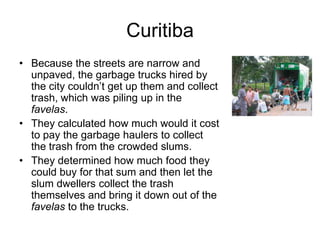
• Because the streets are narrow and
unpaved, the garbage trucks hired by
the city couldn’t get up them and collect
trash, which was piling up in the
favelas.
• They calculated how much would it cost
to pay the garbage haulers to collect
the trash from the crowded slums.
• They determined how much food they
could buy for that sum and then let the
slum dwellers collect the trash
themselves and bring it down out of the
favelas to the trucks.
Curitiba
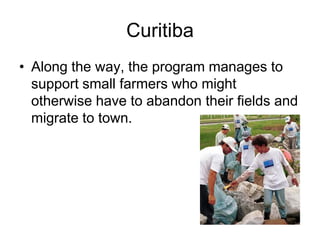
• Along the way, the program manages to
support small farmers who might
otherwise have to abandon their fields and
migrate to town.
Curitiba
• To learn from Curitiba, the rest of the
world would have to break some long
standing habits – the habit of finding
answers in the rich countries, for
instance, “People can’t imagine there’s a
city in Brazil with all the facilities.”
Curitiba Videos
• Brazil- Curitiba, a sustainable city
• http://www.youtube.com/results?search_query=Brazil-
+Curitiba&aq=f
• Jaime Lerner: A song of the city
• http://www.ted.com/talks/jaime_lerner_sings_of_the_city.
html
• Eduardo Paes: The 4 commandments of cities
• http://www.ted.com/talks/eduardo_paes_the_4_comman
dments_of_cities.html
END

Daup mupd-upl-2015-lecture 7

  • 1.
  • 2.
    Chapter 1 Voula Mega,The Concept and Civilization of an Eco-society: Dilemmas, Innovations, and Urban Dramas. In Cities and the Environment: New Approaches for Eco-societies, edited by Takashi Inoguchi, Edward Newman, and Glen Paoletto 1999
  • 3.
    The Concept andCivilization of an Eco-society • The city is dynamic and complex socio-economic and human eco system, a place of encounters, challenges, sociability, confrontation, dialectics, and emotion.
  • 4.
    The Concept andCivilization of an Eco-society • According to Aristotle, the city is “built politics”: the high interaction between its form and the political values predominating in its governance. • Vitruvius wanted the city to be solid, beautiful, and useful. • Levi-Straus proclaims it to be the human invention “par excellence.”
  • 5.
    The Concept andCivilization of an Eco-society • Jacobs defines the city as a settlement that consistently generates its economic growth from its own local economy. • Mumford defines it as the form and symbol of an integrated social relationship.
  • 6.
    The Concept andCivilization of an Eco-society • As we move towards the 21st century cities will continue to be the main centers of economic activity, innovation, and culture.
  • 7.
    The Concept andCivilization of an Eco-society • Cities are increasingly strong on European scene, they compete more, but they also collaborate more. • They all want to win the battle of sustainable development and to become more attractive to people and capital.
  • 8.
    The Concept andCivilization of an Eco-society • But cities are becoming more ambivalent. • There are cities that: – Include but also exclude – Assemble but also divide – Integrate but also disintegrate – Enrich but also impoverish – Fulfill but also drain
  • 9.
    The Concept andCivilization of an Eco-society • Turning problems into opportunities is a paramount challenge for all actors and decision-makers. • “Sustainability” has been the most popular and emblematic term in recent years.
  • 10.
    The Concept andCivilization of an Eco-society • “Sustainable development” succeeded the concepts holistic, integral, or endogenous development. • Urban sustainability links cities to the density of the planet. • Process not as an end-point, as a journey rather than a destination.
  • 11.
    The Concept andCivilization of an Eco-society • Environmental Sustainability cannot be envisaged without social equity and economic sustainability.
  • 12.
    The Concept andCivilization of an Eco-society • “Creative, balance– seeking process extending into all areas of local decision-making. • A healthy environment, social cohesion and economic efficiency, harmonious co- evolution, based on a active citizenship, are the pillars of urban sustainability.”
  • 13.
    The Concept andCivilization of an Eco-society • Cities should not simply invest in a better environment, but should be recreated as Civitas (the social body of the cives), or citizens, united by law. • It is the law that binds them together, giving them responsibilities on the one hand and rights of citizenship on the other, places of civilization.
  • 14.
    The Concept andCivilization of an Eco-society • The city at least has the capacity to renew itself. • The renaissance cannot be perceived without as overall rethinking of the city, its form, and its function.
  • 15.
    The Concept andCivilization of an Eco-society • Habitat II (Istanbul 3-14 June 1996) – Indicators: A new measure of progress. – Measure the success of on course of action and even stimulate action, but they do not indicate what kind of action to take.
  • 16.
    The Concept andCivilization of an Eco-society • Cities are networks of networks and at the same time the poles of global networks. • Society is based on networks and local actors constitute the diversified poles of the global networks.
  • 17.
    The Concept andCivilization of an Eco-society • Technology, information, and markets are global, but people are local. • Information technology provides the infrastructure for the integration of the global system.
  • 18.
    The Concept andCivilization of an Eco-society • The space of flows (global) is in interaction with the space of the place (local) and the cities gain and increasingly dual (global-local) function.
  • 19.
    The Concept andCivilization of an Eco-society • Competition is geographically uneven and new technologies have the power to shrink distance and to extend geographical distribution.
  • 20.
    The world todayis more about cities than countries, and a place like Seoul has more in common with Singapore and Hong Kong than with smaller Korean cities.
  • 21.
    City Life inDeveloping Nations Bill McKibben, Curitiba, in Hope, Human and Wild: True Stories of Living Lightly on the Earth (Ch2. 1995)
  • 22.
    Curitiba • Curitiba: amid-size Brazilian city • Mentioned in planning magazines • Winning various awards from the UN • Poor: average per capita income $ 2500 • Population: 1.5 million • Why?
  • 25.
    Curitiba • Livability! • 99%happy with their town • It has slums favelas • Under a city program a slum dweller who collects a sack of garbage gets a sack of food from the city in return.
  • 26.
    Curitiba • “Decent liveshelping produce a decent environment.” • Fine transit system. • Its inhabitants are attracted toward the city center instead of repelled out to a sprawl of suburbs. • 25% less fuel per capita than other Brazilians.
  • 27.
    Curitiba • It camefrom designing a city that actually meets people’s desires, a city that is as much an example for the sprawling, decaying cities of the First World as for the crowded, booming cities of the Third World.
  • 29.
    Curitiba • 1940 125,000 residents • 1950  180,000 residents • 1960  361,000 residents • Population explosion • Traffic downtown • Air pollution • It was clear that the time had come to plan, and as in almost every other city, planning meant planning for automobiles.
  • 30.
    Curitiba • The schemecalled for widening the main streets of the city to add more lanes. • Knocking down the turn-of-the-century buildings that lined the downtown • Building overpass that would link two of the city’s main squares.
  • 31.
    Curitiba • Any Americanliving in a city that has undergone urban renewal or been cut off from its waterfront by a belt of highway would recognize the plan in an instant. • It’s how urban areas around the globe have been reconfigured for the auto age.
  • 32.
    Curitiba • Jamie Lerner:Mayor of Curitiba at the age of 33. • Remake Curitiba not for cars but for people.
  • 33.
    Curitiba • Pedestrian mall •A human-scale city • Jackhammering up the pavement, putting down cobblestones, erecting streetlights and kiosks, and putting in tens of thousands of flowers. • Children sitting in the former street painting pictures.
  • 35.
    Curitiba • Instead ofbuying up buildings and tearing them down to widen streets, planners stared at the maps long enough to see that the existing streets would do just fine. • No highways in the city – three streets still scaled to human beings.
  • 36.
    Curitiba “Every city hasits hidden designs old roads, old streetcar ways. You’re not going to invent a new city. Instead, you’re doing a strange archaeology, trying to enhance the old, hidden design. You can’t go wrong if the city is growing along the trail of memory and of transport. Memory is the identity of the city, and transport is the future.” Jaime Lerner (Curitiba mayor)
  • 37.
    Curitiba • Transport inthe case of Curitiba means buses. • Glass “tube station”, a bus shelter raised off the ground and with an attendant to fares. • “Speedbuses”
  • 42.
    Curitiba • “Cheapness” isone of the cardinal dictates of Curitiban planning. • Many of the city’s buildings are “recycled”. – Old furniture factory  Planning headquarters – Gunpowder depot  Furniture factory – Glue plant  children’s center • “Simple is brother to cheap.”
  • 43.
    Curitiba “It’s very hardto understand simplicity. Simplicity needs a kind of commitment. You have to be sure of yourself.” Jaime Lerner (Curitiba mayor)
  • 44.
    Curitiba • “twenty-four-hour street”,a block-long covered arcade near the city center with shops and restaurants than never close.
  • 45.
    Curitiba “You have tobegin the game. You don’t have to have all the answers before you start – you can’t be such smart guys. To start is important.” Jaime Lerner (Curitiba mayor)
  • 46.
    Curitiba • Ideology inthe name of constructive pragmatism. Building things to human scale may be an ideology of sorts. • It gave buses priorities over cars. • Many streets are totally canopied, tunnels of green.
  • 47.
    Curitiba • Streetchildren. • Ashelter with activities ongoing all day in an effort to keep the children off the streets. • “They need a lot of love.” • “13 support houses” where a pair of houseparents raises 8 or 10 of streetchildren. • Newsvendors – carry bags for shoppers – assistant gardeners • Food program • “Food is what they need. Love is what they need. They come out differently if they get it.”
  • 48.
    Curitiba • Two priorities:Environment and Children • Education • “PIA” centers – pia is Indian slang for small child and also stands for Childhood and Adolescence Integration Program.
  • 49.
    Curitiba • Garbage program1989 • Buying surplus food from farmers in the surrounding countryside and trading it for bags of garbage – 6 kilos of trash bought a sack of rice, potatoes, beans and bananas. For a kilo more, some eggs.
  • 50.
    Curitiba • Because thestreets are narrow and unpaved, the garbage trucks hired by the city couldn’t get up them and collect trash, which was piling up in the favelas. • They calculated how much would it cost to pay the garbage haulers to collect the trash from the crowded slums. • They determined how much food they could buy for that sum and then let the slum dwellers collect the trash themselves and bring it down out of the favelas to the trucks.
  • 51.
    Curitiba • Along theway, the program manages to support small farmers who might otherwise have to abandon their fields and migrate to town.
  • 52.
    Curitiba • To learnfrom Curitiba, the rest of the world would have to break some long standing habits – the habit of finding answers in the rich countries, for instance, “People can’t imagine there’s a city in Brazil with all the facilities.”
  • 53.
    Curitiba Videos • Brazil-Curitiba, a sustainable city • http://www.youtube.com/results?search_query=Brazil- +Curitiba&aq=f • Jaime Lerner: A song of the city • http://www.ted.com/talks/jaime_lerner_sings_of_the_city. html • Eduardo Paes: The 4 commandments of cities • http://www.ted.com/talks/eduardo_paes_the_4_comman dments_of_cities.html
  • 54.