SECONDARY
PPH
Prepared by
Dr.Hesham Abd Elaziz
Elmahalla gen. hosp.
+2 01069241551
Fresh or excessive bleeding
from the vagina between 24
hours and 12 weeks after
giving birth
(Alexander et al. 2002)
Definition
*In the developed world 0.5-1%
*85% requiring hospital admission
*15% require bl. transfusion
*1-3 % Obliges hysterectomy
Alexander et al. 2002
Incidence
1- A history of primary PPH
2- Manual removal of placenta
3- PROM
4- Previous 2ry PPH
5-Other risk factors include : Multiple
pregnancy ,threatened miscarriage,
precipitate labour , prolonged third stage, CS
and not breast feeding.
Risk factors
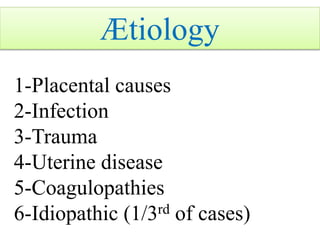
1-Placental causes
2-Infection
3-Trauma
4-Uterine disease
5-Coagulopathies
6-Idiopathic (1/3rd of cases)
Ætiology
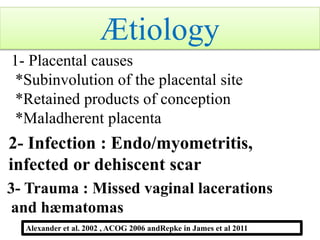
1- Placental causes
*Subinvolution of the placental site
*Retained products of conception
*Maladherent placenta
2- Infection : Endo/myometritis,
infected or dehiscent scar
3- Trauma : Missed vaginal lacerations
and hæmatomas
Alexander et al. 2002 , ACOG 2006 andRepke in James et al 2011
Ætiology
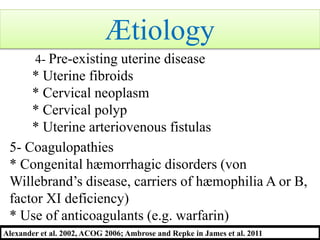
4- Pre-existing uterine disease
* Uterine fibroids
* Cervical neoplasm
* Cervical polyp
* Uterine arteriovenous fistulas
5- Coagulopathies
* Congenital hæmorrhagic disorders (von
Willebrand’s disease, carriers of hæmophilia A or B,
factor XI deficiency)
* Use of anticoagulants (e.g. warfarin)
Alexander et al. 2002, ACOG 2006; Ambrose and Repke in James et al. 2011
Ætiology
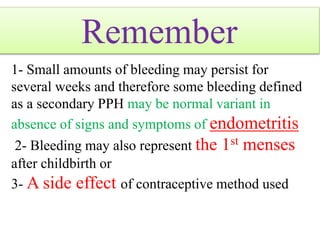
1- Small amounts of bleeding may persist for
several weeks and therefore some bleeding defined
as a secondary PPH may be normal variant in
absence of signs and symptoms of endometritis
2- Bleeding may also represent the 1st menses
after childbirth or
3- A side effect of contraceptive method used
Remember
4- Suspect endometritis if there is
uterine tenderness, fever or foul
smelling lochia
5- Secondary PPH in the first week
may be related to coagulopathy,
especially Von Willebrand’s dis.
Assessment
1- Detailed history including parity, mode of
delivery, third stage and puerperal
complications
2- Check pulse , blood pressure and
temperature
3- Assess uterine size & cervical excitation
and uterine tenderness
Assessment
4- Exclude other sources of infection e.g.
mastitis, urinary tract infection or septic
pelvic thrombophlebitis
5- Assess clinical signs of blood loss
6- Speculum examination : Cervical
dilatation, tears, infection , blood or
remnant of tissues
Assessment
Investigations
1-U/S and Doppler study
2- CBC, C-RP and ß-hCG
3- Low vaginal, high vaginal,
endocervical and rectal swabs.
4- Coagulation profile
5- Midstream urine specimen
6- Blood cultures if temperature ≥
38°C
King Edward Memorial HospitalClinical Guidelines
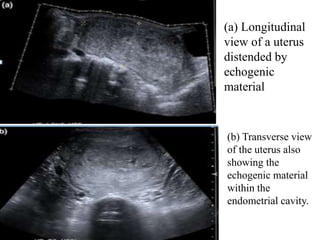
(a) Longitudinal
view of a uterus
distended by
echogenic
material
(b) Transverse view
of the uterus also
showing the
echogenic material
within the
endometrial cavity.
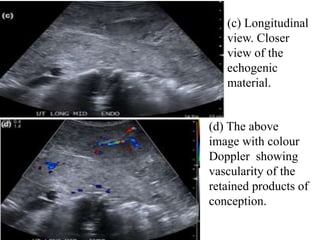
(c) Longitudinal
view. Closer
view of the
echogenic
material.
(d) The above
image with colour
Doppler showing
vascularity of the
retained products of
conception.
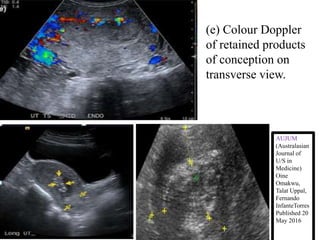
(e) Colour Doppler
of retained products
of conception on
transverse view.
AUJUM
(Australasian
Journal of
U/S in
Medicine)
Oine
Omakwu,
Talat Uppal,
Fernando
InfanteTorres
Published 20
May 2016
Prevention
1-At risk women should deliver at hospital
2-Sterilization &antiseptic technique
3-Ensure complete removal of the placenta
4-Patients with history of 1ry PPH or of
2ry PPH should receive a course of
ecbolics & antibiotics
5-Consider prophylactic antibiotics in risky
patients
6-Correction of anæmia
The initial treatments are
*Ecbolics and antibiotics
*Surgical intervention if
bleeding is heavy and ongoing e.g.
urgent ultrasonographic guided E&C
Treatment
Aiken et al. 2011
Endometritis can be effectively treated with
antibiotics
If curettage is recommended, aim to give
antibiotics for 6-12 hours before the
procedure unless bleeding requires earlier
intervention
(U/S guided E&C and send for
histopathology)
King et al. 1989; Ambrose and
Repke in James et al. 2011
Treatment
Hæmodinamically
stable woman
1-Take history : parity, 3rd stage
complications, birth mode, & any
relevant medical or family history &
consider obstetric risk factors.
2- Uterine size & tenderness.
3. Investigations: CBC, CRP, coagulation
studies, serum ß-hCG
Vaginal , cervical and rectal swabs, mid
stream urine, & blood culture if
temperature ≥ 38°C.
4. U/S & Doppler ? Other imaging as
needed.
Hæmodinamically
stable woman
*Conservative management
1-Intravenous antibiotics and ecbolics
2-If bleeding has not settled after 24
hours of antibiotic & ecbolics ,
consider surgical intervention
Hæmodinamically
stable woman
Antibiotics
*In endometritis (tender uterus)
*Ampicillin or amoxicillin 2gm IV initial dose
then 1gm IV /4 hrs plus
*Metronidazol 500 mg/12 hrs IV infusion
*Gentamycin 5mg/kg/d IV or
Ceftriaxone 1gm/24hrs
*If allergic to penicillin shift to
Clindamycin 300 mg/8h plus Gentamycin or
Lincomycin 600 mg IV in 100 ml over 1hr.
RCOG Green-top Guidelines no. 52
Ecbolics
Administer bolus dose then maintenance doses of
one of the following:
*Oxytocin 10 IU Intramuscular
*Syntometrine IM
*Ergometrine 500 micrograms IM
*Carboprost 250 μg
*Misoprostol 800 μg rectal and/or intrauterine to
help the uterus expel products of conception
BJOG: An International Journal of Obstetrics & Gynaecology
Indicated if excessive
or continuing bleeding
irrespective of ultrasonic
finding (after excluding
coagulopathy)
Surgical management
RCOG Green-top Guidelines no. 52
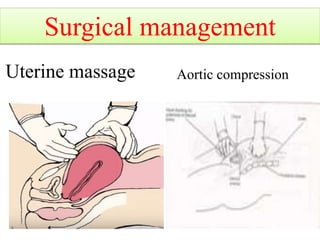
Uterine massage Aortic compression
Surgical management
May include any of the following:
*Examination under anæsthesia
*Ultrasonic guided E&C (suction)
* Balloon tamponade (? CS scar)
*Ligation of internal iliac arteries
*Interventional radiology ?
* Hysterectomy (1-3%) of cases
Surgical management
U/S guided E&C
*Administer antibiotics for 6 to 12 hours
*Suction curettage is expedient
*Avoid vigorous curettage (3%) risk of uterine
perforation & Asherman’s syndrome
*Send tissue for histopathology to exclude
choriocarcinoma and to confirm diagnosis
*If bleeding continues after curettage (suction)
consider further intervention
King et al. 1989; Ambrose and Repke in James et al. 2011
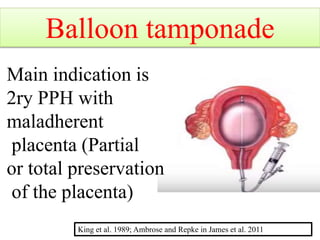
Balloon tamponade
Main indication is
2ry PPH with
maladherent
placenta (Partial
or total preservation
of the placenta)
King et al. 1989; Ambrose and Repke in James et al. 2011
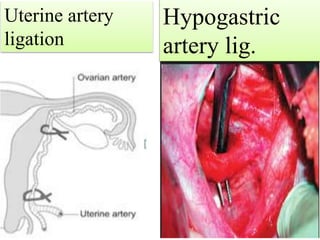
Uterine artery
ligation
Hypogastric
artery lig.
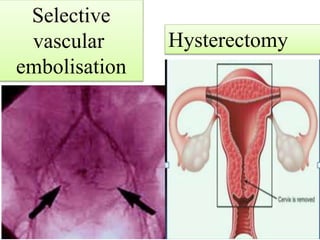
Selective
vascular
embolisation
Hysterectomy
Hæmodynamically
compromised woman
1- Start resuscitation (ABCD)
2- O2 mask and insert 2 large bore IV lines
3- CBC, cross match, coagulation studies
4- Commence fluid replacement until blood arrives
and monitor urine output.
5- IV antibiotics and ecbolics
6- Examination under anæsthesia
to identify cause & treat accordingly
7- Rub up the uterus , evacuate clots.
8- Bimanual compression of the uterus
9- External aortic compression
Hæmodynamically
compromised woman
10-surgical evacuation (E&C) (suction)
11- If bleeding continue other options include
*Balloon tamponade
*Uterine devascularization
*Specific factor transfer
*Hysterectomy
12- Specialized treatments as choriocarcinoma and
coagulopathies. (consultation or referral)
Hæmodynamically
compromised woman
*O2 mask and 2 cannulas 16 gouge
*Crystalloids : up to 2 liters Hartman’s solution
*Colloids : up to 1-2 liters until blood arrives
(?Dextran)
*Blood : Cross-matched or O negative blood
*Fresh frozen plasma: 4 units for every 6 units
RBCs (15 ml/kg or total 1 liter)
*Platelet concentrates : If platelet < 50.000/cc
*Cryoprecipitate : If fibrinogen < 100 mg/dl
RCOG Green-top Guideline No. 52
Stabilization of marked
bleeding
up to 1 litre of fresh frozen plasma (FFP) and 10 units
of cryoprecipitate may be given empirically in the
face of relentless bleeding , while awaiting the results of
coagulation studies.
*Avoid hypothermia and hypotension
* Observations : pulse , BP, RR , O2 saturation, urine
output
RCOG Green-top Guideline No. 52
Stabilization of marked
bleeding
Rfactor VIIa suggested dose is
90 ug /kg which may be repeated in the
absence of clinical response within 15–30
minutes
Before giving rFactor VII be sure that :
Fibrinogen > 100 mg/dl
*Platelets > 20 .000/cc
to achieve good clinical response
Stabilization of marked
bleeding
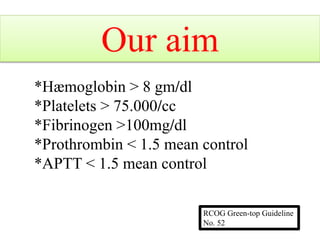
Our aim
*Hæmoglobin > 8 gm/dl
*Platelets > 75.000/cc
*Fibrinogen >100mg/dl
*Prothrombin < 1.5 mean control
*APTT < 1.5 mean control
RCOG Green-top Guideline
No. 52
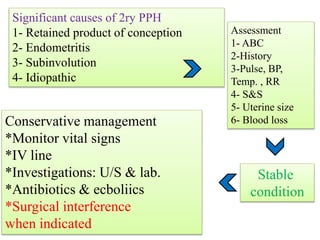
Significant causes of 2ry PPH
1- Retained product of conception
2- Endometritis
3- Subinvolution
4- Idiopathic
Assessment
1- ABC
2-History
3-Pulse, BP,
Temp. , RR
4- S&S
5- Uterine size
6- Blood lossConservative management
*Monitor vital signs
*IV line
*Investigations: U/S & lab.
*Antibiotics & ecboliics
*Surgical interference
when indicated
Stable
condition
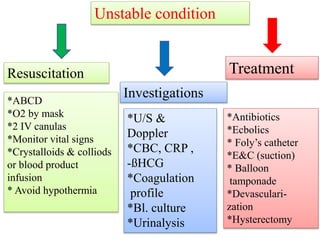
*ABCD
*O2 by mask
*2 IV canulas
*Monitor vital signs
*Crystalloids & colliods
or blood product
infusion
* Avoid hypothermia
Unstable condition
*U/S &
Doppler
*CBC, CRP ,
-ßHCG
*Coagulation
profile
*Bl. culture
*Urinalysis
*Antibiotics
*Ecbolics
* Foly’s catheter
*E&C (suction)
* Balloon
tamponade
*Devasculari-
zation
*Hysterectomy
Resuscitation
Investigations
Treatment
References
1. RCOG. Prevention and management of postpartum haemorrhage. Green top
guideline No. 52; April 2011
2. Cochrane Database of Systematic Reviews 2002,
Alexander J, Thomas P, Sanghera J. Treatments for secondary haemorrhage.
3 . ACOG. ACOG Practice Bulletin. Postpartum Haemorrhage. Clinical
Management Guidelines for ObstetricianGynecologists. Number 76, October 2006.
4. Ambrose A, Repke JT. Puerperal problemsThird ed. Philadelphia: Elsevier;
2011.
5. Aiken CEM, Mehasseb MK, Prentice A. Secondary postpartum haemorrhage
2011
6. Neill A, Thornton S. Secondary postpartum haemorrhage. J Obstet Gynaecol
2002
7-BJOG: An International Journal of Obstetrics & Gynaecology
THANKS
Prepared by
Dr.Hesham Abd Elaziz
Elmahalla gen. hosp.
+2 01069241551

secondary postpartum hemorrhage

  • 1.
    SECONDARY PPH Prepared by Dr.Hesham AbdElaziz Elmahalla gen. hosp. +2 01069241551
  • 2.
    Fresh or excessivebleeding from the vagina between 24 hours and 12 weeks after giving birth (Alexander et al. 2002) Definition
  • 3.
    *In the developedworld 0.5-1% *85% requiring hospital admission *15% require bl. transfusion *1-3 % Obliges hysterectomy Alexander et al. 2002 Incidence
  • 4.
    1- A historyof primary PPH 2- Manual removal of placenta 3- PROM 4- Previous 2ry PPH 5-Other risk factors include : Multiple pregnancy ,threatened miscarriage, precipitate labour , prolonged third stage, CS and not breast feeding. Risk factors
  • 5.
  • 6.
    1- Placental causes *Subinvolutionof the placental site *Retained products of conception *Maladherent placenta 2- Infection : Endo/myometritis, infected or dehiscent scar 3- Trauma : Missed vaginal lacerations and hæmatomas Alexander et al. 2002 , ACOG 2006 andRepke in James et al 2011 Ætiology
  • 7.
    4- Pre-existing uterinedisease * Uterine fibroids * Cervical neoplasm * Cervical polyp * Uterine arteriovenous fistulas 5- Coagulopathies * Congenital hæmorrhagic disorders (von Willebrand’s disease, carriers of hæmophilia A or B, factor XI deficiency) * Use of anticoagulants (e.g. warfarin) Alexander et al. 2002, ACOG 2006; Ambrose and Repke in James et al. 2011 Ætiology
  • 8.
    1- Small amountsof bleeding may persist for several weeks and therefore some bleeding defined as a secondary PPH may be normal variant in absence of signs and symptoms of endometritis 2- Bleeding may also represent the 1st menses after childbirth or 3- A side effect of contraceptive method used Remember
  • 9.
    4- Suspect endometritisif there is uterine tenderness, fever or foul smelling lochia 5- Secondary PPH in the first week may be related to coagulopathy, especially Von Willebrand’s dis. Assessment
  • 10.
    1- Detailed historyincluding parity, mode of delivery, third stage and puerperal complications 2- Check pulse , blood pressure and temperature 3- Assess uterine size & cervical excitation and uterine tenderness Assessment
  • 11.
    4- Exclude othersources of infection e.g. mastitis, urinary tract infection or septic pelvic thrombophlebitis 5- Assess clinical signs of blood loss 6- Speculum examination : Cervical dilatation, tears, infection , blood or remnant of tissues Assessment
  • 12.
    Investigations 1-U/S and Dopplerstudy 2- CBC, C-RP and ß-hCG 3- Low vaginal, high vaginal, endocervical and rectal swabs. 4- Coagulation profile 5- Midstream urine specimen 6- Blood cultures if temperature ≥ 38°C King Edward Memorial HospitalClinical Guidelines
  • 13.
    (a) Longitudinal view ofa uterus distended by echogenic material (b) Transverse view of the uterus also showing the echogenic material within the endometrial cavity.
  • 14.
    (c) Longitudinal view. Closer viewof the echogenic material. (d) The above image with colour Doppler showing vascularity of the retained products of conception.
  • 15.
    (e) Colour Doppler ofretained products of conception on transverse view. AUJUM (Australasian Journal of U/S in Medicine) Oine Omakwu, Talat Uppal, Fernando InfanteTorres Published 20 May 2016
  • 16.
    Prevention 1-At risk womenshould deliver at hospital 2-Sterilization &antiseptic technique 3-Ensure complete removal of the placenta 4-Patients with history of 1ry PPH or of 2ry PPH should receive a course of ecbolics & antibiotics 5-Consider prophylactic antibiotics in risky patients 6-Correction of anæmia
  • 17.
    The initial treatmentsare *Ecbolics and antibiotics *Surgical intervention if bleeding is heavy and ongoing e.g. urgent ultrasonographic guided E&C Treatment Aiken et al. 2011
  • 18.
    Endometritis can beeffectively treated with antibiotics If curettage is recommended, aim to give antibiotics for 6-12 hours before the procedure unless bleeding requires earlier intervention (U/S guided E&C and send for histopathology) King et al. 1989; Ambrose and Repke in James et al. 2011 Treatment
  • 19.
    Hæmodinamically stable woman 1-Take history: parity, 3rd stage complications, birth mode, & any relevant medical or family history & consider obstetric risk factors. 2- Uterine size & tenderness.
  • 20.
    3. Investigations: CBC,CRP, coagulation studies, serum ß-hCG Vaginal , cervical and rectal swabs, mid stream urine, & blood culture if temperature ≥ 38°C. 4. U/S & Doppler ? Other imaging as needed. Hæmodinamically stable woman
  • 21.
    *Conservative management 1-Intravenous antibioticsand ecbolics 2-If bleeding has not settled after 24 hours of antibiotic & ecbolics , consider surgical intervention Hæmodinamically stable woman
  • 22.
    Antibiotics *In endometritis (tenderuterus) *Ampicillin or amoxicillin 2gm IV initial dose then 1gm IV /4 hrs plus *Metronidazol 500 mg/12 hrs IV infusion *Gentamycin 5mg/kg/d IV or Ceftriaxone 1gm/24hrs *If allergic to penicillin shift to Clindamycin 300 mg/8h plus Gentamycin or Lincomycin 600 mg IV in 100 ml over 1hr. RCOG Green-top Guidelines no. 52
  • 23.
    Ecbolics Administer bolus dosethen maintenance doses of one of the following: *Oxytocin 10 IU Intramuscular *Syntometrine IM *Ergometrine 500 micrograms IM *Carboprost 250 μg *Misoprostol 800 μg rectal and/or intrauterine to help the uterus expel products of conception BJOG: An International Journal of Obstetrics & Gynaecology
  • 24.
    Indicated if excessive orcontinuing bleeding irrespective of ultrasonic finding (after excluding coagulopathy) Surgical management RCOG Green-top Guidelines no. 52
  • 25.
    Uterine massage Aorticcompression Surgical management
  • 26.
    May include anyof the following: *Examination under anæsthesia *Ultrasonic guided E&C (suction) * Balloon tamponade (? CS scar) *Ligation of internal iliac arteries *Interventional radiology ? * Hysterectomy (1-3%) of cases Surgical management
  • 27.
    U/S guided E&C *Administerantibiotics for 6 to 12 hours *Suction curettage is expedient *Avoid vigorous curettage (3%) risk of uterine perforation & Asherman’s syndrome *Send tissue for histopathology to exclude choriocarcinoma and to confirm diagnosis *If bleeding continues after curettage (suction) consider further intervention King et al. 1989; Ambrose and Repke in James et al. 2011
  • 28.
    Balloon tamponade Main indicationis 2ry PPH with maladherent placenta (Partial or total preservation of the placenta) King et al. 1989; Ambrose and Repke in James et al. 2011
  • 29.
  • 30.
  • 31.
    Hæmodynamically compromised woman 1- Startresuscitation (ABCD) 2- O2 mask and insert 2 large bore IV lines 3- CBC, cross match, coagulation studies 4- Commence fluid replacement until blood arrives and monitor urine output. 5- IV antibiotics and ecbolics
  • 32.
    6- Examination underanæsthesia to identify cause & treat accordingly 7- Rub up the uterus , evacuate clots. 8- Bimanual compression of the uterus 9- External aortic compression Hæmodynamically compromised woman
  • 33.
    10-surgical evacuation (E&C)(suction) 11- If bleeding continue other options include *Balloon tamponade *Uterine devascularization *Specific factor transfer *Hysterectomy 12- Specialized treatments as choriocarcinoma and coagulopathies. (consultation or referral) Hæmodynamically compromised woman
  • 34.
    *O2 mask and2 cannulas 16 gouge *Crystalloids : up to 2 liters Hartman’s solution *Colloids : up to 1-2 liters until blood arrives (?Dextran) *Blood : Cross-matched or O negative blood *Fresh frozen plasma: 4 units for every 6 units RBCs (15 ml/kg or total 1 liter) *Platelet concentrates : If platelet < 50.000/cc *Cryoprecipitate : If fibrinogen < 100 mg/dl RCOG Green-top Guideline No. 52 Stabilization of marked bleeding
  • 35.
    up to 1litre of fresh frozen plasma (FFP) and 10 units of cryoprecipitate may be given empirically in the face of relentless bleeding , while awaiting the results of coagulation studies. *Avoid hypothermia and hypotension * Observations : pulse , BP, RR , O2 saturation, urine output RCOG Green-top Guideline No. 52 Stabilization of marked bleeding
  • 36.
    Rfactor VIIa suggesteddose is 90 ug /kg which may be repeated in the absence of clinical response within 15–30 minutes Before giving rFactor VII be sure that : Fibrinogen > 100 mg/dl *Platelets > 20 .000/cc to achieve good clinical response Stabilization of marked bleeding
  • 37.
    Our aim *Hæmoglobin >8 gm/dl *Platelets > 75.000/cc *Fibrinogen >100mg/dl *Prothrombin < 1.5 mean control *APTT < 1.5 mean control RCOG Green-top Guideline No. 52
  • 38.
    Significant causes of2ry PPH 1- Retained product of conception 2- Endometritis 3- Subinvolution 4- Idiopathic Assessment 1- ABC 2-History 3-Pulse, BP, Temp. , RR 4- S&S 5- Uterine size 6- Blood lossConservative management *Monitor vital signs *IV line *Investigations: U/S & lab. *Antibiotics & ecboliics *Surgical interference when indicated Stable condition
  • 39.
    *ABCD *O2 by mask *2IV canulas *Monitor vital signs *Crystalloids & colliods or blood product infusion * Avoid hypothermia Unstable condition *U/S & Doppler *CBC, CRP , -ßHCG *Coagulation profile *Bl. culture *Urinalysis *Antibiotics *Ecbolics * Foly’s catheter *E&C (suction) * Balloon tamponade *Devasculari- zation *Hysterectomy Resuscitation Investigations Treatment
  • 40.
    References 1. RCOG. Preventionand management of postpartum haemorrhage. Green top guideline No. 52; April 2011 2. Cochrane Database of Systematic Reviews 2002, Alexander J, Thomas P, Sanghera J. Treatments for secondary haemorrhage. 3 . ACOG. ACOG Practice Bulletin. Postpartum Haemorrhage. Clinical Management Guidelines for ObstetricianGynecologists. Number 76, October 2006. 4. Ambrose A, Repke JT. Puerperal problemsThird ed. Philadelphia: Elsevier; 2011. 5. Aiken CEM, Mehasseb MK, Prentice A. Secondary postpartum haemorrhage 2011 6. Neill A, Thornton S. Secondary postpartum haemorrhage. J Obstet Gynaecol 2002 7-BJOG: An International Journal of Obstetrics & Gynaecology
  • 41.
    THANKS Prepared by Dr.Hesham AbdElaziz Elmahalla gen. hosp. +2 01069241551