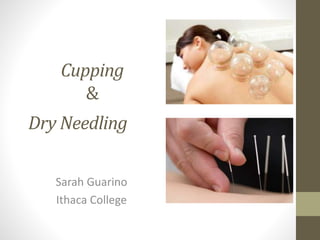
Cupping
&
Dry Needling
Sarah Guarino
Ithaca College
Cupping
What is Cupping?
"Cupping is a form of alternative medicine in which cups are
placed on the skin to create suction. The pressure in the cup
is reduced by use of heat or suctioning out the air so the skin
and superficial layers are drawn out and held in the cup.”
• Ancient Chinese practice.
• A Handbook of Prescriptions for Emergencies.
• Taoist Herbalist: Ge Hong (281-341 A.D.)
• Animal horns
• Hippocrates
• Father of modern medicine.
Benefits
• Mobilizes blood flow to promote healing.
• Promotes detoxification.
• Invigorates Qi.
• Regulates aspects of the autonomic NS.
• Deep relaxation of muscle fascia.
Indications
• Incontinence
• OA
• Nerve Pain
• Hyper/hypo tension
• LBP
• Facial Paralysis
• Sciatica
• Shingles
• GI disorders
• Asthma
• Weight loss
• Respiratory Diseases
• Pain syndromes
• Headaches
• Gynecological
Disorders
• Common Colds
• Insomnia
• Acne
Contraindications
• Skin that is inflamed
• High fever
• Convulsions
• Cramping
• Easy bleeding
• Pathological level of low platelets
• Abdominal area or low back area during pregnancy
• Should not glide over boney prominences
• Best use is over fleshy areas
Technique
Various types of Cupping involving different levels of suction, heat
and duration.
• Dry Cupping
• Wet Cupping
• Medicinal bleeding
• Needle Cupping
• Acupuncture
• Dry needling
• Gliding
• Massage cupping
*Cupping is the inverse of massage- cupping draws the skin
upwards (massage pushes the muscles downward) which causes a
relaxing and relieving sensation.
*Moxibustion therapy
• Wet cupping- Muslim world.
• Mild suction using cups, left for 3 minutes then remove
and make a small skin incision using a cupping scalpel.
• Gliding- oil used to decrease friction (sometimes medical
oils with herbs)
• Moxibustion- moxa made from dried mugwort.
• Use with acupuncture or burned on pts skin.
• Warm meridian points to promote flow of Qi.
• Pain control.
• RCT found that moxibustion alone and with acupuncture
may be effective in changing breech presentation of
babies by affecting the placental release of estrogen and
prostaglandins which leads to uterine contractions that
change the babies positioning.
Steps
1. Flammable substance is placed in a cup and set on fire.
2. As the fire burns out, the cup is places upside down on the
patients skin
3. The air inside the cup is cooling which causes the vacuuming
effect.
4. This causes the skin to rise and redden as blood vessels
expand.
5. Generally left on the skin
for 5-20 minutes.
*Plastic cups used with suction pump vs. glass cups with fire
*Plastic cups are not suitable for gliding cupping. They have
more control over the amount of suction and are easier to use.
Qi
"A circulating life force or energy whose existence and properties
are the basis of much Chinese philosophy and medicine."
• 5 Elements
• Cyclic
• Create
• Destroy
• Sickness due to imbalance
of elements
• Overproduction
• Underproduction
• Associated with symptoms or traits
• Complementary forces not opposing
• Everything is composed of both Yin & Yang (ex: shadow)
• Health and longevity
Yin & Yang
Yin
• Dark, cool, wet
• Earth to heaven
• Female
• Solid organs
• Negative force
• Outward movement
• Towards periphery
• Internal energy
Yang
• Light, warm, dry
• Heaven to Earth
• Male
• Hollow organs
• Positive force
• Inward movement
• Towards center
• Physical body
Meridians
• Yin & Yang determine
meridians
• Associated with body
parts/ organs
• Manipulating meridians
has effect on body
functions associated
with that meridian
• Qi flows through
meridians
• Used to balance the
5 elements
Case Study 1
Method:
• LBP in pregnant women
• 50 women in control (no cupping)
50 women in cupping group
• 15 to 20 min. up to 4 consecutive times
• VAS scale 0-10
Results:
• Baseline 7.8
• Immediately: 3.7
• 24 hours: 2.5
• 2 weeks: 1.4
• ANOVA: Significant difference in pain due to intervention
Case Study 2
“Medicinal cupping therapy in 30 patients with fibromyalgia: a
case series observation”
• 30 patients with Fibromyalgia at an outpatient hospital in
Beijing, China
• Patients diagnosed according to criteria set by the American
College of Rheumatology (1990)
• Bamboo cup boiled in herbal liquor for 5 minutes applied to
Ashi points (defined as a tender point) for 10 minutes 1x daily
for 15 days.
• Pain assessed on a 10 point VAS.
Time Pain (VAS) Number of Tender Points
Baseline 2.63 13.5
5 days 2.22 12.57
10 days 1.78 11.2
15 days 1.36 9.33
• 29 patients completed a 2 week follow-up:
• Reduction in pain (1.31) and in the number of tender
points (9.07) was sustained
• No serious adverse effects.
• Conclusion:
• Medicinal cupping therapy was associated with a
reduction in fibromyalgia symptoms for both pain ratings
and number of tender points.
Case Study 3
“Effects of wet-cupping on BP in hypertensive patients: a randomized
controlled trial”
• 2 clinical groups (40 subjects each)
• Intervention group: wet cupping & conventional hypertension
treatment
• 3 cupping sessions performed every other day
• Control group: conventional hypertension treatment
• Mean systolic and diastolic BP measured using a validated automatic
sphygmomanometer
• Follow up period was 8 weeks
•
•
• Results:
• Wet cupping provided an immediate reduction of systolic BP.
• 4 week follow up: mean systolic BP was 8.4 mmHg less in the
intervention group compared to control group.
• 8 week follow up: no significant differences
• No serious side effects
• Conclusion:
• Wet cupping is effective for reducing systolic BP in hypertensive
patients for up to 4 weeks with no serious side effects and should
be considered as a complementary hypertensive treatment.
•
•
Case Study 4
“Management of knee osteoarthritis with cupping therapy”
• RCT
• Cupping performed on days 0-6, 9-11 and 14
• 15 day span
• Significant and better results in the overall management of knee OA
• Pain, edema, stiffness and disability
• Comparable with acetaminophen 650 mg 3x a day orally in terms of
analgesia, anti-inflammatory and resolution of edema with minimal
and temporary side effects like ecchymosis and blister formation.
• Control drug has greater side effects on the GI tract.
Dry Needling
What is Dry Needling?
Skilled intervention used by PTs that uses a thin,
solid filiform needle (without medication) to
penetrate the skin and stimulate underlying
myofascial trigger points, muscular, and connective
tissue for the management
of neuro-musculoskeletal
pain and movement
impairments.
Dry Needling
Uses of Dry Needling
• Research Supports:
• Pain control
• Reduces muscle tension
• Normalizes biochemical and electrical
dysfunction of motor endplates
• Facilitates an accelerated return to active
rehabilitation
Goals of Dry Needling
To release/inactivate the trigger point and
relieve pain.
Diagnostic Evidence
• Latent trigger points are shown to increase EMG activity at
rest and during movement and can alter motor control.
• Trigger points are related to pain, inflammation and misfiring of
intercellular signaling.
• Needling is shown to reduce trigger point sensitivity and
spontaneous electrical activity therefore affecting the pain
threshold associated with trigger points.
• Trigger point diagnostic essential criteria:
• Taut band of muscle
• Spot tenderness of a nodule in a taut band
• Patient complaint of pain with pressure applied to the nodule.
• Identify active trigger point
• Painful limit to full stretch ROM
Types of DN
• Pistoning- rhythmic & multidirectional passes into tissue. May
see LTR; used with trigger point model.
• Local twitch response (LTR)- muscle spindle and reflex arc at
the segmental level of innervation. Needle inserted into point
of tenderness.
• Superficial- reduce or eliminate post-tx soreness.
• Trigger point- LTR; causing local or widespread myofascial pain.
Most researched model.
• Neurofunctional- leaving needles in mm, sensory or motor
effects (motor point).
• Perineurial- all needling impacts nervous system.
• Tendon or ligament- VAS improvements (achilles, shouler).
• Estim- easier twitch response elicited. Decrease soreness.
Common Impairments
• Acute/chronic
tendonitis
• Overuse injuries
• Scarring & post-
surgical pain
• Carpal tunnel
• Sciatic pain
• TMJ
• Myofascial pain
• Headaches &
whiplash
• LBP
• Motor recruitment
• Neuromuscular
firing problems
• Decrease spasm/
increase muscle
extensibility
Adverse Events
• Practiced for over 20 years by PTs.
• Most common side effects include post-needling soreness
and minor hematomas.
• FSBPT’s (Federation of state boards of PT) ELDD
(Examination, licensure and disciplinary database) has 0
entries of harm caused by DN performed by PTs.
• Europe: 2 reports of pneumothoraces, 1 autonomic
response, no other serious side effects.
• DN is under-utilized with no real danger/side effects
involved in its practice by PTs.
• *Pneumothorax: the abnormal presence of air between the lung and
the wall of the chest (pleural cavity), resulting in collapse of the lung
APTA
• Recognizes dry needling as being part of the Physical
Therapist professional scope of practice.
2012 = 27 states
• As of April 2014 states that include dry needling in PT
scope of practice include but are not limited to Alabama,
Arizona, Georgia, Kentucky, Maryland, Massachusetts,
New Hampshire, North/South Carolina, Texas, Wisconsin.
• 9 State boards (Idaho, Kansas, New York, South Dakota,
Hawaii) have stated it is not within PT scope of
practice.
• Others :“not-prohibited”, “no position”, “unresolved”
• Countries that currently practice dry needling include
Australia, Belgium, Canada, Chile, Denmark, Ireland, The
Netherlands, New Zealand, Norway, South Africa, Spain
and the United Kingdom.
Dry Needling in NJ
As of October 23, 2012:
• “The NJ State Board of Physical Therapy Examiners
statutes and regulations do not prohibit the use of
dry needling techniques or trigger point release by a
physical therapist provided the physical therapist is
trained and competent in the technique. Dry
needling is not solely under the practice of
acupuncture.”
• “The NJ Acupuncture Examining Board considers dry
needling by a NJ PT to be the unlicensed practice of
acupuncture.”
Dry Needling VS.
-Based on Western
neuroanatomy
and the scientific study of the
musculoskeletal and nervous
system.
-Not curative.
Acupuncture
-Based on ancient Chinese
medicine.
-Uses Meridians/Channels,
energetic physiology and energy
flow patterns.
-Can treat smoking termination,
fertility, depression, allergies
and other non-
musculoskeletal
conditions.
-Promotion,
maintenance and
restoration of health and
the prevention of disease.
-3 yr. graduate program.
Billing/Reimbursement
• Medicare part A:
• Dry needling not covered.
• Medicare part B:
• Medically necessary services: Services or supplies that
are needed to diagnose or treat your medical condition
and that meet accepted standards of medical practice.
• Preventive services: Health care to prevent illness (ex:
flu) or detect it at an early stage, when treatment is
most likely to work best.
Cost to PT and patient
• For patients:
• $75-$100 per initial evaluation.
• $30-$60 per average treatment.
• Based on time.
• For PTs:
• #1 Brand: Lhasa Oms Inc.
• DBC Spring Acupuncture Needles ~$35-$50.
• Box of 1000 disposable needles.
• Various length/thickness.
• Additional Features:
• Wires for E-Stim through needle ~$20/ pair.
Opportunities
• Not being taught in most entry level PT programs
with the exception of Georgia State University,
Mercer University, University of St. Augustine for
Health Sciences and the Army PT program at Baylor.
*Taught at most international universities
THERAPY CONCEPTS COURSE
• Level 1: 3 day course $950
• Theory and physiology of myofascial trigger points, history of
dry needling, anatomy review and referral patterns.
• Cervical & lumbar spine, hip, LE, shoulder and forearm.
• 20 participants/course, min. 2 years experience.
• Level 2: 3 day course $950
• Lecture, testing, demo & hands on lab sessions.
• Ant. Neck, head/face, thoracic spine, rib cage, hand, foot
and other musculature.
http://www.therapyconceptsinc.com/#!/physical-therapy-continuing-
education
GLOBAL EDUCATION FOR MANUAL THERAPISTS
• Level 1: 3 days (27.5 contact hrs.) $950
• Evaluation/ application of dry needling of
neuromyofascial trigger points for basic musculature.
• Lecture, testing, demo, hands on lab sessions.
• Level 2: 2 days $550
• Research based, specific Dx.
• Level 3: 2 days $550
http://www.gemtinfo.com.au
Various Seminars: ~55 hrs. of online/ home study + 3
day theoretical and practical examinations. ~$1295
http://dryneedlingcourse.com/schedule-and-registration
Case Study 1
“Efficacy of myofascial trigger point dry needling in the
prevention of pain after TKA.”
• Randomized, double-blind, placebo controlled.
• Population: >65 yr. old (mean age: 72)
• Acute care
• Subjects: 40 participants (29 F, 11 M)
• Involved knee: 60% R, 40% L
• 70% general anesthesia, 30% spinal anesthesia
Inclusion: dx of knee OA and scheduled for TKA, + presence of
active or latent myofascial trigger points in at least 1 of the
muscles involved in the examination protocol
Exclusion any other condition that causes myofascial or
neuropathic pain in LE. Ex: fibromyalgia.
• Treatment Group 1: After anesthesia and before
surgery. Myofascial trigger points located in TFL,
hip add., H/S, quads, gastrocnemius, popliteal.
• Both active and latent trigger points marked.
• 20 insertions in each trigger point with
consistent patient/ joint positions.
• Patients were unable to see their LE during
treatment.
• Treatment Group 2: Sham, no treatment given for
myofascial trigger points.
• Purpose: Is dry needling of myofascial trigger point
effective in the prevention of pain post-TKA?
• Conclusion: Group 1 experienced reduced pain in
1st month post-op compared to group 2, when pain
is typically at its highest.
• Group 1 reached the same degree of pain
reduction in month 1 as group 2 reached by
month 6.
• Significantly reduced need for post-op analgesia
for group 1.
• No difference in WOMAC, knee ROM or knee
strength at any time post-op.
Case Study 2
“Management of shoulder injuries using dry needling in elite
volleyball players.”
• Case report/ case study
• Population: 18-64 yr. old (mean age: 25, SD 2)
• Outpatient care
• 4 women on Great Britain national volleyball squad with
complaints of anterior/anterolateral shoulder pain
• Subjects: 4- all female
• Right arm dominant
• Pain in shoulder ranging from 4/10 to 8/10 prior to
treatment, shoulder ROM limited in all cases in ABD and IR
due to pain.
• Treatment Group 1: Dry needling to myofascial
trigger points, STM to shoulder, Cryo post-
training, exercises and stretching as needed.
• 1 session of dry needling, 5-12 needles used and left
inserted for 10 minutes.
• Purpose: To describe the ST benefits of dry
needling on shoulder problems in 4 elite
athletes, with replicable measures of functional
pain scores on court and objective
measurements of AROM.
Results:
• Pain decreased to 3/10 or less
-3 with outcome, 1 without
• Full pain-free ROM post-treatment into shoulder ABD
-3 with outcome, 1 without
• Full pain-free ROM post-treatment into shoulder IR
@ 90 ABD
-2 with outcome, 2 without
• Conclusion: Supports use of trigger point dry
needling in elite female athletes with ST pain relief
and improved AROM in the management of acute
shoulder injuries, during an intense competitive
period.
Considerations
• There is no way to blind subjects or therapists.
• How long do benefits last?
• How many treatment sessions per muscle?
• Patient reported outcome measurements.
• Diagnostic imaging is gold standard.
• Minimal adverse events reported.
• Are eastern medicinal techniques under utilized?
• Insurance coverage.
• Skepticism
• Meridian lines
• Qi
• Balance of 5 elements

cupping & dry needling

  • 1.
  • 2.
  • 3.
    What is Cupping? "Cuppingis a form of alternative medicine in which cups are placed on the skin to create suction. The pressure in the cup is reduced by use of heat or suctioning out the air so the skin and superficial layers are drawn out and held in the cup.” • Ancient Chinese practice. • A Handbook of Prescriptions for Emergencies. • Taoist Herbalist: Ge Hong (281-341 A.D.) • Animal horns • Hippocrates • Father of modern medicine.
  • 4.
    Benefits • Mobilizes bloodflow to promote healing. • Promotes detoxification. • Invigorates Qi. • Regulates aspects of the autonomic NS. • Deep relaxation of muscle fascia.
  • 5.
    Indications • Incontinence • OA •Nerve Pain • Hyper/hypo tension • LBP • Facial Paralysis • Sciatica • Shingles • GI disorders • Asthma • Weight loss • Respiratory Diseases • Pain syndromes • Headaches • Gynecological Disorders • Common Colds • Insomnia • Acne
  • 6.
    Contraindications • Skin thatis inflamed • High fever • Convulsions • Cramping • Easy bleeding • Pathological level of low platelets • Abdominal area or low back area during pregnancy • Should not glide over boney prominences • Best use is over fleshy areas
  • 7.
    Technique Various types ofCupping involving different levels of suction, heat and duration. • Dry Cupping • Wet Cupping • Medicinal bleeding • Needle Cupping • Acupuncture • Dry needling • Gliding • Massage cupping *Cupping is the inverse of massage- cupping draws the skin upwards (massage pushes the muscles downward) which causes a relaxing and relieving sensation. *Moxibustion therapy
  • 8.
    • Wet cupping-Muslim world. • Mild suction using cups, left for 3 minutes then remove and make a small skin incision using a cupping scalpel. • Gliding- oil used to decrease friction (sometimes medical oils with herbs) • Moxibustion- moxa made from dried mugwort. • Use with acupuncture or burned on pts skin. • Warm meridian points to promote flow of Qi. • Pain control. • RCT found that moxibustion alone and with acupuncture may be effective in changing breech presentation of babies by affecting the placental release of estrogen and prostaglandins which leads to uterine contractions that change the babies positioning.
  • 9.
    Steps 1. Flammable substanceis placed in a cup and set on fire. 2. As the fire burns out, the cup is places upside down on the patients skin 3. The air inside the cup is cooling which causes the vacuuming effect. 4. This causes the skin to rise and redden as blood vessels expand. 5. Generally left on the skin for 5-20 minutes. *Plastic cups used with suction pump vs. glass cups with fire *Plastic cups are not suitable for gliding cupping. They have more control over the amount of suction and are easier to use.
  • 10.
    Qi "A circulating lifeforce or energy whose existence and properties are the basis of much Chinese philosophy and medicine." • 5 Elements • Cyclic • Create • Destroy • Sickness due to imbalance of elements • Overproduction • Underproduction • Associated with symptoms or traits • Complementary forces not opposing • Everything is composed of both Yin & Yang (ex: shadow) • Health and longevity
  • 11.
    Yin & Yang Yin •Dark, cool, wet • Earth to heaven • Female • Solid organs • Negative force • Outward movement • Towards periphery • Internal energy Yang • Light, warm, dry • Heaven to Earth • Male • Hollow organs • Positive force • Inward movement • Towards center • Physical body
  • 12.
    Meridians • Yin &Yang determine meridians • Associated with body parts/ organs • Manipulating meridians has effect on body functions associated with that meridian • Qi flows through meridians • Used to balance the 5 elements
  • 13.
    Case Study 1 Method: •LBP in pregnant women • 50 women in control (no cupping) 50 women in cupping group • 15 to 20 min. up to 4 consecutive times • VAS scale 0-10 Results: • Baseline 7.8 • Immediately: 3.7 • 24 hours: 2.5 • 2 weeks: 1.4 • ANOVA: Significant difference in pain due to intervention
  • 14.
    Case Study 2 “Medicinalcupping therapy in 30 patients with fibromyalgia: a case series observation” • 30 patients with Fibromyalgia at an outpatient hospital in Beijing, China • Patients diagnosed according to criteria set by the American College of Rheumatology (1990) • Bamboo cup boiled in herbal liquor for 5 minutes applied to Ashi points (defined as a tender point) for 10 minutes 1x daily for 15 days. • Pain assessed on a 10 point VAS.
  • 15.
    Time Pain (VAS)Number of Tender Points Baseline 2.63 13.5 5 days 2.22 12.57 10 days 1.78 11.2 15 days 1.36 9.33 • 29 patients completed a 2 week follow-up: • Reduction in pain (1.31) and in the number of tender points (9.07) was sustained • No serious adverse effects. • Conclusion: • Medicinal cupping therapy was associated with a reduction in fibromyalgia symptoms for both pain ratings and number of tender points.
  • 16.
    Case Study 3 “Effectsof wet-cupping on BP in hypertensive patients: a randomized controlled trial” • 2 clinical groups (40 subjects each) • Intervention group: wet cupping & conventional hypertension treatment • 3 cupping sessions performed every other day • Control group: conventional hypertension treatment • Mean systolic and diastolic BP measured using a validated automatic sphygmomanometer • Follow up period was 8 weeks • •
  • 17.
    • Results: • Wetcupping provided an immediate reduction of systolic BP. • 4 week follow up: mean systolic BP was 8.4 mmHg less in the intervention group compared to control group. • 8 week follow up: no significant differences • No serious side effects • Conclusion: • Wet cupping is effective for reducing systolic BP in hypertensive patients for up to 4 weeks with no serious side effects and should be considered as a complementary hypertensive treatment. • •
  • 18.
    Case Study 4 “Managementof knee osteoarthritis with cupping therapy” • RCT • Cupping performed on days 0-6, 9-11 and 14 • 15 day span • Significant and better results in the overall management of knee OA • Pain, edema, stiffness and disability • Comparable with acetaminophen 650 mg 3x a day orally in terms of analgesia, anti-inflammatory and resolution of edema with minimal and temporary side effects like ecchymosis and blister formation. • Control drug has greater side effects on the GI tract.
  • 19.
  • 20.
    What is DryNeedling? Skilled intervention used by PTs that uses a thin, solid filiform needle (without medication) to penetrate the skin and stimulate underlying myofascial trigger points, muscular, and connective tissue for the management of neuro-musculoskeletal pain and movement impairments.
  • 21.
  • 22.
    Uses of DryNeedling • Research Supports: • Pain control • Reduces muscle tension • Normalizes biochemical and electrical dysfunction of motor endplates • Facilitates an accelerated return to active rehabilitation Goals of Dry Needling To release/inactivate the trigger point and relieve pain.
  • 23.
    Diagnostic Evidence • Latenttrigger points are shown to increase EMG activity at rest and during movement and can alter motor control. • Trigger points are related to pain, inflammation and misfiring of intercellular signaling. • Needling is shown to reduce trigger point sensitivity and spontaneous electrical activity therefore affecting the pain threshold associated with trigger points. • Trigger point diagnostic essential criteria: • Taut band of muscle • Spot tenderness of a nodule in a taut band • Patient complaint of pain with pressure applied to the nodule. • Identify active trigger point • Painful limit to full stretch ROM
  • 24.
    Types of DN •Pistoning- rhythmic & multidirectional passes into tissue. May see LTR; used with trigger point model. • Local twitch response (LTR)- muscle spindle and reflex arc at the segmental level of innervation. Needle inserted into point of tenderness. • Superficial- reduce or eliminate post-tx soreness. • Trigger point- LTR; causing local or widespread myofascial pain. Most researched model. • Neurofunctional- leaving needles in mm, sensory or motor effects (motor point). • Perineurial- all needling impacts nervous system. • Tendon or ligament- VAS improvements (achilles, shouler). • Estim- easier twitch response elicited. Decrease soreness.
  • 25.
    Common Impairments • Acute/chronic tendonitis •Overuse injuries • Scarring & post- surgical pain • Carpal tunnel • Sciatic pain • TMJ • Myofascial pain • Headaches & whiplash • LBP • Motor recruitment • Neuromuscular firing problems • Decrease spasm/ increase muscle extensibility
  • 26.
    Adverse Events • Practicedfor over 20 years by PTs. • Most common side effects include post-needling soreness and minor hematomas. • FSBPT’s (Federation of state boards of PT) ELDD (Examination, licensure and disciplinary database) has 0 entries of harm caused by DN performed by PTs. • Europe: 2 reports of pneumothoraces, 1 autonomic response, no other serious side effects. • DN is under-utilized with no real danger/side effects involved in its practice by PTs. • *Pneumothorax: the abnormal presence of air between the lung and the wall of the chest (pleural cavity), resulting in collapse of the lung
  • 27.
    APTA • Recognizes dryneedling as being part of the Physical Therapist professional scope of practice. 2012 = 27 states
  • 28.
    • As ofApril 2014 states that include dry needling in PT scope of practice include but are not limited to Alabama, Arizona, Georgia, Kentucky, Maryland, Massachusetts, New Hampshire, North/South Carolina, Texas, Wisconsin. • 9 State boards (Idaho, Kansas, New York, South Dakota, Hawaii) have stated it is not within PT scope of practice. • Others :“not-prohibited”, “no position”, “unresolved” • Countries that currently practice dry needling include Australia, Belgium, Canada, Chile, Denmark, Ireland, The Netherlands, New Zealand, Norway, South Africa, Spain and the United Kingdom.
  • 29.
    Dry Needling inNJ As of October 23, 2012: • “The NJ State Board of Physical Therapy Examiners statutes and regulations do not prohibit the use of dry needling techniques or trigger point release by a physical therapist provided the physical therapist is trained and competent in the technique. Dry needling is not solely under the practice of acupuncture.” • “The NJ Acupuncture Examining Board considers dry needling by a NJ PT to be the unlicensed practice of acupuncture.”
  • 30.
    Dry Needling VS. -Basedon Western neuroanatomy and the scientific study of the musculoskeletal and nervous system. -Not curative. Acupuncture -Based on ancient Chinese medicine. -Uses Meridians/Channels, energetic physiology and energy flow patterns. -Can treat smoking termination, fertility, depression, allergies and other non- musculoskeletal conditions. -Promotion, maintenance and restoration of health and the prevention of disease. -3 yr. graduate program.
  • 31.
    Billing/Reimbursement • Medicare partA: • Dry needling not covered. • Medicare part B: • Medically necessary services: Services or supplies that are needed to diagnose or treat your medical condition and that meet accepted standards of medical practice. • Preventive services: Health care to prevent illness (ex: flu) or detect it at an early stage, when treatment is most likely to work best.
  • 32.
    Cost to PTand patient • For patients: • $75-$100 per initial evaluation. • $30-$60 per average treatment. • Based on time. • For PTs: • #1 Brand: Lhasa Oms Inc. • DBC Spring Acupuncture Needles ~$35-$50. • Box of 1000 disposable needles. • Various length/thickness. • Additional Features: • Wires for E-Stim through needle ~$20/ pair.
  • 33.
    Opportunities • Not beingtaught in most entry level PT programs with the exception of Georgia State University, Mercer University, University of St. Augustine for Health Sciences and the Army PT program at Baylor. *Taught at most international universities
  • 34.
    THERAPY CONCEPTS COURSE •Level 1: 3 day course $950 • Theory and physiology of myofascial trigger points, history of dry needling, anatomy review and referral patterns. • Cervical & lumbar spine, hip, LE, shoulder and forearm. • 20 participants/course, min. 2 years experience. • Level 2: 3 day course $950 • Lecture, testing, demo & hands on lab sessions. • Ant. Neck, head/face, thoracic spine, rib cage, hand, foot and other musculature. http://www.therapyconceptsinc.com/#!/physical-therapy-continuing- education
  • 35.
    GLOBAL EDUCATION FORMANUAL THERAPISTS • Level 1: 3 days (27.5 contact hrs.) $950 • Evaluation/ application of dry needling of neuromyofascial trigger points for basic musculature. • Lecture, testing, demo, hands on lab sessions. • Level 2: 2 days $550 • Research based, specific Dx. • Level 3: 2 days $550 http://www.gemtinfo.com.au Various Seminars: ~55 hrs. of online/ home study + 3 day theoretical and practical examinations. ~$1295 http://dryneedlingcourse.com/schedule-and-registration
  • 36.
    Case Study 1 “Efficacyof myofascial trigger point dry needling in the prevention of pain after TKA.” • Randomized, double-blind, placebo controlled. • Population: >65 yr. old (mean age: 72) • Acute care • Subjects: 40 participants (29 F, 11 M) • Involved knee: 60% R, 40% L • 70% general anesthesia, 30% spinal anesthesia Inclusion: dx of knee OA and scheduled for TKA, + presence of active or latent myofascial trigger points in at least 1 of the muscles involved in the examination protocol Exclusion any other condition that causes myofascial or neuropathic pain in LE. Ex: fibromyalgia.
  • 37.
    • Treatment Group1: After anesthesia and before surgery. Myofascial trigger points located in TFL, hip add., H/S, quads, gastrocnemius, popliteal. • Both active and latent trigger points marked. • 20 insertions in each trigger point with consistent patient/ joint positions. • Patients were unable to see their LE during treatment. • Treatment Group 2: Sham, no treatment given for myofascial trigger points.
  • 38.
    • Purpose: Isdry needling of myofascial trigger point effective in the prevention of pain post-TKA? • Conclusion: Group 1 experienced reduced pain in 1st month post-op compared to group 2, when pain is typically at its highest. • Group 1 reached the same degree of pain reduction in month 1 as group 2 reached by month 6. • Significantly reduced need for post-op analgesia for group 1. • No difference in WOMAC, knee ROM or knee strength at any time post-op.
  • 39.
    Case Study 2 “Managementof shoulder injuries using dry needling in elite volleyball players.” • Case report/ case study • Population: 18-64 yr. old (mean age: 25, SD 2) • Outpatient care • 4 women on Great Britain national volleyball squad with complaints of anterior/anterolateral shoulder pain • Subjects: 4- all female • Right arm dominant • Pain in shoulder ranging from 4/10 to 8/10 prior to treatment, shoulder ROM limited in all cases in ABD and IR due to pain.
  • 40.
    • Treatment Group1: Dry needling to myofascial trigger points, STM to shoulder, Cryo post- training, exercises and stretching as needed. • 1 session of dry needling, 5-12 needles used and left inserted for 10 minutes. • Purpose: To describe the ST benefits of dry needling on shoulder problems in 4 elite athletes, with replicable measures of functional pain scores on court and objective measurements of AROM.
  • 41.
    Results: • Pain decreasedto 3/10 or less -3 with outcome, 1 without • Full pain-free ROM post-treatment into shoulder ABD -3 with outcome, 1 without • Full pain-free ROM post-treatment into shoulder IR @ 90 ABD -2 with outcome, 2 without • Conclusion: Supports use of trigger point dry needling in elite female athletes with ST pain relief and improved AROM in the management of acute shoulder injuries, during an intense competitive period.
  • 42.
    Considerations • There isno way to blind subjects or therapists. • How long do benefits last? • How many treatment sessions per muscle? • Patient reported outcome measurements. • Diagnostic imaging is gold standard. • Minimal adverse events reported. • Are eastern medicinal techniques under utilized? • Insurance coverage. • Skepticism • Meridian lines • Qi • Balance of 5 elements

Editor's Notes

  • #30 Not prohibited but not written into the scope of practice- still up for debate
  • #31 Dry needling is 1 technique utilized by PTs -already have anatomy and knowledge of massage techniques and utilize same basic principle with elbow and hand Acupuncture is an entire discipline
  • #32 Medicare Part A and Part B does not cover: Long term care Cosmetic surgery Acupuncture Dental Hearing aids Eye examination Podiatrist
  • #33 Estim- additional pain control, similar to DTM followed by estim