INTENDED LEARNING OUTCOME:
* DESIGN A PLAN IN ASSISTING TEACHERS IN THE INTEGRATION OF TECH NOLOGY IN
INSTRUCTION
Bataan Peninsula State University
College of Education
Learning Action Cell
Integrating Technology
Prof. Yolanda D. Reyes
TEACHERS AND STUDENTS IN THE DIGITAL AGE
Bataan Peninsula State University
College of Education
Learning Action Cell
Integrating Technology
Prof. Yolanda D. Reyes
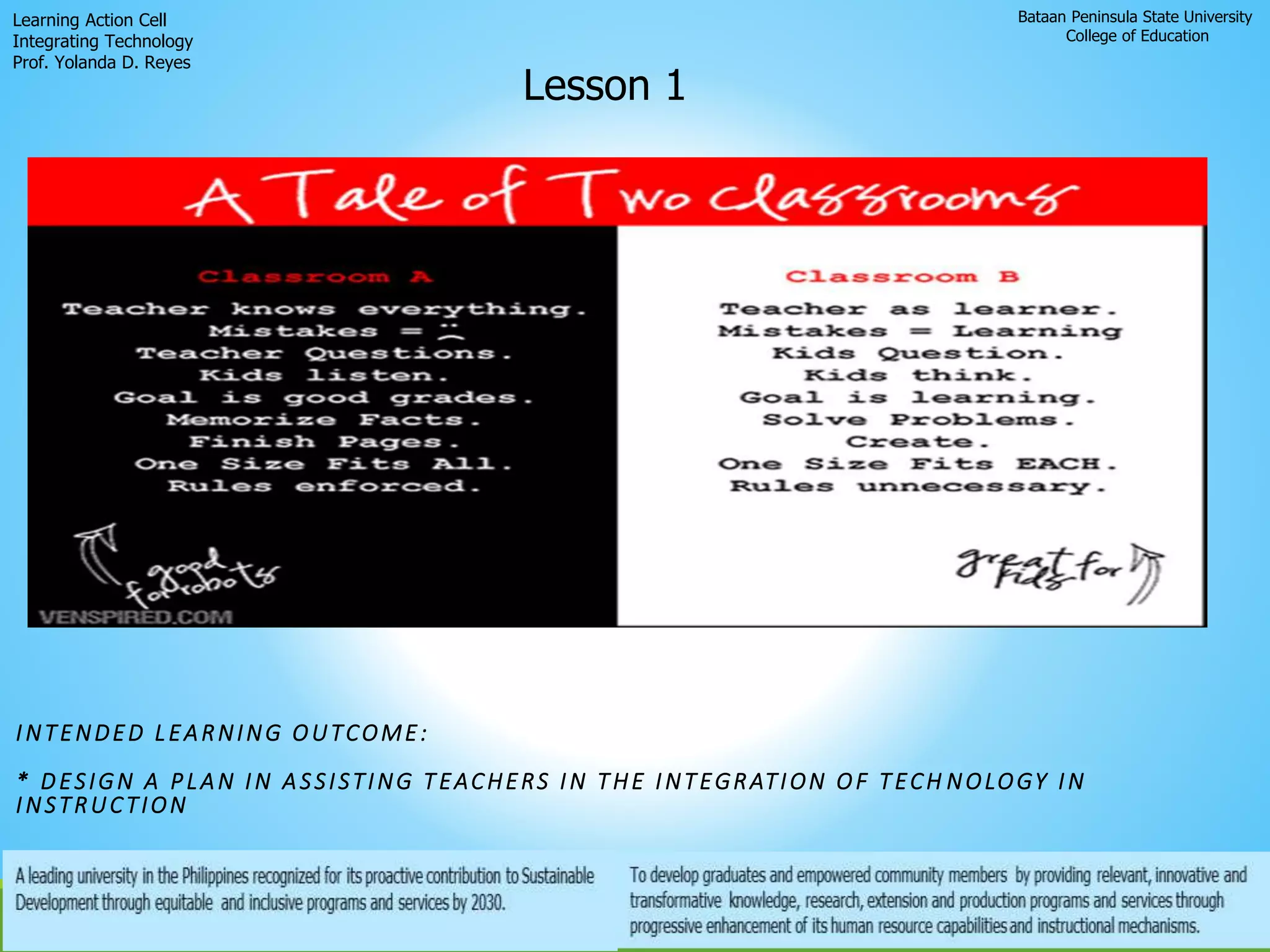
Lesson 1
INTENDED LEARNING OUTCOME:
* DESIGN A PLAN IN ASSISTING TEACHERS IN THE INTEGRATION OF TECH NOLOGY IN
INSTRUCTION
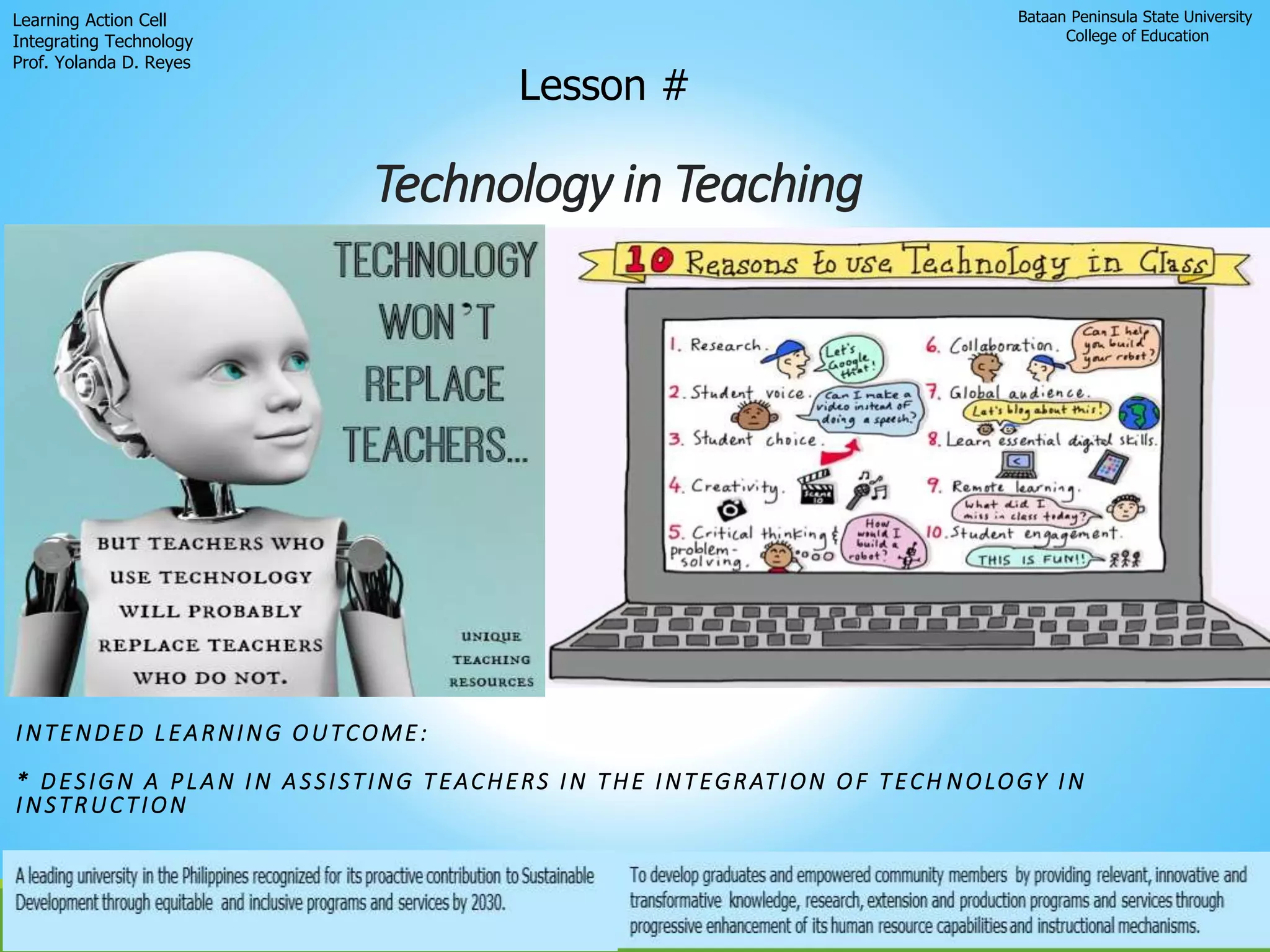
Technology in Teaching
Bataan Peninsula State University
College of Education
Learning Action Cell
Integrating Technology
Prof. Yolanda D. Reyes
Lesson #
INTENDED LEARNING OUTCOME:
* DESIGN A PLAN IN ASSISTING TEACHERS IN THE INTEGRATION OF TECH NOLOGY IN
INSTRUCTION
Technology in Teaching
Bataan Peninsula State University
College of Education
Learning Action Cell
Integrating Technology
Prof. Yolanda D. Reyes
Lesson #
INTENDED LEARNING OUTCOME:
* DESIGN A PLAN IN ASSISTING TEACHERS IN THE INTEGRATION OF TECH NOLOGY IN
INSTRUCTION
ISTE – International Society for Technology in Education
Bataan Peninsula State University
College of Education
Learning Action Cell
Integrating Technology
Prof. Yolanda D. Reyes
Lesson #
INTENDED LEARNING OUTCOME:
* DESIGN A PLAN IN ASSISTING TEACHERS IN THE INTEGRATION OF TECH NOLOGY IN
INSTRUCTION
Bataan Peninsula State University
College of Education
Learning Action Cell
Integrating Technology
Prof. Yolanda D. Reyes
INTENDED LEARNING OUTCOME:
* DESIGN A PLAN IN ASSISTING TEACHERS IN THE INTEGRATION OF TECH NOLOGY IN
INSTRUCTION
Bataan Peninsula State University
College of Education
Learning Action Cell
Integrating Technology
Prof. Yolanda D. Reyes
TPACK Model
INTENDED LEARNING OUTCOME:
* DESIGN A PLAN IN ASSISTING TEACHERS IN THE INTEGRATION OF TECH NOLOGY IN
INSTRUCTION
Bataan Peninsula State University
College of Education
Learning Action Cell
Integrating Technology
Prof. Yolanda D. Reyes
TPACK
framework
emphasizes the
connections,
interactions,
affordances, and
constraints
between and
among content,
pedagogy
technology
INTENDED LEARNING OUTCOME:
* DESIGN A PLAN IN ASSISTING TEACHERS IN THE INTEGRATION OF TECH NOLOGY IN
INSTRUCTION
Bataan Peninsula State University
College of Education
Learning Action Cell
Integrating Technology
Prof. Yolanda D. Reyes
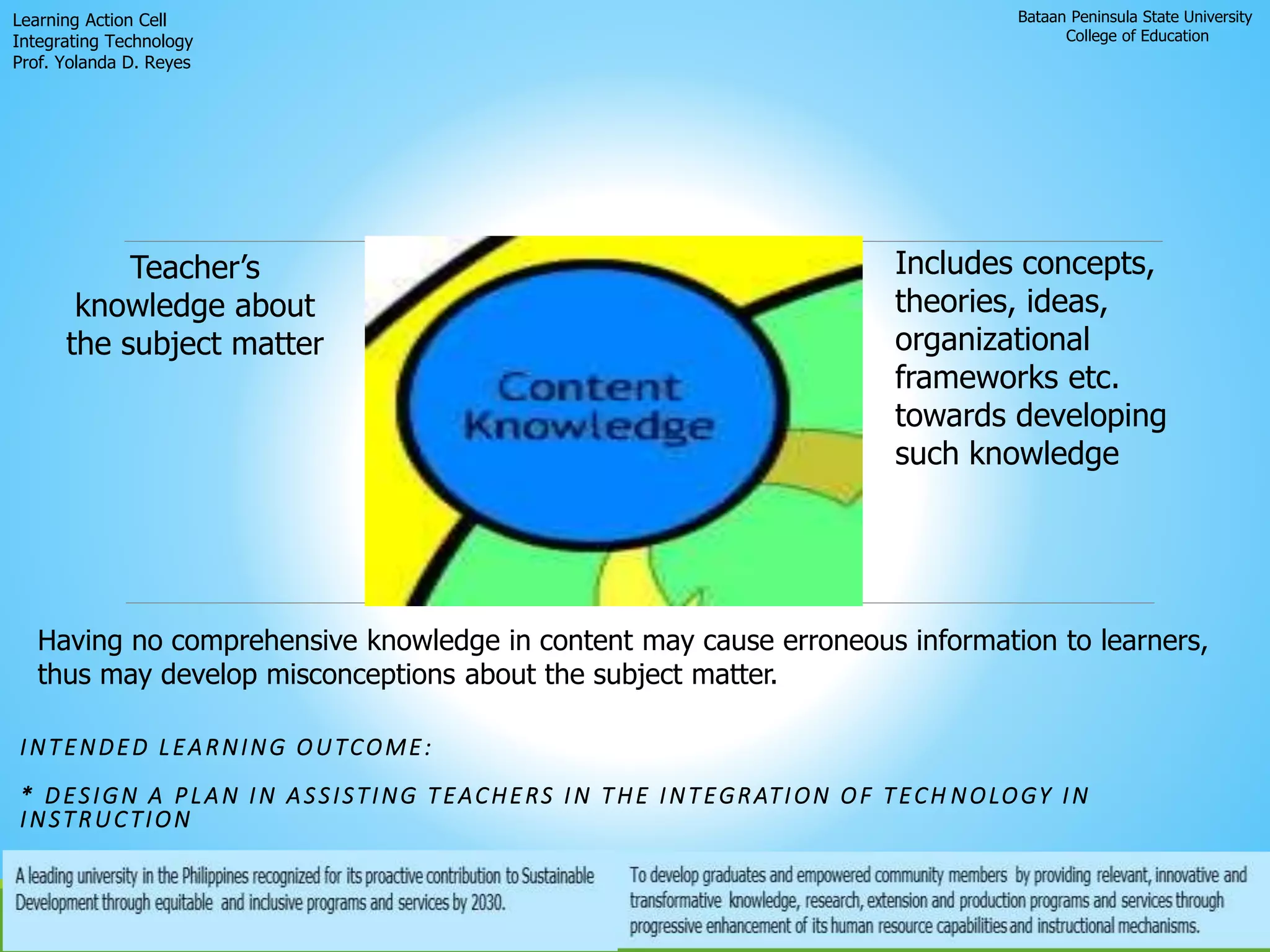
Teacher’s
knowledge about
the subject matter
INTENDED LEARNING OUTCOME:
* DESIGN A PLAN IN ASSISTING TEACHERS IN THE INTEGRATION OF TECH NOLOGY IN
INSTRUCTION
Includes concepts,
theories, ideas,
organizational
frameworks etc.
towards developing
such knowledge
Having no comprehensive knowledge in content may cause erroneous information to learners,
thus may develop misconceptions about the subject matter.
Bataan Peninsula State University
College of Education
Learning Action Cell
Integrating Technology
Prof. Yolanda D. Reyes
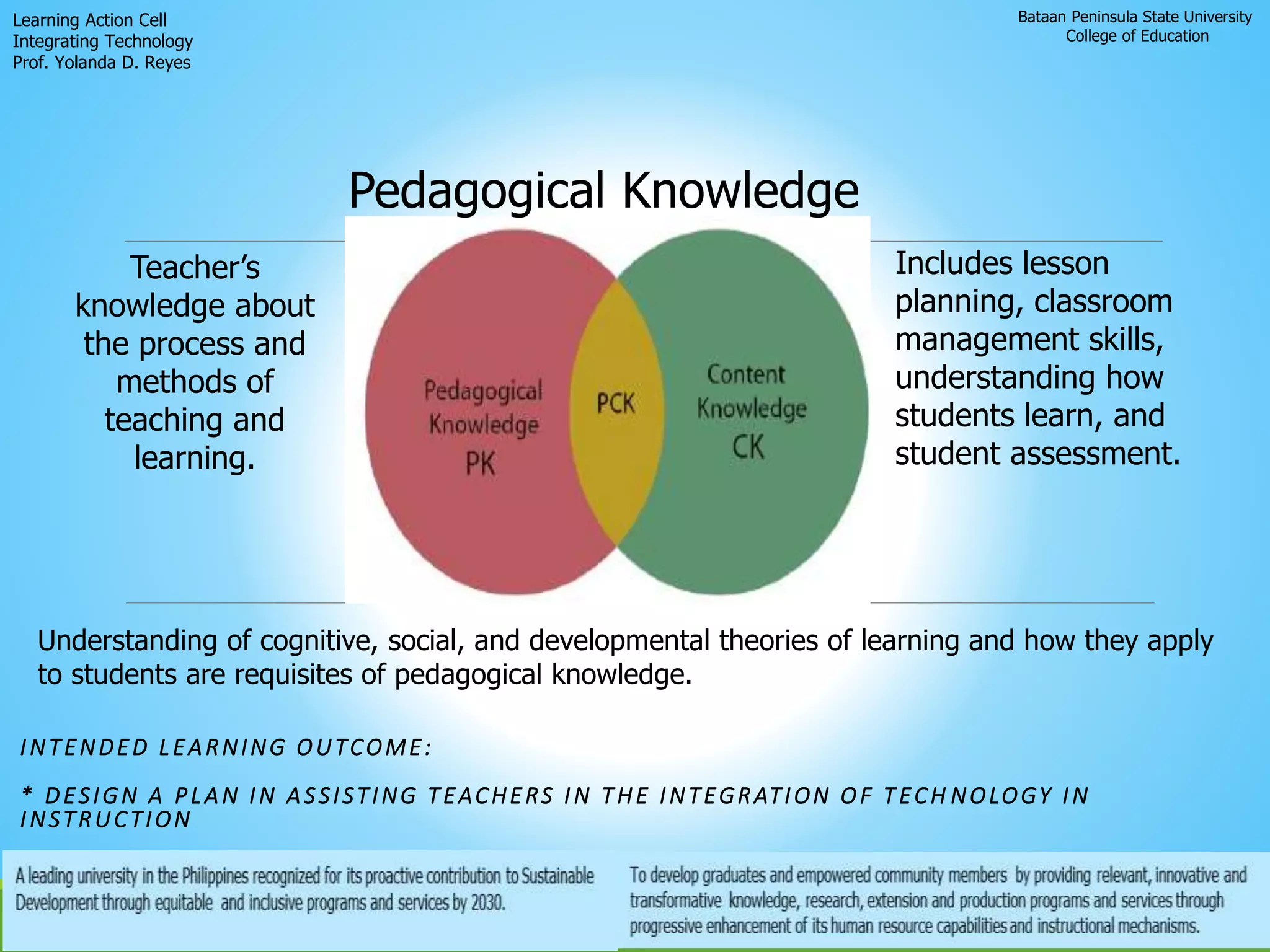
Teacher’s
knowledge about
the process and
methods of
teaching and
learning.
INTENDED LEARNING OUTCOME:
* DESIGN A PLAN IN ASSISTING TEACHERS IN THE INTEGRATION OF TECH NOLOGY IN
INSTRUCTION
Includes lesson
planning, classroom
management skills,
understanding how
students learn, and
student assessment.
Understanding of cognitive, social, and developmental theories of learning and how they apply
to students are requisites of pedagogical knowledge.
Pedagogical Knowledge
Bataan Peninsula State University
College of Education
Learning Action Cell
Integrating Technology
Prof. Yolanda D. Reyes
Covers conditions that
promote learning:
teaching, learning ,
curriculum,
assessment,
reporting, and
pedagogy.
INTENDED LEARNING OUTCOME:
* DESIGN A PLAN IN ASSISTING TEACHERS IN THE INTEGRATION OF TECH NOLOGY IN
INSTRUCTION
There is transformation
of the subject matter
for teaching which
happens when teacher
interprets the subject
matter.
Pedagogical Content Knowledge
Bataan Peninsula State University
College of Education
Learning Action Cell
Integrating Technology
Prof. Yolanda D. Reyes
INTENDED LEARNING OUTCOME:
* DESIGN A PLAN IN ASSISTING TEACHERS IN THE INTEGRATION OF TECH NOLOGY IN
INSTRUCTION
Technology applies to all technological tools and resources.
Technology Knowledge
Bataan Peninsula State University
College of Education
Learning Action Cell
Integrating Technology
Prof. Yolanda D. Reyes
INTENDED LEARNING OUTCOME:
* DESIGN A PLAN IN ASSISTING TEACHERS IN THE INTEGRATION OF TECH NOLOGY IN
INSTRUCTION
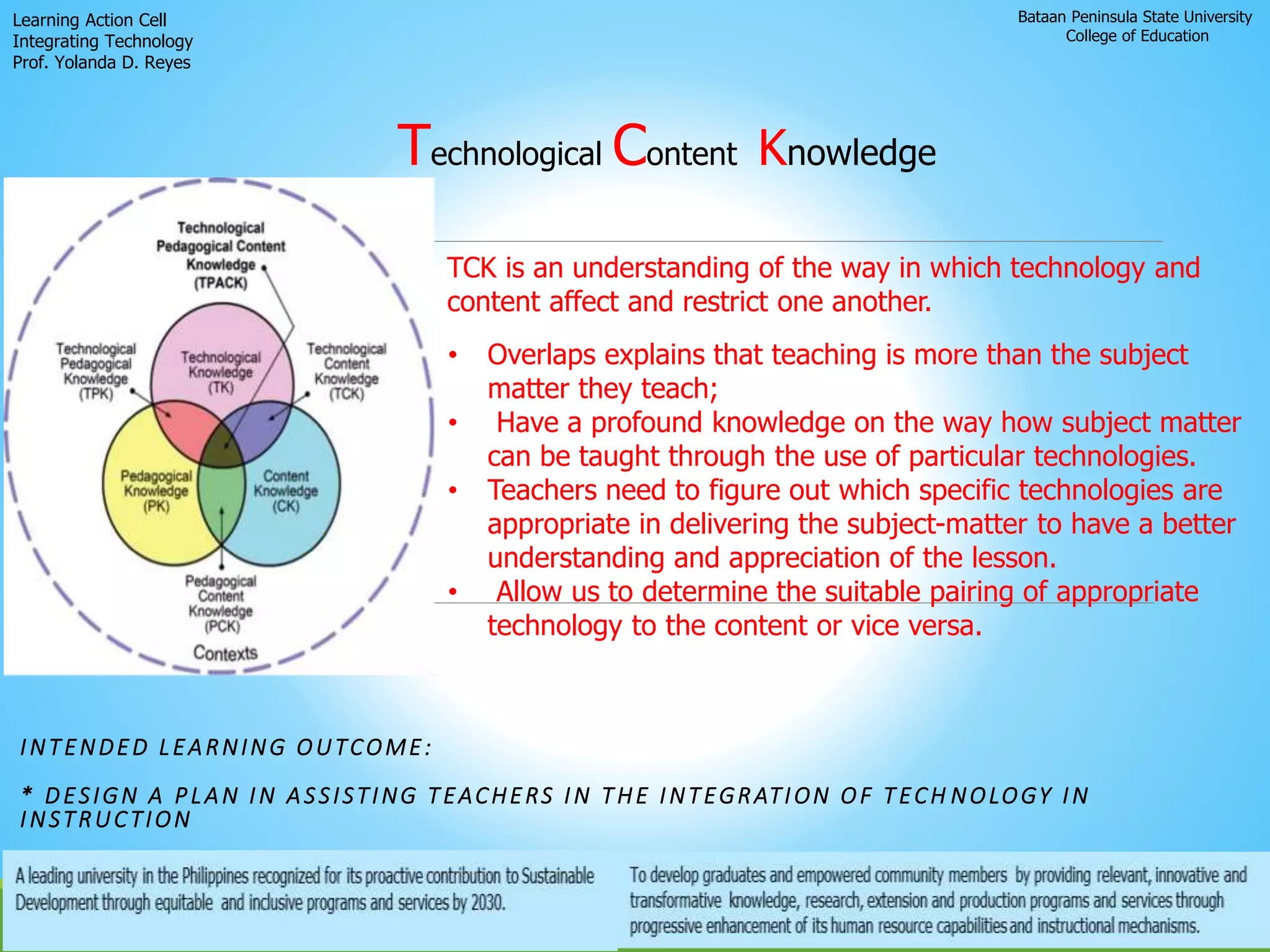
TCK is an understanding of the way in which technology and
content affect and restrict one another.
Technological Content Knowledge
• Overlaps explains that teaching is more than the subject
matter they teach;
• Have a profound knowledge on the way how subject matter
can be taught through the use of particular technologies.
• Teachers need to figure out which specific technologies are
appropriate in delivering the subject-matter to have a better
understanding and appreciation of the lesson.
• Allow us to determine the suitable pairing of appropriate
technology to the content or vice versa.
Bataan Peninsula State University
College of Education
Learning Action Cell
Integrating Technology
Prof. Yolanda D. Reyes
INTENDED LEARNING OUTCOME:
* DESIGN A PLAN IN ASSISTING TEACHERS IN THE INTEGRATION OF TECH NOLOGY IN
INSTRUCTION
TPK is an understanding of how teaching and learning
can change when particular technologies are used in
particular methods.
Technological Pedagogical Knowledge
Focus: to have an understanding of the affordances of
technology and how they can influence differently the
context and intentions of teaching.
Teachers have to be creative and think of other possible
things that these technologies can do to achieve
advancement in the learning and understanding of the
students.
Bataan Peninsula State University
College of Education
Learning Action Cell
Integrating Technology
Prof. Yolanda D. Reyes
INTENDED LEARNING OUTCOME:
* DESIGN A PLAN IN ASSISTING TEACHERS IN THE INTEGRATION OF TECH NOLOGY IN
INSTRUCTION
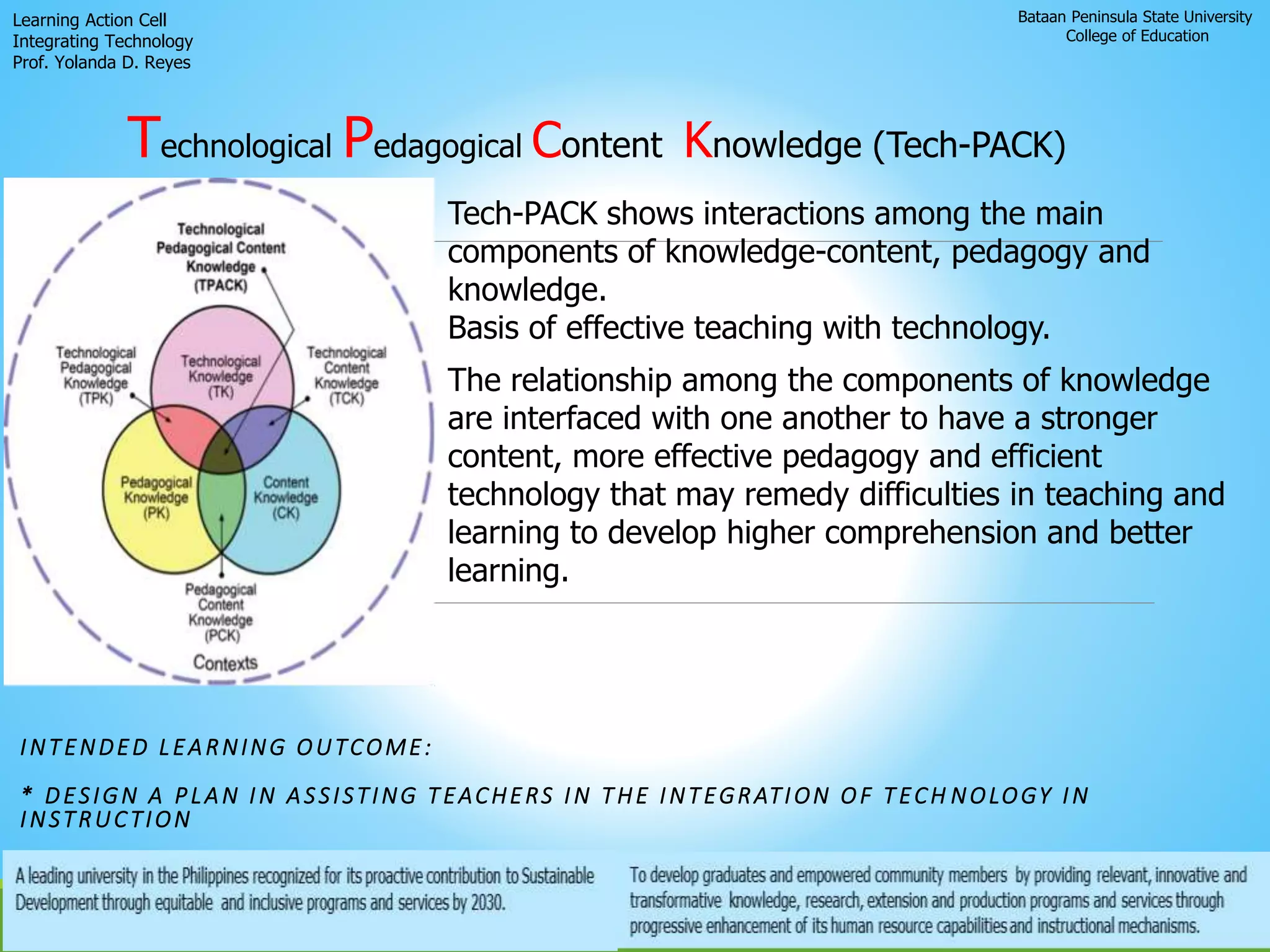
Tech-PACK shows interactions among the main
components of knowledge-content, pedagogy and
knowledge.
Basis of effective teaching with technology.
Technological Pedagogical Content Knowledge (Tech-PACK)
The relationship among the components of knowledge
are interfaced with one another to have a stronger
content, more effective pedagogy and efficient
technology that may remedy difficulties in teaching and
learning to develop higher comprehension and better
learning.
Bataan Peninsula State University
College of Education
Learning Action Cell
Integrating Technology
Prof. Yolanda D. Reyes
INTENDED LEARNING OUTCOME:
* DESIGN A PLAN IN ASSISTING TEACHERS IN THE INTEGRATION OF TECH NOLOGY IN
INSTRUCTION
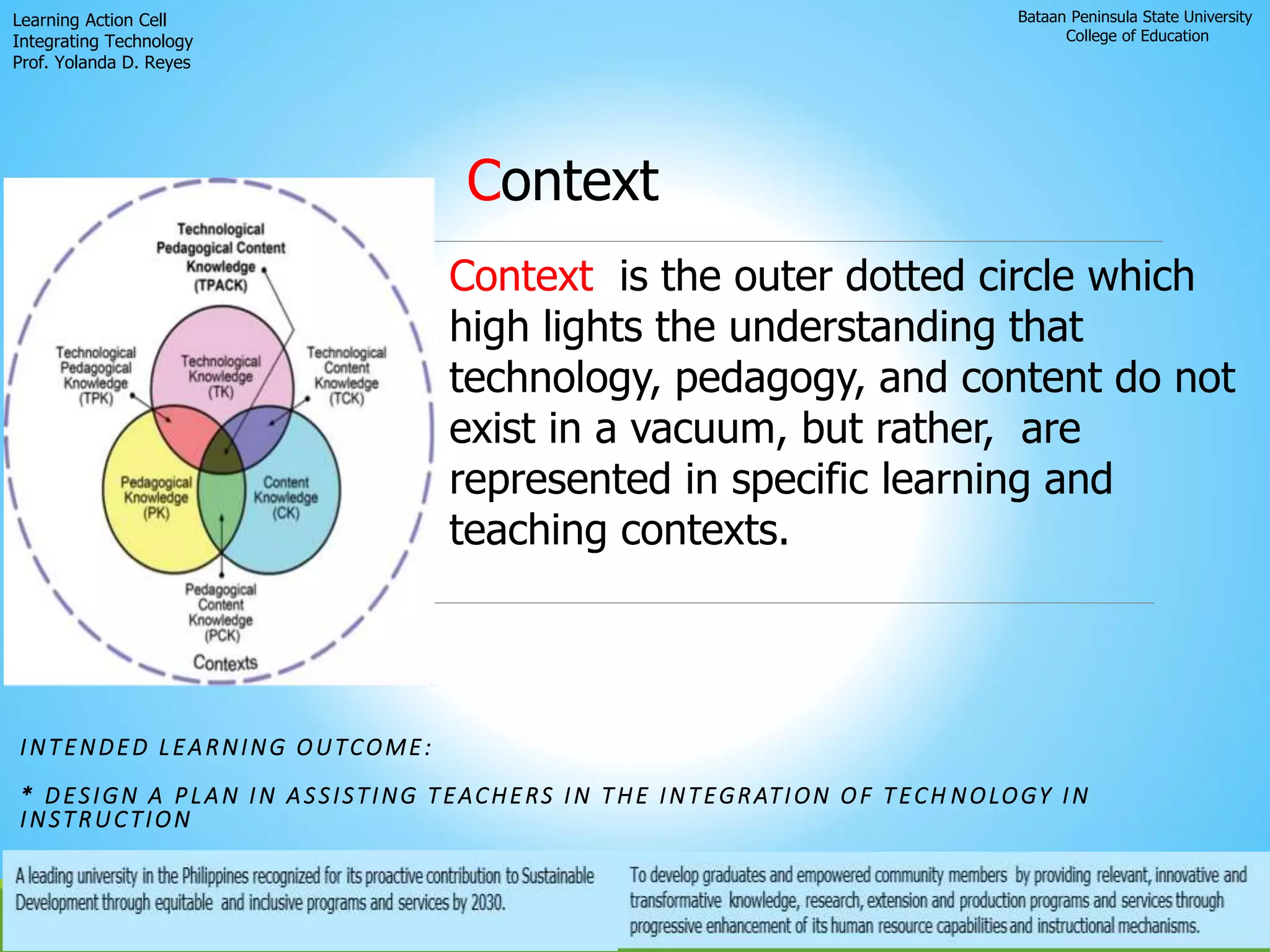
Context
Context is the outer dotted circle which
high lights the understanding that
technology, pedagogy, and content do not
exist in a vacuum, but rather, are
represented in specific learning and
teaching contexts.
Bataan Peninsula State University
College of Education
Learning Action Cell
Integrating Technology
Prof. Yolanda D. Reyes
INTENDED LEARNING OUTCOME:
* DESIGN A PLAN IN ASSISTING TEACHERS IN THE INTEGRATION OF TECH NOLOGY IN
INSTRUCTION
Technology Integration Planning
Technologies do not create
improvements, it's how the
teacher utilizes technology
that is most crucial.
Bad Example: Students watch a lengthy
video with no worksheet. There are no
pauses; the video itself is the focus of
the lesson.
Good Example: The teacher provides
worksheets containing tips of what to
watch for during the video. The teacher
pauses frequently at important spots to
interact with students about content.
The focus of the lesson is content and
the video is a subtle tool.
Bataan Peninsula State University
College of Education
Learning Action Cell
Integrating Technology
Prof. Yolanda D. Reyes
INTENDED LEARNING OUTCOME:
* DESIGN A PLAN IN ASSISTING TEACHERS IN THE INTEGRATION OF TECH NOLOGY IN
INSTRUCTION
Technology Integration Planning
Bad Example: Students search Google and
Wikipedia, cut and paste without
documenting sources, and then drop bullets
into a PowerPoint presentation.
Good Example: Students use a variety of
sources chosen by the class as a whole, and
assessed for content and relevance to the
subject. The PowerPoint contains not just
bullets, but also photos and written content
that are relevant and focused. All downloaded
content is student work and sources are
documented with citations. The computer and
publishing program are used as tools to cover
the content; they are not the main focus of
the lesson.
"Using computers can be a
mixed bag," (Wargo) . The
question becomes: Is the
technology being used
creatively?
Bataan Peninsula State University
College of Education
Learning Action Cell
Integrating Technology
Prof. Yolanda D. Reyes
INTENDED LEARNING OUTCOME:
* DESIGN A PLAN IN ASSISTING TEACHERS IN THE INTEGRATION OF TECH NOLOGY IN
INSTRUCTION
Technology Integration Planning
As Eleanor Doan put it so well: "Good tools do not
make a good teacher, but a good teacher makes good
use of tools." So the second prerequisite for seamless
integration of technology in the classroom is well-
trained teachers who are committed to taking
advantage of the technology to improve the quality and
effectiveness of education.
Bataan Peninsula State University
College of Education
Learning Action Cell
Integrating Technology
Prof. Yolanda D. Reyes
INTENDED LEARNING OUTCOME:
* DESIGN A PLAN IN ASSISTING TEACHERS IN THE INTEGRATION OF TECH NOLOGY IN
INSTRUCTION
References
Vindollo, Shiela C and Maria Mercedes C. Buendia.
Educational Technology 2, Adriana Publishing.
2015.pages 23-26
http://www.educationworld.com/a_tech/tech/tech243.
shtml
Bataan Peninsula State University
College of Education
Learning Action Cell
Integrating Technology
Prof. Yolanda D. Reyes
INTENDED LEARNING OUTCOME:
* DESIGN A PLAN IN ASSISTING TEACHERS IN THE INTEGRATION OF TECH NOLOGY IN
INSTRUCTION
The Technology Integration Planning (TIP)
model is developed by Roblyer (2006), and
adapted by Finger, et al (2007).
It describes 5 phases:
1. Determine relative advantage
2. Decide on objectives and assessments
3. Design integration strategies
4. Prepare the instructional environment
5. Revise integration strategies Finger, et al
(2007) p. 155
Below is my adaptation of the model:
Technology Integration Planning
Bataan Peninsula State University
College of Education
Learning Action Cell
Integrating Technology
Prof. Yolanda D. Reyes
INTENDED LEARNING OUTCOME:
* DESIGN A PLAN IN ASSISTING TEACHERS IN THE INTEGRATION OF TECH NOLOGY IN
INSTRUCTION
The Technology Integration Planning (TIP) model is developed by
Roblyer (2006), and adapted by Finger, et al (2007).
It is a model created for teachers as a guide that ensures the
efficiency of integration of technology in education.
TIP gives teachers a systematic way to identify and address
challenges involved in integrating technology into teaching
practices.
Technology Integration Planning
Bataan Peninsula State University
College of Education
Learning Action Cell
Integrating Technology
Prof. Yolanda D. Reyes
INTENDED LEARNING OUTCOME:
* DESIGN A PLAN IN ASSISTING TEACHERS IN THE INTEGRATION OF TECH NOLOGY IN
INSTRUCTION
Phase 1 – Analysis of
Learning and Teaching
Needs
Phase 2 – Planning
for Integration
Phase 3 – Post
Instruction Analysis
and Revisions
Bataan Peninsula State University
College of Education
Learning Action Cell
Integrating Technology
Prof. Yolanda D. Reyes
INTENDED LEARNING OUTCOME:
* DESIGN A PLAN IN ASSISTING TEACHERS IN THE INTEGRATION OF TECH NOLOGY IN
INSTRUCTION
Context
Context is the outer dotted circle which
high lights the understanding that
technology, pedagogy, and content do not
exist in a vacuum, but rather, are
represented in specific learning and
teaching contexts.

Digital technology TPACK

  • 1.
    INTENDED LEARNING OUTCOME: *DESIGN A PLAN IN ASSISTING TEACHERS IN THE INTEGRATION OF TECH NOLOGY IN INSTRUCTION Bataan Peninsula State University College of Education Learning Action Cell Integrating Technology Prof. Yolanda D. Reyes
  • 2.
    TEACHERS AND STUDENTSIN THE DIGITAL AGE Bataan Peninsula State University College of Education Learning Action Cell Integrating Technology Prof. Yolanda D. Reyes Lesson 1 INTENDED LEARNING OUTCOME: * DESIGN A PLAN IN ASSISTING TEACHERS IN THE INTEGRATION OF TECH NOLOGY IN INSTRUCTION
  • 3.
    Technology in Teaching BataanPeninsula State University College of Education Learning Action Cell Integrating Technology Prof. Yolanda D. Reyes Lesson # INTENDED LEARNING OUTCOME: * DESIGN A PLAN IN ASSISTING TEACHERS IN THE INTEGRATION OF TECH NOLOGY IN INSTRUCTION
  • 4.
    Technology in Teaching BataanPeninsula State University College of Education Learning Action Cell Integrating Technology Prof. Yolanda D. Reyes Lesson # INTENDED LEARNING OUTCOME: * DESIGN A PLAN IN ASSISTING TEACHERS IN THE INTEGRATION OF TECH NOLOGY IN INSTRUCTION
  • 5.
    ISTE – InternationalSociety for Technology in Education Bataan Peninsula State University College of Education Learning Action Cell Integrating Technology Prof. Yolanda D. Reyes Lesson # INTENDED LEARNING OUTCOME: * DESIGN A PLAN IN ASSISTING TEACHERS IN THE INTEGRATION OF TECH NOLOGY IN INSTRUCTION
  • 6.
    Bataan Peninsula StateUniversity College of Education Learning Action Cell Integrating Technology Prof. Yolanda D. Reyes INTENDED LEARNING OUTCOME: * DESIGN A PLAN IN ASSISTING TEACHERS IN THE INTEGRATION OF TECH NOLOGY IN INSTRUCTION
  • 7.
    Bataan Peninsula StateUniversity College of Education Learning Action Cell Integrating Technology Prof. Yolanda D. Reyes TPACK Model INTENDED LEARNING OUTCOME: * DESIGN A PLAN IN ASSISTING TEACHERS IN THE INTEGRATION OF TECH NOLOGY IN INSTRUCTION
  • 8.
    Bataan Peninsula StateUniversity College of Education Learning Action Cell Integrating Technology Prof. Yolanda D. Reyes TPACK framework emphasizes the connections, interactions, affordances, and constraints between and among content, pedagogy technology INTENDED LEARNING OUTCOME: * DESIGN A PLAN IN ASSISTING TEACHERS IN THE INTEGRATION OF TECH NOLOGY IN INSTRUCTION
  • 9.
    Bataan Peninsula StateUniversity College of Education Learning Action Cell Integrating Technology Prof. Yolanda D. Reyes Teacher’s knowledge about the subject matter INTENDED LEARNING OUTCOME: * DESIGN A PLAN IN ASSISTING TEACHERS IN THE INTEGRATION OF TECH NOLOGY IN INSTRUCTION Includes concepts, theories, ideas, organizational frameworks etc. towards developing such knowledge Having no comprehensive knowledge in content may cause erroneous information to learners, thus may develop misconceptions about the subject matter.
  • 10.
    Bataan Peninsula StateUniversity College of Education Learning Action Cell Integrating Technology Prof. Yolanda D. Reyes Teacher’s knowledge about the process and methods of teaching and learning. INTENDED LEARNING OUTCOME: * DESIGN A PLAN IN ASSISTING TEACHERS IN THE INTEGRATION OF TECH NOLOGY IN INSTRUCTION Includes lesson planning, classroom management skills, understanding how students learn, and student assessment. Understanding of cognitive, social, and developmental theories of learning and how they apply to students are requisites of pedagogical knowledge. Pedagogical Knowledge
  • 11.
    Bataan Peninsula StateUniversity College of Education Learning Action Cell Integrating Technology Prof. Yolanda D. Reyes Covers conditions that promote learning: teaching, learning , curriculum, assessment, reporting, and pedagogy. INTENDED LEARNING OUTCOME: * DESIGN A PLAN IN ASSISTING TEACHERS IN THE INTEGRATION OF TECH NOLOGY IN INSTRUCTION There is transformation of the subject matter for teaching which happens when teacher interprets the subject matter. Pedagogical Content Knowledge
  • 12.
    Bataan Peninsula StateUniversity College of Education Learning Action Cell Integrating Technology Prof. Yolanda D. Reyes INTENDED LEARNING OUTCOME: * DESIGN A PLAN IN ASSISTING TEACHERS IN THE INTEGRATION OF TECH NOLOGY IN INSTRUCTION Technology applies to all technological tools and resources. Technology Knowledge
  • 13.
    Bataan Peninsula StateUniversity College of Education Learning Action Cell Integrating Technology Prof. Yolanda D. Reyes INTENDED LEARNING OUTCOME: * DESIGN A PLAN IN ASSISTING TEACHERS IN THE INTEGRATION OF TECH NOLOGY IN INSTRUCTION TCK is an understanding of the way in which technology and content affect and restrict one another. Technological Content Knowledge • Overlaps explains that teaching is more than the subject matter they teach; • Have a profound knowledge on the way how subject matter can be taught through the use of particular technologies. • Teachers need to figure out which specific technologies are appropriate in delivering the subject-matter to have a better understanding and appreciation of the lesson. • Allow us to determine the suitable pairing of appropriate technology to the content or vice versa.
  • 14.
    Bataan Peninsula StateUniversity College of Education Learning Action Cell Integrating Technology Prof. Yolanda D. Reyes INTENDED LEARNING OUTCOME: * DESIGN A PLAN IN ASSISTING TEACHERS IN THE INTEGRATION OF TECH NOLOGY IN INSTRUCTION TPK is an understanding of how teaching and learning can change when particular technologies are used in particular methods. Technological Pedagogical Knowledge Focus: to have an understanding of the affordances of technology and how they can influence differently the context and intentions of teaching. Teachers have to be creative and think of other possible things that these technologies can do to achieve advancement in the learning and understanding of the students.
  • 15.
    Bataan Peninsula StateUniversity College of Education Learning Action Cell Integrating Technology Prof. Yolanda D. Reyes INTENDED LEARNING OUTCOME: * DESIGN A PLAN IN ASSISTING TEACHERS IN THE INTEGRATION OF TECH NOLOGY IN INSTRUCTION Tech-PACK shows interactions among the main components of knowledge-content, pedagogy and knowledge. Basis of effective teaching with technology. Technological Pedagogical Content Knowledge (Tech-PACK) The relationship among the components of knowledge are interfaced with one another to have a stronger content, more effective pedagogy and efficient technology that may remedy difficulties in teaching and learning to develop higher comprehension and better learning.
  • 16.
    Bataan Peninsula StateUniversity College of Education Learning Action Cell Integrating Technology Prof. Yolanda D. Reyes INTENDED LEARNING OUTCOME: * DESIGN A PLAN IN ASSISTING TEACHERS IN THE INTEGRATION OF TECH NOLOGY IN INSTRUCTION Context Context is the outer dotted circle which high lights the understanding that technology, pedagogy, and content do not exist in a vacuum, but rather, are represented in specific learning and teaching contexts.
  • 17.
    Bataan Peninsula StateUniversity College of Education Learning Action Cell Integrating Technology Prof. Yolanda D. Reyes INTENDED LEARNING OUTCOME: * DESIGN A PLAN IN ASSISTING TEACHERS IN THE INTEGRATION OF TECH NOLOGY IN INSTRUCTION Technology Integration Planning Technologies do not create improvements, it's how the teacher utilizes technology that is most crucial. Bad Example: Students watch a lengthy video with no worksheet. There are no pauses; the video itself is the focus of the lesson. Good Example: The teacher provides worksheets containing tips of what to watch for during the video. The teacher pauses frequently at important spots to interact with students about content. The focus of the lesson is content and the video is a subtle tool.
  • 18.
    Bataan Peninsula StateUniversity College of Education Learning Action Cell Integrating Technology Prof. Yolanda D. Reyes INTENDED LEARNING OUTCOME: * DESIGN A PLAN IN ASSISTING TEACHERS IN THE INTEGRATION OF TECH NOLOGY IN INSTRUCTION Technology Integration Planning Bad Example: Students search Google and Wikipedia, cut and paste without documenting sources, and then drop bullets into a PowerPoint presentation. Good Example: Students use a variety of sources chosen by the class as a whole, and assessed for content and relevance to the subject. The PowerPoint contains not just bullets, but also photos and written content that are relevant and focused. All downloaded content is student work and sources are documented with citations. The computer and publishing program are used as tools to cover the content; they are not the main focus of the lesson. "Using computers can be a mixed bag," (Wargo) . The question becomes: Is the technology being used creatively?
  • 19.
    Bataan Peninsula StateUniversity College of Education Learning Action Cell Integrating Technology Prof. Yolanda D. Reyes INTENDED LEARNING OUTCOME: * DESIGN A PLAN IN ASSISTING TEACHERS IN THE INTEGRATION OF TECH NOLOGY IN INSTRUCTION Technology Integration Planning As Eleanor Doan put it so well: "Good tools do not make a good teacher, but a good teacher makes good use of tools." So the second prerequisite for seamless integration of technology in the classroom is well- trained teachers who are committed to taking advantage of the technology to improve the quality and effectiveness of education.
  • 20.
    Bataan Peninsula StateUniversity College of Education Learning Action Cell Integrating Technology Prof. Yolanda D. Reyes INTENDED LEARNING OUTCOME: * DESIGN A PLAN IN ASSISTING TEACHERS IN THE INTEGRATION OF TECH NOLOGY IN INSTRUCTION References Vindollo, Shiela C and Maria Mercedes C. Buendia. Educational Technology 2, Adriana Publishing. 2015.pages 23-26 http://www.educationworld.com/a_tech/tech/tech243. shtml
  • 21.
    Bataan Peninsula StateUniversity College of Education Learning Action Cell Integrating Technology Prof. Yolanda D. Reyes INTENDED LEARNING OUTCOME: * DESIGN A PLAN IN ASSISTING TEACHERS IN THE INTEGRATION OF TECH NOLOGY IN INSTRUCTION The Technology Integration Planning (TIP) model is developed by Roblyer (2006), and adapted by Finger, et al (2007). It describes 5 phases: 1. Determine relative advantage 2. Decide on objectives and assessments 3. Design integration strategies 4. Prepare the instructional environment 5. Revise integration strategies Finger, et al (2007) p. 155 Below is my adaptation of the model: Technology Integration Planning
  • 22.
    Bataan Peninsula StateUniversity College of Education Learning Action Cell Integrating Technology Prof. Yolanda D. Reyes INTENDED LEARNING OUTCOME: * DESIGN A PLAN IN ASSISTING TEACHERS IN THE INTEGRATION OF TECH NOLOGY IN INSTRUCTION The Technology Integration Planning (TIP) model is developed by Roblyer (2006), and adapted by Finger, et al (2007). It is a model created for teachers as a guide that ensures the efficiency of integration of technology in education. TIP gives teachers a systematic way to identify and address challenges involved in integrating technology into teaching practices. Technology Integration Planning
  • 23.
    Bataan Peninsula StateUniversity College of Education Learning Action Cell Integrating Technology Prof. Yolanda D. Reyes INTENDED LEARNING OUTCOME: * DESIGN A PLAN IN ASSISTING TEACHERS IN THE INTEGRATION OF TECH NOLOGY IN INSTRUCTION Phase 1 – Analysis of Learning and Teaching Needs Phase 2 – Planning for Integration Phase 3 – Post Instruction Analysis and Revisions
  • 24.
    Bataan Peninsula StateUniversity College of Education Learning Action Cell Integrating Technology Prof. Yolanda D. Reyes INTENDED LEARNING OUTCOME: * DESIGN A PLAN IN ASSISTING TEACHERS IN THE INTEGRATION OF TECH NOLOGY IN INSTRUCTION Context Context is the outer dotted circle which high lights the understanding that technology, pedagogy, and content do not exist in a vacuum, but rather, are represented in specific learning and teaching contexts.

Editor's Notes

  • #2 Faculty of Computing, Engineering and Mathematical Sciences
  • #3 Faculty of Computing, Engineering and Mathematical Sciences
  • #4 Faculty of Computing, Engineering and Mathematical Sciences
  • #5 Faculty of Computing, Engineering and Mathematical Sciences
  • #6 Faculty of Computing, Engineering and Mathematical Sciences
  • #7 Faculty of Computing, Engineering and Mathematical Sciences
  • #8 Faculty of Computing, Engineering and Mathematical Sciences
  • #9 Faculty of Computing, Engineering and Mathematical Sciences
  • #10 Faculty of Computing, Engineering and Mathematical Sciences
  • #11 Faculty of Computing, Engineering and Mathematical Sciences
  • #12 Faculty of Computing, Engineering and Mathematical Sciences
  • #13 Faculty of Computing, Engineering and Mathematical Sciences
  • #14 Faculty of Computing, Engineering and Mathematical Sciences
  • #15 Faculty of Computing, Engineering and Mathematical Sciences
  • #16 Faculty of Computing, Engineering and Mathematical Sciences
  • #17 Faculty of Computing, Engineering and Mathematical Sciences
  • #18 Faculty of Computing, Engineering and Mathematical Sciences
  • #19 Faculty of Computing, Engineering and Mathematical Sciences
  • #20 Faculty of Computing, Engineering and Mathematical Sciences
  • #21 Faculty of Computing, Engineering and Mathematical Sciences
  • #22 Faculty of Computing, Engineering and Mathematical Sciences
  • #23 Faculty of Computing, Engineering and Mathematical Sciences
  • #24 Faculty of Computing, Engineering and Mathematical Sciences
  • #25 Faculty of Computing, Engineering and Mathematical Sciences