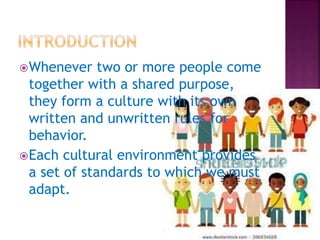
Whenever two or more people come
together with a shared purpose,
they form a culture with its own
written and unwritten rules for
behavior.
Each cultural environment provides
a set of standards to which we must
adapt.
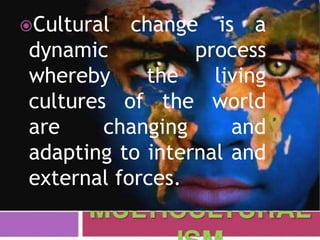
Cultural change is a
dynamic process
whereby the living
cultures of the world
are changing and
adapting to internal and
external forces.
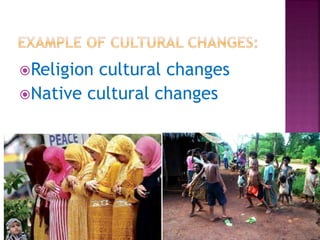
Religion cultural changes
Native cultural changes
According to Harrison (1984),
multiculturalism is a theory about the
foundations of a culture rather than a
practice which subsumes cultural ideas.
Multiculturalism is a systematic and
comprehensive response to cultural and
ethnic diversity, with educational,
linguistic, economic and social components
and specific institutional mechanisms.
“Multiculturalism" is the co-
existence of diverse cultures,
where culture includes racial,
religious, or cultural groups and
is manifested in customary
behaviours, cultural assumptions
and values, patterns of thinking,
and communicative styles.
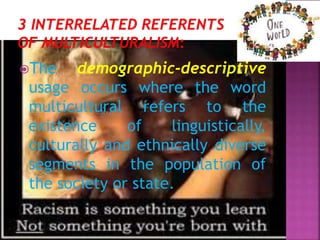
The demographic-descriptive
usage occurs where the word
multicultural refers to the
existence of linguistically,
culturally and ethnically diverse
segments in the population of
the society or state.
Ideological-normative usage
of multiculturalism generates
the greatest level of debate
since it constitutes a slogan and
basis for political action.
Programmatic-political usage
of multiculturalism refers to
the specific policies developed
to respond and manage ethnic
diversity.
refers to any form
of education or
teaching that
incorporates the
histories, texts,
values, beliefs,
, and
perspectives of
people from
different cultural
backgrounds.
 Is an emerging
discipline whose
aim is to create
equal educational
opportunities
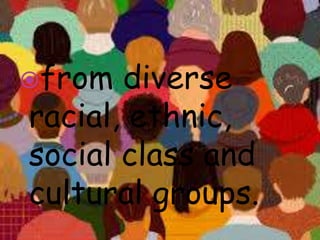
from diverse
racial, ethnic,
social class and
cultural groups.
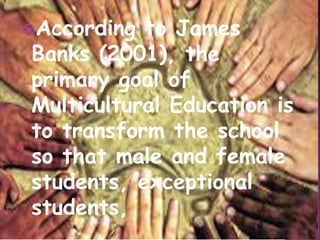
According to James
Banks (2001), the
primary goal of
Multicultural Education is
to transform the school
so that male and female
students, exceptional
students,
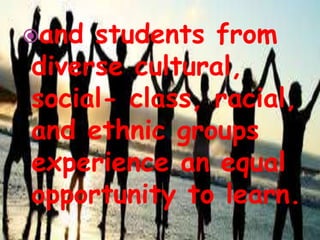
and students from
diverse cultural,
social- class, racial,
and ethnic groups
experience an equal
opportunity to learn.
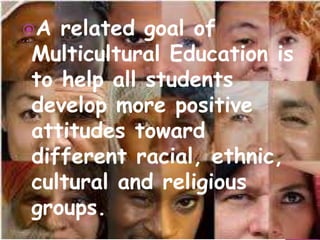
A related goal of
Multicultural Education is
to help all students
develop more positive
attitudes toward
different racial, ethnic,
cultural and religious
groups.
Approaches to
Multicultural
Education:
Dr. James A. Banks,
educator and author of
over 20 books on
multicultural education,
has identified four
approaches that teachers
can use for integrating
multiculturalism into their
curriculum. Let's look at
each approach,
 1. Contributions
Approach
 ___ The ethnic
heroes and holidays
are included in the
curriculum.
AdditiveApproach
____ A unit or
course is
incorporated, but no
substantial change is
made to the
curriculum as a whole.

Cultural changes

  • 2.
    Whenever two ormore people come together with a shared purpose, they form a culture with its own written and unwritten rules for behavior. Each cultural environment provides a set of standards to which we must adapt.
  • 3.
    Cultural change isa dynamic process whereby the living cultures of the world are changing and adapting to internal and external forces.
  • 4.
  • 5.
    According to Harrison(1984), multiculturalism is a theory about the foundations of a culture rather than a practice which subsumes cultural ideas. Multiculturalism is a systematic and comprehensive response to cultural and ethnic diversity, with educational, linguistic, economic and social components and specific institutional mechanisms.
  • 6.
    “Multiculturalism" is theco- existence of diverse cultures, where culture includes racial, religious, or cultural groups and is manifested in customary behaviours, cultural assumptions and values, patterns of thinking, and communicative styles.
  • 7.
    The demographic-descriptive usage occurswhere the word multicultural refers to the existence of linguistically, culturally and ethnically diverse segments in the population of the society or state.
  • 8.
    Ideological-normative usage of multiculturalismgenerates the greatest level of debate since it constitutes a slogan and basis for political action. Programmatic-political usage of multiculturalism refers to the specific policies developed to respond and manage ethnic diversity.
  • 10.
    refers to anyform of education or teaching that incorporates the histories, texts, values, beliefs,
  • 11.
    , and perspectives of peoplefrom different cultural backgrounds.
  • 12.
     Is anemerging discipline whose aim is to create equal educational opportunities
  • 13.
    from diverse racial, ethnic, socialclass and cultural groups.
  • 14.
    According to James Banks(2001), the primary goal of Multicultural Education is to transform the school so that male and female students, exceptional students,
  • 15.
    and students from diversecultural, social- class, racial, and ethnic groups experience an equal opportunity to learn.
  • 16.
    A related goalof Multicultural Education is to help all students develop more positive attitudes toward different racial, ethnic, cultural and religious groups.
  • 17.
  • 18.
    Dr. James A.Banks, educator and author of over 20 books on multicultural education, has identified four approaches that teachers can use for integrating multiculturalism into their curriculum. Let's look at each approach,
  • 19.
     1. Contributions Approach ___ The ethnic heroes and holidays are included in the curriculum.
  • 20.
    AdditiveApproach ____ A unitor course is incorporated, but no substantial change is made to the curriculum as a whole.