Criticizing Cultural Studies
Page8
By Abdul Ghafoor chhachhar
Academic Vocabulary
 Alleged means illegal
 Dilettantism means inability or inexperience
 Rigorous means strict
 Ahistorical means not related with history
 Fade means craze
 Absurdity means ridiculous
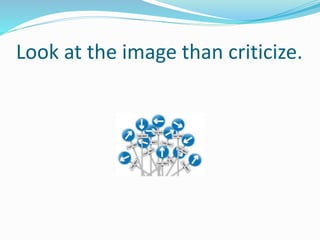
Look at the image than criticize.
Criticizing Cultural Studies
 The philosopher Roger Scruton claim both cultural
studies as an Ideal and as reality.
 Think and write:
 What do you think as an Ideal?
 What do you think as a reality?
In Real
 Cultural studies deals with the daily activity of the
culture.
 List some cultural activities in your note book.
 Example: Pearl diving, fishing, desert
Central goal of cultural studies are
Political Purpose Moral purpose
 All the matters, issues,
activities done according to
law.
 Like fishing, pear diving,
immigration, labour, and art
galleries,
 Relations with an individual.
 Relations with society.
 Relation with nature
 Behaviors
 Good
 Bad
Vocabulary
 Transgressing (An act goes against law or rule)
 Social Text means Academic journal (presentation for new
research.
 Postmodern means late 20th century
 Jouissance means enjoyment
 Differance French term means critical relationship
between text and meaning.
 Hoax means (Play a joke, Prank, trick)
 Detract means reduce value or worth
 Dogma (Law, rule, teaching, principle)
 Clinging means( too dependent on someone emotionally).
The Sokal Affair
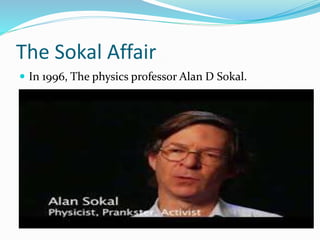
 In 1996, The physics professor Alan D Sokal.
Transgressing the Boundaries: Towards a transformative
Hermeneutics of Quantum Gravity
 Quantum Gravity: Behaviors of objects (Near and
Close)
 What do you think cultural studies behaviors are same
or different?
Candid Camera (Comedy reality)
 Candid Camera is an American hidden camera, practical joke, reality
television series created and produced by Allen ,
 https://www.youtube.com/watch?v=MLHw2dIMnMo
Answering Questions
Q1: What are your views on this hoax? Was Sokal’s point legitimate, or was he
simply being unfair to a discipline that approaches sense-making in a manner
different from his own?
Q2: Do you think it was Ok for him to use his academic credentials to trick the
editors of Social Text into thinking his essay was submitted in good faith- or
should they have taken greater to check his work?
Q3: Do the complex and specialized vocabularies associated with academic fields
such as cultural studies add to or detract from meaning?
Q4: Are there any similarities between the Sokal affair and television programmes
such as Candid Camera or Punk’d?
Q5: What are your views, more generally, about the ethics of hoaxing?
Key Concepts of Cultural Studies
 Culture and Signifying Practices.
 By Culture we mean the actual practices,
representations, languages, customs of particular
society.
 Culture is concerned with various ways we make the
sense of the world.
Language in Cultural Studies
 Language is not neutral to understanding about an
independent object meaning exist outside of language.
 It is constitutive of those very meanings and
knowledge.
Cultural Representation
 World is socially constructed and represented by us in
meaningful ways.
 Do you Agree? If Yes THAN Write few lines about
cultural representation in your note book?
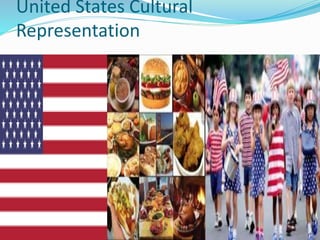
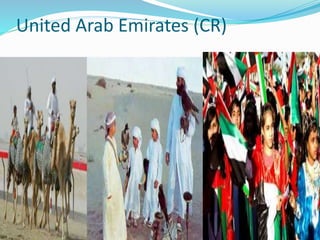
United States Cultural
Representation
United Arab Emirates (CR)
Cultural Representation
 Compare the ways of cultural representation that you
wrote in your notebook:
 By Sounds
 By books
 By Objects
 By images
 By magazines
 By televesions
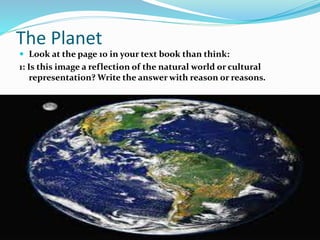
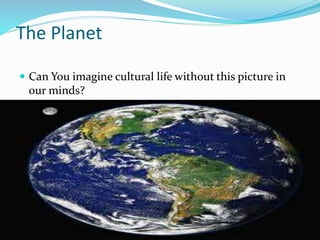
The Planet
 Look at the page 10 in your text book than think:
1: Is this image a reflection of the natural world or cultural
representation? Write the answer with reason or reasons.
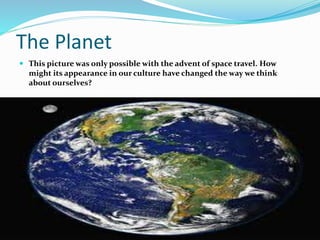
The Planet
 This picture was only possible with the advent of space travel. How
might its appearance in our culture have changed the way we think
about ourselves?
The Planet
 Can You imagine cultural life without this picture in
our minds?
Objective: How cultural studies concerned
(Involvement/ Worried) with Materialism
and non-reductionsim (Not Capable to being
reduced)?
Materialism and Non-Reductionism
Materialism is a tendency to control material possessions.
Like wealth and means of productions.
Cultural Studies:
1: Modern Industrialized (Oil, Steel , Garments etc)
2 :Media culture (T.V SHOWS,INTERNET ETC)
All means of productions are the part of political economy which practiced by
Cultural Materialism.
Cultural Materialism: Cultural materialism is an anthropological research
orientation first introduced by Marvin Harris in his 1968 book.
Marvin Harris said. To consider reproduction of equal importance to
production.
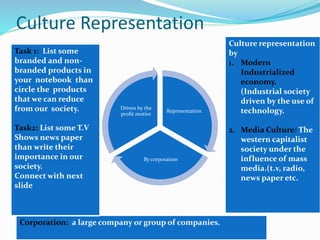
Culture Representation
Representation
By corporation
Driven by the
profit motive
Corporation: a large company or group of companies.
Culture representation
by
1. Modern
Industrialized
economy.
(Industrial society
driven by the use of
technology.
2. Media Culture: The
western capitalist
society under the
influence of mass
media.(t.v, radio,
news paper etc.
Task 1: List some
branded and non-
branded products in
your notebook than
circle the products
that we can reduce
from our society.
Task2: List some T.V
Shows news paper
than write their
importance in our
society.
Connect with next
slide
Cultural Studies has been concerned with.
1: Who owns and controls cultural production?
2: Who distributes cultural products?
Who the patterns of ownership and control?
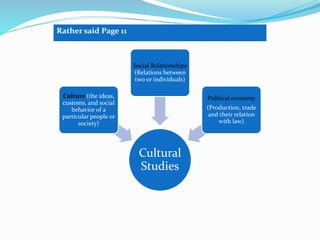
Cultural
Studies
Culture (the ideas,
customs, and social
behavior of a
particular people or
society)
Social Relationships
(Relations between
two or individuals)
Political economy
(Production, trade
and their relation
with law)
Rather said Page 11
https://www.youtube.com/watch?v=z91i8qmu-
RQ
instructions: Watch the video than answer the
questions in your own words.
Cultural Studies
 Hence most part of the CS is concerned modern
industrialized economy (e.g branded garments Nike,
Diesel etc) and Media Culture (e.g film, T.V shows)
 Can you reduce media culture and modern
industrialized economy?
Non-reductionism (To reduce)
 Do you think class, gender, race, nation, ethnicity and
age can be reduced?
Answer
 No, representations having their own particularities
which cannot be reduced either to political economy
or to each other.
Articulation (Expression) theorize the relationship
between components of social formation or
relationship between culture and political economy.
(able to bind people and their sense of identity
together in concrete ways (The action or manner to
jointing or interrelating, bond, formation
By power and Ideology.
 Power: Influence to behavior of others.
Ideology and Popular Culture (Power)
 Ideology means an orientation that characterize the
thinking of a group or nation.
 Ideology implemented by (Hegemony)
 Hegemony (Dominance or leadership of one social
group or nation over others)
 Ideology reference the Tea Party activity.
Activity:
 Instructions: Choose any product and modify
according your ideas.
 Example (PENCIL, China mobile)
 Activity: List Hegemony groups
Ideology and Popular Culture
 Vocabulary words:
 Consent means give permission for something to happen.
 Grasping means greedy (having an excessive desire)
 Obscure means unclear (Not Discovered)
 coercions means the actions or practices.
 Historical bloc means implies a relation between the
cultural and the political and the economic and also
requires an organic link between people and
intellectuals, governors and governed, leaders
and led.
Popular Culture
 Definition : Represents the common and every day
experiences of people.
 Definition : Popular culture define the sum of ideas,
images, attitudes, and other phenomena of everyday
lives of society.
Task 1: List some every day experience of our
lives than share with your friend.
 Example: Reading news paper, watching television etc.
Categories of poplar culture
 Our experiences, practices and ideas has been
categorize according to qualities and importance.
 In other words that poplar culture categorize our daily
live activities according to our priorities, common
practice and experiences in to three categories.
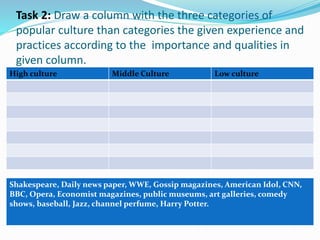
 1: High culture (High quality things but less in
practice we didn’t spend much time. (e.g Shakespeare)
 2. Middle Culture (We spent much time related with
education specially art)(e.g Daily news paper)
 3. Low culture ( Less well educated we spent most of
our time) (e.g WWE)
Task 2: Draw a column with the three categories of
popular culture than categories the given experience and
practices according to the importance and qualities in
given column.
High culture Middle Culture Low culture
Shakespeare, Daily news paper, WWE, Gossip magazines, American Idol, CNN,
BBC, Opera, Economist magazines, public museums, art galleries, comedy
shows, baseball, Jazz, channel perfume, Harry Potter.
UNDERSTANDING
 So cultural studies deal with the consent of won or
lost.
 As we know that Hegemony deal with the process of
making, maintaining, reproducing and practices of our
daily lives.

Cultural studies

  • 1.
  • 2.
    Academic Vocabulary  Allegedmeans illegal  Dilettantism means inability or inexperience  Rigorous means strict  Ahistorical means not related with history  Fade means craze  Absurdity means ridiculous
  • 3.
    Look at theimage than criticize.
  • 4.
    Criticizing Cultural Studies The philosopher Roger Scruton claim both cultural studies as an Ideal and as reality.  Think and write:  What do you think as an Ideal?  What do you think as a reality?
  • 5.
    In Real  Culturalstudies deals with the daily activity of the culture.  List some cultural activities in your note book.  Example: Pearl diving, fishing, desert
  • 6.
    Central goal ofcultural studies are Political Purpose Moral purpose  All the matters, issues, activities done according to law.  Like fishing, pear diving, immigration, labour, and art galleries,  Relations with an individual.  Relations with society.  Relation with nature  Behaviors  Good  Bad
  • 7.
    Vocabulary  Transgressing (Anact goes against law or rule)  Social Text means Academic journal (presentation for new research.  Postmodern means late 20th century  Jouissance means enjoyment  Differance French term means critical relationship between text and meaning.  Hoax means (Play a joke, Prank, trick)  Detract means reduce value or worth  Dogma (Law, rule, teaching, principle)  Clinging means( too dependent on someone emotionally).
  • 8.
    The Sokal Affair In 1996, The physics professor Alan D Sokal.
  • 9.
    Transgressing the Boundaries:Towards a transformative Hermeneutics of Quantum Gravity  Quantum Gravity: Behaviors of objects (Near and Close)  What do you think cultural studies behaviors are same or different?
  • 10.
    Candid Camera (Comedyreality)  Candid Camera is an American hidden camera, practical joke, reality television series created and produced by Allen ,  https://www.youtube.com/watch?v=MLHw2dIMnMo
  • 11.
    Answering Questions Q1: Whatare your views on this hoax? Was Sokal’s point legitimate, or was he simply being unfair to a discipline that approaches sense-making in a manner different from his own? Q2: Do you think it was Ok for him to use his academic credentials to trick the editors of Social Text into thinking his essay was submitted in good faith- or should they have taken greater to check his work? Q3: Do the complex and specialized vocabularies associated with academic fields such as cultural studies add to or detract from meaning? Q4: Are there any similarities between the Sokal affair and television programmes such as Candid Camera or Punk’d? Q5: What are your views, more generally, about the ethics of hoaxing?
  • 12.
    Key Concepts ofCultural Studies  Culture and Signifying Practices.  By Culture we mean the actual practices, representations, languages, customs of particular society.  Culture is concerned with various ways we make the sense of the world.
  • 13.
    Language in CulturalStudies  Language is not neutral to understanding about an independent object meaning exist outside of language.  It is constitutive of those very meanings and knowledge.
  • 14.
    Cultural Representation  Worldis socially constructed and represented by us in meaningful ways.  Do you Agree? If Yes THAN Write few lines about cultural representation in your note book?
  • 15.
  • 16.
  • 17.
    Cultural Representation  Comparethe ways of cultural representation that you wrote in your notebook:  By Sounds  By books  By Objects  By images  By magazines  By televesions
  • 18.
    The Planet  Lookat the page 10 in your text book than think: 1: Is this image a reflection of the natural world or cultural representation? Write the answer with reason or reasons.
  • 19.
    The Planet  Thispicture was only possible with the advent of space travel. How might its appearance in our culture have changed the way we think about ourselves?
  • 20.
    The Planet  CanYou imagine cultural life without this picture in our minds?
  • 21.
    Objective: How culturalstudies concerned (Involvement/ Worried) with Materialism and non-reductionsim (Not Capable to being reduced)?
  • 22.
    Materialism and Non-Reductionism Materialismis a tendency to control material possessions. Like wealth and means of productions. Cultural Studies: 1: Modern Industrialized (Oil, Steel , Garments etc) 2 :Media culture (T.V SHOWS,INTERNET ETC) All means of productions are the part of political economy which practiced by Cultural Materialism. Cultural Materialism: Cultural materialism is an anthropological research orientation first introduced by Marvin Harris in his 1968 book. Marvin Harris said. To consider reproduction of equal importance to production.
  • 23.
    Culture Representation Representation By corporation Drivenby the profit motive Corporation: a large company or group of companies. Culture representation by 1. Modern Industrialized economy. (Industrial society driven by the use of technology. 2. Media Culture: The western capitalist society under the influence of mass media.(t.v, radio, news paper etc. Task 1: List some branded and non- branded products in your notebook than circle the products that we can reduce from our society. Task2: List some T.V Shows news paper than write their importance in our society. Connect with next slide
  • 24.
    Cultural Studies hasbeen concerned with. 1: Who owns and controls cultural production? 2: Who distributes cultural products? Who the patterns of ownership and control?
  • 25.
    Cultural Studies Culture (the ideas, customs,and social behavior of a particular people or society) Social Relationships (Relations between two or individuals) Political economy (Production, trade and their relation with law) Rather said Page 11
  • 26.
    https://www.youtube.com/watch?v=z91i8qmu- RQ instructions: Watch thevideo than answer the questions in your own words.
  • 27.
    Cultural Studies  Hencemost part of the CS is concerned modern industrialized economy (e.g branded garments Nike, Diesel etc) and Media Culture (e.g film, T.V shows)  Can you reduce media culture and modern industrialized economy?
  • 28.
    Non-reductionism (To reduce) Do you think class, gender, race, nation, ethnicity and age can be reduced?
  • 29.
    Answer  No, representationshaving their own particularities which cannot be reduced either to political economy or to each other.
  • 30.
    Articulation (Expression) theorizethe relationship between components of social formation or relationship between culture and political economy. (able to bind people and their sense of identity together in concrete ways (The action or manner to jointing or interrelating, bond, formation By power and Ideology.  Power: Influence to behavior of others.
  • 31.
    Ideology and PopularCulture (Power)  Ideology means an orientation that characterize the thinking of a group or nation.  Ideology implemented by (Hegemony)  Hegemony (Dominance or leadership of one social group or nation over others)  Ideology reference the Tea Party activity.
  • 32.
    Activity:  Instructions: Chooseany product and modify according your ideas.  Example (PENCIL, China mobile)  Activity: List Hegemony groups
  • 33.
    Ideology and PopularCulture  Vocabulary words:  Consent means give permission for something to happen.  Grasping means greedy (having an excessive desire)  Obscure means unclear (Not Discovered)  coercions means the actions or practices.  Historical bloc means implies a relation between the cultural and the political and the economic and also requires an organic link between people and intellectuals, governors and governed, leaders and led.
  • 34.
    Popular Culture  Definition: Represents the common and every day experiences of people.  Definition : Popular culture define the sum of ideas, images, attitudes, and other phenomena of everyday lives of society.
  • 35.
    Task 1: Listsome every day experience of our lives than share with your friend.  Example: Reading news paper, watching television etc.
  • 36.
    Categories of poplarculture  Our experiences, practices and ideas has been categorize according to qualities and importance.  In other words that poplar culture categorize our daily live activities according to our priorities, common practice and experiences in to three categories.  1: High culture (High quality things but less in practice we didn’t spend much time. (e.g Shakespeare)  2. Middle Culture (We spent much time related with education specially art)(e.g Daily news paper)  3. Low culture ( Less well educated we spent most of our time) (e.g WWE)
  • 37.
    Task 2: Drawa column with the three categories of popular culture than categories the given experience and practices according to the importance and qualities in given column. High culture Middle Culture Low culture Shakespeare, Daily news paper, WWE, Gossip magazines, American Idol, CNN, BBC, Opera, Economist magazines, public museums, art galleries, comedy shows, baseball, Jazz, channel perfume, Harry Potter.
  • 38.
    UNDERSTANDING  So culturalstudies deal with the consent of won or lost.  As we know that Hegemony deal with the process of making, maintaining, reproducing and practices of our daily lives.