002# Early Child-Development
Standard 1
Performance Criteria 1
https://www.youtube.com/@PedagogyTLS
Demonstrate Understanding of child development theories and children's
developmental characteristics.
1- Demonstrate understanding of physical, social, emotional, and cognitive
development milestones in early childhood.
2- Demonstrate understanding of children's developmental characteristics
from birth to 8 years. -
3- Demonstrate understanding of development theories in early childhood.
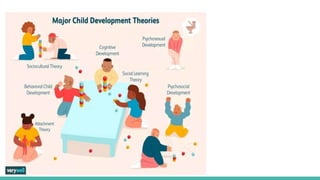
Child Development Theories
Child development theories focus on explaining how children change and
grow over the course of childhood. Such theories center on various aspects of
development including social, emotional, and cognitive growth.
Which of following theories best describes the every aspect of life?
1. Grand Theories
2. Mini Theories
Which of following theories best describes the limited aspect of child development?
1. Grand Theories
2. Mini Theories
Erikson's Psychosocial Developmental Theory
Erikson's eight-stage theory of psychosocial development describes
growth and change throughout life, focusing on social interaction and
conflicts that arise during different stages of development.
Behavioral Child Development Theories
According to the behavioral perspective, all human behavior can be described in
terms of environmental influences. Some behaviorists, such as John B. Watson and
B.F. Skinner, insisted that learning occurs purely through processes of association
and reinforcement.
Behavioral theories of child development focus on how environmental interaction
influences behavior and is based on the theories of theorists such as John B.
Watson, Ivan Pavlov, and B. F. Skinner. These theories deal only with observable
behaviors. Development is considered a reaction to rewards, punishments, stimuli,
and reinforcement.
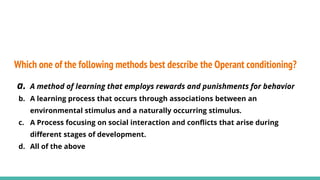
Which one of the following methods best describe the Operant conditioning?
a. A method of learning that employs rewards and punishments for behavior
b. A learning process that occurs through associations between an
environmental stimulus and a naturally occurring stimulus.
c. A Process focusing on social interaction and conflicts that arise during
different stages of development.
d. All of the above
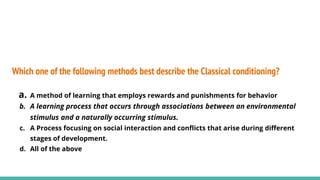
Which one of the following methods best describe the Classical conditioning?
a. A method of learning that employs rewards and punishments for behavior
b. A learning process that occurs through associations between an environmental
stimulus and a naturally occurring stimulus.
c. A Process focusing on social interaction and conflicts that arise during different
stages of development.
d. All of the above
Characteristics of Child-development
Four main domains
1. The Communication and Speech Domain
2. The Physical Domain
3. The Social and Emotional Domain
4. The Cognitive Domain
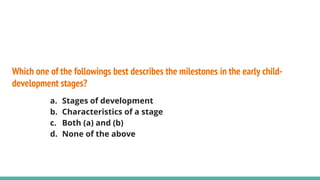
Which one of the followings best describes the milestones in the early child-
development stages?
a. Stages of development
b. Characteristics of a stage
c. Both (a) and (b)
d. None of the above
002# Early Child-Development.pptx

002# Early Child-Development.pptx

  • 1.
    002# Early Child-Development Standard1 Performance Criteria 1 https://www.youtube.com/@PedagogyTLS
  • 2.
    Demonstrate Understanding ofchild development theories and children's developmental characteristics. 1- Demonstrate understanding of physical, social, emotional, and cognitive development milestones in early childhood. 2- Demonstrate understanding of children's developmental characteristics from birth to 8 years. - 3- Demonstrate understanding of development theories in early childhood.
  • 4.
    Child Development Theories Childdevelopment theories focus on explaining how children change and grow over the course of childhood. Such theories center on various aspects of development including social, emotional, and cognitive growth.
  • 5.
    Which of followingtheories best describes the every aspect of life? 1. Grand Theories 2. Mini Theories
  • 6.
    Which of followingtheories best describes the limited aspect of child development? 1. Grand Theories 2. Mini Theories
  • 7.
    Erikson's Psychosocial DevelopmentalTheory Erikson's eight-stage theory of psychosocial development describes growth and change throughout life, focusing on social interaction and conflicts that arise during different stages of development.
  • 8.
    Behavioral Child DevelopmentTheories According to the behavioral perspective, all human behavior can be described in terms of environmental influences. Some behaviorists, such as John B. Watson and B.F. Skinner, insisted that learning occurs purely through processes of association and reinforcement. Behavioral theories of child development focus on how environmental interaction influences behavior and is based on the theories of theorists such as John B. Watson, Ivan Pavlov, and B. F. Skinner. These theories deal only with observable behaviors. Development is considered a reaction to rewards, punishments, stimuli, and reinforcement.
  • 9.
    Which one ofthe following methods best describe the Operant conditioning? a. A method of learning that employs rewards and punishments for behavior b. A learning process that occurs through associations between an environmental stimulus and a naturally occurring stimulus. c. A Process focusing on social interaction and conflicts that arise during different stages of development. d. All of the above
  • 10.
    Which one ofthe following methods best describe the Classical conditioning? a. A method of learning that employs rewards and punishments for behavior b. A learning process that occurs through associations between an environmental stimulus and a naturally occurring stimulus. c. A Process focusing on social interaction and conflicts that arise during different stages of development. d. All of the above
  • 11.
    Characteristics of Child-development Fourmain domains 1. The Communication and Speech Domain 2. The Physical Domain 3. The Social and Emotional Domain 4. The Cognitive Domain
  • 12.
    Which one ofthe followings best describes the milestones in the early child- development stages? a. Stages of development b. Characteristics of a stage c. Both (a) and (b) d. None of the above