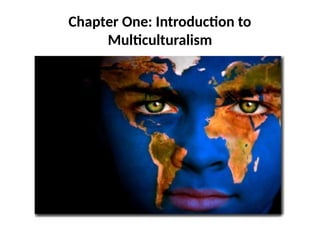
Chapter One: Introduction to
Multiculturalism
• “We may have different religions, different
languages, different colored skin, but we all
belong to one human race." --Kofi Annan
• “Peace is not unity in similarity but unity in
diversity, in the comparison and conciliation
of differences.” --Mikhail Gorbachev
• “Our cultural strength has always been
derived from our diversity of understanding
and experience.” -- Yo-Yo Ma
• We live in a diverse world and an
increasingly diverse society in Ethiopia.
• Through the application of multicultural
education concepts, we can strive to
create more inclusive classrooms and
schools in which our students can see
themselves in the curriculum.
 Multiculturalism:
• _It is commitment to diversity
• _It is commitment to social justice and activism
• _It is concerned with optimizing communication
• _It is concerned with empowering individuals, groups,
and nations.
• _It is concerned with offering hope, optimism, and
opportunity
• _It is multicultural, multidisciplinary, and multi-
sectional.
• _It is revolutionary and progressive
 Multiculturalism:
• _It is commitment to diversity
• _It is commitment to social justice and activism
• _It is concerned with optimizing communication
• _It is concerned with empowering individuals, groups,
and nations.
• _It is concerned with offering hope, optimism, and
opportunity
• _It is multicultural, multidisciplinary, and multi-
sectional.
• _It is revolutionary and progressive
Culture-Working Definition
• Learned traditions, loyalties,
beliefs, customs that guide
behavior of a group of people
6
More definitions of Multiculturalism
• deals with diversity via accommodation, not
exclusion;
• is based on respecting diversity and valuing
cultural difference;
• is a policy agenda designed to redress unequal
treatment and “cultureracism”
• is a political, social and cultural movement that
respects a multiplicity of diverging perspectives
outside of dominant traditions
• involves a range of rights, different foci, including
political representation, affirmative action, exemptions
from laws, recognition of traditional legal codes, etc.
• the belief that all cultures are equal in value; every
individual and every culture in which individuals
participate, as being equally valuable
• the political idea of multiculturalism – the recognition
of group differences within the political sphere of laws,
policies, democratic discourses and the terms of a
shared citizenship and
• a shift to true multiculturalism … would involve the
abandonment of cultural hegemony by the native
Britons.
We are all multicultural!
• Members of many groups that have cultural
aspects
• Gender, social class, regional, ethnicity,
religious,…..
• Race-White, Black, ???
• Dynamic--our loyalties change over time
• Complex--groups overlap
9
Cultural Elements
• Values and beliefs
• Customs and traditions
• Language/communication patterns
• Diet and food preparation
• Dress and/or body decoration
• Religious practices
• Family structure
• View of time may vary
10
• ‘Multiculturalism’ is a term that was
introduced into the political bureaucratic
language decades ago, and has since become
synonymous with diversity and tolerance.
• It is the co-existence of diverse cultures,
where culture includes racial, religious, or
cultural groups and is manifested in
customary behaviors, cultural assumptions
and values, patterns of thinking, and
communicative styles.
• According to Mahnaz Afkhami “We have the
ability to achieve, if we master the necessary
goodwill, a common global society blessed with
a shared culture of peace that is nourished by
the ethnic, national and local diversities that
enrich our lives.” --
• Samuel P. Huntington's The Clash of
Civilizations and the Remaking of World Order
was among the first works that drawn
widespread attention to the social problems
arising from diversity.
• Multiculturalism has become the dominant
theory in the world. It was generally accepted
that due to the practice of multiculturalism,
the different cultures can live peacefully side
by side.
• The idea of multiculturalism in contemporary
political discourse and in political philosophy
is about how to understand and respond to
the challenges associated with cultural and
religious diversity.
• The term “multicultural” is often used as a
descriptive term to characterize the fact of
diversity in a society, but in what follows, the
focus is on its prescriptive use in the context
of Western liberal democratic societies.
• In fact, multiculturalism is a political
philosophy and a social doctrine, which takes
into account diversity and cultural
differences, and defines itself as an
alternative to assimilation.
• While the term has come to encompass a
variety of prescriptive claims, it is fair to say
that proponents of multiculturalism reject
the ideal of the “melting pot” in which
members of minority groups are expected
to assimilate into the dominant culture
• Instead it is prefered as the “salad bowl” or
the “glorious mosaic”, in which each ethnic
and racial element in the population
maintains its distinctiveness.
• Multiculturalism did not appear until the
1960s and 1970s, when it was used to
describe a new public policy, first in Canada
and then in Australia.
• In both of these cases, this development
marked an explicit movement by federal
governments away from policies of
assimilation of ethnic minorities, and
immigrants in particular, toward policies of
acceptance and integration of diverse
cultures
• For some, multiculturalism requires moderate
changes to social and political institutions to
enable cultural minorities to preserve their
languages and their distinctive customs or
practices.
• For others, however, multiculturalism
requires much greater social transformation
to turn modern society into one in which
racism has been eliminated and ‘difference’
is nurtured rather than repudiated, or simply
tolerated.
Multiculturalism form different
perspetives
• Empirical fact:-
• Many immigrant and ethnic groups from a
wide variety of countries, speaking a variety of
languages, and having diverse cultural values
and practices.
• These are the diversity and pluralism that
exists in the world
18
.
• Ideology:-
• This values and encourages diversity and is
usually associated with the view that we are
tolerant, non-discriminatory, and respectful
of others
• Theory:-
• Kymlicka presents a number of arguments
for polyethnic group rights in Multicultural
Citizenship. Sociological theories of
difference and integration
19
.
Policy:-
• a policy of multiculturalism within a bilingual
or multi-lingual framework. (A
Multiculturalism Act or policy for example in
Canada)
Programs:-
• Countries have a number of multicultural
programs, such as heritage languages, support
to multicultural councils, and ethnic programs.
Country wide Heritage to issues related to
civic participation and social justice.
20
.
• Practice:-
• A multicultural practice means that there
will be fair and equitable treatment of
others by individuals, groups, and
institutions.
• Instead of racism and discrimination, there
will be respectful and equal treatment of
individuals and groups from any ethnic,
racial, or immigrant background.
21
Arguments in favor of Multiculturalism
• High level of tolerance towards minorities
• Can lead to a more peaceful society
• We can learn from different cultures
• Life becomes more interesting
• it is an important part of modern tolerant societies
• Lower prejudice towards certain cultures
• Lower tensions among societies
• Gives broader picture of reality
• Helps to know different languages
Arguments against Multiculturalism
• Tensions between peoples of different background
• Some peoples have hard time to integrate into
society
• Language barriers are big problems
• Peoples have fear to lose their identity
• Multiculturalism leads to radical movement
• Original local peoples may be extinct
• Peoples may be frustrated
• It may lead higher sovereign debt
Pillars of multicultural society
1. Acceptance/Recognitions
• Acceptance is to deal with positive welcome;
favour and endorsement. In which a person
could like someone and have acceptance for
them do to their approval of that person.
• Acceptance of difference
• Acceptance of others...not mere tolerance of
others
• Belief in something; agreement
2. Respect
• Denotes both a positive feeling of esteem for a
person or other entity (such as a nation or
religion), and also specific actions and conduct
representative of that esteem.
• Respect should not be confused with tolerance,
since tolerance doesn’t necessary imply any
positive feeling, and is not incompatible with
contept, which is the opposite of respect.
• Respect for other cultures, languages, religion
3. Institutionalization
• the action of establishing something as a convention
or norm in an organization or culture.
4. Tolerances
• Implies a respect for another person, because he is
wrong or even because he is right, but because he is
human.
• In social, cultural and religious contexts, toleration
and tolerance used to describe attitudes which are
“tolerant” (or moderately respectful) of practices or
group memberships that may be disapproved of by
those in the majority.
5. Valuing diversity
• Valuing diversity is what institutions and members
of communities do to acknowledge the benefits of
their differences and similarities. They work to
build sustainable relationships among people and
institutions with diverse memberships.
• A community that values diversity ensures that
institutions provide equal treatment and access to
resources and decisions for all community
regardless of race, ethnicity, sexual orientation,
and physical disability.
6. Equality and Egalitarian society
• Equality refers to the equality of being fair or
impartial, fairness
• Egalitarian doctrine tends to express the idea
that all human being are equal in fundamental
worth or moral status. People should get the
same, or be treated the same, or be treated as
equals, in some respect.
Elimination of Diversity
1. Assimilation
• Assimilation policies, in turn, are based on the
idea that minorities/ immigrants should
adopt the language, customs, and values of
the national majorities, and abandon their
own cultural heritage.
• Assimilationist policies thus aim to
homogenize the population and to reduce
cultural diversity.
2. Partition /secession
• Secession is the withdrawal of a group from a
larger entity, especially a political entity, but
also from any organization, union or military
alliance.
3. Forced mass population transfers
• Population transfer or resettlement is the
movement of a large group of people
from one region to another, often a form
of forced migration imposed by state
policy or international authority and most
frequently on the basis of ethnicity or
religion but also due to economic
development.
4. Genocide as a danger for diversity
• Genocide is the intentional destruction of a
people, usually defined as an ethnic,
national, racial, or religious group. Raphael
Lemkin coined the term in 1944, combining
the Greek word γένος (genos, "race, people")
with the Latin suffix -caedo ("act of killing").
Management of Diversity
1. Territorial autonomy
• Territorial autonomy is a common aspiration of
many minority ethnic groups, including Indigenous
Peoples, and is the prevalent approach to the
resolution of ethnic conflict.
• Territorial autonomy represents an important tool to
overcome conflict and better represent ethnic
minorities. It features a variety of economic, political
and cultural powers that allow minorities to govern
themselves within the borders of a larger country.
2. Non-territorial autonomy
• Non-territorial autonomy is a collective-rights-based
concept to deal with national diversity within a country.
It grants autonomous decision-making to an ethnically,
linguistically or culturally defined national group.
• Irrespective of their place of residence within the state
they elect representatives who then autonomously
manage clearly defined areas of their national life, e.g.
schools, cultural institutions, associations, etc. With its
emphasis on national affiliation as the key denominator
of autonomous rights, non-territorial autonomy belongs
unquestionably to groupist approaches to minority
protection.
Consociational democracy and multiculturalism
A. Premises of Consociational Democracy
• Democracy is possible in multi-ethnic states.
• Ethnicity is an inescapable aspect of the
political process in these societies.
• Minority ethnic groups should be
accommodated to avoid majority tyranny and
ensure minority allegiance to the state.
Characteristics of a Consociational System
Lijphart the founder of Consociational Democracy
identifies four key characteristics of consociational
democracies. These are:
1. Government by grand coalition (in the context of a
parliamentary system)
• General political willingness to cooperate
• Backed by elaborate system of advisory councils and
committees in which all parties participate.
2. Mutual or minority veto
• Minorities have veto power over policy matters on vital
interests
3. Principle of proportionality
• All public resources allocated in strict proportion
between the communities (i.e. government funds,
jobs, services, etc.
• Where communities are unequal in size, then
minorities is given party or to be overrepresented.
4. Regional autonomy
• Culturally distinct groups allowed considerable
autonomy (eg. Religious,teathing at school or in
local language)
Favorable Conditions For Consociational
Democracy
Lijphart acknowledges that there are particular
environments which are most appropriate for
consociational democracy:
• 1. A balance of power among groups
• 2. The presence of cross-cutting cleavages
• 3. An overarching loyalty to the state
• 4. A small, wealthy country
States that Employ Consociational Practices
Lijphart points to a number of states that have
applied consociational principles. Examples
include:
1. The Netherlands
2. Belgium
3. Lebanon’s National Pact of 1943
Chapter Two
• Theoretical and Philosophical
Foundations of Multiculturalism
Communitarian Perspective
• Communitarians reject the idea that the
individual is prior to the community and that
the value of social goods can be reduced to their
contribution to individual well-being.
• They instead embrace ontological holism, which
acknowledges collective goods as, in Charles
Taylor's words, “irreducibly social” and
intrinsically valuable.
• An ontologically holist view of collective
identities and cultures underlies Taylor's
argument for a “politics of recognition.”
• Drawing on Rousseau, Herder, and Hegel,
among others, Taylor argues that we do not
become full human agents and define our
identity in isolation from others rather, “we
define our identity always in dialogue with,
sometimes in struggle against, the things our
significant others want to see in us”.
• Because our identities are formed dialogically,
we are dependent on the recognition of others.
• The absence of recognition or misrecognition
can cause serious injury
Liberal egalitarian
• Will Kymlicka has developed the most
influential liberal theory of multiculturalism by
marrying the liberal values of autonomy and
equality with an argument about the value of
cultural membership.
• Egalitarian theories of distributive justice
that focus on distributing different types of
rights
• Rather than beginning with intrinsically
valuable collective goals and goods as Taylor
does, Kymlicka views cultures as
instrumentally valuable to individuals, for
two main reasons.
• First, cultural membership is an important
condition of personal autonomy. Cultural
membership as a “primary good,” things that
every rational person is presumed to want and
which are necessary for the pursuit of one's
goals.
• Second, cultural membership plays an important
role in people's self-identity.
• Kymlicka views cultural identity as providing people
with an “anchor for their self-identification and the
safety of effortless secure belonging”.
• This means there is a deep and general connection
between a person's self-respect and the respect
accorded to the cultural group of which she is a part.
• It is not simply membership in any culture but one's
own culture that must be secured in order for
cultural membership to serve as a meaningful
context of choice and a basis of self-respect
• Kymlicka moves from these premises about
the instrumental value of cultural membership
to the egalitarian claim that because members
of minority groups are disadvantaged in terms
of access to their own cultures, they are
entitled to special protections.
• It is important to note that Kymlicka's
egalitarian argument for multiculturalism rests
on a theory of equality that critics have
dubbed “luck egalitarianism”.
Why not governments just enforce antidiscrimination laws?
• Kymlicka and other liberal theorists of
multiculturalism contend that
antidiscrimination laws fall short of treating
members of minority groups as equals.
• This is because states cannot be neutral with
respect to culture. In culturally diverse
societies, we can easily find patterns of state
support for some cultural groups over others.
• While states may prohibit racial discrimination
and avoid official establishment of any religion,
they cannot avoid establishing one language
for public schooling and other state services
such as language being a paradigmatic marker
of culture.
• Linguistic advantage translates into economic
and political advantage since members of the
dominant cultural community have a leg up in
schools, the workplace, and politics. Linguistic
advantage also takes a symbolic form.
• When state action extends symbolic
affirmation to some groups and not others by
adopting a particular language or by
organizing the work week and public holidays
around the calendar of particular religions, it
has a normalizing effect, suggesting that one
group's language and customs are more
valued than those of other groups.
Can state pass a law that places constraint on some cultural
groups?
• In addition to state support of certain cultures over
others, state laws may place constraints on some
cultural groups over others.
• Consider the case of dress code regulations in public
schools or the workplace. The case of the French
state's ban on religious dress in public schools, which
burdens Muslim girls who wish to wear headscarves
to school, is another example.
• Religion may command that believers dress in a
certain way -“intrinsic burden”, not that believers
refrain from attending school or going to work.
Freedom from Domination
• Another argument for multiculturalism begins
from the value of freedom from domination. One
might value freedom from domination because
that domination presents a serious obstacle to
human flourishing.
• In contrast to the conception of freedom as non-
interference dominant in liberal theory, freedom
as non-domination, drawn from the civic republic
tradition, focuses on a person's “capacity to
interfere, on an arbitrary basis, in certain choices
that the other is in a position to make”.
• Frank Lovett begins from the premise that
freedom from domination is an important human
good and that we have a prima facie obligation to
reduce domination.
• He argues that the state should not
accommodate social practices that directly
involve domination; indeed, if freedom from
domination is a priority, then one should “aim to
bring such practices to an end as quickly as
possible, despite any subjective value they
happen to have for their participants”.
• Frank Lovett begins from the premise that
freedom from domination is an important human
good and that we have a prima facie obligation to
reduce domination.
• He argues that the state should not
accommodate social practices that directly
involve domination; indeed, if freedom from
domination is a priority, then one should “aim to
bring such practices to an end as quickly as
possible, despite any subjective value they
happen to have for their participants”.
Severe patriarchal domination
• Lovett suggests, a detailed study of a
particular Muslim community in a liberal
democratic society is undertaken and it
reveals that women's educational and
employment opportunities are discouraged,
generating “severe patriarchal domination,”
but the study also shows that the practice of
wearing headscarves does not.
Merits of a non-domination-based multiculturalism as
compared to liberal egalitarian approaches
• Non-domination approach may be more
sensitive to power dynamics in both inter-
group and intra-group relations
• Non-domination approach focuses on the
“moral quality of the relationship between the
central actors” and insists on continuity of
treatment between and within groups.
Left-essentialist multiculturalism
• The term “essentialist” may be applied to any
approach to multiculturalism which:
attributes to each culture essential, homogeneous
features that are non-modifiable, non-negotiable
and impermeable to criticism from inside or outside;
Naturally assigns each group or individual to such a
monolithic culture, considering its members as
faithful representatives, or even as passive vehicles
or “victims”, in the case of non-modern cultures,
having simply to accept or refuse it in to;
uses culture as a perfect synonym for “identity”,
which fully explains the social and political
relations of groups (“ethnicization”) and thus
makes it possible to differentiate, to place in a
hierarchy (“radicalization”) and to oppose
(“conflict of civilizations”) countries, communities
and individuals;
Emphasizes the cultural differences of other
groups in comparison with the assumed centrality
of its own cultural models (“ethnocentrism”), not
recognizing the differences and potential for
change which also affect the latter.
uses culture as a perfect synonym for “identity”,
which fully explains the social and political
relations of groups (“ethnicization”) and thus
makes it possible to differentiate, to place in a
hierarchy (“radicalization”) and to oppose
(“conflict of civilizations”) countries, communities
and individuals;
Emphasizes the cultural differences of other
groups in comparison with the assumed centrality
of its own cultural models (“ethnocentrism”), not
recognizing the differences and potential for
change which also affect the latter.
• Left-essentialist multiculturalists stand
accused of failing to acknowledge the
dynamic and fluid nature of the identity
formation process.
• In a critical examination of left essentialist
multiculturalism critical multiculturalists make
the point that identity formation is in itself
socially constructed and therefore is subject
to the constant shifts inherent in all such
discursive and ideological constructions.
• Central to this approach is the idea of a ‘common
culture’, which is seen as the only way to secure
the effective functioning of society.
• It is therefore deemed necessary to assimilate all
to the white middle class social ideal.
• The western monoculturalist construction of
traditional consensus encompasses the
perpetuation of the white fear of non-whites.
• This position is also characterized by the
polarization of ‘we’ and ‘they’, ‘we’ being the
legitimate homogeneous civil assembly and ‘they’
being the heterogeneous burdens to society.
Critical Multiculturalism
• the theory of critical multiculturalism is effectively a
critique of all of the above approaches.
• Critical multiculturalists are concerned with the
interaction of class with other axes of power and with
the particular contexts in which class and gender
inequalities emerge.
• The term critical multiculturalism is sometimes coined as
a radical alternative to liberal multiculturalism.
• Unlike the latter the former sees diversity itself as a
goal, but rather argues that diversity must be affirmed
within a politics of cultural criticism and a commitment
to social justice.
Conservative (Ethnocentrist) multiculturalism
• Conservative multiculturalism is also known as mono-
culturalism. Conservative multiculturalism basically
reflects a belief in the superiority if Western patriarchal
culture.
• It tends not to address issues of social injustice and
conceptualizes multiculturalism as a threat to western
identity.
• In a more activist context it argues that, multiculturalism
stands for a left-radical attempt to overturn dominant,
monoculture conception of history and society, which
are considered ethnocentric or even racist.
Conservative (Ethnocentrist) multiculturalism
• Conservative multiculturalism is also known as mono-
culturalism. Conservative multiculturalism basically
reflects a belief in the superiority if Western patriarchal
culture.
• It tends not to address issues of social injustice and
conceptualizes multiculturalism as a threat to western
identity.
• In a more activist context it argues that, multiculturalism
stands for a left-radical attempt to overturn dominant,
monoculture conception of history and society, which
are considered ethnocentric or even racist.
Democracy and multiculturalism
• Democracy is a form of government in which the
right to make political decisions is exercised
directly by the whole body of citizens, acting under
procedures of majority rule
• Democracy is above all a moral value or
imperative that is a basic human need, a necessity
and therefore a political demand of all freedom
loving human beings.
• The concept of democracy highly advocates the
idea of multiculturalism. Because, democracy
rejuvenate the concept of equality of every person
and fair treatment without any discrimination.
• Democracy can also be understood as a way of
living and working together.
• We cannot properly manage multicultural
society without implementation of democratic
values.
• All major pillars of multiculturalism are
included under the basic democratic values.
Group Differentiated Right
• Group-differentiated rights, or rights that vest on
the basis of an individual's membership in a
particular social or cultural group, are an
increasingly common and controversial aspect of
modern liberal legal systems
• Modern states are organized around the language
and cultural norms of the dominant groups that
have historically constituted them.
• Members of minority cultural groups face
barriers in pursuing their social practices in
ways that members of dominant groups do
not.
• Some theorists argue for tolerating minority
groups by leaving them free of state
interference. Others argue that mere
toleration of group differences falls short of
treating members of minority groups as
equals
Examples of cultural accommodations or “group-
differentiated rights” include
• exemptions from generally applicable law e.g.
religious exemptions;
• assistance to do things that the majority can do
unassisted e.g. multilingual ballots, funding for
minority language schools and ethnic associations,
affirmative action;
• representation of minorities in government bodies
e.g. ethnic quotas for party lists or legislative seats,
minority-majority Congressional districts;
• recognition of traditional legal codes by the
dominant legal system e.g. granting
jurisdiction over family law to religious courts;
or
• limited self-government rights e.g. qualified
recognition of tribal sovereignty and federal
arrangements recognizing the political
autonomy e.g. Québec.
• What is required is recognition and positive
accommodation of minority group practices through
what the leading theorist of multiculturalism Will
Kymlicka has called “group-differentiated rights”.
• Some group-differentiated rights are held by
individual members of minority groups, as in the
case of individuals who are granted exemptions from
generally applicable laws in virtue of their religious
beliefs or individuals who seek language
accommodations in education and in voting.
• Other group-differentiated rights are held by the
group qua group rather by its members severally;
such rights are properly called “group rights,” as in
the case of indigenous groups and minority nations,
who claim the right of self-determination. In the
latter respect, multiculturalism is closely allied with
nationalism.
• Typically, a group-differentiated right is a right of a
minority group or a member of such a group to act
or not act in a certain way in accordance with their
religious obligations and/or cultural commitments.
• In some cases, it is a right that directly restricts the
freedom of non-members in order to protect the
minority group's culture, as in the case of
restrictions on the use of the English language in
Québec.
• When the right-holder is the group, the right may
protect group rules that restrict the freedom of
individual members, as in the case of the Pueblo
membership rule that excludes the children of
women who marry outside the group.
• Multiculturalism has been used as an umbrella term
to characterize the moral and political claims of a
wide range of marginalized groups, including
African Americans, women, and people with
disabilities and etc.
• Contemporary theories of multiculturalism, which
originated in the late 1980s and early 1990s, tend to
focus their arguments on immigrants who are
ethnic and religious minorities (e.g. Latinos in the
U.S., Muslims in Western Europe), minority nations
(e.g. Catalans, Basque, Welsh, Québécois), and
indigenous peoples (e.g. Native peoples in North
America, Australia, and New Zealand).
• Today, governments are confronted by demands from
cultural minorities for recognition, protection,
preferential treatment, and political autonomy within
the boundaries of the state.
• Equally, international society and its political institutions,
as well as states themselves, have had to deal with
demands from various peoples for political recognition as
independent nations, and for national self-determination.
• Multiculturalism involves not only claims of identity and
culture but also a matter of economic interests and
political power. It includes demands for remedying
economic and political disadvantages that people suffer
as a result of their marginalized group identities.
• Multiculturalism is closely associated with
“identity politics,” “the politics of difference,”
and “the politics of recognition,” all of which
share a commitment to revaluing disrespected
identities and changing dominant patterns of
representation and communication that
marginalize certain groups.
• Multiculturalists take for granted that it is
“culture” and “cultural groups” that are to be
recognized and accommodated.
• Yet multicultural claims include a wide range of
claims involving religion, language, ethnicity,
nationality, and race.
• Culture is a contested, open-ended concept, and
all of these categories have been subsumed by or
equated with the concept of culture.
• Language and religion are at the heart of many
claims for cultural accommodation by immigrants.
• The key claim made by minority nations is for
self- government rights. Race has a more limited
role in multicultural discourse
Multiculturalism and Liberalism
• The first systematic theory of multiculturalism
was developed by Will Kymlicka in two major
works namely Liberalism, Community and
Culture (1989) and Multicultural Citizenship
(1995a).
• Kymlicka’s work was born out of
dissatisfaction with the political theory of
post-war liberalism which, in his view, had
wrongly assumed that the problem of national
minorities could be resolved by ensuring the
provision of basic individual rights.
• Just as religious minorities were protected by
the separation of church from state, and the
entrenching of freedom of religion, so would
ethnic identity be protected by freedom to
express in private life those cultural
attachments that were no business of the
state.
• The state would neither oppose nor nurture
the freedom people enjoyed to express their
attachments to their particular cultures, but
respond with what called ‘benign neglect’.
• According to Kymlicka, minority rights could
not simply be subsumed under human rights
because ‘human rights standards are simply
unable to resolve some of the most important
and controversial questions relating to cultural
minorities’.
• These included questions about which languages
should be recognized in the parliaments,
bureaucracies and courts; whether any ethnic or
national groups should have publicly funded
education in their mother tongue; whether
internal boundaries should be drawn so that
cultural minorities form majorities in local regions;
whether traditional homelands of indigenous
peoples should be reserved for their benefit; and
what degree of cultural integration might be
required of immigrants seeking citizenship.
• The theory ultimately advanced by Kymlicka distinguished
three kinds of minority or group differentiated rights that
were to be accorded to ethnic and national groups are
a. Self-government rights are of indigenous peoples and
national minorities for the luck egalitarian reason that
their minority status is unchosen and were coercively
incorporated into the larger state.
b. Polyethnic rights (Immigrant multiculturalism) is
understood as a demand for fairer terms of integration
into the broader society through the granting of
exemptions and accommodations, not a rejection of
integration or a demand for collective self-determination.
c. Special representation rights guarantees places for
minority representatives on state bodies or institutions.
• Liberal Multiculturalist insist that individuals
should be free to choose and pursue their own
conceptions of the good life.
• They give primacy to individual rights and
liberties over community life and collective
goods. Some liberals are also individualists
when it comes to social ontology what some
call methodological individualism or atomism.
• Methodological individualists believe that you
can and should account for social actions and
social goods in terms of the properties of the
constituent individuals and individual goods.
5.3 Postcolonial
• The case for tribal sovereignty rests not simply on
premises about the value of tribal culture and
membership, but also on what is owed to Native peoples
for the historical injustices perpetrated (committed)
against them. Reckoning (estimate) with history is
crucial
• Proponents of indigenous sovereignty emphasize the
importance of understanding indigenous claims against
the historical background of the denial of equal sovereign
status of indigenous groups, the dispossession of their
lands, and the destruction of their cultural practices
83
.
• This background calls into question the
legitimacy of the state's authority over
aboriginal (indigenous people in Australia)
peoples and provides a prima facie (not
needing proof) case for special rights and
protections for indigenous groups,
including the right of self-government.
• E.g -The caste system in India
84
5.3 Postcolonial
• The case for tribal sovereignty rests not simply on
premises about the value of tribal culture and
membership, but also on what is owed to Native peoples
for the historical injustices perpetrated (committed)
against them. Reckoning (estimate) with history is
crucial
• Proponents of indigenous sovereignty emphasize the
importance of understanding indigenous claims against
the historical background of the denial of equal sovereign
status of indigenous groups, the dispossession of their
lands, and the destruction of their cultural practices
85
.
• This background calls into question the
legitimacy of the state's authority over
aboriginal (indigenous people in Australia)
peoples and provides a prima facie (not
needing proof) case for special rights and
protections for indigenous groups,
including the right of self-government.
• E.g -The caste system in India
86
.
• A postcolonial perspective also seeks to
develop models of constitutional and
political dialogue that recognize culturally
distinct ways of speaking and acting.
• Multicultural societies consist of diverse
religious and moral outlooks.
87
.
• Bhikhu Parekh (a renowned political scientist on
multiculturalism)argues, liberal theory cannot
provide an impartial framework governing
relations between different cultural communities
(2000).
• He argues instead for a more open model of
intercultural dialogue in which a liberal society's
constitutional and legal values serve as the initial
starting point for cross-cultural dialogue while
also being open to contestation
88
.
• James Tully (a Canadian political
philosopher) surveys the language of
historical and contemporary
constitutionalism with a focus on Western
state's relations with Native peoples to
uncover more inclusive bases for
intercultural dialogue (1995).
89
6. Ethnic integration, diversity and
conflict
• Many states in the world today are characterized by
multiethnic populations. Often they have evolved in this
way over the course of centuries.
• as a result of long histories of changing borders,
occupations by foreign powers and regional migration.
• Other societies have become multiethnic more rapidly,
as a result of deliberate policies encouraging migration,
or by way of colonial and imperial legacies.
90
.
• In an age of globalization and rapid social
change, the rich benefits and complex
challenges of ethnic diversity are confronting a
growing number of states.
• International migration is accelerating with the
further integration of the global economy; the
movement and mixing of human populations
seems sure to intensify in years to come.
• Meanwhile, ethnic tensions and conflicts
continue to flame in societies around the world,
threatening to lead to the disintegration of some
multiethnic states and hinting at protracted
(extended ) violence in others 91
.
• How can ethnic diversity be accommodated
and the outbreak of ethnic conflict averted
(prevented)?
• Within multiethnic societies, what should be
the relation between ethnic minority groups
and the majority population?
• There are three primary models of ethnic
integration that have been adopted by
multiethnic societies in relation to these
challenges: assimilation, the 'melting pot'
and, finally, cultural pluralism or
multiculturalism
92
7. Models of ethnic integration
A) Assimilation, meaning that people abandon
their original customs and practices, moulding
their behaviour to the values and norms of the
political majority.
 An assimilationist approach demands that
minorities and immigrants change their
language, dress, lifestyles and cultural outlooks
as part of integrating into a new social order.
(France esp. during colonial times)
93
.
(B) The melting pot. Rather than the traditions of
the immigrants being dissolved in favour of
those dominant among the pre-existing
population, they become blended (mixed
together) to form new, evolving cultural patterns.
• With its attractions for a diverse range of ethnic
groups, the USA is often said to best exhibit the
pattern associated with the idea of a melting pot.
• Not only are differing cultural values and norms
'brought in' to a society from the outside, but
diversity is also created as ethnic groups adapt to
the wider social environments in which they find
themselves 94
.
• One often-cited literal example of a
melting-pot culture is the chicken tikka
masala, a meal said to have been invented
by Bangladeshi chefs in Indian restaurants
in the UK.
• The chicken tikka is an Indian dish, but the
masala sauce was then added.
• It is a ‘British national dish’
95
.
C) cultural pluralism, in which ethnic cultures are
given full validity to exist separately, yet
participate in the larger society's economic and
political life.
• A recent and important outgrowth of pluralism
is multiculturalism, which refers to policies that
encourage cultural or ethnic groups to live in
harmony with each other
96
.
• Western countries are pluralistic in many senses,
but ethnic differences have for the most part been
associated with inequalities rather than equal but
independent membership in the national
community.
• It does seem at least possible to create a society
in which ethnic groups are distinct but equal (to
be equal and different), as is demonstrated by
Switzerland, where French, German and Italian
groups coexist in the same society
97
.
• Though multiculturalism has its critics. One
advocate of multiculturalism, political scientist
Bhikhu Parekh argues:
• The cultural identity of some groups ('minorities')
should not have to be confined to the private
sphere while the language, culture and religion of
others ('the majority') enjoy a public monopoly
and are treated as the norm. For a lack of public
recognition is damaging to people's self-esteem
and is not conducive to encouraging the full
participation of everyone in the public sphere.
98
.
• Though multiculturalism has its critics. One
advocate of multiculturalism, political scientist
Bhikhu Parekh argues:
• The cultural identity of some groups ('minorities')
should not have to be confined to the private
sphere while the language, culture and religion of
others ('the majority') enjoy a public monopoly
and are treated as the norm. For a lack of public
recognition is damaging to people's self-esteem
and is not conducive to encouraging the full
participation of everyone in the public sphere.
99
Parekh argues that there are three 'insights‘
(approaches) within multicultural thinking
• First, human beings are embedded (surrounded) within a
culturally structured world, which provides them with a
system of meanings. And though individuals are not entirely
determined by their cultures, they are 'deeply shaped' by
them.
• Second, cultures also contain visions of what constitutes 'a
good life'. But if they are not to stagnate or become
irrelevant, each culture needs other, different cultures with
alternative visions, which encourage critical reflection and
the expansion of horizons.
• Finally, cultures are not monolithic (colossal), but are
internally plural with continuing debates between different
traditions. 100
.
• The crucial task for multicultural societies in the
twenty-first century, according to Parekh, is 'the
need to find ways of reconciling the legitimate
demands of unity and diversity, of achieving
political unity without cultural uniformity, and
cultivating among its citizens both a common
sense of belonging and a willingness to respect
and cherish deep cultural differences'
.
• Amartya Sen a noble prize winning economist
(2007) argues against a 'solitarist approach' to
understanding human identities.
• Solitarism, such as that found in some religious
and civilizationist approaches, which perceive a
person's national, civilizational or religious
adherence to be their primary form of identity,
assumes that it is possible to understand people
by placing them into just one 'identity group'.
102
.
• This background calls into question the
legitimacy of the state's authority over
aboriginal (indigenous people in Australia)
peoples and provides a prima facie (not
needing proof) case for special rights and
protections for indigenous groups,
including the right of self-government.
• E.g -The caste system in India
103
.
• Bhikhu Parekh (a renowned political scientist on
multiculturalism)argues, liberal theory cannot
provide an impartial framework governing
relations between different cultural communities
(2000).
• He argues instead for a more open model of
intercultural dialogue in which a liberal society's
constitutional and legal values serve as the initial
starting point for cross-cultural dialogue while
also being open to contestation
104
.
• However, the meaning of multiculturalism
has actually become very confused.
• People often confuse multiculturalism with
cultural diversity- they talk about living in
a 'multicultural society' when, in reality;
they mean that society is made up of
people from many different ethnic
backgrounds
105
.
• Others think that multiculturalism is about
separatism, or cultural relativism.
• But this is a very naïve/immature way of
thinking about multiculturalism.
• According to this view, we simply have to
accept that there are many different cultures
across the world and within societies and that
none can have primacy over others
106
.
• An alternative view is what Anthony Giddens
(2009) call ‘sophisticated multiculturalism’.
• This perspective emphasizes the importance of
national identity and national laws, but also the
fostering of connections between different
social and ethnic groups.
This form of multiculturalism is concerned
with social solidarity, not separateness as
some people claim.
107
.
• An alternative view is what Anthony Giddens
(2009) call ‘sophisticated multiculturalism’.
• This perspective emphasizes the importance of
national identity and national laws, but also the
fostering of connections between different
social and ethnic groups.
This form of multiculturalism is concerned
with social solidarity, not separateness as
some people claim.
108
CHAPTER THREE
Multicultural Policies of Some
Selected Countries
Specific Policy Directions to Deal with Claims of Minorities
• It is capable of recognizing the plurinational
character of a country, establishing a multi-tiered
governance structure which can protect and
empower minority groups by giving them an area
within the country where they form a majority.
• This divides power between the centre and the
constituent, allowing the majority within the
latter to govern their own affairs with regard to
specific, constitutionally prescribed responsibilities
• This territorial arrangement of power,
however, is often perceived as ‘autonomy for
a particular group’ and the group that enjoys
political control over a particular area may
often perceive that area as an ethnonational
‘homeland’
• Judicially enforceable fundamental rights offer
key protections for marginalized and minority
groups and individuals.
• Just as with protection for minorities at the
country-wide level, a robust set of constitutional
rights, upheld through a strong and independent
judiciary, is a critical pillar in protecting minorities
within minorities in constituent units.
• The federal constitution reaches across all
internal boundaries and offers protections and
safeguards to groups and individuals no matter
where they are situated.
• This layer of protection is important for two
reasons: first, as the country’s constitution
‘reaches’ beyond constituent unit boundaries, it
protects fundamental rights against
infringement by both central and constituent
unit governments.
• In contexts where minorities within a
constituent unit fear oppression from the
majority, the country’s constitution and courts
can be crucial in ensuring equal protection
under the law
• But second, and more particularly, the cultural
rights of minorities within constituent units
are often under threat.
• Ethnic majorities in constituent units often see
the bounded territory as ‘their homeland’, a
place where they can assert full expression of
their own cultural identity.
• Similarly, Canada is home to an English-speaking
majority, but the province of Quebec has a
historically important French-speaking majority.
• When the Quebec National Assembly sought to
make French the exclusive language of the
legislature and the courts, and sought to constrain
Englishs peaking parents to send their children to
French-speaking schools (with the exception of
parents schooled in English in Quebec), the
Canadian Supreme Court struck these provisions
down as violating rights enshrined in the Charter of
Rights and Freedoms .
• The rights protection even further—for
example, in the constitutions of many Ethiopian
states, the list of non-derogable rights under a
state of emergency is longer than in the Federal
Constitution.
• Lastly, it should be noted that fundamental
rights protection may be most effective in
situations of ‘majorities within minorities’—that
is, areas where the country-wide majority
constitutes a territorial minority—as such
groups may be more trusting of, and more
protected by, federal structures.

Multiculturalism Ch1-3.pptx includes arguments against mc

  • 1.
    Chapter One: Introductionto Multiculturalism
  • 2.
    • “We mayhave different religions, different languages, different colored skin, but we all belong to one human race." --Kofi Annan • “Peace is not unity in similarity but unity in diversity, in the comparison and conciliation of differences.” --Mikhail Gorbachev • “Our cultural strength has always been derived from our diversity of understanding and experience.” -- Yo-Yo Ma
  • 3.
    • We livein a diverse world and an increasingly diverse society in Ethiopia. • Through the application of multicultural education concepts, we can strive to create more inclusive classrooms and schools in which our students can see themselves in the curriculum.
  • 4.
     Multiculturalism: • _Itis commitment to diversity • _It is commitment to social justice and activism • _It is concerned with optimizing communication • _It is concerned with empowering individuals, groups, and nations. • _It is concerned with offering hope, optimism, and opportunity • _It is multicultural, multidisciplinary, and multi- sectional. • _It is revolutionary and progressive
  • 5.
     Multiculturalism: • _Itis commitment to diversity • _It is commitment to social justice and activism • _It is concerned with optimizing communication • _It is concerned with empowering individuals, groups, and nations. • _It is concerned with offering hope, optimism, and opportunity • _It is multicultural, multidisciplinary, and multi- sectional. • _It is revolutionary and progressive
  • 6.
    Culture-Working Definition • Learnedtraditions, loyalties, beliefs, customs that guide behavior of a group of people 6
  • 7.
    More definitions ofMulticulturalism • deals with diversity via accommodation, not exclusion; • is based on respecting diversity and valuing cultural difference; • is a policy agenda designed to redress unequal treatment and “cultureracism” • is a political, social and cultural movement that respects a multiplicity of diverging perspectives outside of dominant traditions
  • 8.
    • involves arange of rights, different foci, including political representation, affirmative action, exemptions from laws, recognition of traditional legal codes, etc. • the belief that all cultures are equal in value; every individual and every culture in which individuals participate, as being equally valuable • the political idea of multiculturalism – the recognition of group differences within the political sphere of laws, policies, democratic discourses and the terms of a shared citizenship and • a shift to true multiculturalism … would involve the abandonment of cultural hegemony by the native Britons.
  • 9.
    We are allmulticultural! • Members of many groups that have cultural aspects • Gender, social class, regional, ethnicity, religious,….. • Race-White, Black, ??? • Dynamic--our loyalties change over time • Complex--groups overlap 9
  • 10.
    Cultural Elements • Valuesand beliefs • Customs and traditions • Language/communication patterns • Diet and food preparation • Dress and/or body decoration • Religious practices • Family structure • View of time may vary 10
  • 11.
    • ‘Multiculturalism’ isa term that was introduced into the political bureaucratic language decades ago, and has since become synonymous with diversity and tolerance. • It is the co-existence of diverse cultures, where culture includes racial, religious, or cultural groups and is manifested in customary behaviors, cultural assumptions and values, patterns of thinking, and communicative styles.
  • 12.
    • According toMahnaz Afkhami “We have the ability to achieve, if we master the necessary goodwill, a common global society blessed with a shared culture of peace that is nourished by the ethnic, national and local diversities that enrich our lives.” -- • Samuel P. Huntington's The Clash of Civilizations and the Remaking of World Order was among the first works that drawn widespread attention to the social problems arising from diversity.
  • 13.
    • Multiculturalism hasbecome the dominant theory in the world. It was generally accepted that due to the practice of multiculturalism, the different cultures can live peacefully side by side. • The idea of multiculturalism in contemporary political discourse and in political philosophy is about how to understand and respond to the challenges associated with cultural and religious diversity.
  • 14.
    • The term“multicultural” is often used as a descriptive term to characterize the fact of diversity in a society, but in what follows, the focus is on its prescriptive use in the context of Western liberal democratic societies. • In fact, multiculturalism is a political philosophy and a social doctrine, which takes into account diversity and cultural differences, and defines itself as an alternative to assimilation.
  • 15.
    • While theterm has come to encompass a variety of prescriptive claims, it is fair to say that proponents of multiculturalism reject the ideal of the “melting pot” in which members of minority groups are expected to assimilate into the dominant culture • Instead it is prefered as the “salad bowl” or the “glorious mosaic”, in which each ethnic and racial element in the population maintains its distinctiveness.
  • 16.
    • Multiculturalism didnot appear until the 1960s and 1970s, when it was used to describe a new public policy, first in Canada and then in Australia. • In both of these cases, this development marked an explicit movement by federal governments away from policies of assimilation of ethnic minorities, and immigrants in particular, toward policies of acceptance and integration of diverse cultures
  • 17.
    • For some,multiculturalism requires moderate changes to social and political institutions to enable cultural minorities to preserve their languages and their distinctive customs or practices. • For others, however, multiculturalism requires much greater social transformation to turn modern society into one in which racism has been eliminated and ‘difference’ is nurtured rather than repudiated, or simply tolerated.
  • 18.
    Multiculturalism form different perspetives •Empirical fact:- • Many immigrant and ethnic groups from a wide variety of countries, speaking a variety of languages, and having diverse cultural values and practices. • These are the diversity and pluralism that exists in the world 18
  • 19.
    . • Ideology:- • Thisvalues and encourages diversity and is usually associated with the view that we are tolerant, non-discriminatory, and respectful of others • Theory:- • Kymlicka presents a number of arguments for polyethnic group rights in Multicultural Citizenship. Sociological theories of difference and integration 19
  • 20.
    . Policy:- • a policyof multiculturalism within a bilingual or multi-lingual framework. (A Multiculturalism Act or policy for example in Canada) Programs:- • Countries have a number of multicultural programs, such as heritage languages, support to multicultural councils, and ethnic programs. Country wide Heritage to issues related to civic participation and social justice. 20
  • 21.
    . • Practice:- • Amulticultural practice means that there will be fair and equitable treatment of others by individuals, groups, and institutions. • Instead of racism and discrimination, there will be respectful and equal treatment of individuals and groups from any ethnic, racial, or immigrant background. 21
  • 22.
    Arguments in favorof Multiculturalism • High level of tolerance towards minorities • Can lead to a more peaceful society • We can learn from different cultures • Life becomes more interesting • it is an important part of modern tolerant societies • Lower prejudice towards certain cultures • Lower tensions among societies • Gives broader picture of reality • Helps to know different languages
  • 23.
    Arguments against Multiculturalism •Tensions between peoples of different background • Some peoples have hard time to integrate into society • Language barriers are big problems • Peoples have fear to lose their identity • Multiculturalism leads to radical movement • Original local peoples may be extinct • Peoples may be frustrated • It may lead higher sovereign debt
  • 24.
    Pillars of multiculturalsociety 1. Acceptance/Recognitions • Acceptance is to deal with positive welcome; favour and endorsement. In which a person could like someone and have acceptance for them do to their approval of that person. • Acceptance of difference • Acceptance of others...not mere tolerance of others • Belief in something; agreement
  • 25.
    2. Respect • Denotesboth a positive feeling of esteem for a person or other entity (such as a nation or religion), and also specific actions and conduct representative of that esteem. • Respect should not be confused with tolerance, since tolerance doesn’t necessary imply any positive feeling, and is not incompatible with contept, which is the opposite of respect. • Respect for other cultures, languages, religion
  • 26.
    3. Institutionalization • theaction of establishing something as a convention or norm in an organization or culture. 4. Tolerances • Implies a respect for another person, because he is wrong or even because he is right, but because he is human. • In social, cultural and religious contexts, toleration and tolerance used to describe attitudes which are “tolerant” (or moderately respectful) of practices or group memberships that may be disapproved of by those in the majority.
  • 27.
    5. Valuing diversity •Valuing diversity is what institutions and members of communities do to acknowledge the benefits of their differences and similarities. They work to build sustainable relationships among people and institutions with diverse memberships. • A community that values diversity ensures that institutions provide equal treatment and access to resources and decisions for all community regardless of race, ethnicity, sexual orientation, and physical disability.
  • 28.
    6. Equality andEgalitarian society • Equality refers to the equality of being fair or impartial, fairness • Egalitarian doctrine tends to express the idea that all human being are equal in fundamental worth or moral status. People should get the same, or be treated the same, or be treated as equals, in some respect.
  • 29.
    Elimination of Diversity 1.Assimilation • Assimilation policies, in turn, are based on the idea that minorities/ immigrants should adopt the language, customs, and values of the national majorities, and abandon their own cultural heritage. • Assimilationist policies thus aim to homogenize the population and to reduce cultural diversity.
  • 30.
    2. Partition /secession •Secession is the withdrawal of a group from a larger entity, especially a political entity, but also from any organization, union or military alliance.
  • 31.
    3. Forced masspopulation transfers • Population transfer or resettlement is the movement of a large group of people from one region to another, often a form of forced migration imposed by state policy or international authority and most frequently on the basis of ethnicity or religion but also due to economic development.
  • 32.
    4. Genocide asa danger for diversity • Genocide is the intentional destruction of a people, usually defined as an ethnic, national, racial, or religious group. Raphael Lemkin coined the term in 1944, combining the Greek word γένος (genos, "race, people") with the Latin suffix -caedo ("act of killing").
  • 33.
    Management of Diversity 1.Territorial autonomy • Territorial autonomy is a common aspiration of many minority ethnic groups, including Indigenous Peoples, and is the prevalent approach to the resolution of ethnic conflict. • Territorial autonomy represents an important tool to overcome conflict and better represent ethnic minorities. It features a variety of economic, political and cultural powers that allow minorities to govern themselves within the borders of a larger country.
  • 34.
    2. Non-territorial autonomy •Non-territorial autonomy is a collective-rights-based concept to deal with national diversity within a country. It grants autonomous decision-making to an ethnically, linguistically or culturally defined national group. • Irrespective of their place of residence within the state they elect representatives who then autonomously manage clearly defined areas of their national life, e.g. schools, cultural institutions, associations, etc. With its emphasis on national affiliation as the key denominator of autonomous rights, non-territorial autonomy belongs unquestionably to groupist approaches to minority protection.
  • 35.
    Consociational democracy andmulticulturalism A. Premises of Consociational Democracy • Democracy is possible in multi-ethnic states. • Ethnicity is an inescapable aspect of the political process in these societies. • Minority ethnic groups should be accommodated to avoid majority tyranny and ensure minority allegiance to the state.
  • 36.
    Characteristics of aConsociational System Lijphart the founder of Consociational Democracy identifies four key characteristics of consociational democracies. These are: 1. Government by grand coalition (in the context of a parliamentary system) • General political willingness to cooperate • Backed by elaborate system of advisory councils and committees in which all parties participate. 2. Mutual or minority veto • Minorities have veto power over policy matters on vital interests
  • 37.
    3. Principle ofproportionality • All public resources allocated in strict proportion between the communities (i.e. government funds, jobs, services, etc. • Where communities are unequal in size, then minorities is given party or to be overrepresented. 4. Regional autonomy • Culturally distinct groups allowed considerable autonomy (eg. Religious,teathing at school or in local language)
  • 38.
    Favorable Conditions ForConsociational Democracy Lijphart acknowledges that there are particular environments which are most appropriate for consociational democracy: • 1. A balance of power among groups • 2. The presence of cross-cutting cleavages • 3. An overarching loyalty to the state • 4. A small, wealthy country
  • 39.
    States that EmployConsociational Practices Lijphart points to a number of states that have applied consociational principles. Examples include: 1. The Netherlands 2. Belgium 3. Lebanon’s National Pact of 1943
  • 40.
    Chapter Two • Theoreticaland Philosophical Foundations of Multiculturalism
  • 41.
    Communitarian Perspective • Communitariansreject the idea that the individual is prior to the community and that the value of social goods can be reduced to their contribution to individual well-being. • They instead embrace ontological holism, which acknowledges collective goods as, in Charles Taylor's words, “irreducibly social” and intrinsically valuable. • An ontologically holist view of collective identities and cultures underlies Taylor's argument for a “politics of recognition.”
  • 42.
    • Drawing onRousseau, Herder, and Hegel, among others, Taylor argues that we do not become full human agents and define our identity in isolation from others rather, “we define our identity always in dialogue with, sometimes in struggle against, the things our significant others want to see in us”. • Because our identities are formed dialogically, we are dependent on the recognition of others. • The absence of recognition or misrecognition can cause serious injury
  • 43.
    Liberal egalitarian • WillKymlicka has developed the most influential liberal theory of multiculturalism by marrying the liberal values of autonomy and equality with an argument about the value of cultural membership. • Egalitarian theories of distributive justice that focus on distributing different types of rights
  • 44.
    • Rather thanbeginning with intrinsically valuable collective goals and goods as Taylor does, Kymlicka views cultures as instrumentally valuable to individuals, for two main reasons. • First, cultural membership is an important condition of personal autonomy. Cultural membership as a “primary good,” things that every rational person is presumed to want and which are necessary for the pursuit of one's goals.
  • 45.
    • Second, culturalmembership plays an important role in people's self-identity. • Kymlicka views cultural identity as providing people with an “anchor for their self-identification and the safety of effortless secure belonging”. • This means there is a deep and general connection between a person's self-respect and the respect accorded to the cultural group of which she is a part. • It is not simply membership in any culture but one's own culture that must be secured in order for cultural membership to serve as a meaningful context of choice and a basis of self-respect
  • 46.
    • Kymlicka movesfrom these premises about the instrumental value of cultural membership to the egalitarian claim that because members of minority groups are disadvantaged in terms of access to their own cultures, they are entitled to special protections. • It is important to note that Kymlicka's egalitarian argument for multiculturalism rests on a theory of equality that critics have dubbed “luck egalitarianism”.
  • 47.
    Why not governmentsjust enforce antidiscrimination laws? • Kymlicka and other liberal theorists of multiculturalism contend that antidiscrimination laws fall short of treating members of minority groups as equals. • This is because states cannot be neutral with respect to culture. In culturally diverse societies, we can easily find patterns of state support for some cultural groups over others.
  • 48.
    • While statesmay prohibit racial discrimination and avoid official establishment of any religion, they cannot avoid establishing one language for public schooling and other state services such as language being a paradigmatic marker of culture. • Linguistic advantage translates into economic and political advantage since members of the dominant cultural community have a leg up in schools, the workplace, and politics. Linguistic advantage also takes a symbolic form.
  • 49.
    • When stateaction extends symbolic affirmation to some groups and not others by adopting a particular language or by organizing the work week and public holidays around the calendar of particular religions, it has a normalizing effect, suggesting that one group's language and customs are more valued than those of other groups.
  • 50.
    Can state passa law that places constraint on some cultural groups? • In addition to state support of certain cultures over others, state laws may place constraints on some cultural groups over others. • Consider the case of dress code regulations in public schools or the workplace. The case of the French state's ban on religious dress in public schools, which burdens Muslim girls who wish to wear headscarves to school, is another example. • Religion may command that believers dress in a certain way -“intrinsic burden”, not that believers refrain from attending school or going to work.
  • 51.
    Freedom from Domination •Another argument for multiculturalism begins from the value of freedom from domination. One might value freedom from domination because that domination presents a serious obstacle to human flourishing. • In contrast to the conception of freedom as non- interference dominant in liberal theory, freedom as non-domination, drawn from the civic republic tradition, focuses on a person's “capacity to interfere, on an arbitrary basis, in certain choices that the other is in a position to make”.
  • 52.
    • Frank Lovettbegins from the premise that freedom from domination is an important human good and that we have a prima facie obligation to reduce domination. • He argues that the state should not accommodate social practices that directly involve domination; indeed, if freedom from domination is a priority, then one should “aim to bring such practices to an end as quickly as possible, despite any subjective value they happen to have for their participants”.
  • 53.
    • Frank Lovettbegins from the premise that freedom from domination is an important human good and that we have a prima facie obligation to reduce domination. • He argues that the state should not accommodate social practices that directly involve domination; indeed, if freedom from domination is a priority, then one should “aim to bring such practices to an end as quickly as possible, despite any subjective value they happen to have for their participants”.
  • 54.
    Severe patriarchal domination •Lovett suggests, a detailed study of a particular Muslim community in a liberal democratic society is undertaken and it reveals that women's educational and employment opportunities are discouraged, generating “severe patriarchal domination,” but the study also shows that the practice of wearing headscarves does not.
  • 55.
    Merits of anon-domination-based multiculturalism as compared to liberal egalitarian approaches • Non-domination approach may be more sensitive to power dynamics in both inter- group and intra-group relations • Non-domination approach focuses on the “moral quality of the relationship between the central actors” and insists on continuity of treatment between and within groups.
  • 56.
    Left-essentialist multiculturalism • Theterm “essentialist” may be applied to any approach to multiculturalism which: attributes to each culture essential, homogeneous features that are non-modifiable, non-negotiable and impermeable to criticism from inside or outside; Naturally assigns each group or individual to such a monolithic culture, considering its members as faithful representatives, or even as passive vehicles or “victims”, in the case of non-modern cultures, having simply to accept or refuse it in to;
  • 57.
    uses culture asa perfect synonym for “identity”, which fully explains the social and political relations of groups (“ethnicization”) and thus makes it possible to differentiate, to place in a hierarchy (“radicalization”) and to oppose (“conflict of civilizations”) countries, communities and individuals; Emphasizes the cultural differences of other groups in comparison with the assumed centrality of its own cultural models (“ethnocentrism”), not recognizing the differences and potential for change which also affect the latter.
  • 58.
    uses culture asa perfect synonym for “identity”, which fully explains the social and political relations of groups (“ethnicization”) and thus makes it possible to differentiate, to place in a hierarchy (“radicalization”) and to oppose (“conflict of civilizations”) countries, communities and individuals; Emphasizes the cultural differences of other groups in comparison with the assumed centrality of its own cultural models (“ethnocentrism”), not recognizing the differences and potential for change which also affect the latter.
  • 59.
    • Left-essentialist multiculturalistsstand accused of failing to acknowledge the dynamic and fluid nature of the identity formation process. • In a critical examination of left essentialist multiculturalism critical multiculturalists make the point that identity formation is in itself socially constructed and therefore is subject to the constant shifts inherent in all such discursive and ideological constructions.
  • 60.
    • Central tothis approach is the idea of a ‘common culture’, which is seen as the only way to secure the effective functioning of society. • It is therefore deemed necessary to assimilate all to the white middle class social ideal. • The western monoculturalist construction of traditional consensus encompasses the perpetuation of the white fear of non-whites. • This position is also characterized by the polarization of ‘we’ and ‘they’, ‘we’ being the legitimate homogeneous civil assembly and ‘they’ being the heterogeneous burdens to society.
  • 61.
    Critical Multiculturalism • thetheory of critical multiculturalism is effectively a critique of all of the above approaches. • Critical multiculturalists are concerned with the interaction of class with other axes of power and with the particular contexts in which class and gender inequalities emerge. • The term critical multiculturalism is sometimes coined as a radical alternative to liberal multiculturalism. • Unlike the latter the former sees diversity itself as a goal, but rather argues that diversity must be affirmed within a politics of cultural criticism and a commitment to social justice.
  • 62.
    Conservative (Ethnocentrist) multiculturalism •Conservative multiculturalism is also known as mono- culturalism. Conservative multiculturalism basically reflects a belief in the superiority if Western patriarchal culture. • It tends not to address issues of social injustice and conceptualizes multiculturalism as a threat to western identity. • In a more activist context it argues that, multiculturalism stands for a left-radical attempt to overturn dominant, monoculture conception of history and society, which are considered ethnocentric or even racist.
  • 63.
    Conservative (Ethnocentrist) multiculturalism •Conservative multiculturalism is also known as mono- culturalism. Conservative multiculturalism basically reflects a belief in the superiority if Western patriarchal culture. • It tends not to address issues of social injustice and conceptualizes multiculturalism as a threat to western identity. • In a more activist context it argues that, multiculturalism stands for a left-radical attempt to overturn dominant, monoculture conception of history and society, which are considered ethnocentric or even racist.
  • 64.
    Democracy and multiculturalism •Democracy is a form of government in which the right to make political decisions is exercised directly by the whole body of citizens, acting under procedures of majority rule • Democracy is above all a moral value or imperative that is a basic human need, a necessity and therefore a political demand of all freedom loving human beings. • The concept of democracy highly advocates the idea of multiculturalism. Because, democracy rejuvenate the concept of equality of every person and fair treatment without any discrimination.
  • 65.
    • Democracy canalso be understood as a way of living and working together. • We cannot properly manage multicultural society without implementation of democratic values. • All major pillars of multiculturalism are included under the basic democratic values.
  • 66.
    Group Differentiated Right •Group-differentiated rights, or rights that vest on the basis of an individual's membership in a particular social or cultural group, are an increasingly common and controversial aspect of modern liberal legal systems • Modern states are organized around the language and cultural norms of the dominant groups that have historically constituted them.
  • 67.
    • Members ofminority cultural groups face barriers in pursuing their social practices in ways that members of dominant groups do not. • Some theorists argue for tolerating minority groups by leaving them free of state interference. Others argue that mere toleration of group differences falls short of treating members of minority groups as equals
  • 68.
    Examples of culturalaccommodations or “group- differentiated rights” include • exemptions from generally applicable law e.g. religious exemptions; • assistance to do things that the majority can do unassisted e.g. multilingual ballots, funding for minority language schools and ethnic associations, affirmative action; • representation of minorities in government bodies e.g. ethnic quotas for party lists or legislative seats, minority-majority Congressional districts;
  • 69.
    • recognition oftraditional legal codes by the dominant legal system e.g. granting jurisdiction over family law to religious courts; or • limited self-government rights e.g. qualified recognition of tribal sovereignty and federal arrangements recognizing the political autonomy e.g. Québec.
  • 70.
    • What isrequired is recognition and positive accommodation of minority group practices through what the leading theorist of multiculturalism Will Kymlicka has called “group-differentiated rights”. • Some group-differentiated rights are held by individual members of minority groups, as in the case of individuals who are granted exemptions from generally applicable laws in virtue of their religious beliefs or individuals who seek language accommodations in education and in voting.
  • 71.
    • Other group-differentiatedrights are held by the group qua group rather by its members severally; such rights are properly called “group rights,” as in the case of indigenous groups and minority nations, who claim the right of self-determination. In the latter respect, multiculturalism is closely allied with nationalism. • Typically, a group-differentiated right is a right of a minority group or a member of such a group to act or not act in a certain way in accordance with their religious obligations and/or cultural commitments.
  • 72.
    • In somecases, it is a right that directly restricts the freedom of non-members in order to protect the minority group's culture, as in the case of restrictions on the use of the English language in Québec. • When the right-holder is the group, the right may protect group rules that restrict the freedom of individual members, as in the case of the Pueblo membership rule that excludes the children of women who marry outside the group.
  • 73.
    • Multiculturalism hasbeen used as an umbrella term to characterize the moral and political claims of a wide range of marginalized groups, including African Americans, women, and people with disabilities and etc. • Contemporary theories of multiculturalism, which originated in the late 1980s and early 1990s, tend to focus their arguments on immigrants who are ethnic and religious minorities (e.g. Latinos in the U.S., Muslims in Western Europe), minority nations (e.g. Catalans, Basque, Welsh, Québécois), and indigenous peoples (e.g. Native peoples in North America, Australia, and New Zealand).
  • 74.
    • Today, governmentsare confronted by demands from cultural minorities for recognition, protection, preferential treatment, and political autonomy within the boundaries of the state. • Equally, international society and its political institutions, as well as states themselves, have had to deal with demands from various peoples for political recognition as independent nations, and for national self-determination. • Multiculturalism involves not only claims of identity and culture but also a matter of economic interests and political power. It includes demands for remedying economic and political disadvantages that people suffer as a result of their marginalized group identities.
  • 75.
    • Multiculturalism isclosely associated with “identity politics,” “the politics of difference,” and “the politics of recognition,” all of which share a commitment to revaluing disrespected identities and changing dominant patterns of representation and communication that marginalize certain groups. • Multiculturalists take for granted that it is “culture” and “cultural groups” that are to be recognized and accommodated.
  • 76.
    • Yet multiculturalclaims include a wide range of claims involving religion, language, ethnicity, nationality, and race. • Culture is a contested, open-ended concept, and all of these categories have been subsumed by or equated with the concept of culture. • Language and religion are at the heart of many claims for cultural accommodation by immigrants. • The key claim made by minority nations is for self- government rights. Race has a more limited role in multicultural discourse
  • 77.
    Multiculturalism and Liberalism •The first systematic theory of multiculturalism was developed by Will Kymlicka in two major works namely Liberalism, Community and Culture (1989) and Multicultural Citizenship (1995a). • Kymlicka’s work was born out of dissatisfaction with the political theory of post-war liberalism which, in his view, had wrongly assumed that the problem of national minorities could be resolved by ensuring the provision of basic individual rights.
  • 78.
    • Just asreligious minorities were protected by the separation of church from state, and the entrenching of freedom of religion, so would ethnic identity be protected by freedom to express in private life those cultural attachments that were no business of the state. • The state would neither oppose nor nurture the freedom people enjoyed to express their attachments to their particular cultures, but respond with what called ‘benign neglect’.
  • 79.
    • According toKymlicka, minority rights could not simply be subsumed under human rights because ‘human rights standards are simply unable to resolve some of the most important and controversial questions relating to cultural minorities’.
  • 80.
    • These includedquestions about which languages should be recognized in the parliaments, bureaucracies and courts; whether any ethnic or national groups should have publicly funded education in their mother tongue; whether internal boundaries should be drawn so that cultural minorities form majorities in local regions; whether traditional homelands of indigenous peoples should be reserved for their benefit; and what degree of cultural integration might be required of immigrants seeking citizenship.
  • 81.
    • The theoryultimately advanced by Kymlicka distinguished three kinds of minority or group differentiated rights that were to be accorded to ethnic and national groups are a. Self-government rights are of indigenous peoples and national minorities for the luck egalitarian reason that their minority status is unchosen and were coercively incorporated into the larger state. b. Polyethnic rights (Immigrant multiculturalism) is understood as a demand for fairer terms of integration into the broader society through the granting of exemptions and accommodations, not a rejection of integration or a demand for collective self-determination. c. Special representation rights guarantees places for minority representatives on state bodies or institutions.
  • 82.
    • Liberal Multiculturalistinsist that individuals should be free to choose and pursue their own conceptions of the good life. • They give primacy to individual rights and liberties over community life and collective goods. Some liberals are also individualists when it comes to social ontology what some call methodological individualism or atomism. • Methodological individualists believe that you can and should account for social actions and social goods in terms of the properties of the constituent individuals and individual goods.
  • 83.
    5.3 Postcolonial • Thecase for tribal sovereignty rests not simply on premises about the value of tribal culture and membership, but also on what is owed to Native peoples for the historical injustices perpetrated (committed) against them. Reckoning (estimate) with history is crucial • Proponents of indigenous sovereignty emphasize the importance of understanding indigenous claims against the historical background of the denial of equal sovereign status of indigenous groups, the dispossession of their lands, and the destruction of their cultural practices 83
  • 84.
    . • This backgroundcalls into question the legitimacy of the state's authority over aboriginal (indigenous people in Australia) peoples and provides a prima facie (not needing proof) case for special rights and protections for indigenous groups, including the right of self-government. • E.g -The caste system in India 84
  • 85.
    5.3 Postcolonial • Thecase for tribal sovereignty rests not simply on premises about the value of tribal culture and membership, but also on what is owed to Native peoples for the historical injustices perpetrated (committed) against them. Reckoning (estimate) with history is crucial • Proponents of indigenous sovereignty emphasize the importance of understanding indigenous claims against the historical background of the denial of equal sovereign status of indigenous groups, the dispossession of their lands, and the destruction of their cultural practices 85
  • 86.
    . • This backgroundcalls into question the legitimacy of the state's authority over aboriginal (indigenous people in Australia) peoples and provides a prima facie (not needing proof) case for special rights and protections for indigenous groups, including the right of self-government. • E.g -The caste system in India 86
  • 87.
    . • A postcolonialperspective also seeks to develop models of constitutional and political dialogue that recognize culturally distinct ways of speaking and acting. • Multicultural societies consist of diverse religious and moral outlooks. 87
  • 88.
    . • Bhikhu Parekh(a renowned political scientist on multiculturalism)argues, liberal theory cannot provide an impartial framework governing relations between different cultural communities (2000). • He argues instead for a more open model of intercultural dialogue in which a liberal society's constitutional and legal values serve as the initial starting point for cross-cultural dialogue while also being open to contestation 88
  • 89.
    . • James Tully(a Canadian political philosopher) surveys the language of historical and contemporary constitutionalism with a focus on Western state's relations with Native peoples to uncover more inclusive bases for intercultural dialogue (1995). 89
  • 90.
    6. Ethnic integration,diversity and conflict • Many states in the world today are characterized by multiethnic populations. Often they have evolved in this way over the course of centuries. • as a result of long histories of changing borders, occupations by foreign powers and regional migration. • Other societies have become multiethnic more rapidly, as a result of deliberate policies encouraging migration, or by way of colonial and imperial legacies. 90
  • 91.
    . • In anage of globalization and rapid social change, the rich benefits and complex challenges of ethnic diversity are confronting a growing number of states. • International migration is accelerating with the further integration of the global economy; the movement and mixing of human populations seems sure to intensify in years to come. • Meanwhile, ethnic tensions and conflicts continue to flame in societies around the world, threatening to lead to the disintegration of some multiethnic states and hinting at protracted (extended ) violence in others 91
  • 92.
    . • How canethnic diversity be accommodated and the outbreak of ethnic conflict averted (prevented)? • Within multiethnic societies, what should be the relation between ethnic minority groups and the majority population? • There are three primary models of ethnic integration that have been adopted by multiethnic societies in relation to these challenges: assimilation, the 'melting pot' and, finally, cultural pluralism or multiculturalism 92
  • 93.
    7. Models ofethnic integration A) Assimilation, meaning that people abandon their original customs and practices, moulding their behaviour to the values and norms of the political majority.  An assimilationist approach demands that minorities and immigrants change their language, dress, lifestyles and cultural outlooks as part of integrating into a new social order. (France esp. during colonial times) 93
  • 94.
    . (B) The meltingpot. Rather than the traditions of the immigrants being dissolved in favour of those dominant among the pre-existing population, they become blended (mixed together) to form new, evolving cultural patterns. • With its attractions for a diverse range of ethnic groups, the USA is often said to best exhibit the pattern associated with the idea of a melting pot. • Not only are differing cultural values and norms 'brought in' to a society from the outside, but diversity is also created as ethnic groups adapt to the wider social environments in which they find themselves 94
  • 95.
    . • One often-citedliteral example of a melting-pot culture is the chicken tikka masala, a meal said to have been invented by Bangladeshi chefs in Indian restaurants in the UK. • The chicken tikka is an Indian dish, but the masala sauce was then added. • It is a ‘British national dish’ 95
  • 96.
    . C) cultural pluralism,in which ethnic cultures are given full validity to exist separately, yet participate in the larger society's economic and political life. • A recent and important outgrowth of pluralism is multiculturalism, which refers to policies that encourage cultural or ethnic groups to live in harmony with each other 96
  • 97.
    . • Western countriesare pluralistic in many senses, but ethnic differences have for the most part been associated with inequalities rather than equal but independent membership in the national community. • It does seem at least possible to create a society in which ethnic groups are distinct but equal (to be equal and different), as is demonstrated by Switzerland, where French, German and Italian groups coexist in the same society 97
  • 98.
    . • Though multiculturalismhas its critics. One advocate of multiculturalism, political scientist Bhikhu Parekh argues: • The cultural identity of some groups ('minorities') should not have to be confined to the private sphere while the language, culture and religion of others ('the majority') enjoy a public monopoly and are treated as the norm. For a lack of public recognition is damaging to people's self-esteem and is not conducive to encouraging the full participation of everyone in the public sphere. 98
  • 99.
    . • Though multiculturalismhas its critics. One advocate of multiculturalism, political scientist Bhikhu Parekh argues: • The cultural identity of some groups ('minorities') should not have to be confined to the private sphere while the language, culture and religion of others ('the majority') enjoy a public monopoly and are treated as the norm. For a lack of public recognition is damaging to people's self-esteem and is not conducive to encouraging the full participation of everyone in the public sphere. 99
  • 100.
    Parekh argues thatthere are three 'insights‘ (approaches) within multicultural thinking • First, human beings are embedded (surrounded) within a culturally structured world, which provides them with a system of meanings. And though individuals are not entirely determined by their cultures, they are 'deeply shaped' by them. • Second, cultures also contain visions of what constitutes 'a good life'. But if they are not to stagnate or become irrelevant, each culture needs other, different cultures with alternative visions, which encourage critical reflection and the expansion of horizons. • Finally, cultures are not monolithic (colossal), but are internally plural with continuing debates between different traditions. 100
  • 101.
    . • The crucialtask for multicultural societies in the twenty-first century, according to Parekh, is 'the need to find ways of reconciling the legitimate demands of unity and diversity, of achieving political unity without cultural uniformity, and cultivating among its citizens both a common sense of belonging and a willingness to respect and cherish deep cultural differences'
  • 102.
    . • Amartya Sena noble prize winning economist (2007) argues against a 'solitarist approach' to understanding human identities. • Solitarism, such as that found in some religious and civilizationist approaches, which perceive a person's national, civilizational or religious adherence to be their primary form of identity, assumes that it is possible to understand people by placing them into just one 'identity group'. 102
  • 103.
    . • This backgroundcalls into question the legitimacy of the state's authority over aboriginal (indigenous people in Australia) peoples and provides a prima facie (not needing proof) case for special rights and protections for indigenous groups, including the right of self-government. • E.g -The caste system in India 103
  • 104.
    . • Bhikhu Parekh(a renowned political scientist on multiculturalism)argues, liberal theory cannot provide an impartial framework governing relations between different cultural communities (2000). • He argues instead for a more open model of intercultural dialogue in which a liberal society's constitutional and legal values serve as the initial starting point for cross-cultural dialogue while also being open to contestation 104
  • 105.
    . • However, themeaning of multiculturalism has actually become very confused. • People often confuse multiculturalism with cultural diversity- they talk about living in a 'multicultural society' when, in reality; they mean that society is made up of people from many different ethnic backgrounds 105
  • 106.
    . • Others thinkthat multiculturalism is about separatism, or cultural relativism. • But this is a very naïve/immature way of thinking about multiculturalism. • According to this view, we simply have to accept that there are many different cultures across the world and within societies and that none can have primacy over others 106
  • 107.
    . • An alternativeview is what Anthony Giddens (2009) call ‘sophisticated multiculturalism’. • This perspective emphasizes the importance of national identity and national laws, but also the fostering of connections between different social and ethnic groups. This form of multiculturalism is concerned with social solidarity, not separateness as some people claim. 107
  • 108.
    . • An alternativeview is what Anthony Giddens (2009) call ‘sophisticated multiculturalism’. • This perspective emphasizes the importance of national identity and national laws, but also the fostering of connections between different social and ethnic groups. This form of multiculturalism is concerned with social solidarity, not separateness as some people claim. 108
  • 109.
    CHAPTER THREE Multicultural Policiesof Some Selected Countries
  • 110.
    Specific Policy Directionsto Deal with Claims of Minorities • It is capable of recognizing the plurinational character of a country, establishing a multi-tiered governance structure which can protect and empower minority groups by giving them an area within the country where they form a majority. • This divides power between the centre and the constituent, allowing the majority within the latter to govern their own affairs with regard to specific, constitutionally prescribed responsibilities
  • 111.
    • This territorialarrangement of power, however, is often perceived as ‘autonomy for a particular group’ and the group that enjoys political control over a particular area may often perceive that area as an ethnonational ‘homeland’
  • 112.
    • Judicially enforceablefundamental rights offer key protections for marginalized and minority groups and individuals. • Just as with protection for minorities at the country-wide level, a robust set of constitutional rights, upheld through a strong and independent judiciary, is a critical pillar in protecting minorities within minorities in constituent units. • The federal constitution reaches across all internal boundaries and offers protections and safeguards to groups and individuals no matter where they are situated.
  • 113.
    • This layerof protection is important for two reasons: first, as the country’s constitution ‘reaches’ beyond constituent unit boundaries, it protects fundamental rights against infringement by both central and constituent unit governments. • In contexts where minorities within a constituent unit fear oppression from the majority, the country’s constitution and courts can be crucial in ensuring equal protection under the law
  • 114.
    • But second,and more particularly, the cultural rights of minorities within constituent units are often under threat. • Ethnic majorities in constituent units often see the bounded territory as ‘their homeland’, a place where they can assert full expression of their own cultural identity.
  • 115.
    • Similarly, Canadais home to an English-speaking majority, but the province of Quebec has a historically important French-speaking majority. • When the Quebec National Assembly sought to make French the exclusive language of the legislature and the courts, and sought to constrain Englishs peaking parents to send their children to French-speaking schools (with the exception of parents schooled in English in Quebec), the Canadian Supreme Court struck these provisions down as violating rights enshrined in the Charter of Rights and Freedoms .
  • 116.
    • The rightsprotection even further—for example, in the constitutions of many Ethiopian states, the list of non-derogable rights under a state of emergency is longer than in the Federal Constitution. • Lastly, it should be noted that fundamental rights protection may be most effective in situations of ‘majorities within minorities’—that is, areas where the country-wide majority constitutes a territorial minority—as such groups may be more trusting of, and more protected by, federal structures.