@MHWILLEKE | CULTIVATING THE LEARNING MINDSET
Cultivating the Learning Mindset
MARIAN WILLEKE, PHD
MHWILLEKE.COM /IN/MARIANWILLEKE @MHWILLEKE
LEAN KANBAN CENTRAL EUROPE 2015 #LKCE15
@MHWILLEKE | CULTIVATING THE LEARNING MINDSET
Cognitive Learning
 MEASURABLE
 “FROM THE NECK UP”
@MHWILLEKE | CULTIVATING THE LEARNING MINDSET
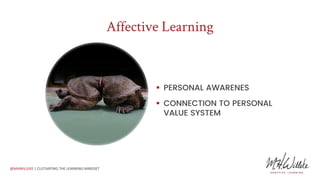
Affective Learning
 PERSONAL AWARENES
 CONNECTION TO PERSONAL
VALUE SYSTEM
@MHWILLEKE | CULTIVATING THE LEARNING MINDSET
Our Questions Today
What motivates a learning mindset?
How do adults learn effectively?
How do we, as managers, influence a learning mindset?
@MHWILLEKE | CULTIVATING THE LEARNING MINDSET
Growth Mindset
What is mindset, anyway?
The perception of control over intellect that
determines how to handle:
Threat Self-evaluation Performance
DWECK, 2007 | JOHNSON & STAPEL, 2010
@MHWILLEKE | CULTIVATING THE LEARNING MINDSET
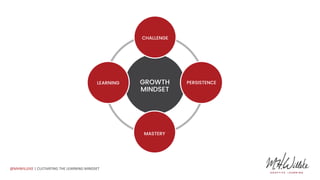
GROWTH
MINDSET
CHALLENGE
PERSISTENCE
MASTERY
LEARNING
@MHWILLEKE | CULTIVATING THE LEARNING MINDSET
GROWTH
MINDSET
FIXED
MINDSET
Avoiding
Challenge Embracing
Challenge
CHALLENGE
PERSISTENCE
Give Up
Challenged by
Setbacks
MASTERY
Efforts are
Pointless
Efforts are a
Journey
@MHWILLEKE | CULTIVATING THE LEARNING MINDSET
GROWTH
MINDSET
FIXED
MINDSET
Dismiss
Criticism Embrace
Criticism
LEARNING
SUB-CONSTRUCTS
Insecure by
Others’ Success Pleased by
Others’ Success
Threatened by
Others Inspired by
Others
@MHWILLEKE | CULTIVATING THE LEARNING MINDSET
Catalyst: Whole Person Learning
 Cognitive Learning Domain
BLOOM, 1956
 Affective Learning Domain
KRATHWOHL, BLOOM, & MASIA, 1973
Affective learning has been
found as a predictor to
attitude and motivation.
@MHWILLEKE | CULTIVATING THE LEARNING MINDSET
Cognitive Learning
Domain
Simple recall
Explain in own
words
Perform task
Deconstruct
elements of
system
Critique based
on experience
and theory
Add to
existing
knowledge
@MHWILLEKE | CULTIVATING THE LEARNING MINDSET
Affective Learning
Domain
Present and
Listening
Actively
Participates
Believes Strongly
Organise Values
into Personal
Value System
Value System
Influences
Others
@MHWILLEKE | CULTIVATING THE LEARNING MINDSET
Individuation
 Metaphors and stories vs literal analysis
provides emotional connection.
 The emotional connection creates paths for
resolution of issues.
 Free writing, journaling, and symbol images
helps pattern discovery individually and as
groups.
A Path to
Transformation
Through
Understanding
One’s Self
JUNG, 1969
@MHWILLEKE | CULTIVATING THE LEARNING MINDSET
Felt Encounter Framework
 Approach a learning encounter as a verb instead
of a noun.
 Facilitate with the understanding that individuals
will have a unique way of knowing something
that is equally valid to a different way.
 Distinguish between emotion and feeling in the
learning.
 Feeling: detecting what you feel through inputs
 Emotion: determining what the feelings mean
Designing Learning
Experiences to
Include Affect
HERON, 1992
@MHWILLEKE | CULTIVATING THE LEARNING MINDSET
Authenticity Model
 Maintain strong personal self-awareness.
 Be aware of the differences and preferences
of the individuals in your audience.
 Develop unique relationship between each
individual and yourself.
 Be aware of constraints.
 Engage in reflection.
Fostering Authentic
Relationships
CRANTON, 2006
@MHWILLEKE | CULTIVATING THE LEARNING MINDSET
Promoting Growth Mindset
ANDRAGOGICAL
FRAMEWORK
LEARNING
PROCESS
LEARNING
THEORY
Transformative
Experiential
@MHWILLEKE | CULTIVATING THE LEARNING MINDSET
Movement
from
dependency
to self-
directed
Applies
experience
to learning
Learning
readiness
connects to
social roles
Problem
centered
(vs subject
centered)
Internal
motivations
are more
effective
Knowing the
“why” is
essential
Andragogy
Framework
KNOWLES, 1980
@MHWILLEKE | CULTIVATING THE LEARNING MINDSET
ILLERIS, 2003
ENVIRONMENT
SOCIETY
FUNCTIONALITY SENSIBILITY
SOCIALITY
Meaning ability Mental balance
Integration
Acquisition
Interaction
Learning Process
@MHWILLEKE | CULTIVATING THE LEARNING MINDSET
MEZIROW, 2001
DESCRIPTION
What happened?
 Context
 Roles played by you and others
FEELINGS
What were you thinking and
feeling at the time? How have
those feelings changed?
EVALUATION
What was good and bad about
the experience? Make a
judgement.
ANALYSIS
What sense can you make of the
situation?
 Explore details & the ‘why’ of your
judgements.
 What challenged you?
TEXT
How do class readings and
lectures relate to your
understanding of the incident?
CONCLUSION
What did you learn? What else
could you have done? Asses the
impact on you and on your future
actions.
REFLECTIVE
CYCLE
Transformative
Learning
@MHWILLEKE | CULTIVATING THE LEARNING MINDSET
ACT
Concrete Experience
Facts (What Happened?)
Theory of Action
CONCEPTUALIZE
Abstract Conceptualization
Findings (Why Did This Happen?)
Revise Theory
REFLECT
Reflective Observation
Feelings (What Did I Experience?)
Asses Behavior & Consequences
APPLY
Active Experimentation
Futures (What Will I Do?)
Implement Revised Theory
DAVID KOLB ROGER GREENAWAY CHRIS ARGYRIS & DONALD SCHÖN
COMPILED BY ANDREA CORNEY
www.edbatista.com/2007/10/experiential.html
Learning
Cycles
@MHWILLEKE | CULTIVATING THE LEARNING MINDSET
EXCITERS COMFORTS
CHALLENGES FEARS
@ERWILLEKE
Understand Your
People
Individuals are shaped by their
backgrounds and experiences.
Cherish it.
@MHWILLEKE | CULTIVATING THE LEARNING MINDSET
There are no tradeoffs –
the managers job is to:
 Empower your people to make the decisions
 Facilitate the decision making process when
they are afraid
 Let them fail
 Change the context to ensure their success
How do I manage the constraints between
learning and work?
Managing these constraints
is a perception of making
tradeoffs
@MHWILLEKE | CULTIVATING THE LEARNING MINDSET
Building a Learning Mindset Space
 Propel the growth mindset
 Connect to each individual authentically
 Understand how adults learn
 Demonstrate vulnerability in your own
journey to self-actualisation
@MHWILLEKE | CULTIVATING THE LEARNING MINDSET
Your Action….
Pick one thing.
Do it.
Reflect on your success of doing it in 6 months.
Ask yourself:
 Am I more aware?
 Do I have more empathy?
@MHWILLEKE | CULTIVATING THE LEARNING MINDSET

Cultivating the Learning Mindset

  • 1.
    @MHWILLEKE | CULTIVATINGTHE LEARNING MINDSET Cultivating the Learning Mindset MARIAN WILLEKE, PHD MHWILLEKE.COM /IN/MARIANWILLEKE @MHWILLEKE LEAN KANBAN CENTRAL EUROPE 2015 #LKCE15
  • 2.
    @MHWILLEKE | CULTIVATINGTHE LEARNING MINDSET Cognitive Learning  MEASURABLE  “FROM THE NECK UP”
  • 3.
    @MHWILLEKE | CULTIVATINGTHE LEARNING MINDSET Affective Learning  PERSONAL AWARENES  CONNECTION TO PERSONAL VALUE SYSTEM
  • 4.
    @MHWILLEKE | CULTIVATINGTHE LEARNING MINDSET Our Questions Today What motivates a learning mindset? How do adults learn effectively? How do we, as managers, influence a learning mindset?
  • 5.
    @MHWILLEKE | CULTIVATINGTHE LEARNING MINDSET Growth Mindset What is mindset, anyway? The perception of control over intellect that determines how to handle: Threat Self-evaluation Performance DWECK, 2007 | JOHNSON & STAPEL, 2010
  • 6.
    @MHWILLEKE | CULTIVATINGTHE LEARNING MINDSET GROWTH MINDSET CHALLENGE PERSISTENCE MASTERY LEARNING
  • 7.
    @MHWILLEKE | CULTIVATINGTHE LEARNING MINDSET GROWTH MINDSET FIXED MINDSET Avoiding Challenge Embracing Challenge CHALLENGE PERSISTENCE Give Up Challenged by Setbacks MASTERY Efforts are Pointless Efforts are a Journey
  • 8.
    @MHWILLEKE | CULTIVATINGTHE LEARNING MINDSET GROWTH MINDSET FIXED MINDSET Dismiss Criticism Embrace Criticism LEARNING SUB-CONSTRUCTS Insecure by Others’ Success Pleased by Others’ Success Threatened by Others Inspired by Others
  • 9.
    @MHWILLEKE | CULTIVATINGTHE LEARNING MINDSET Catalyst: Whole Person Learning  Cognitive Learning Domain BLOOM, 1956  Affective Learning Domain KRATHWOHL, BLOOM, & MASIA, 1973 Affective learning has been found as a predictor to attitude and motivation.
  • 10.
    @MHWILLEKE | CULTIVATINGTHE LEARNING MINDSET Cognitive Learning Domain Simple recall Explain in own words Perform task Deconstruct elements of system Critique based on experience and theory Add to existing knowledge
  • 11.
    @MHWILLEKE | CULTIVATINGTHE LEARNING MINDSET Affective Learning Domain Present and Listening Actively Participates Believes Strongly Organise Values into Personal Value System Value System Influences Others
  • 12.
    @MHWILLEKE | CULTIVATINGTHE LEARNING MINDSET Individuation  Metaphors and stories vs literal analysis provides emotional connection.  The emotional connection creates paths for resolution of issues.  Free writing, journaling, and symbol images helps pattern discovery individually and as groups. A Path to Transformation Through Understanding One’s Self JUNG, 1969
  • 13.
    @MHWILLEKE | CULTIVATINGTHE LEARNING MINDSET Felt Encounter Framework  Approach a learning encounter as a verb instead of a noun.  Facilitate with the understanding that individuals will have a unique way of knowing something that is equally valid to a different way.  Distinguish between emotion and feeling in the learning.  Feeling: detecting what you feel through inputs  Emotion: determining what the feelings mean Designing Learning Experiences to Include Affect HERON, 1992
  • 14.
    @MHWILLEKE | CULTIVATINGTHE LEARNING MINDSET Authenticity Model  Maintain strong personal self-awareness.  Be aware of the differences and preferences of the individuals in your audience.  Develop unique relationship between each individual and yourself.  Be aware of constraints.  Engage in reflection. Fostering Authentic Relationships CRANTON, 2006
  • 15.
    @MHWILLEKE | CULTIVATINGTHE LEARNING MINDSET Promoting Growth Mindset ANDRAGOGICAL FRAMEWORK LEARNING PROCESS LEARNING THEORY Transformative Experiential
  • 16.
    @MHWILLEKE | CULTIVATINGTHE LEARNING MINDSET Movement from dependency to self- directed Applies experience to learning Learning readiness connects to social roles Problem centered (vs subject centered) Internal motivations are more effective Knowing the “why” is essential Andragogy Framework KNOWLES, 1980
  • 17.
    @MHWILLEKE | CULTIVATINGTHE LEARNING MINDSET ILLERIS, 2003 ENVIRONMENT SOCIETY FUNCTIONALITY SENSIBILITY SOCIALITY Meaning ability Mental balance Integration Acquisition Interaction Learning Process
  • 18.
    @MHWILLEKE | CULTIVATINGTHE LEARNING MINDSET MEZIROW, 2001 DESCRIPTION What happened?  Context  Roles played by you and others FEELINGS What were you thinking and feeling at the time? How have those feelings changed? EVALUATION What was good and bad about the experience? Make a judgement. ANALYSIS What sense can you make of the situation?  Explore details & the ‘why’ of your judgements.  What challenged you? TEXT How do class readings and lectures relate to your understanding of the incident? CONCLUSION What did you learn? What else could you have done? Asses the impact on you and on your future actions. REFLECTIVE CYCLE Transformative Learning
  • 19.
    @MHWILLEKE | CULTIVATINGTHE LEARNING MINDSET ACT Concrete Experience Facts (What Happened?) Theory of Action CONCEPTUALIZE Abstract Conceptualization Findings (Why Did This Happen?) Revise Theory REFLECT Reflective Observation Feelings (What Did I Experience?) Asses Behavior & Consequences APPLY Active Experimentation Futures (What Will I Do?) Implement Revised Theory DAVID KOLB ROGER GREENAWAY CHRIS ARGYRIS & DONALD SCHÖN COMPILED BY ANDREA CORNEY www.edbatista.com/2007/10/experiential.html Learning Cycles
  • 20.
    @MHWILLEKE | CULTIVATINGTHE LEARNING MINDSET
  • 21.
    @MHWILLEKE | CULTIVATINGTHE LEARNING MINDSET EXCITERS COMFORTS CHALLENGES FEARS @ERWILLEKE Understand Your People Individuals are shaped by their backgrounds and experiences. Cherish it.
  • 22.
    @MHWILLEKE | CULTIVATINGTHE LEARNING MINDSET There are no tradeoffs – the managers job is to:  Empower your people to make the decisions  Facilitate the decision making process when they are afraid  Let them fail  Change the context to ensure their success How do I manage the constraints between learning and work? Managing these constraints is a perception of making tradeoffs
  • 23.
    @MHWILLEKE | CULTIVATINGTHE LEARNING MINDSET Building a Learning Mindset Space  Propel the growth mindset  Connect to each individual authentically  Understand how adults learn  Demonstrate vulnerability in your own journey to self-actualisation
  • 24.
    @MHWILLEKE | CULTIVATINGTHE LEARNING MINDSET Your Action…. Pick one thing. Do it. Reflect on your success of doing it in 6 months. Ask yourself:  Am I more aware?  Do I have more empathy?
  • 25.
    @MHWILLEKE | CULTIVATINGTHE LEARNING MINDSET