







Teaching by Design:
Managing Successful
Mindsets
February, 10 2018- 10am-2pm
Presenter: Val Margarit, Ed.D
www.valmargarit.com
Overview
●Teach (Live) by Design
●Fixed versus Growth mindset
●Research on how beliefs shape
learning and who we become
●How to teach by design using
mindsets to achieve success
www.valmargarit.com
Quick Activity
Write (quickly – not much thinking)
about
• One thing you’ve always been good
at,
• One thing you think you’ll never be
good at and
• One thing you weren’t good at, but
became good at over time
www.valmargarit.com
Some students are highly motivated and
others are not.
Why?
Why some people achieve their
goals and others do not?
What Motivates Students
to Achieve Success in School?
www.valmargarit.com
Mindsets and Achievement
● Decades of research show a powerful
relationship between
mindset and achievement.
● Students’ beliefs about intelligence and
learning, impact:
■Motivation
■Academic behaviors (e.g., studying and seeking help)
■Responses to challenges and setbacks
■Academic achievement
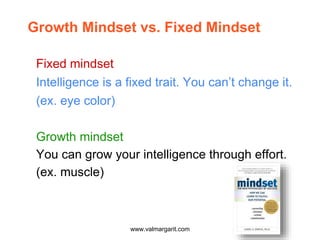
Growth Mindset vs. Fixed Mindset
Fixed mindset
Intelligence is a fixed trait. You can’t change it.
(ex. eye color)
Growth mindset
You can grow your intelligence through effort.
(ex. muscle)
www.valmargarit.com
Activity
● Your intelligence is something very basic about you
that you cannot change very much
● No matter how much intelligence you have, you can
always change it quite a bit
● Only a few people will be truly good at sports, you
have to be born with the ability
● The harder you work at something, the better you will
be
● You can always change how intelligent you are
● You are who you are and there is not much that can
be done to change that
www.valmargarit.com
Mindsets
These two beliefs lead students to very different conclusions about the
meaning of events
www.valmargarit.com
Mindsets
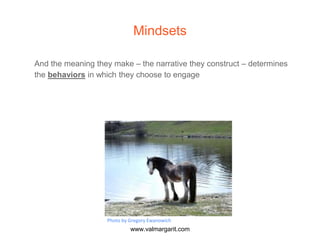
And the meaning they make – the narrative they construct – determines
the behaviors in which they choose to engage
Photo by Gregory Ewanowich
www.valmargarit.com
Blackwell, Trzesniewski, & Dweck 2007
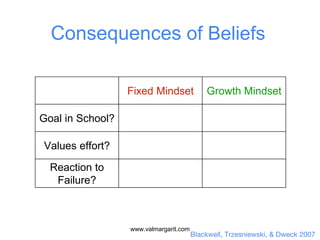
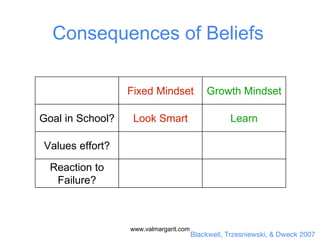
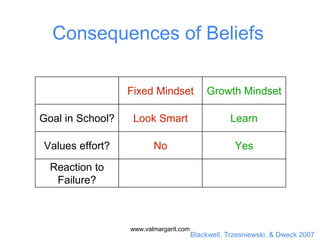
Consequences of Beliefs
Fixed Mindset Growth Mindset
Goal in School?
Values effort?
Reaction to
Failure?
www.valmargarit.com
Blackwell, Trzesniewski, & Dweck 2007
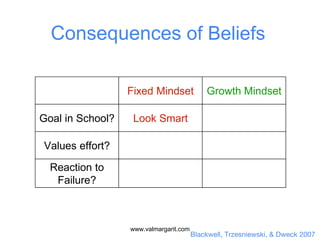
Fixed Mindset Growth Mindset
Goal in School? Look Smart
Values effort?
Reaction to
Failure?
Consequences of Beliefs
www.valmargarit.com
Blackwell, Trzesniewski, & Dweck 2007
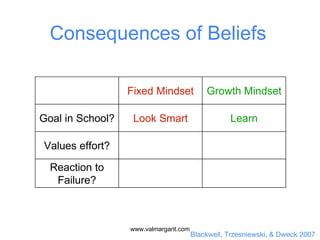
Fixed Mindset Growth Mindset
Goal in School? Look Smart Learn
Values effort?
Reaction to
Failure?
Consequences of Beliefs
www.valmargarit.com
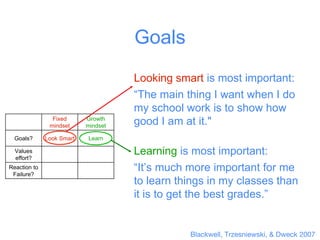
Goals
Looking smart is most important:
“The main thing I want when I do
my school work is to show how
good I am at it."
Learning is most important:
“It’s much more important for me
to learn things in my classes than
it is to get the best grades.”
Fixed
mindset
Growth
mindset
Goals? Look Smart Learn
Values
effort?
Reaction to
Failure?
Blackwell, Trzesniewski, & Dweck 2007
Consequences of Beliefs
Fixed Mindset Growth Mindset
Goal in School? Look Smart Learn
Values effort?
Reaction to
Failure?
www.valmargarit.com
Blackwell, Trzesniewski, & Dweck 2007
Consequences of Beliefs
Fixed Mindset Growth Mindset
Goal in School? Look Smart Learn
Values effort? No
Reaction to
Failure?
www.valmargarit.com
Blackwell, Trzesniewski, & Dweck 2007
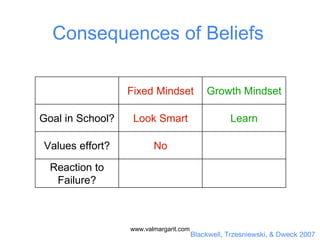
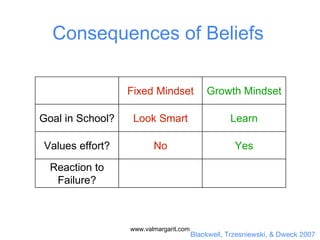
Consequences of Beliefs
Fixed Mindset Growth Mindset
Goal in School? Look Smart Learn
Values effort? No Yes
Reaction to
Failure?
www.valmargarit.com
Value of Effort
Fixed
mindset
Growth
mindset
Goals? Look Smart Learn
Values
effort?
No Yes
Reaction to
Failure?
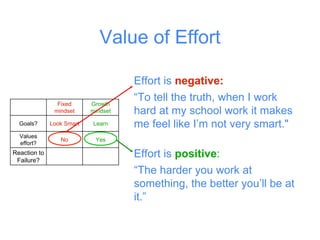
Effort is negative:
“To tell the truth, when I work
hard at my school work it makes
me feel like I’m not very smart."
Effort is positive:
“The harder you work at
something, the better you’ll be at
it.”
Blackwell, Trzesniewski, & Dweck 2007
Consequences of Beliefs
Fixed Mindset Growth Mindset
Goal in School? Look Smart Learn
Values effort? No Yes
Reaction to
Failure?
www.valmargarit.com
Blackwell, Trzesniewski, & Dweck 2007
Consequences of Beliefs
Fixed Mindset Growth Mindset
Goal in School? Look Smart Learn
Values effort? No Yes
Reaction to
Failure?
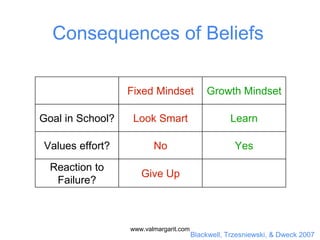
Give Up
www.valmargarit.com
Blackwell, Trzesniewski, & Dweck 2007
Consequences of Beliefs
Fixed Mindset Growth Mindset
Goal in School? Look Smart Learn
Values effort? No Yes
Reaction to
Failure?
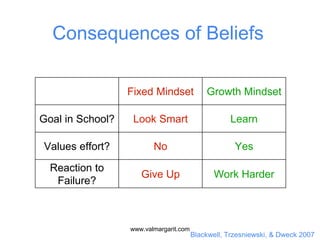
Give Up Work Harder
www.valmargarit.com
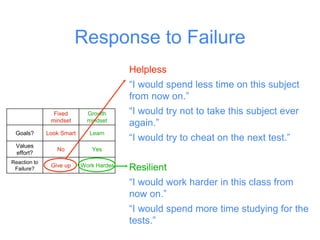
Response to Failure
Helpless
“I would spend less time on this subject
from now on.”
“I would try not to take this subject ever
again.”
“I would try to cheat on the next test.”
Resilient
“I would work harder in this class from
now on.”
“I would spend more time studying for the
tests.”
Fixed
mindset
Growth
mindset
Goals? Look Smart Learn
Values
effort?
No Yes
Reaction to
Failure?
Give up Work Harder
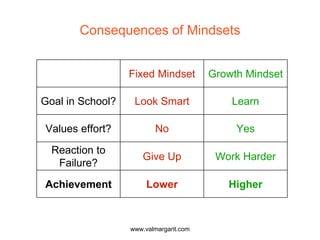
Consequences of Mindsets
Fixed Mindset Growth Mindset
Goal in School? Look Smart Learn
Values effort? No Yes
Reaction to
Failure?
Give Up Work Harder
Achievement Lower Higher
www.valmargarit.com
Let’s Watch “Growing Your Mind”
Questions:
When our brains grow the most?
How do people become more intelligent?
www.valmargarit.com
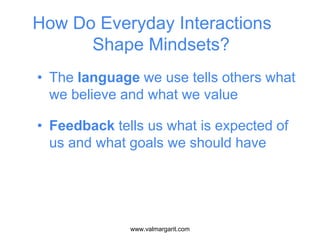
How Do Everyday Interactions
Shape Mindsets?
• The language we use tells others what
we believe and what we value
• Feedback tells us what is expected of
us and what goals we should have
www.valmargarit.com
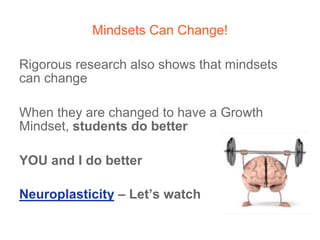
Mindsets Can Change!
Rigorous research also shows that mindsets
can change
When they are changed to have a Growth
Mindset, students do better
YOU and I do better
Neuroplasticity – Let’s watch
What Can We Do For
Our Students?
What Can We Do For
Ourselves?
Teach and Live by Design!
Let’s learn together and use
growth mindset to teach and
live by design!
www.valmargarit.com
Activities
• How I overcame a struggle to solve a problem.
• In a group, share a story about a time that you
made your brain smarter.
• Let’s apply growth mindset strategies to
achieve our (SMART) goals-
personal/professional
○ What is the goal? (ex. Health, career, financial,
personal…)
○ What challenges you have and want to overcome?
(stress, time management, sleep, …)
www.valmargarit.com
Reflection & Comments?
Workshop Evaluation Form
Testimonials
Thank you!
www.valmargarit.com

Val Margarit, Ed.D Faculty Training Workshop: Teaching by Design

  • 1.
    Teaching by Design: ManagingSuccessful Mindsets February, 10 2018- 10am-2pm Presenter: Val Margarit, Ed.D www.valmargarit.com
  • 2.
    Overview ●Teach (Live) byDesign ●Fixed versus Growth mindset ●Research on how beliefs shape learning and who we become ●How to teach by design using mindsets to achieve success www.valmargarit.com
  • 3.
    Quick Activity Write (quickly– not much thinking) about • One thing you’ve always been good at, • One thing you think you’ll never be good at and • One thing you weren’t good at, but became good at over time www.valmargarit.com
  • 4.
    Some students arehighly motivated and others are not. Why? Why some people achieve their goals and others do not? What Motivates Students to Achieve Success in School? www.valmargarit.com
  • 5.
    Mindsets and Achievement ●Decades of research show a powerful relationship between mindset and achievement. ● Students’ beliefs about intelligence and learning, impact: ■Motivation ■Academic behaviors (e.g., studying and seeking help) ■Responses to challenges and setbacks ■Academic achievement
  • 6.
    Growth Mindset vs.Fixed Mindset Fixed mindset Intelligence is a fixed trait. You can’t change it. (ex. eye color) Growth mindset You can grow your intelligence through effort. (ex. muscle) www.valmargarit.com
  • 7.
    Activity ● Your intelligenceis something very basic about you that you cannot change very much ● No matter how much intelligence you have, you can always change it quite a bit ● Only a few people will be truly good at sports, you have to be born with the ability ● The harder you work at something, the better you will be ● You can always change how intelligent you are ● You are who you are and there is not much that can be done to change that www.valmargarit.com
  • 8.
    Mindsets These two beliefslead students to very different conclusions about the meaning of events www.valmargarit.com
  • 9.
    Mindsets And the meaningthey make – the narrative they construct – determines the behaviors in which they choose to engage Photo by Gregory Ewanowich www.valmargarit.com
  • 10.
    Blackwell, Trzesniewski, &Dweck 2007 Consequences of Beliefs Fixed Mindset Growth Mindset Goal in School? Values effort? Reaction to Failure? www.valmargarit.com
  • 11.
    Blackwell, Trzesniewski, &Dweck 2007 Fixed Mindset Growth Mindset Goal in School? Look Smart Values effort? Reaction to Failure? Consequences of Beliefs www.valmargarit.com
  • 12.
    Blackwell, Trzesniewski, &Dweck 2007 Fixed Mindset Growth Mindset Goal in School? Look Smart Learn Values effort? Reaction to Failure? Consequences of Beliefs www.valmargarit.com
  • 13.
    Goals Looking smart ismost important: “The main thing I want when I do my school work is to show how good I am at it." Learning is most important: “It’s much more important for me to learn things in my classes than it is to get the best grades.” Fixed mindset Growth mindset Goals? Look Smart Learn Values effort? Reaction to Failure? Blackwell, Trzesniewski, & Dweck 2007
  • 14.
    Blackwell, Trzesniewski, &Dweck 2007 Consequences of Beliefs Fixed Mindset Growth Mindset Goal in School? Look Smart Learn Values effort? Reaction to Failure? www.valmargarit.com
  • 15.
    Blackwell, Trzesniewski, &Dweck 2007 Consequences of Beliefs Fixed Mindset Growth Mindset Goal in School? Look Smart Learn Values effort? No Reaction to Failure? www.valmargarit.com
  • 16.
    Blackwell, Trzesniewski, &Dweck 2007 Consequences of Beliefs Fixed Mindset Growth Mindset Goal in School? Look Smart Learn Values effort? No Yes Reaction to Failure? www.valmargarit.com
  • 17.
    Value of Effort Fixed mindset Growth mindset Goals?Look Smart Learn Values effort? No Yes Reaction to Failure? Effort is negative: “To tell the truth, when I work hard at my school work it makes me feel like I’m not very smart." Effort is positive: “The harder you work at something, the better you’ll be at it.”
  • 18.
    Blackwell, Trzesniewski, &Dweck 2007 Consequences of Beliefs Fixed Mindset Growth Mindset Goal in School? Look Smart Learn Values effort? No Yes Reaction to Failure? www.valmargarit.com
  • 19.
    Blackwell, Trzesniewski, &Dweck 2007 Consequences of Beliefs Fixed Mindset Growth Mindset Goal in School? Look Smart Learn Values effort? No Yes Reaction to Failure? Give Up www.valmargarit.com
  • 20.
    Blackwell, Trzesniewski, &Dweck 2007 Consequences of Beliefs Fixed Mindset Growth Mindset Goal in School? Look Smart Learn Values effort? No Yes Reaction to Failure? Give Up Work Harder www.valmargarit.com
  • 21.
    Response to Failure Helpless “Iwould spend less time on this subject from now on.” “I would try not to take this subject ever again.” “I would try to cheat on the next test.” Resilient “I would work harder in this class from now on.” “I would spend more time studying for the tests.” Fixed mindset Growth mindset Goals? Look Smart Learn Values effort? No Yes Reaction to Failure? Give up Work Harder
  • 22.
    Consequences of Mindsets FixedMindset Growth Mindset Goal in School? Look Smart Learn Values effort? No Yes Reaction to Failure? Give Up Work Harder Achievement Lower Higher www.valmargarit.com
  • 23.
    Let’s Watch “GrowingYour Mind” Questions: When our brains grow the most? How do people become more intelligent? www.valmargarit.com
  • 24.
    How Do EverydayInteractions Shape Mindsets? • The language we use tells others what we believe and what we value • Feedback tells us what is expected of us and what goals we should have www.valmargarit.com
  • 25.
    Mindsets Can Change! Rigorousresearch also shows that mindsets can change When they are changed to have a Growth Mindset, students do better YOU and I do better Neuroplasticity – Let’s watch
  • 26.
    What Can WeDo For Our Students? What Can We Do For Ourselves? Teach and Live by Design!
  • 27.
    Let’s learn togetherand use growth mindset to teach and live by design! www.valmargarit.com
  • 28.
    Activities • How Iovercame a struggle to solve a problem. • In a group, share a story about a time that you made your brain smarter. • Let’s apply growth mindset strategies to achieve our (SMART) goals- personal/professional ○ What is the goal? (ex. Health, career, financial, personal…) ○ What challenges you have and want to overcome? (stress, time management, sleep, …) www.valmargarit.com
  • 29.
    Reflection & Comments? WorkshopEvaluation Form Testimonials Thank you! www.valmargarit.com