CU06997 Fluid Dynamics
    Flow in pipes and closed conduits
    4.5 Turbulent flow (page 100-111)
    4.6 Local head losses (page 112-116)
    4.7 Partially full pipes (page 116-121)


1
Culvert, no upstream and downstream
velocity


1
Culvert, with upstream and downstream
velocity


1
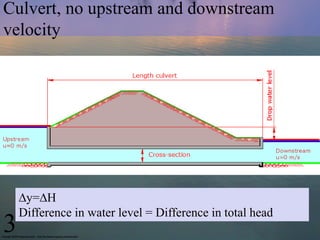
Culvert, no upstream and downstream
velocity           2         2
                   u1              u2
         y1  z1      y 2  z2      H12
                   2g              2g


 P1                                                    P2

                                       2
                                   u
2       ΔΗ culvert  ξ culvert        culvert
                                                 [m]
                                       2g
Friction loss, Darcy Weisbach


                        L
              f   
                       4R
2
Inlet and outlet loss [intree en uitree verlies]


                                         o  1
               2
      1   
 i    1
         
          
µ=contraction coëfficiënt (bv 0,6) [1]
2
Outlet los


    u  0,3   u  0,5

2
Loss at a (open) valve [klep]

      Between 0,1 and 0,2

    Loss at a non-return valve
    [terugslag klep]
      approximately 1
2
Head (energy) loss strategy
                       2
                   u
    ΔΗ  ξ                [m]
                   2g
                           2       2                  2
                     u       u         u
    ΔΗ total    ξ1   ξ 2   ξ... 
                           1       2
                                          [m]         ....
                     2g      2g        2g
    If velocity does not change

                                            2
                                        u
    ΔΗ total  (ξ1  ξ 2  ξ..... )            [m]
2                                       2g
Head (energy) loss culvert


                                                   o  1
               2
      1                     L
 i    1
                 f   
                           4R
                                                2
                                            u
        ΔΗ culvert  (ξ i  ξ f  ξ o )        culvert
                                                          [m]
2                                               2g
Submerged Culvert 1 [Volledig gevuld]
                      u2      tot  (ξ i  ξ f  ξ o  ....)
  ΔΗ tot     ξ tot   c
                      2g
∆𝐻 𝑡𝑜𝑡 =   Total Head Loss Culvert             [m]                    1   
                                                                                2

 𝜉 𝑡𝑜𝑡 =   Sum of Loss coefficients            [1]               i    1
                                                                         
 𝑢𝑐 =      Mean Fluid Velocity Culvert         [m/s]                      
 𝜉𝑖    =   Loss coefficient due to contraction [1]
                                                                            l
 𝜉𝑤 =      Loss coefficient due to friction    [1]              f   
                                                                           4R
 𝜉𝑜 =      Loss coefficient due to outlet      [1]
 𝜇     =   Contraction coefficient             [1]
 𝑔     =    earths gravity                     [m/s2]            o  1
 𝜆     =   Friction coefficient                [1]
R      =   Hydraulic Radius                    [m]
𝑙      =   Length between the Head Loss        [m]                          2
Submerged Culvert 2
                      2
                      u
     ΔΗ tot  ξ tot  c
                      2g   𝑄= 𝑢∙ 𝐴

            1
     m
             tot


     q  m  Ac  2 g  H tot
2b
Submerged Culvert 2

q  m  Ac  2 g  H tot
        1
m
        tot

 q = Flow rate Culvert              [m3/s]
  𝑚 = Discharge coefficient         [m]
  𝐴 = Wetted Area Culvert           [m2]
 ∆𝐻 𝑡𝑜𝑡 = Total Head Loss Culvert   [m]
 𝜉 𝑡𝑜𝑡 = Sum of Loss coefficients   [1]
  𝑔 = earths gravity                [m/s2]
2b
Culvert, no upstream and downstream
velocity


    ∆y=∆H
    Difference in water level = Difference in total head
3
Culvert, with upstream and downstream
velocity


    ∆y≠∆H
    Difference in water level ≠ Difference in total head
3
Culvert, with upstream and downstream
velocity
          2               2
          u               u
y1  z1  1
              y 2  z2  2
                              H12
          2g              2g


    P1                                                           P2

                                                      2
                                                  u
                        ΔΗculvert  ξ culvert        culvert
                                                                [m]
3                                                     2g
Exercise 1 culvert


•Difference in waterlevel 1 m
•Dimensions culvert 2 x 2 m

•μ=0,6 and λ = 0,022

•Calculate Q and draw the H and y line
Discharge culvert
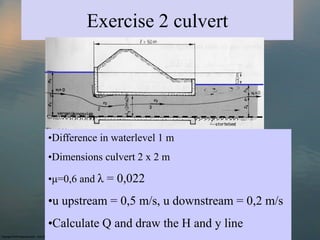
Exercise 2 culvert


•Difference in waterlevel 1 m
•Dimensions culvert 2 x 2 m

•μ=0,6 and λ = 0,022

•u upstream = 0,5 m/s, u downstream = 0,2 m/s
•Calculate Q and draw the H and y line

Cu06997 lecture 7_culvert_2013

  • 1.
    CU06997 Fluid Dynamics Flow in pipes and closed conduits 4.5 Turbulent flow (page 100-111) 4.6 Local head losses (page 112-116) 4.7 Partially full pipes (page 116-121) 1
  • 2.
    Culvert, no upstreamand downstream velocity 1
  • 3.
    Culvert, with upstreamand downstream velocity 1
  • 4.
    Culvert, no upstreamand downstream velocity 2 2 u1 u2 y1  z1   y 2  z2   H12 2g 2g P1 P2 2 u 2 ΔΗ culvert  ξ culvert  culvert [m] 2g
  • 5.
    Friction loss, DarcyWeisbach L f    4R 2
  • 6.
    Inlet and outletloss [intree en uitree verlies] o  1 2 1   i    1     µ=contraction coëfficiënt (bv 0,6) [1] 2
  • 7.
    Outlet los u  0,3 u  0,5 2
  • 8.
    Loss at a(open) valve [klep]   Between 0,1 and 0,2 Loss at a non-return valve [terugslag klep]   approximately 1 2
  • 9.
    Head (energy) lossstrategy 2 u ΔΗ  ξ  [m] 2g 2 2 2 u u u ΔΗ total  ξ1   ξ 2   ξ...  1 2 [m] .... 2g 2g 2g If velocity does not change 2 u ΔΗ total  (ξ1  ξ 2  ξ..... )  [m] 2 2g
  • 10.
    Head (energy) lossculvert o  1 2 1  L  i    1   f      4R 2 u ΔΗ culvert  (ξ i  ξ f  ξ o )  culvert [m] 2 2g
  • 11.
    Submerged Culvert 1[Volledig gevuld] u2 tot  (ξ i  ξ f  ξ o  ....) ΔΗ tot  ξ tot  c 2g ∆𝐻 𝑡𝑜𝑡 = Total Head Loss Culvert [m] 1  2 𝜉 𝑡𝑜𝑡 = Sum of Loss coefficients [1]  i    1   𝑢𝑐 = Mean Fluid Velocity Culvert [m/s]   𝜉𝑖 = Loss coefficient due to contraction [1] l 𝜉𝑤 = Loss coefficient due to friction [1] f    4R 𝜉𝑜 = Loss coefficient due to outlet [1] 𝜇 = Contraction coefficient [1] 𝑔 = earths gravity [m/s2] o  1 𝜆 = Friction coefficient [1] R = Hydraulic Radius [m] 𝑙 = Length between the Head Loss [m] 2
  • 12.
    Submerged Culvert 2 2 u ΔΗ tot  ξ tot  c 2g 𝑄= 𝑢∙ 𝐴 1 m  tot q  m  Ac  2 g  H tot 2b
  • 13.
    Submerged Culvert 2 q m  Ac  2 g  H tot 1 m  tot q = Flow rate Culvert [m3/s] 𝑚 = Discharge coefficient [m] 𝐴 = Wetted Area Culvert [m2] ∆𝐻 𝑡𝑜𝑡 = Total Head Loss Culvert [m] 𝜉 𝑡𝑜𝑡 = Sum of Loss coefficients [1] 𝑔 = earths gravity [m/s2] 2b
  • 14.
    Culvert, no upstreamand downstream velocity ∆y=∆H Difference in water level = Difference in total head 3
  • 15.
    Culvert, with upstreamand downstream velocity ∆y≠∆H Difference in water level ≠ Difference in total head 3
  • 16.
    Culvert, with upstreamand downstream velocity 2 2 u u y1  z1  1  y 2  z2  2  H12 2g 2g P1 P2 2 u ΔΗculvert  ξ culvert  culvert [m] 3 2g
  • 17.
    Exercise 1 culvert •Differencein waterlevel 1 m •Dimensions culvert 2 x 2 m •μ=0,6 and λ = 0,022 •Calculate Q and draw the H and y line
  • 18.
  • 19.
    Exercise 2 culvert •Differencein waterlevel 1 m •Dimensions culvert 2 x 2 m •μ=0,6 and λ = 0,022 •u upstream = 0,5 m/s, u downstream = 0,2 m/s •Calculate Q and draw the H and y line