Introduction to  Complex System Engineering Emmanuel FUCHS Slides available soon at www.elfuchs.fr
 
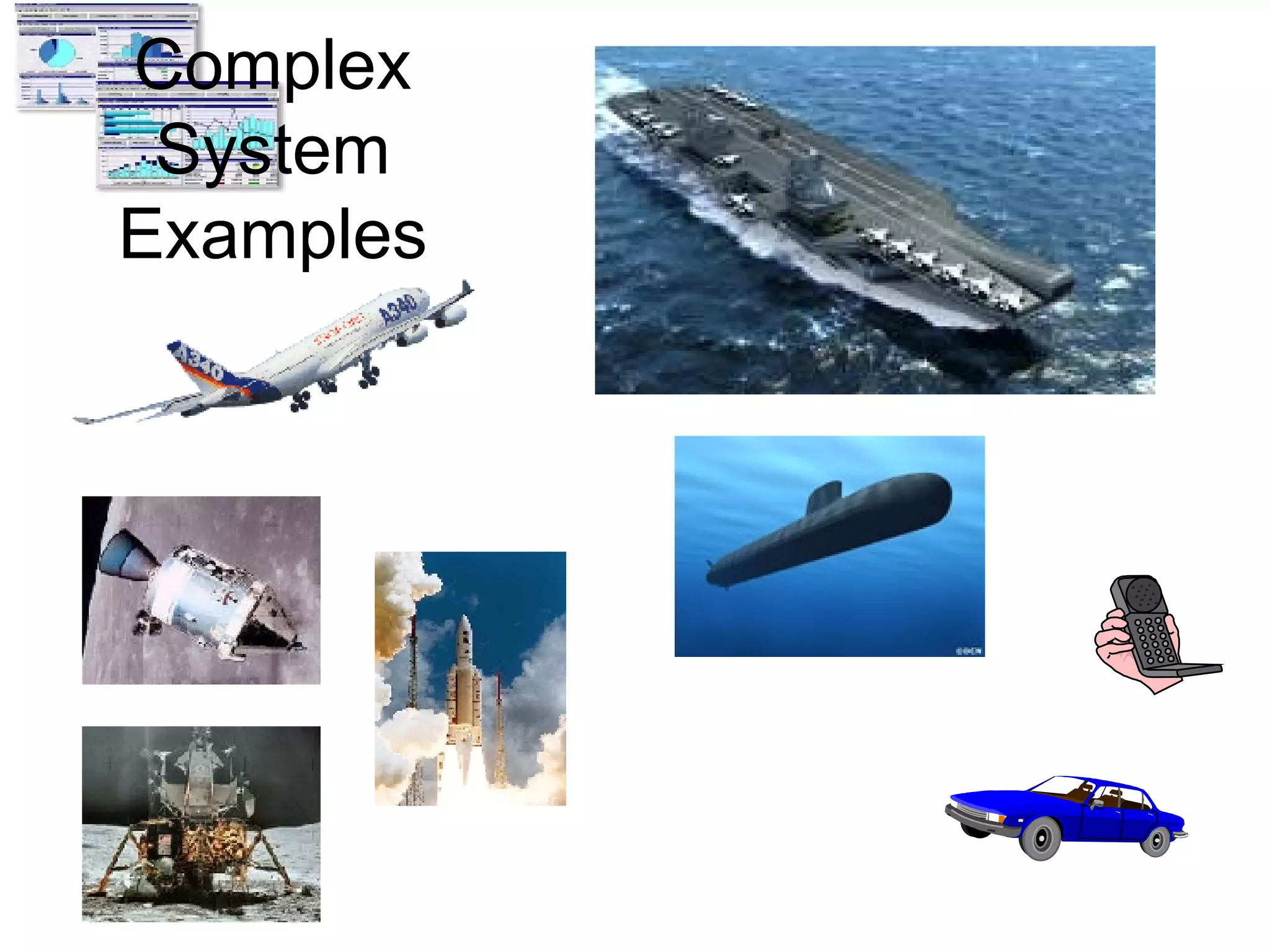
Complex System Examples Information Systems
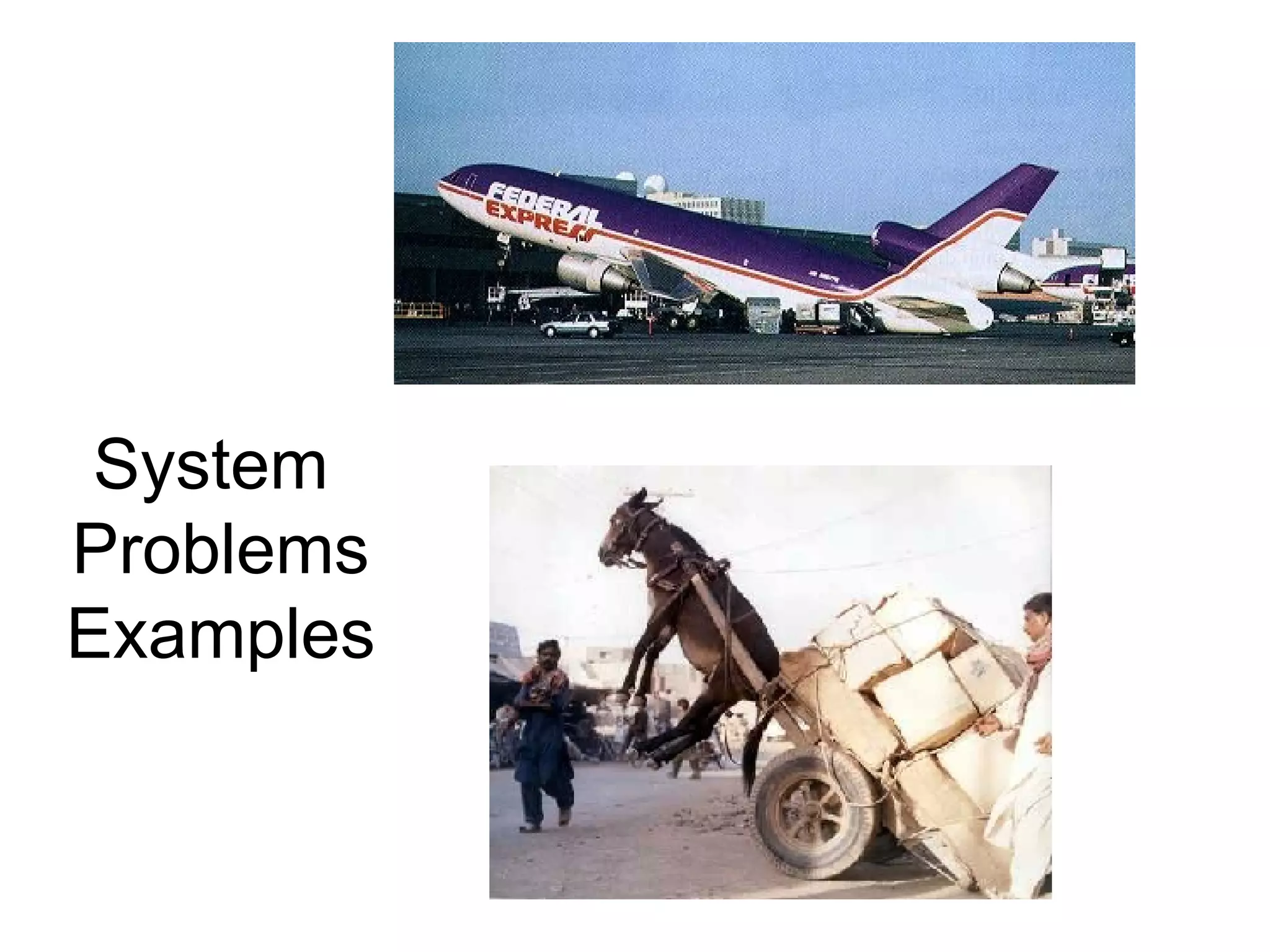
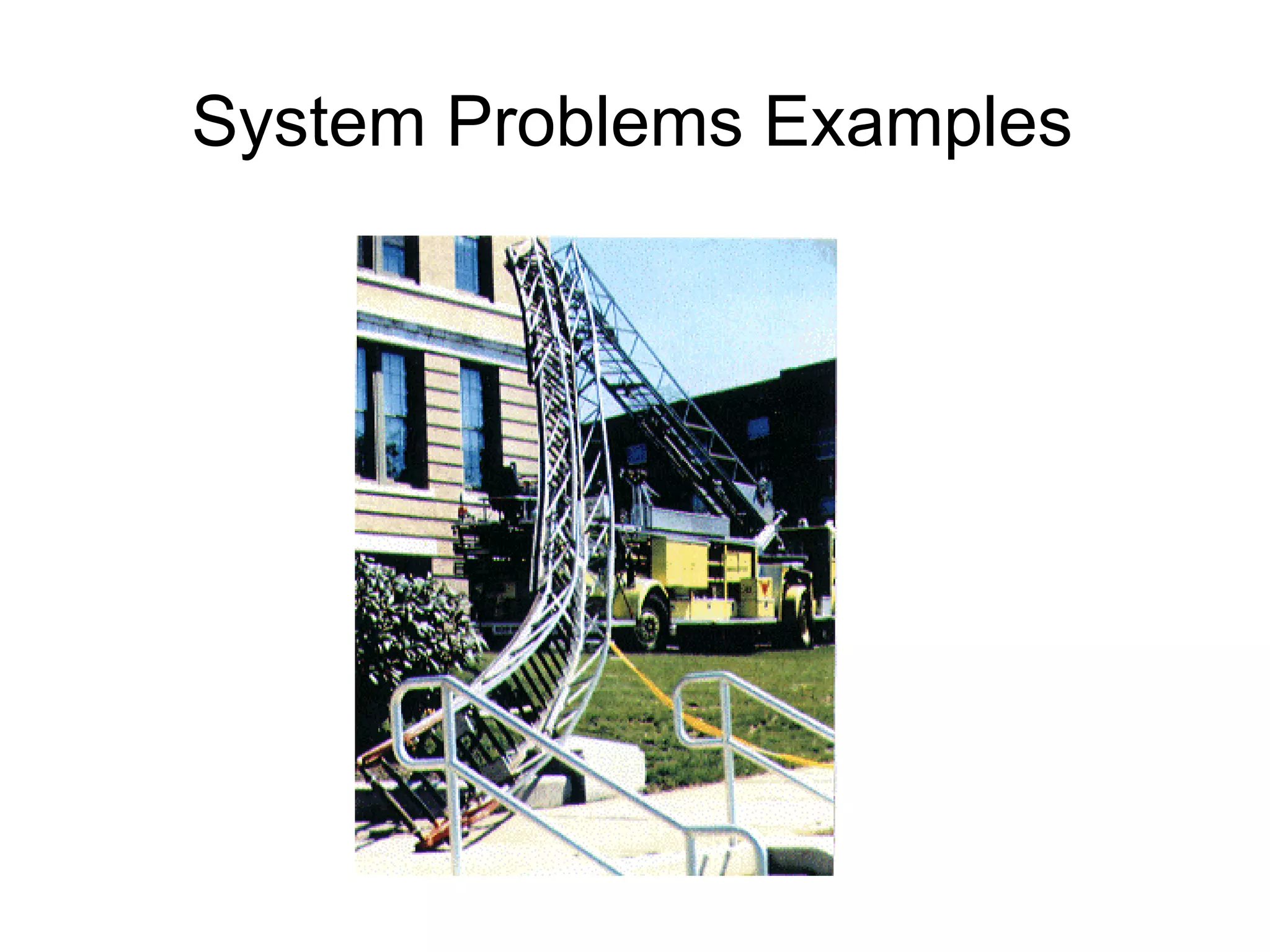
System  Problems Examples
System Problems Examples
 
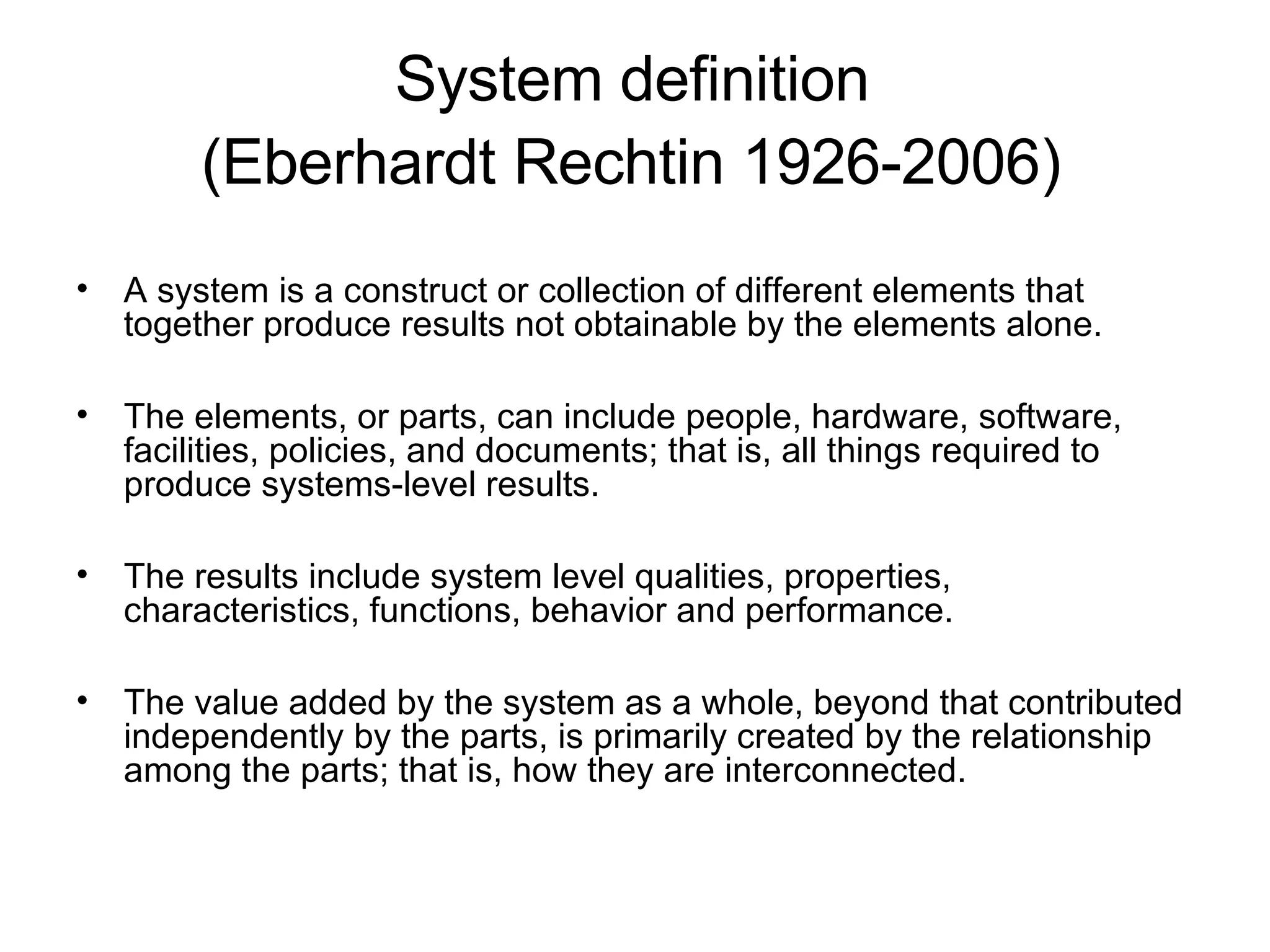
System definition  (Eberhardt Rechtin 1926-2006)   A system is a construct or collection of different elements that together produce results not obtainable by the elements alone.   The elements, or parts, can include people, hardware, software, facilities, policies, and documents; that is, all things required to produce systems-level results.   The results include system level qualities, properties, characteristics, functions, behavior and performance.   The value added by the system as a whole, beyond that contributed independently by the parts, is primarily created by the relationship among the parts; that is, how they are interconnected.
Systemic The whole is greater than the sum of the parts;  The part is greater than a fraction of the whole. Aristotle
System: another definition A  system  is any set (group) of interdependent or  temporally  interacting  parts .  Parts  are generally systems themselves and are composed of other parts, just as systems are generally parts of other systems.
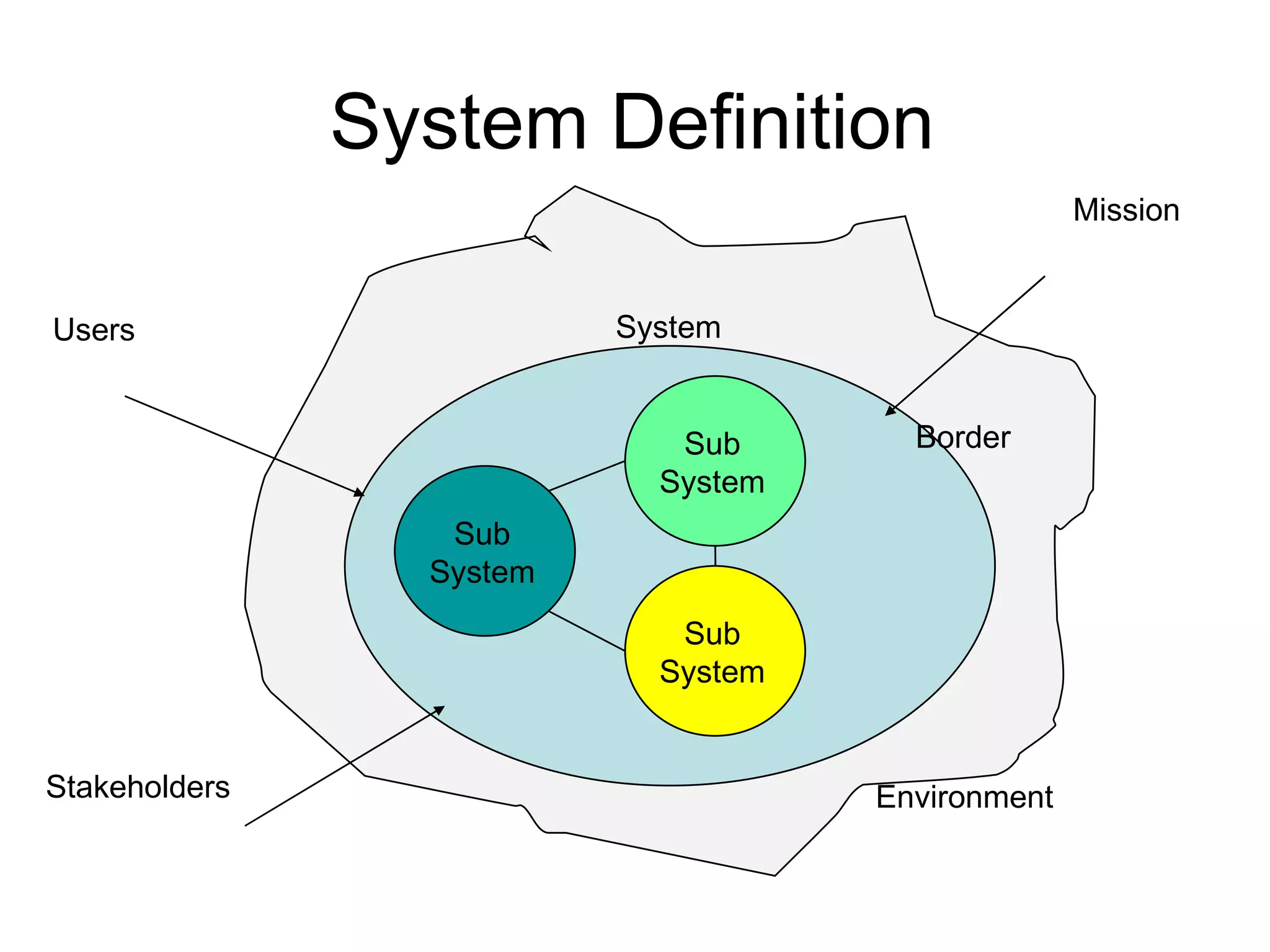
System Definition System Users Mission Environment Stakeholders Border Sub System Sub System Sub System
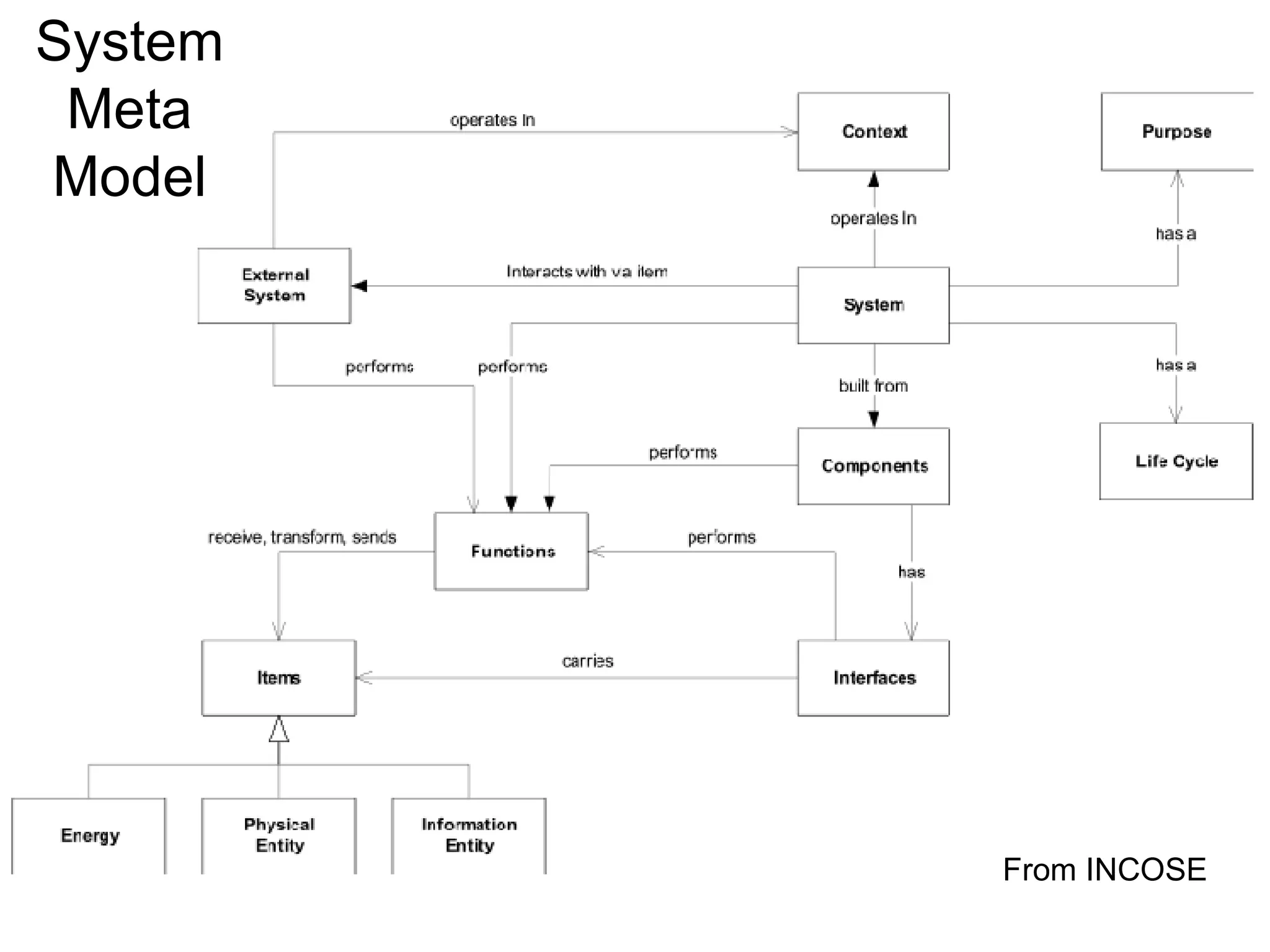
System Meta Model From INCOSE
SE Bodies http://www.afis.fr/ Association Française d'Ingénierie Système  http://www.incose.org/ International Council on Systems Engineering (INCOSE)
 
System Engineering Definition “ an  interdisciplinary  approach encompassing the entire technical effort to evolve and verify an integrated and balanced set of  system, people, product, and process solutions  that  satisfy customer needs …..”
System Engineering (SE) SE focuses on defining customer needs and required functionality early in the development cycle, documenting requirements, then proceeding with design synthesis and system validation while considering the complete problem Systems engineers deal with abstract systems, and rely on other engineering disciplines to design and deliver the tangible products that are the realization of those systems. Systems engineering effort spans the whole  system lifecycle .
Systemic Approach One + One >  two Aristotle : The whole is more than the sum of its parts. Parts (Components) Connections
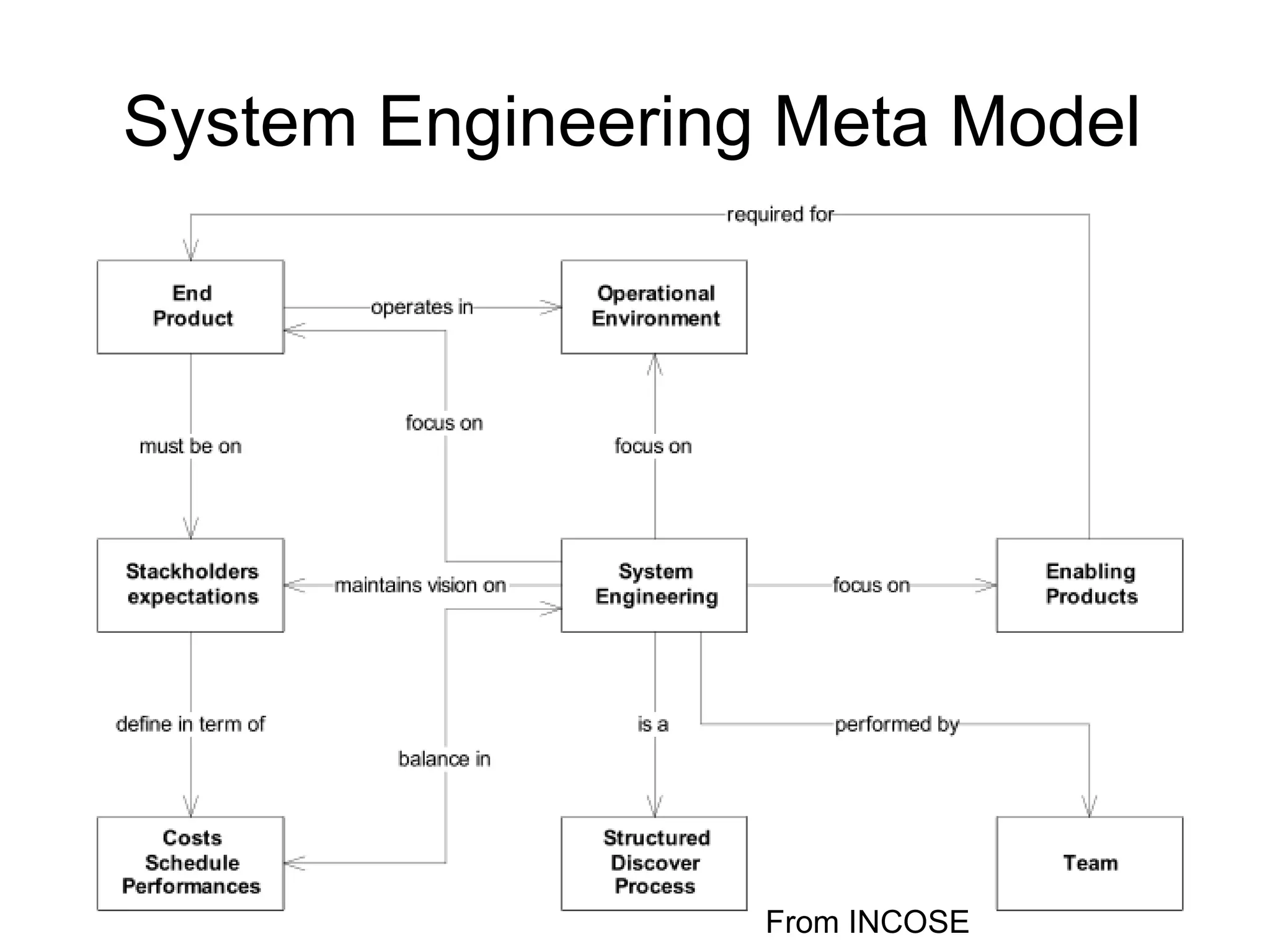
System Engineering Meta Model From INCOSE
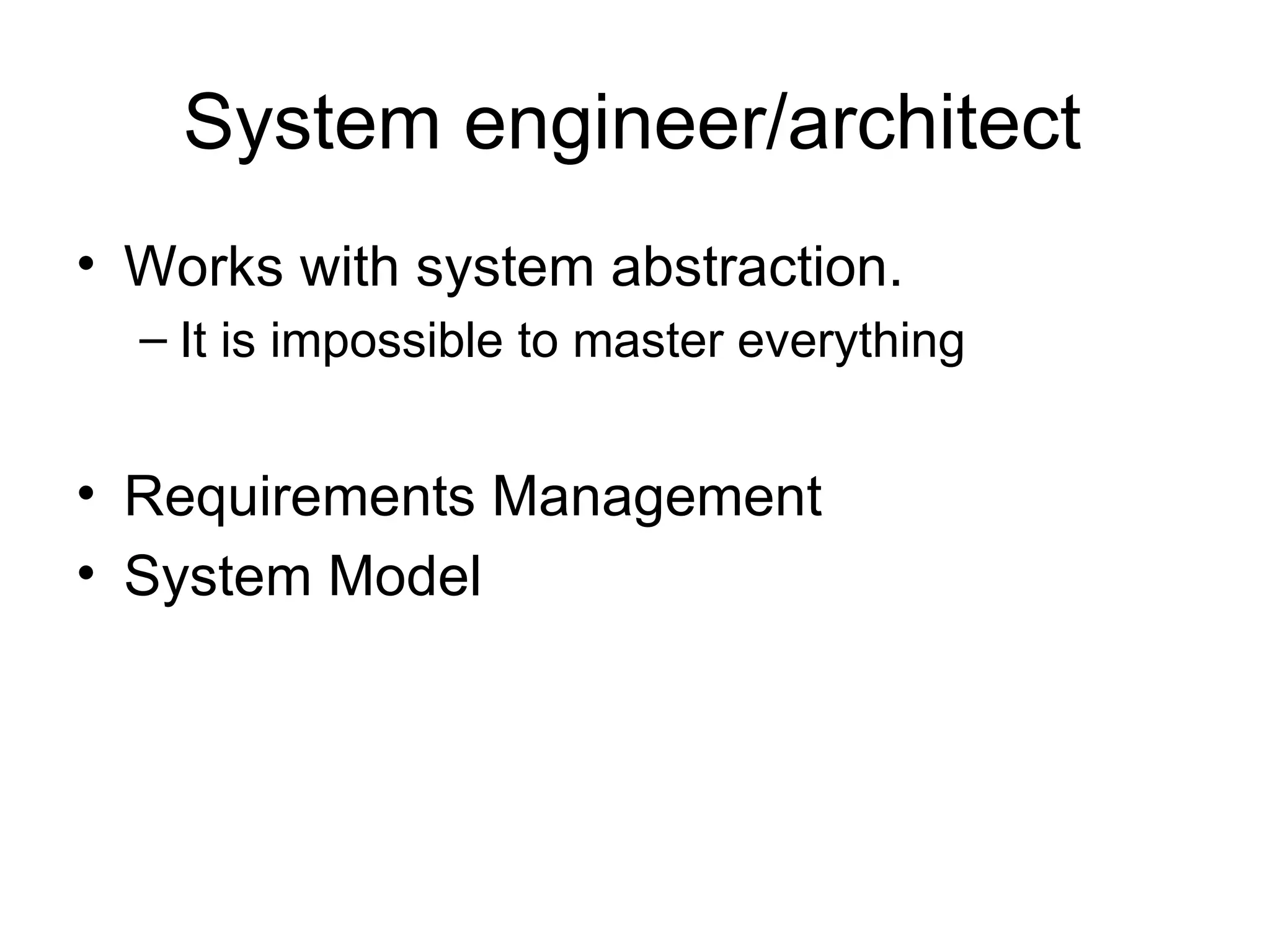
System engineer/architect Works with system abstraction. It is impossible to master everything Requirements Management System Model
 
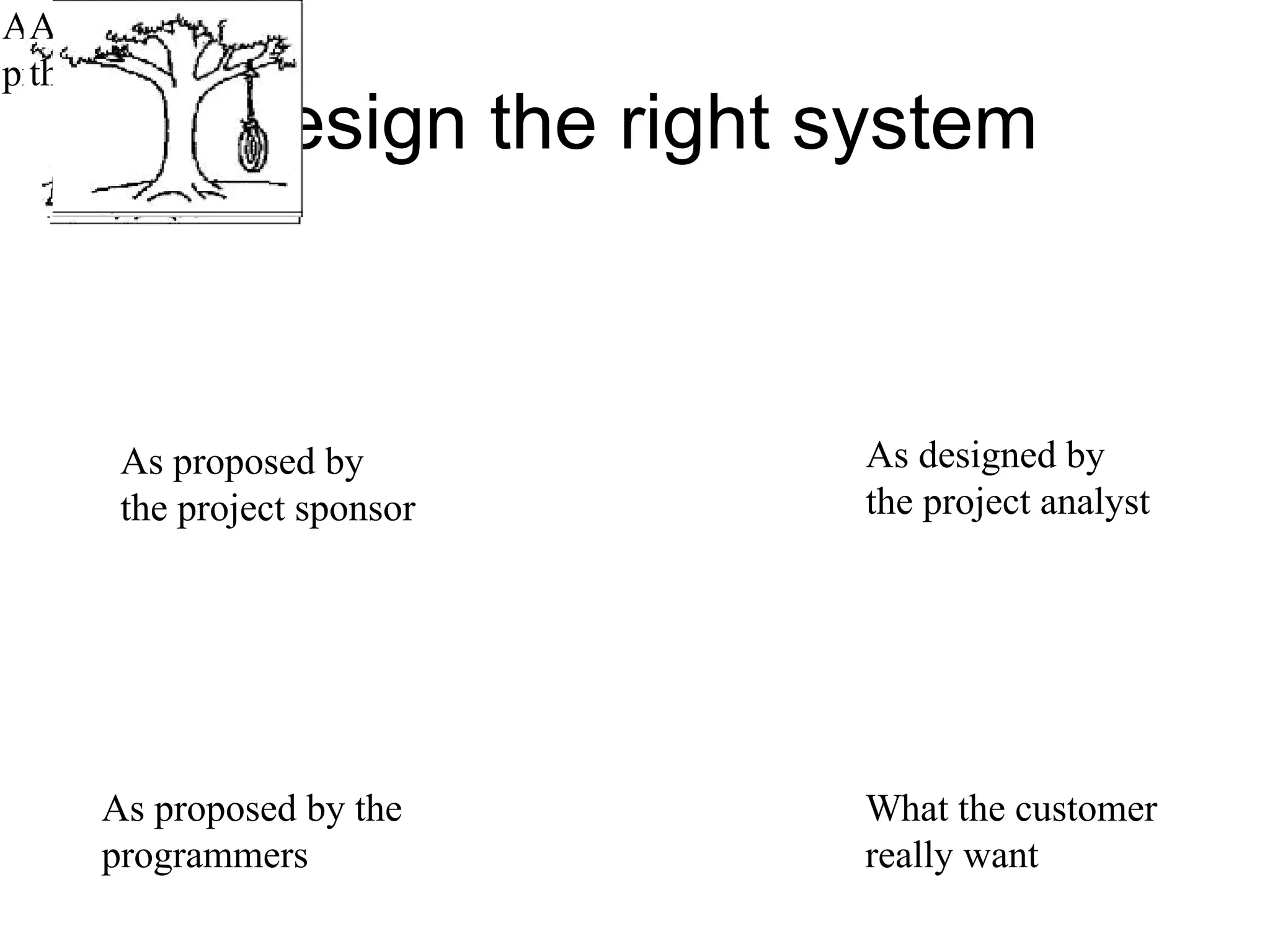
Design the right system As proposed by the project sponsor As proposed by the programmers As specified in the  project request As designed by the project analyst As installed at the users’ site What the customer really want
 
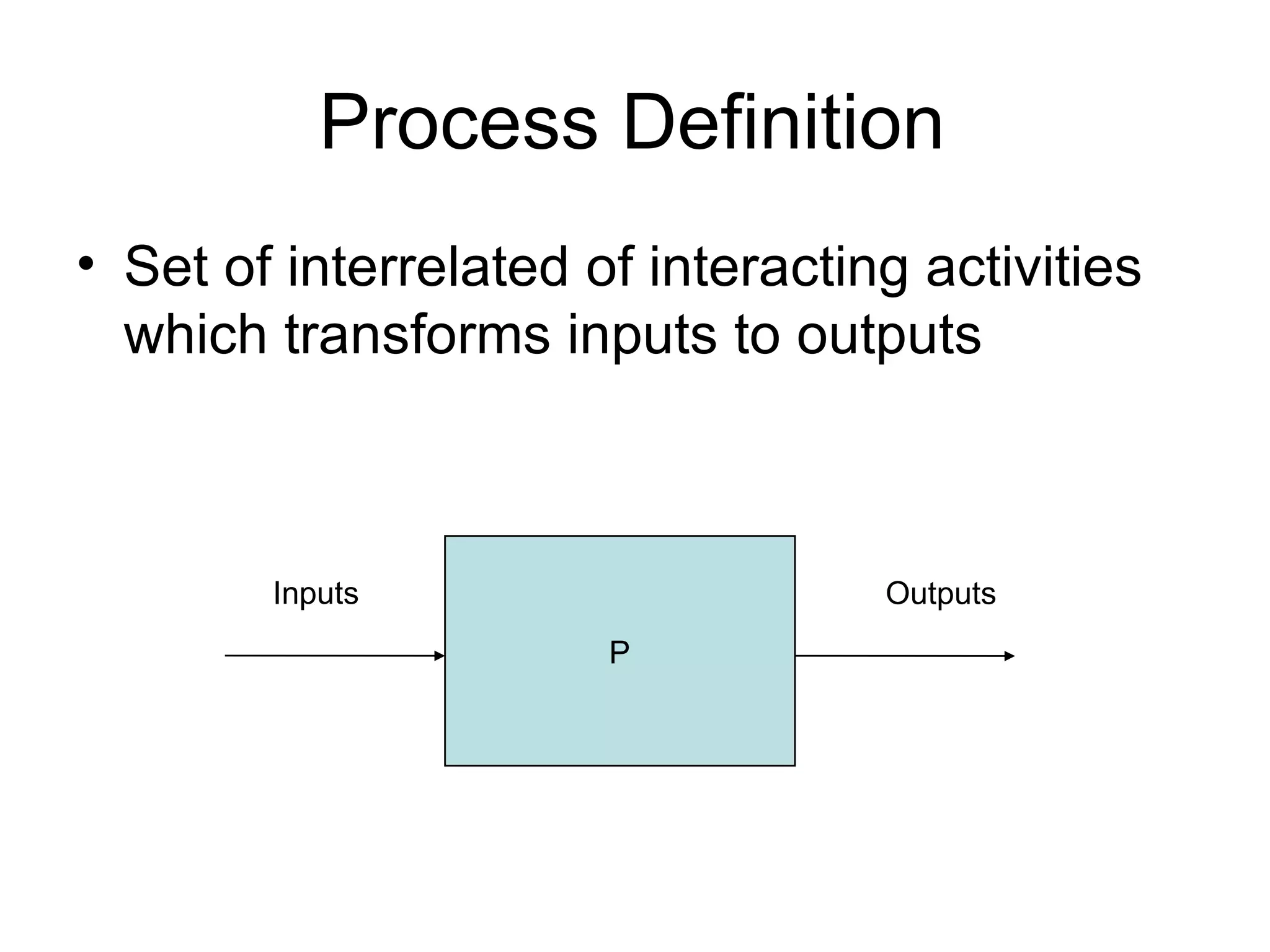
Process Definition Set of interrelated of interacting activities which transforms inputs to outputs Inputs Outputs P
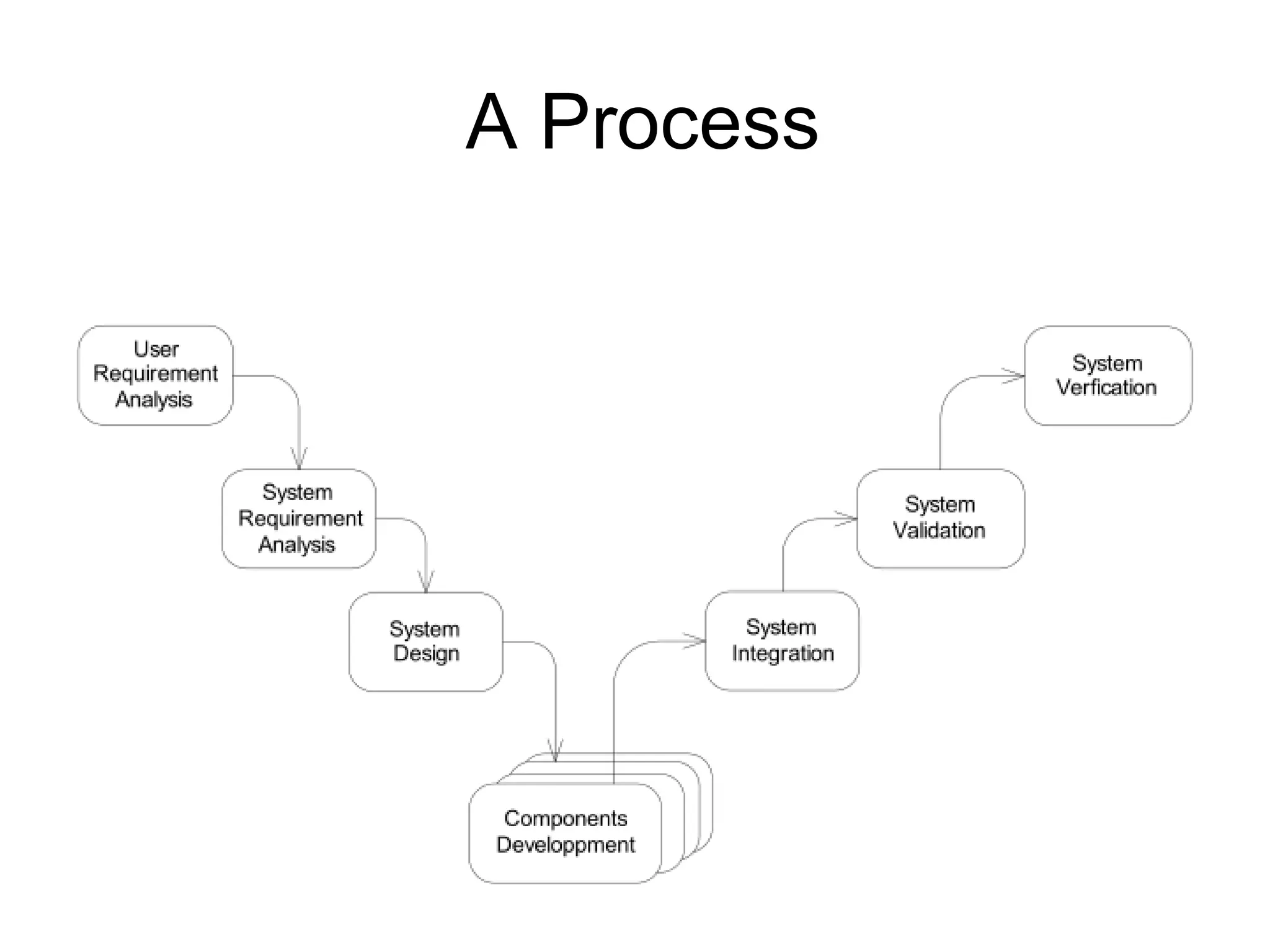
A Process
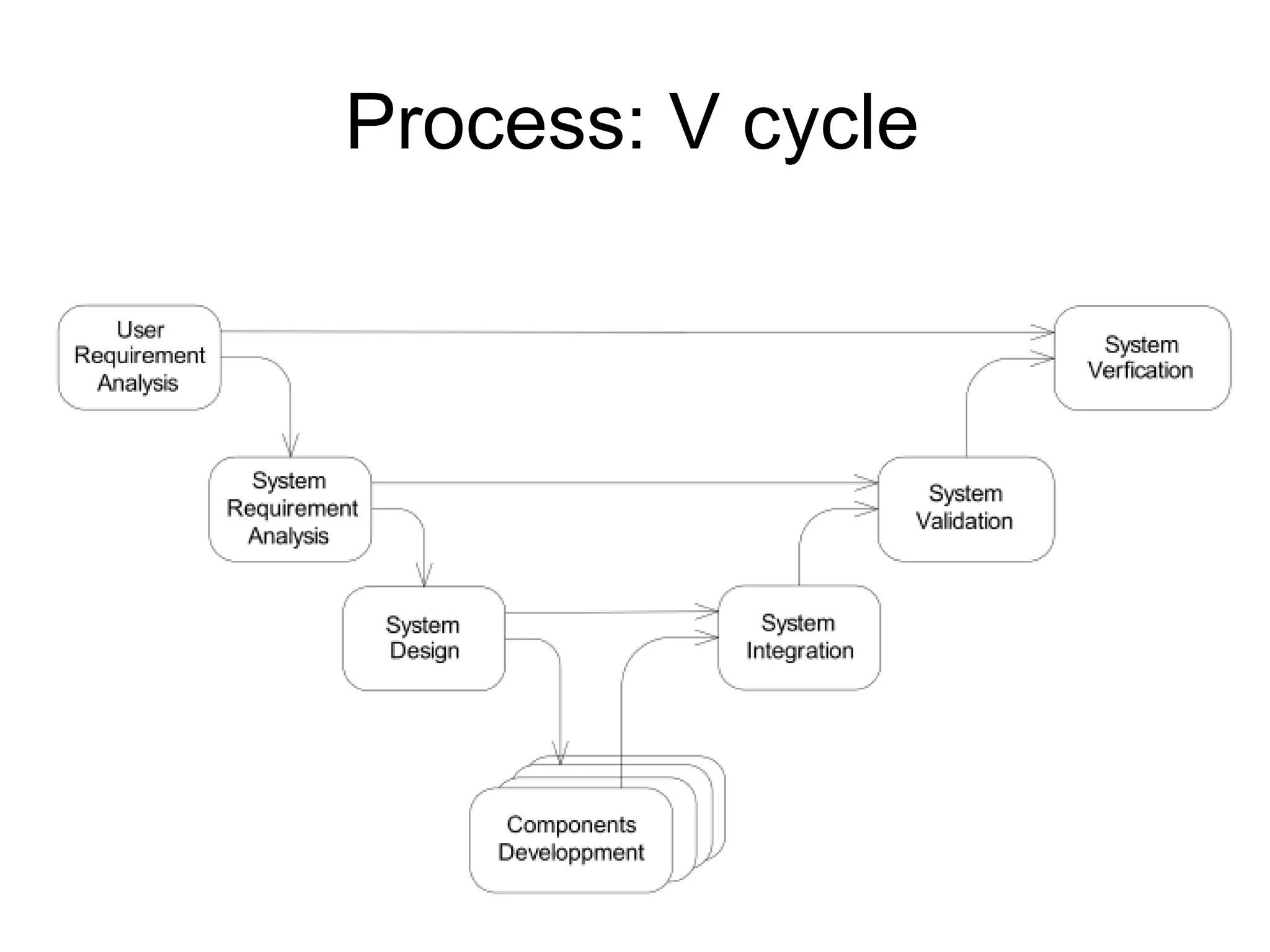
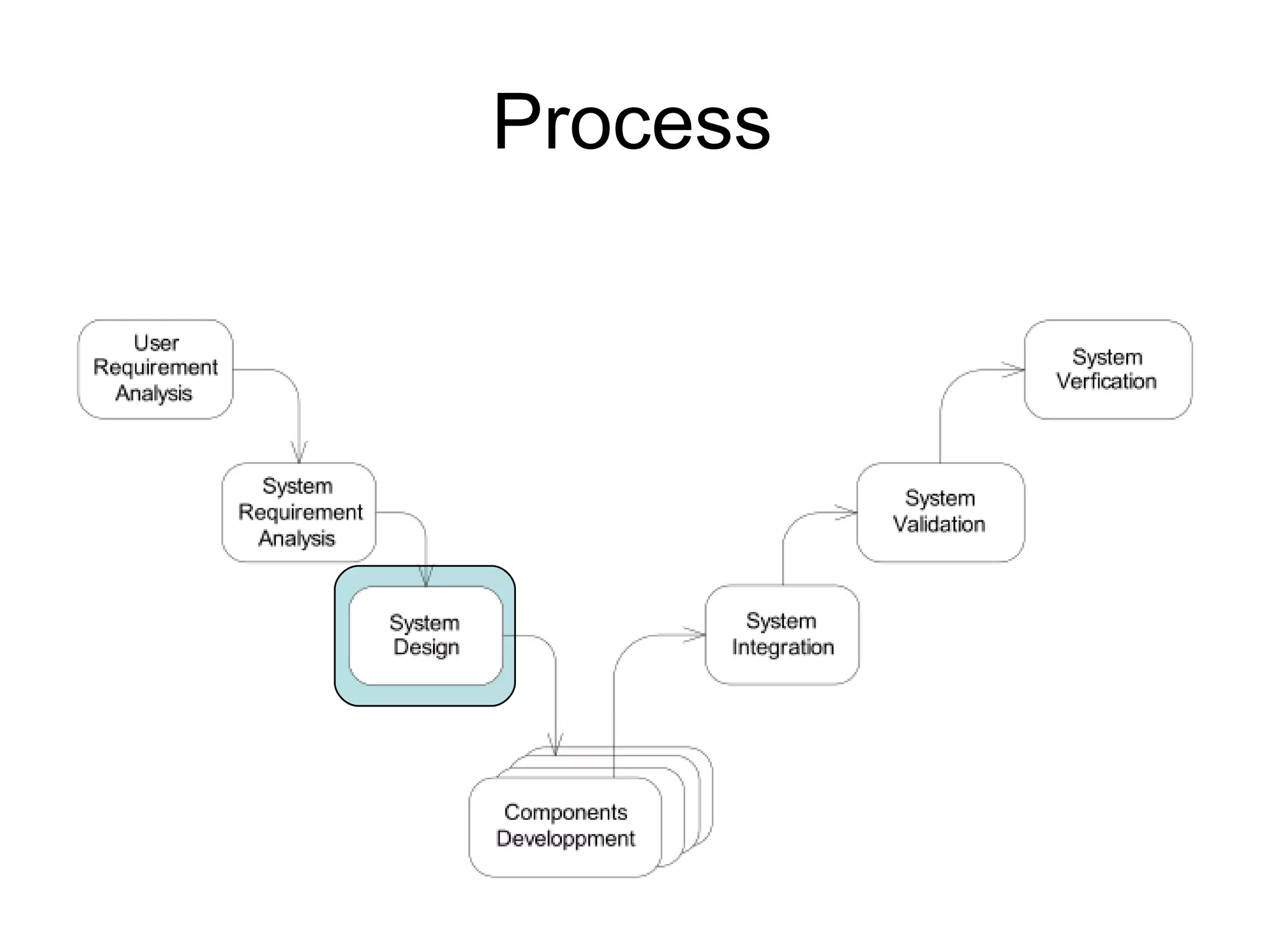
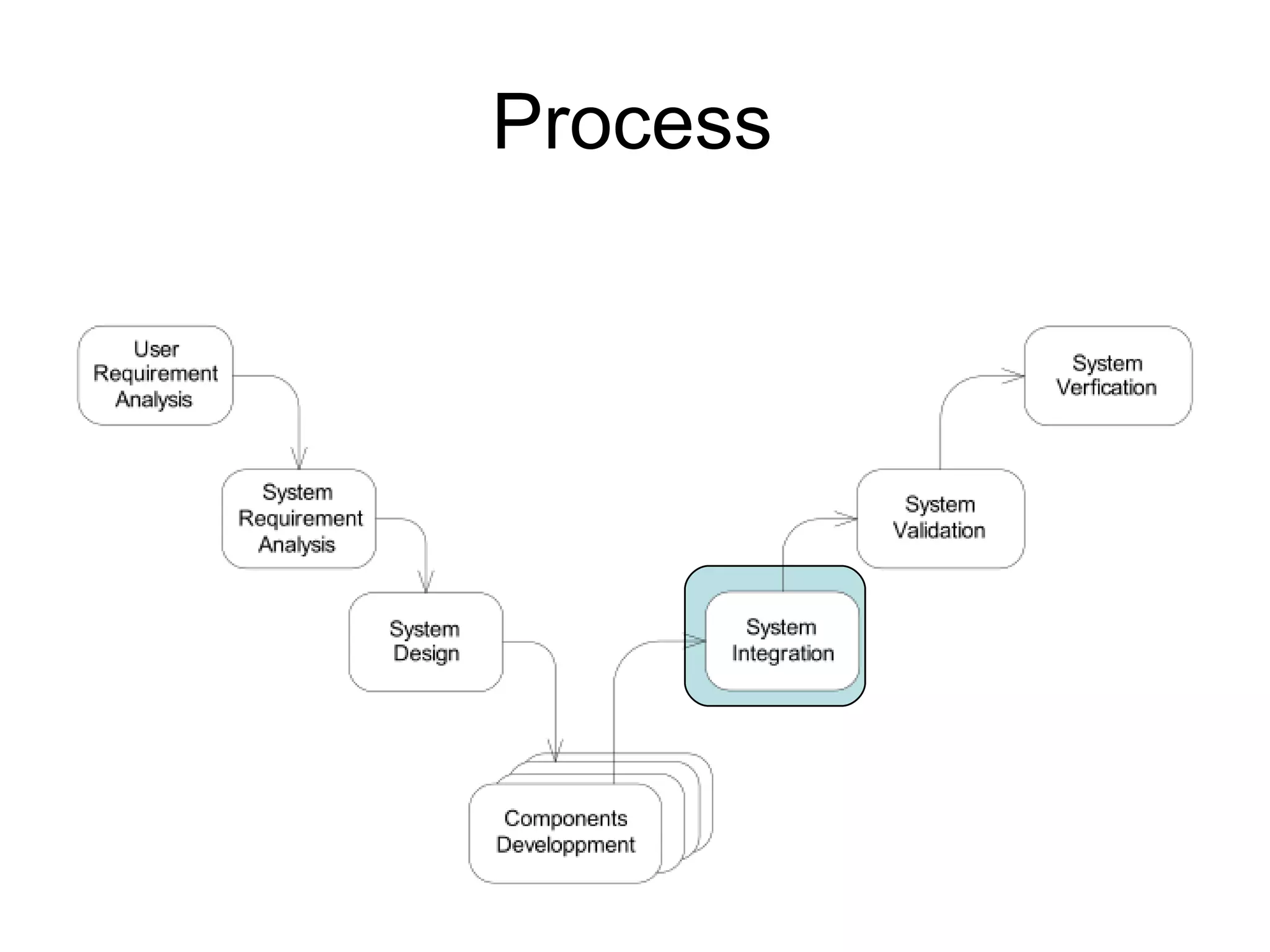
Process: V cycle
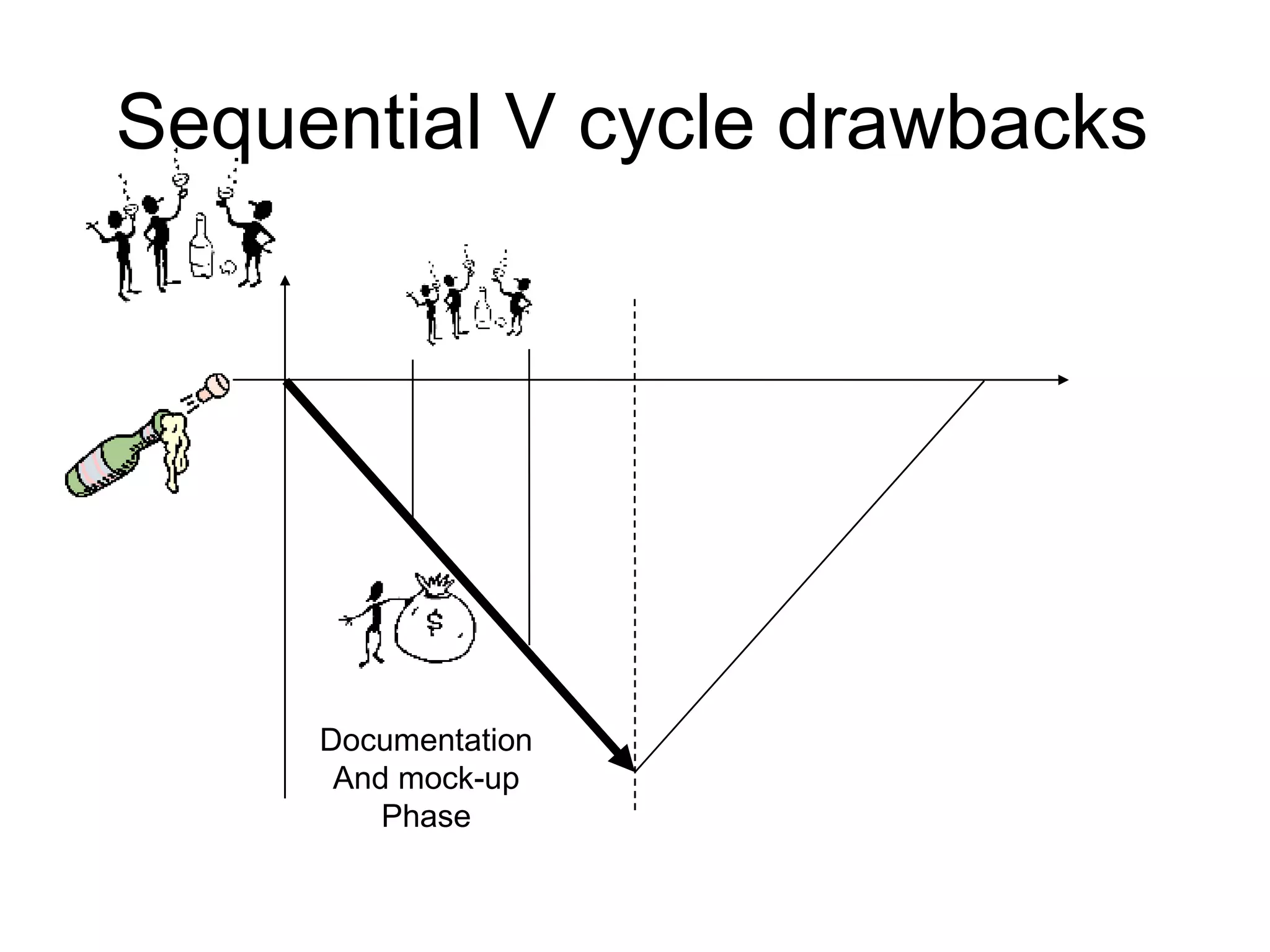
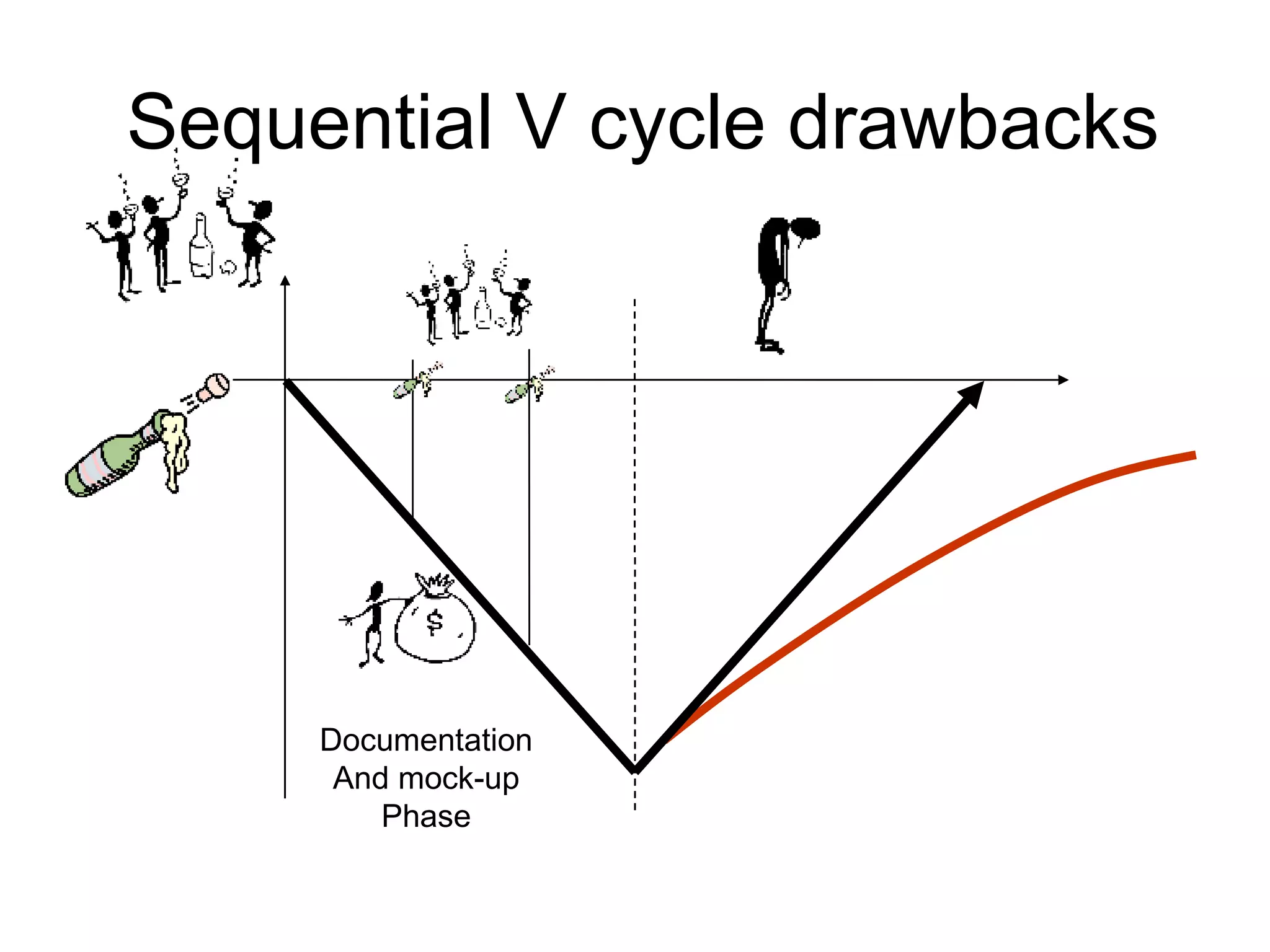
Sequential V cycle drawbacks Documentation And mock-up Phase
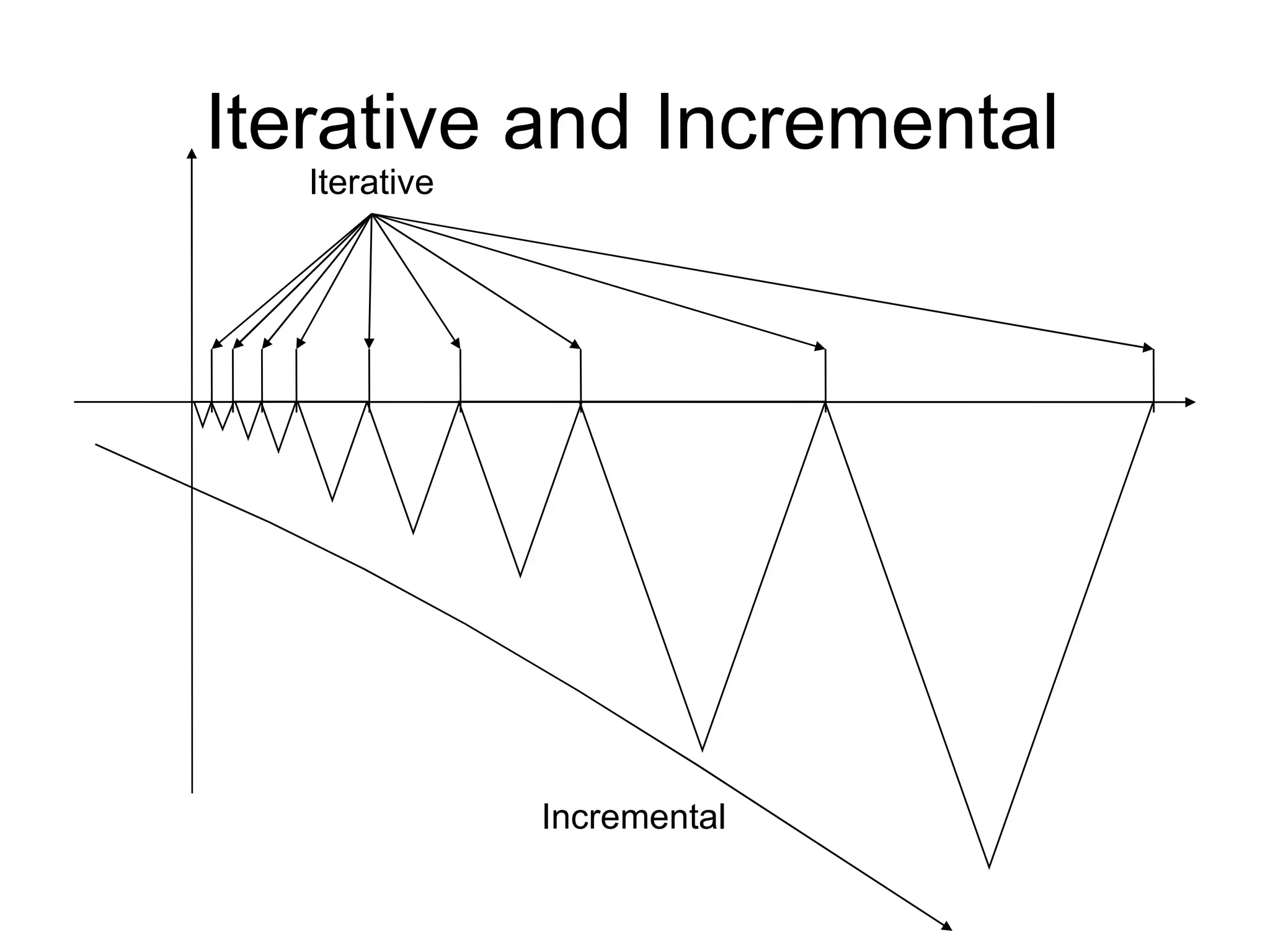
Iterative and Incremental Incremental Iterative
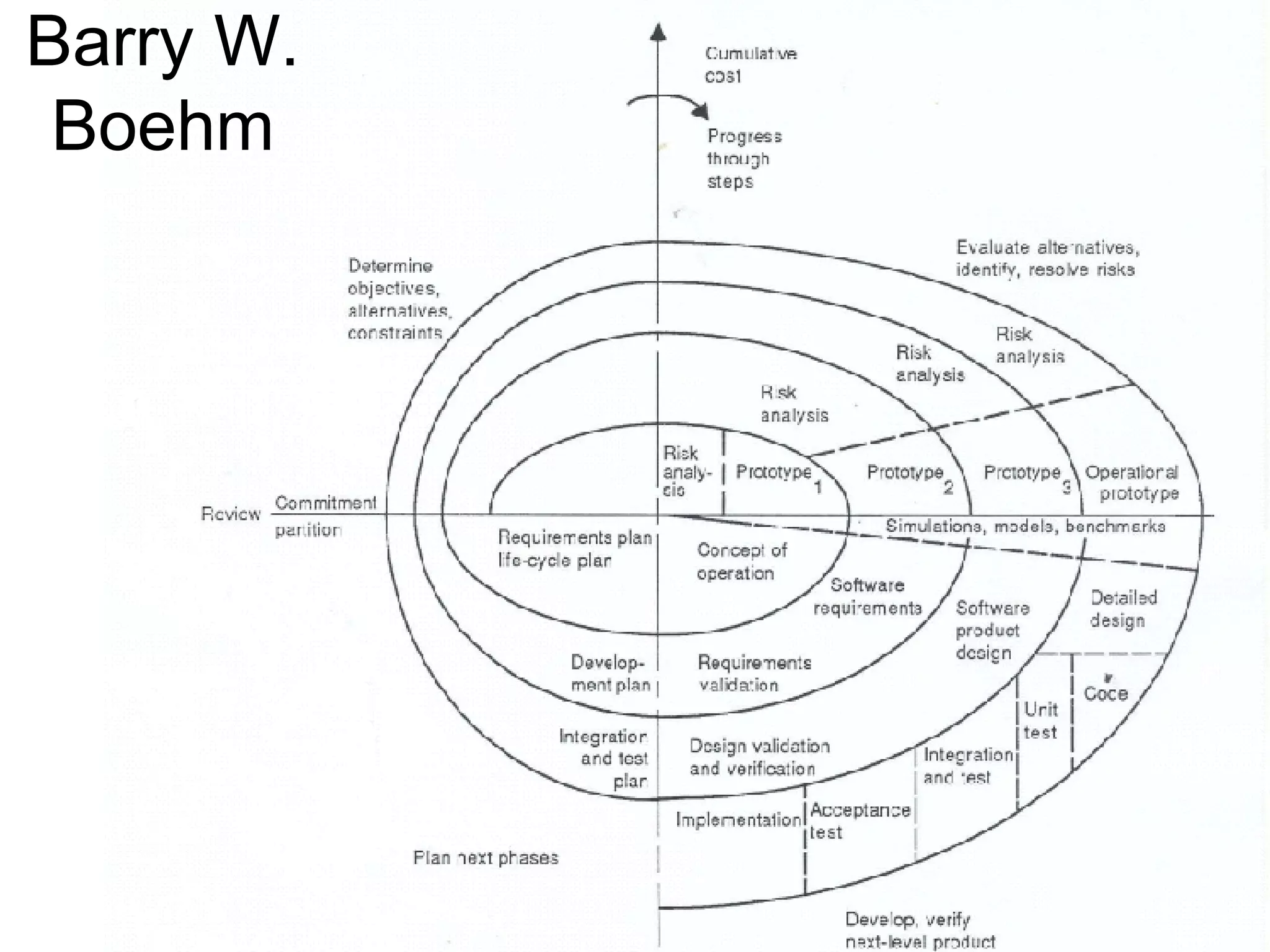
Barry W. Boehm
Iterative and Incremental The Systems Engineering Process is not sequential.  It is parallel and iterative.  The complex interrelationship between creating and improving models throughout the process of developing and selecting alternatives is a good example of the dynamic nature of the systems engineering process.
Process Standardization NASA DOD (US Departement Of Defense): Documentation Model  IEEE ISO (International Organization for Standardization)  IEC (International Electrotechnical Committee).  ISO/IEC 15504  /  SPICE  (Software Process Improvement and Capability dEtermination)  SEI (Software Engineering Institute)
Capability Maturity Model - Integration CMMI  defines the essential elements of effective processes for engineering  disciplines based on best industry experiences. CMMI models provide guidance when developing and evaluating processes.  CMMI models are not actually processes or process descriptions.
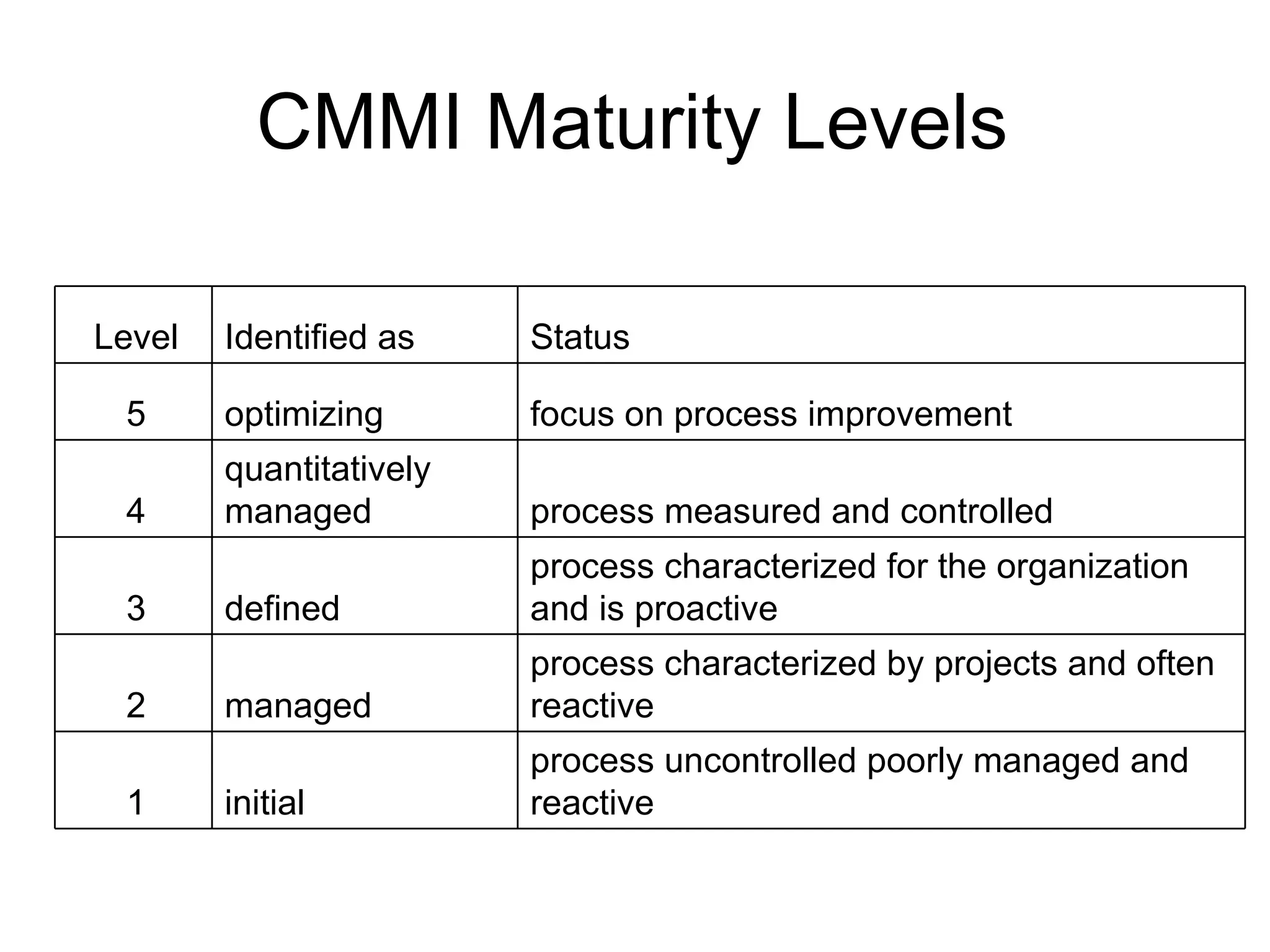
CMMI Maturity Levels Level Identified as Status 5 optimizing focus on process improvement 4 quantitatively managed process measured and controlled 3 defined process characterized for the organization and is proactive 2 managed process characterized by projects and often reactive 1 initial process uncontrolled poorly managed and reactive
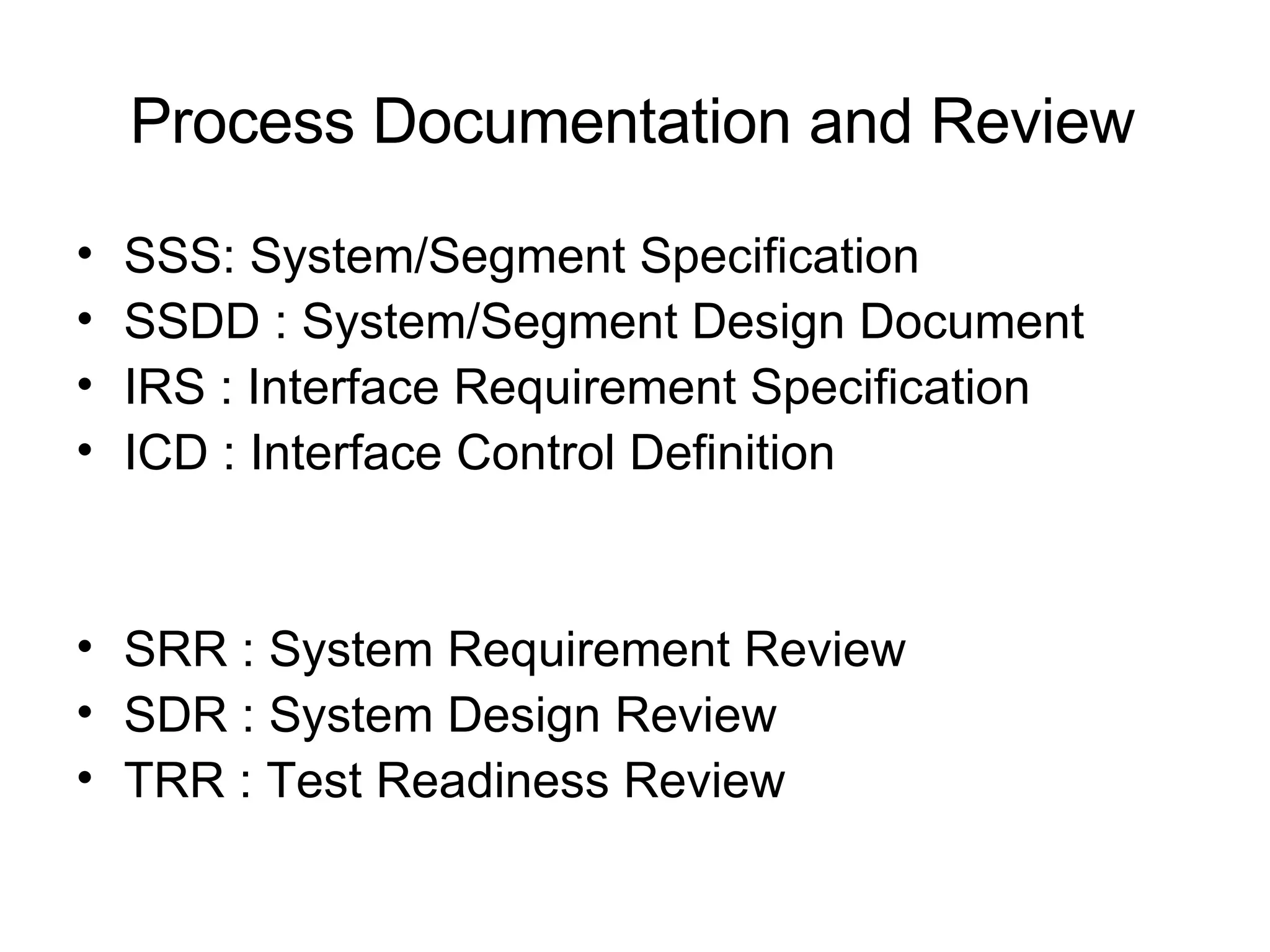
Process Documentation and Review SSS: System/Segment Specification  SSDD : System/Segment Design Document  IRS : Interface Requirement Specification ICD : Interface Control Definition SRR : System Requirement Review SDR : System Design Review TRR : Test Readiness Review
 
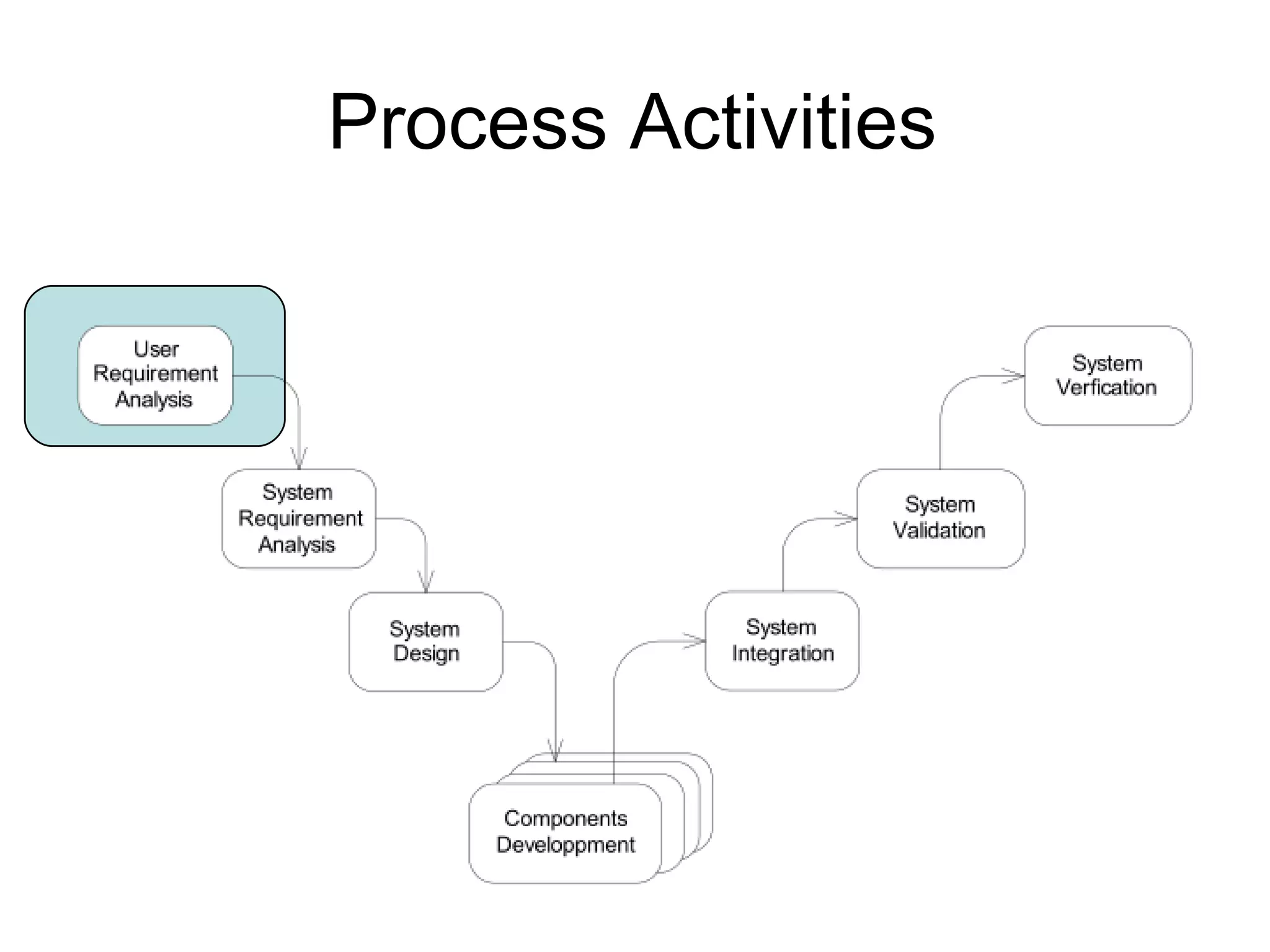
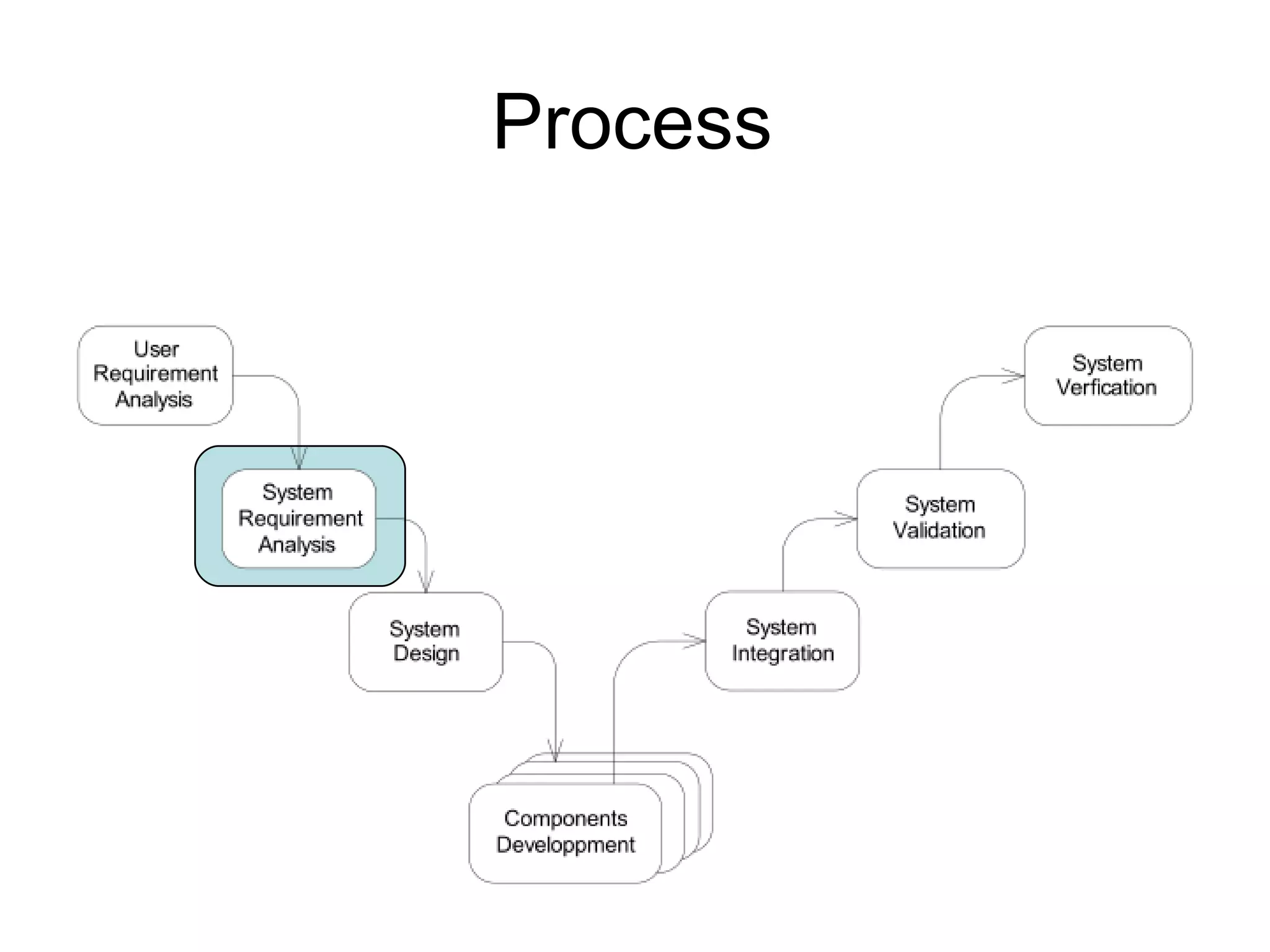
Process Activities
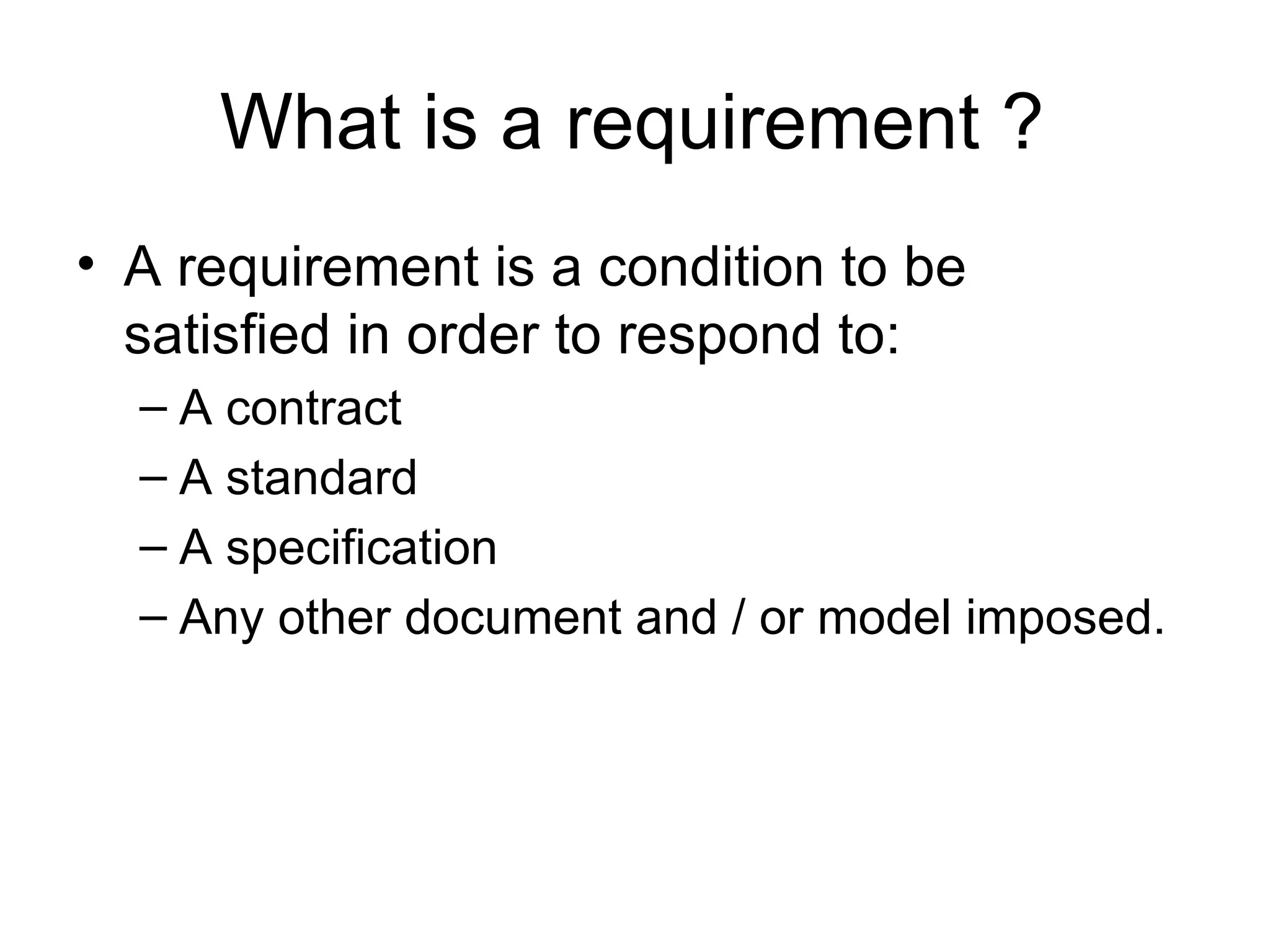
What is a requirement ? A requirement is a condition to be satisfied in order to respond to: A contract A standard A specification  Any other document and / or model imposed.
Requirements  User’s Requirements Statements in natural language of the system services. Described by the user System Requirements Structured document setting out detailed description of system services.  Part of the contract
User’s Requirements example A customer must be able to abort a transaction in progress by pressing the Cancel key instead of responding to a request from the machine. The washing machine will be used in the following countries: UK, USA, Europe, Eastern Europe
Process
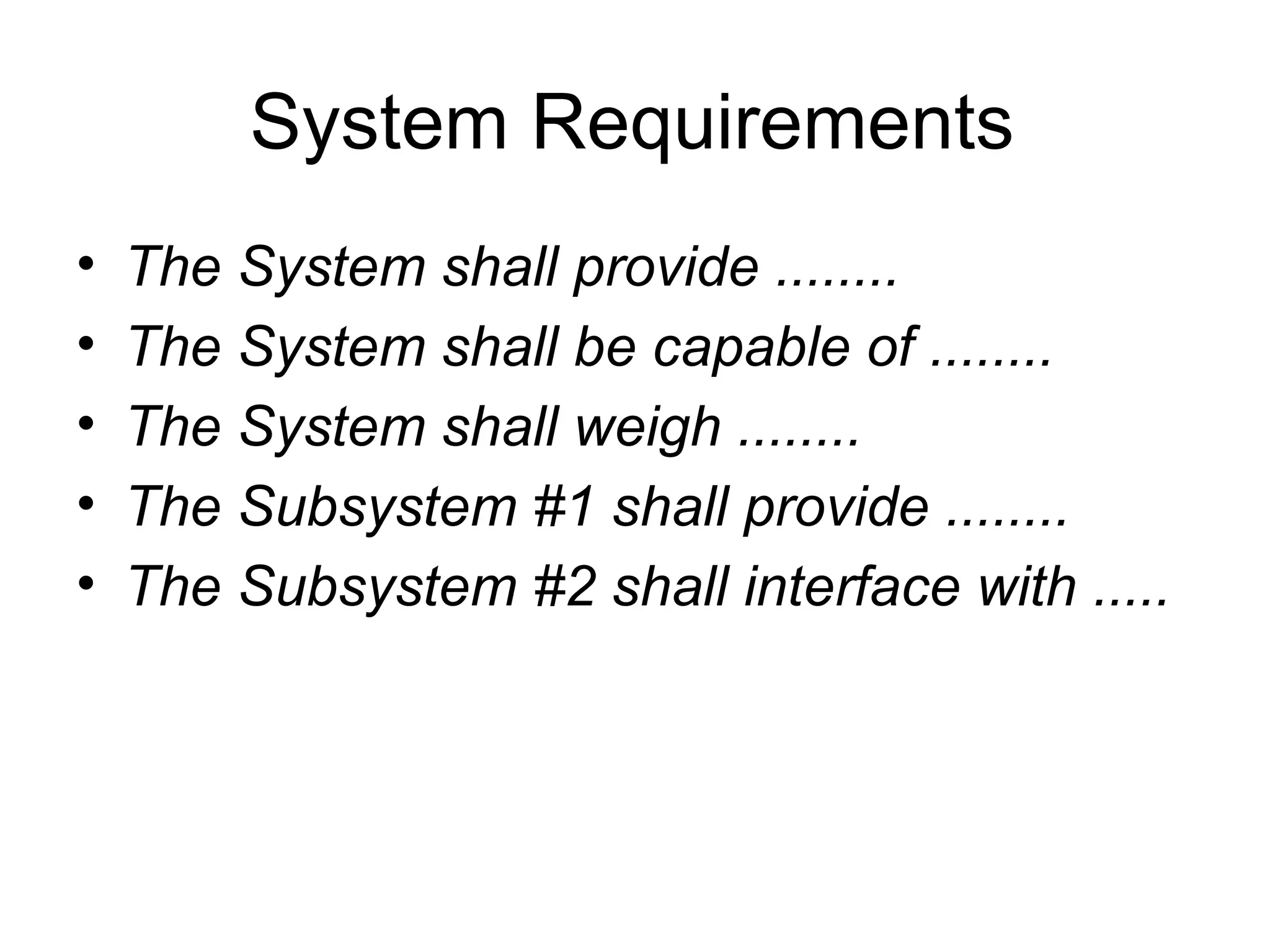
System Requirements The System shall provide ........   The System shall be capable of ........   The System shall weigh ........   The Subsystem #1 shall provide ........   The Subsystem #2 shall interface with .....
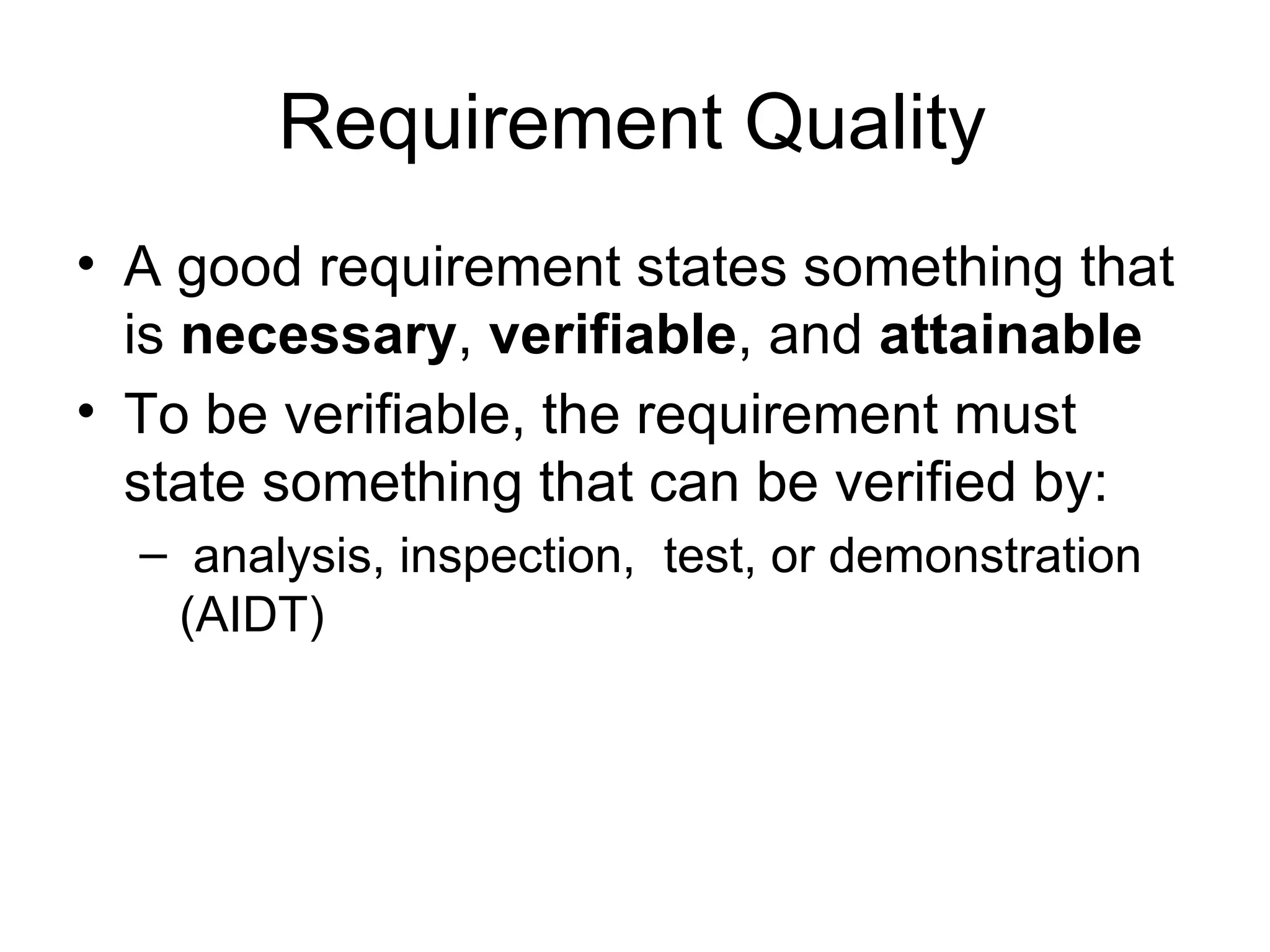
Requirement Quality A good requirement states something that is  necessary ,  verifiable , and  attainable   To be verifiable, the requirement must state something that can be verified by: analysis, inspection,  test, or demonstration (AIDT)
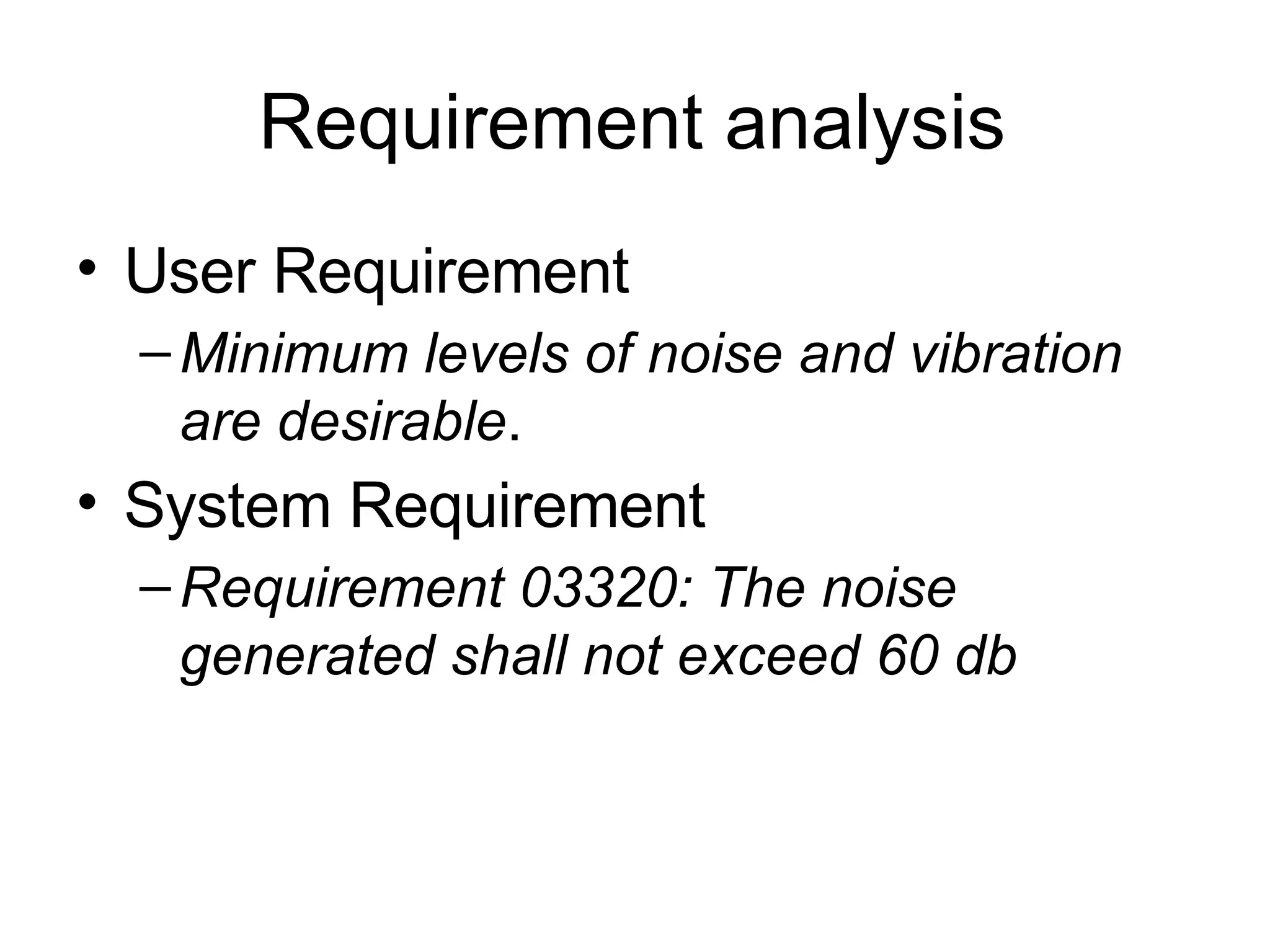
Requirement analysis User Requirement Minimum levels of noise and vibration are desirable . System Requirement Requirement 03320: The noise generated shall not exceed 60 db
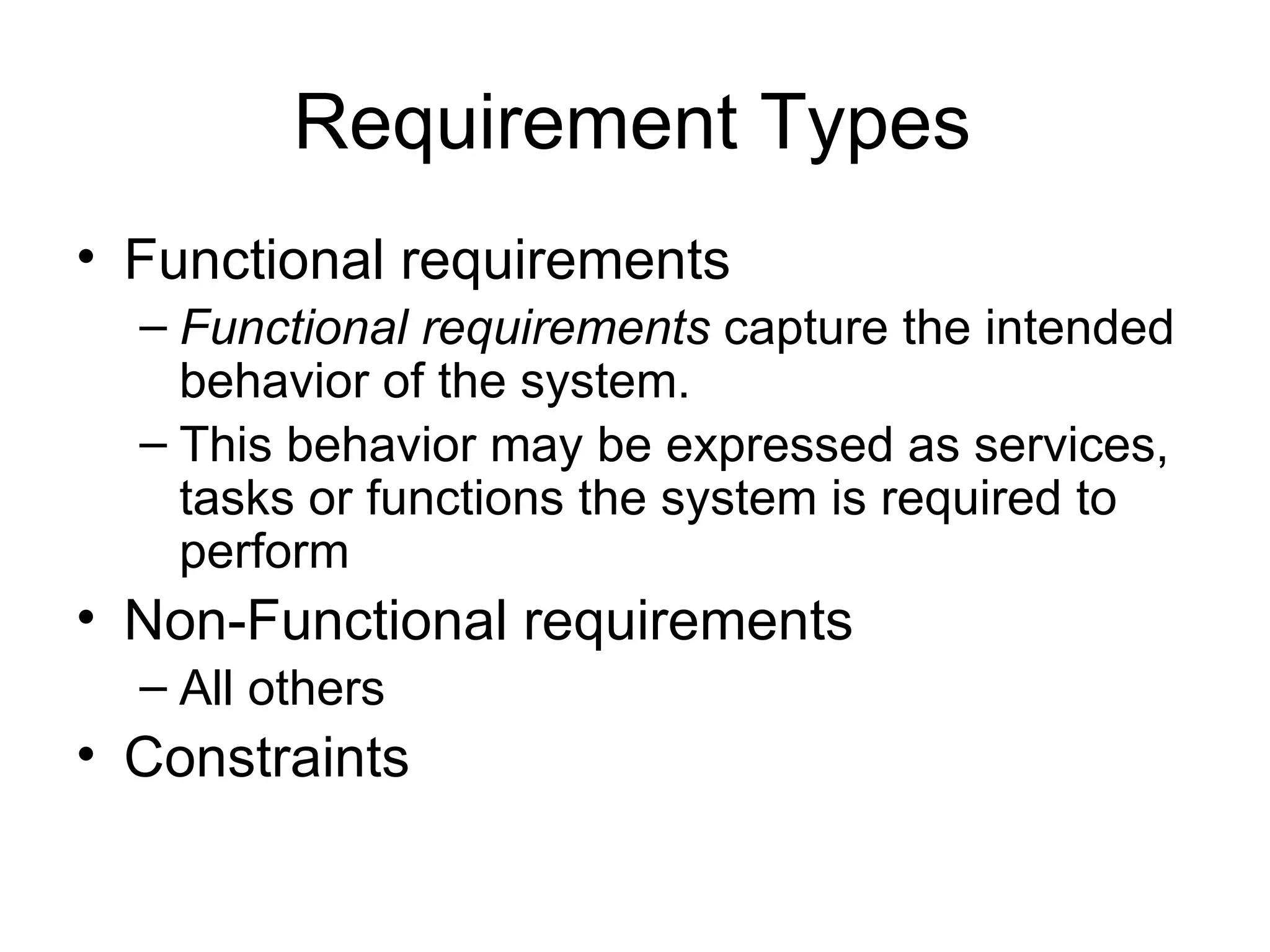
Requirement Types Functional requirements Functional requirements  capture the intended behavior of the system.  This behavior may be expressed as services, tasks or functions the system is required to perform Non-Functional requirements All others Constraints
 
Process
System Architecture The  System Architecture  identifies all the products (including enabling products) that are necessary to support the system and, by implication, the processes necessary for development, production/construction, deployment, operations, support, disposal, training, and verification
Architecture Modeling  System : Abstraction Functional model Dynamic model Semantic Model Object model Physical Model Interfaces Model Model Views
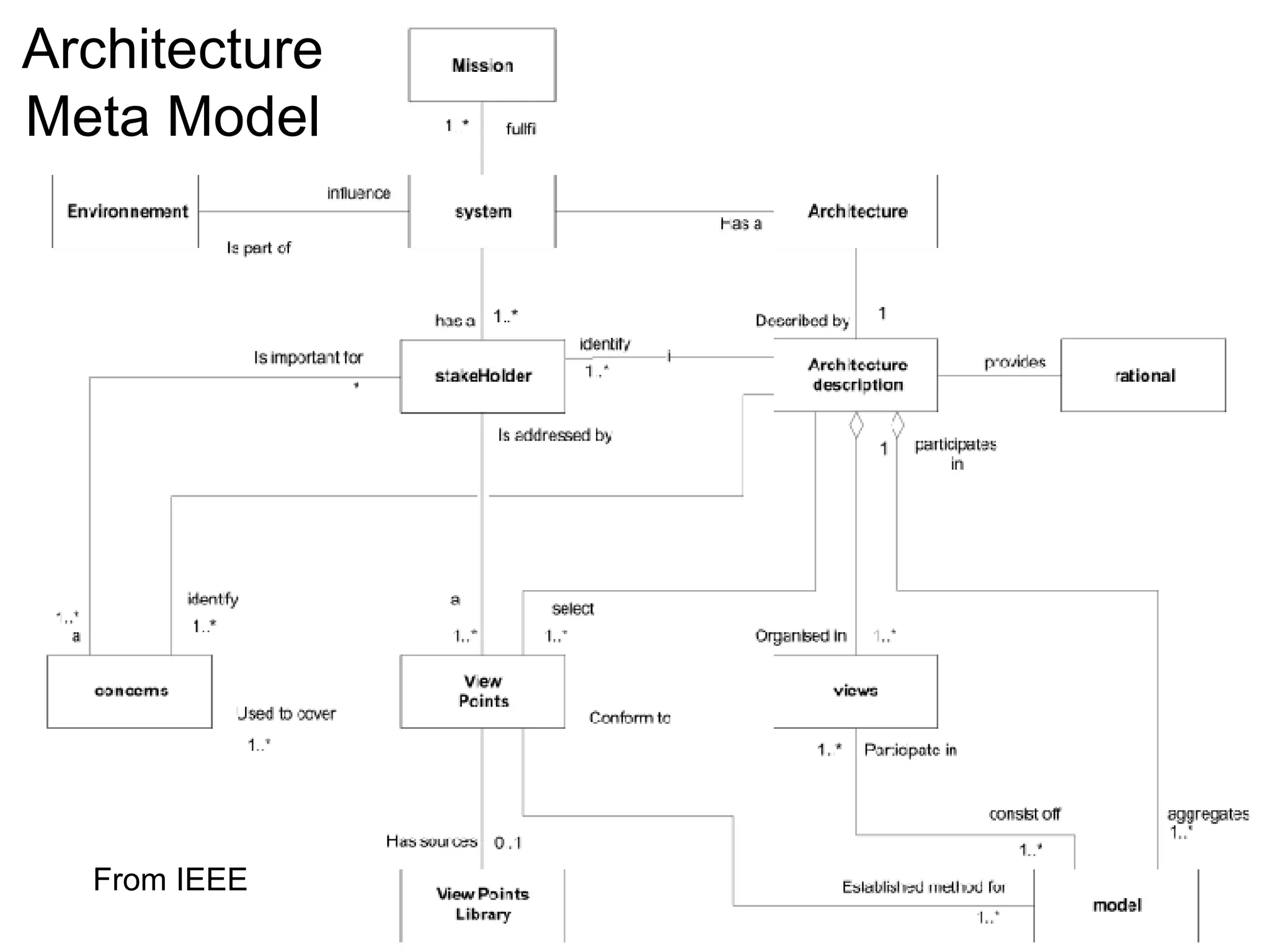
Architecture Meta Model From IEEE
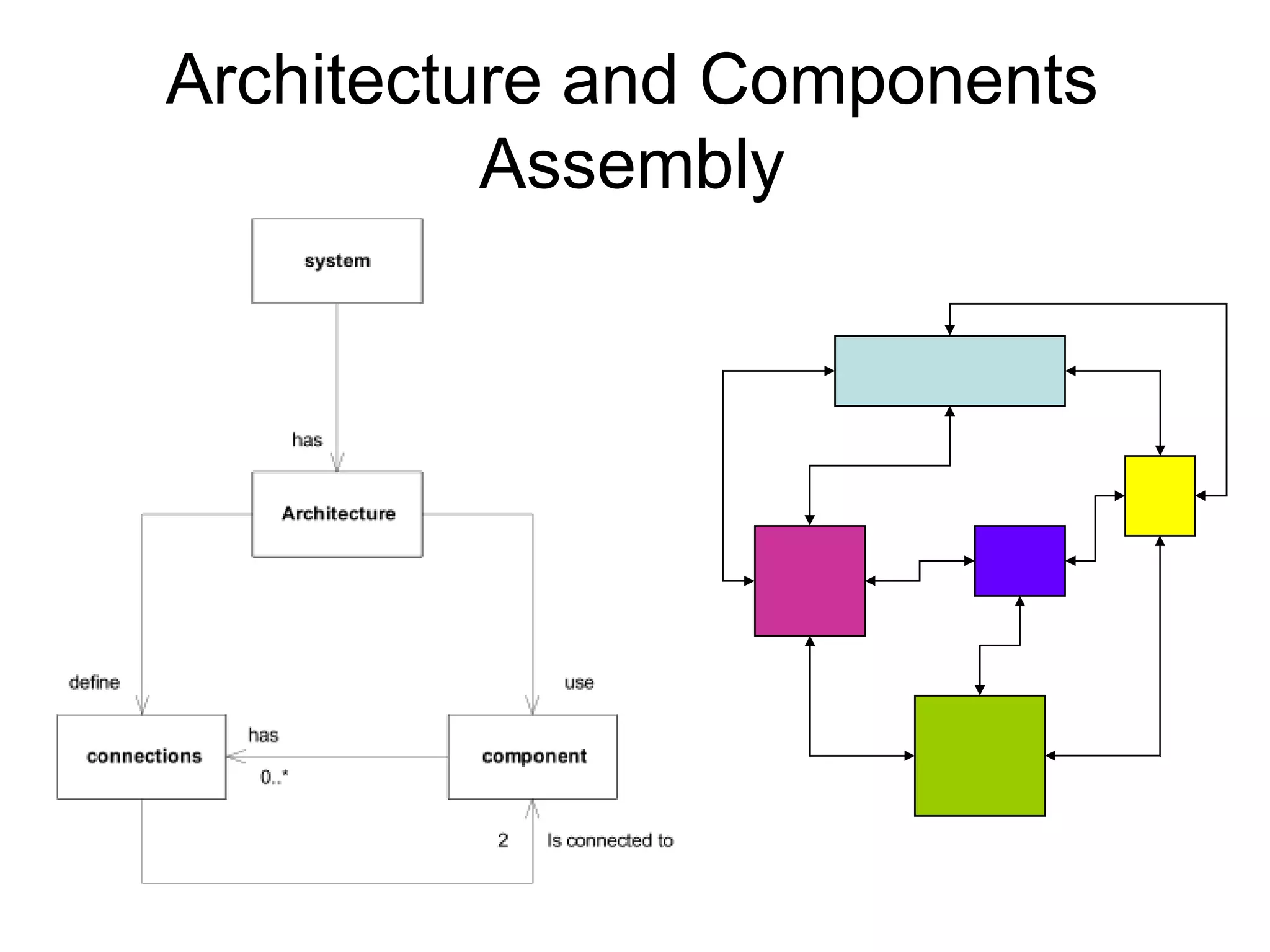
Architecture and Components Assembly
Example of Architecture Views The  Functional Architecture  identifies and structures the allocated  functional and performance requirements. The  Physical Architecture depicts the system product by showing how it is broken down into subsystems and components
 
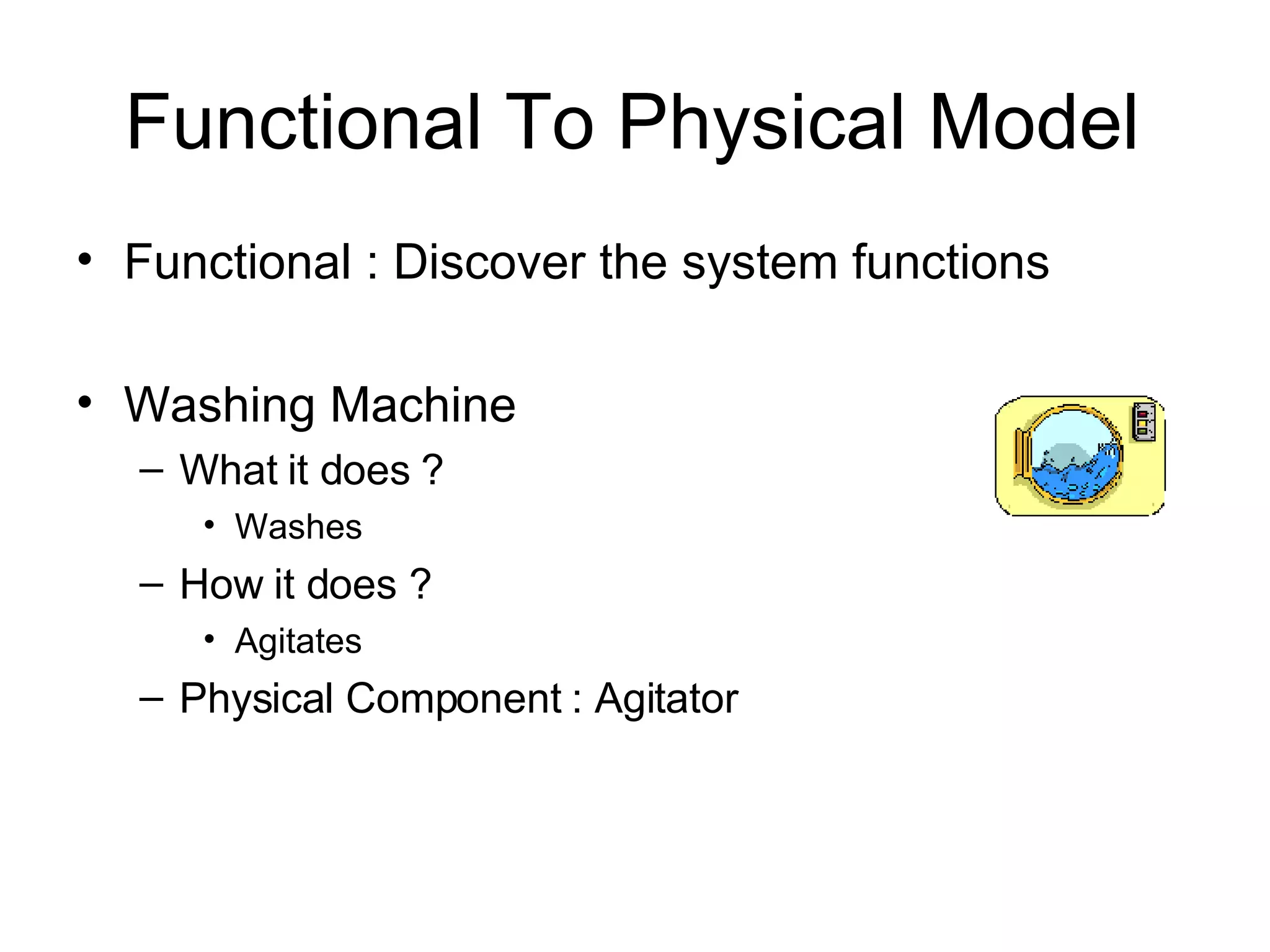
Functional To Physical Model Functional : Discover the system functions Washing Machine What it does ? Washes How it does ? Agitates Physical Component : Agitator
Functional VS physical Model How to fly ? Look at birds: Physical Model So I need: Legs, Eyes, Brain, and Wings. But I can not fly !!! Why ? I have to find the flight functional model !
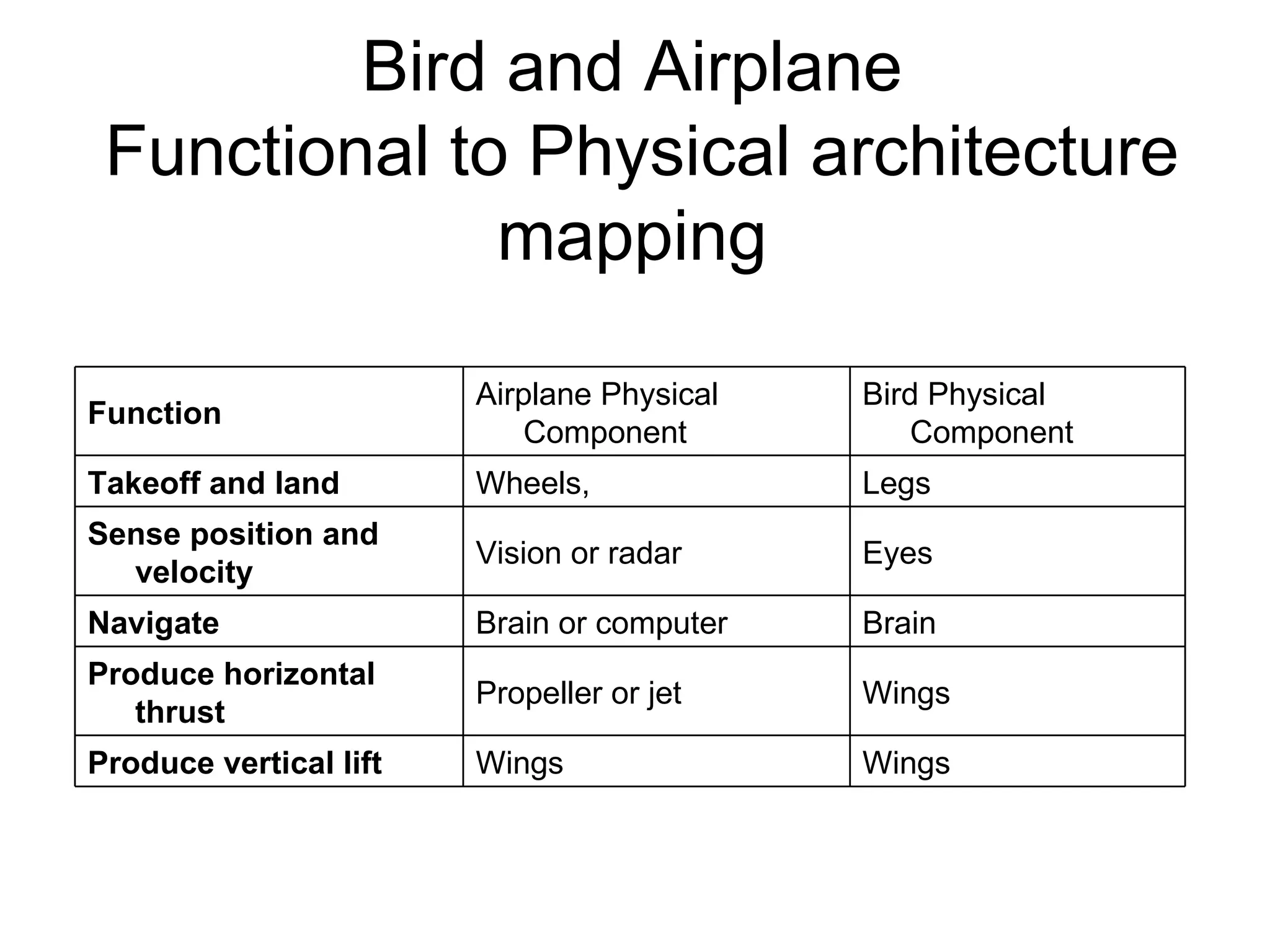
Flying functional model Functional decomposition of flying function: Produce horizontal thrust, Produce vertical lift.  Takeoff and land,  Sense position and velocity,  Navigate,
Example Birds physical for flying Physical decomposition:  physical components that birds used to fly: Legs, Eyes, Brain, and Wings. But can not be applied to system directly
Bird and Airplane  Functional to Physical architecture mapping Function  Airplane Physical Component  Bird Physical Component  Takeoff and land  Wheels, Legs  Sense position and velocity  Vision or radar  Eyes  Navigate  Brain or computer  Brain  Produce horizontal thrust  Propeller or jet  Wings  Produce vertical lift  Wings  Wings
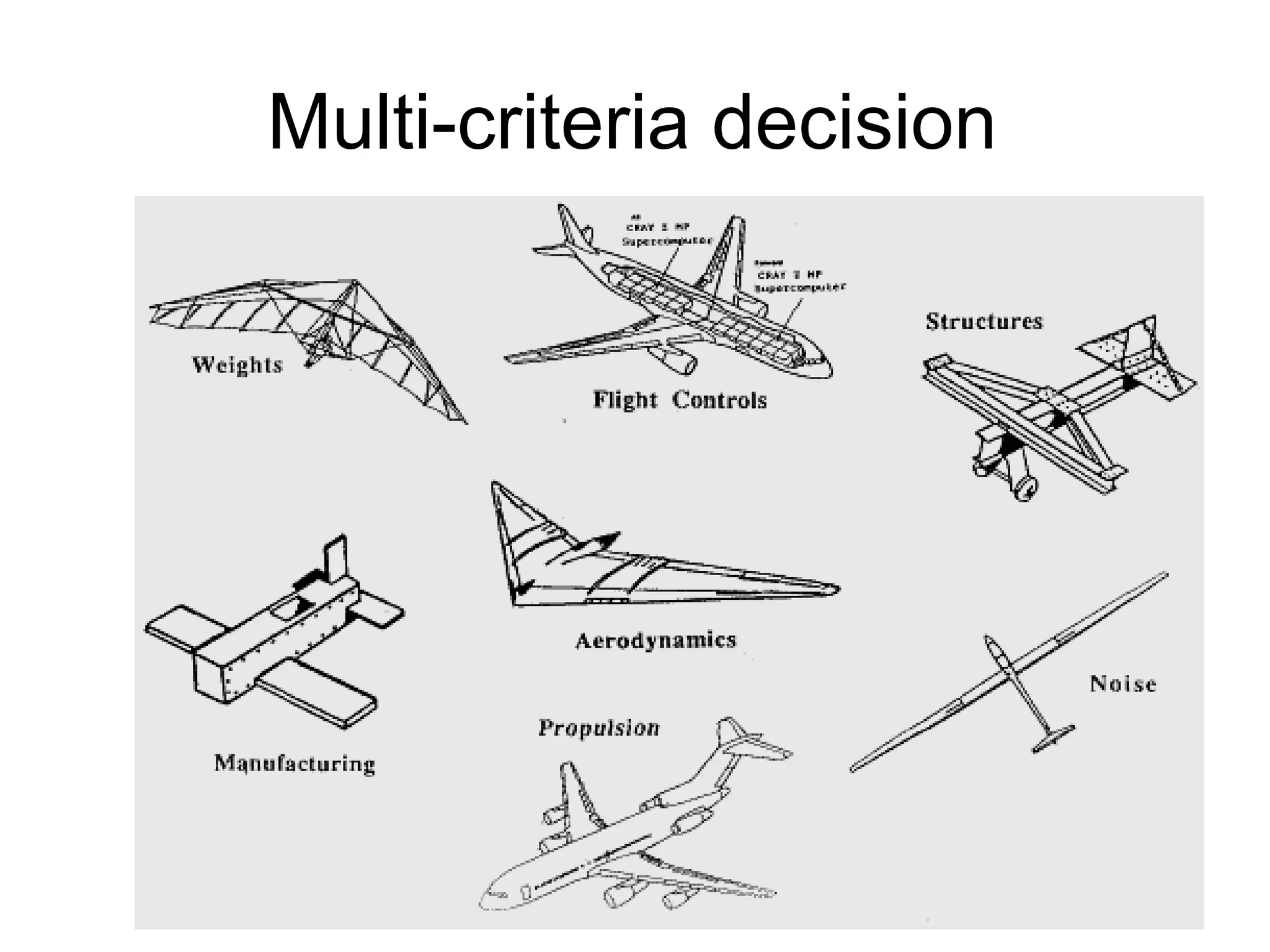
Multi-criteria decision
Trade Off Multi-criteria decision-aiding techniques are available to help discover the preferred alternatives.  This analysis should be repeated, as better data becomes available.
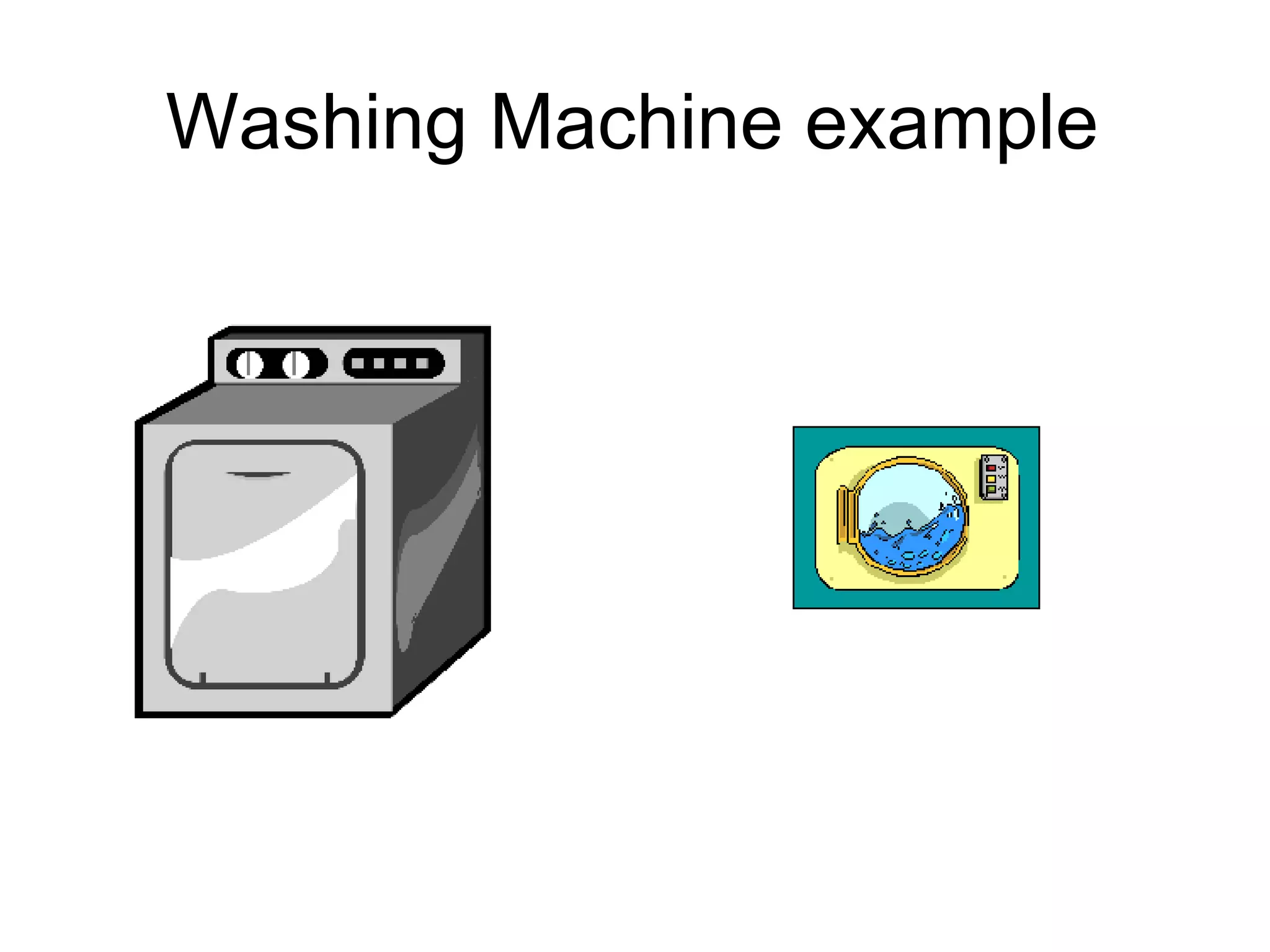
Washing Machine example
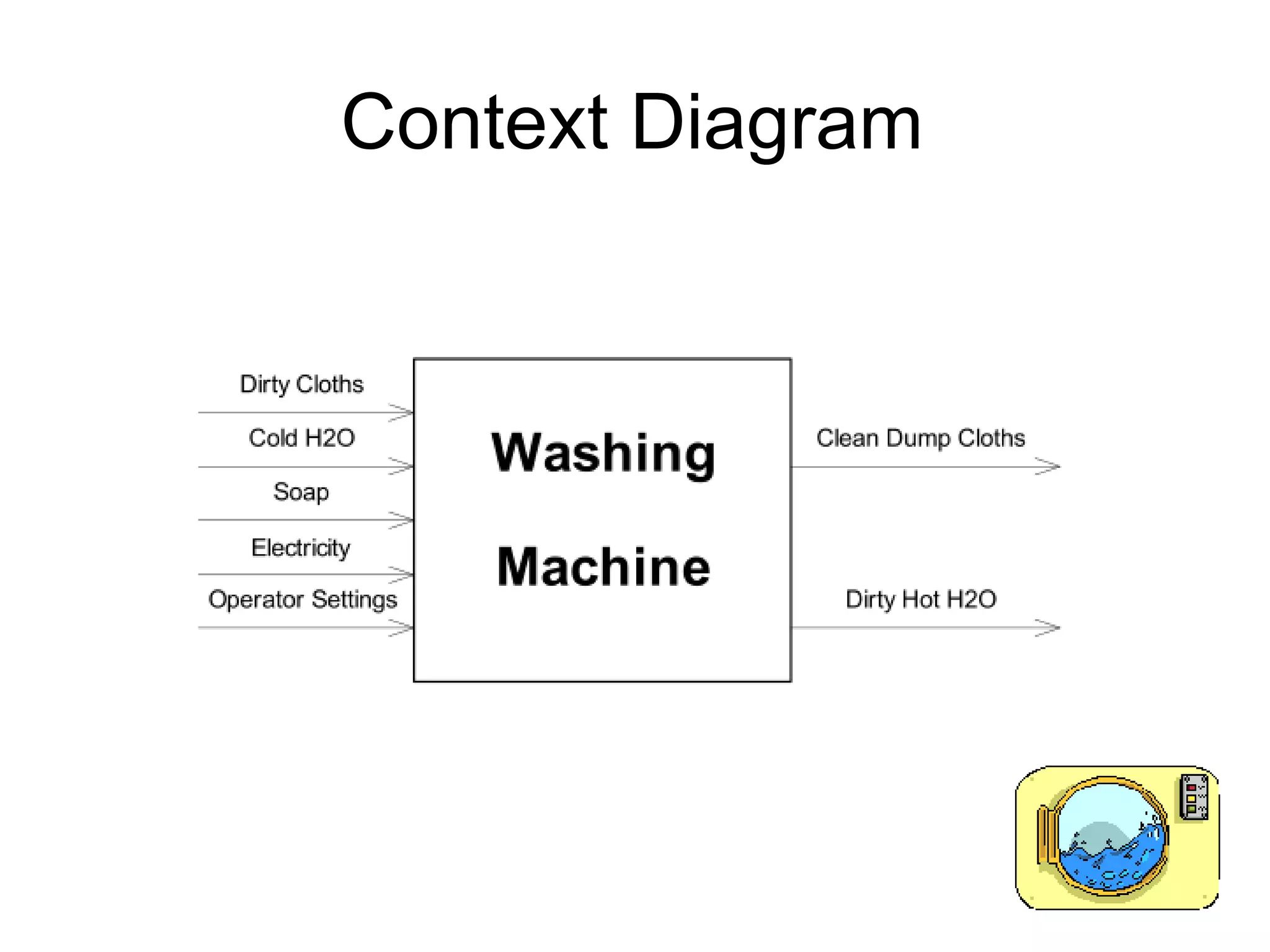
Context Diagram
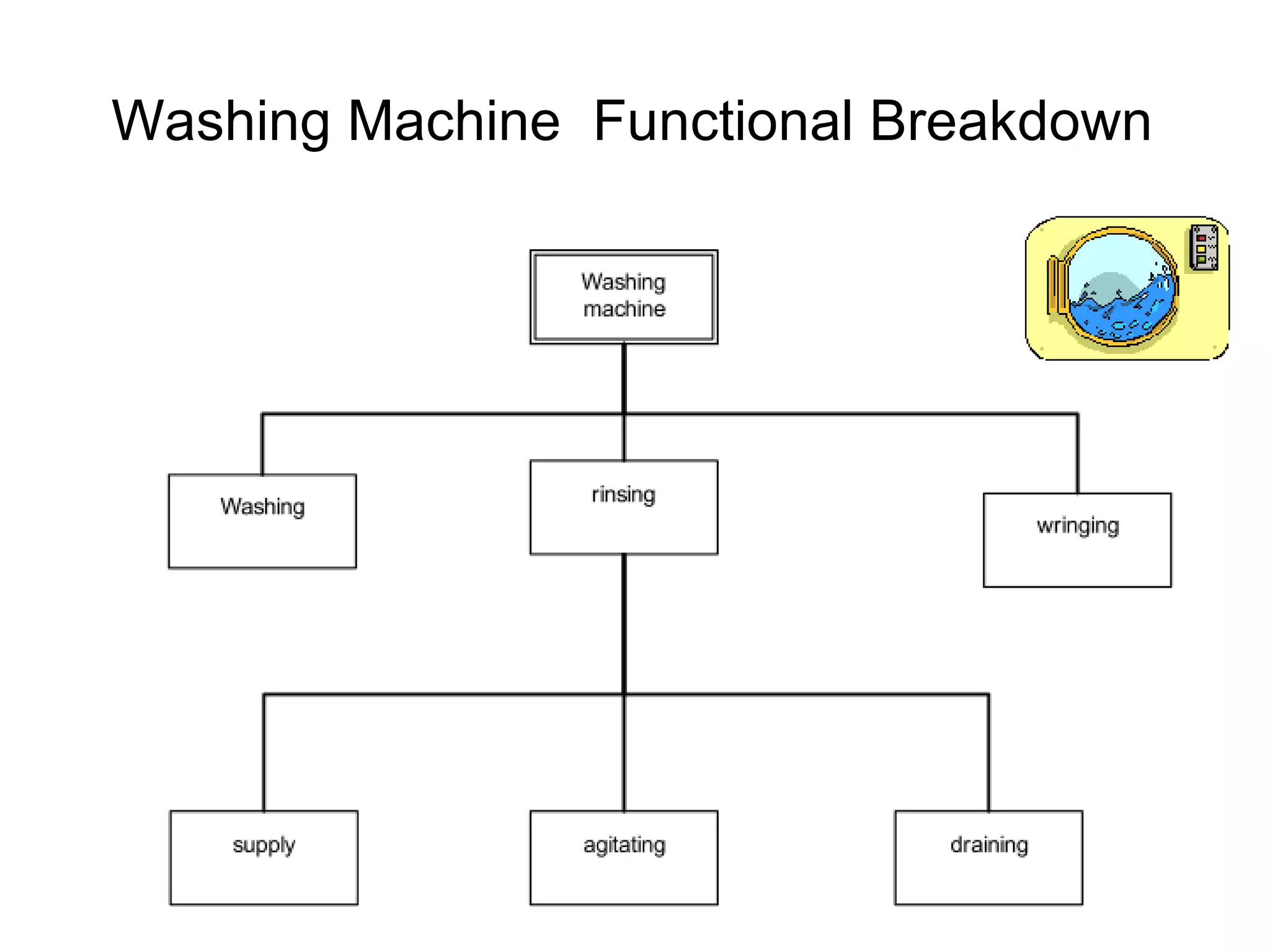
Washing Machine  Functional Breakdown
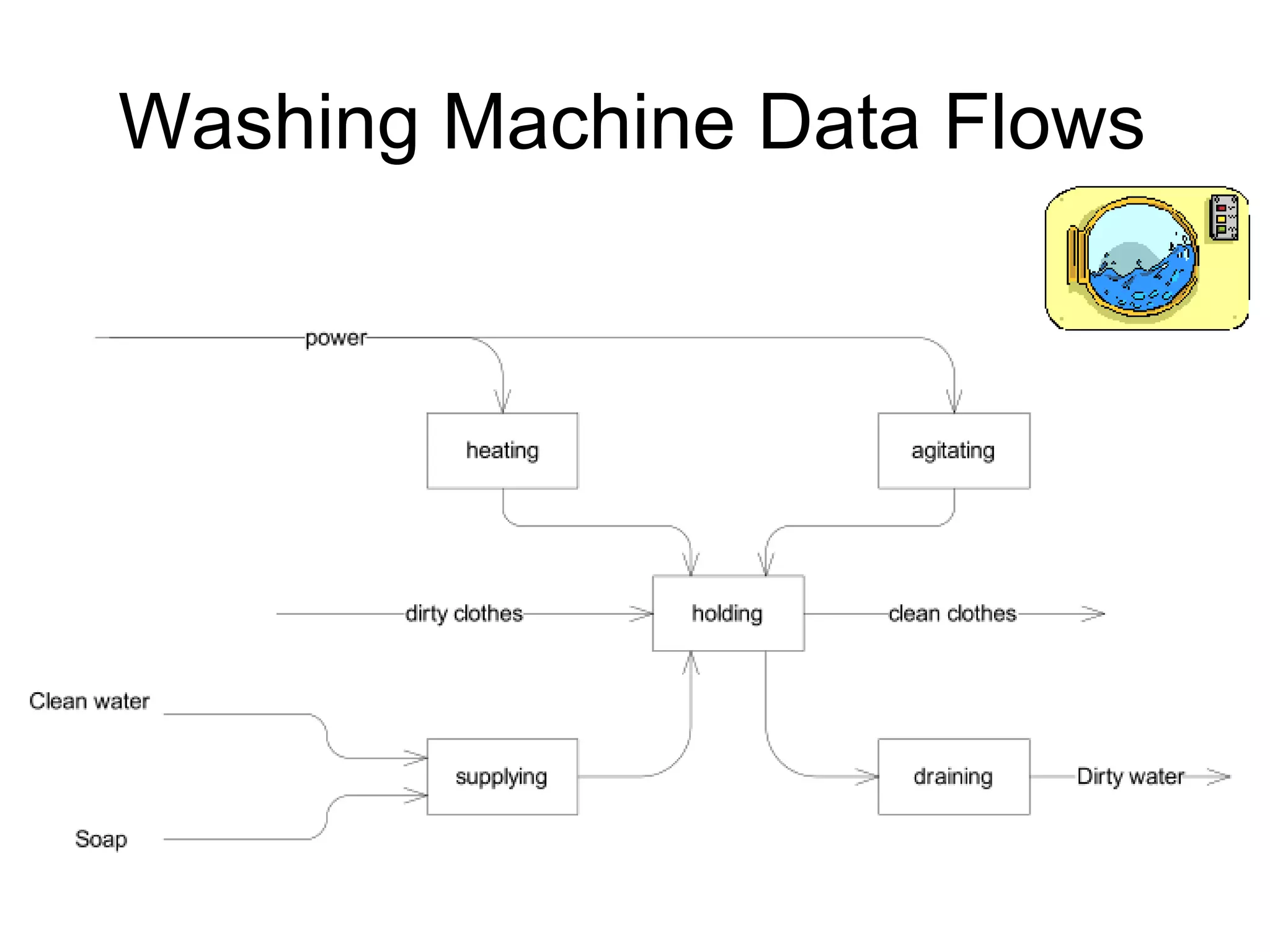
Washing Machine Data Flows
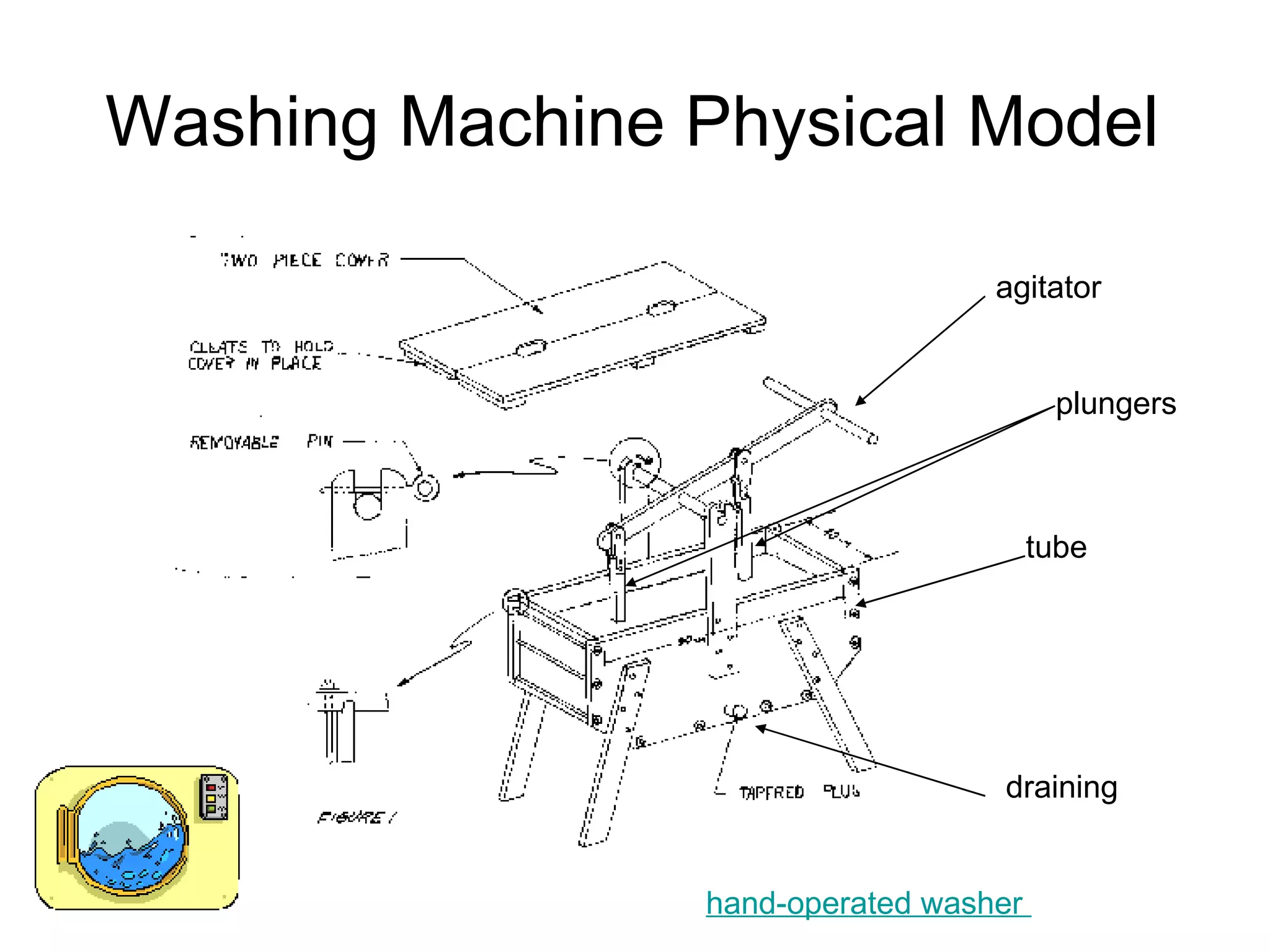
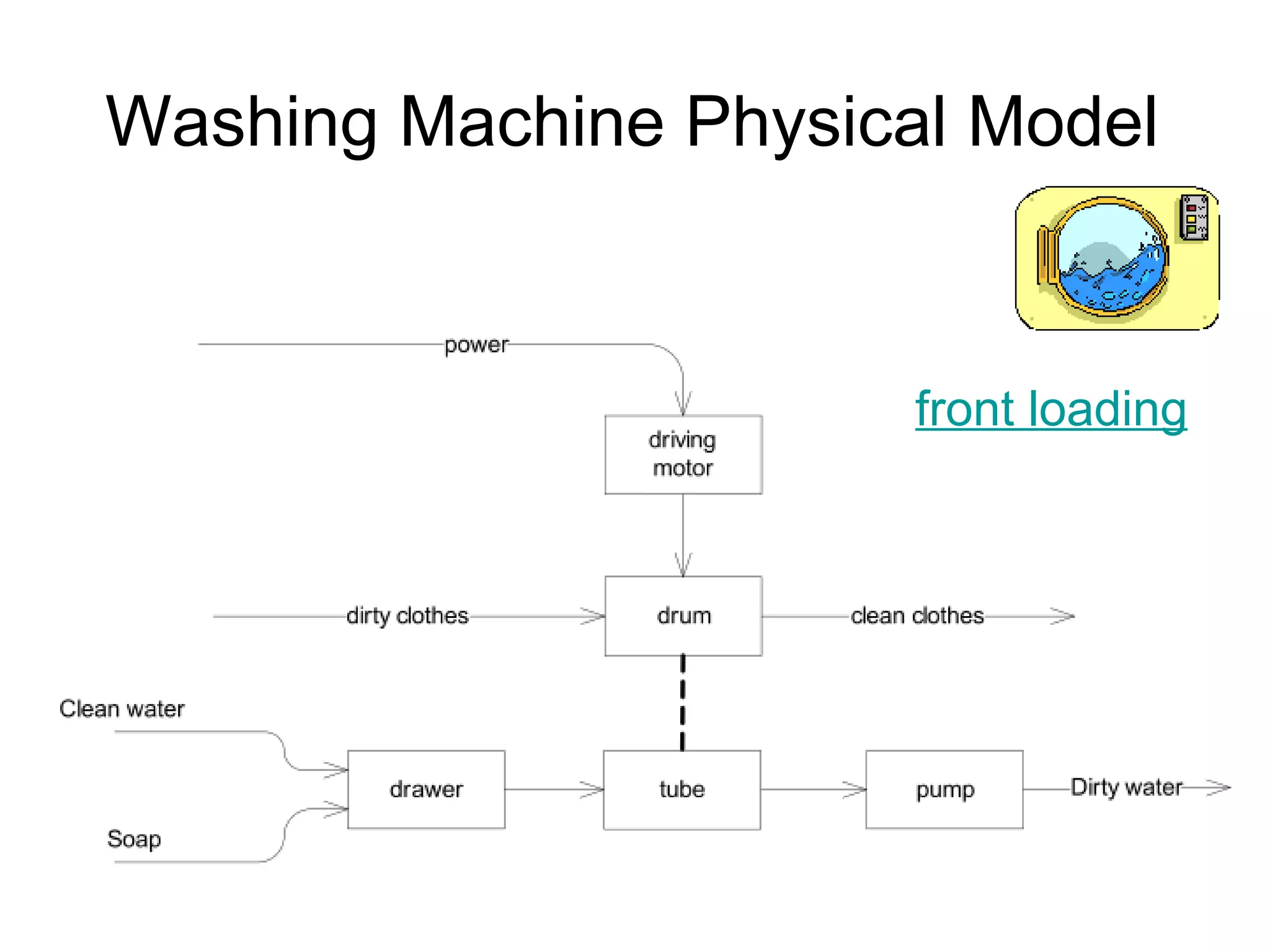
Washing Machine Physical Model agitator tube draining hand-operated washer  plungers
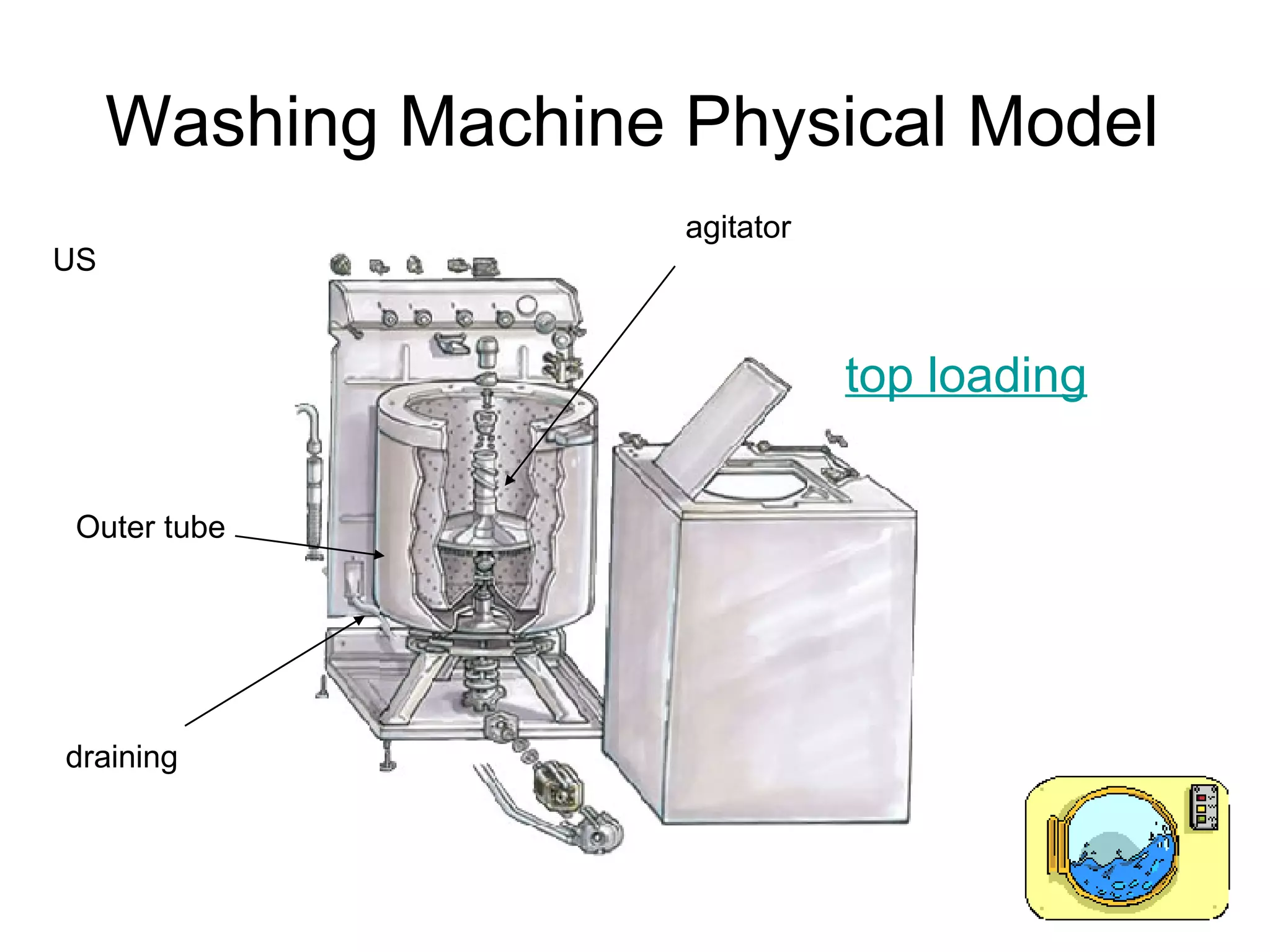
Washing Machine Physical Model agitator Outer tube draining top loading US
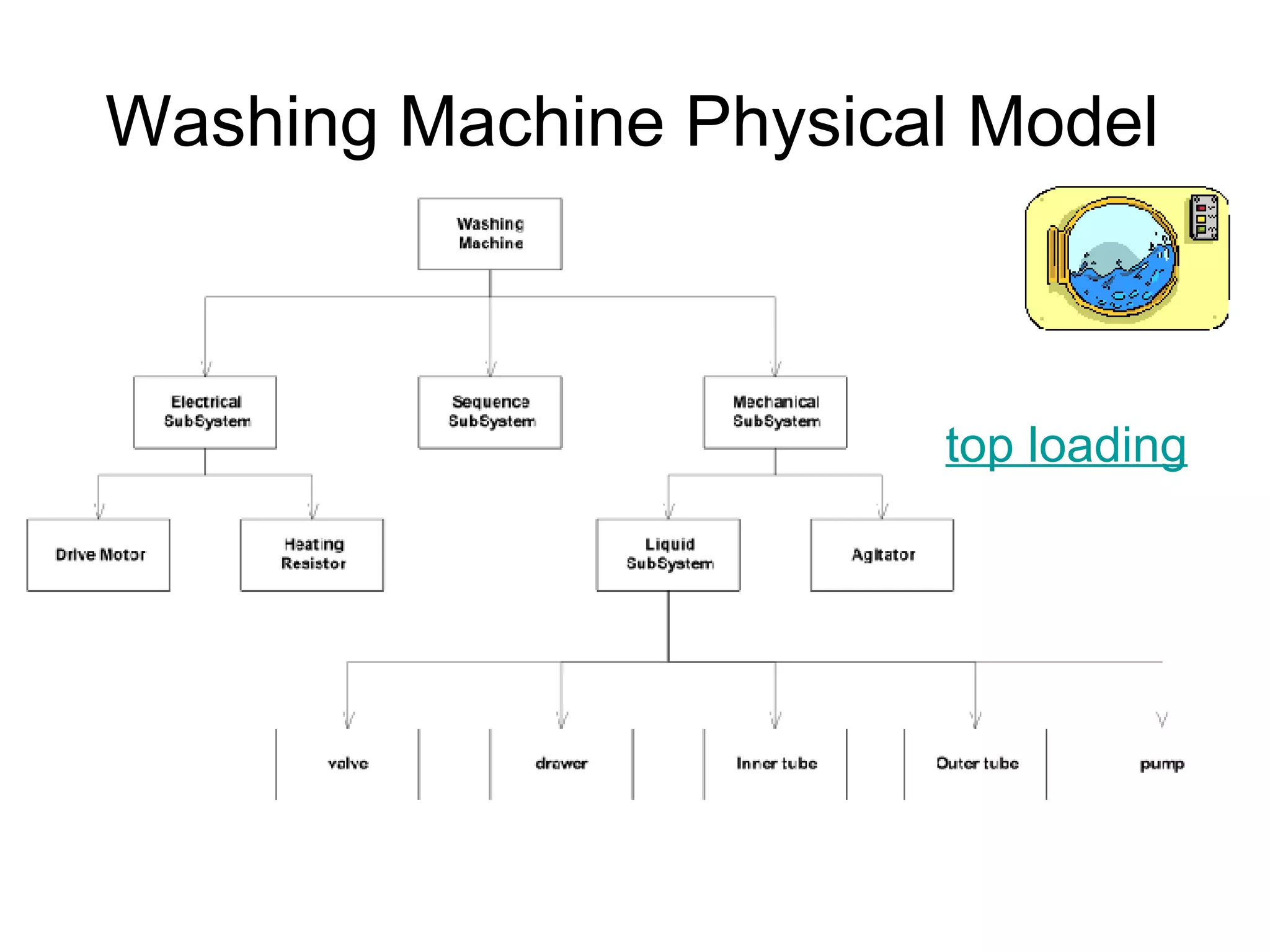
Washing Machine Physical Model top loading
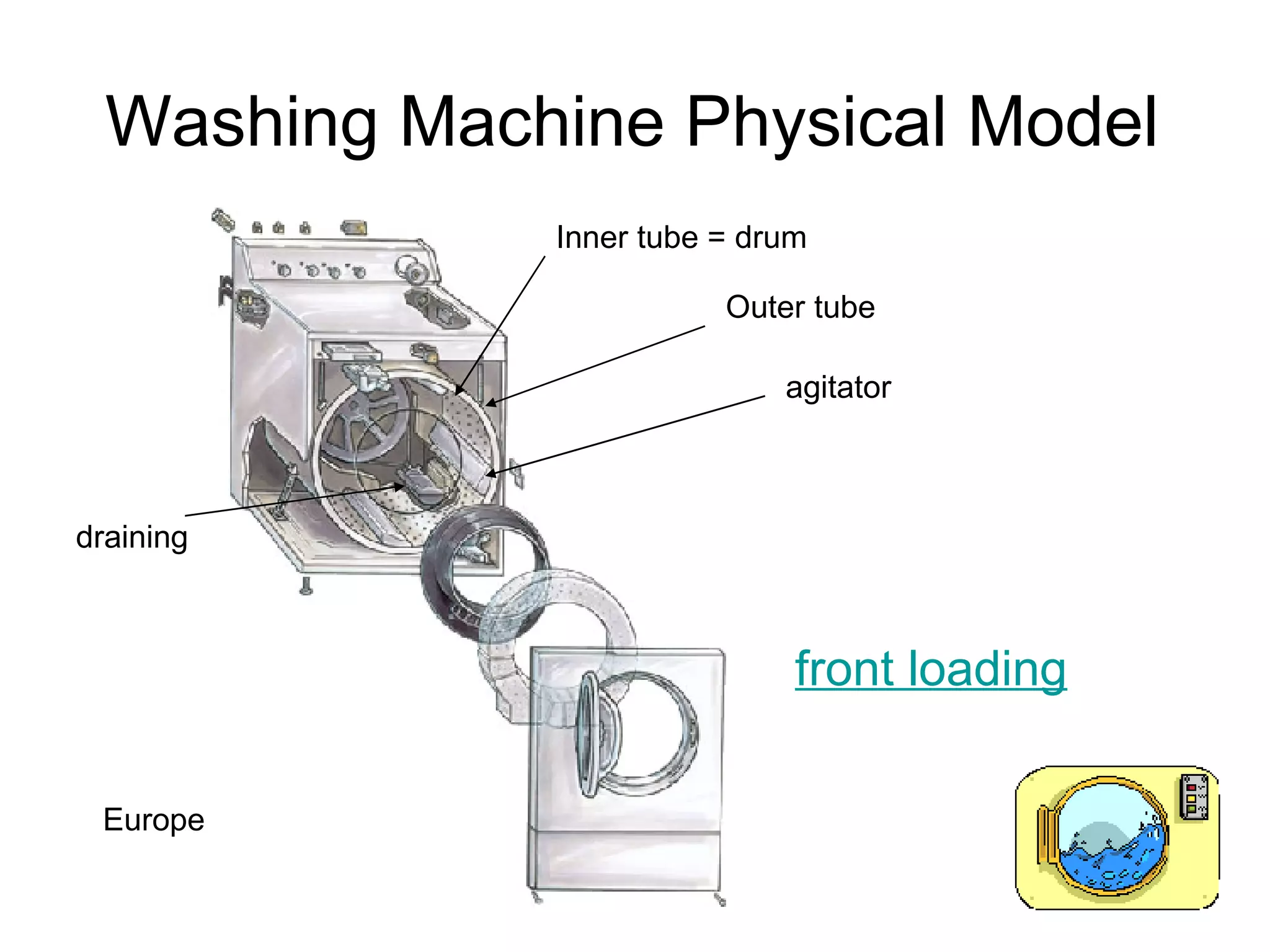
Washing Machine Physical Model agitator Outer tube draining Inner tube = drum front loading Europe
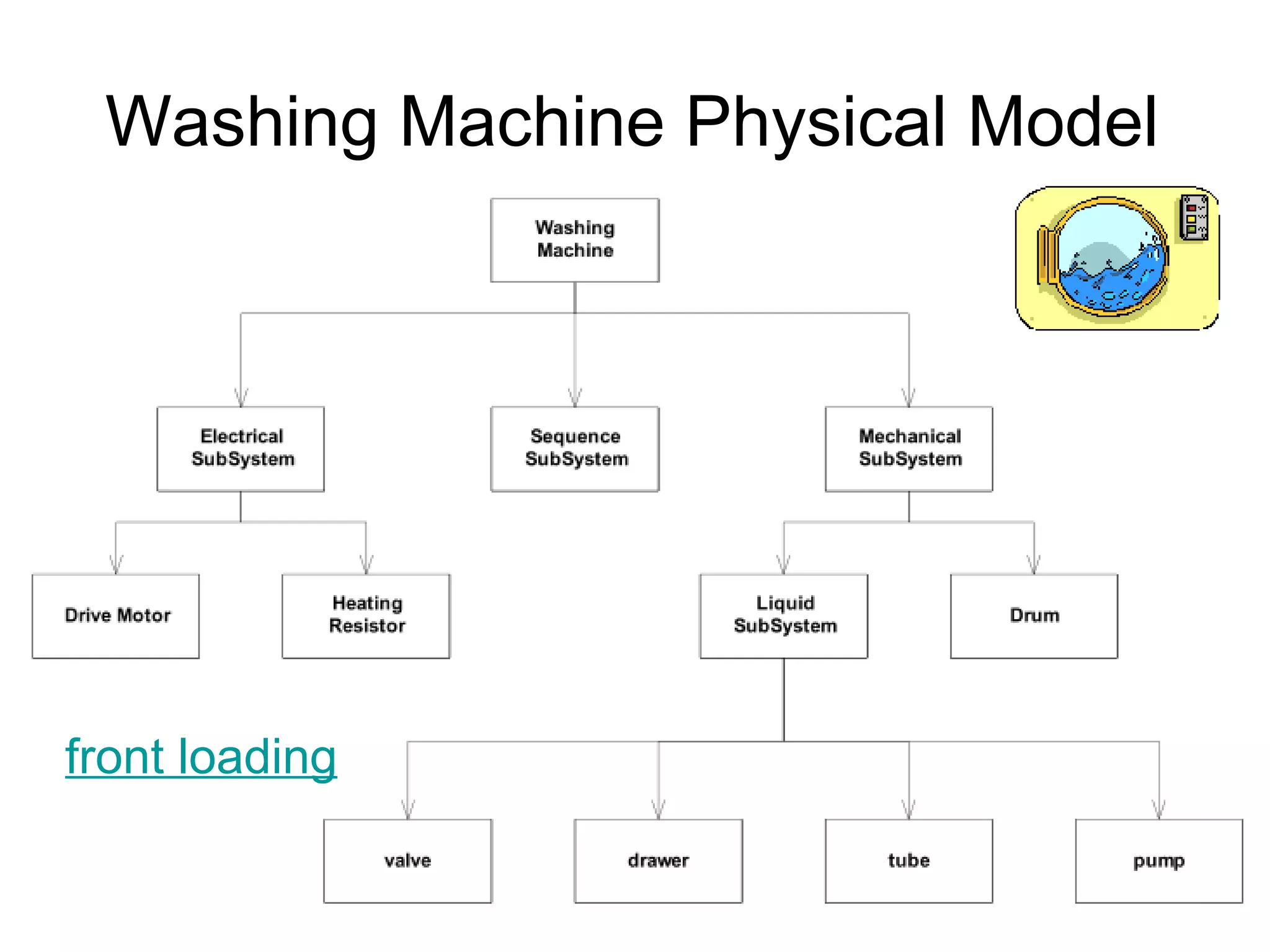
Washing Machine Physical Model front loading
 
Process
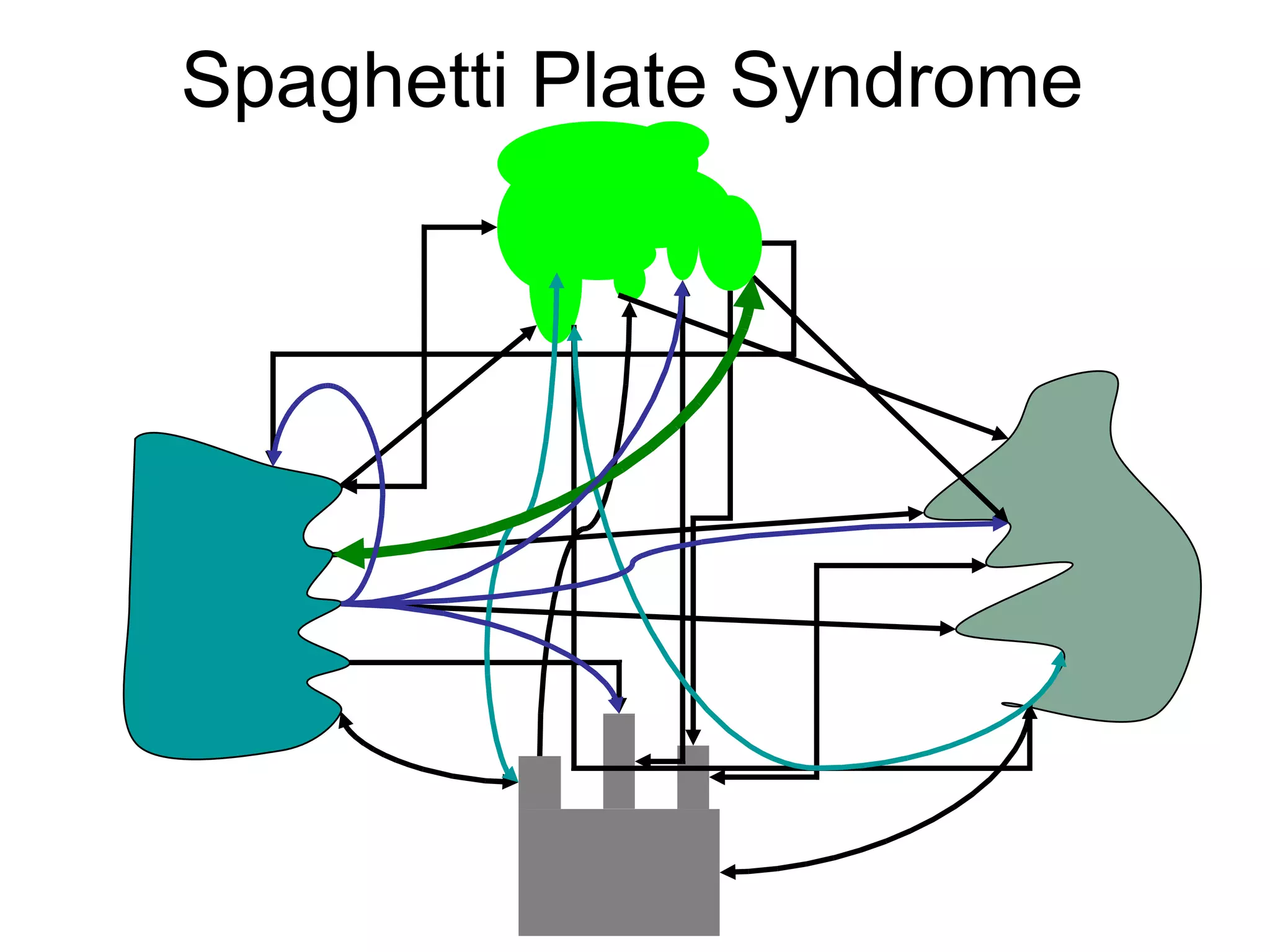
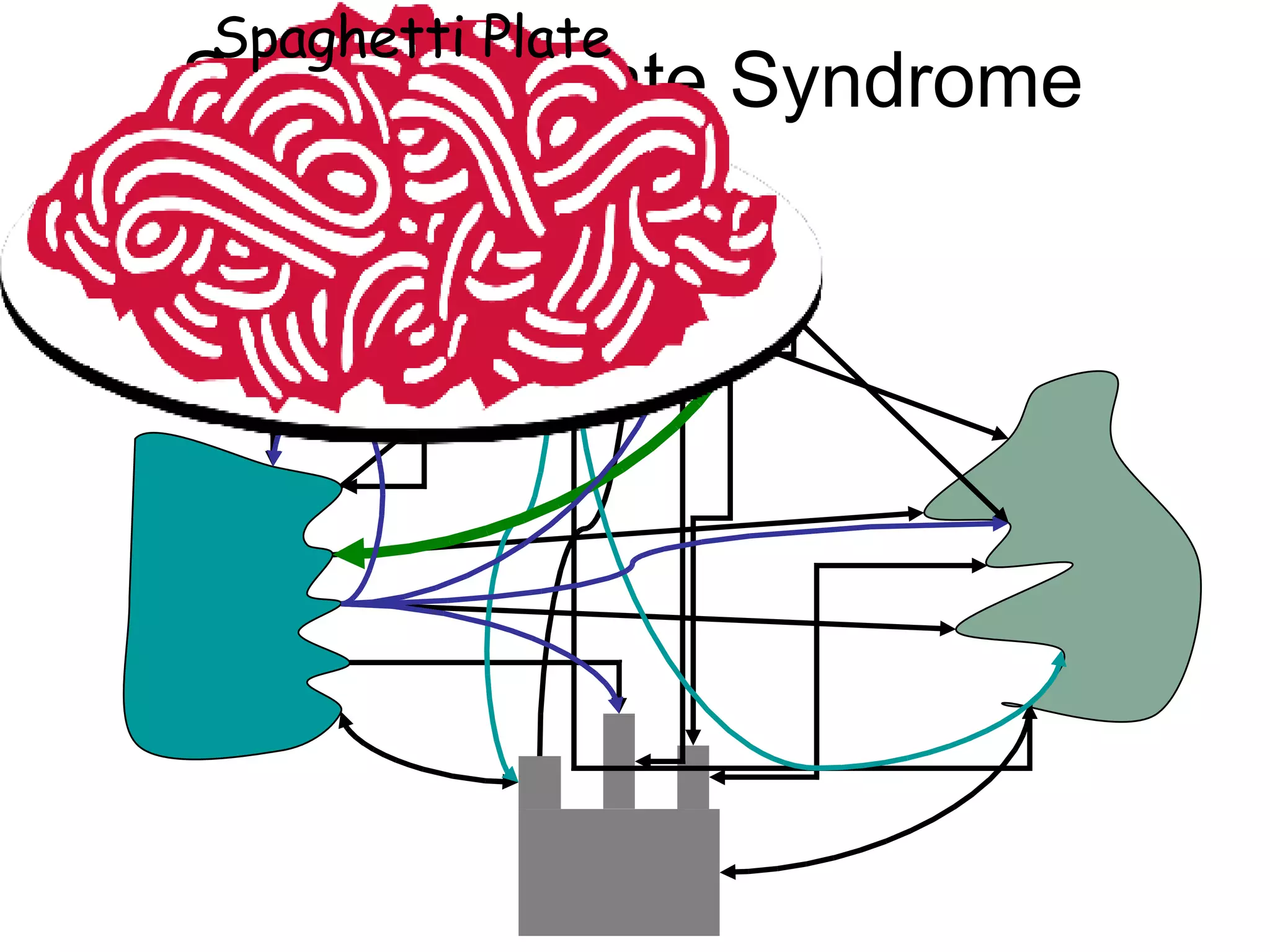
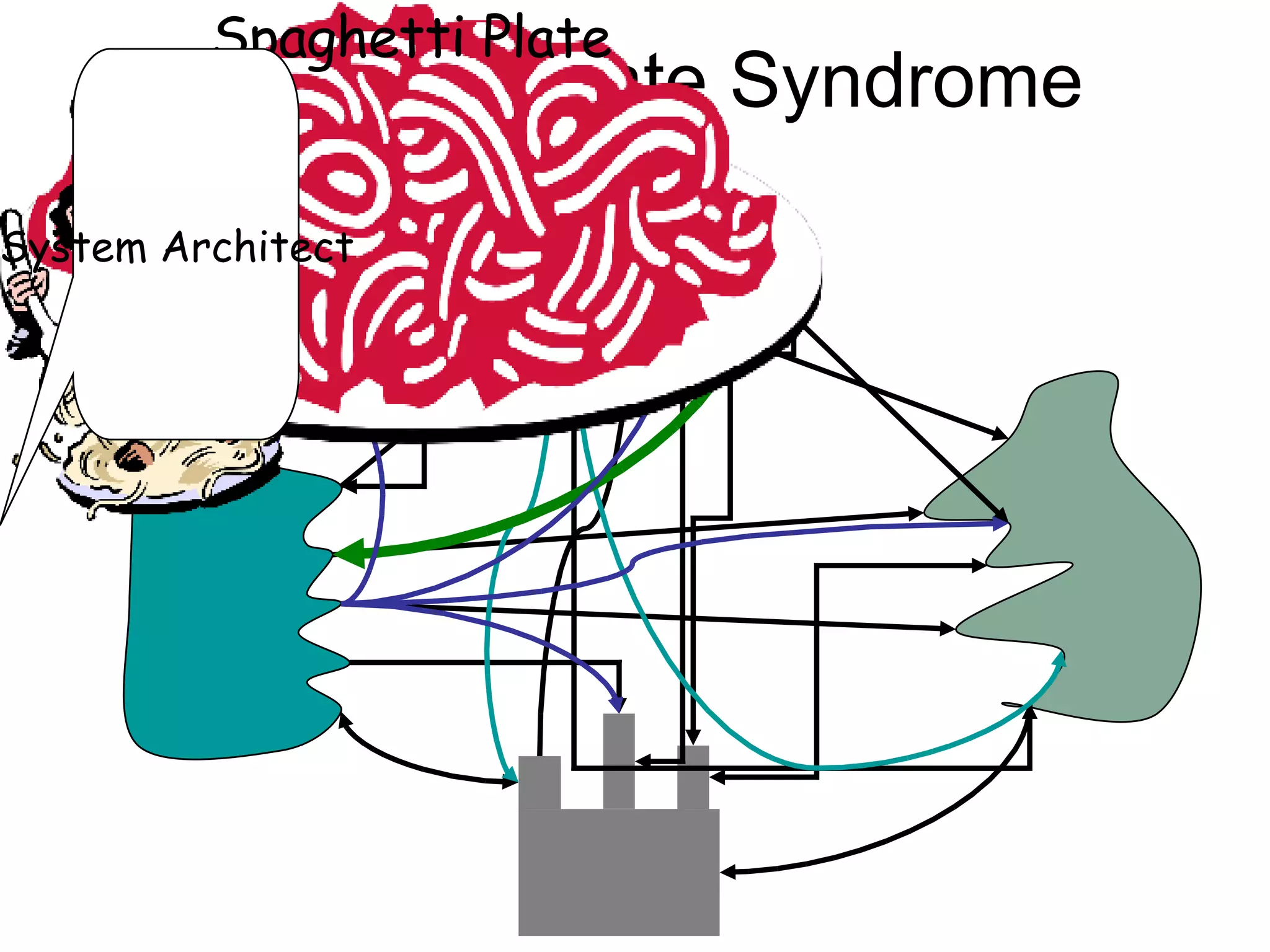
Integration Integration means bringing things together so they work as a whole.
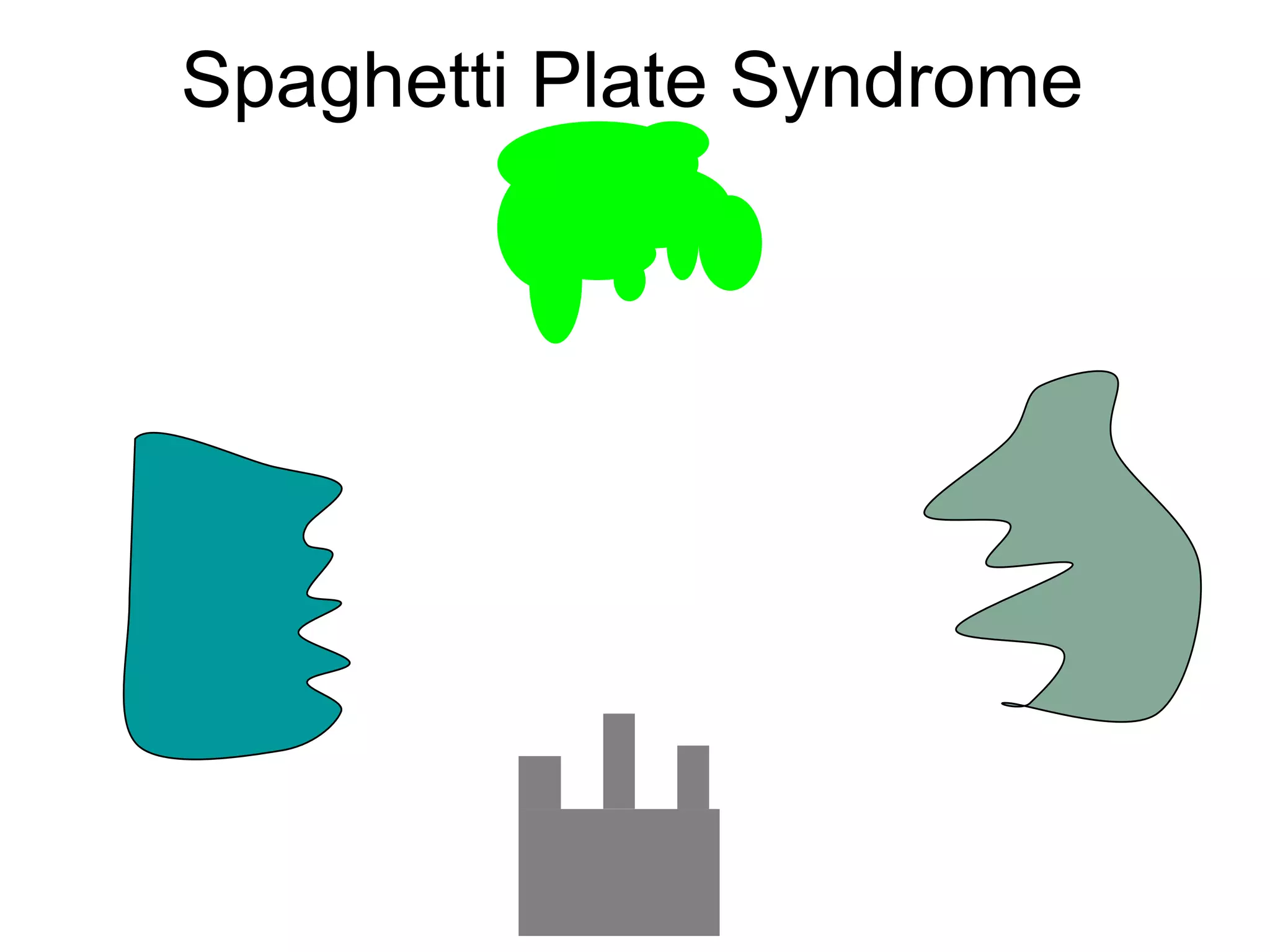
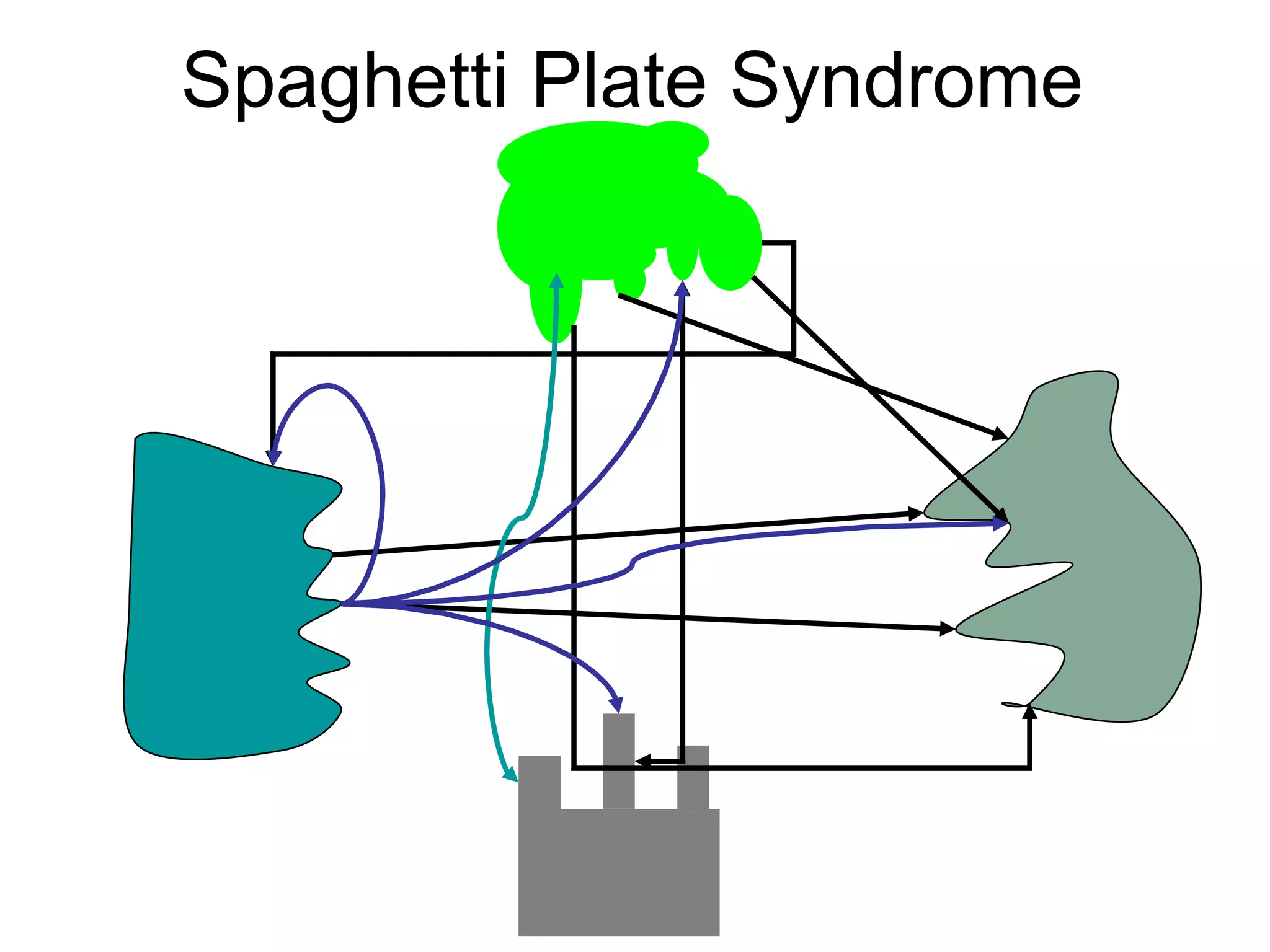
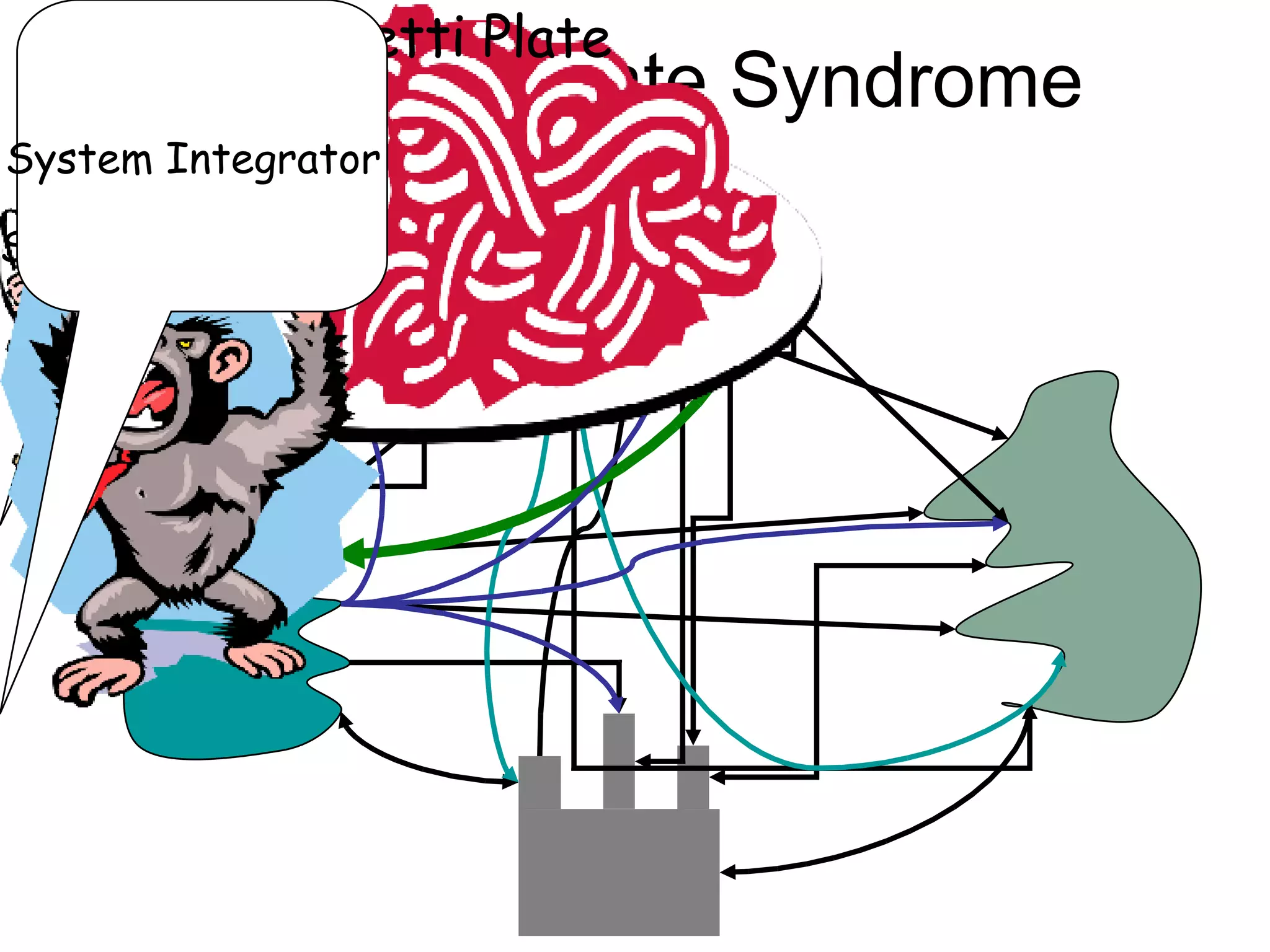
Spaghetti Plate Syndrome
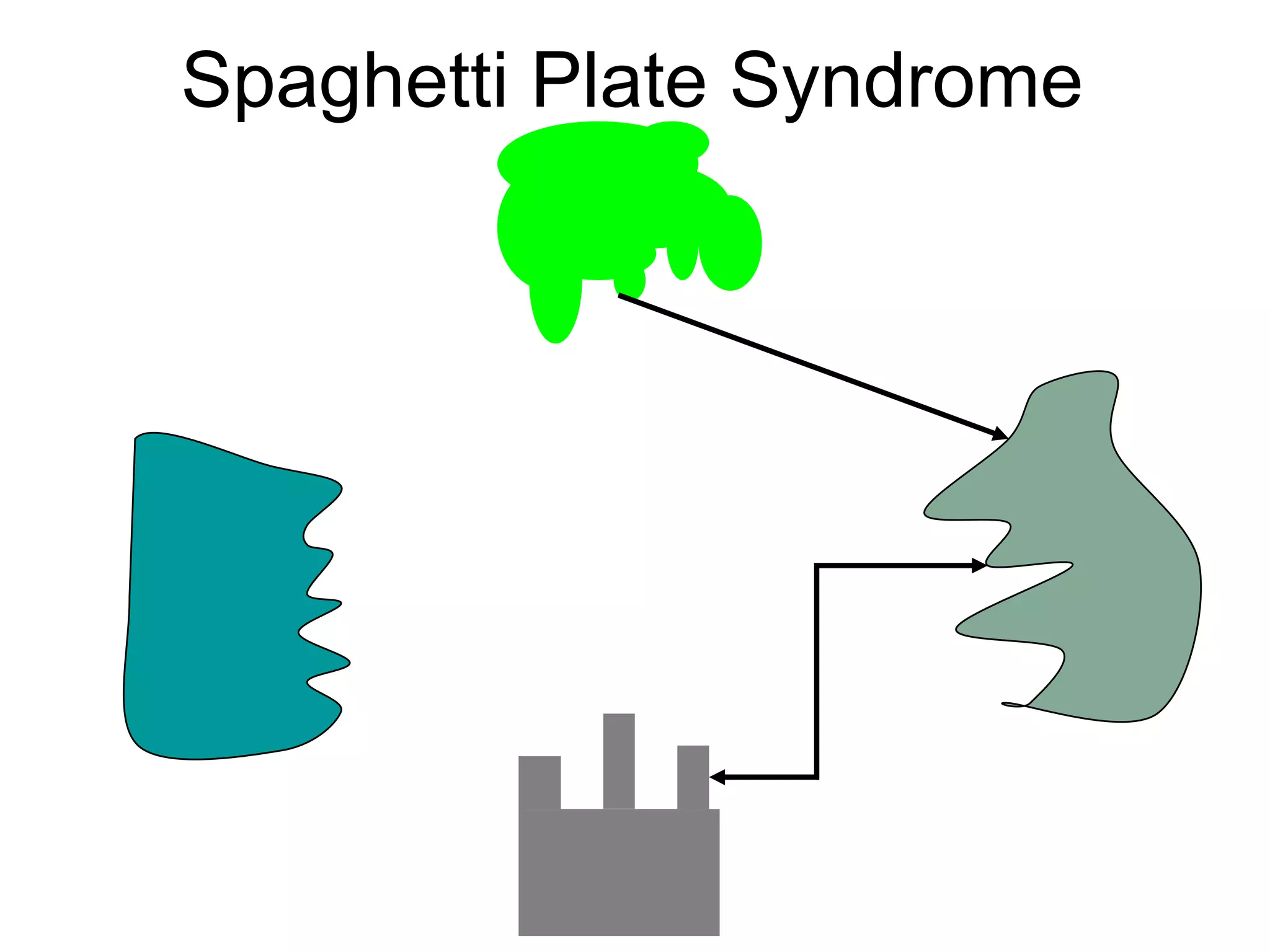
Spaghetti Plate Syndrome Spaghetti Plate
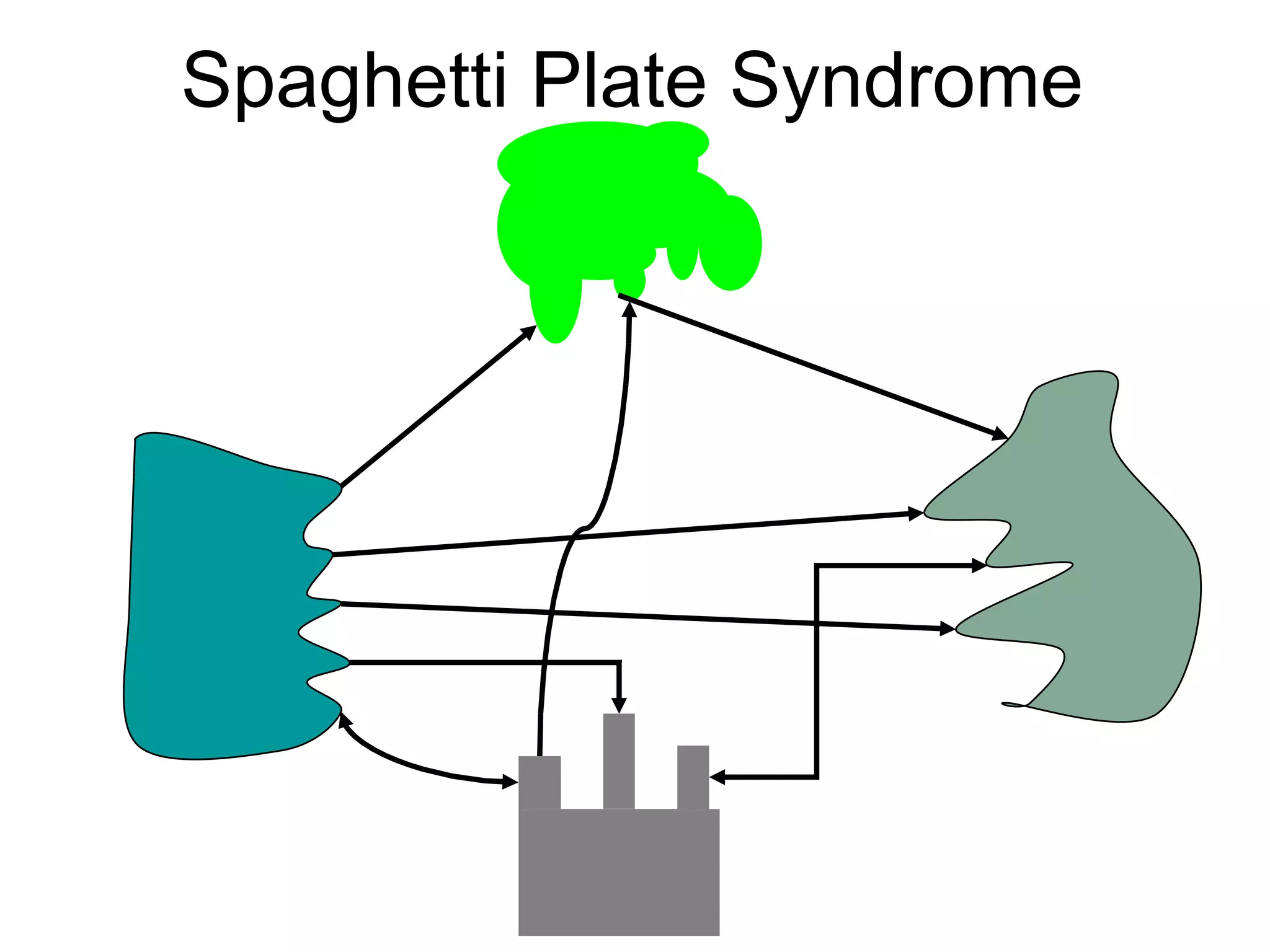
Spaghetti Plate Syndrome Spaghetti Plate System Architect
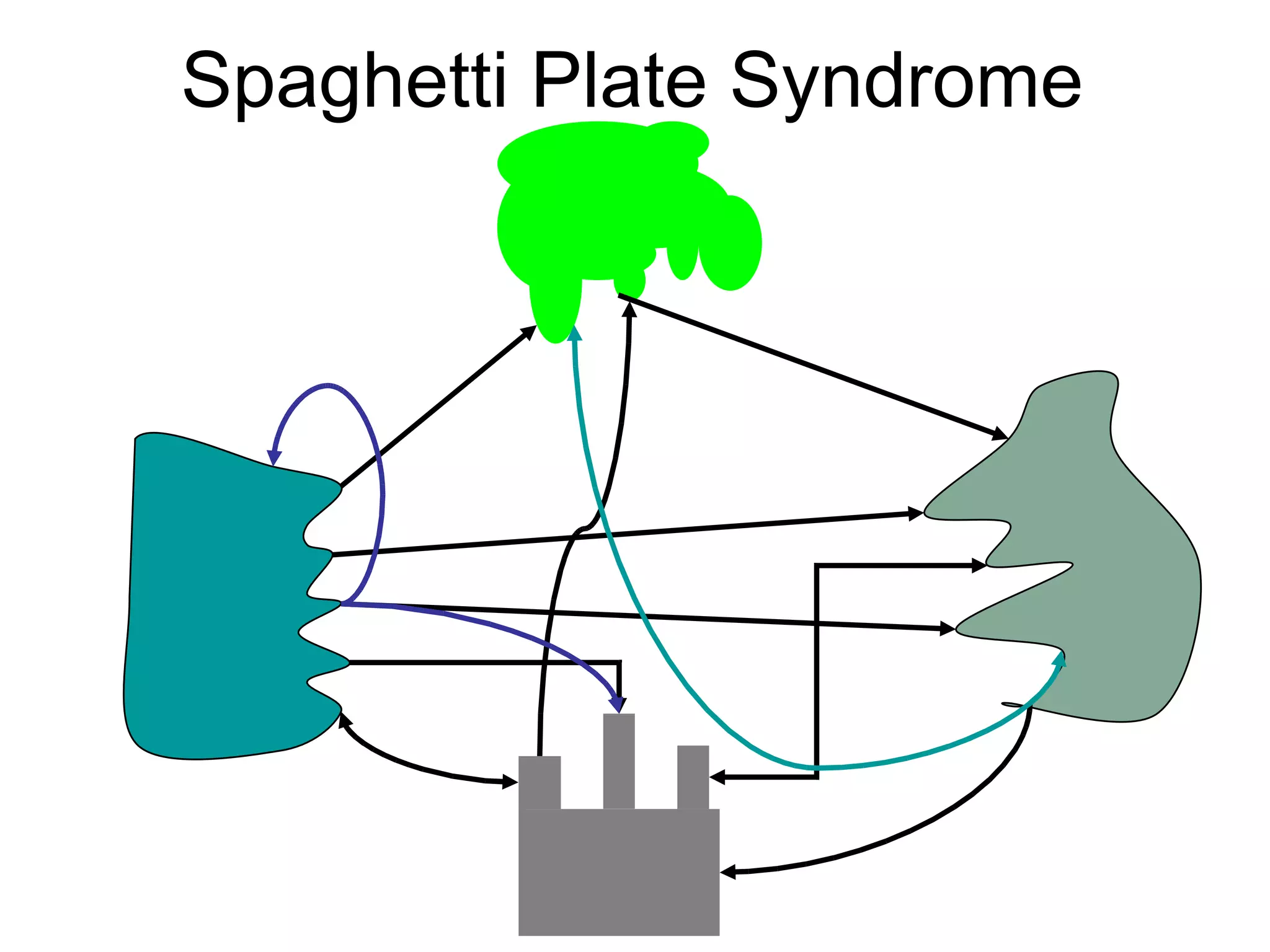
Spaghetti Plate Syndrome Spaghetti Plate System Architect  System Integrator
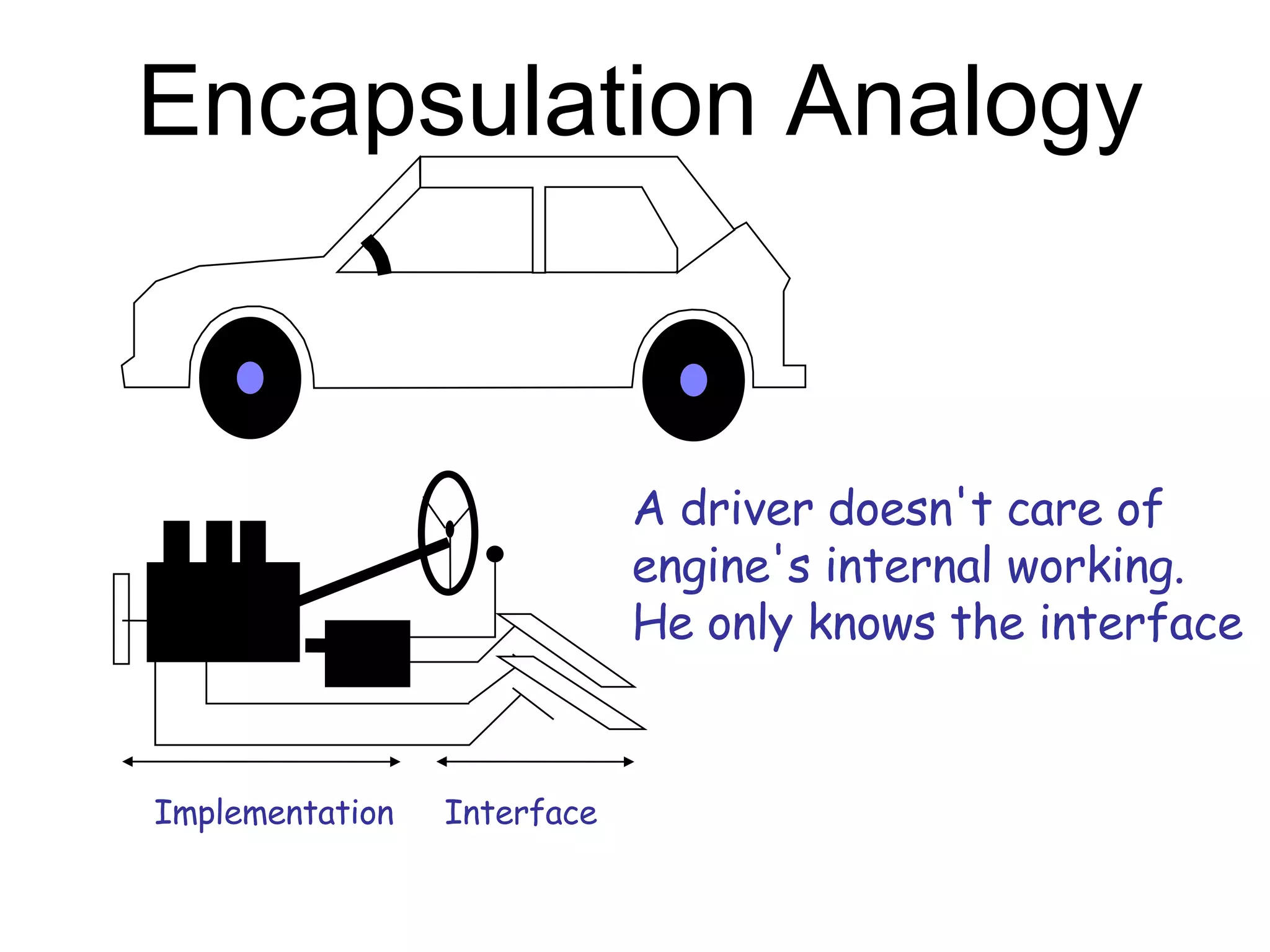
Encapsulation Analogy Implementation Interface A driver doesn't care of  engine's internal working. He only knows the interface
 
Process
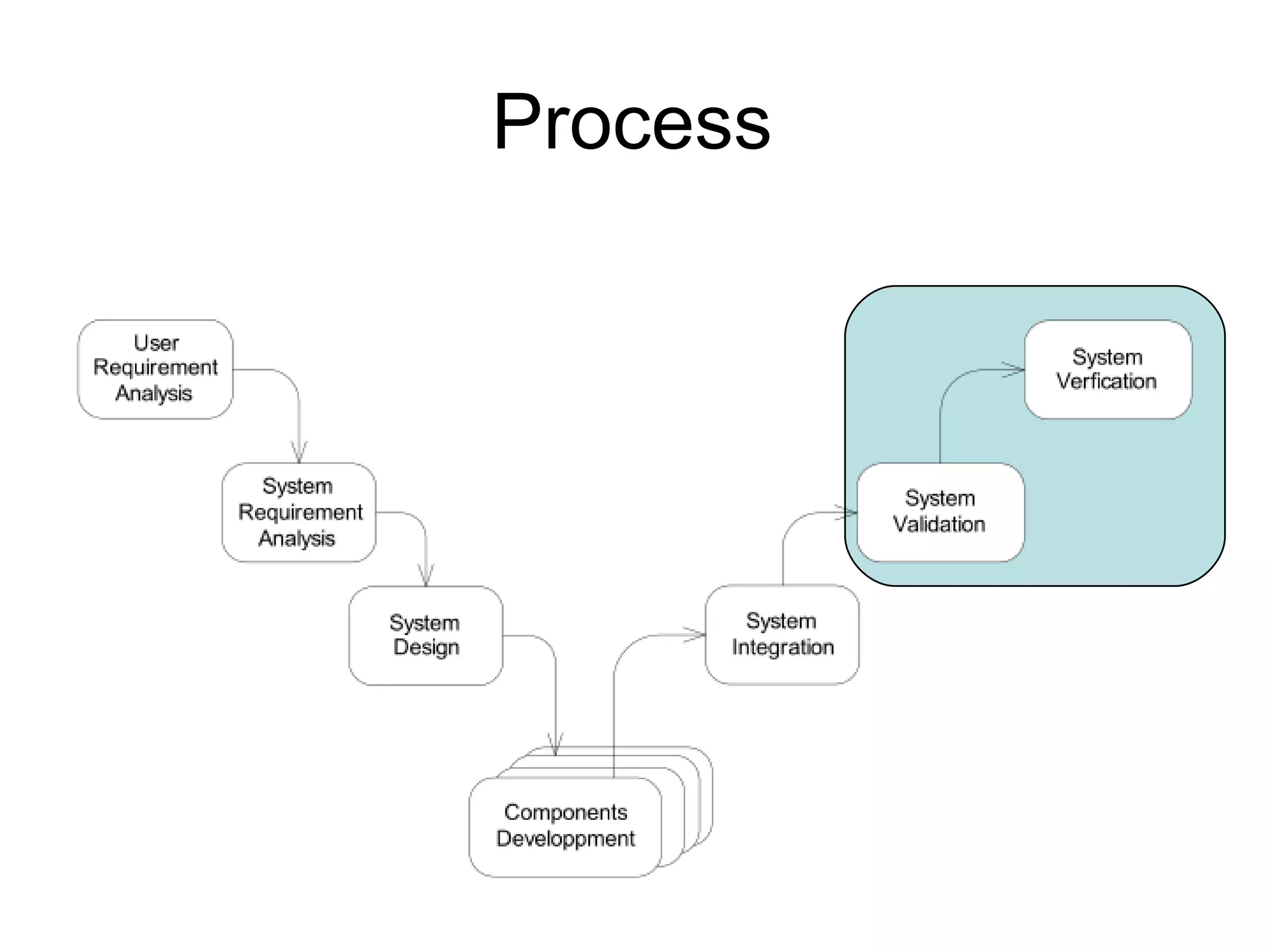
IVVQCA Integrate :  Build the system Verification :  Ensures that you built it right Validation :  Ensures that you built the right thing Certification :  Ensure that the system is safe Acceptance :  Ensures that the customer gets what he wants and the company get paid.
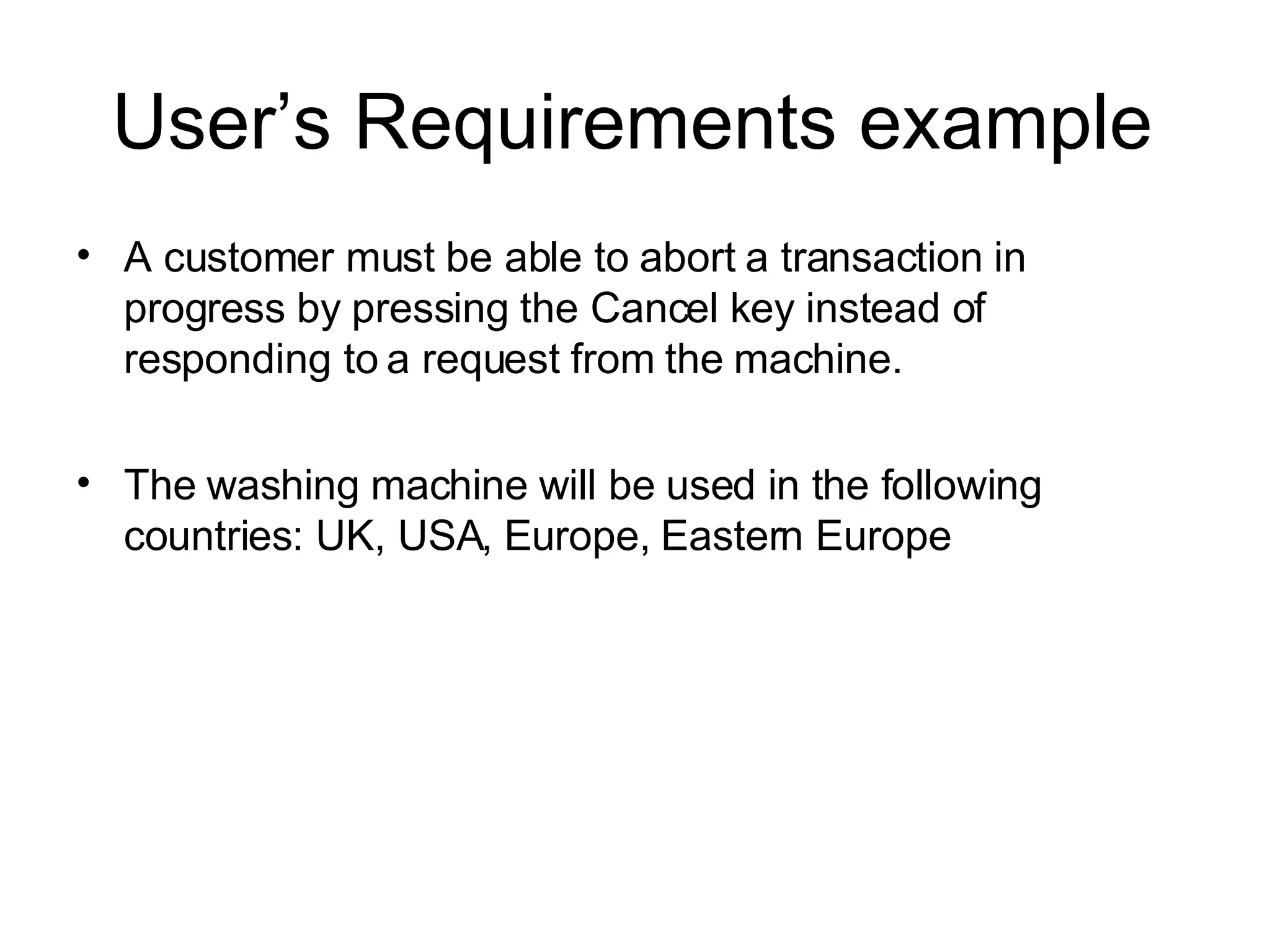
Ensure that the system is safe
Conclusion Thank You For Your Attention Questions are welcome Contacts :  [email_address] Slides Available soon at www.elfuchs.fr

Complex System Engineering

  • 1.
    Introduction to Complex System Engineering Emmanuel FUCHS Slides available soon at www.elfuchs.fr
  • 2.
  • 3.
    Complex System ExamplesInformation Systems
  • 4.
  • 5.
  • 6.
  • 7.
    System definition (Eberhardt Rechtin 1926-2006) A system is a construct or collection of different elements that together produce results not obtainable by the elements alone.  The elements, or parts, can include people, hardware, software, facilities, policies, and documents; that is, all things required to produce systems-level results.  The results include system level qualities, properties, characteristics, functions, behavior and performance.   The value added by the system as a whole, beyond that contributed independently by the parts, is primarily created by the relationship among the parts; that is, how they are interconnected.
  • 8.
    Systemic The wholeis greater than the sum of the parts; The part is greater than a fraction of the whole. Aristotle
  • 9.
    System: another definitionA system is any set (group) of interdependent or temporally interacting parts . Parts are generally systems themselves and are composed of other parts, just as systems are generally parts of other systems.
  • 10.
    System Definition SystemUsers Mission Environment Stakeholders Border Sub System Sub System Sub System
  • 11.
    System Meta ModelFrom INCOSE
  • 12.
    SE Bodies http://www.afis.fr/Association Française d'Ingénierie Système http://www.incose.org/ International Council on Systems Engineering (INCOSE)
  • 13.
  • 14.
    System Engineering Definition“ an interdisciplinary approach encompassing the entire technical effort to evolve and verify an integrated and balanced set of system, people, product, and process solutions that satisfy customer needs …..”
  • 15.
    System Engineering (SE)SE focuses on defining customer needs and required functionality early in the development cycle, documenting requirements, then proceeding with design synthesis and system validation while considering the complete problem Systems engineers deal with abstract systems, and rely on other engineering disciplines to design and deliver the tangible products that are the realization of those systems. Systems engineering effort spans the whole system lifecycle .
  • 16.
    Systemic Approach One+ One > two Aristotle : The whole is more than the sum of its parts. Parts (Components) Connections
  • 17.
    System Engineering MetaModel From INCOSE
  • 18.
    System engineer/architect Workswith system abstraction. It is impossible to master everything Requirements Management System Model
  • 19.
  • 20.
    Design the rightsystem As proposed by the project sponsor As proposed by the programmers As specified in the project request As designed by the project analyst As installed at the users’ site What the customer really want
  • 21.
  • 22.
    Process Definition Setof interrelated of interacting activities which transforms inputs to outputs Inputs Outputs P
  • 23.
  • 24.
  • 25.
    Sequential V cycledrawbacks Documentation And mock-up Phase
  • 26.
    Sequential V cycledrawbacks Documentation And mock-up Phase
  • 27.
    Iterative and IncrementalIncremental Iterative
  • 28.
  • 29.
    Iterative and IncrementalThe Systems Engineering Process is not sequential. It is parallel and iterative. The complex interrelationship between creating and improving models throughout the process of developing and selecting alternatives is a good example of the dynamic nature of the systems engineering process.
  • 30.
    Process Standardization NASADOD (US Departement Of Defense): Documentation Model IEEE ISO (International Organization for Standardization) IEC (International Electrotechnical Committee). ISO/IEC 15504 / SPICE (Software Process Improvement and Capability dEtermination) SEI (Software Engineering Institute)
  • 31.
    Capability Maturity Model- Integration CMMI defines the essential elements of effective processes for engineering disciplines based on best industry experiences. CMMI models provide guidance when developing and evaluating processes. CMMI models are not actually processes or process descriptions.
  • 32.
    CMMI Maturity LevelsLevel Identified as Status 5 optimizing focus on process improvement 4 quantitatively managed process measured and controlled 3 defined process characterized for the organization and is proactive 2 managed process characterized by projects and often reactive 1 initial process uncontrolled poorly managed and reactive
  • 33.
    Process Documentation andReview SSS: System/Segment Specification SSDD : System/Segment Design Document IRS : Interface Requirement Specification ICD : Interface Control Definition SRR : System Requirement Review SDR : System Design Review TRR : Test Readiness Review
  • 34.
  • 35.
  • 36.
    What is arequirement ? A requirement is a condition to be satisfied in order to respond to: A contract A standard A specification Any other document and / or model imposed.
  • 37.
    Requirements User’sRequirements Statements in natural language of the system services. Described by the user System Requirements Structured document setting out detailed description of system services. Part of the contract
  • 38.
    User’s Requirements exampleA customer must be able to abort a transaction in progress by pressing the Cancel key instead of responding to a request from the machine. The washing machine will be used in the following countries: UK, USA, Europe, Eastern Europe
  • 39.
  • 40.
    System Requirements TheSystem shall provide ........ The System shall be capable of ........ The System shall weigh ........ The Subsystem #1 shall provide ........ The Subsystem #2 shall interface with .....
  • 41.
    Requirement Quality Agood requirement states something that is necessary , verifiable , and attainable To be verifiable, the requirement must state something that can be verified by: analysis, inspection, test, or demonstration (AIDT)
  • 42.
    Requirement analysis UserRequirement Minimum levels of noise and vibration are desirable . System Requirement Requirement 03320: The noise generated shall not exceed 60 db
  • 43.
    Requirement Types Functionalrequirements Functional requirements capture the intended behavior of the system. This behavior may be expressed as services, tasks or functions the system is required to perform Non-Functional requirements All others Constraints
  • 44.
  • 45.
  • 46.
    System Architecture The System Architecture identifies all the products (including enabling products) that are necessary to support the system and, by implication, the processes necessary for development, production/construction, deployment, operations, support, disposal, training, and verification
  • 47.
    Architecture Modeling System : Abstraction Functional model Dynamic model Semantic Model Object model Physical Model Interfaces Model Model Views
  • 48.
  • 49.
  • 50.
    Example of ArchitectureViews The Functional Architecture identifies and structures the allocated functional and performance requirements. The Physical Architecture depicts the system product by showing how it is broken down into subsystems and components
  • 51.
  • 52.
    Functional To PhysicalModel Functional : Discover the system functions Washing Machine What it does ? Washes How it does ? Agitates Physical Component : Agitator
  • 53.
    Functional VS physicalModel How to fly ? Look at birds: Physical Model So I need: Legs, Eyes, Brain, and Wings. But I can not fly !!! Why ? I have to find the flight functional model !
  • 54.
    Flying functional modelFunctional decomposition of flying function: Produce horizontal thrust, Produce vertical lift. Takeoff and land, Sense position and velocity, Navigate,
  • 55.
    Example Birds physicalfor flying Physical decomposition: physical components that birds used to fly: Legs, Eyes, Brain, and Wings. But can not be applied to system directly
  • 56.
    Bird and Airplane Functional to Physical architecture mapping Function Airplane Physical Component Bird Physical Component Takeoff and land Wheels, Legs Sense position and velocity Vision or radar Eyes Navigate Brain or computer Brain Produce horizontal thrust Propeller or jet Wings Produce vertical lift Wings Wings
  • 57.
  • 58.
    Trade Off Multi-criteriadecision-aiding techniques are available to help discover the preferred alternatives. This analysis should be repeated, as better data becomes available.
  • 59.
  • 60.
  • 61.
    Washing Machine Functional Breakdown
  • 62.
  • 63.
    Washing Machine PhysicalModel agitator tube draining hand-operated washer plungers
  • 64.
    Washing Machine PhysicalModel agitator Outer tube draining top loading US
  • 65.
    Washing Machine PhysicalModel top loading
  • 66.
    Washing Machine PhysicalModel agitator Outer tube draining Inner tube = drum front loading Europe
  • 67.
    Washing Machine PhysicalModel front loading
  • 68.
    Washing Machine PhysicalModel front loading
  • 69.
  • 70.
  • 71.
    Integration Integration meansbringing things together so they work as a whole.
  • 72.
  • 73.
  • 74.
  • 75.
  • 76.
  • 77.
  • 78.
    Spaghetti Plate SyndromeSpaghetti Plate
  • 79.
    Spaghetti Plate SyndromeSpaghetti Plate System Architect
  • 80.
    Spaghetti Plate SyndromeSpaghetti Plate System Architect System Integrator
  • 81.
    Encapsulation Analogy ImplementationInterface A driver doesn't care of engine's internal working. He only knows the interface
  • 82.
  • 83.
  • 84.
    IVVQCA Integrate : Build the system Verification : Ensures that you built it right Validation : Ensures that you built the right thing Certification : Ensure that the system is safe Acceptance : Ensures that the customer gets what he wants and the company get paid.
  • 85.
    Ensure that thesystem is safe
  • 86.
    Conclusion Thank YouFor Your Attention Questions are welcome Contacts : [email_address] Slides Available soon at www.elfuchs.fr