
WHAT IS VERIFICATION AND VALIDATION OF SOFTWARE ??
SUBMITTED TO :
SUBMITTED BY : Group 2
Adeel Kamran 03
Ali Raza Sheikh 04
Ali Raza 07
Sir Shafiq Shb
University of Education Lahore D.G Khan Campus 1
Software verification
Definition:
“The process of evaluating software to determine whether the products of a given development
phase satisfy the conditions imposed at the start of that phase.”
Articles:
• Fault – wrong or missing function in the code.
• Failure – the manifestation of a fault during execution. The software was not effective. It does
not do "what" it is supposed to do.
• Malfunction – according to its specification the system does not meet its specified functionality.
The software was not efficient (it took too many resources such as CPU cycles, it used too much
memory, performed too many I/O operations, etc.), it was not usable, it was not reliable, etc. It
does not do something "how" it is supposed to do it.
University of Education Lahore D.G Khan Campus 2
Types of Verification:
Verification is static type of s/w testing. It means code is not executed. The product
is evaluated by going through the code.
There are three types of verification.
1) Walk through
2) Inspection
3) Reviews
University of Education Lahore D.G Khan Campus 3
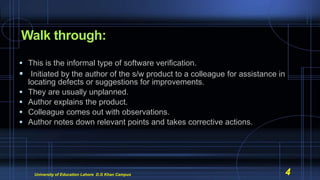
Walk through:
 This is the informal type of software verification.
 Initiated by the author of the s/w product to a colleague for assistance in
locating defects or suggestions for improvements.
 They are usually unplanned.
 Author explains the product.
 Colleague comes out with observations.
 Author notes down relevant points and takes corrective actions.
University of Education Lahore D.G Khan Campus 4
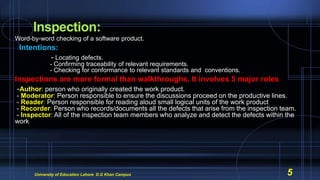
Inspection:
Word-by-word checking of a software product.
Intentions:
- Locating defects.
- Confirming traceability of relevant requirements.
- Checking for conformance to relevant standards and conventions.
Inspections are more formal than walkthroughs. It involves 5 major roles
-Author: person who originally created the work product.
- Moderator: Person responsible to ensure the discussions proceed on the productive lines.
- Reader: Person responsible for reading aloud small logical units of the work product
- Recorder: Person who records/documents all the defects that arise from the inspection team.
- Inspector: All of the inspection team members who analyze and detect the defects within the
work
University of Education Lahore D.G Khan Campus 5
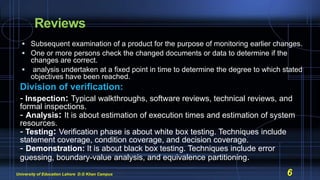
Reviews
 Subsequent examination of a product for the purpose of monitoring earlier changes.
 One or more persons check the changed documents or data to determine if the
changes are correct.
 analysis undertaken at a fixed point in time to determine the degree to which stated
objectives have been reached.
Division of verification:
- Inspection: Typical walkthroughs, software reviews, technical reviews, and
formal inspections.
- Analysis: It is about estimation of execution times and estimation of system
resources.
- Testing: Verification phase is about white box testing. Techniques include
statement coverage, condition coverage, and decision coverage.
- Demonstration: It is about black box testing. Techniques include error
guessing, boundary-value analysis, and equivalence partitioning.
University of Education Lahore D.G Khan Campus 6
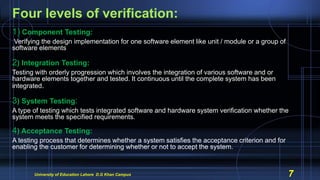
Four levels of verification:
1) Component Testing:
Verifying the design implementation for one software element like unit / module or a group of
software elements
2) Integration Testing:
Testing with orderly progression which involves the integration of various software and or
hardware elements together and tested. It continuous until the complete system has been
integrated.
3) System Testing:
A type of testing which tests integrated software and hardware system verification whether the
system meets the specified requirements.
4) Acceptance Testing:
A testing process that determines whether a system satisfies the acceptance criterion and for
enabling the customer for determining whether or not to accept the system.
University of Education Lahore D.G Khan Campus 7
Software Validation
 Validation: Are we building the right product?
In simple terms, software verification is:
"Assuming we should build X, does our software
achieve its goals without any bugs or gaps?"
On the other hand, software validation is:
"Was X what we should have built? Does X
meet the high level requirements?"
University of Education Lahore D.G Khan Campus 8
Software Validation:
 Software validation checks that
the software product satisfies or
fits the intended use (high-level
checking).
 the software meets the user
requirements, not or as needs of
those who will operate the
software only; but, as the needs
of all the stakeholders (such as
users, operators, administrators,
managers, investors, etc.).
University of Education Lahore D.G Khan Campus 9
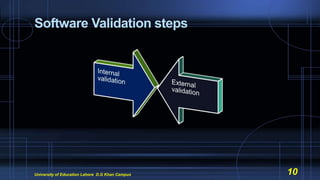
Software Validation steps
University of Education Lahore D.G Khan Campus 10
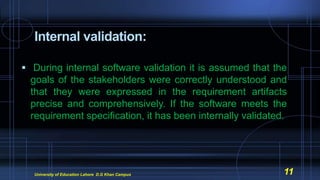
Internal validation:
 During internal software validation it is assumed that the
goals of the stakeholders were correctly understood and
that they were expressed in the requirement artifacts
precise and comprehensively. If the software meets the
requirement specification, it has been internally validated.
University of Education Lahore D.G Khan Campus 11
External validation:
 External validation happens when it is performed by
asking the stakeholders if the software meets their needs.
Different software development methodologies call for
different levels of user and stakeholder involvement and
feedback; so, external validation can be a discrete or a
continuous event. Successful final external validation
occurs when all the stakeholders accept the software
product and express that it satisfies their needs
University of Education Lahore D.G Khan Campus
12
What is basic difference between v&v
( verification and validation )
University of Education Lahore D.G Khan Campus 13
The terms Verification and Validation are commonly used in
software engineering to mean two different types of
analysis. The usual definitions are:
Verification: Are we building the system right?
Validation: Are we building the right system?
University of Education Lahore D.G Khan Campus 14
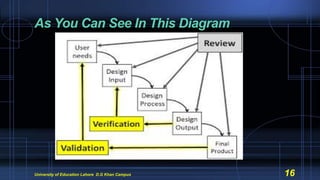
 In other words, validation is concerned with checking that the
system will meet the customer’s actual needs, while
verification is concerned with whether the system is well-
engineered, error-free, and so on. Verification will help to
determine whether the software is of high quality, but it will
not ensure that the system is useful.
 The distinction between the two terms is largely to do with the
role of specifications. Validation is the process of checking
whether the specification captures the customer’s needs,
while verification is the process of checking that the software
meets the specification.
University of Education Lahore D.G Khan Campus 15
As You Can See In This Diagram
University of Education Lahore D.G Khan Campus 16
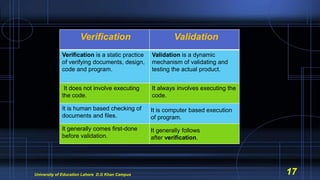
Verification Validation
Verification is a static practice
of verifying documents, design,
code and program.
Validation is a dynamic
mechanism of validating and
testing the actual product.
It does not involve executing
the code.
It always involves executing the
code.
It is human based checking of
documents and files.
It is computer based execution
of program.
It generally comes first-done
before validation.
It generally follows
after verification.
University of Education Lahore D.G Khan Campus 17
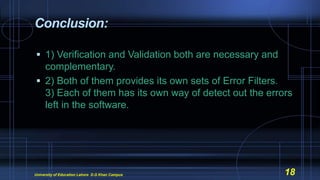
Conclusion:
 1) Verification and Validation both are necessary and
complementary.
 2) Both of them provides its own sets of Error Filters.
3) Each of them has its own way of detect out the errors
left in the software.
University of Education Lahore D.G Khan Campus 18
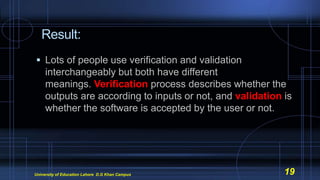
Result:
 Lots of people use verification and validation
interchangeably but both have different
meanings. Verification process describes whether the
outputs are according to inputs or not, and validation is
whether the software is accepted by the user or not.
University of Education Lahore D.G Khan Campus 19
THANK YOU FOR YOUR
ATTENTION!
University of Education Lahore D.G Khan Campus 20

Software Verification and Validation

  • 1.
    WHAT IS VERIFICATIONAND VALIDATION OF SOFTWARE ?? SUBMITTED TO : SUBMITTED BY : Group 2 Adeel Kamran 03 Ali Raza Sheikh 04 Ali Raza 07 Sir Shafiq Shb University of Education Lahore D.G Khan Campus 1
  • 2.
    Software verification Definition: “The processof evaluating software to determine whether the products of a given development phase satisfy the conditions imposed at the start of that phase.” Articles: • Fault – wrong or missing function in the code. • Failure – the manifestation of a fault during execution. The software was not effective. It does not do "what" it is supposed to do. • Malfunction – according to its specification the system does not meet its specified functionality. The software was not efficient (it took too many resources such as CPU cycles, it used too much memory, performed too many I/O operations, etc.), it was not usable, it was not reliable, etc. It does not do something "how" it is supposed to do it. University of Education Lahore D.G Khan Campus 2
  • 3.
    Types of Verification: Verificationis static type of s/w testing. It means code is not executed. The product is evaluated by going through the code. There are three types of verification. 1) Walk through 2) Inspection 3) Reviews University of Education Lahore D.G Khan Campus 3
  • 4.
    Walk through:  Thisis the informal type of software verification.  Initiated by the author of the s/w product to a colleague for assistance in locating defects or suggestions for improvements.  They are usually unplanned.  Author explains the product.  Colleague comes out with observations.  Author notes down relevant points and takes corrective actions. University of Education Lahore D.G Khan Campus 4
  • 5.
    Inspection: Word-by-word checking ofa software product. Intentions: - Locating defects. - Confirming traceability of relevant requirements. - Checking for conformance to relevant standards and conventions. Inspections are more formal than walkthroughs. It involves 5 major roles -Author: person who originally created the work product. - Moderator: Person responsible to ensure the discussions proceed on the productive lines. - Reader: Person responsible for reading aloud small logical units of the work product - Recorder: Person who records/documents all the defects that arise from the inspection team. - Inspector: All of the inspection team members who analyze and detect the defects within the work University of Education Lahore D.G Khan Campus 5
  • 6.
    Reviews  Subsequent examinationof a product for the purpose of monitoring earlier changes.  One or more persons check the changed documents or data to determine if the changes are correct.  analysis undertaken at a fixed point in time to determine the degree to which stated objectives have been reached. Division of verification: - Inspection: Typical walkthroughs, software reviews, technical reviews, and formal inspections. - Analysis: It is about estimation of execution times and estimation of system resources. - Testing: Verification phase is about white box testing. Techniques include statement coverage, condition coverage, and decision coverage. - Demonstration: It is about black box testing. Techniques include error guessing, boundary-value analysis, and equivalence partitioning. University of Education Lahore D.G Khan Campus 6
  • 7.
    Four levels ofverification: 1) Component Testing: Verifying the design implementation for one software element like unit / module or a group of software elements 2) Integration Testing: Testing with orderly progression which involves the integration of various software and or hardware elements together and tested. It continuous until the complete system has been integrated. 3) System Testing: A type of testing which tests integrated software and hardware system verification whether the system meets the specified requirements. 4) Acceptance Testing: A testing process that determines whether a system satisfies the acceptance criterion and for enabling the customer for determining whether or not to accept the system. University of Education Lahore D.G Khan Campus 7
  • 8.
    Software Validation  Validation:Are we building the right product? In simple terms, software verification is: "Assuming we should build X, does our software achieve its goals without any bugs or gaps?" On the other hand, software validation is: "Was X what we should have built? Does X meet the high level requirements?" University of Education Lahore D.G Khan Campus 8
  • 9.
    Software Validation:  Softwarevalidation checks that the software product satisfies or fits the intended use (high-level checking).  the software meets the user requirements, not or as needs of those who will operate the software only; but, as the needs of all the stakeholders (such as users, operators, administrators, managers, investors, etc.). University of Education Lahore D.G Khan Campus 9
  • 10.
    Software Validation steps Universityof Education Lahore D.G Khan Campus 10
  • 11.
    Internal validation:  Duringinternal software validation it is assumed that the goals of the stakeholders were correctly understood and that they were expressed in the requirement artifacts precise and comprehensively. If the software meets the requirement specification, it has been internally validated. University of Education Lahore D.G Khan Campus 11
  • 12.
    External validation:  Externalvalidation happens when it is performed by asking the stakeholders if the software meets their needs. Different software development methodologies call for different levels of user and stakeholder involvement and feedback; so, external validation can be a discrete or a continuous event. Successful final external validation occurs when all the stakeholders accept the software product and express that it satisfies their needs University of Education Lahore D.G Khan Campus 12
  • 13.
    What is basicdifference between v&v ( verification and validation ) University of Education Lahore D.G Khan Campus 13
  • 14.
    The terms Verificationand Validation are commonly used in software engineering to mean two different types of analysis. The usual definitions are: Verification: Are we building the system right? Validation: Are we building the right system? University of Education Lahore D.G Khan Campus 14
  • 15.
     In otherwords, validation is concerned with checking that the system will meet the customer’s actual needs, while verification is concerned with whether the system is well- engineered, error-free, and so on. Verification will help to determine whether the software is of high quality, but it will not ensure that the system is useful.  The distinction between the two terms is largely to do with the role of specifications. Validation is the process of checking whether the specification captures the customer’s needs, while verification is the process of checking that the software meets the specification. University of Education Lahore D.G Khan Campus 15
  • 16.
    As You CanSee In This Diagram University of Education Lahore D.G Khan Campus 16
  • 17.
    Verification Validation Verification isa static practice of verifying documents, design, code and program. Validation is a dynamic mechanism of validating and testing the actual product. It does not involve executing the code. It always involves executing the code. It is human based checking of documents and files. It is computer based execution of program. It generally comes first-done before validation. It generally follows after verification. University of Education Lahore D.G Khan Campus 17
  • 18.
    Conclusion:  1) Verificationand Validation both are necessary and complementary.  2) Both of them provides its own sets of Error Filters. 3) Each of them has its own way of detect out the errors left in the software. University of Education Lahore D.G Khan Campus 18
  • 19.
    Result:  Lots ofpeople use verification and validation interchangeably but both have different meanings. Verification process describes whether the outputs are according to inputs or not, and validation is whether the software is accepted by the user or not. University of Education Lahore D.G Khan Campus 19
  • 20.
    THANK YOU FORYOUR ATTENTION! University of Education Lahore D.G Khan Campus 20