Procurement
CONSTRUCTION SUPPLY CHAIN
MANAGEMENT (MGT60803/QSB 2433)
Introduction
• Supply chain (SC) is long and has many links, such
as logistics, distribution, materials management,
inventory control and freight (goods) to the
procurement function.
• SCM is a process from conception to
consumption.
• Procurement will help to ensure the relevant
resources needed are continuously provided.
2
Definition of Procurement
• Procurement is the business management
function (process) that ensures identification,
sourcing, access and management of the
external resources (supplies / services –
equipment / materials) that an organization
needs or may need to fulfill its strategic
objectives.
3
Definition of Procurement
• Procurement deals with the sourcing
activities, negotiation and strategic selection
of goods and services.
• Procurement and supply management
involves buying the goods and services that
enable an organization to operate.
4
Definition of Procurement
• Procurement
- The entire process by which goods and
services are selected, based on:-
1.What goods and services are needed?
2.When the items will be needed?
3.From which vendors you will purchase?
5
Objectives of Procurement
• “Securing supplies, materials and services of
the right quality in the right quantity at the
right time from the right place (source) at the
right cost.” (Emmett and Crocker, 2008)
6
Objectives of Procurement
• From the client perspective, the COST,
QUALITY and TIME paradigm might be
considered as being the highest quality, at
lowest cost, in the shortest time.
• Unfortunately, this is not always possible.
(Hackett et al, 2007)
7
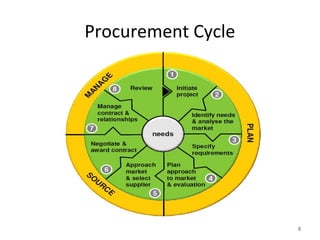
Procurement Cycle
8
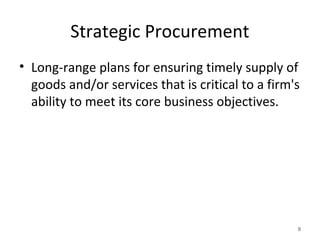
Strategic Procurement
• Long-range plans for ensuring timely supply of
goods and/or services that is critical to a firm's
ability to meet its core business objectives.
9
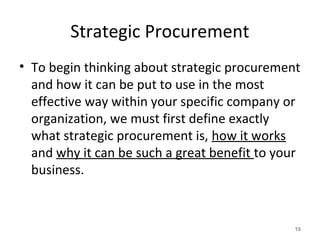
Strategic Procurement
• To begin thinking about strategic procurement
and how it can be put to use in the most
effective way within your specific company or
organization, we must first define exactly
what strategic procurement is, how it works
and why it can be such a great benefit to your
business.
10
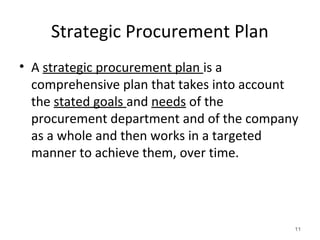
Strategic Procurement Plan
• A strategic procurement plan is a
comprehensive plan that takes into account
the stated goals and needs of the
procurement department and of the company
as a whole and then works in a targeted
manner to achieve them, over time.
11
Traditional Procurement
• A traditional approach to procurement is to
view it as an administrative function for
buying goods and services.
• Traditional procurement skills, such as
financial management, contract management,
cost reduction and basic negotiation will
always be fundamental to the procurement
process.
12
Today’s
• Combine traditional purchasing skills with
good relationship management skills -
listening, understanding, communicating and
empathy.
13
Strategic Procurement
• The buyer and supplier work together right
from the start of the relationship to share
information, training, support, technical input
and ideas in order to reduce the total overall
cost.
• At the same time the buyer also needs to
work closely with internal customers to
ensure their needs are met.
14
Total Cost of Ownership (TCO)
• Buying price is probably the factor most often
associated with procurement.
• However, price does not equal to cost. The
procurement should consider the TCO.
15
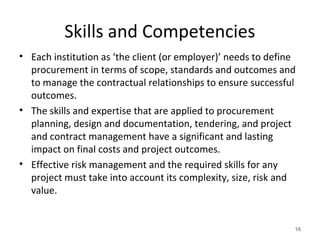
Skills and Competencies
• Each institution as ‘the client (or employer)’ needs to define
procurement in terms of scope, standards and outcomes and
to manage the contractual relationships to ensure successful
outcomes.
• The skills and expertise that are applied to procurement
planning, design and documentation, tendering, and project
and contract management have a significant and lasting
impact on final costs and project outcomes.
• Effective risk management and the required skills for any
project must take into account its complexity, size, risk and
value.
16
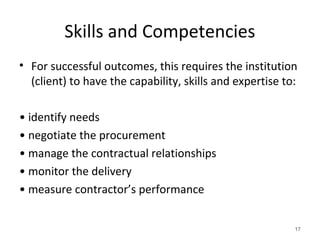
Skills and Competencies
• For successful outcomes, this requires the institution
(client) to have the capability, skills and expertise to:
• identify needs
• negotiate the procurement
• manage the contractual relationships
• monitor the delivery
• measure contractor’s performance
17
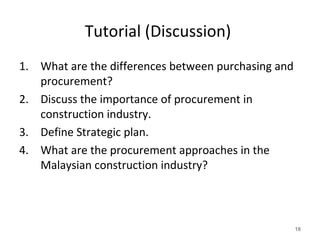
Tutorial (Discussion)
1. What are the differences between purchasing and
procurement?
2. Discuss the importance of procurement in
construction industry.
3. Define Strategic plan.
4. What are the procurement approaches in the
Malaysian construction industry?
18

CSCM Chapter 2 procurement

  • 1.
  • 2.
    Introduction • Supply chain(SC) is long and has many links, such as logistics, distribution, materials management, inventory control and freight (goods) to the procurement function. • SCM is a process from conception to consumption. • Procurement will help to ensure the relevant resources needed are continuously provided. 2
  • 3.
    Definition of Procurement •Procurement is the business management function (process) that ensures identification, sourcing, access and management of the external resources (supplies / services – equipment / materials) that an organization needs or may need to fulfill its strategic objectives. 3
  • 4.
    Definition of Procurement •Procurement deals with the sourcing activities, negotiation and strategic selection of goods and services. • Procurement and supply management involves buying the goods and services that enable an organization to operate. 4
  • 5.
    Definition of Procurement •Procurement - The entire process by which goods and services are selected, based on:- 1.What goods and services are needed? 2.When the items will be needed? 3.From which vendors you will purchase? 5
  • 6.
    Objectives of Procurement •“Securing supplies, materials and services of the right quality in the right quantity at the right time from the right place (source) at the right cost.” (Emmett and Crocker, 2008) 6
  • 7.
    Objectives of Procurement •From the client perspective, the COST, QUALITY and TIME paradigm might be considered as being the highest quality, at lowest cost, in the shortest time. • Unfortunately, this is not always possible. (Hackett et al, 2007) 7
  • 8.
  • 9.
    Strategic Procurement • Long-rangeplans for ensuring timely supply of goods and/or services that is critical to a firm's ability to meet its core business objectives. 9
  • 10.
    Strategic Procurement • Tobegin thinking about strategic procurement and how it can be put to use in the most effective way within your specific company or organization, we must first define exactly what strategic procurement is, how it works and why it can be such a great benefit to your business. 10
  • 11.
    Strategic Procurement Plan •A strategic procurement plan is a comprehensive plan that takes into account the stated goals and needs of the procurement department and of the company as a whole and then works in a targeted manner to achieve them, over time. 11
  • 12.
    Traditional Procurement • Atraditional approach to procurement is to view it as an administrative function for buying goods and services. • Traditional procurement skills, such as financial management, contract management, cost reduction and basic negotiation will always be fundamental to the procurement process. 12
  • 13.
    Today’s • Combine traditionalpurchasing skills with good relationship management skills - listening, understanding, communicating and empathy. 13
  • 14.
    Strategic Procurement • Thebuyer and supplier work together right from the start of the relationship to share information, training, support, technical input and ideas in order to reduce the total overall cost. • At the same time the buyer also needs to work closely with internal customers to ensure their needs are met. 14
  • 15.
    Total Cost ofOwnership (TCO) • Buying price is probably the factor most often associated with procurement. • However, price does not equal to cost. The procurement should consider the TCO. 15
  • 16.
    Skills and Competencies •Each institution as ‘the client (or employer)’ needs to define procurement in terms of scope, standards and outcomes and to manage the contractual relationships to ensure successful outcomes. • The skills and expertise that are applied to procurement planning, design and documentation, tendering, and project and contract management have a significant and lasting impact on final costs and project outcomes. • Effective risk management and the required skills for any project must take into account its complexity, size, risk and value. 16
  • 17.
    Skills and Competencies •For successful outcomes, this requires the institution (client) to have the capability, skills and expertise to: • identify needs • negotiate the procurement • manage the contractual relationships • monitor the delivery • measure contractor’s performance 17
  • 18.
    Tutorial (Discussion) 1. Whatare the differences between purchasing and procurement? 2. Discuss the importance of procurement in construction industry. 3. Define Strategic plan. 4. What are the procurement approaches in the Malaysian construction industry? 18