Construction Supply Chain
Management
Construction Supply Chain
Management
(MGT60803/QSB2433)
Introduction
• The ability successfully to procure built assets
is at the heart of the construction process.
• At the heart of the procurement process is
identifying the constantly evolving needs of
the construction client.
Just what every construction client
wants!
Supply Chain
• Supply chain is used to describe the
interconnected hierarchy of supply contracts
necessary to procure the built assets.
• Managing the supply chain involves
understanding the breakdown and traceability
of products and services, organizations,
logistics, people, activities, information and
resources that transform raw materials into a
finished product.
Supply Chain
• Construction industry has the particular
difficulty that every building is different, a
unique prototype, developed by a team od
consultants, contractors and suppliers that
may never have worked together before.
• To add to the complexity, different
procurement systems place elements of
supply chain management with varying
disciplines and organizations.
Construction Procurement
• Procurement is the process of obtaining goods
and services from another for some
consideration. (Generally – acquire
something)
• Procurement is used in the context of
construction and refers to the processes of
acquiring construction project.
(E.g. a building)
Construction Procurement
• When a project is dreamt about by the client,
he works towards actualizing it.
• Apart from funding and providing land for
development, the client does not have the
requisite skills to actualize his dream.
• He has to employ the services of those who
would do so.
** In this case, the client might be the
government sectors.
Construction Procurement
• The task of designing his dream and its
subsequent construction are open to different
methods.
• Hence, to choose the most appropriate
method for his project, he needs professional
advice (consultant team).
How to choose the most appropriate
procurement method to satisfy the
client’s needs?
Procurement
• Procurement is a term used to describe all
activities undertaken by the client in seeking
to bring about the construction, says a
building.
• When client wishes to choose any type of
procurement method for realizing his project,
his major concern are the drivers of the
procurement.
What are the drivers of
construction procurement?
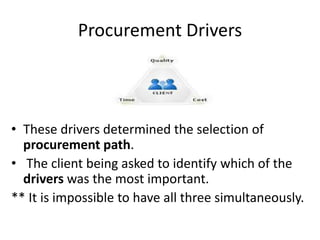
Procurement Drivers
• These drivers determined the selection of
procurement path.
• The client being asked to identify which of the
drivers was the most important.
** It is impossible to have all three simultaneously.
Procurement Drivers
• To finish the project on time (Time)
• The cost of the project (Cost)
• Performance or quality in relation to both
design and construction of the building
(Quality)
Procurement Method
• Traditional
• Design and build
• Management Contracting
• Public-Private Partnership (PPP)
** Only focus on first three methods.
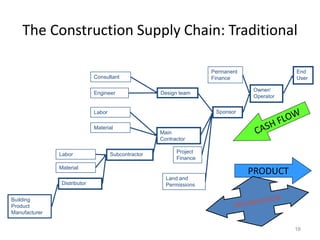
Traditional Building Project
• On a traditional building project, design
consultants are the first tier suppliers,
working for the client and the contractor has
the supply chain of sub-constructors and
specialist suppliers.
The Construction Supply Chain: Traditional
16
Owner/
Operator
Labor Subcontractor
Engineer
Main
Contractor
Design team
Sponsor
Distributor
End
User
Permanent
Finance
Project
Finance
Land and
Permissions
Consultant
Labor
Material
Material
Building
Product
Manufacturer
PRODUCT
Traditional
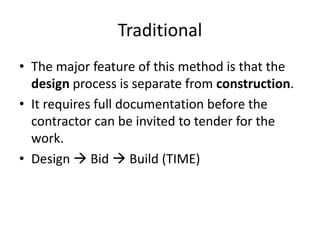
• The major feature of this method is that the
design process is separate from construction.
• It requires full documentation before the
contractor can be invited to tender for the
work.
• Design  Bid  Build (TIME)
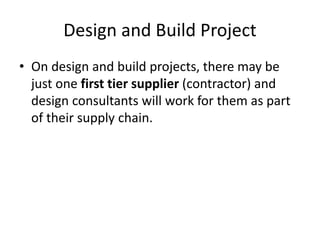
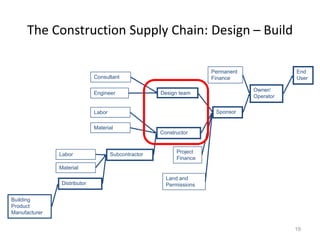
Design and Build Project
• On design and build projects, there may be
just one first tier supplier (contractor) and
design consultants will work for them as part
of their supply chain.
The Construction Supply Chain: Design – Build
19
Owner/
Operator
Labor Subcontractor
Engineer
Constructor
Design team
Sponsor
Distributor
End
User
Permanent
Finance
Project
Finance
Land and
Permissions
Consultant
Labor
Material
Material
Building
Product
Manufacturer
Design and Build
• In this method, the contractor is responsible
for undertaking both design and construction
of the work.
• To choose a suitable contractor for the job,
contractors are required to develop a design
(from an initial concept prepared by the
consultant appointed to advice the client),
prepare a tender figure and submit the whole
package to be evaluated by the client.
Design and Build
• A team of consultants will be needed to
assess each contractor’s proposal. (different
designs)
• Tenderers should be informed of the criteria
to be used.
• Price will be the prime factor in this method.
(COST)
Management
• This method of procurement is based upon
the client appointing a consultant who will
prepare project drawings and project
specifications.
• A management contractor is selected by a
process of tender and interviews.
• The management contractor will not carry out
construction work. WHY??
Management
• This helps to preserve the management
contractor’s independence and reinforces a
consultancy relationship with the client.
• The success of this approach depends on the
contractor’s team (experienced in construction
team working).
• Adjustments will be made to the design and
specification of work packages later to keep the
project within budget.
• The overall process will be shorter. (TIME)
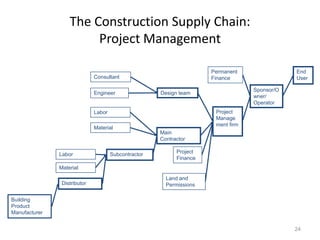
The Construction Supply Chain:
Project Management
24
Sponsor/O
wner/
Operator
Labor Subcontractor
Engineer
Main
Contractor
Design team
Project
Manage
ment firm
Distributor
End
User
Permanent
Finance
Project
Finance
Land and
Permissions
Consultant
Labor
Material
Material
Building
Product
Manufacturer
Large/Complex Project
• On large or complex projects, responsibility
and performance generally cascades down the
supply chain to a plethora / redundancy of
suppliers, sometimes unknown to
management at the top of the chain.
The End

CSCM Chapter 1 construction supply chain management

  • 1.
    Construction Supply Chain Management ConstructionSupply Chain Management (MGT60803/QSB2433)
  • 2.
    Introduction • The abilitysuccessfully to procure built assets is at the heart of the construction process. • At the heart of the procurement process is identifying the constantly evolving needs of the construction client.
  • 3.
    Just what everyconstruction client wants!
  • 4.
    Supply Chain • Supplychain is used to describe the interconnected hierarchy of supply contracts necessary to procure the built assets. • Managing the supply chain involves understanding the breakdown and traceability of products and services, organizations, logistics, people, activities, information and resources that transform raw materials into a finished product.
  • 5.
    Supply Chain • Constructionindustry has the particular difficulty that every building is different, a unique prototype, developed by a team od consultants, contractors and suppliers that may never have worked together before. • To add to the complexity, different procurement systems place elements of supply chain management with varying disciplines and organizations.
  • 6.
    Construction Procurement • Procurementis the process of obtaining goods and services from another for some consideration. (Generally – acquire something) • Procurement is used in the context of construction and refers to the processes of acquiring construction project. (E.g. a building)
  • 7.
    Construction Procurement • Whena project is dreamt about by the client, he works towards actualizing it. • Apart from funding and providing land for development, the client does not have the requisite skills to actualize his dream. • He has to employ the services of those who would do so. ** In this case, the client might be the government sectors.
  • 8.
    Construction Procurement • Thetask of designing his dream and its subsequent construction are open to different methods. • Hence, to choose the most appropriate method for his project, he needs professional advice (consultant team).
  • 9.
    How to choosethe most appropriate procurement method to satisfy the client’s needs?
  • 10.
    Procurement • Procurement isa term used to describe all activities undertaken by the client in seeking to bring about the construction, says a building. • When client wishes to choose any type of procurement method for realizing his project, his major concern are the drivers of the procurement.
  • 11.
    What are thedrivers of construction procurement?
  • 12.
    Procurement Drivers • Thesedrivers determined the selection of procurement path. • The client being asked to identify which of the drivers was the most important. ** It is impossible to have all three simultaneously.
  • 13.
    Procurement Drivers • Tofinish the project on time (Time) • The cost of the project (Cost) • Performance or quality in relation to both design and construction of the building (Quality)
  • 14.
    Procurement Method • Traditional •Design and build • Management Contracting • Public-Private Partnership (PPP) ** Only focus on first three methods.
  • 15.
    Traditional Building Project •On a traditional building project, design consultants are the first tier suppliers, working for the client and the contractor has the supply chain of sub-constructors and specialist suppliers.
  • 16.
    The Construction SupplyChain: Traditional 16 Owner/ Operator Labor Subcontractor Engineer Main Contractor Design team Sponsor Distributor End User Permanent Finance Project Finance Land and Permissions Consultant Labor Material Material Building Product Manufacturer PRODUCT
  • 17.
    Traditional • The majorfeature of this method is that the design process is separate from construction. • It requires full documentation before the contractor can be invited to tender for the work. • Design  Bid  Build (TIME)
  • 18.
    Design and BuildProject • On design and build projects, there may be just one first tier supplier (contractor) and design consultants will work for them as part of their supply chain.
  • 19.
    The Construction SupplyChain: Design – Build 19 Owner/ Operator Labor Subcontractor Engineer Constructor Design team Sponsor Distributor End User Permanent Finance Project Finance Land and Permissions Consultant Labor Material Material Building Product Manufacturer
  • 20.
    Design and Build •In this method, the contractor is responsible for undertaking both design and construction of the work. • To choose a suitable contractor for the job, contractors are required to develop a design (from an initial concept prepared by the consultant appointed to advice the client), prepare a tender figure and submit the whole package to be evaluated by the client.
  • 21.
    Design and Build •A team of consultants will be needed to assess each contractor’s proposal. (different designs) • Tenderers should be informed of the criteria to be used. • Price will be the prime factor in this method. (COST)
  • 22.
    Management • This methodof procurement is based upon the client appointing a consultant who will prepare project drawings and project specifications. • A management contractor is selected by a process of tender and interviews. • The management contractor will not carry out construction work. WHY??
  • 23.
    Management • This helpsto preserve the management contractor’s independence and reinforces a consultancy relationship with the client. • The success of this approach depends on the contractor’s team (experienced in construction team working). • Adjustments will be made to the design and specification of work packages later to keep the project within budget. • The overall process will be shorter. (TIME)
  • 24.
    The Construction SupplyChain: Project Management 24 Sponsor/O wner/ Operator Labor Subcontractor Engineer Main Contractor Design team Project Manage ment firm Distributor End User Permanent Finance Project Finance Land and Permissions Consultant Labor Material Material Building Product Manufacturer
  • 25.
    Large/Complex Project • Onlarge or complex projects, responsibility and performance generally cascades down the supply chain to a plethora / redundancy of suppliers, sometimes unknown to management at the top of the chain.
  • 26.