New Directions of Procurement and Supply Chain ManagementSubmitted ByAhmed Ali (860828)Ali Ammara (860657)Ali Dow (862247)Submitted ToProf. David BurnellApril,28,2010
Introductionprocurement function is part of logistics system. Procurement is one the important activities of the supply chain. Procurement plays an important role in achieving the organization goal.  Buying is an important role in the profit of the organization.
What is the supply chain planning.Classifications of procurement activities. The role of procurement within business organizations The objectives of procurement and supply The procurement procedures The selection and evaluation of a supplier The benefits and disadvantages of buying The logistical organization of procurement processes Strategy of Logistics
What is Supply Chain Planning ?Supply Chain is a set of activities (e.g. purchasing,manufacturing, logistics, distribution, marketing) that perform the function of delivering value to end customerTraditionally, all the business units along a supply chain have their own objectives and these are often conflicting   There is no single plan to carry out supply chain activities
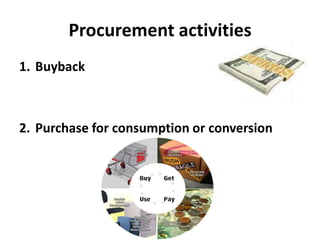
Procurement activities Buyback  Purchase for consumption or conversion
The Role of Procurement within Business Organizations The procurement function is one of the business functionsThe procurement function  is required to support the labor productivity.The procurement function play an important role in managing manufacturing abroad.
Goals of Purchasing and Supply Administrative level Quality
Amount
Price
 Time
SourcingOperational / Functional level Material and service flowWise PurchaseAchieve competitive procurement Reduce the stock costDevelopment of new sourcesDevelopment of good relations with suppliers
More detailed level Purchasing policies (manual) Selection of suppliers and awarding contracts Review material specifications and purchase orders Policies on Public Tenders Policies relating to ethical practices
Procurement ProceduresRepresents the general framework and direction of the actions .Represent the means to run the input information from outside the organization.Procurement cycle.Feel the need.Check the availability of appropriations.
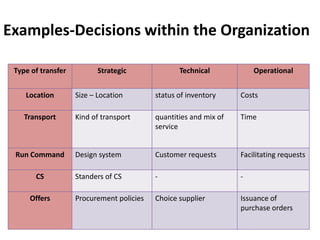
Examples-Decisions within the Organization
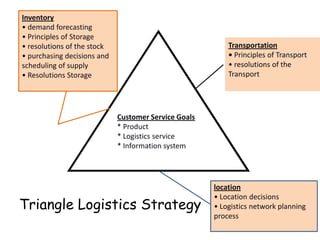
Triangle Logistics StrategyInventory• demand forecasting• Principles of Storage• resolutions of the stock• purchasing decisions and scheduling of supply• Resolutions StorageCustomer Service Goals* Product* Logistics service* Information systemTransportation• Principles of Transport• resolutions of the Transportlocation• Location decisions• Logistics network planning process
Purpose of ProcurementFlow of raw materials and services.Level of inventory investment.Level of service. Competitive situation. Goals of the organization.
How to choose a supplier?14 Steps to choose a supplier: Lead TimeLead time variabilityDelivery timeDelivery time variabilityCommunicationAbility to send
Vendor errors.Maintenance.QualityPriceExperienceTerms of contractServices after sellConfidential data
Evaluation of the supplier They are several criteria to measure the performance of suppliers, such as: Effect the priceSaving
ControlThe material flowDeliveryPlanning
Procurement ContractsProcurement contracts recoveredPartnership contracts in the flowContracts amounts
The Benefits of Purchasing and Supply ExternalEconomies of scale Risk reduction Reduce the capital invested Focus on the goal of the organization Increased flexibility
Disadvantages of Purchasing and Supply the OuterLack of knowledge of competitors Collision targets A system for integrated logistical
Logistical Organization of Procurement ProcessesStructure and controlCentralized structure for decision-making.Cost analysis for decision support site.Cost of holding inventory, costs and interest of the process of delay.Re-evaluation of global logistics network.
Outsourcing from Abroad and to Participate Range of activities in the value chain
Increased outsourcing
Strategic decision taken centrally with the monitoring and control in the performance of suppliers.Logistics InformationGlobal logistics management. Global leadership in the field of business. Time-delay.Quick respond. Information system.
Consumer choice of suppliersInternetGovernment DirectoryInternational and regional organizationsExperienceReputationCompetition

Presentation1 new eddition_s_c_m_end_version

  • 1.
    New Directions ofProcurement and Supply Chain ManagementSubmitted ByAhmed Ali (860828)Ali Ammara (860657)Ali Dow (862247)Submitted ToProf. David BurnellApril,28,2010
  • 2.
    Introductionprocurement function ispart of logistics system. Procurement is one the important activities of the supply chain. Procurement plays an important role in achieving the organization goal. Buying is an important role in the profit of the organization.
  • 3.
    What is thesupply chain planning.Classifications of procurement activities. The role of procurement within business organizations The objectives of procurement and supply The procurement procedures The selection and evaluation of a supplier The benefits and disadvantages of buying The logistical organization of procurement processes Strategy of Logistics
  • 4.
    What is SupplyChain Planning ?Supply Chain is a set of activities (e.g. purchasing,manufacturing, logistics, distribution, marketing) that perform the function of delivering value to end customerTraditionally, all the business units along a supply chain have their own objectives and these are often conflicting There is no single plan to carry out supply chain activities
  • 5.
    Procurement activities Buyback Purchase for consumption or conversion
  • 6.
    The Role ofProcurement within Business Organizations The procurement function is one of the business functionsThe procurement function is required to support the labor productivity.The procurement function play an important role in managing manufacturing abroad.
  • 7.
    Goals of Purchasingand Supply Administrative level Quality
  • 8.
  • 9.
  • 10.
  • 11.
    SourcingOperational / Functionallevel Material and service flowWise PurchaseAchieve competitive procurement Reduce the stock costDevelopment of new sourcesDevelopment of good relations with suppliers
  • 12.
    More detailed levelPurchasing policies (manual) Selection of suppliers and awarding contracts Review material specifications and purchase orders Policies on Public Tenders Policies relating to ethical practices
  • 13.
    Procurement ProceduresRepresents thegeneral framework and direction of the actions .Represent the means to run the input information from outside the organization.Procurement cycle.Feel the need.Check the availability of appropriations.
  • 14.
  • 15.
    Triangle Logistics StrategyInventory•demand forecasting• Principles of Storage• resolutions of the stock• purchasing decisions and scheduling of supply• Resolutions StorageCustomer Service Goals* Product* Logistics service* Information systemTransportation• Principles of Transport• resolutions of the Transportlocation• Location decisions• Logistics network planning process
  • 16.
    Purpose of ProcurementFlowof raw materials and services.Level of inventory investment.Level of service. Competitive situation. Goals of the organization.
  • 17.
    How to choosea supplier?14 Steps to choose a supplier: Lead TimeLead time variabilityDelivery timeDelivery time variabilityCommunicationAbility to send
  • 18.
    Vendor errors.Maintenance.QualityPriceExperienceTerms ofcontractServices after sellConfidential data
  • 19.
    Evaluation of thesupplier They are several criteria to measure the performance of suppliers, such as: Effect the priceSaving
  • 20.
  • 21.
    Procurement ContractsProcurement contractsrecoveredPartnership contracts in the flowContracts amounts
  • 22.
    The Benefits ofPurchasing and Supply ExternalEconomies of scale Risk reduction Reduce the capital invested Focus on the goal of the organization Increased flexibility
  • 23.
    Disadvantages of Purchasingand Supply the OuterLack of knowledge of competitors Collision targets A system for integrated logistical
  • 24.
    Logistical Organization ofProcurement ProcessesStructure and controlCentralized structure for decision-making.Cost analysis for decision support site.Cost of holding inventory, costs and interest of the process of delay.Re-evaluation of global logistics network.
  • 25.
    Outsourcing from Abroadand to Participate Range of activities in the value chain
  • 26.
  • 27.
    Strategic decision takencentrally with the monitoring and control in the performance of suppliers.Logistics InformationGlobal logistics management. Global leadership in the field of business. Time-delay.Quick respond. Information system.
  • 28.
    Consumer choice ofsuppliersInternetGovernment DirectoryInternational and regional organizationsExperienceReputationCompetition

Editor's Notes

  • #6 Buy-back or returnAllows a manufacture to return non product inventory up to a specified amount
  • #7 To identify the role of procurement within business organizations, we should know that:
  • #8 Five commitments or rights by five to get on the needs of the organization of materials, parts and equipment: Appropriate quality The right amount The right price Timely The source of supply appropriate
  • #11 Aims to achieve main purposes Represents the general framework and direction of the actions necessary to complete the required activities of the management and materials efficiently.Represent the means to run the input information from outside the organization.Procurement cycle.Feel the need.Check the availability of appropriations.
  • #14 Provide a flow of raw materials and services required for the various operations within the organizations.Maintain the level of inventory investment.Improve the level of service. Choose the best suppliers. Standardize of the various units. Improve the competitive situation of the Organization. Implement the goals of the organization.
  • #15 When you choose the supplier you should link to the several factors complicated. that There are 15 step when selecting the resource:
  • #17 Suppliers are evaluated according to measure the performance of each supplier separately. Used several criteria to measure the performance of suppliers, such as: Effect the price The unit price and the in accordance with the market price, unit price and in accordance with the competitors.Saving Discount on large quantities
  • #18 Control Track the arrival of goodsThe material flow There are no obstructions preventing the flow of goodsDelivery The arrival of the goods without damage in a timely mannerPlanning to predict the price and demand
  • #19 There are several types of contracts with suppliers: Procurement contracts recoveredallowed to retrieve the remainder of the goods Partnership contracts in the flowallowed for the resource Distributed organizations in profits Contracts amountsallows the Organization to amend the quantity required by the application
  • #22 Structure and controlIf the goal is to achieve trade-offs expected from the use of outsourcing from abroad in the production and distribution across international borders, it is necessary to establish a centralized structure for decision-making.In global manufacturing is the use of cost analysis for decision support site.Accurate information on the cost of holding inventory, costs and interest of the process of delay is one of the key variables in the site selection process.Site decisions taken in a central web only.Re-evaluation of global logistics network provides a tremendous opportunity to reduce taka life and improve efficiency In the output
  • #23 Sense to focus on the range of activities in the value chain which has a unique competitive advantage to the company, and are outsourcing from abroad for the rest of the activities
  • #24 Logistics informationGlobal logistics management are in fact manage to force information. Organization that is looking for global leadership in the field of business based on a vision of which can be obtained for entry into force of material, stockpiles, and demand along the channel of supply. Time-delay in the flow of data translates directly to the inventory Quick response logistics depend on the flow of data from the point of actual demand and directly to suppliers and systems re-supply. There is an urgent need for information system can read the request at every point in the channel for the supply provides the ability to control the central system in logistics