Supply Chain
Dynamics
Supply Network Dynamics
•Supply chains are rarely stable particularly the consumer
goods supply chains.
•Small changes in ordering patterns causes fluctuations in
order levels that increase both in scale and unpredictability as
we proceed upstream in the chain. This phenomenon is known
as ‘supply chain amplification’, ‘supply chain distortion’,
‘the Forrester effect’ (after the person who first modelled it),
or most descriptively ‘the bull whip effect’.
•Supply chain dynamics can wreak havoc on supply chain
performance measures.
•The underlying cause of the supply chain dynamics may be
both quantitative and qualitative.
2
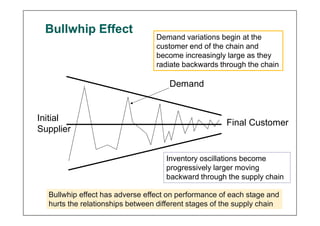
Final Customer
Initial
Supplier
Demand
Demand variations begin at the
customer end of the chain and
become increasingly large as they
radiate backwards through the chain
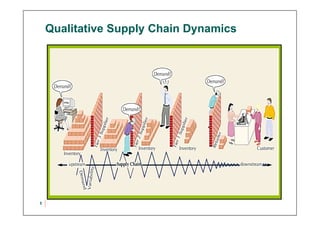
Bullwhip Effect
Inventory oscillations become
progressively larger moving
backward through the supply chain
Bullwhip effect has adverse effect on performance of each stage and
hurts the relationships between different stages of the supply chain
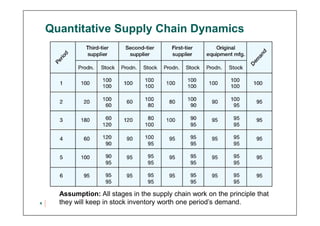
Quantitative Supply Chain Dynamics
4
Assumption: All stages in the supply chain work on the principle that
they will keep in stock inventory worth one period’s demand.
Qualitative Supply Chain Dynamics
5
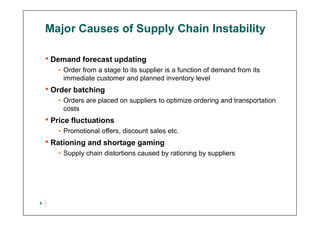
Major Causes of Supply Chain Instability
• Demand forecast updating
- Order from a stage to its supplier is a function of demand from its
immediate customer and planned inventory level
• Order batching
- Orders are placed on suppliers to optimize ordering and transportation
costs
• Price fluctuations
- Promotional offers, discount sales etc.
• Rationing and shortage gaming
- Supply chain distortions caused by rationing by suppliers
6
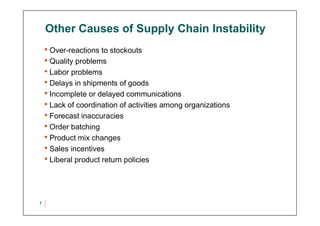
• Over-reactions to stockouts
• Quality problems
• Labor problems
• Delays in shipments of goods
• Incomplete or delayed communications
• Lack of coordination of activities among organizations
• Forecast inaccuracies
• Order batching
• Product mix changes
• Sales incentives
• Liberal product return policies
7
Other Causes of Supply Chain Instability
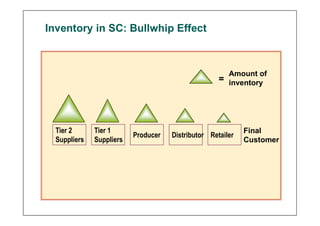
Tier 2
Suppliers
Tier 1
Suppliers
Producer Distributor Retailer
Final
Customer
Amount of
inventory
=
Inventory in SC: Bullwhip Effect
Managing Supply Chain Dynamics
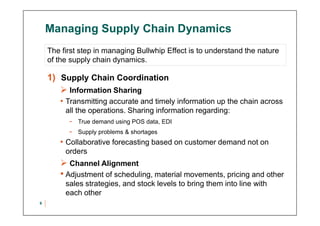
1) Supply Chain Coordination
 Information Sharing
• Transmitting accurate and timely information up the chain across
all the operations. Sharing information regarding:
- True demand using POS data, EDI
- Supply problems & shortages
• Collaborative forecasting based on customer demand not on
orders
 Channel Alignment
• Adjustment of scheduling, material movements, pricing and other
sales strategies, and stock levels to bring them into line with
each other
9
The first step in managing Bullwhip Effect is to understand the nature
of the supply chain dynamics.
Managing Supply Chain Dynamics
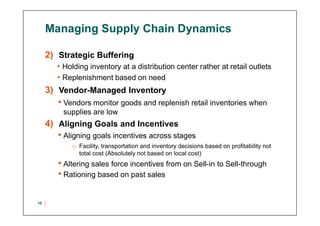
2) Strategic Buffering
• Holding inventory at a distribution center rather at retail outlets
• Replenishment based on need
3) Vendor-Managed Inventory
• Vendors monitor goods and replenish retail inventories when
supplies are low
4) Aligning Goals and Incentives
• Aligning goals incentives across stages
o Facility, transportation and inventory decisions based on profitability not
total cost (Absolutely not based on local cost)
• Altering sales force incentives from on Sell-in to Sell-through
• Rationing based on past sales
10
Managing Supply Chain Dynamics
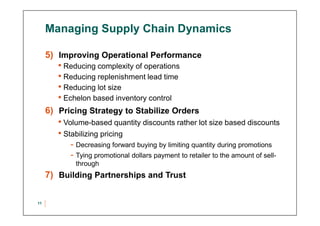
5) Improving Operational Performance
• Reducing complexity of operations
• Reducing replenishment lead time
• Reducing lot size
• Echelon based inventory control
6) Pricing Strategy to Stabilize Orders
• Volume-based quantity discounts rather lot size based discounts
• Stabilizing pricing
- Decreasing forward buying by limiting quantity during promotions
- Tying promotional dollars payment to retailer to the amount of sell-
through
7) Building Partnerships and Trust
11

11- Supply chain dynamics.pdf

  • 1.
  • 2.
    Supply Network Dynamics •Supplychains are rarely stable particularly the consumer goods supply chains. •Small changes in ordering patterns causes fluctuations in order levels that increase both in scale and unpredictability as we proceed upstream in the chain. This phenomenon is known as ‘supply chain amplification’, ‘supply chain distortion’, ‘the Forrester effect’ (after the person who first modelled it), or most descriptively ‘the bull whip effect’. •Supply chain dynamics can wreak havoc on supply chain performance measures. •The underlying cause of the supply chain dynamics may be both quantitative and qualitative. 2
  • 3.
    Final Customer Initial Supplier Demand Demand variationsbegin at the customer end of the chain and become increasingly large as they radiate backwards through the chain Bullwhip Effect Inventory oscillations become progressively larger moving backward through the supply chain Bullwhip effect has adverse effect on performance of each stage and hurts the relationships between different stages of the supply chain
  • 4.
    Quantitative Supply ChainDynamics 4 Assumption: All stages in the supply chain work on the principle that they will keep in stock inventory worth one period’s demand.
  • 5.
  • 6.
    Major Causes ofSupply Chain Instability • Demand forecast updating - Order from a stage to its supplier is a function of demand from its immediate customer and planned inventory level • Order batching - Orders are placed on suppliers to optimize ordering and transportation costs • Price fluctuations - Promotional offers, discount sales etc. • Rationing and shortage gaming - Supply chain distortions caused by rationing by suppliers 6
  • 7.
    • Over-reactions tostockouts • Quality problems • Labor problems • Delays in shipments of goods • Incomplete or delayed communications • Lack of coordination of activities among organizations • Forecast inaccuracies • Order batching • Product mix changes • Sales incentives • Liberal product return policies 7 Other Causes of Supply Chain Instability
  • 8.
    Tier 2 Suppliers Tier 1 Suppliers ProducerDistributor Retailer Final Customer Amount of inventory = Inventory in SC: Bullwhip Effect
  • 9.
    Managing Supply ChainDynamics 1) Supply Chain Coordination  Information Sharing • Transmitting accurate and timely information up the chain across all the operations. Sharing information regarding: - True demand using POS data, EDI - Supply problems & shortages • Collaborative forecasting based on customer demand not on orders  Channel Alignment • Adjustment of scheduling, material movements, pricing and other sales strategies, and stock levels to bring them into line with each other 9 The first step in managing Bullwhip Effect is to understand the nature of the supply chain dynamics.
  • 10.
    Managing Supply ChainDynamics 2) Strategic Buffering • Holding inventory at a distribution center rather at retail outlets • Replenishment based on need 3) Vendor-Managed Inventory • Vendors monitor goods and replenish retail inventories when supplies are low 4) Aligning Goals and Incentives • Aligning goals incentives across stages o Facility, transportation and inventory decisions based on profitability not total cost (Absolutely not based on local cost) • Altering sales force incentives from on Sell-in to Sell-through • Rationing based on past sales 10
  • 11.
    Managing Supply ChainDynamics 5) Improving Operational Performance • Reducing complexity of operations • Reducing replenishment lead time • Reducing lot size • Echelon based inventory control 6) Pricing Strategy to Stabilize Orders • Volume-based quantity discounts rather lot size based discounts • Stabilizing pricing - Decreasing forward buying by limiting quantity during promotions - Tying promotional dollars payment to retailer to the amount of sell- through 7) Building Partnerships and Trust 11