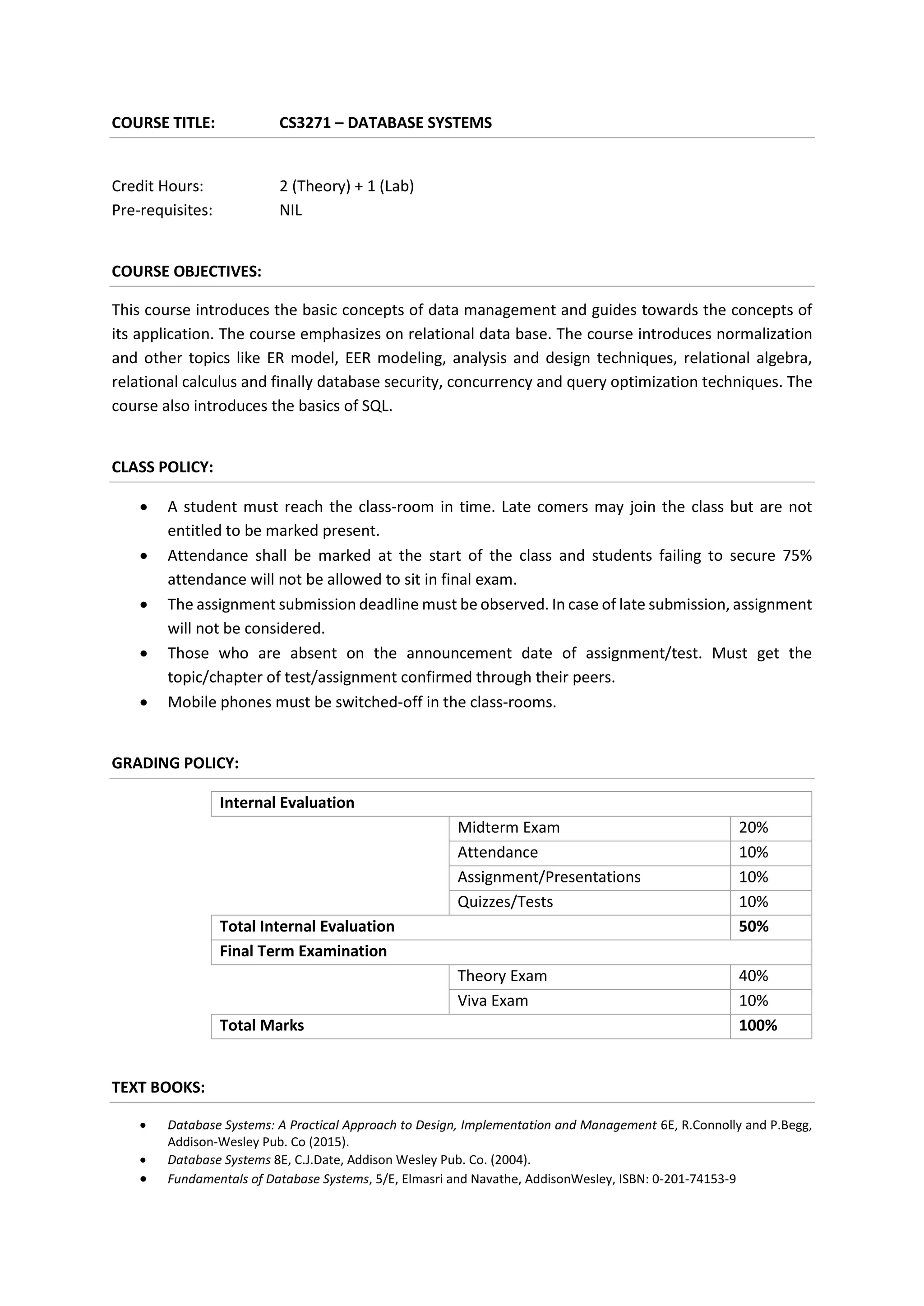
COURSE TITLE: CS3271 – DATABASE SYSTEMS
Credit Hours: 2 (Theory) + 1 (Lab)
Pre-requisites: NIL
COURSE OBJECTIVES:
This course introduces the basic concepts of data management and guides towards the concepts of
its application. The course emphasizes on relational data base. The course introduces normalization
and other topics like ER model, EER modeling, analysis and design techniques, relational algebra,
relational calculus and finally database security, concurrency and query optimization techniques. The
course also introduces the basics of SQL.
CLASS POLICY:
 A student must reach the class-room in time. Late comers may join the class but are not
entitled to be marked present.
 Attendance shall be marked at the start of the class and students failing to secure 75%
attendance will not be allowed to sit in final exam.
 The assignment submission deadline must be observed. In case of late submission, assignment
will not be considered.
 Those who are absent on the announcement date of assignment/test. Must get the
topic/chapter of test/assignment confirmed through their peers.
 Mobile phones must be switched-off in the class-rooms.
GRADING POLICY:
Internal Evaluation
Midterm Exam 20%
Attendance 10%
Assignment/Presentations 10%
Quizzes/Tests 10%
Total Internal Evaluation 50%
Final Term Examination
Theory Exam 40%
Viva Exam 10%
Total Marks 100%
TEXT BOOKS:
 Database Systems: A Practical Approach to Design, Implementation and Management 6E, R.Connolly and P.Begg,
Addison-Wesley Pub. Co (2015).
 Database Systems 8E, C.J.Date, Addison Wesley Pub. Co. (2004).
 Fundamentals of Database Systems, 5/E, Elmasri and Navathe, AddisonWesley, ISBN: 0-201-74153-9
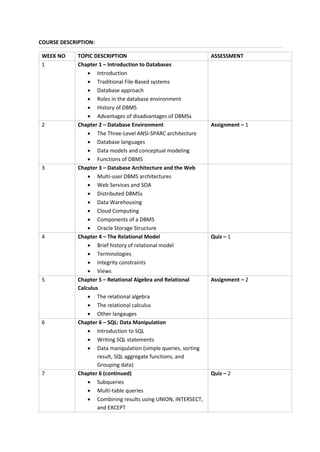
COURSE DESCRIPTION:
WEEK NO TOPIC DESCRIPTION ASSESSMENT
1 Chapter 1 – Introduction to Databases
 Introduction
 Traditional File-Based systems
 Database approach
 Roles in the database environment
 History of DBMS
 Advantages of disadvantages of DBMSs
2 Chapter 2 – Database Environment
 The Three-Level ANSI-SPARC architecture
 Database languages
 Data models and conceptual modeling
 Functions of DBMS
Assignment – 1
3 Chapter 3 – Database Architecture and the Web
 Multi-user DBMS architectures
 Web Services and SOA
 Distributed DBMSs
 Data Warehousing
 Cloud Computing
 Components of a DBMS
 Oracle Storage Structure
4 Chapter 4 – The Relational Model
 Brief history of relational model
 Terminologies
 Integrity constraints
 Views
Quiz – 1
5 Chapter 5 – Relational Algebra and Relational
Calculus
 The relational algebra
 The relational calculus
 Other langauges
Assignment – 2
6 Chapter 6 – SQL: Data Manipulation
 Introduction to SQL
 Writing SQL statements
 Data manipulation (simple queries, sorting
result, SQL aggregate functions, and
Grouping data)
7 Chapter 6 (continued)
 Subqueries
 Multi-table queries
 Combining results using UNION, INTERSECT,
and EXCEPT
Quiz – 2
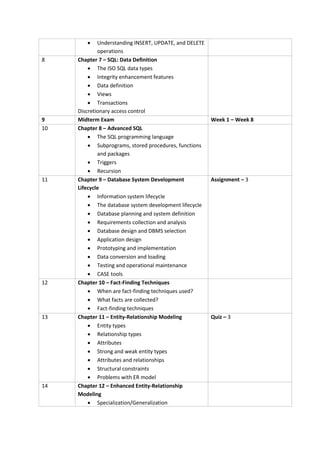
 Understanding INSERT, UPDATE, and DELETE
operations
8 Chapter 7 – SQL: Data Definition
 The ISO SQL data types
 Integrity enhancement features
 Data definition
 Views
 Transactions
Discretionary access control
9 Midterm Exam Week 1 – Week 8
10 Chapter 8 – Advanced SQL
 The SQL programming language
 Subprograms, stored procedures, functions
and packages
 Triggers
 Recursion
11 Chapter 9 – Database System Development
Lifecycle
 Information system lifecycle
 The database system development lifecycle
 Database planning and system definition
 Requirements collection and analysis
 Database design and DBMS selection
 Application design
 Prototyping and implementation
 Data conversion and loading
 Testing and operational maintenance
 CASE tools
Assignment – 3
12 Chapter 10 – Fact-Finding Techniques
 When are fact-finding techniques used?
 What facts are collected?
 Fact-finding techniques
13 Chapter 11 – Entity-Relationship Modeling
 Entity types
 Relationship types
 Attributes
 Strong and weak entity types
 Attributes and relationships
 Structural constraints
 Problems with ER model
Quiz – 3
14 Chapter 12 – Enhanced Entity-Relationship
Modeling
 Specialization/Generalization
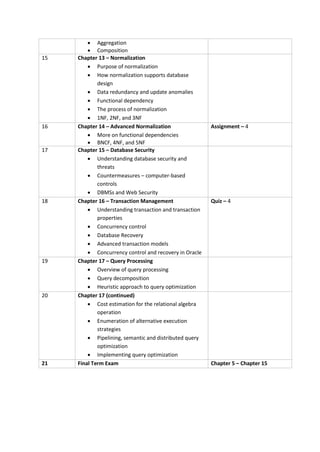
 Aggregation
 Composition
15 Chapter 13 – Normalization
 Purpose of normalization
 How normalization supports database
design
 Data redundancy and update anomalies
 Functional dependency
 The process of normalization
 1NF, 2NF, and 3NF
16 Chapter 14 – Advanced Normalization
 More on functional dependencies
 BNCF, 4NF, and 5NF
Assignment – 4
17 Chapter 15 – Database Security
 Understanding database security and
threats
 Countermeasures – computer-based
controls
 DBMSs and Web Security
18 Chapter 16 – Transaction Management
 Understanding transaction and transaction
properties
 Concurrency control
 Database Recovery
 Advanced transaction models
 Concurrency control and recovery in Oracle
Quiz – 4
19 Chapter 17 – Query Processing
 Overview of query processing
 Query decomposition
 Heuristic approach to query optimization
20 Chapter 17 (continued)
 Cost estimation for the relational algebra
operation
 Enumeration of alternative execution
strategies
 Pipelining, semantic and distributed query
optimization
 Implementing query optimization
21 Final Term Exam Chapter 5 – Chapter 15

CS3270 – Database Systems Course Outline

  • 1.
    COURSE TITLE: CS3271– DATABASE SYSTEMS Credit Hours: 2 (Theory) + 1 (Lab) Pre-requisites: NIL COURSE OBJECTIVES: This course introduces the basic concepts of data management and guides towards the concepts of its application. The course emphasizes on relational data base. The course introduces normalization and other topics like ER model, EER modeling, analysis and design techniques, relational algebra, relational calculus and finally database security, concurrency and query optimization techniques. The course also introduces the basics of SQL. CLASS POLICY:  A student must reach the class-room in time. Late comers may join the class but are not entitled to be marked present.  Attendance shall be marked at the start of the class and students failing to secure 75% attendance will not be allowed to sit in final exam.  The assignment submission deadline must be observed. In case of late submission, assignment will not be considered.  Those who are absent on the announcement date of assignment/test. Must get the topic/chapter of test/assignment confirmed through their peers.  Mobile phones must be switched-off in the class-rooms. GRADING POLICY: Internal Evaluation Midterm Exam 20% Attendance 10% Assignment/Presentations 10% Quizzes/Tests 10% Total Internal Evaluation 50% Final Term Examination Theory Exam 40% Viva Exam 10% Total Marks 100% TEXT BOOKS:  Database Systems: A Practical Approach to Design, Implementation and Management 6E, R.Connolly and P.Begg, Addison-Wesley Pub. Co (2015).  Database Systems 8E, C.J.Date, Addison Wesley Pub. Co. (2004).  Fundamentals of Database Systems, 5/E, Elmasri and Navathe, AddisonWesley, ISBN: 0-201-74153-9
  • 2.
    COURSE DESCRIPTION: WEEK NOTOPIC DESCRIPTION ASSESSMENT 1 Chapter 1 – Introduction to Databases  Introduction  Traditional File-Based systems  Database approach  Roles in the database environment  History of DBMS  Advantages of disadvantages of DBMSs 2 Chapter 2 – Database Environment  The Three-Level ANSI-SPARC architecture  Database languages  Data models and conceptual modeling  Functions of DBMS Assignment – 1 3 Chapter 3 – Database Architecture and the Web  Multi-user DBMS architectures  Web Services and SOA  Distributed DBMSs  Data Warehousing  Cloud Computing  Components of a DBMS  Oracle Storage Structure 4 Chapter 4 – The Relational Model  Brief history of relational model  Terminologies  Integrity constraints  Views Quiz – 1 5 Chapter 5 – Relational Algebra and Relational Calculus  The relational algebra  The relational calculus  Other langauges Assignment – 2 6 Chapter 6 – SQL: Data Manipulation  Introduction to SQL  Writing SQL statements  Data manipulation (simple queries, sorting result, SQL aggregate functions, and Grouping data) 7 Chapter 6 (continued)  Subqueries  Multi-table queries  Combining results using UNION, INTERSECT, and EXCEPT Quiz – 2
  • 3.
     Understanding INSERT,UPDATE, and DELETE operations 8 Chapter 7 – SQL: Data Definition  The ISO SQL data types  Integrity enhancement features  Data definition  Views  Transactions Discretionary access control 9 Midterm Exam Week 1 – Week 8 10 Chapter 8 – Advanced SQL  The SQL programming language  Subprograms, stored procedures, functions and packages  Triggers  Recursion 11 Chapter 9 – Database System Development Lifecycle  Information system lifecycle  The database system development lifecycle  Database planning and system definition  Requirements collection and analysis  Database design and DBMS selection  Application design  Prototyping and implementation  Data conversion and loading  Testing and operational maintenance  CASE tools Assignment – 3 12 Chapter 10 – Fact-Finding Techniques  When are fact-finding techniques used?  What facts are collected?  Fact-finding techniques 13 Chapter 11 – Entity-Relationship Modeling  Entity types  Relationship types  Attributes  Strong and weak entity types  Attributes and relationships  Structural constraints  Problems with ER model Quiz – 3 14 Chapter 12 – Enhanced Entity-Relationship Modeling  Specialization/Generalization
  • 4.
     Aggregation  Composition 15Chapter 13 – Normalization  Purpose of normalization  How normalization supports database design  Data redundancy and update anomalies  Functional dependency  The process of normalization  1NF, 2NF, and 3NF 16 Chapter 14 – Advanced Normalization  More on functional dependencies  BNCF, 4NF, and 5NF Assignment – 4 17 Chapter 15 – Database Security  Understanding database security and threats  Countermeasures – computer-based controls  DBMSs and Web Security 18 Chapter 16 – Transaction Management  Understanding transaction and transaction properties  Concurrency control  Database Recovery  Advanced transaction models  Concurrency control and recovery in Oracle Quiz – 4 19 Chapter 17 – Query Processing  Overview of query processing  Query decomposition  Heuristic approach to query optimization 20 Chapter 17 (continued)  Cost estimation for the relational algebra operation  Enumeration of alternative execution strategies  Pipelining, semantic and distributed query optimization  Implementing query optimization 21 Final Term Exam Chapter 5 – Chapter 15