INTERNATIONAL ISLAMIC UNIVERSITY MALAYSIA
COURSE OUTLINE
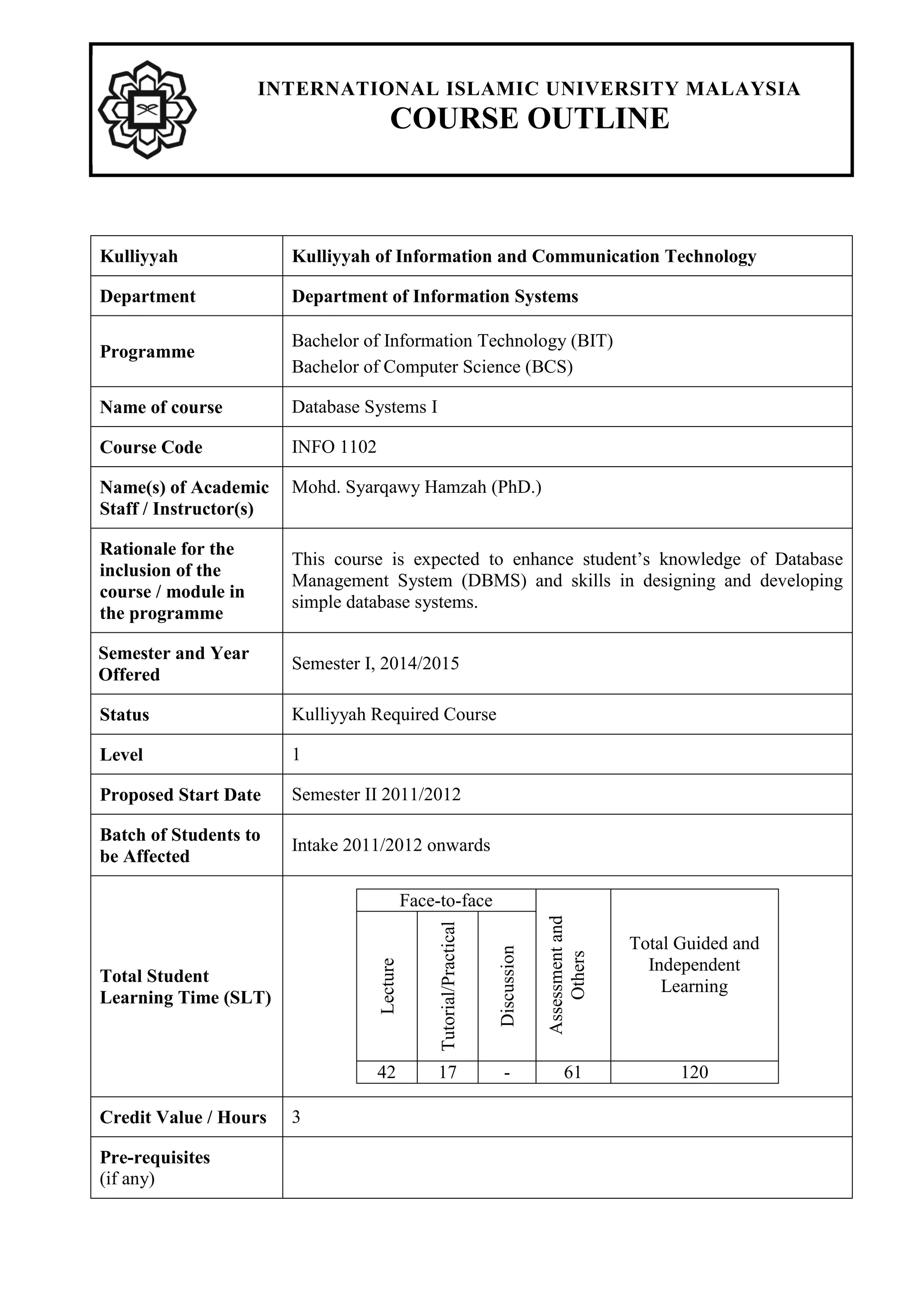
Kulliyyah Kulliyyah of Information and Communication Technology
Department Department of Information Systems
Programme
Bachelor of Information Technology (BIT)
Bachelor of Computer Science (BCS)
Name of course Database Systems I
Course Code INFO 1102
Name(s) of Academic
Staff / Instructor(s)
Mohd. Syarqawy Hamzah (PhD.)
Rationale for the
inclusion of the
course / module in
the programme
This course is expected to enhance student’s knowledge of Database
Management System (DBMS) and skills in designing and developing
simple database systems.
Semester and Year
Offered
Semester I, 2014/2015
Status Kulliyyah Required Course
Level 1
Proposed Start Date Semester II 2011/2012
Batch of Students to
be Affected
Intake 2011/2012 onwards
Total Student
Learning Time (SLT)
Face-to-face
Assessmentand
Others
Total Guided and
Independent
Learning
Lecture
Tutorial/Practical
Discussion
42 17 - 61 120
Credit Value / Hours 3
Pre-requisites
(if any)
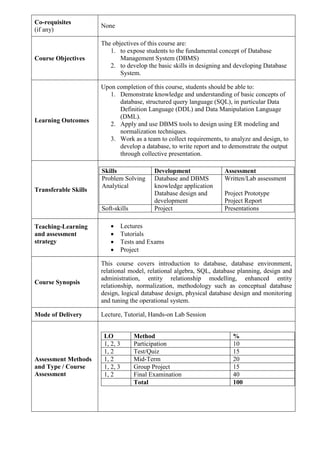
Co-requisites
(if any)
None
Course Objectives
The objectives of this course are:
1. to expose students to the fundamental concept of Database
Management System (DBMS)
2. to develop the basic skills in designing and developing Database
System.
Learning Outcomes
Upon completion of this course, students should be able to:
1. Demonstrate knowledge and understanding of basic concepts of
database, structured query language (SQL), in particular Data
Definition Language (DDL) and Data Manipulation Language
(DML).
2. Apply and use DBMS tools to design using ER modeling and
normalization techniques.
3. Work as a team to collect requirements, to analyze and design, to
develop a database, to write report and to demonstrate the output
through collective presentation.
Transferable Skills
Skills Development Assessment
Problem Solving
Analytical
Database and DBMS
knowledge application
Database design and
development
Written/Lab assessment
Project Prototype
Project Report
Soft-skills Project Presentations
Teaching-Learning
and assessment
strategy
 Lectures
 Tutorials
 Tests and Exams
 Project
Course Synopsis
This course covers introduction to database, database environment,
relational model, relational algebra, SQL, database planning, design and
administration, entity relationship modelling, enhanced entity
relationship, normalization, methodology such as conceptual database
design, logical database design, physical database design and monitoring
and tuning the operational system.
Mode of Delivery Lecture, Tutorial, Hands-on Lab Session
Assessment Methods
and Type / Course
Assessment
LO Method %
1, 2, 3 Participation 10
1, 2 Test/Quiz 15
1, 2 Mid-Term 20
1, 2, 3 Group Project 15
1, 2 Final Examination 40
Total 100
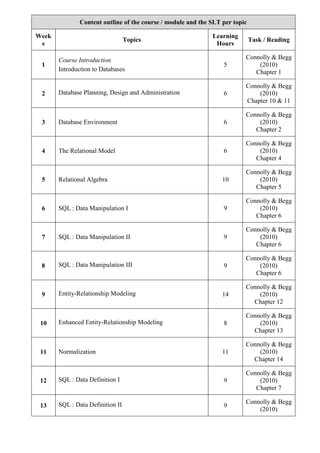
Content outline of the course / module and the SLT per topic
Week
s
Topics
Learning
Hours
Task / Reading
1
Course Introduction
Introduction to Databases
5
Connolly & Begg
(2010)
Chapter 1
2 Database Planning, Design and Administration 6
Connolly & Begg
(2010)
Chapter 10 & 11
3 Database Environment 6
Connolly & Begg
(2010)
Chapter 2
4 The Relational Model 6
Connolly & Begg
(2010)
Chapter 4
5 Relational Algebra 10
Connolly & Begg
(2010)
Chapter 5
6 SQL : Data Manipulation I 9
Connolly & Begg
(2010)
Chapter 6
7 SQL : Data Manipulation II 9
Connolly & Begg
(2010)
Chapter 6
8 SQL : Data Manipulation III 9
Connolly & Begg
(2010)
Chapter 6
9 Entity-Relationship Modeling 14
Connolly & Begg
(2010)
Chapter 12
10 Enhanced Entity-Relationship Modeling 8
Connolly & Begg
(2010)
Chapter 13
11 Normalization 11
Connolly & Begg
(2010)
Chapter 14
12 SQL : Data Definition I 9
Connolly & Begg
(2010)
Chapter 7
13 SQL : Data Definition II 9
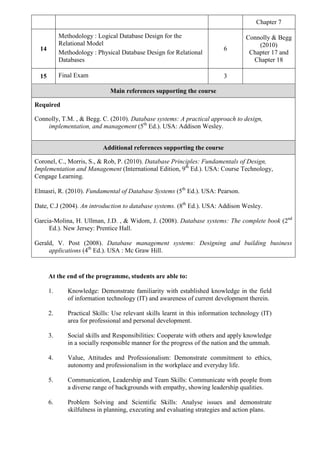
Connolly & Begg
(2010)
Chapter 7
14
Methodology : Logical Database Design for the
Relational Model
Methodology : Physical Database Design for Relational
Databases
6
Connolly & Begg
(2010)
Chapter 17 and
Chapter 18
15 Final Exam 3
Main references supporting the course
Required
Connolly, T.M. , & Begg. C. (2010). Database systems: A practical approach to design,
implementation, and management (5th
Ed.). USA: Addison Wesley.
Additional references supporting the course
Coronel, C., Morris, S., & Rob, P. (2010). Database Principles: Fundamentals of Design,
Implementation and Management (International Edition, 9th
Ed.). USA: Course Technology,
Cengage Learning.
Elmasri, R. (2010). Fundamental of Database Systems (5th
Ed.). USA: Pearson.
Date, C.J (2004). An introduction to database systems. (8th
Ed.). USA: Addison Wesley.
Garcia-Molina, H. Ullman, J.D. , & Widom, J. (2008). Database systems: The complete book (2nd
Ed.). New Jersey: Prentice Hall.
Gerald, V. Post (2008). Database management systems: Designing and building business
applications (4th
Ed.). USA : Mc Graw Hill.
At the end of the programme, students are able to:
1. Knowledge: Demonstrate familiarity with established knowledge in the field
of information technology (IT) and awareness of current development therein.
2. Practical Skills: Use relevant skills learnt in this information technology (IT)
area for professional and personal development.
3. Social skills and Responsibilities: Cooperate with others and apply knowledge
in a socially responsible manner for the progress of the nation and the ummah.
4. Value, Attitudes and Professionalism: Demonstrate commitment to ethics,
autonomy and professionalism in the workplace and everyday life.
5. Communication, Leadership and Team Skills: Communicate with people from
a diverse range of backgrounds with empathy, showing leadership qualities.
6. Problem Solving and Scientific Skills: Analyse issues and demonstrate
skilfulness in planning, executing and evaluating strategies and action plans.
7. Information Management and Lifelong Learning Skills: Use the necessary
learning skills in information management and apply effective strategies for
lifelong self-improvement.
8. Managerial and Entrepreneurial Skills: Apply basic managerial and
entrepreneurial skills in relevant fields.
9. Leadership skills: Understand the different type of leadership styles and the
demonstration of interpersonal skills when leading in a group situation.

Sem1 2014 15 course-outline info 1102

  • 1.
    INTERNATIONAL ISLAMIC UNIVERSITYMALAYSIA COURSE OUTLINE Kulliyyah Kulliyyah of Information and Communication Technology Department Department of Information Systems Programme Bachelor of Information Technology (BIT) Bachelor of Computer Science (BCS) Name of course Database Systems I Course Code INFO 1102 Name(s) of Academic Staff / Instructor(s) Mohd. Syarqawy Hamzah (PhD.) Rationale for the inclusion of the course / module in the programme This course is expected to enhance student’s knowledge of Database Management System (DBMS) and skills in designing and developing simple database systems. Semester and Year Offered Semester I, 2014/2015 Status Kulliyyah Required Course Level 1 Proposed Start Date Semester II 2011/2012 Batch of Students to be Affected Intake 2011/2012 onwards Total Student Learning Time (SLT) Face-to-face Assessmentand Others Total Guided and Independent Learning Lecture Tutorial/Practical Discussion 42 17 - 61 120 Credit Value / Hours 3 Pre-requisites (if any)
  • 2.
    Co-requisites (if any) None Course Objectives Theobjectives of this course are: 1. to expose students to the fundamental concept of Database Management System (DBMS) 2. to develop the basic skills in designing and developing Database System. Learning Outcomes Upon completion of this course, students should be able to: 1. Demonstrate knowledge and understanding of basic concepts of database, structured query language (SQL), in particular Data Definition Language (DDL) and Data Manipulation Language (DML). 2. Apply and use DBMS tools to design using ER modeling and normalization techniques. 3. Work as a team to collect requirements, to analyze and design, to develop a database, to write report and to demonstrate the output through collective presentation. Transferable Skills Skills Development Assessment Problem Solving Analytical Database and DBMS knowledge application Database design and development Written/Lab assessment Project Prototype Project Report Soft-skills Project Presentations Teaching-Learning and assessment strategy  Lectures  Tutorials  Tests and Exams  Project Course Synopsis This course covers introduction to database, database environment, relational model, relational algebra, SQL, database planning, design and administration, entity relationship modelling, enhanced entity relationship, normalization, methodology such as conceptual database design, logical database design, physical database design and monitoring and tuning the operational system. Mode of Delivery Lecture, Tutorial, Hands-on Lab Session Assessment Methods and Type / Course Assessment LO Method % 1, 2, 3 Participation 10 1, 2 Test/Quiz 15 1, 2 Mid-Term 20 1, 2, 3 Group Project 15 1, 2 Final Examination 40 Total 100
  • 3.
    Content outline ofthe course / module and the SLT per topic Week s Topics Learning Hours Task / Reading 1 Course Introduction Introduction to Databases 5 Connolly & Begg (2010) Chapter 1 2 Database Planning, Design and Administration 6 Connolly & Begg (2010) Chapter 10 & 11 3 Database Environment 6 Connolly & Begg (2010) Chapter 2 4 The Relational Model 6 Connolly & Begg (2010) Chapter 4 5 Relational Algebra 10 Connolly & Begg (2010) Chapter 5 6 SQL : Data Manipulation I 9 Connolly & Begg (2010) Chapter 6 7 SQL : Data Manipulation II 9 Connolly & Begg (2010) Chapter 6 8 SQL : Data Manipulation III 9 Connolly & Begg (2010) Chapter 6 9 Entity-Relationship Modeling 14 Connolly & Begg (2010) Chapter 12 10 Enhanced Entity-Relationship Modeling 8 Connolly & Begg (2010) Chapter 13 11 Normalization 11 Connolly & Begg (2010) Chapter 14 12 SQL : Data Definition I 9 Connolly & Begg (2010) Chapter 7 13 SQL : Data Definition II 9 Connolly & Begg (2010)
  • 4.
    Chapter 7 14 Methodology :Logical Database Design for the Relational Model Methodology : Physical Database Design for Relational Databases 6 Connolly & Begg (2010) Chapter 17 and Chapter 18 15 Final Exam 3 Main references supporting the course Required Connolly, T.M. , & Begg. C. (2010). Database systems: A practical approach to design, implementation, and management (5th Ed.). USA: Addison Wesley. Additional references supporting the course Coronel, C., Morris, S., & Rob, P. (2010). Database Principles: Fundamentals of Design, Implementation and Management (International Edition, 9th Ed.). USA: Course Technology, Cengage Learning. Elmasri, R. (2010). Fundamental of Database Systems (5th Ed.). USA: Pearson. Date, C.J (2004). An introduction to database systems. (8th Ed.). USA: Addison Wesley. Garcia-Molina, H. Ullman, J.D. , & Widom, J. (2008). Database systems: The complete book (2nd Ed.). New Jersey: Prentice Hall. Gerald, V. Post (2008). Database management systems: Designing and building business applications (4th Ed.). USA : Mc Graw Hill. At the end of the programme, students are able to: 1. Knowledge: Demonstrate familiarity with established knowledge in the field of information technology (IT) and awareness of current development therein. 2. Practical Skills: Use relevant skills learnt in this information technology (IT) area for professional and personal development. 3. Social skills and Responsibilities: Cooperate with others and apply knowledge in a socially responsible manner for the progress of the nation and the ummah. 4. Value, Attitudes and Professionalism: Demonstrate commitment to ethics, autonomy and professionalism in the workplace and everyday life. 5. Communication, Leadership and Team Skills: Communicate with people from a diverse range of backgrounds with empathy, showing leadership qualities. 6. Problem Solving and Scientific Skills: Analyse issues and demonstrate skilfulness in planning, executing and evaluating strategies and action plans.
  • 5.
    7. Information Managementand Lifelong Learning Skills: Use the necessary learning skills in information management and apply effective strategies for lifelong self-improvement. 8. Managerial and Entrepreneurial Skills: Apply basic managerial and entrepreneurial skills in relevant fields. 9. Leadership skills: Understand the different type of leadership styles and the demonstration of interpersonal skills when leading in a group situation.