PUNJAB COLLEGE OF TECHNICAL EDUCATION, LUDHIANA


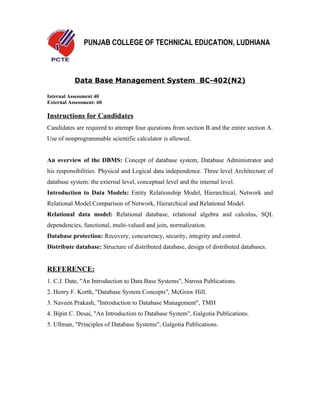
           Data Base Management System BC-402(N2)

Internal Assessment 40
External Assessment: 60

Instructions for Candidates
Candidates are required to attempt four questions from section B and the entire section A.
Use of nonprogrammable scientific calculator is allowed.


An overview of the DBMS: Concept of database system, Database Administrator and
his responsibilities. Physical and Logical data independence. Three level Architecture of
database system: the external level, conceptual level and the internal level.
Introduction to Data Models: Entity Relationship Model, Hierarchical, Network and
Relational Model.Comparison of Network, Hierarchical and Relational Model.
Relational data model: Relational database, relational algebra and calculus, SQL
dependencies, functional, multi-valued and join, normalization.
Database protection: Recovery, concurrency, security, integrity and control.
Distribute database: Structure of distributed database, design of distributed databases.


REFERENCE:
1. C.J. Date, "An Introduction to Data Base Systems", Narosa Publications.
2. Henry F. Korth, "Database System Concepts", McGraw Hill.
3. Naveen Prakash, "Introduction to Database Management", TMH
4. Bipin C. Desai, "An Introduction to Database System", Galgotia Publications.
5. Ullman, "Principles of Database Systems", Galgotia Publications.
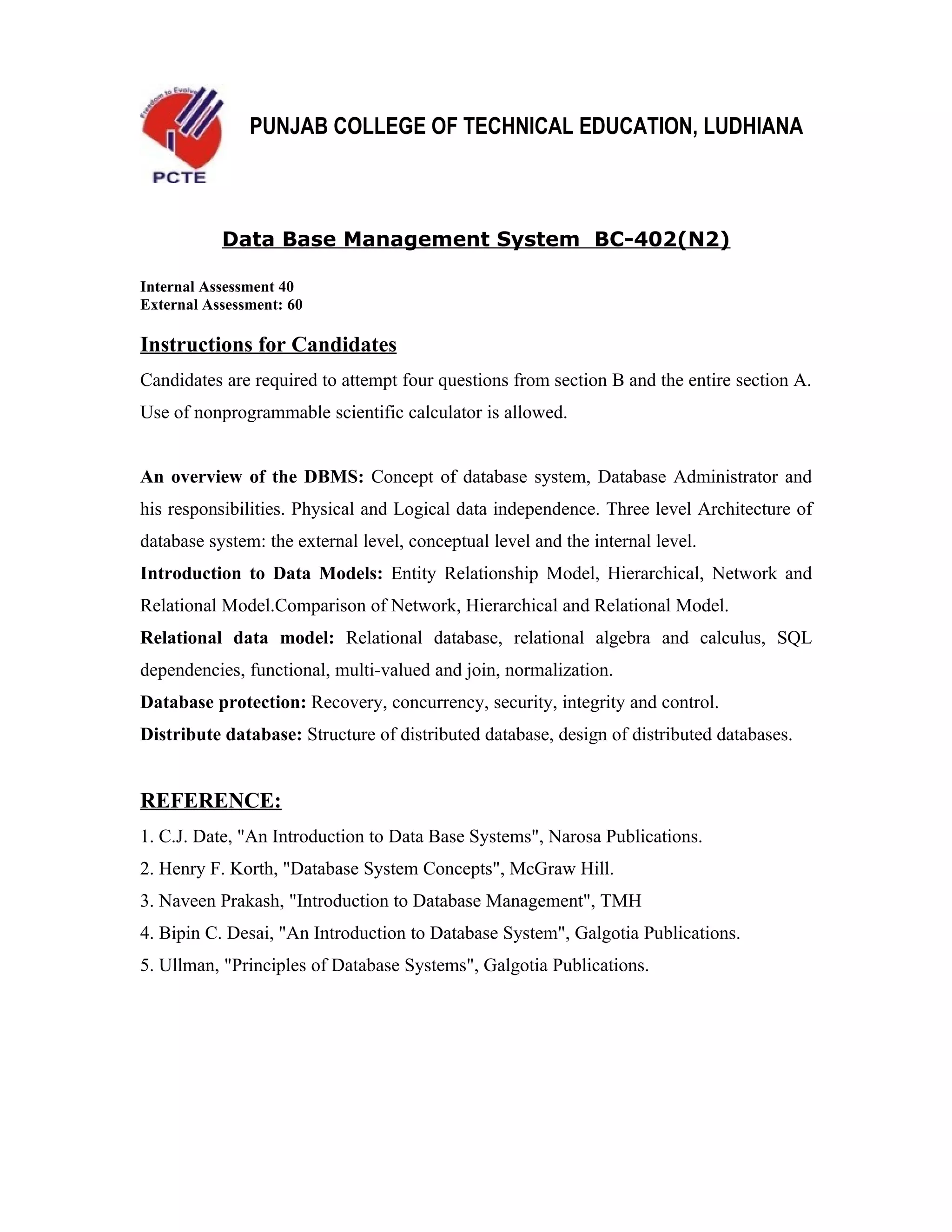
Practical S/W Lab - V
                                   BC-406(N2)

                                                            Max. Marks 100
                                                            Internal Assessment 40
                                                            External Assessment 60


This laboratory course will mainly comprise of exercise on what is learnt under the paper:
BC-402(DBMS).
Maximum Marks for Continuous Assessment: 40
Maximum Marks for University Examination: 60
Note: The break up of marks for the practical will be as under
Lab Record 15 marks
Viva Voce 15 marks
Program development 30 marks
And execution
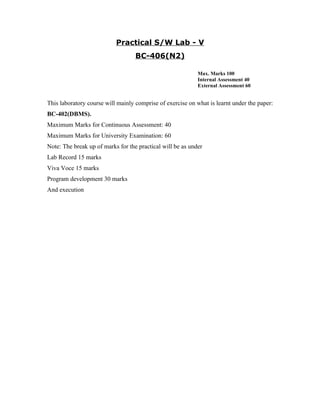
Class: BCA-II(B)                                   Subject: Database Management System
Name of the Instructor: Rupali                                           Assignments: 3
Subject Code: BC-402 (N2)                                                        Tests: 3
Total Lectures: 45                                                   Class Discussions: 6

          Topics                               Tentative     Actual        Assignment       Test
                                               Date          Conduct
                                                             Date
   1.     Overview of DBMS
              •    Database
              •    Database system
              •    DBMS
   2.     Introduction to DBMS
              •  Why database
              •  Characteristics of Data in
                 Database
              • Types of DBMS
              • Advantages of DBMS
   3.         Data independence
                 • Physical
                 • Logical
              • Database administrator and
                 his responsibilities
              • Three levels of architecture

   4.     Three levels of architecture …                                   Assign 1-
          contd                                                            DOD
             • Mapping
   5.     Data models-
          Entity Relationship model
             • Components of E-R model
             • Symbols of E-R model
             • Attribute inheritance

   6.        • Generalization
             • Specification
             • Aggregation
   7.        • Hierarchical Model
             • Network Model
   8.     Comparison of Models                                             Assign 1-        Test 1-
                                                                           DOS              DOD
   9.     Relational DBMS
             • What is a Relation?
             • RDBMS terminology
             • Referential integrity

   10.            CLASS DISCUSSION
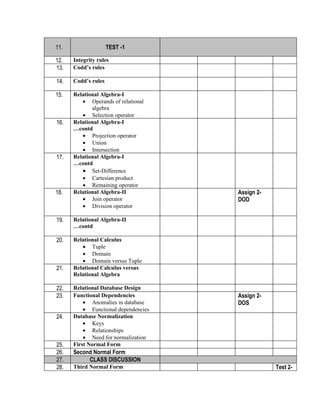
11.                  TEST -1

12.   Integrity rules
13.   Codd’s rules

14.   Codd’s rules

15.   Relational Algebra-I
         • Operands of relational
             algebra
         • Selection operator
16.   Relational Algebra-I
      …contd
         • Projection operator
         • Union
         • Intersection
17.   Relational Algebra-I
      …contd
         • Set-Difference
         • Cartesian product
         • Remaining operator
18.   Relational Algebra-II           Assign 2-
         • Join operator              DOD
         • Division operator

19.   Relational Algebra-II
      …contd

20.   Relational Calculus
         • Tuple
         • Domain
         • Domain versus Tuple
21.   Relational Calculus versus
      Relational Algebra

22.   Relational Database Design
23.   Functional Dependencies         Assign 2-
          • Anomalies in database     DOS
          • Functional dependencies
24.   Database Normalization
          • Keys
          • Relationships
          • Need for normalization
25.   First Normal Form
26.   Second Normal Form
27.        CLASS DISCUSSION
28.   Third Normal Form                           Test 2-
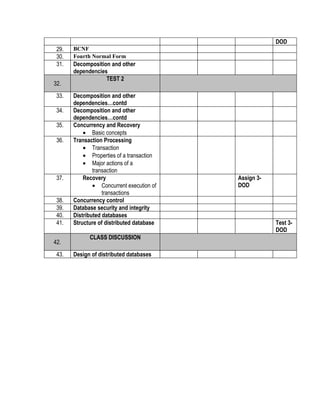
DOD
 29.   BCNF
 30.   Fourth Normal Form
 31.   Decomposition and other
       dependencies
                   TEST 2
32.
 33.   Decomposition and other
       dependencies…contd
 34.   Decomposition and other
       dependencies…contd
 35.   Concurrency and Recovery
           • Basic concepts
 36.   Transaction Processing
           • Transaction
           • Properties of a transaction
           • Major actions of a
               transaction
 37.       Recovery                        Assign 3-
               • Concurrent execution of   DOD
                   transactions
 38.   Concurrency control
 39.   Database security and integrity
 40.   Distributed databases
 41.   Structure of distributed database               Test 3-
                                                       DOD
             CLASS DISCUSSION
42.
 43.   Design of distributed databases
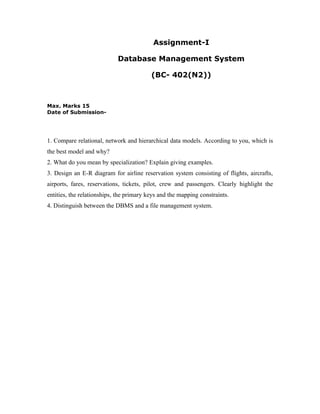
Assignment-I

                            Database Management System

                                          (BC- 402(N2))


Max. Marks 15
Date of Submission-


1. Compare relational, network and hierarchical data models. According to you, which is
the best model and why?
2. What do you mean by specialization? Explain giving examples.
3. Design an E-R diagram for airline reservation system consisting of flights, aircrafts,
airports, fares, reservations, tickets, pilot, crew and passengers. Clearly highlight the
entities, the relationships, the primary keys and the mapping constraints.
4. Distinguish between the DBMS and a file management system.
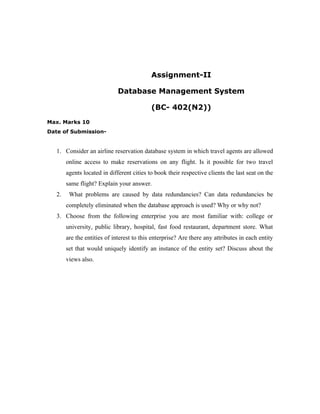
Assignment-II

                              Database Management System

                                            (BC- 402(N2))
Max. Marks 10
Date of Submission-


   1. Consider an airline reservation database system in which travel agents are allowed
        online access to make reservations on any flight. Is it possible for two travel
        agents located in different cities to book their respective clients the last seat on the
        same flight? Explain your answer.
   2.    What problems are caused by data redundancies? Can data redundancies be
        completely eliminated when the database approach is used? Why or why not?
   3. Choose from the following enterprise you are most familiar with: college or
        university, public library, hospital, fast food restaurant, department store. What
        are the entities of interest to this enterprise? Are there any attributes in each entity
        set that would uniquely identify an instance of the entity set? Discuss about the
        views also.
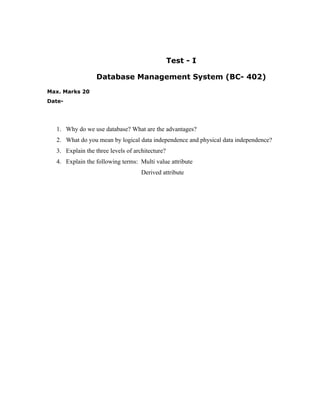
Test - I

                  Database Management System (BC- 402)
Max. Marks 20
Date-


  1. Why do we use database? What are the advantages?
  2. What do you mean by logical data independence and physical data independence?
  3. Explain the three levels of architecture?
  4. Explain the following terms: Multi value attribute
                                    Derived attribute
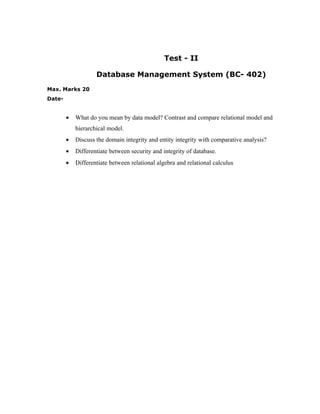
Test - II

                    Database Management System (BC- 402)
Max. Marks 20
Date-


        •   What do you mean by data model? Contrast and compare relational model and
            hierarchical model.
        •   Discuss the domain integrity and entity integrity with comparative analysis?
        •   Differentiate between security and integrity of database.
        •   Differentiate between relational algebra and relational calculus

Coursemodule dbms

  • 1.
    PUNJAB COLLEGE OFTECHNICAL EDUCATION, LUDHIANA Data Base Management System BC-402(N2) Internal Assessment 40 External Assessment: 60 Instructions for Candidates Candidates are required to attempt four questions from section B and the entire section A. Use of nonprogrammable scientific calculator is allowed. An overview of the DBMS: Concept of database system, Database Administrator and his responsibilities. Physical and Logical data independence. Three level Architecture of database system: the external level, conceptual level and the internal level. Introduction to Data Models: Entity Relationship Model, Hierarchical, Network and Relational Model.Comparison of Network, Hierarchical and Relational Model. Relational data model: Relational database, relational algebra and calculus, SQL dependencies, functional, multi-valued and join, normalization. Database protection: Recovery, concurrency, security, integrity and control. Distribute database: Structure of distributed database, design of distributed databases. REFERENCE: 1. C.J. Date, "An Introduction to Data Base Systems", Narosa Publications. 2. Henry F. Korth, "Database System Concepts", McGraw Hill. 3. Naveen Prakash, "Introduction to Database Management", TMH 4. Bipin C. Desai, "An Introduction to Database System", Galgotia Publications. 5. Ullman, "Principles of Database Systems", Galgotia Publications.
  • 2.
    Practical S/W Lab- V BC-406(N2) Max. Marks 100 Internal Assessment 40 External Assessment 60 This laboratory course will mainly comprise of exercise on what is learnt under the paper: BC-402(DBMS). Maximum Marks for Continuous Assessment: 40 Maximum Marks for University Examination: 60 Note: The break up of marks for the practical will be as under Lab Record 15 marks Viva Voce 15 marks Program development 30 marks And execution
  • 3.
    Class: BCA-II(B) Subject: Database Management System Name of the Instructor: Rupali Assignments: 3 Subject Code: BC-402 (N2) Tests: 3 Total Lectures: 45 Class Discussions: 6 Topics Tentative Actual Assignment Test Date Conduct Date 1. Overview of DBMS • Database • Database system • DBMS 2. Introduction to DBMS • Why database • Characteristics of Data in Database • Types of DBMS • Advantages of DBMS 3. Data independence • Physical • Logical • Database administrator and his responsibilities • Three levels of architecture 4. Three levels of architecture … Assign 1- contd DOD • Mapping 5. Data models- Entity Relationship model • Components of E-R model • Symbols of E-R model • Attribute inheritance 6. • Generalization • Specification • Aggregation 7. • Hierarchical Model • Network Model 8. Comparison of Models Assign 1- Test 1- DOS DOD 9. Relational DBMS • What is a Relation? • RDBMS terminology • Referential integrity 10. CLASS DISCUSSION
  • 4.
    11. TEST -1 12. Integrity rules 13. Codd’s rules 14. Codd’s rules 15. Relational Algebra-I • Operands of relational algebra • Selection operator 16. Relational Algebra-I …contd • Projection operator • Union • Intersection 17. Relational Algebra-I …contd • Set-Difference • Cartesian product • Remaining operator 18. Relational Algebra-II Assign 2- • Join operator DOD • Division operator 19. Relational Algebra-II …contd 20. Relational Calculus • Tuple • Domain • Domain versus Tuple 21. Relational Calculus versus Relational Algebra 22. Relational Database Design 23. Functional Dependencies Assign 2- • Anomalies in database DOS • Functional dependencies 24. Database Normalization • Keys • Relationships • Need for normalization 25. First Normal Form 26. Second Normal Form 27. CLASS DISCUSSION 28. Third Normal Form Test 2-
  • 5.
    DOD 29. BCNF 30. Fourth Normal Form 31. Decomposition and other dependencies TEST 2 32. 33. Decomposition and other dependencies…contd 34. Decomposition and other dependencies…contd 35. Concurrency and Recovery • Basic concepts 36. Transaction Processing • Transaction • Properties of a transaction • Major actions of a transaction 37. Recovery Assign 3- • Concurrent execution of DOD transactions 38. Concurrency control 39. Database security and integrity 40. Distributed databases 41. Structure of distributed database Test 3- DOD CLASS DISCUSSION 42. 43. Design of distributed databases
  • 6.
    Assignment-I Database Management System (BC- 402(N2)) Max. Marks 15 Date of Submission- 1. Compare relational, network and hierarchical data models. According to you, which is the best model and why? 2. What do you mean by specialization? Explain giving examples. 3. Design an E-R diagram for airline reservation system consisting of flights, aircrafts, airports, fares, reservations, tickets, pilot, crew and passengers. Clearly highlight the entities, the relationships, the primary keys and the mapping constraints. 4. Distinguish between the DBMS and a file management system.
  • 7.
    Assignment-II Database Management System (BC- 402(N2)) Max. Marks 10 Date of Submission- 1. Consider an airline reservation database system in which travel agents are allowed online access to make reservations on any flight. Is it possible for two travel agents located in different cities to book their respective clients the last seat on the same flight? Explain your answer. 2. What problems are caused by data redundancies? Can data redundancies be completely eliminated when the database approach is used? Why or why not? 3. Choose from the following enterprise you are most familiar with: college or university, public library, hospital, fast food restaurant, department store. What are the entities of interest to this enterprise? Are there any attributes in each entity set that would uniquely identify an instance of the entity set? Discuss about the views also.
  • 8.
    Test - I Database Management System (BC- 402) Max. Marks 20 Date- 1. Why do we use database? What are the advantages? 2. What do you mean by logical data independence and physical data independence? 3. Explain the three levels of architecture? 4. Explain the following terms: Multi value attribute Derived attribute
  • 9.
    Test - II Database Management System (BC- 402) Max. Marks 20 Date- • What do you mean by data model? Contrast and compare relational model and hierarchical model. • Discuss the domain integrity and entity integrity with comparative analysis? • Differentiate between security and integrity of database. • Differentiate between relational algebra and relational calculus