1.4
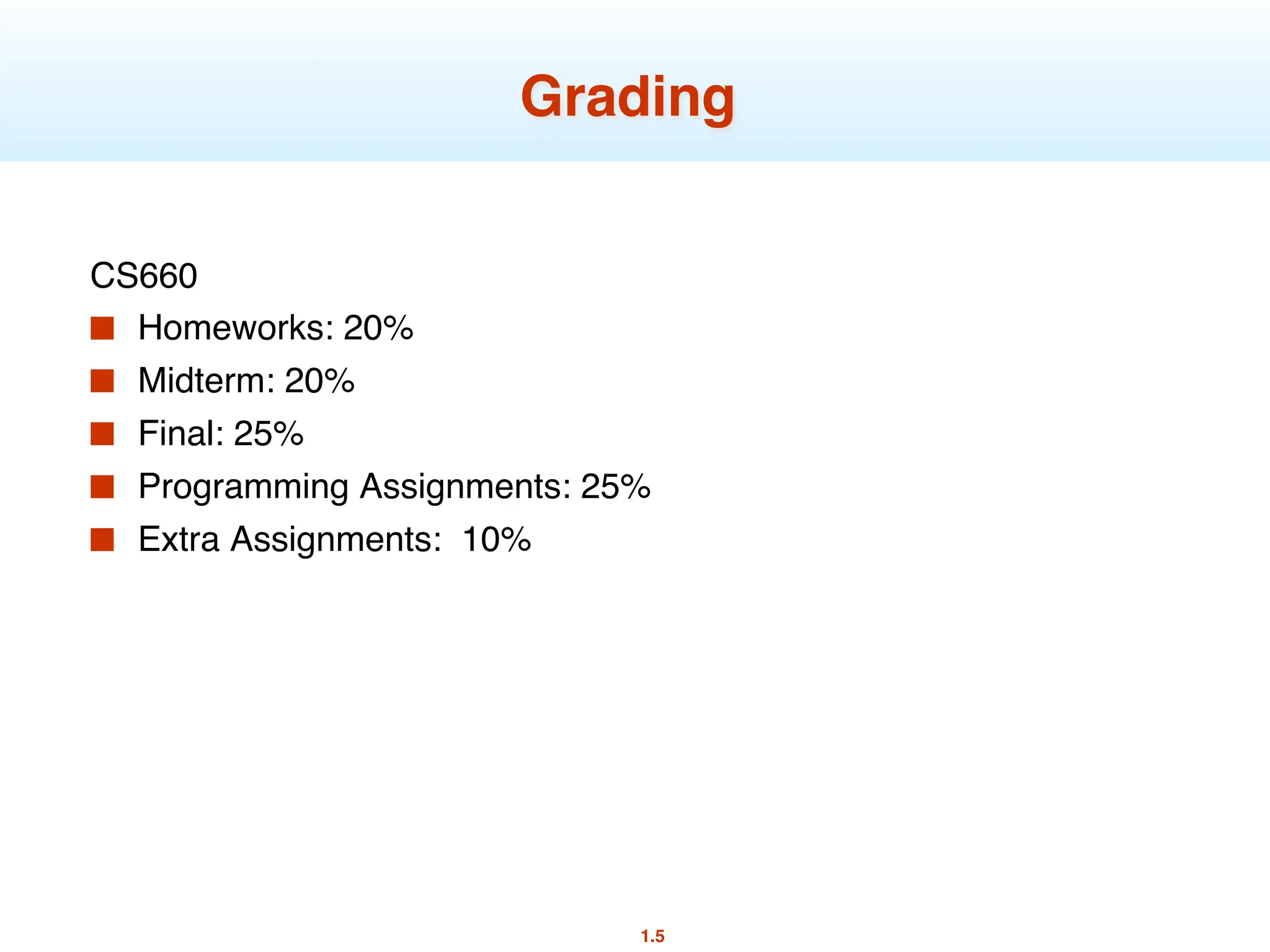
Grading
CS460
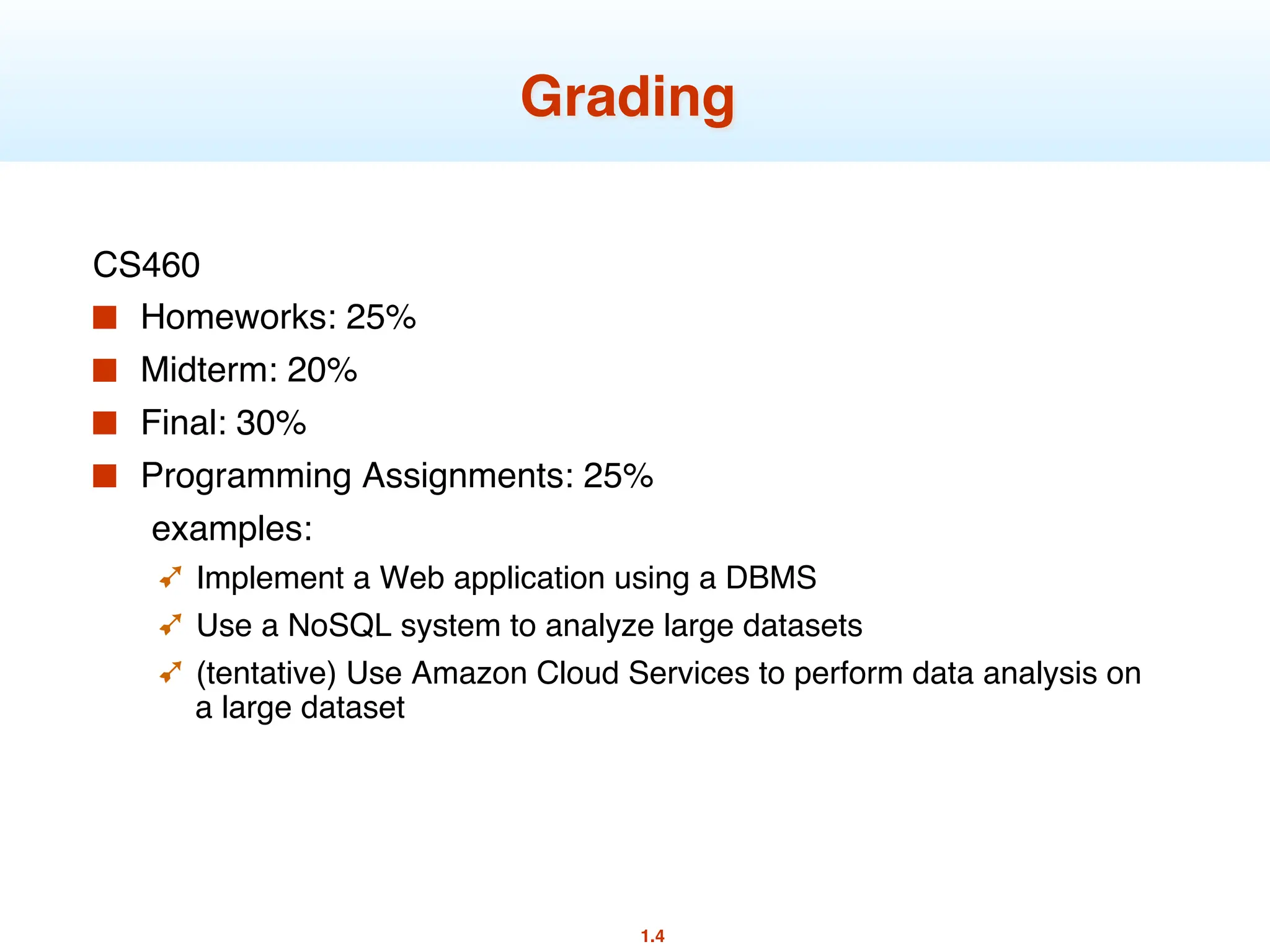
■ Homeworks: 25%
■Midterm: 20%
■ Final: 30%
■ Programming Assignments: 25%
examples:
➹ Implement a Web application using a DBMS
➹ Use a NoSQL system to analyze large datasets
➹ (tentative) Use Amazon Cloud Services to perform data analysis on
a large dataset
1.6
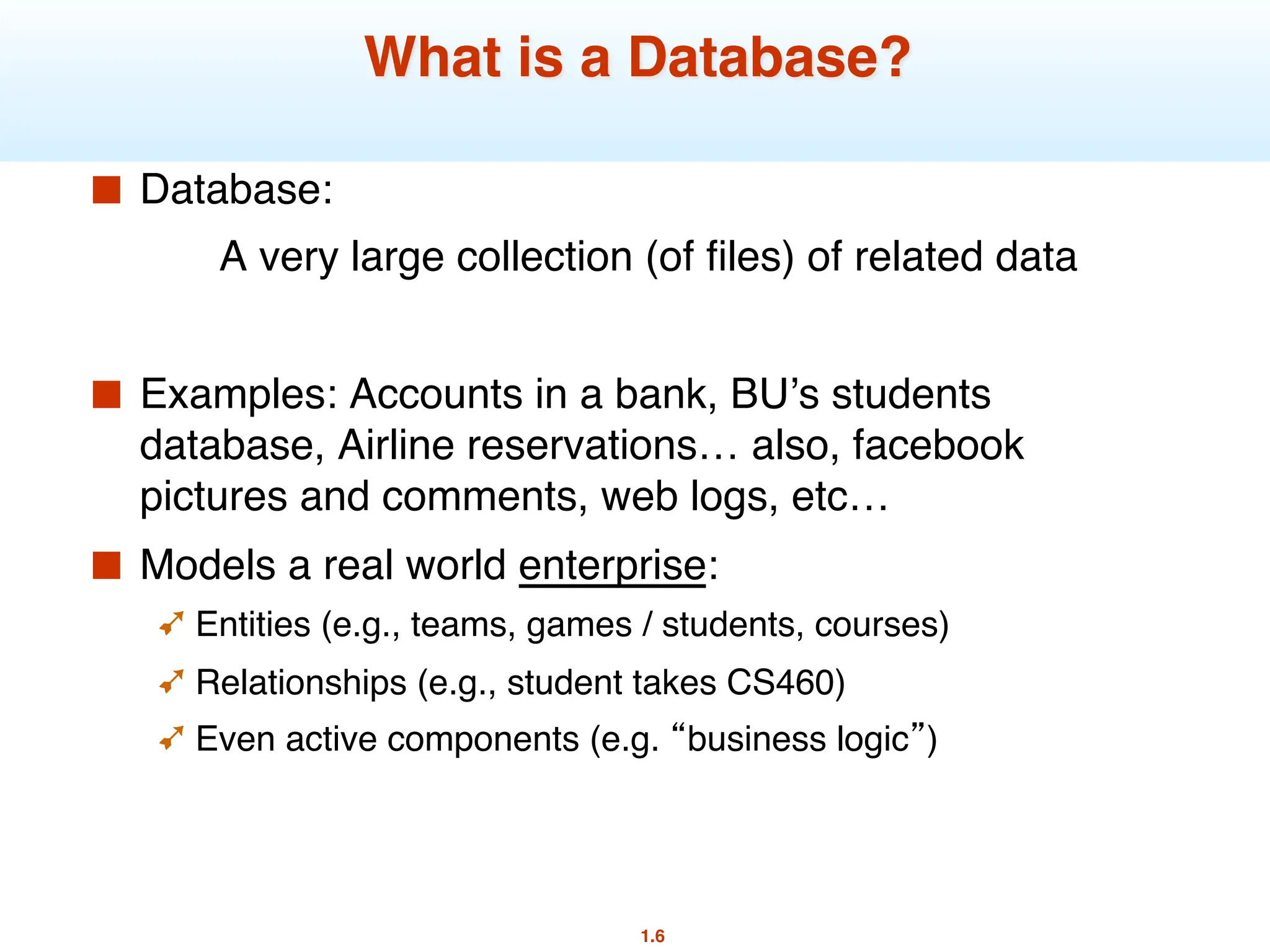
What is aDatabase?
■ Database:
A very large collection (of files) of related data
■ Examples: Accounts in a bank, BU’s students
database, Airline reservations… also, facebook
pictures and comments, web logs, etc…
■ Models a real world enterprise:
➹ Entities (e.g., teams, games / students, courses)
➹ Relationships (e.g., student takes CS460)
➹ Even active components (e.g. “business logic”)
7.
1.7
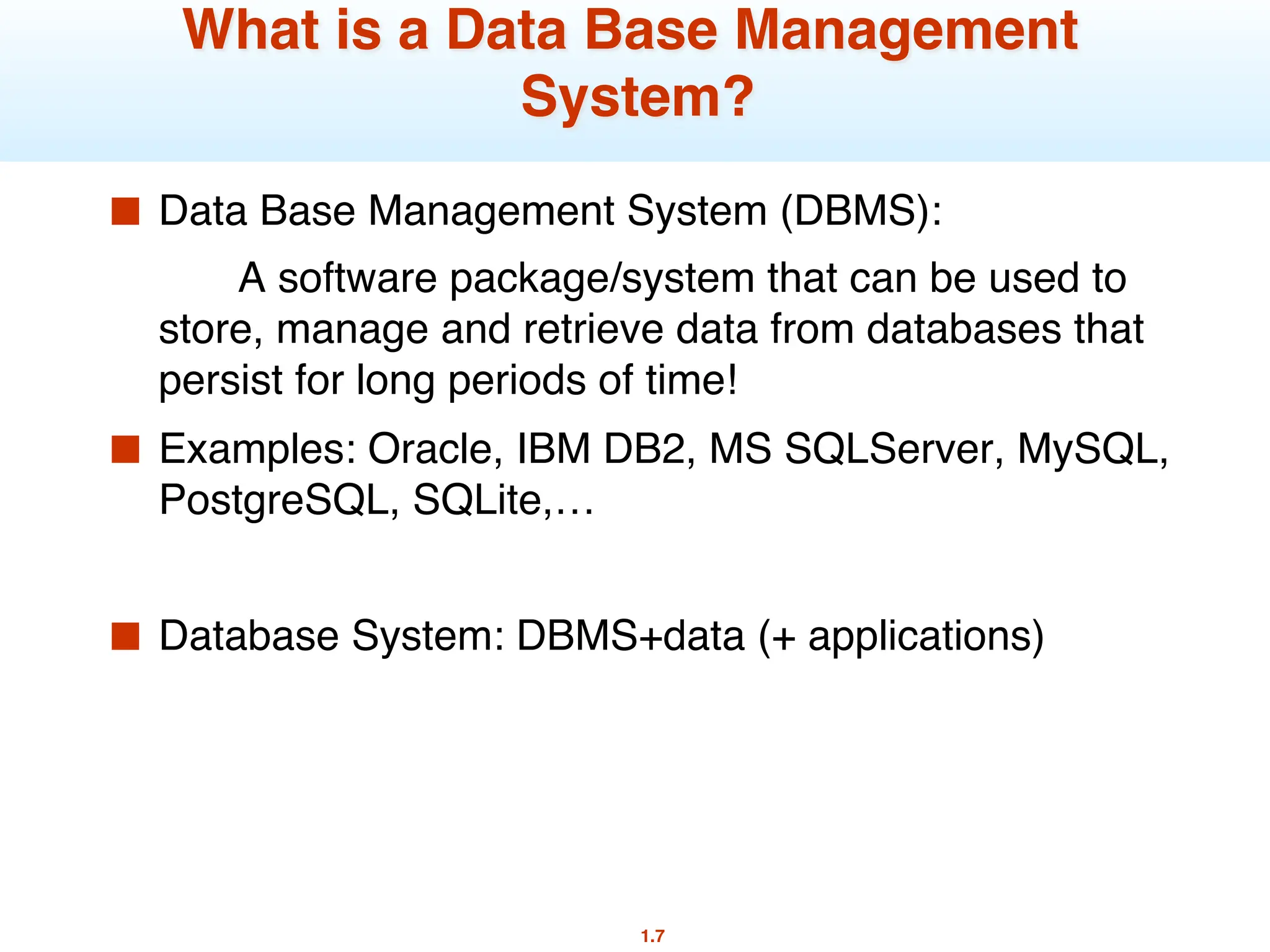
What is aData Base Management
System?
■ Data Base Management System (DBMS):
A software package/system that can be used to
store, manage and retrieve data from databases that
persist for long periods of time!
■ Examples: Oracle, IBM DB2, MS SQLServer, MySQL,
PostgreSQL, SQLite,…
■ Database System: DBMS+data (+ applications)
8.
1.8
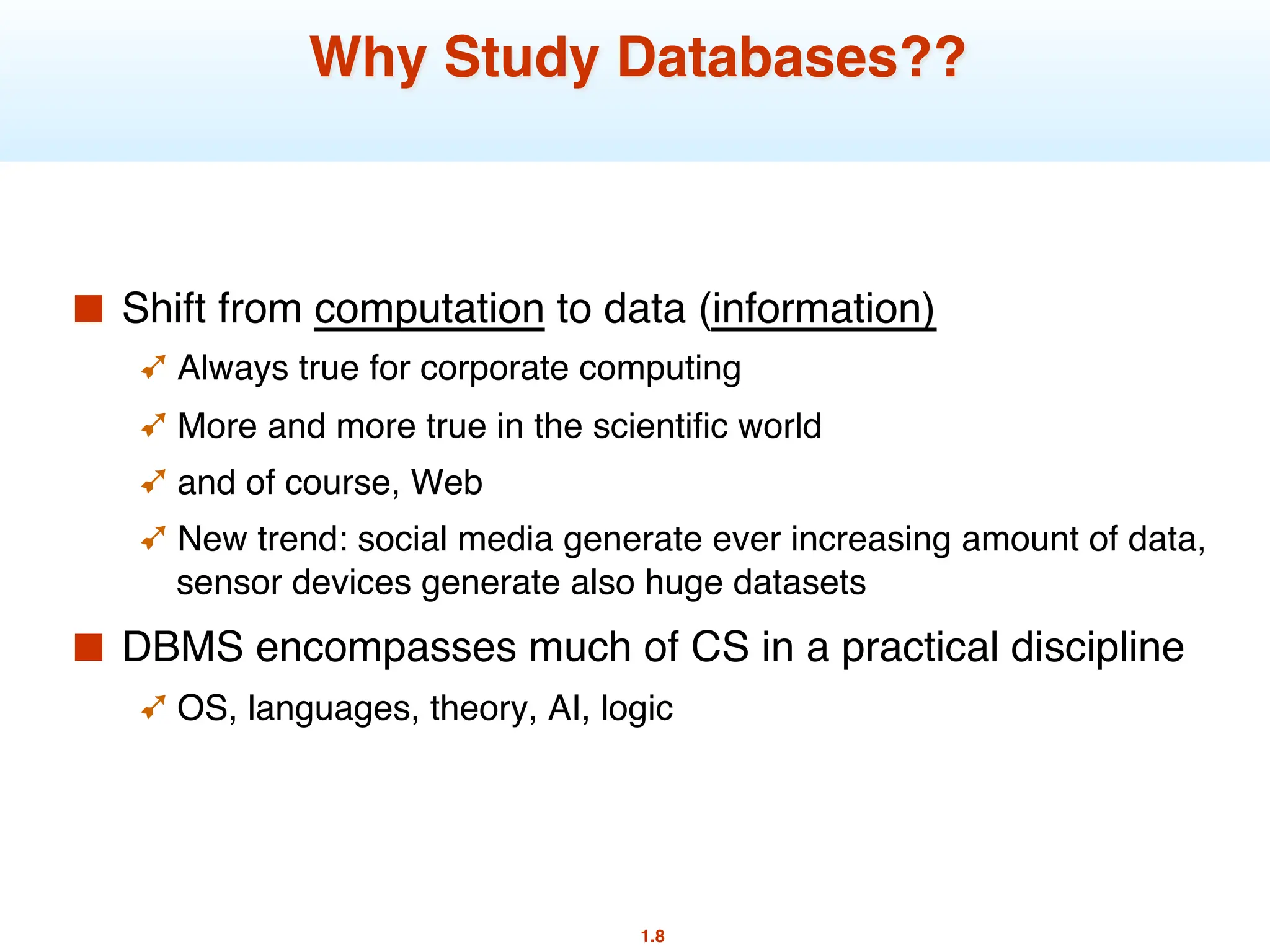
Why Study Databases??
■Shift from computation to data (information)
➹ Always true for corporate computing
➹ More and more true in the scientific world
➹ and of course, Web
➹ New trend: social media generate ever increasing amount of data,
sensor devices generate also huge datasets
■ DBMS encompasses much of CS in a practical discipline
➹ OS, languages, theory, AI, logic
9.
1.9
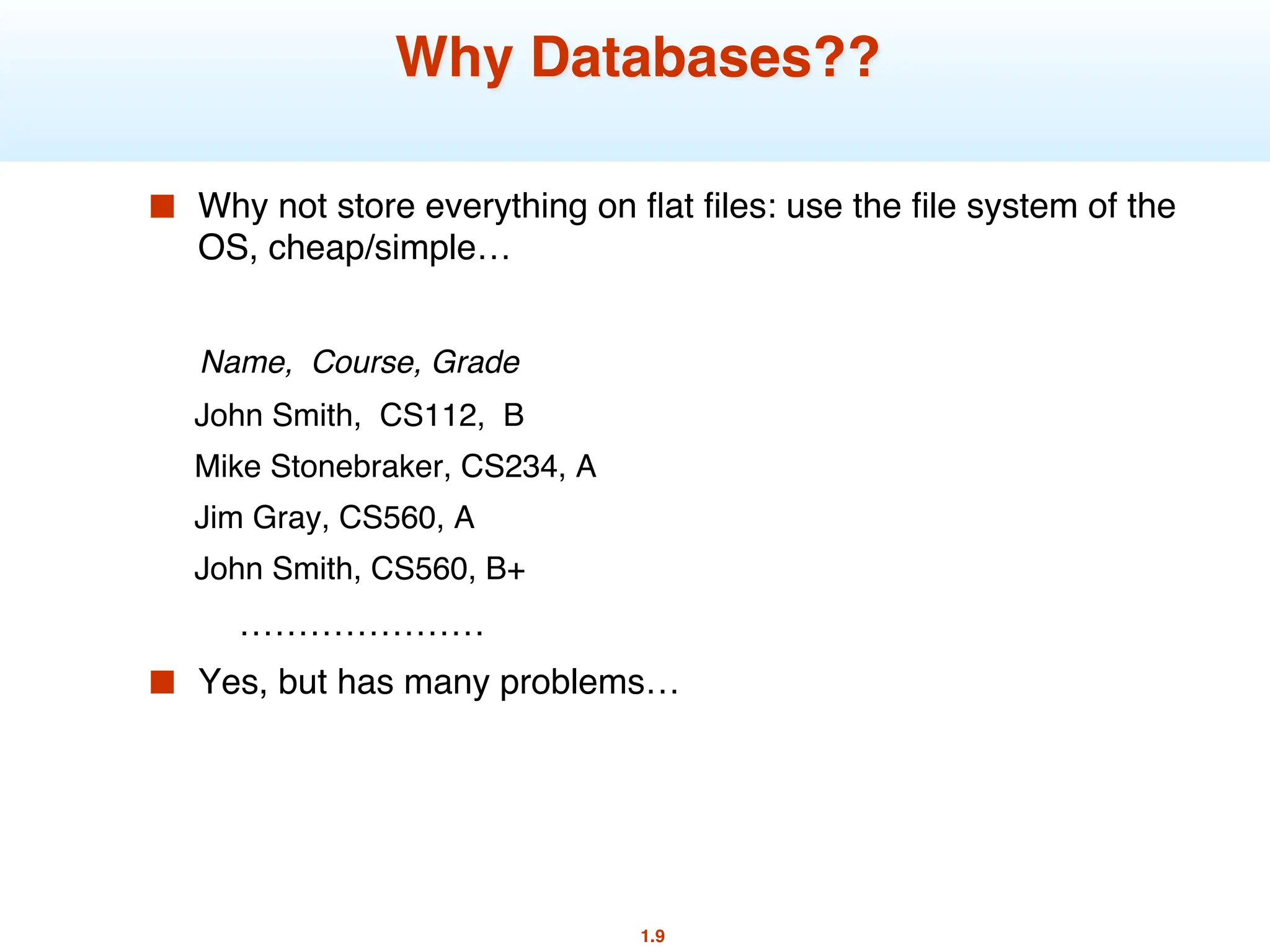
Why Databases??
■ Whynot store everything on flat files: use the file system of the
OS, cheap/simple…
Name, Course, Grade
John Smith, CS112, B
Mike Stonebraker, CS234, A
Jim Gray, CS560, A
John Smith, CS560, B+
…………………
■ Yes, but has many problems…
10.
1.10
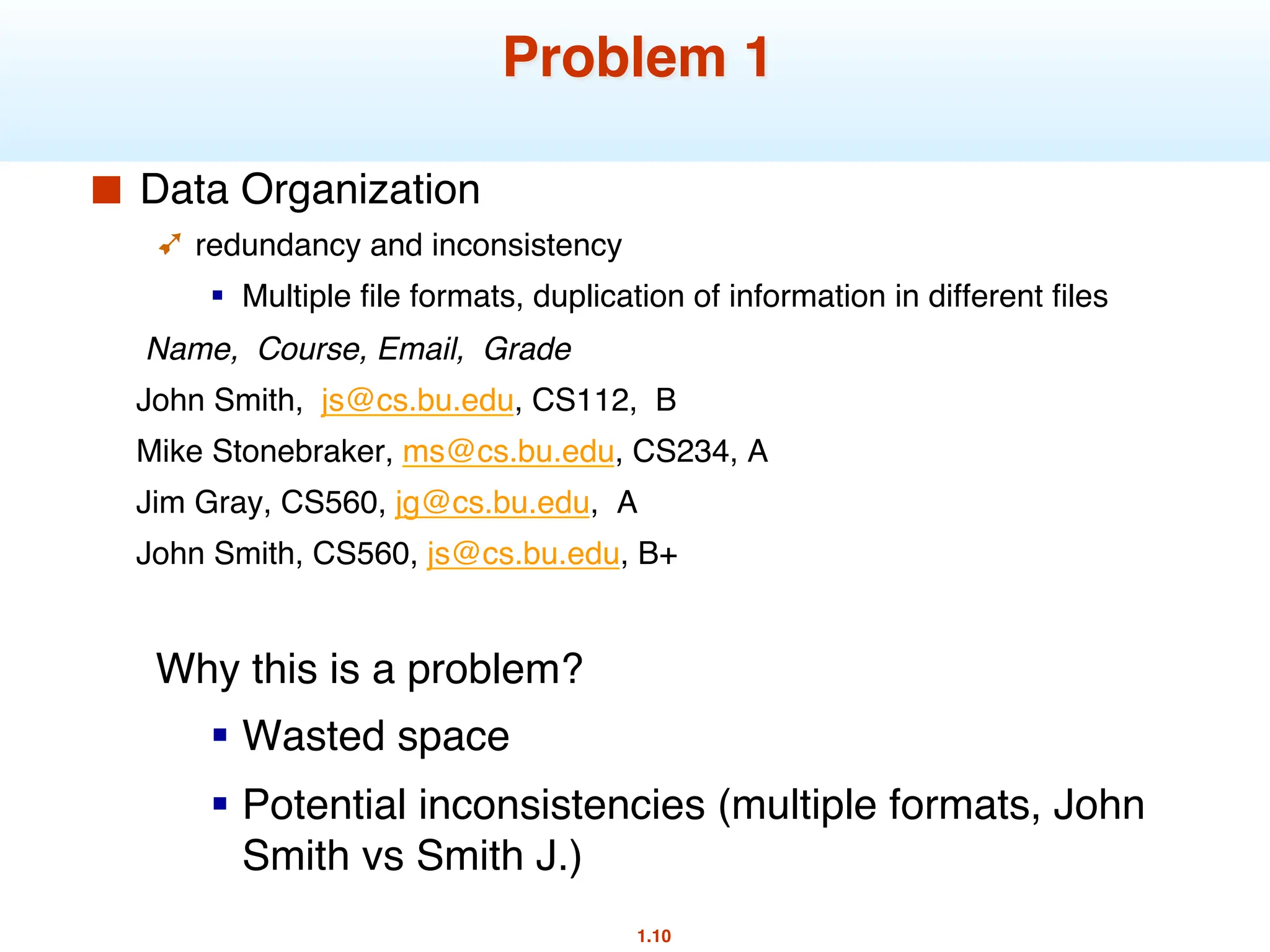
Problem 1
■ DataOrganization
➹ redundancy and inconsistency
§ Multiple file formats, duplication of information in different files
Name, Course, Email, Grade
John Smith, js@cs.bu.edu, CS112, B
Mike Stonebraker, ms@cs.bu.edu, CS234, A
Jim Gray, CS560, jg@cs.bu.edu, A
John Smith, CS560, js@cs.bu.edu, B+
Why this is a problem?
§ Wasted space
§ Potential inconsistencies (multiple formats, John
Smith vs Smith J.)
11.
1.11
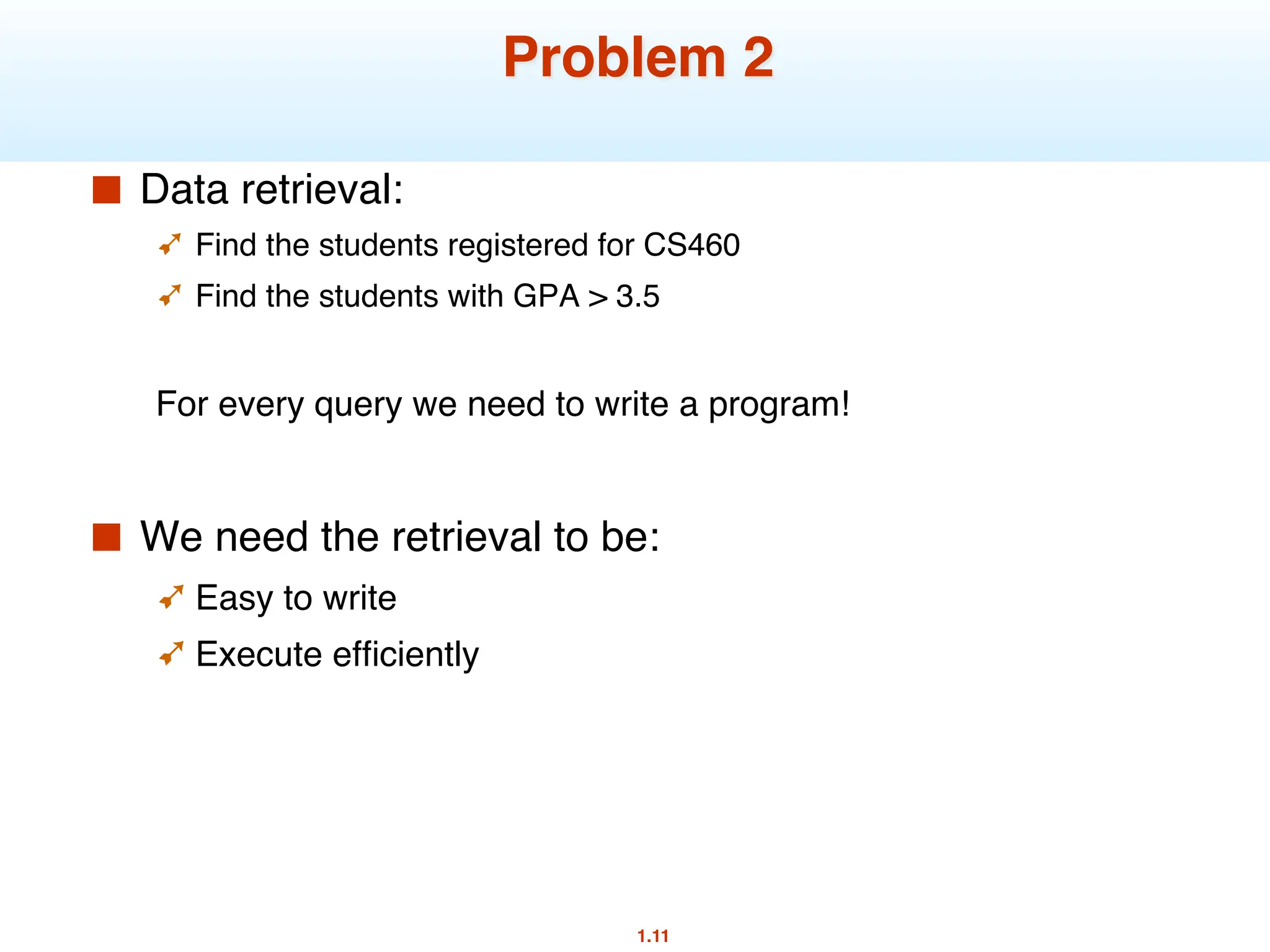
Problem 2
■ Dataretrieval:
➹ Find the students registered for CS460
➹ Find the students with GPA > 3.5
For every query we need to write a program!
■ We need the retrieval to be:
➹ Easy to write
➹ Execute efficiently
12.
1.12
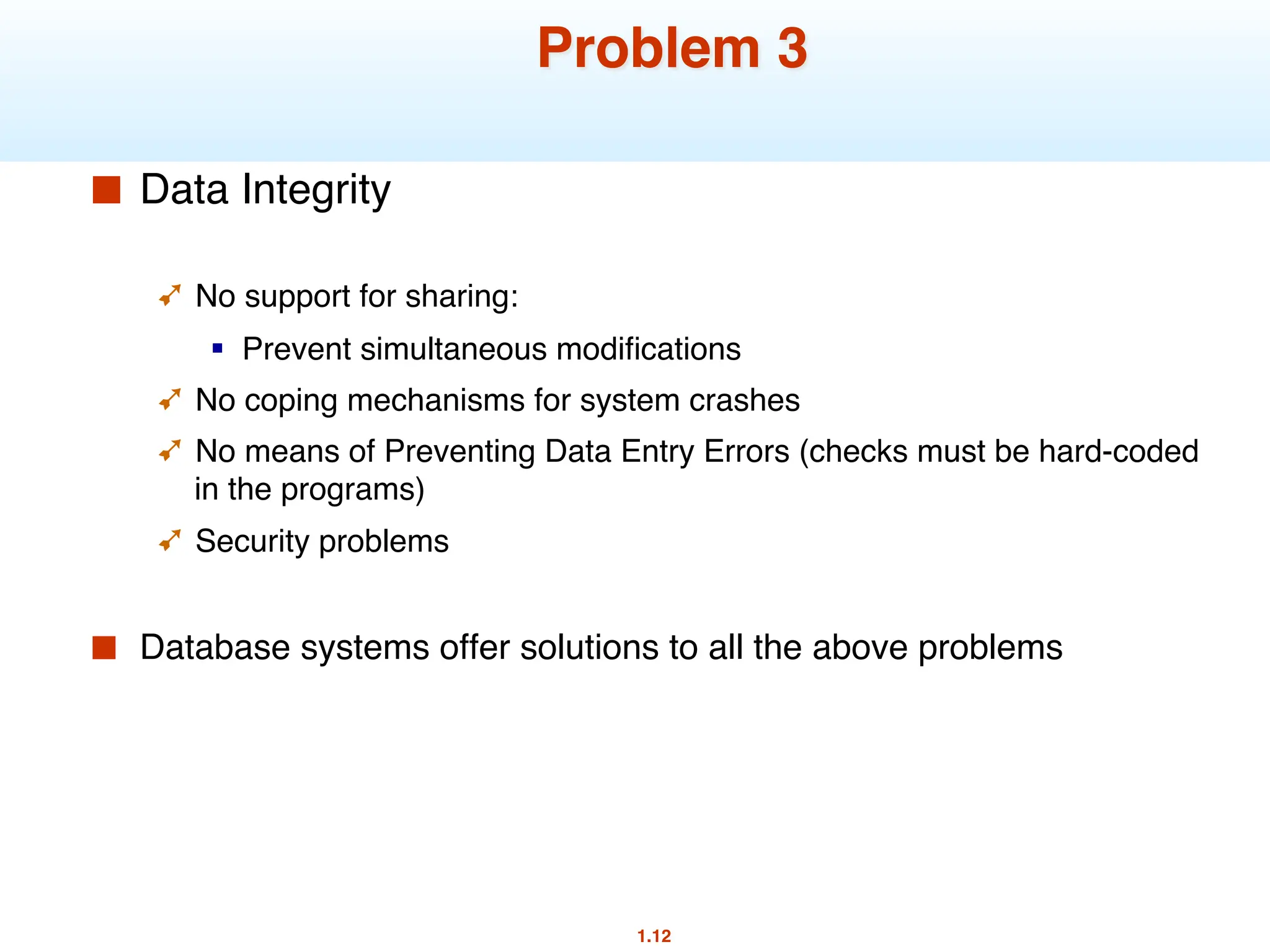
Problem 3
■ DataIntegrity
➹ No support for sharing:
§ Prevent simultaneous modifications
➹ No coping mechanisms for system crashes
➹ No means of Preventing Data Entry Errors (checks must be hard-coded
in the programs)
➹ Security problems
■ Database systems offer solutions to all the above problems
13.
1.13
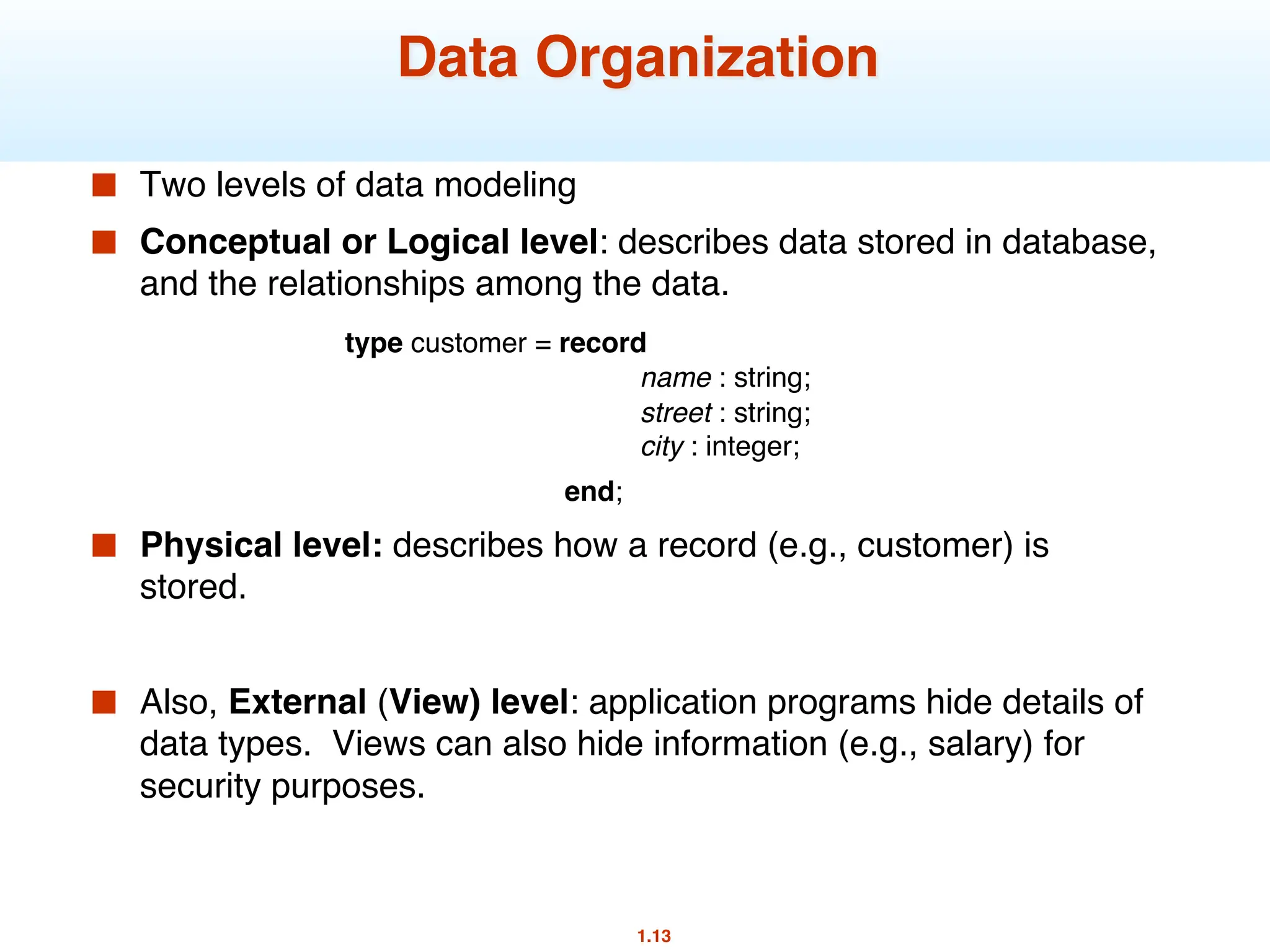
Data Organization
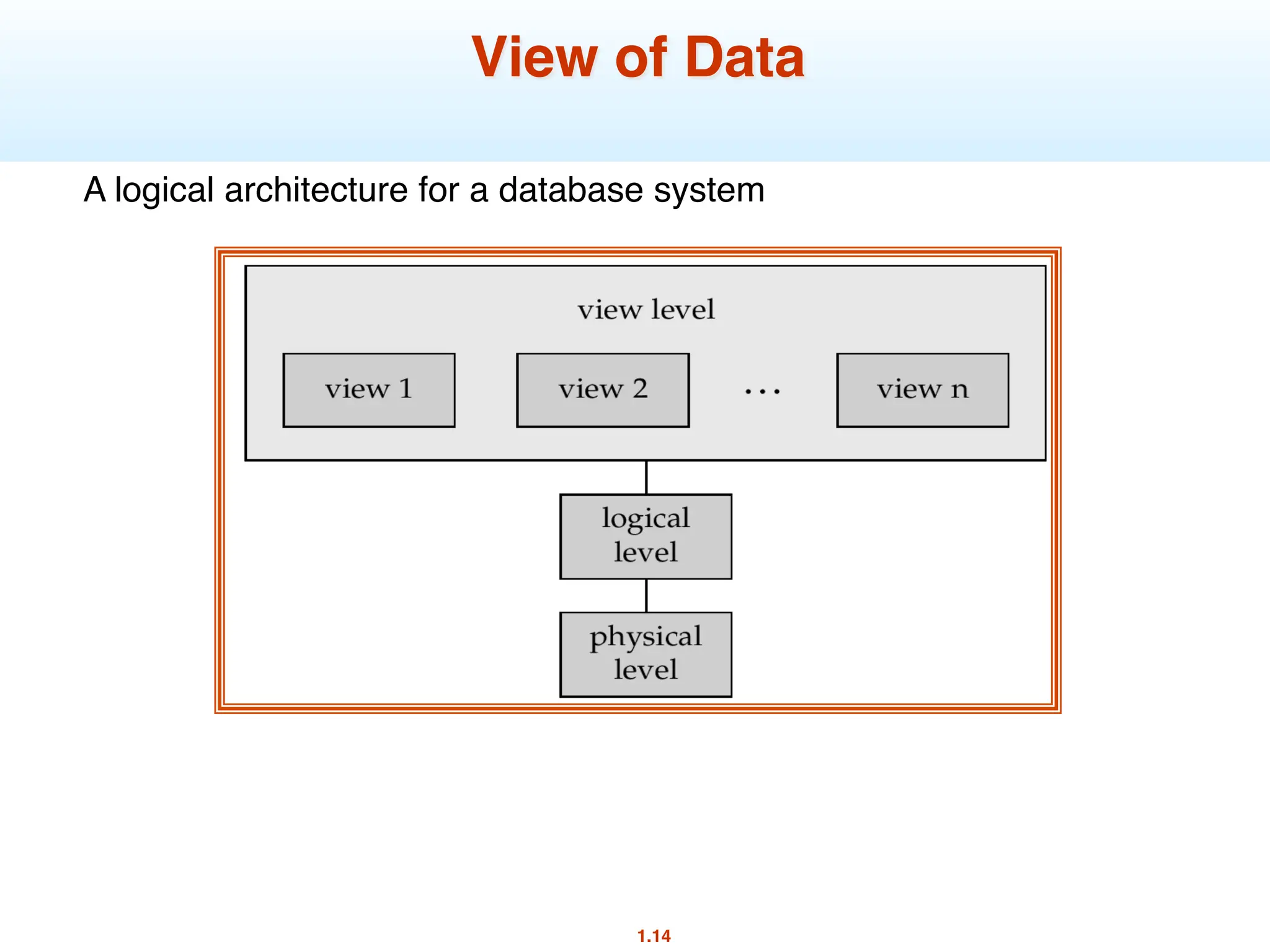
■ Twolevels of data modeling
■ Conceptual or Logical level: describes data stored in database,
and the relationships among the data.
type customer = record
name : string;
street : string;
city : integer;
end;
■ Physical level: describes how a record (e.g., customer) is
stored.
■ Also, External (View) level: application programs hide details of
data types. Views can also hide information (e.g., salary) for
security purposes.
1.15
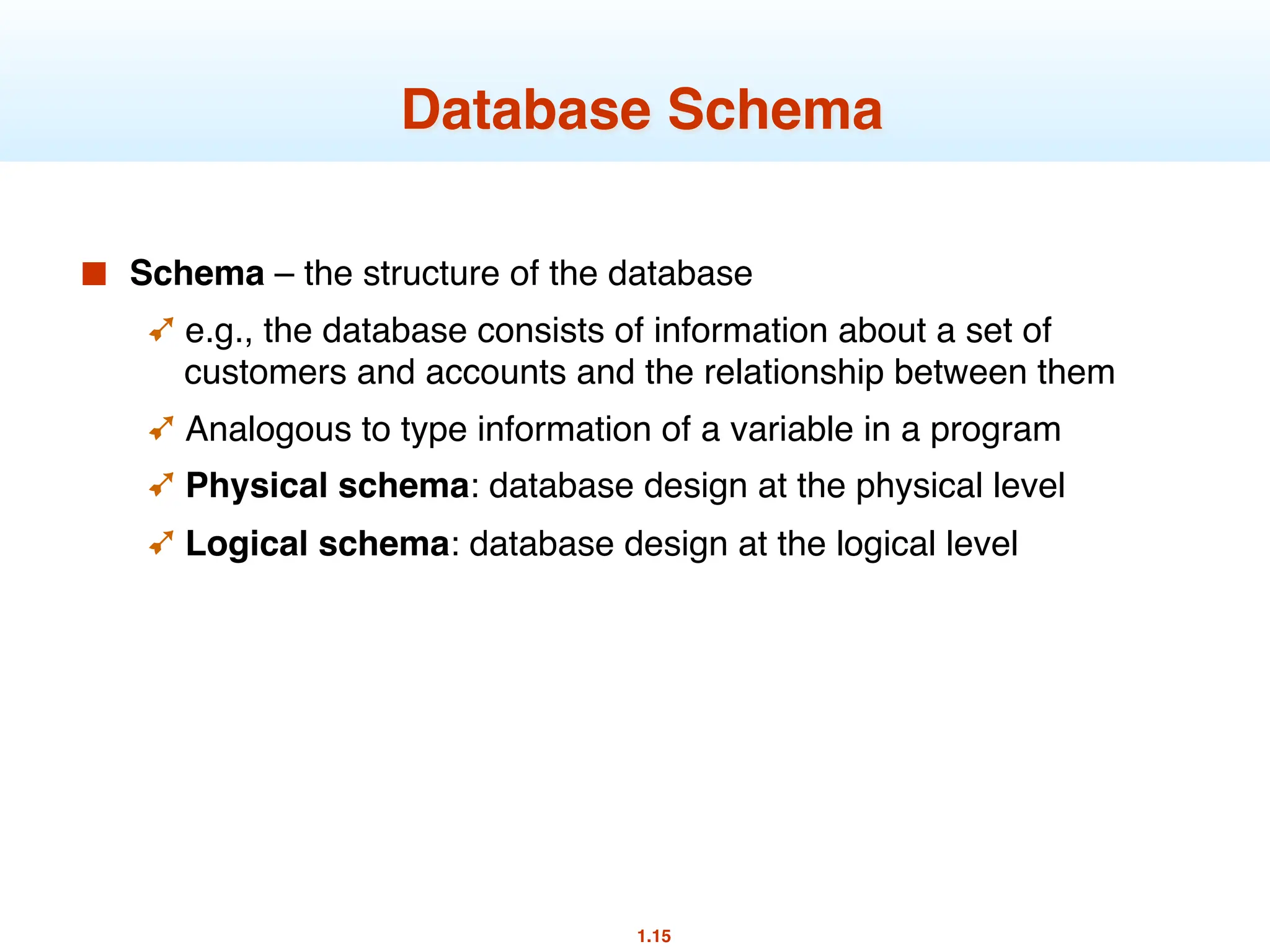
Database Schema
■ Schema– the structure of the database
➹ e.g., the database consists of information about a set of
customers and accounts and the relationship between them
➹ Analogous to type information of a variable in a program
➹ Physical schema: database design at the physical level
➹ Logical schema: database design at the logical level
16.
1.16
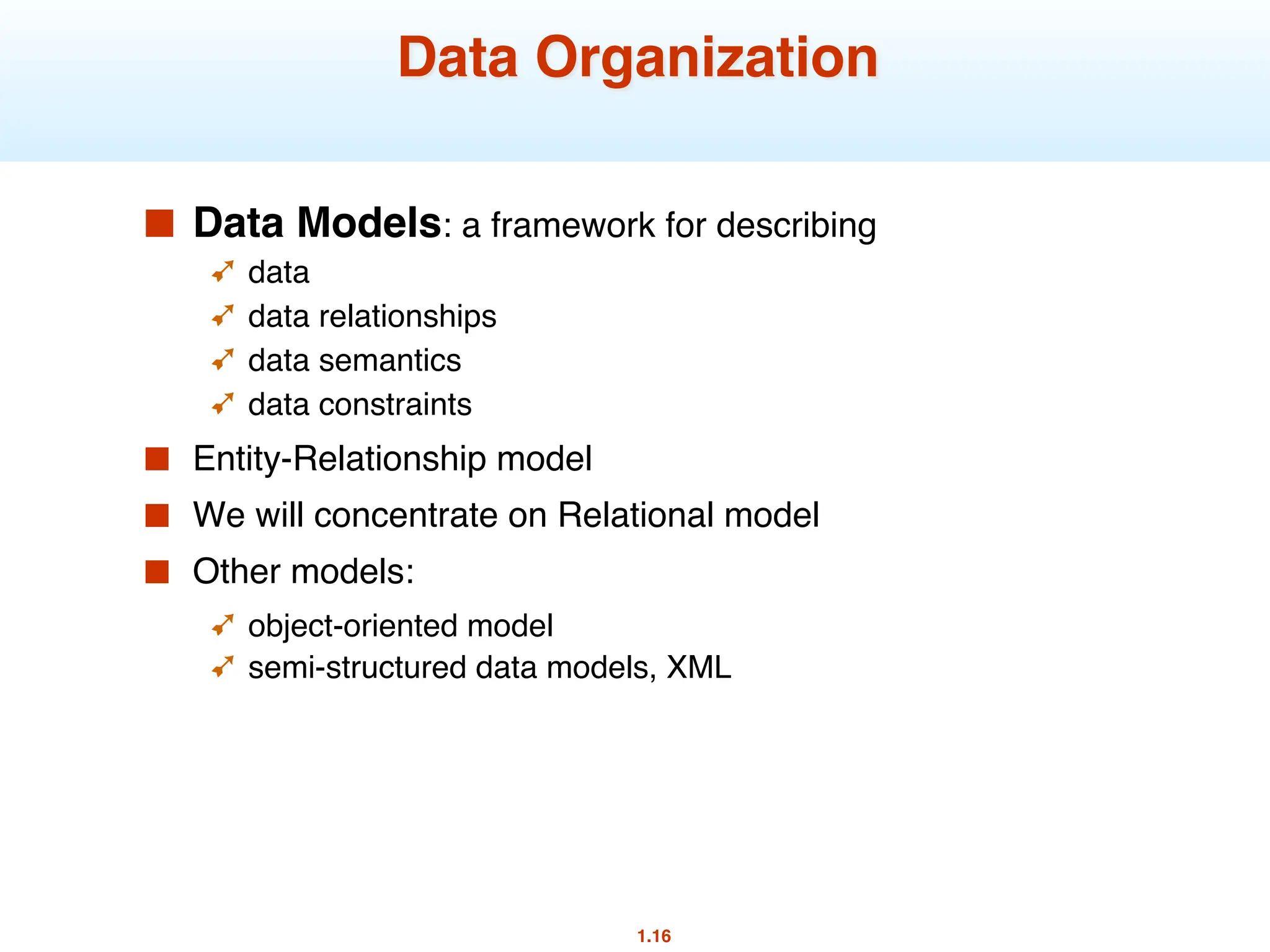
Data Organization
■ DataModels: a framework for describing
➹ data
➹ data relationships
➹ data semantics
➹ data constraints
■ Entity-Relationship model
■ We will concentrate on Relational model
■ Other models:
➹ object-oriented model
➹ semi-structured data models, XML
17.
1.17
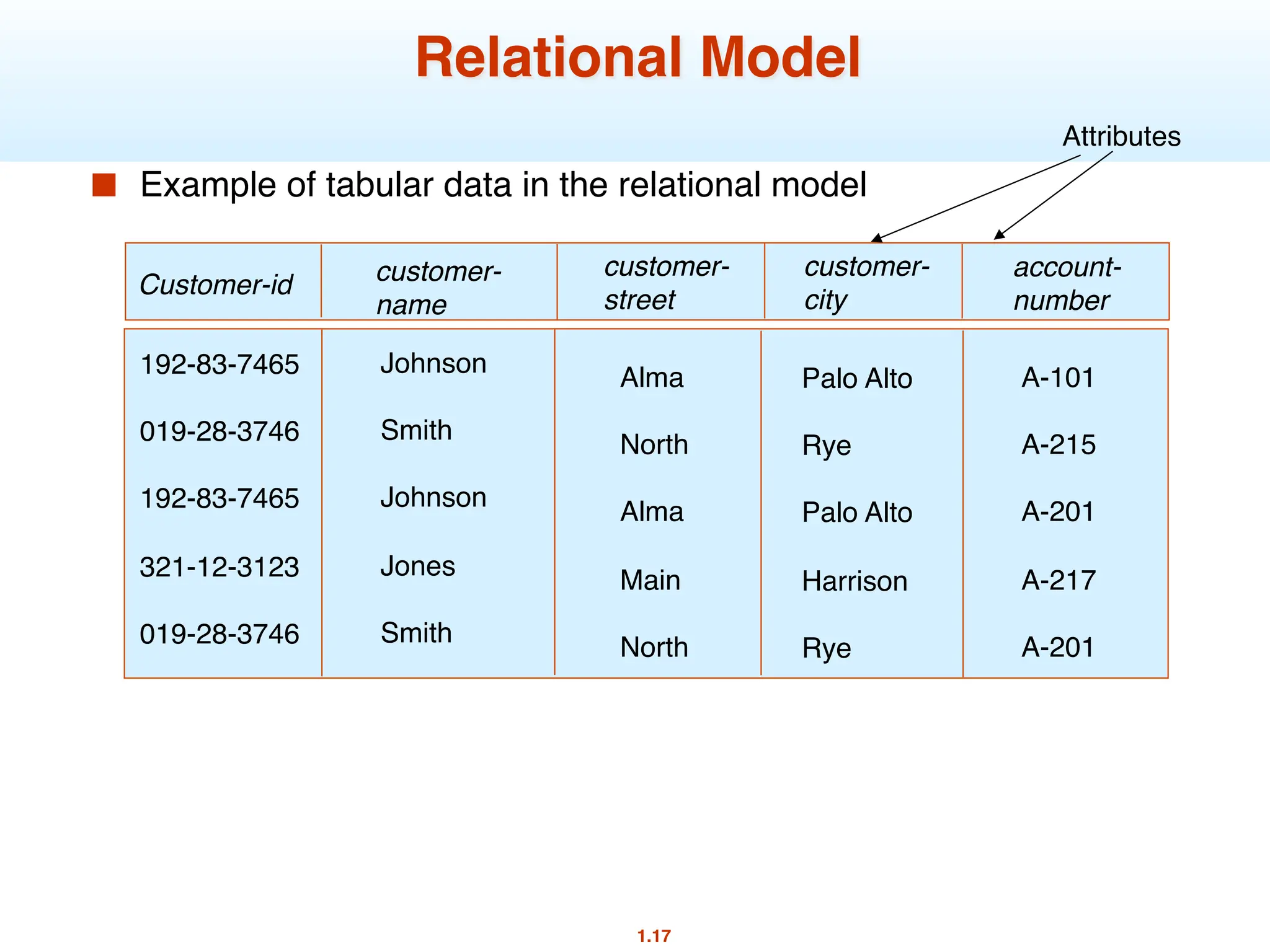
Relational Model
■ Exampleof tabular data in the relational model
customer-
name
Customer-id
customer-
street
customer-
city
account-
number
Johnson
Smith
Johnson
Jones
Smith
192-83-7465
019-28-3746
192-83-7465
321-12-3123
019-28-3746
Alma
North
Alma
Main
North
Palo Alto
Rye
Palo Alto
Harrison
Rye
A-101
A-215
A-201
A-217
A-201
Attributes
18.
1.18
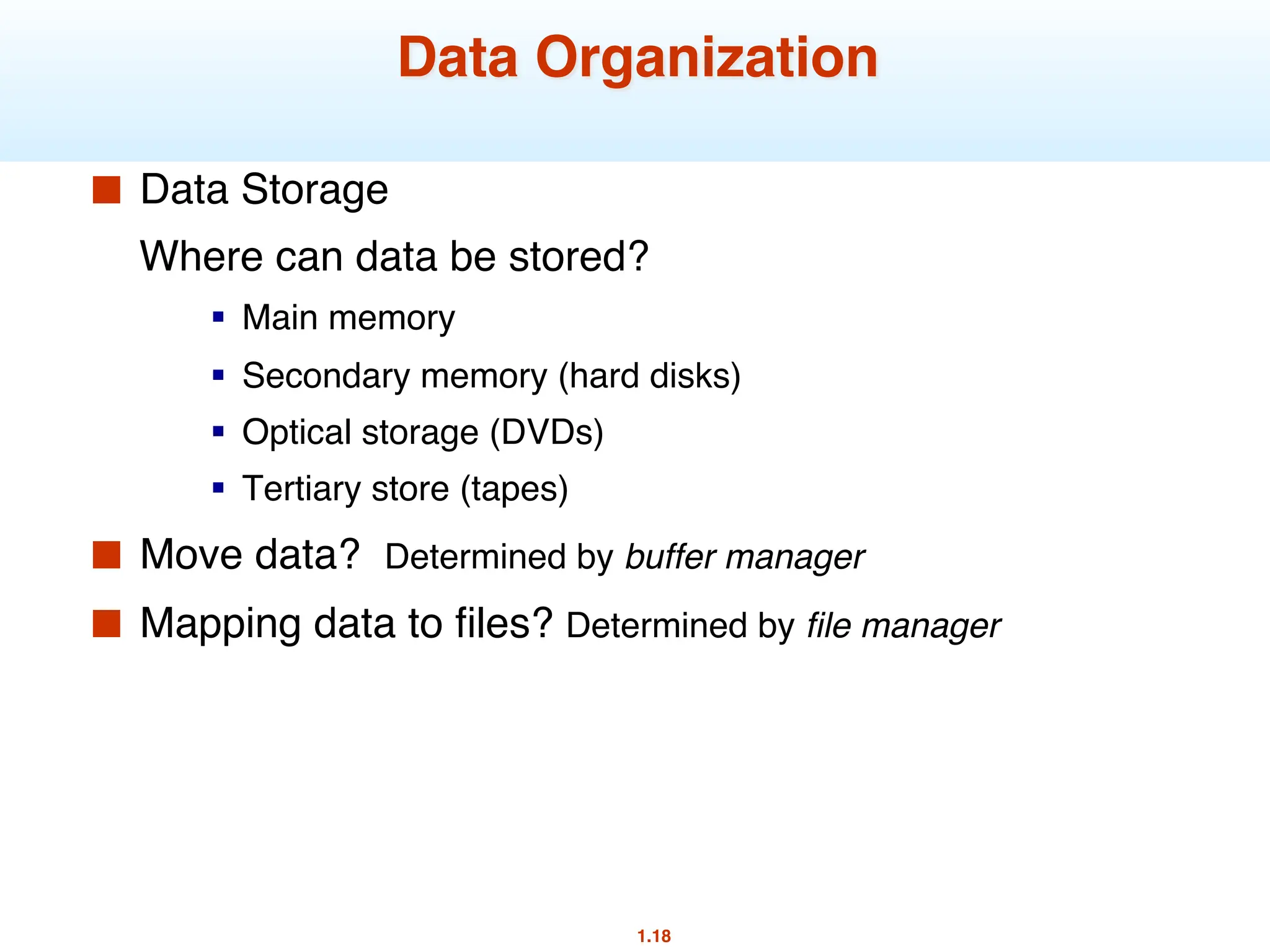
Data Organization
■ DataStorage
Where can data be stored?
§ Main memory
§ Secondary memory (hard disks)
§ Optical storage (DVDs)
§ Tertiary store (tapes)
■ Move data? Determined by buffer manager
■ Mapping data to files? Determined by file manager
19.
1.19
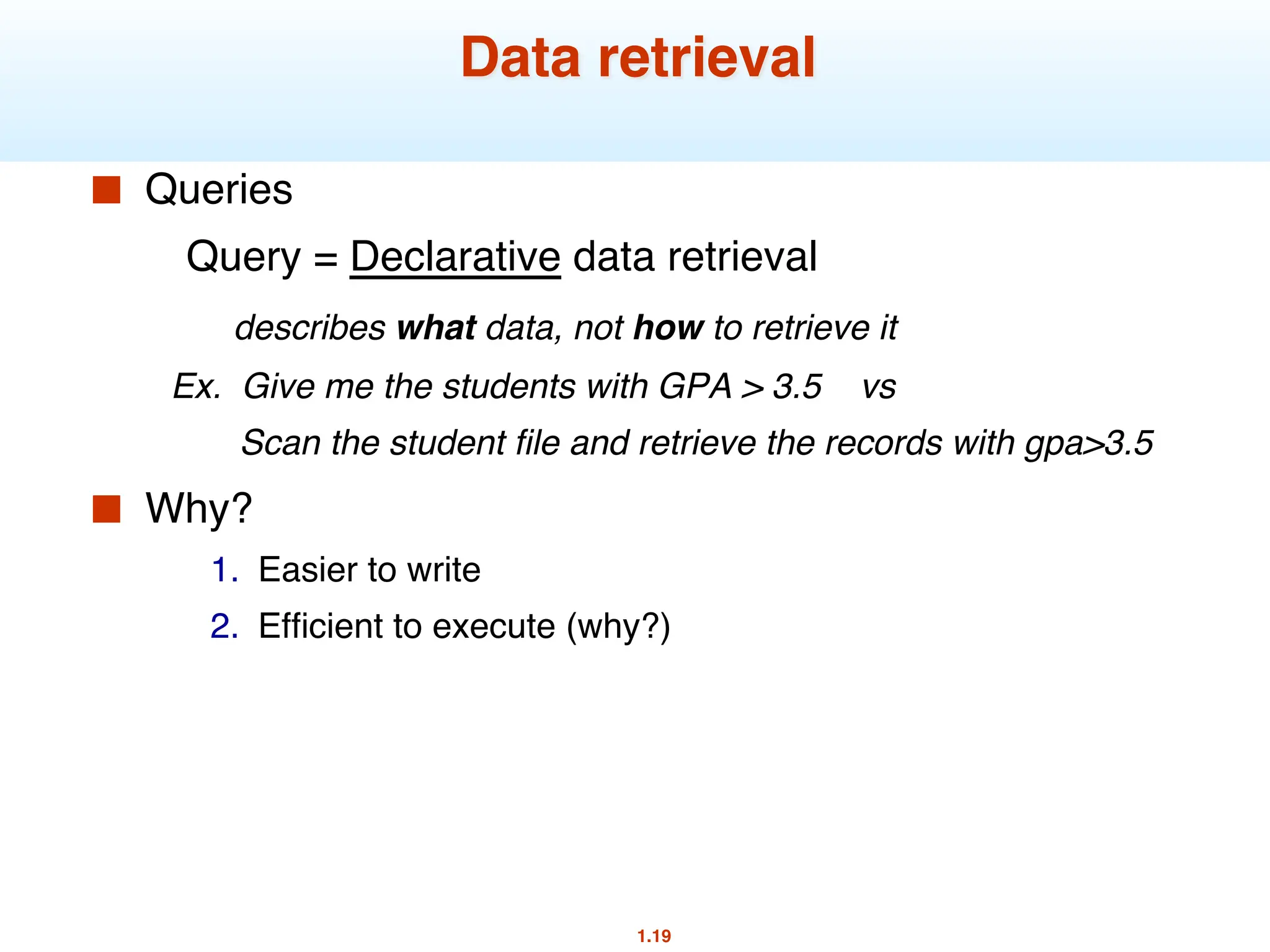
Data retrieval
■ Queries
Query= Declarative data retrieval
describes what data, not how to retrieve it
Ex. Give me the students with GPA > 3.5 vs
Scan the student file and retrieve the records with gpa>3.5
■ Why?
1. Easier to write
2. Efficient to execute (why?)
20.
1.20
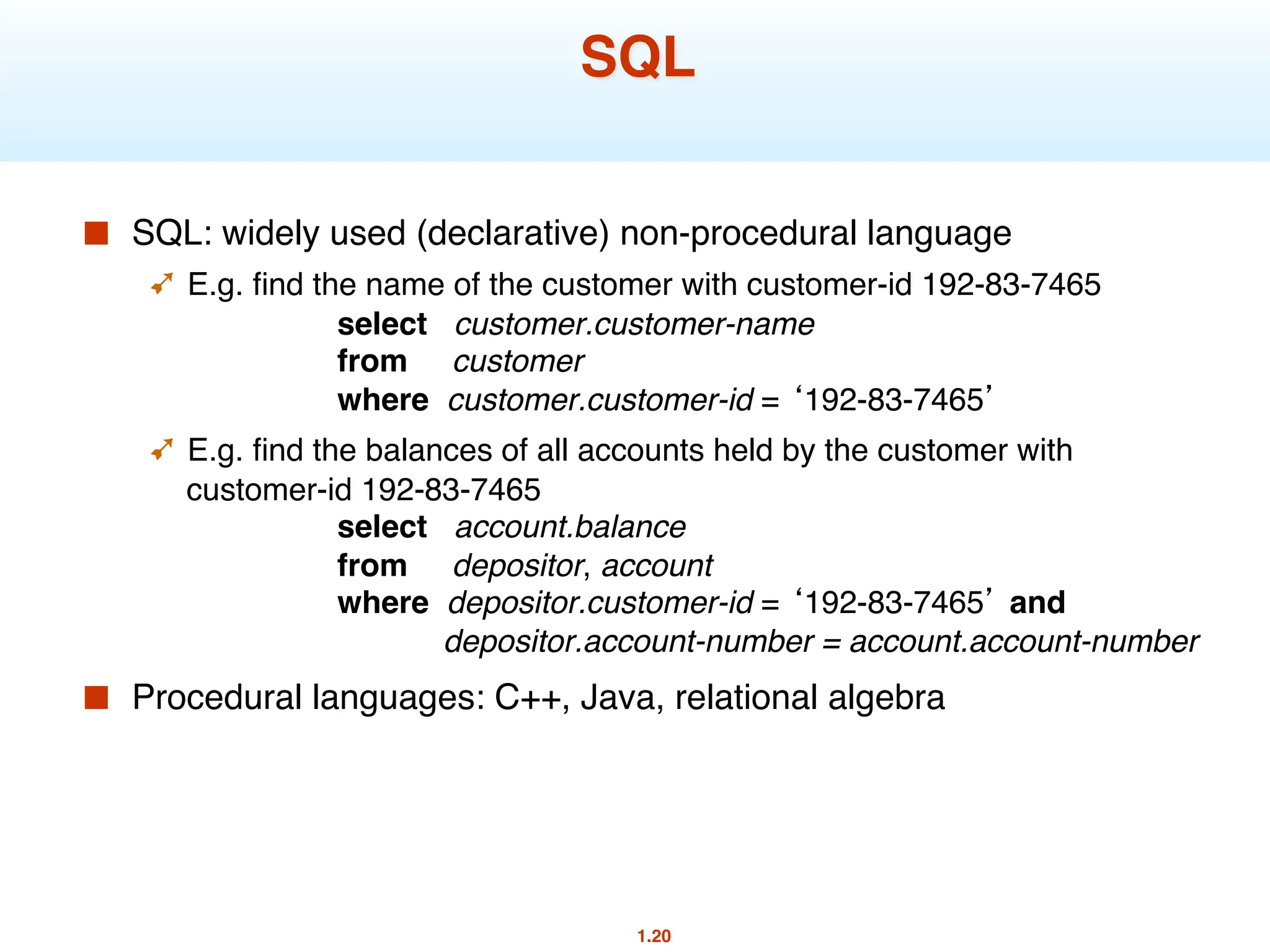
SQL
■ SQL: widelyused (declarative) non-procedural language
➹ E.g. find the name of the customer with customer-id 192-83-7465
select customer.customer-name
from customer
where customer.customer-id = ‘192-83-7465’
➹ E.g. find the balances of all accounts held by the customer with
customer-id 192-83-7465
select account.balance
from depositor, account
where depositor.customer-id = ‘192-83-7465’ and
depositor.account-number = account.account-number
■ Procedural languages: C++, Java, relational algebra
21.
1.21
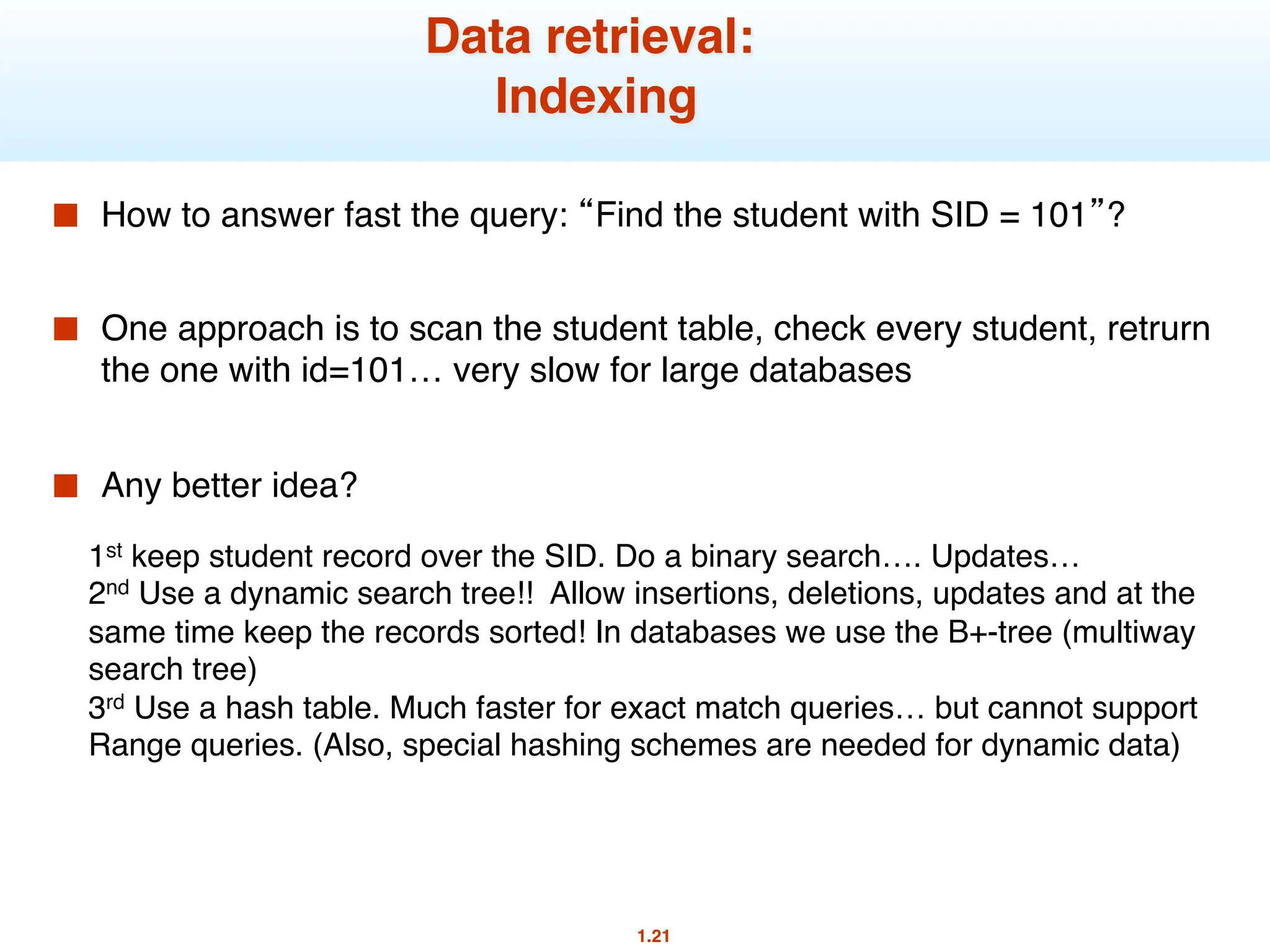
Data retrieval:
Indexing
■ Howto answer fast the query: “Find the student with SID = 101”?
■ One approach is to scan the student table, check every student, retrurn
the one with id=101… very slow for large databases
■ Any better idea?
1st keep student record over the SID. Do a binary search…. Updates…
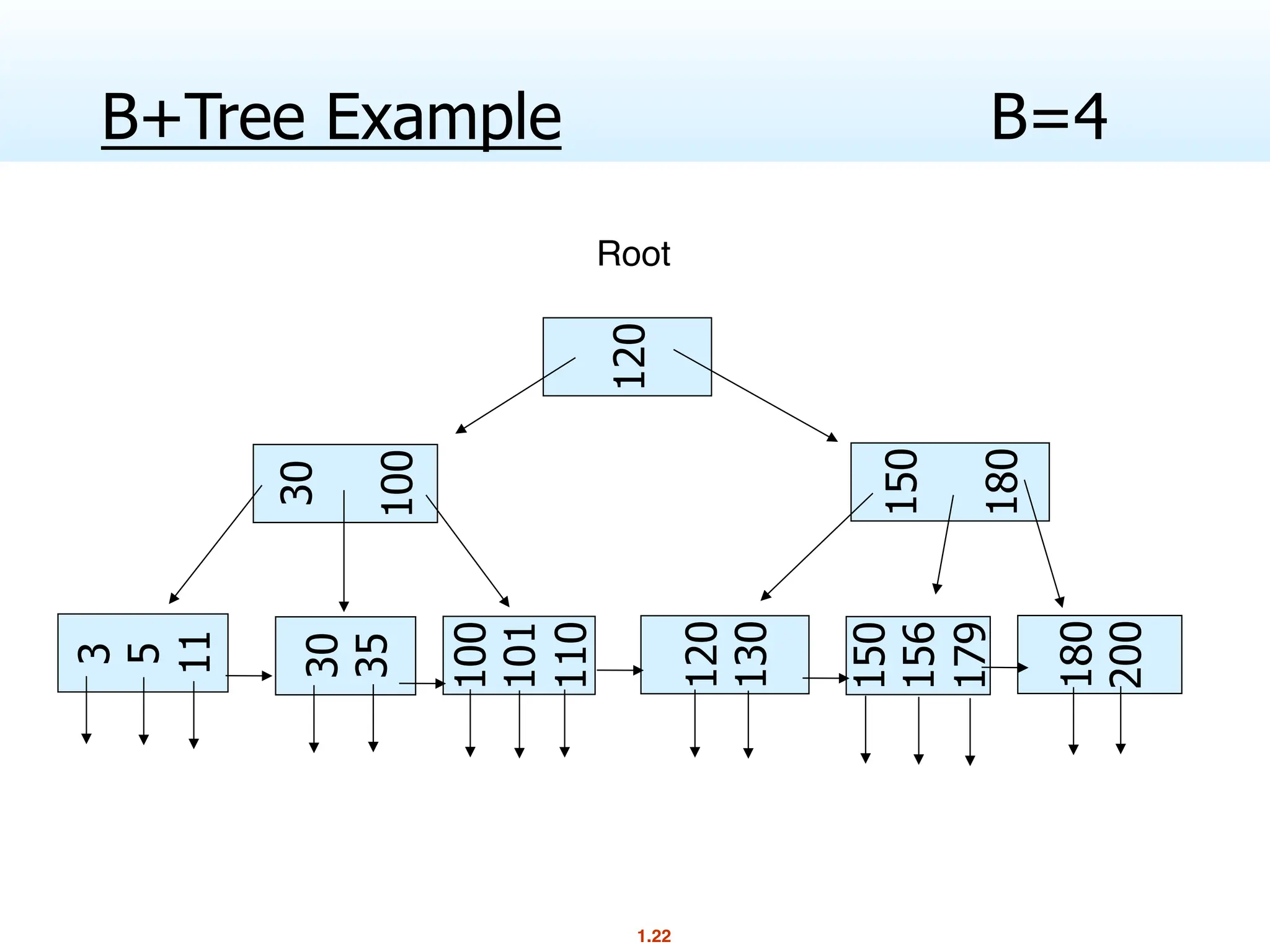
2nd Use a dynamic search tree!! Allow insertions, deletions, updates and at the
same time keep the records sorted! In databases we use the B+-tree (multiway
search tree)
3rd Use a hash table. Much faster for exact match queries… but cannot support
Range queries. (Also, special hashing schemes are needed for dynamic data)
1.23
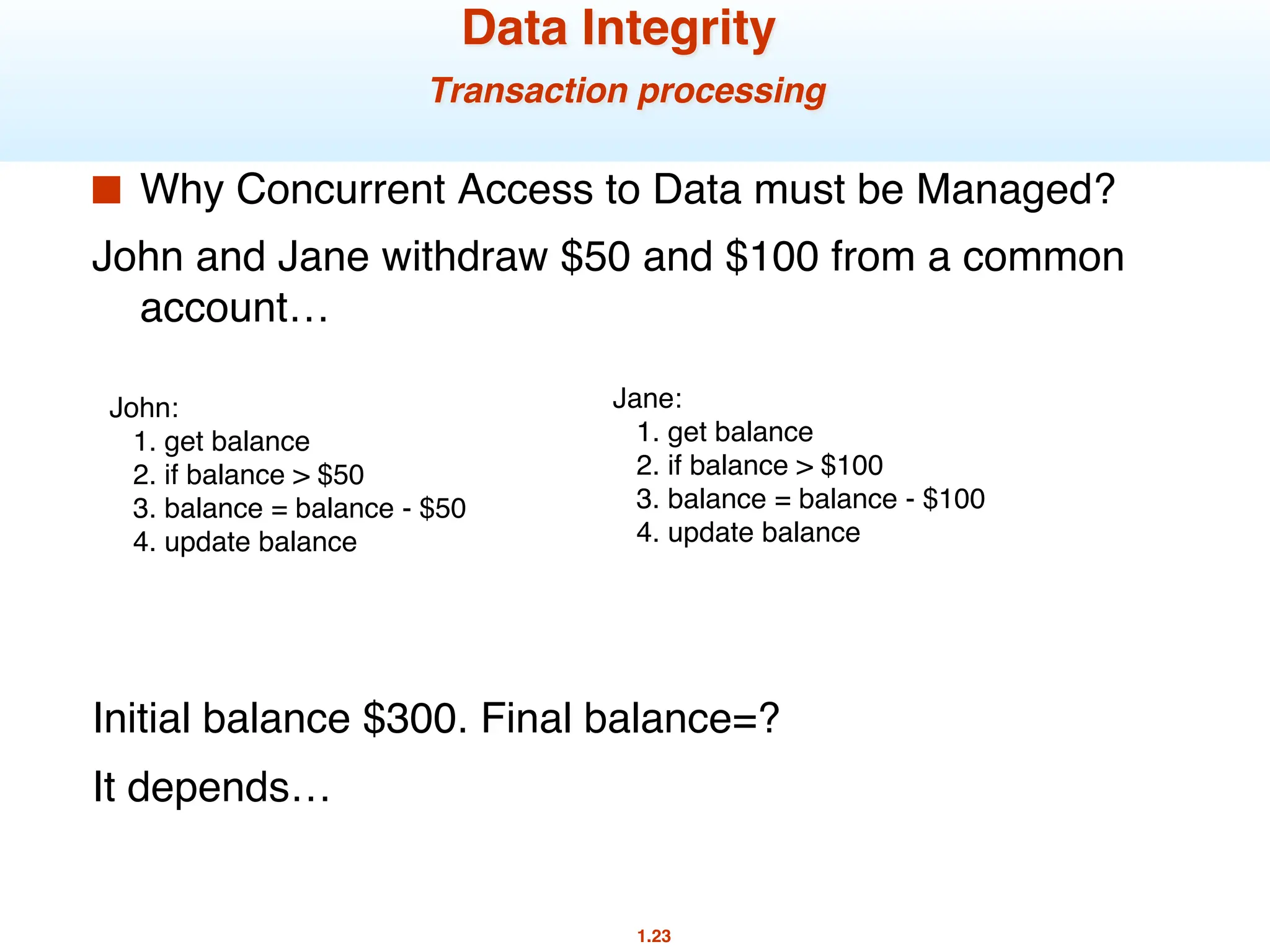
Data Integrity
Transaction processing
■Why Concurrent Access to Data must be Managed?
John and Jane withdraw $50 and $100 from a common
account…
Initial balance $300. Final balance=?
It depends…
John:
1. get balance
2. if balance > $50
3. balance = balance - $50
4. update balance
Jane:
1. get balance
2. if balance > $100
3. balance = balance - $100
4. update balance
24.
1.24
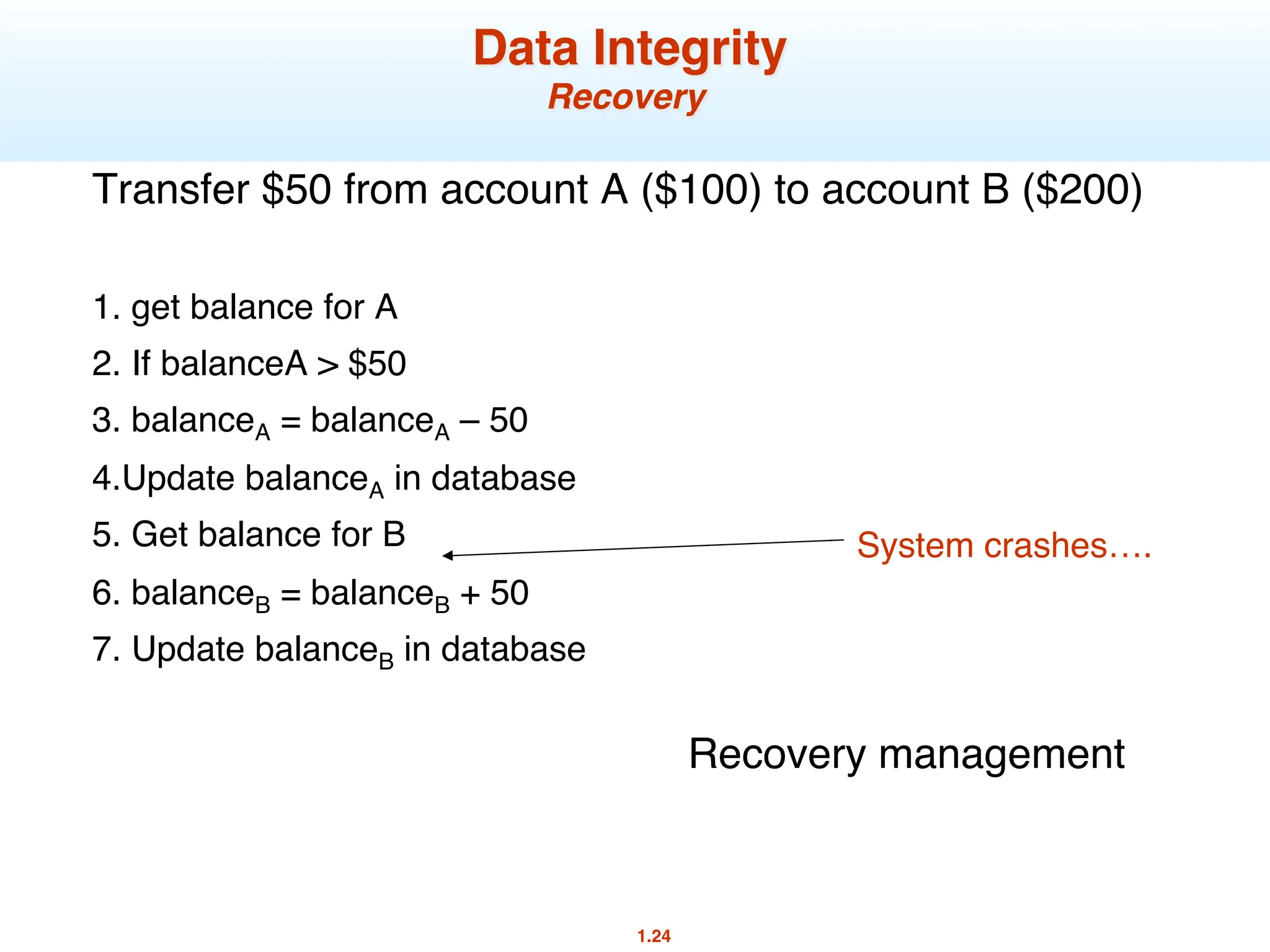
Data Integrity
Recovery
Transfer $50from account A ($100) to account B ($200)
1. get balance for A
2. If balanceA > $50
3. balanceA = balanceA – 50
4.Update balanceA in database
5. Get balance for B
6. balanceB = balanceB + 50
7. Update balanceB in database
System crashes….
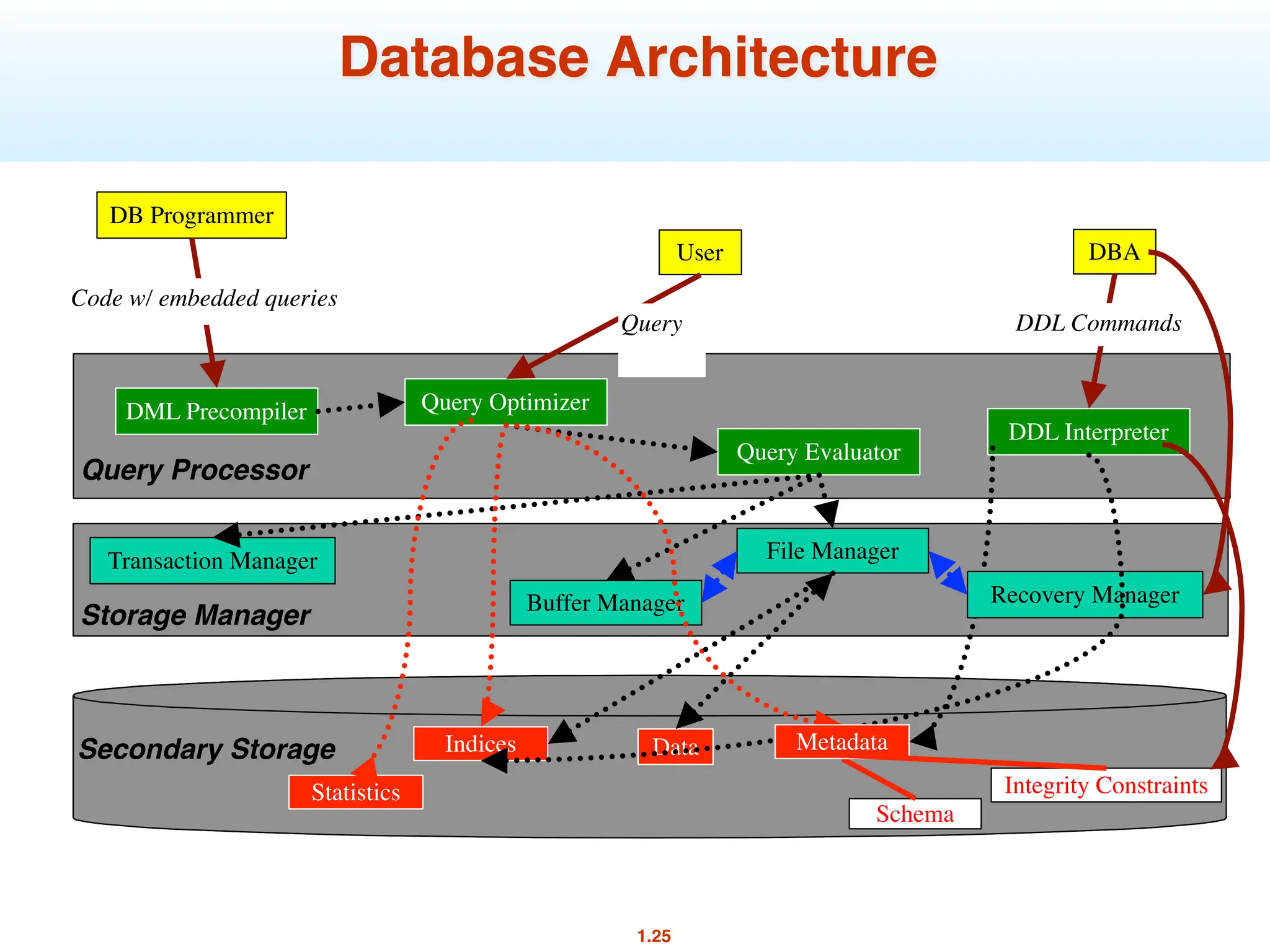
Recovery management
1.26
Big Data andNoSQL
■ Large amount of data are collected and stored everyday
➹ Can come from different sources, huge amounts, large update rates
■ Examples: facebook needs to handle: 2.7 billion “likes”, 400
million images, 500+ TB per day!!, Google receives more than 1
billion queries per day!
■ Question: How to utilize these datasets in order to help us on our
goals:
➹ Data Analytics: Try to analyze the data in order to find useful,
unknown and actionable information in the data
■ Cluster based data analytics:
➹ Map-Reduce, shared nothing DBs
■ NoSQL: trade something for improved performance
§ (usually: ACID properties, flexibility, functionality)
27.
1.27
Outline
■ 1st halfof the course: application-oriented
➹ How to develop database applications: User + DBA
■ 2nd part of the course: system-oriented
➹ Learn the internals of a relational DBMS (developer for Oracle..)