COMPETITOR ANALYSIS
Presented by:
Mayank Mishra (20165020)
Meet Shah (20165021)
Mili Patel (20165022)
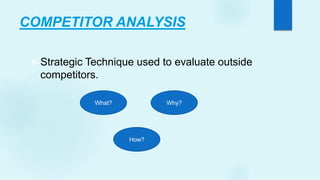
COMPETITOR ANALYSIS
 Strategic Technique used to evaluate outside
competitors.
What?
How?
Why?
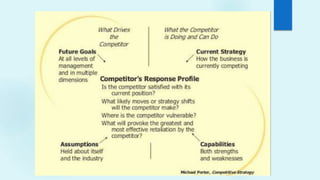
FUTURE GOALS
The diagnosis of competitors’ goals is very important
 A knowledge of goals will allow predictions about whether
competitor satisfied with current position or not
Knowing a competitor’s strategic goals will also help to
predicting its reactions to strategic changes
►A diagnosis of competitor goals helps interpret the seriousness
of initiatives the competitor takes.
►Goals should be multiple level at corporate wide goals, business
unit goals etc.
►The following diagnostic questions help to determine a
competitor’s present and future goals
► What is the organizational structure of the competitor?
► What control and incentive systems are in place? how are executive
compensated? what measures of performance are tracked regularly?
► What is the competitor's attitude towards risks? If financial objectives
essentially consist of profitability, market position, rate of growth, and
desire level of risk, how does competitor appear to balance these factors?
ASSUMPTIONS
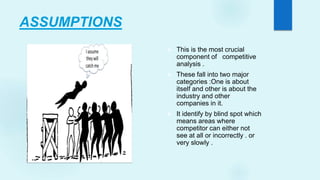
 This is the most crucial
component of competitive
analysis .
 These fall into two major
categories :One is about
itself and other is about the
industry and other
companies in it.
 It identify by blind spot which
means areas where
competitor can either not
see at all or incorrectly . or
very slowly .
KEY INDICATORS OF
ASSUMPTIONS
 History as an indicator of goals and assumptions :
 It deals with various aspects of competitor like past performance,
marketplace, area of success reaction to moves like emotional.
 Managerial backgrounds and advisory relationships :
 It deals with where its leadership come from and what manager’s track
records and personal successes and failure have been like functional
background.
CURRENT STRATEGY
 It is the Third Component of Competitor
Analysis.
 It’s a key operating policies in each functional area.
 And also it is interrelate the function.
 This strategy are of two types explicit and implicit.
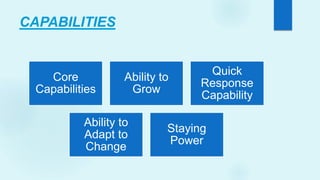
CAPABILITIES
Core
Capabilities
Ability to
Grow
Quick
Response
Capability
Ability to
Adapt to
Change
Staying
Power
Thank You

Cs ppt1

  • 1.
    COMPETITOR ANALYSIS Presented by: MayankMishra (20165020) Meet Shah (20165021) Mili Patel (20165022)
  • 2.
    COMPETITOR ANALYSIS  StrategicTechnique used to evaluate outside competitors. What? How? Why?
  • 4.
    FUTURE GOALS The diagnosisof competitors’ goals is very important  A knowledge of goals will allow predictions about whether competitor satisfied with current position or not Knowing a competitor’s strategic goals will also help to predicting its reactions to strategic changes
  • 5.
    ►A diagnosis ofcompetitor goals helps interpret the seriousness of initiatives the competitor takes. ►Goals should be multiple level at corporate wide goals, business unit goals etc. ►The following diagnostic questions help to determine a competitor’s present and future goals
  • 6.
    ► What isthe organizational structure of the competitor? ► What control and incentive systems are in place? how are executive compensated? what measures of performance are tracked regularly? ► What is the competitor's attitude towards risks? If financial objectives essentially consist of profitability, market position, rate of growth, and desire level of risk, how does competitor appear to balance these factors?
  • 7.
    ASSUMPTIONS  This isthe most crucial component of competitive analysis .  These fall into two major categories :One is about itself and other is about the industry and other companies in it.  It identify by blind spot which means areas where competitor can either not see at all or incorrectly . or very slowly .
  • 8.
    KEY INDICATORS OF ASSUMPTIONS History as an indicator of goals and assumptions :  It deals with various aspects of competitor like past performance, marketplace, area of success reaction to moves like emotional.  Managerial backgrounds and advisory relationships :  It deals with where its leadership come from and what manager’s track records and personal successes and failure have been like functional background.
  • 9.
    CURRENT STRATEGY  Itis the Third Component of Competitor Analysis.  It’s a key operating policies in each functional area.  And also it is interrelate the function.  This strategy are of two types explicit and implicit.
  • 10.
  • 11.