Competitor
Insights
Value Creation, Value Delivery,
alue Communication, & Value Extraction
Program
Design
Strategic
Market
Planning
Model
Company
Insights
Customer
Insights
Competitor
Insights
Segmentation
Insights
Opportunity Assessment
& Targeting
Objectives & Strategic Focus
Positioning
Executio
Budgeting
Market Insight
Strategy
Development
Macro-Analysis
Micro-Analysis
3
It Begins With Knowledge
“Knowing the other and knowing oneself,
In one hundred battles no danger.
Not knowing the other and knowing oneself,
One victory for one loss.
Not knowing the other and not knowing oneself,
In every battle certain defeat.”
Sun Tzu 300 BC
“In business, the competition will
bite you if you keep running, if you
stand still, they will swallow you.”
- William Knudsen
Competitive Analysis Process
Competitiv
e
prediction
s
Competitive
set
definition
Intelligence
Gathering
Intelligence
analysis
Competitive
actions/reactio
ns
Hyper competitive environments
means that organisations shouldn’t be
complacent about competition.
Need to identify threats, opportunities
& strategic uncertainties relating to
observed and potential competitors.
Competitive Analysis Process
Competitiv
e
prediction
s
Competitive set
definition
Intelligenc
e
Gatherin
g
Intelligenc
e
analysis
Competitive
actions/reactions
Who are the competitors?
(1) Brand competitors market products with similar features and benefits to
the same customers at similar prices.
(2) Product competitors compete in the same product class, but their
products have different features, benefits, and prices.
(3) Generic competitors provide very different products that solve the
same problem or satisfy the same basic customer need.
Brand
competition
• Premium market:
Budweiser,
Corona
Carlsberg, Tiger,
Heineken, San
Miguel
• Mainstream
market:
Saigon, 333,
Hanoi
Product
competition
• All beer
manufacturers
including low-
end markets
• Other
alcohol
products
like wine
• Non-alcohol
products:
Soft- drinks
and tea
Generic and total
budget
competition
• Other
indulgences like
tap water, food,
clothes,
footwear, etc.
which represent
share of wallet
competition.
Specific
market-
level
competitio
n
Generic
industry-
level
competition
Competitive intensity decreases as competition becomes less
direct
Identify Competitive Set
 Judgment-based identification: More subjective, but inexpensive and
future oriented
 Data-based identification: More objective, but present-oriented and
potentially expensive
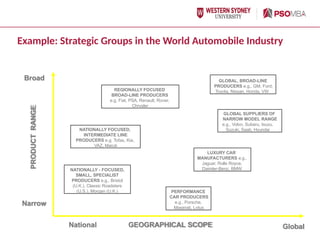
 Form strategic groups based on similar characteristics, similar assets/skills,
and similar competitive strategies (E.g. High, mid, low-end)
 Focus on those who-based on importance of market to you and
importance
of market to them-pose greatest threat, now or in foreseeable future
Competitor analysis: Identification
 Direct competitors
 Same good/service; are products competing for the
dollars?
same
 Latent competition
 Product superseded from an unexpected source
 Industry approach
 Understand the competitive patterns - they also undergo
constant change
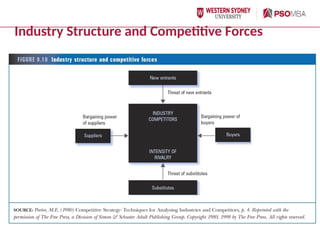
 Five (Competitive) forces model (Porter, 1980,1985)
Competitor analysis: Identification (Cont.)
 Industry structure is significant in international
competition
 Differing requirements for success
 Structural change creates opportunities
 Strategic moves; influence balance of forces;
strengthen
position; reposition; best use of capabilities
 Identify competitors from a market point of
view
 Serving the same group of customers; broad set
of actual and
potential competitors - latent demand
The targets of competitor analysis
Broad
PRODUCT
RANGE
Narrow
National GEOGRAPHICAL SCOPE Global
NATIONALLY - FOCUSED,
SMALL, SPECIALIST
PRODUCERS e.g., Bristol
(U.K.), Classic Roadsters
(U.S.), Morgan (U.K.)
NATIONALLY FOCUSED,
INTERMEDIATE LINE
PRODUCERS e.g. Tofas, Kia,
VAZ, Maruti
REGIONALLY FOCUSED
BROAD-LINE PRODUCERS
e.g. Fiat, PSA, Renault, Rover,
Chrysler
PERFORMANCE
CAR PRODUCERS
e.g., Porsche,
Maserati, Lotus
LUXURY CAR
MANUFACTURERS e.g.,
Jaguar, Rolls Royce,
Daimler-Benz, BMW
GLOBAL SUPPLIERS OF
NARROW MODEL RANGE
e.g., Volvo, Subaru, Isuzu,
Suzuki, Saab, Hyundai
GLOBAL, BROAD-LINE
PRODUCERS e.g., GM, Ford,
Toyota, Nissan, Honda, VW
Example: Strategic Groups in the World Automobile Industry
Industry Structure and Competitive Forces
Michael Porter’s Five Factor Model
○ Tool for evaluating the investment value of an industry or market.
○ Can be applied to an industry, market or sub-market
Porter and Millar’s Five Forces
Rivalry among existing
competitors
Competition among existing
competitors
Threat of new entrants New comers entering into the
current market
Threat of substitute products
or service
Firm offering alterative
products/service to the current
market
Bargaining power of buyers Buyer’s ability to influence your
products/service through their
power to make decision on the
transaction (E.g. price
negotiation)
Bargaining power of
suppliers
Supplier’s ability to provide their
products/services
Competitive forces of Vietnam Post
Rivalry among existing competitors
Threat of new entrants Alternative methods of message delivery - need to anticipate
Threat of substitute products or service SMS, email, facsimilie, telex, mesenger apps, etc.
Bargaining power of buyers Users may use couriers (pay more to be able to track letter),
a substitute product, or don’t send messages at all.
Bargaining power of suppliers Other mail systems outside Vietnam that supply letters for VP
to deliver.
Strategic Implications
● Competitive environment is unattractive from the
standpoint of earning good profits when
○ Rivalry is vigorous
○ Entry barriers are low and entry is likely
○ Competition from substitutes is strong
○ Suppliers and customers have considerable bargaining
power
Strategic Implications
● Competitive environment is ideal from a profit-
making standpoint when
○ Rivalry is moderate
○ Entry barriers are high and no firm is likely to enter
○ Good substitutes do not exist
○ Suppliers and customers are in a weak bargaining
position
● Example: Petrochemicals industry
Five Forces - Restaurant
VERY HIGH
VERY HIGH
● Threat New Entry
○ Small capital (~$50,000)
○ Can be run by a family
● Supplier Power
○ Real Estate controls all
● Buyer Power
○ Do you always go to the exact same
restaurant?
VERY HIGH
● Substitutes
○ How often does the average family
eat out?
VERY HIGH
● Rivalry
○ Why work together?
○ Fierce competition
VERY HIGH
● Profits???
Ouch! Not so good,
Many don’t survive
The components of competitor analysis
Competitor analysis: Objectives
● Determining competitors’ objectives
○ Identify what they seek
○ Their focus; mix of goals
○ Generic strategy
23
(e.g. Investing in building new
factory; shareholder values,
etc. )
Competitor analysis: Strategies
● Identifying competitors’ strategies
○ Similar strategies; degree of competitiveness; strategic groups
○ Enter or avoid strategic groups?
○ Develop competitive strategic advantage?
24
Competitor analysis: Resource profile
● Assessing competitors’ strengths & weaknesses
○ Assets & Capabilities
○ Historical performance
○ Secondary data, personal network
25
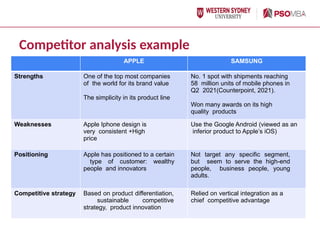
Competitor analysis example
APPLE SAMSUNG
Strengths One of the top most companies
of the world for its brand value
The simplicity in its product line
No. 1 spot with shipments reaching
58 million units of mobile phones in
Q2 2021(Counterpoint, 2021).
Won many awards on its high
quality products
Weaknesses Apple Iphone design is
very consistent +High
price
Use the Google Android (viewed as an
inferior product to Apple’s iOS)
Positioning Apple has positioned to a certain
type of customer: wealthy
people and innovators
Not target any specific segment,
but seem to serve the high-end
people, business people, young
adults.
Competitive strategy Based on product differentiation,
sustainable competitive
strategy, product innovation
Relied on vertical integration as a
chief competitive advantage
Competitor Selection
 Strong or weak competitors?
 Use customer value analysis
 Rank competitors by valued attributes
 Rank yourself against competitors
 Pricing strategies; or develop capabilities?
 Are they close or distant competitors?
 Most compete against companies that resemble
them
most
 Well behaved or disruptive competitors?
27
Tips
 Be sensitive to new competitive forms as they emerge
– don’t rely on historical data and process to guide
future actions even if profitable.
 Include more than primary competitors in analysis.
 Relate analysis to projected level of immediacy.
28
Tips (con’t)
 Assess competitors from consumer
perspective.
 What car would a buyer purchase if
Ferrari were not available?
 Assess competitors from product use
associations
 Ask consumers to identify ‘use contexts’ and nominate products
for each identified context. Then, cluster similar products
related to context.
29
Tool: Competitor Landscape Analysis
Cur. Probable Potential
Direct
competitors
A B C
Indirect
competitors
D E F
Competitor Landscape Analysis
HP Laptop
Cur. Probable Potential
A B C
Direct
competitors
Dell
IBM
Asu
s
App
le
Lenovo
Samsung
Microsoft
D E F
Indirect
competitors
Tablets
Netbook
Blackberry
Portable media
Smart phones ?
Tool: Substitutes Threat Assessment
Customer group:
Functions and Benefits
“What does my product help my
customers do? What benefits do they get
from my product?”
Potential Substitutes
“What are the other ways to fulfill the same
functions or obtain the same benefits?
Substitutes for FedEx Overnight Delivery
Functions and Benefits
“What does my product help
my customers do? What
benefits do they get from my
product?”
Potential Substitutes
“What are the other ways to fulfill the same functions
or obtain the same benefits?
Deliver non-sensitive documents Other
OD
services
(e.g.,
DHL)
Postal
Servic
e
Fax Email Web
postin
g
Deliver sensitive documents Other OD
services
Postal
Service
Certifie
d mail
X Encrypted
Email
X
Share datasets Other
OD
services
PS
Certifie
d mail
X Emai
l
FTP
Web
postin
g
Deliver parcels UPS Postal
Servic
e
X X X
Customer
group:
Professional practices
Substitutes for Unicef Greeting Cards
Functions and Benefits
“What does my product help my
customers do? What benefits
do they get from my product?”
Potential Substitutes
“What are the other ways to fulfill the same functions or
obtain the same benefits?
Feel socially responsible Buy
other
products
from
charitabl
e org.
Donation
s to
other
charities
Voluntee
r work
Buy
“green”
product
s
…
Keep in touch with friends Othe
r
cards
E-mail Phone call Visit …
Congratulate on happy news Othe
r
cards
Phone call Visit Send gift
or
flowers
…
Express support or sympathy Othe
r
cards
Phone call Visit Send
flower
s
…
Customer
group:
Older consumers
Empirical Approaches
● Identify competition based on what customers
choose or what they perceive. Insist on usage
context.
● Judgments of substitutability
(survey/interviews):
“ It’s 5:30 PM on Friday. You have a confidential price list to send to one
of your major customers located in another state by Monday
morning. Suppose that, for some reason, FedEx is not an option.
What would you do?”
Tool: Substitutability Worksheet
Order Customer 1 Customer 2 Customer 3
1
2
3
4
5
Score
10
8
6
4
2
Assessment of FedEx Substitutes
Order Customer 1 Customer 2 Customer 3 Weights
1 DHL EMS DHL 10
2 EMS Vietel Post EMS 8
3 EMAIL DHL UPS 6
4 FAX EMAIL EMAIL 4
5 Phone FAX FAX 2
DHL = 10 + 6 +10 = 26
UPS = 8 + 10 + 6 = 24
EMAIL = 6 + 4 + 2 = 12
Competitive Analysis Process
Competitiv
e
prediction
s
Competitive set
definition
Intelligenc
e
Gatherin
g
Intelligenc
e
analysis
Competitive
actions/reactions
39
Understanding the Competitors
Objectives and
Commitment
Image and
Positioning
Size, Growth
& Profitability
Current and Past
Strategies
Strengths and
Weaknesses
Cost Structure
Exit Barrriers
Organization and
Culture
Competitor Actions
II. Intelligence Gathering
● Consider broad list of intelligence sources
● Be efficient in intelligence gathering
● Beware of legal and ethical hazards
● Filter for reliability
● Intelligence gathering is a “two-way” street: Take appropriate protective
measures
Sources of competitor information
Sources of Competitive Intelligence
 Competitors’ annual reports
 Competitor’s speeches and public
announcements
 Competitor’s products
 Competitor’s web site
 Competitor’s customers: purchasing
agents, engineers, corporate officers
 Employment ads and head hunters
 Securities and Exchange Commission
filings
 Patent filings in US & overseas
 Government contract administration
● Banks
● Ad agencies
● Independent truck fleets
● Retailers
● Trade magazines
● Professional meetings: displays,
brochures, scientific papers
● Own personnel: executives, sales
force, engineers
● Industry observers: consultants,
stock analysts
● Newspapers (especially local)
● Creative observation
Efficient Intelligence Gathering
Assess what is already
known internally
Define what
you expect to
learn
Set priorities
Verify “Who else
needs it?”
Monitor competitor’s
transactions
Intelligence Filtering
● Cross-validate
● Pilot-test external sources
● Factor in ambiguity & reversibility
● Factor in trustworthiness of context
● Code for reliability:
○ rumor=1;  reliable = 2; fact =
3
Competitive Analysis Process
Competitiv
e
prediction
s
Competitive set
definition
Intelligenc
e
Gatherin
g
Intelligenc
e
analysis
Competitive
actions/reactio
ns
III. Principle of Intelligence Analysis
● Benchmarking
● Holistic interpretation
● The value chain
Competitive Benchmarking
Identify who to benchmark
against
Identify what aspects of
business to
benchmark
Collecting relevant data to
enable processes &
operations to be compared
Comparing with own
processes
Best-in-class, industry
leaders
All aspects of business,
value
chain
Published sources
(company reports), data
sharing, direct interviews
Compare &
contrast
Tool: Multi-Attribute Modeling
Criteria Weights Harvard
ratings
Duke
ratings
Columbia
ratings
Stanford
ratings
Brand Name 15% 10 6 8 10
Location 30% 7 4 10 6
Placement record 25% 9 7 8 8
Curriculum 10% 9 7 6 6
Latest Rankings 10% 9 7 7 6
Student profiles 10% 7 8 8 7
Holistic Interpretation
Help wanted ad:
C seeks
experienced
programmers
Sales force:
C is opening
sales offices
Rumor:
Prospects
approached by C
for test
marketing
Multiple UCC
filings for major
equipment
The Value Chain
● The ultimate goal of any business is to provide value
to its customers.
● A business will be profitable if the value it creates is
greater than the cost of producing its products or
services.
The Value Chain
Suppor
t
Activitie
s
Primary Activities
Inboun
d
Logistic
s
Operation
s
Outboun
d
Logistics
Marketin
g
&
Sales
Servic
e
Firm Infrastructure
Human Resource
Management
Technology
Development
Procurement
Porter (1985) identifies five primary activities that add value to the final output of a
company
The Value Chain
● An organisation’s value chain consists of nine
interrelated activities that collectively describe
everything it does.
● The five primary activities consist of the activities
performed in order to create, market, and deliver
products and services to customers and also to provide
post-sales services and support.
Exercise 1
Use provided Competitor Threat Landscape to discuss and
analyze your competitors of the chosen brand (20 min)
 Share your works with class (5 min each)
Note : Exercise worksheet downloaded from e-learning
Competitive Analysis Process
Competitiv
e
prediction
s
Competitive
set
definition
Intelligence
Gathering
Intelligenc
e
analysis
Competitive
actions/reactio
ns
IV. Competitive Prediction
To determine competitors’ response profiles – how a competitor might behave
when faced with various environmental and competitive changes.
• Is the competitor satisfied with the current position?
• What likely moves or strategy shifts will the competitor make?
• Where is the competitor vulnerable?
• What will provoke the greatest and most effective retaliation by
the competitor?
Predict competitors’ future strategies
Competitive Analysis Process
Competitive
predictions
Competitive
set
definition
Intelligence
Gathering
Intelligenc
e
analysis
Competitive
actions/reactio
ns
V. Competitive Actions/Reactions
 Formulate competitor-specific strategies
 Prepare competitor response profiles
 Play games: Select best course given competitor’s
probable actions and reactions
 Flesh out response options
 Change the rules of the game if unhealthy
Reactions
● Estimating competitors’ reactions
○ Cost based
○ Differentiation based
○ Use similar strategies?
62
Competi-
tors
Market Share Positions
Relative
Strengths
Relative
Weak-
nesses
Current
Objective
& Strategy
Future
Objectives
&
Prob
able
Strategy
Threats &
Opportu-
nities
Presented
Proposed
Strategy
Total
Market
Seg-
ment 1
Seg-
ment2
Seg-
ment 3
Seg-
ment 4
Cur. Cur. Cur. Cur. Cur.
Prev. Prev. Prev. Prev. Prev.
Cur. Cur. Cur. Cur. Cur.
Prev. Prev. Prev. Prev. Prev.
Cur. Cur. Cur. Cur. Cur.
Prev. Prev. Prev. Prev. Prev.
Cur. Cur. Cur. Cur. Cur.
Prev. Prev. Prev. Prev. Prev.
Tool: Competitive Summary
Assessment Template
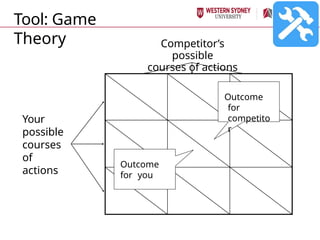
Tool: Game
Theory
Your
possible
courses
of
actions
Competitor’s
possible
courses of actions
Outcome
for
competito
r
Outcome
for you
“Prisoner’s
Dilemma”
Lower:
P=1,800
Lower:
P=1,800
Maintain:
P=2,000
Maintain:
P=2,000
A
B
50 (30,000)
50 (30,000)
50 (40,000)
50 (40,000)
80 (54,000)
20 (10,000)
20 (10,000)
B
A
VCU = 1,000
TFC = 10,000
Total market size =
100
A
B
80 (54,000)
Profit
Sales
B
A
B
A
Effects of Differentiation
Lower:
P=1,800
Lower:
P=1,800
A
Maintain:
P=2,000
Maintain:
P=2,000
B
50 (30,000) 40 (30,000)
A B A B
50 (30,000) 60 (38,000)
60 (38,000) 50 (40,000)
A B A B
40 (30,000) 50 (40,000)
VCU = 1,000
TFC = 10,000
Total market size = 100
Influencing Competitors
 Send market signals
 Play “tit-for-tat”
 Not unnecessarily aggressive
 Firm
 Clear
 Avoids over-reaction
 Forgiving
 Don’t be too greedy
 Hide under dominant brand’s
umbrella
 Limit pricing
 Educate
Market Signaling
 Form
 Prior announcement
 Announcement after the fact
 Discussion of own moves
 Public discussion of industry
 Purpose and Content
 Preemption
 Communicate strategic
advantage,
 Promote coordination
 Threat
 Minimize provocation
Flesh Out the Response
● Should we respond?
● How should we respond?
○ What type?
○ How aggressively?
○ In kind or not in kind?
○ In which market or territory?
● When should we respond?
● For how long?
Example: Response Options toward New Entrants
Source: Gatignon, H. & D. Reibstein (1997)
Learning from competitors
Customer or competitors orientation?
Competitor Oriented Company
 A company whose moves are mainly based on competitors’ actions
and reactions
Customer Oriented Company
 A company that focuses on customer developments in designing its
marketing strategies
Market Oriented Company
 A company that pays balanced attention to both customers and
competitors in designing its marketing strategies
72
Evolving Company Orientations
Market Orientation
 The market and the customers that form the market
should be the starting point in formulating the overall
business strategy.
 Market Orientation:
“the organisational culture that most effectively and efficiently creates the necessary
behaviours for the creation of superior value for buyers and, thus, continues superior
performance for the business (Narver and Slater, 1990).”
Conclusions-I
 Two types of competitor identification methods
 Structured judgment
 Empirical identification based on actual problem-solving and choice
 Numerous sources of competitive intelligence. Be
efficient in searching them: set expectations,
specificity, priority, etc.
 Important step in competitive analysis is intelligence
filtering
Conclusions-II
 Intelligence gathering does not mean breaking the law
 Intelligence gathering is a two-way street. Perform
a risk analysis. Make protective measures
simple
 Key analysis principles: (1) elaborate, (2) use
benchmarks, (3) decompose, and (4) look for the big
picture
Conclusions-III
 Don’t just react to competitor moves, anticipate them
 Don’t just anticipate competitor moves, try to dictate
them
 Use game theory as a tool to model competitive
interactions
 Strategies for playing competitive game:
 Tit-for-tat
 Competitor education
 Changing the rules
Conclusions-IV
● Always compute the break-even before changing price
as a competitive move
● Make sure that you are indeed playing the same game,
that is, playing by the same rules

Competitor insights (Class version).pptx

  • 1.
  • 2.
    Value Creation, ValueDelivery, alue Communication, & Value Extraction Program Design Strategic Market Planning Model Company Insights Customer Insights Competitor Insights Segmentation Insights Opportunity Assessment & Targeting Objectives & Strategic Focus Positioning Executio Budgeting Market Insight Strategy Development Macro-Analysis Micro-Analysis
  • 3.
    3 It Begins WithKnowledge “Knowing the other and knowing oneself, In one hundred battles no danger. Not knowing the other and knowing oneself, One victory for one loss. Not knowing the other and not knowing oneself, In every battle certain defeat.” Sun Tzu 300 BC
  • 4.
    “In business, thecompetition will bite you if you keep running, if you stand still, they will swallow you.” - William Knudsen
  • 5.
    Competitive Analysis Process Competitiv e prediction s Competitive set definition Intelligence Gathering Intelligence analysis Competitive actions/reactio ns Hypercompetitive environments means that organisations shouldn’t be complacent about competition. Need to identify threats, opportunities & strategic uncertainties relating to observed and potential competitors.
  • 7.
    Competitive Analysis Process Competitiv e prediction s Competitiveset definition Intelligenc e Gatherin g Intelligenc e analysis Competitive actions/reactions
  • 8.
    Who are thecompetitors? (1) Brand competitors market products with similar features and benefits to the same customers at similar prices. (2) Product competitors compete in the same product class, but their products have different features, benefits, and prices. (3) Generic competitors provide very different products that solve the same problem or satisfy the same basic customer need.
  • 9.
    Brand competition • Premium market: Budweiser, Corona Carlsberg,Tiger, Heineken, San Miguel • Mainstream market: Saigon, 333, Hanoi Product competition • All beer manufacturers including low- end markets • Other alcohol products like wine • Non-alcohol products: Soft- drinks and tea Generic and total budget competition • Other indulgences like tap water, food, clothes, footwear, etc. which represent share of wallet competition. Specific market- level competitio n Generic industry- level competition Competitive intensity decreases as competition becomes less direct
  • 10.
    Identify Competitive Set Judgment-based identification: More subjective, but inexpensive and future oriented  Data-based identification: More objective, but present-oriented and potentially expensive  Form strategic groups based on similar characteristics, similar assets/skills, and similar competitive strategies (E.g. High, mid, low-end)  Focus on those who-based on importance of market to you and importance of market to them-pose greatest threat, now or in foreseeable future
  • 11.
    Competitor analysis: Identification Direct competitors  Same good/service; are products competing for the dollars? same  Latent competition  Product superseded from an unexpected source  Industry approach  Understand the competitive patterns - they also undergo constant change  Five (Competitive) forces model (Porter, 1980,1985)
  • 12.
    Competitor analysis: Identification(Cont.)  Industry structure is significant in international competition  Differing requirements for success  Structural change creates opportunities  Strategic moves; influence balance of forces; strengthen position; reposition; best use of capabilities  Identify competitors from a market point of view  Serving the same group of customers; broad set of actual and potential competitors - latent demand
  • 13.
    The targets ofcompetitor analysis
  • 14.
    Broad PRODUCT RANGE Narrow National GEOGRAPHICAL SCOPEGlobal NATIONALLY - FOCUSED, SMALL, SPECIALIST PRODUCERS e.g., Bristol (U.K.), Classic Roadsters (U.S.), Morgan (U.K.) NATIONALLY FOCUSED, INTERMEDIATE LINE PRODUCERS e.g. Tofas, Kia, VAZ, Maruti REGIONALLY FOCUSED BROAD-LINE PRODUCERS e.g. Fiat, PSA, Renault, Rover, Chrysler PERFORMANCE CAR PRODUCERS e.g., Porsche, Maserati, Lotus LUXURY CAR MANUFACTURERS e.g., Jaguar, Rolls Royce, Daimler-Benz, BMW GLOBAL SUPPLIERS OF NARROW MODEL RANGE e.g., Volvo, Subaru, Isuzu, Suzuki, Saab, Hyundai GLOBAL, BROAD-LINE PRODUCERS e.g., GM, Ford, Toyota, Nissan, Honda, VW Example: Strategic Groups in the World Automobile Industry
  • 15.
    Industry Structure andCompetitive Forces
  • 16.
    Michael Porter’s FiveFactor Model ○ Tool for evaluating the investment value of an industry or market. ○ Can be applied to an industry, market or sub-market
  • 17.
    Porter and Millar’sFive Forces Rivalry among existing competitors Competition among existing competitors Threat of new entrants New comers entering into the current market Threat of substitute products or service Firm offering alterative products/service to the current market Bargaining power of buyers Buyer’s ability to influence your products/service through their power to make decision on the transaction (E.g. price negotiation) Bargaining power of suppliers Supplier’s ability to provide their products/services
  • 18.
    Competitive forces ofVietnam Post Rivalry among existing competitors Threat of new entrants Alternative methods of message delivery - need to anticipate Threat of substitute products or service SMS, email, facsimilie, telex, mesenger apps, etc. Bargaining power of buyers Users may use couriers (pay more to be able to track letter), a substitute product, or don’t send messages at all. Bargaining power of suppliers Other mail systems outside Vietnam that supply letters for VP to deliver.
  • 19.
    Strategic Implications ● Competitiveenvironment is unattractive from the standpoint of earning good profits when ○ Rivalry is vigorous ○ Entry barriers are low and entry is likely ○ Competition from substitutes is strong ○ Suppliers and customers have considerable bargaining power
  • 20.
    Strategic Implications ● Competitiveenvironment is ideal from a profit- making standpoint when ○ Rivalry is moderate ○ Entry barriers are high and no firm is likely to enter ○ Good substitutes do not exist ○ Suppliers and customers are in a weak bargaining position ● Example: Petrochemicals industry
  • 21.
    Five Forces -Restaurant VERY HIGH VERY HIGH ● Threat New Entry ○ Small capital (~$50,000) ○ Can be run by a family ● Supplier Power ○ Real Estate controls all ● Buyer Power ○ Do you always go to the exact same restaurant? VERY HIGH ● Substitutes ○ How often does the average family eat out? VERY HIGH ● Rivalry ○ Why work together? ○ Fierce competition VERY HIGH ● Profits??? Ouch! Not so good, Many don’t survive
  • 22.
    The components ofcompetitor analysis
  • 23.
    Competitor analysis: Objectives ●Determining competitors’ objectives ○ Identify what they seek ○ Their focus; mix of goals ○ Generic strategy 23 (e.g. Investing in building new factory; shareholder values, etc. )
  • 24.
    Competitor analysis: Strategies ●Identifying competitors’ strategies ○ Similar strategies; degree of competitiveness; strategic groups ○ Enter or avoid strategic groups? ○ Develop competitive strategic advantage? 24
  • 25.
    Competitor analysis: Resourceprofile ● Assessing competitors’ strengths & weaknesses ○ Assets & Capabilities ○ Historical performance ○ Secondary data, personal network 25
  • 26.
    Competitor analysis example APPLESAMSUNG Strengths One of the top most companies of the world for its brand value The simplicity in its product line No. 1 spot with shipments reaching 58 million units of mobile phones in Q2 2021(Counterpoint, 2021). Won many awards on its high quality products Weaknesses Apple Iphone design is very consistent +High price Use the Google Android (viewed as an inferior product to Apple’s iOS) Positioning Apple has positioned to a certain type of customer: wealthy people and innovators Not target any specific segment, but seem to serve the high-end people, business people, young adults. Competitive strategy Based on product differentiation, sustainable competitive strategy, product innovation Relied on vertical integration as a chief competitive advantage
  • 27.
    Competitor Selection  Strongor weak competitors?  Use customer value analysis  Rank competitors by valued attributes  Rank yourself against competitors  Pricing strategies; or develop capabilities?  Are they close or distant competitors?  Most compete against companies that resemble them most  Well behaved or disruptive competitors? 27
  • 28.
    Tips  Be sensitiveto new competitive forms as they emerge – don’t rely on historical data and process to guide future actions even if profitable.  Include more than primary competitors in analysis.  Relate analysis to projected level of immediacy. 28
  • 29.
    Tips (con’t)  Assesscompetitors from consumer perspective.  What car would a buyer purchase if Ferrari were not available?  Assess competitors from product use associations  Ask consumers to identify ‘use contexts’ and nominate products for each identified context. Then, cluster similar products related to context. 29
  • 30.
    Tool: Competitor LandscapeAnalysis Cur. Probable Potential Direct competitors A B C Indirect competitors D E F
  • 31.
    Competitor Landscape Analysis HPLaptop Cur. Probable Potential A B C Direct competitors Dell IBM Asu s App le Lenovo Samsung Microsoft D E F Indirect competitors Tablets Netbook Blackberry Portable media Smart phones ?
  • 32.
    Tool: Substitutes ThreatAssessment Customer group: Functions and Benefits “What does my product help my customers do? What benefits do they get from my product?” Potential Substitutes “What are the other ways to fulfill the same functions or obtain the same benefits?
  • 33.
    Substitutes for FedExOvernight Delivery Functions and Benefits “What does my product help my customers do? What benefits do they get from my product?” Potential Substitutes “What are the other ways to fulfill the same functions or obtain the same benefits? Deliver non-sensitive documents Other OD services (e.g., DHL) Postal Servic e Fax Email Web postin g Deliver sensitive documents Other OD services Postal Service Certifie d mail X Encrypted Email X Share datasets Other OD services PS Certifie d mail X Emai l FTP Web postin g Deliver parcels UPS Postal Servic e X X X Customer group: Professional practices
  • 34.
    Substitutes for UnicefGreeting Cards Functions and Benefits “What does my product help my customers do? What benefits do they get from my product?” Potential Substitutes “What are the other ways to fulfill the same functions or obtain the same benefits? Feel socially responsible Buy other products from charitabl e org. Donation s to other charities Voluntee r work Buy “green” product s … Keep in touch with friends Othe r cards E-mail Phone call Visit … Congratulate on happy news Othe r cards Phone call Visit Send gift or flowers … Express support or sympathy Othe r cards Phone call Visit Send flower s … Customer group: Older consumers
  • 35.
    Empirical Approaches ● Identifycompetition based on what customers choose or what they perceive. Insist on usage context. ● Judgments of substitutability (survey/interviews): “ It’s 5:30 PM on Friday. You have a confidential price list to send to one of your major customers located in another state by Monday morning. Suppose that, for some reason, FedEx is not an option. What would you do?”
  • 36.
    Tool: Substitutability Worksheet OrderCustomer 1 Customer 2 Customer 3 1 2 3 4 5 Score 10 8 6 4 2
  • 37.
    Assessment of FedExSubstitutes Order Customer 1 Customer 2 Customer 3 Weights 1 DHL EMS DHL 10 2 EMS Vietel Post EMS 8 3 EMAIL DHL UPS 6 4 FAX EMAIL EMAIL 4 5 Phone FAX FAX 2 DHL = 10 + 6 +10 = 26 UPS = 8 + 10 + 6 = 24 EMAIL = 6 + 4 + 2 = 12
  • 38.
    Competitive Analysis Process Competitiv e prediction s Competitiveset definition Intelligenc e Gatherin g Intelligenc e analysis Competitive actions/reactions
  • 39.
    39 Understanding the Competitors Objectivesand Commitment Image and Positioning Size, Growth & Profitability Current and Past Strategies Strengths and Weaknesses Cost Structure Exit Barrriers Organization and Culture Competitor Actions
  • 40.
    II. Intelligence Gathering ●Consider broad list of intelligence sources ● Be efficient in intelligence gathering ● Beware of legal and ethical hazards ● Filter for reliability ● Intelligence gathering is a “two-way” street: Take appropriate protective measures
  • 41.
  • 42.
    Sources of CompetitiveIntelligence  Competitors’ annual reports  Competitor’s speeches and public announcements  Competitor’s products  Competitor’s web site  Competitor’s customers: purchasing agents, engineers, corporate officers  Employment ads and head hunters  Securities and Exchange Commission filings  Patent filings in US & overseas  Government contract administration ● Banks ● Ad agencies ● Independent truck fleets ● Retailers ● Trade magazines ● Professional meetings: displays, brochures, scientific papers ● Own personnel: executives, sales force, engineers ● Industry observers: consultants, stock analysts ● Newspapers (especially local) ● Creative observation
  • 43.
    Efficient Intelligence Gathering Assesswhat is already known internally Define what you expect to learn Set priorities Verify “Who else needs it?” Monitor competitor’s transactions
  • 44.
    Intelligence Filtering ● Cross-validate ●Pilot-test external sources ● Factor in ambiguity & reversibility ● Factor in trustworthiness of context ● Code for reliability: ○ rumor=1;  reliable = 2; fact = 3
  • 45.
    Competitive Analysis Process Competitiv e prediction s Competitiveset definition Intelligenc e Gatherin g Intelligenc e analysis Competitive actions/reactio ns
  • 46.
    III. Principle ofIntelligence Analysis ● Benchmarking ● Holistic interpretation ● The value chain
  • 47.
    Competitive Benchmarking Identify whoto benchmark against Identify what aspects of business to benchmark Collecting relevant data to enable processes & operations to be compared Comparing with own processes Best-in-class, industry leaders All aspects of business, value chain Published sources (company reports), data sharing, direct interviews Compare & contrast
  • 49.
    Tool: Multi-Attribute Modeling CriteriaWeights Harvard ratings Duke ratings Columbia ratings Stanford ratings Brand Name 15% 10 6 8 10 Location 30% 7 4 10 6 Placement record 25% 9 7 8 8 Curriculum 10% 9 7 6 6 Latest Rankings 10% 9 7 7 6 Student profiles 10% 7 8 8 7
  • 50.
    Holistic Interpretation Help wantedad: C seeks experienced programmers Sales force: C is opening sales offices Rumor: Prospects approached by C for test marketing Multiple UCC filings for major equipment
  • 51.
    The Value Chain ●The ultimate goal of any business is to provide value to its customers. ● A business will be profitable if the value it creates is greater than the cost of producing its products or services.
  • 52.
    The Value Chain Suppor t Activitie s PrimaryActivities Inboun d Logistic s Operation s Outboun d Logistics Marketin g & Sales Servic e Firm Infrastructure Human Resource Management Technology Development Procurement Porter (1985) identifies five primary activities that add value to the final output of a company
  • 53.
    The Value Chain ●An organisation’s value chain consists of nine interrelated activities that collectively describe everything it does. ● The five primary activities consist of the activities performed in order to create, market, and deliver products and services to customers and also to provide post-sales services and support.
  • 54.
    Exercise 1 Use providedCompetitor Threat Landscape to discuss and analyze your competitors of the chosen brand (20 min)  Share your works with class (5 min each) Note : Exercise worksheet downloaded from e-learning
  • 55.
  • 56.
    IV. Competitive Prediction Todetermine competitors’ response profiles – how a competitor might behave when faced with various environmental and competitive changes. • Is the competitor satisfied with the current position? • What likely moves or strategy shifts will the competitor make? • Where is the competitor vulnerable? • What will provoke the greatest and most effective retaliation by the competitor?
  • 57.
  • 58.
  • 59.
    V. Competitive Actions/Reactions Formulate competitor-specific strategies  Prepare competitor response profiles  Play games: Select best course given competitor’s probable actions and reactions  Flesh out response options  Change the rules of the game if unhealthy
  • 60.
    Reactions ● Estimating competitors’reactions ○ Cost based ○ Differentiation based ○ Use similar strategies? 62
  • 61.
    Competi- tors Market Share Positions Relative Strengths Relative Weak- nesses Current Objective &Strategy Future Objectives & Prob able Strategy Threats & Opportu- nities Presented Proposed Strategy Total Market Seg- ment 1 Seg- ment2 Seg- ment 3 Seg- ment 4 Cur. Cur. Cur. Cur. Cur. Prev. Prev. Prev. Prev. Prev. Cur. Cur. Cur. Cur. Cur. Prev. Prev. Prev. Prev. Prev. Cur. Cur. Cur. Cur. Cur. Prev. Prev. Prev. Prev. Prev. Cur. Cur. Cur. Cur. Cur. Prev. Prev. Prev. Prev. Prev. Tool: Competitive Summary Assessment Template
  • 62.
  • 63.
    “Prisoner’s Dilemma” Lower: P=1,800 Lower: P=1,800 Maintain: P=2,000 Maintain: P=2,000 A B 50 (30,000) 50 (30,000) 50(40,000) 50 (40,000) 80 (54,000) 20 (10,000) 20 (10,000) B A VCU = 1,000 TFC = 10,000 Total market size = 100 A B 80 (54,000) Profit Sales B A B A
  • 64.
    Effects of Differentiation Lower: P=1,800 Lower: P=1,800 A Maintain: P=2,000 Maintain: P=2,000 B 50(30,000) 40 (30,000) A B A B 50 (30,000) 60 (38,000) 60 (38,000) 50 (40,000) A B A B 40 (30,000) 50 (40,000) VCU = 1,000 TFC = 10,000 Total market size = 100
  • 65.
    Influencing Competitors  Sendmarket signals  Play “tit-for-tat”  Not unnecessarily aggressive  Firm  Clear  Avoids over-reaction  Forgiving  Don’t be too greedy  Hide under dominant brand’s umbrella  Limit pricing  Educate
  • 66.
    Market Signaling  Form Prior announcement  Announcement after the fact  Discussion of own moves  Public discussion of industry  Purpose and Content  Preemption  Communicate strategic advantage,  Promote coordination  Threat  Minimize provocation
  • 67.
    Flesh Out theResponse ● Should we respond? ● How should we respond? ○ What type? ○ How aggressively? ○ In kind or not in kind? ○ In which market or territory? ● When should we respond? ● For how long?
  • 68.
    Example: Response Optionstoward New Entrants Source: Gatignon, H. & D. Reibstein (1997)
  • 69.
  • 70.
    Customer or competitorsorientation? Competitor Oriented Company  A company whose moves are mainly based on competitors’ actions and reactions Customer Oriented Company  A company that focuses on customer developments in designing its marketing strategies Market Oriented Company  A company that pays balanced attention to both customers and competitors in designing its marketing strategies 72
  • 71.
  • 72.
    Market Orientation  Themarket and the customers that form the market should be the starting point in formulating the overall business strategy.  Market Orientation: “the organisational culture that most effectively and efficiently creates the necessary behaviours for the creation of superior value for buyers and, thus, continues superior performance for the business (Narver and Slater, 1990).”
  • 73.
    Conclusions-I  Two typesof competitor identification methods  Structured judgment  Empirical identification based on actual problem-solving and choice  Numerous sources of competitive intelligence. Be efficient in searching them: set expectations, specificity, priority, etc.  Important step in competitive analysis is intelligence filtering
  • 74.
    Conclusions-II  Intelligence gatheringdoes not mean breaking the law  Intelligence gathering is a two-way street. Perform a risk analysis. Make protective measures simple  Key analysis principles: (1) elaborate, (2) use benchmarks, (3) decompose, and (4) look for the big picture
  • 75.
    Conclusions-III  Don’t justreact to competitor moves, anticipate them  Don’t just anticipate competitor moves, try to dictate them  Use game theory as a tool to model competitive interactions  Strategies for playing competitive game:  Tit-for-tat  Competitor education  Changing the rules
  • 76.
    Conclusions-IV ● Always computethe break-even before changing price as a competitive move ● Make sure that you are indeed playing the same game, that is, playing by the same rules

Editor's Notes

  • #56 Ex:
  • #63 Tc+10000 Fc=50000 Revenue+50*1800=90000 Profit = 90000-50000-10000=30000
  • #65 Tit4tat= trả đũa