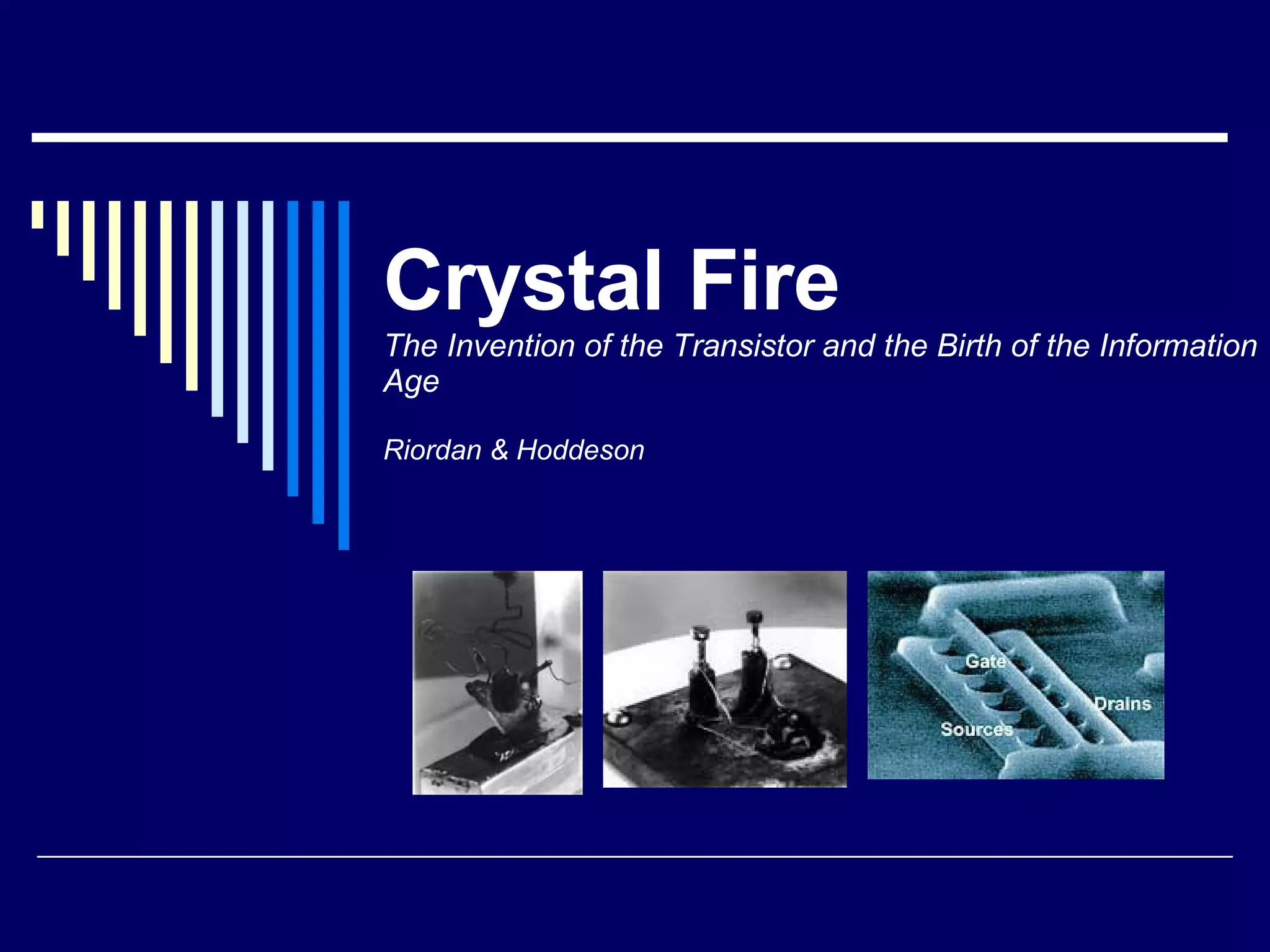
Crystal Fire The Invention of the Transistor and the Birth of the Information Age Riordan & Hoddeson
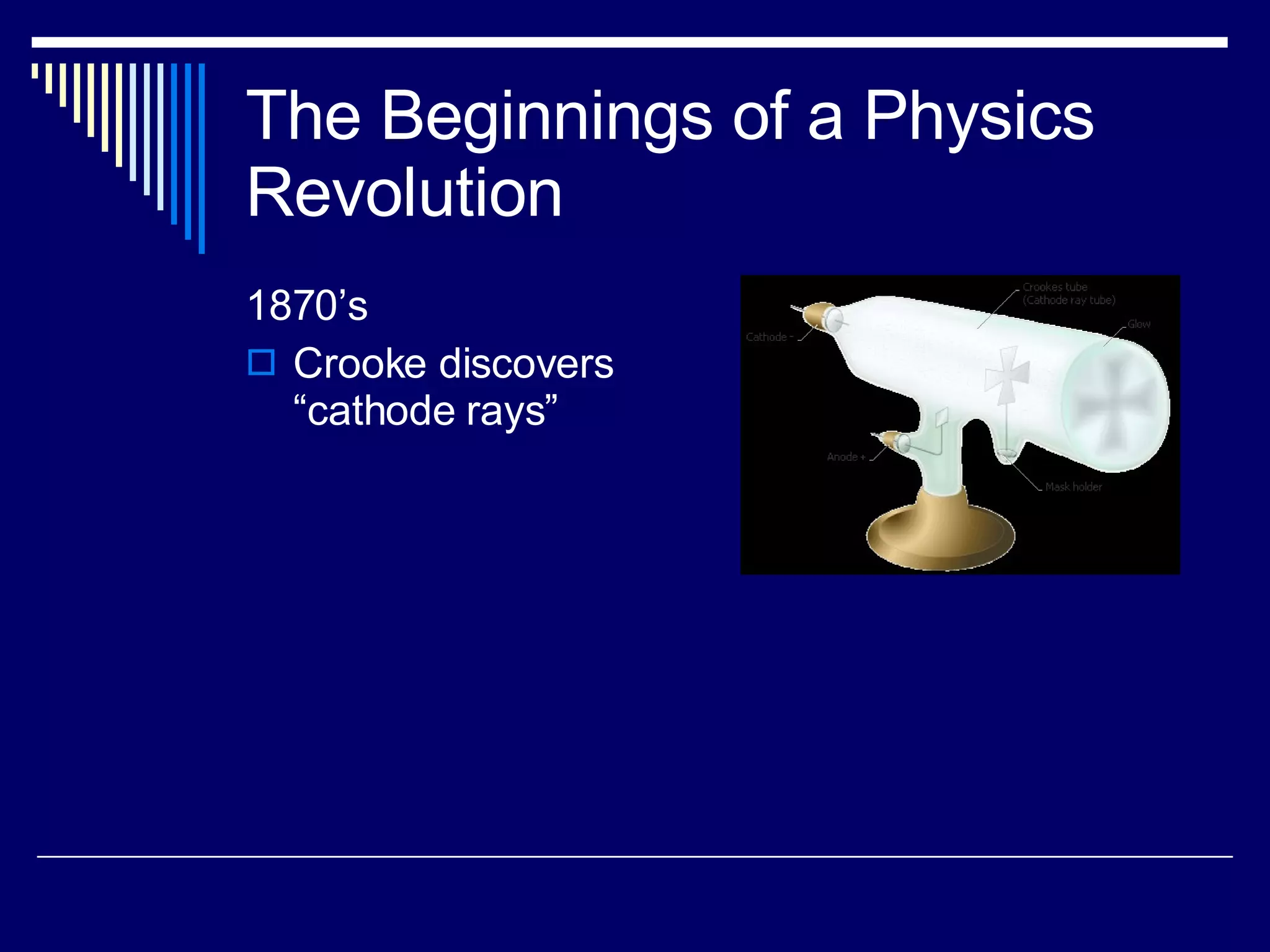
The Beginnings of a Physics Revolution 1870’s Crooke discovers “cathode rays”
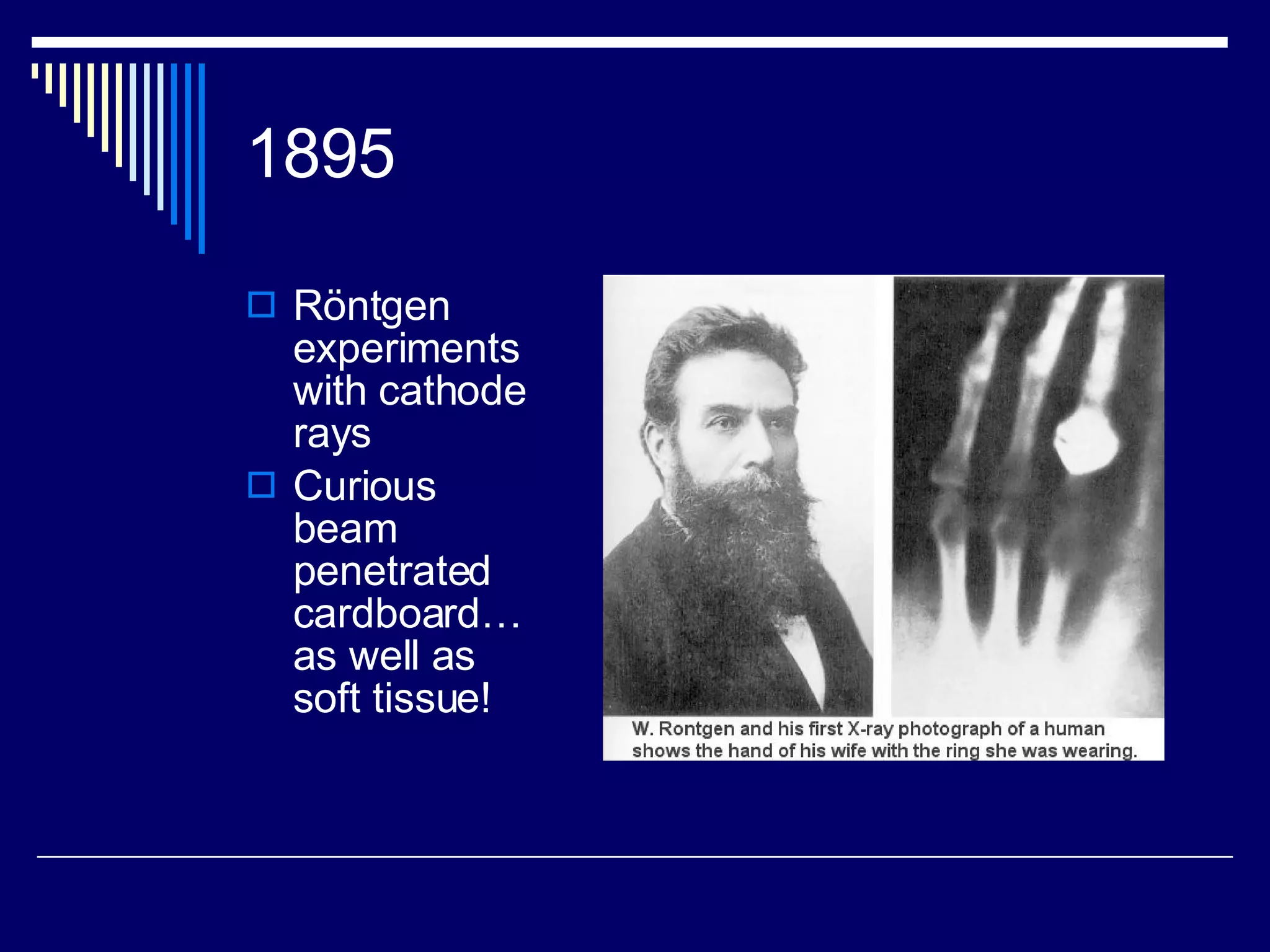
1895 R öntgen experiments with cathode rays Curious beam penetrated cardboard…as well as soft tissue!
1899 Thomson discovers the electron (corpuscle) in his experimentation with cathode ray tubes Electrons are  particles , 1/1000 th  as massive as a hydrogen ion
1900 Max Planck proposed quantization of energy to help explain blackbody radiation Energy is emitted in discrete bundles or packets and can be determined by E = hf
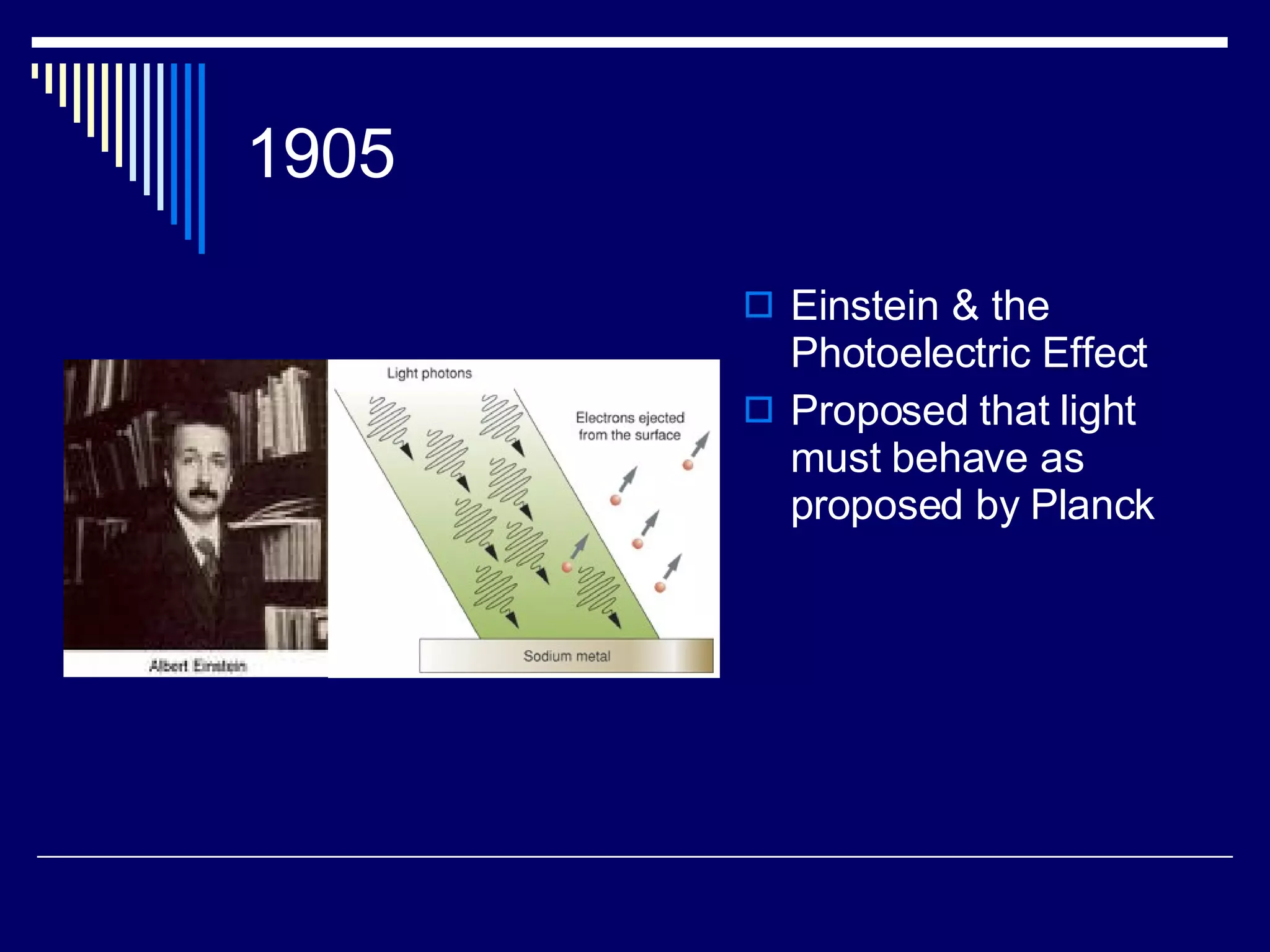
1905 Einstein & the Photoelectric Effect Proposed that light must behave as proposed by Planck
1909 Rutherford performs gold foil experiment “ It was almost as if you fired a fifteen-inch shell at a piece of tissue paper  and it came back and hit you!” But this new model came with a new problem…
Proposed solution by Bohr 1913 Electrons occupy orbitals of quantized energy. Sommerfeld proposed the possiblitiy of elliptical orbitals and quantized angular momentum
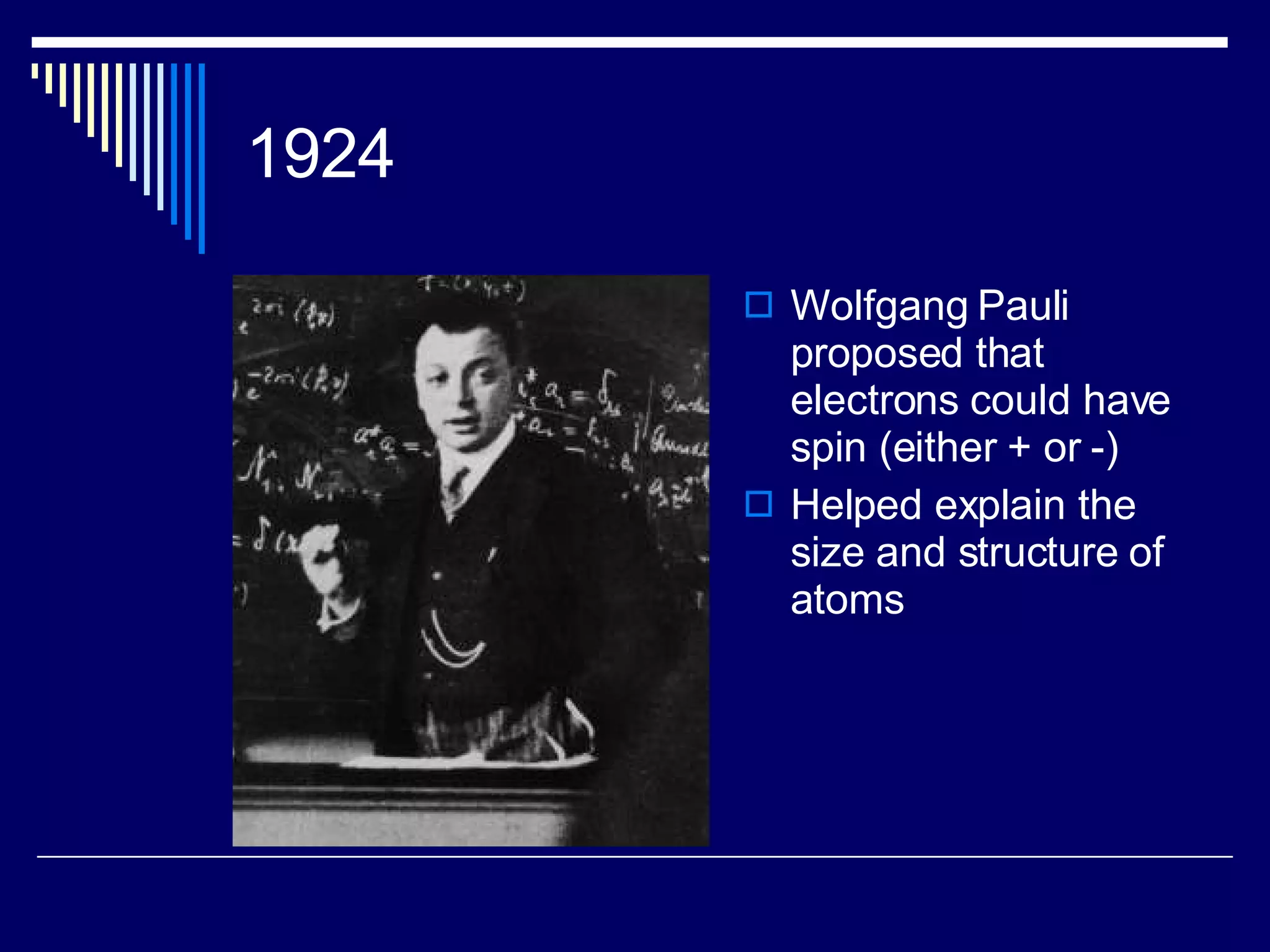
1924 Wolfgang Pauli proposed that electrons could have spin (either + or -) Helped explain the size and structure of atoms
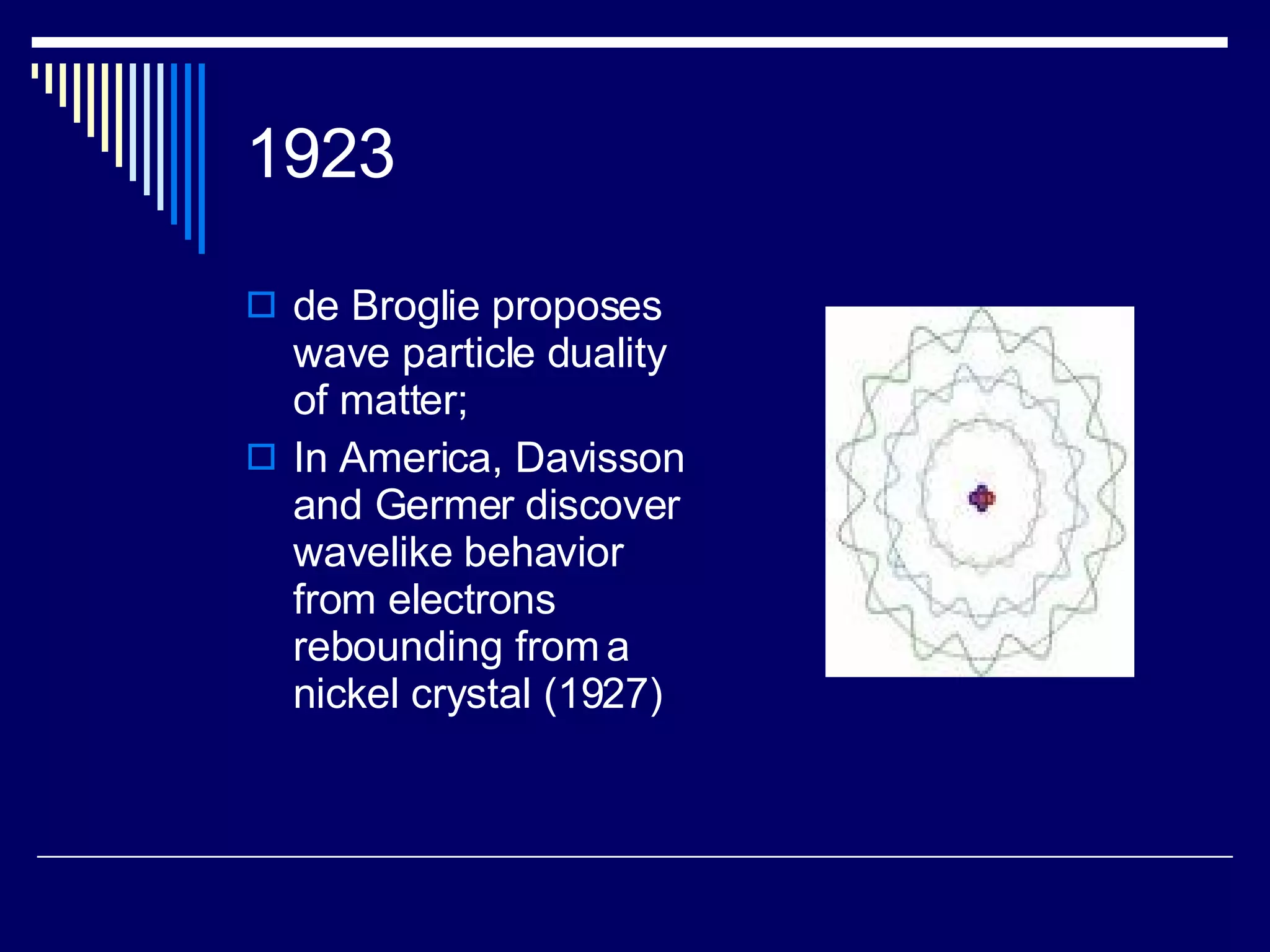
1923 de Broglie proposes wave particle duality of matter;  In America, Davisson and Germer discover wavelike behavior from electrons rebounding from a nickel crystal (1927)
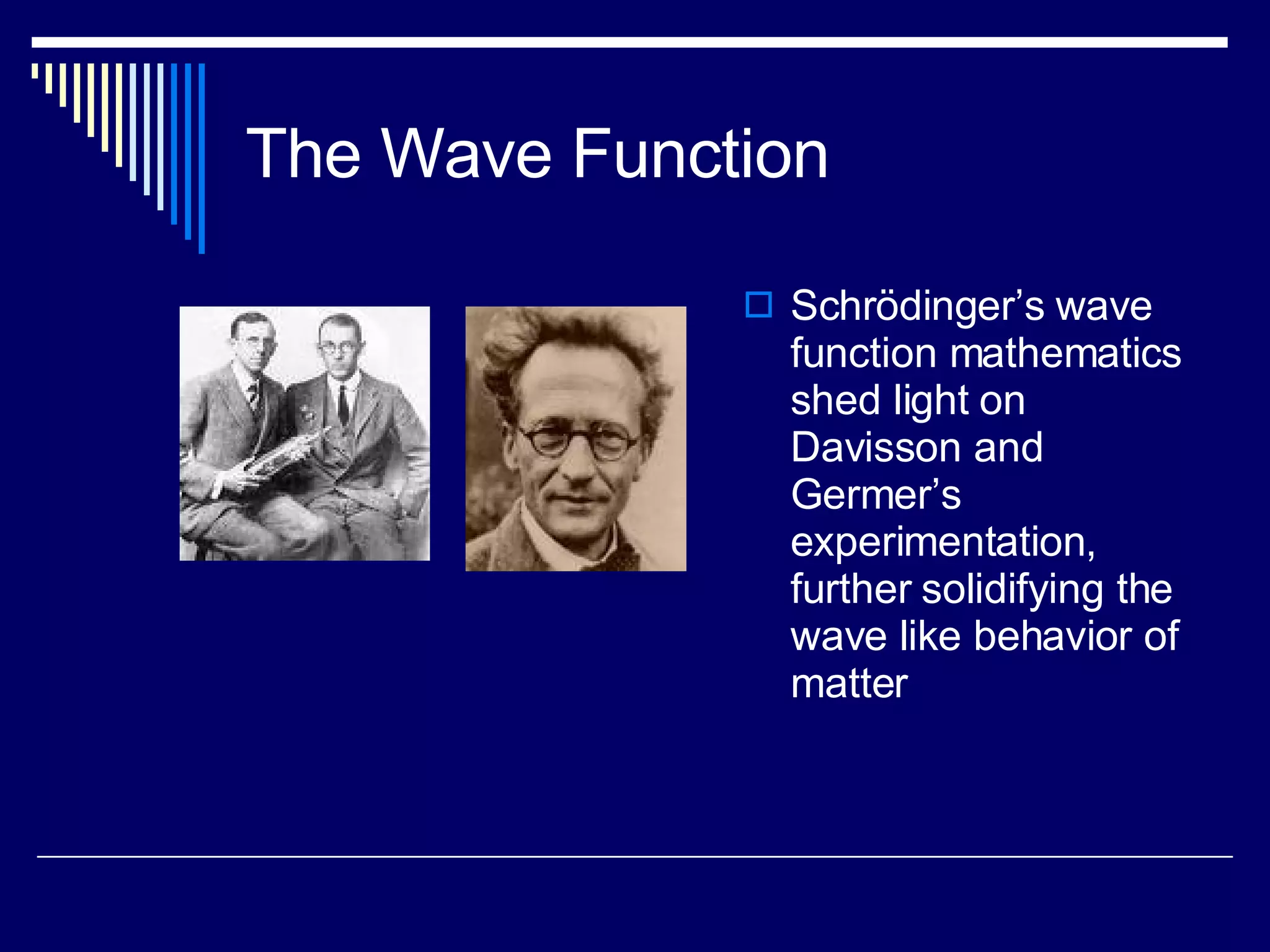
The Wave Function Schr ödinger’s wave function mathematics shed light on Davisson and Germer’s experimentation, further solidifying the wave like behavior of matter
In less than 30 years… Quantum physics was born The model of the atom changed drastically  Matter and light are both proposed to behave like waves and particles
John Bardeen Born in Wisconsin (1908) Unusually bright, “John is the concentrated essence of brain”, wrote his mother Fascinated with crystal radios
A Simple Crystal Radio
John Bardeen Mother died of breast cancer early in his life Finished University High at the age of 14. Took additional year of studies in physics and mathematics at Madison Central High School
Walter Brattain Born in China (1902) Spent most of childhood in Washington Outdoorsman and sharpshooter Educated at the Moran School
William Shockley Born in Europe (1910) Temperamental child Educated at the Palo Alto Military Academy Finished High School at Hollywood High
Bell Laboratories
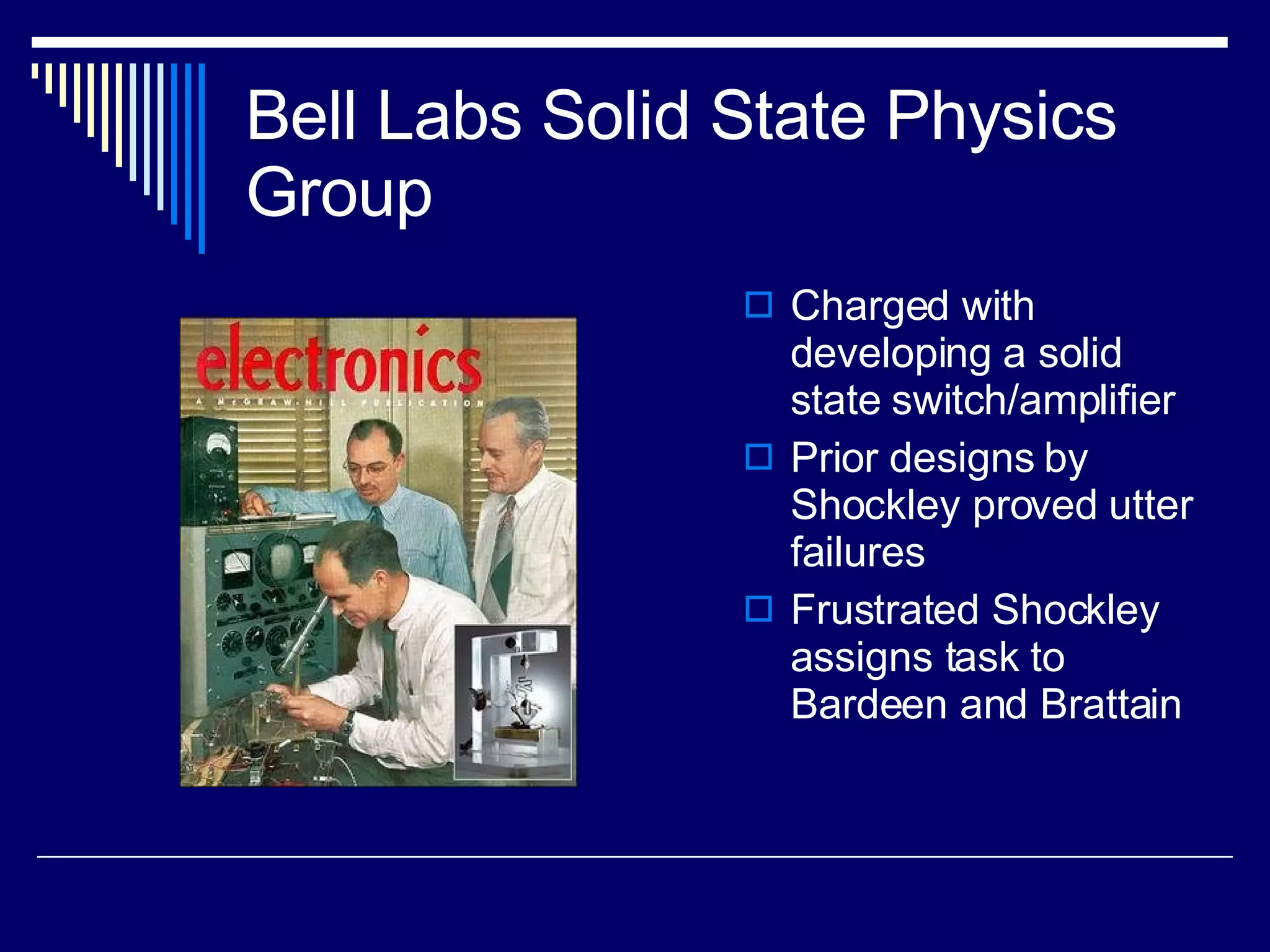
Bell Labs Solid State Physics Group Charged with developing a solid state switch/amplifier Prior designs by Shockley proved utter failures Frustrated Shockley assigns task to Bardeen and Brattain
Point-Contact Transistor
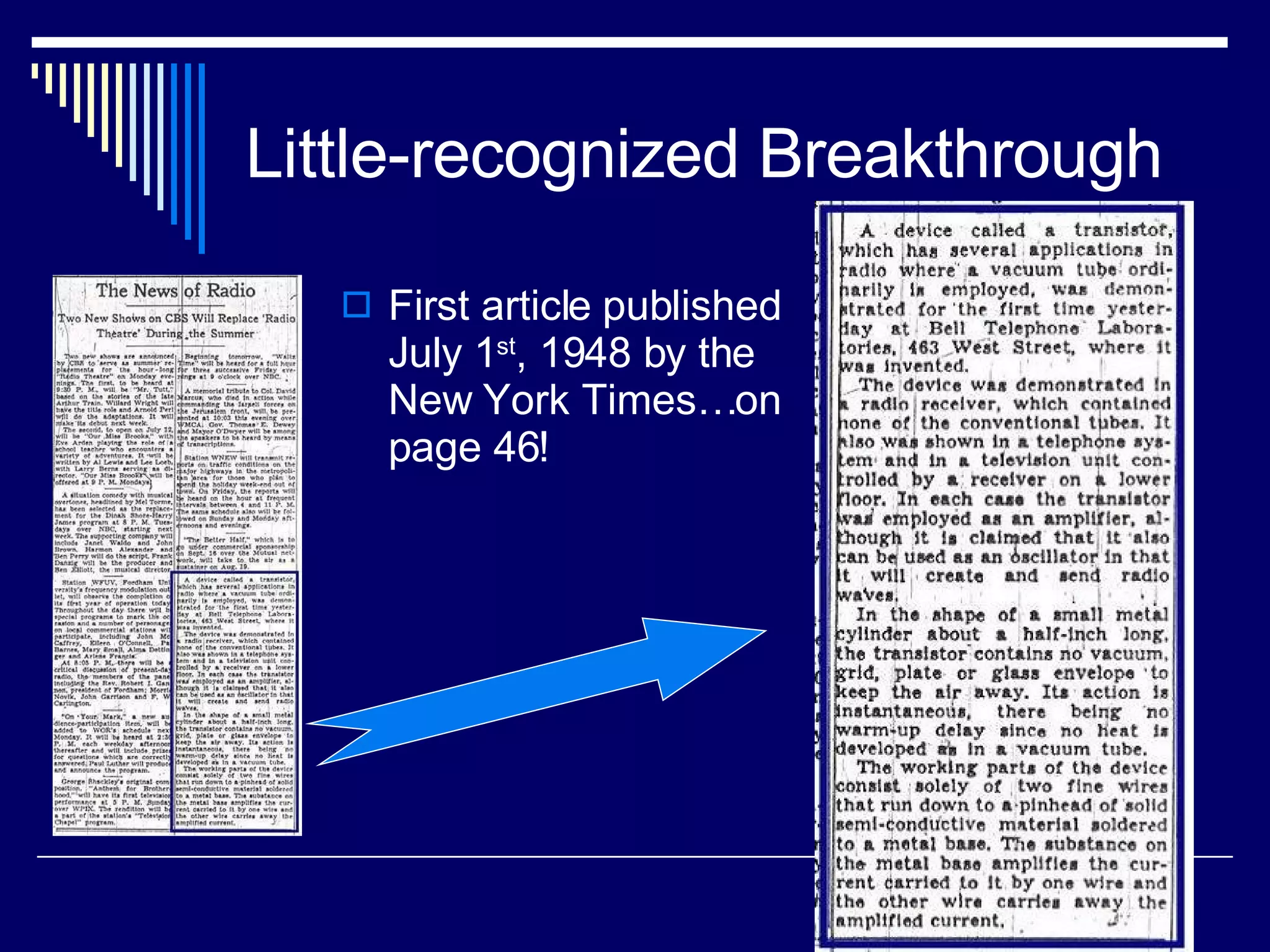
Little-recognized Breakthrough First article published July 1 st , 1948 by the New York Times…on page 46!
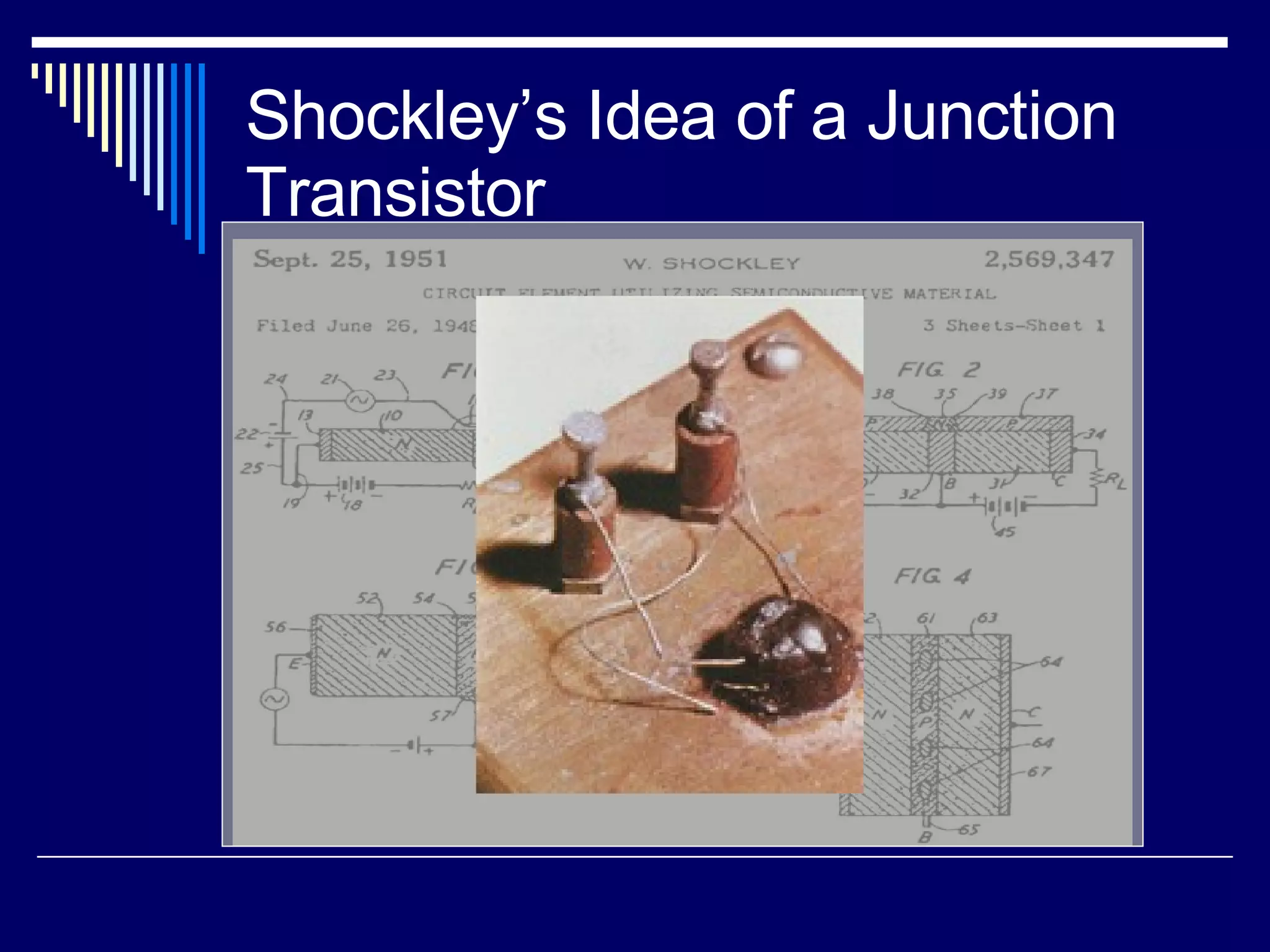
Shockley’s Idea of a Junction Transistor
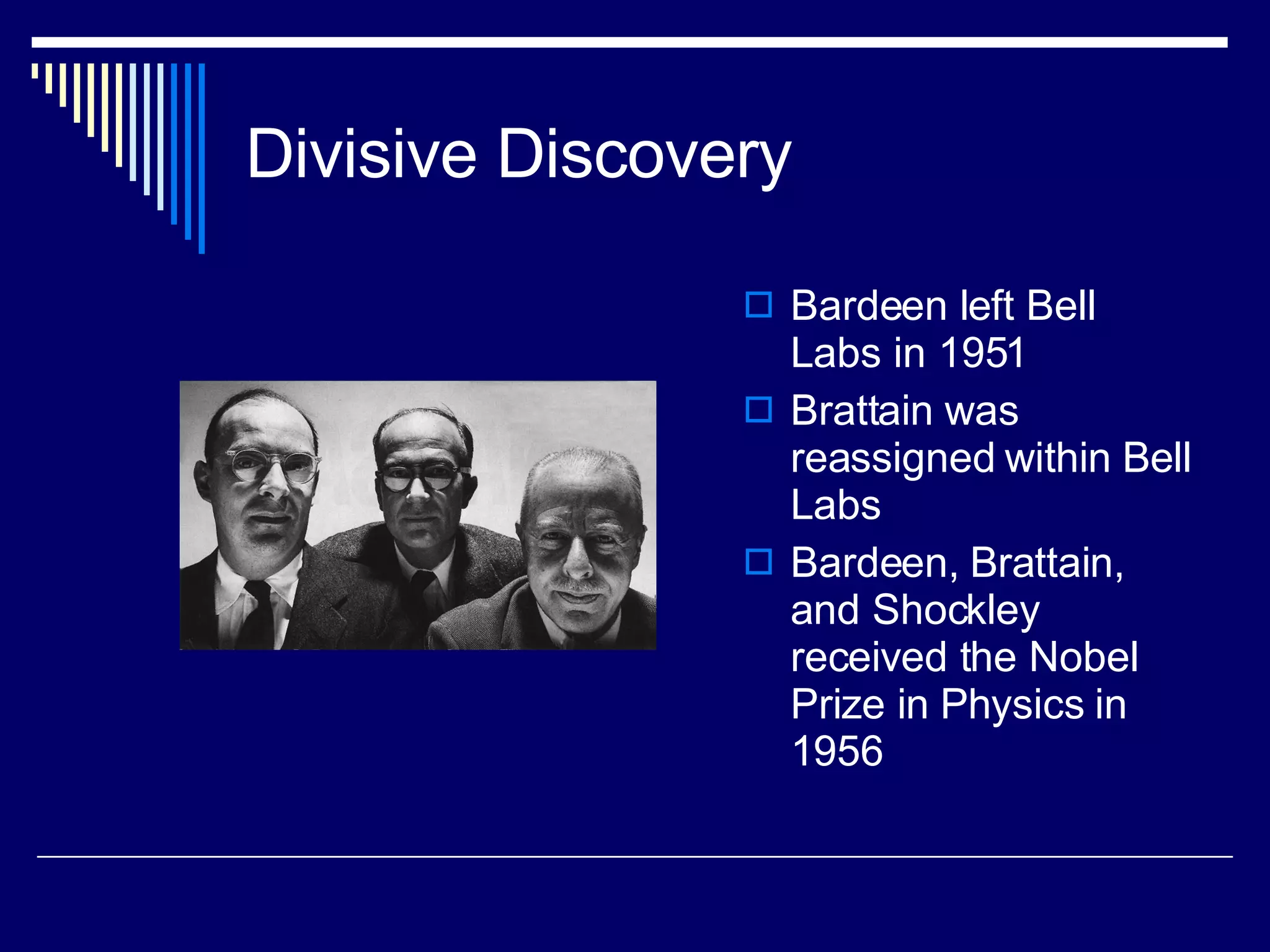
Divisive Discovery Bardeen left Bell Labs in 1951 Brattain was reassigned within Bell Labs Bardeen, Brattain, and Shockley received the Nobel Prize in Physics in 1956
Construct a Point-Contact Transistor
Next…The Road to Discovery

Crystal Fire

  • 1.
    Crystal Fire TheInvention of the Transistor and the Birth of the Information Age Riordan & Hoddeson
  • 2.
    The Beginnings ofa Physics Revolution 1870’s Crooke discovers “cathode rays”
  • 3.
    1895 R öntgenexperiments with cathode rays Curious beam penetrated cardboard…as well as soft tissue!
  • 4.
    1899 Thomson discoversthe electron (corpuscle) in his experimentation with cathode ray tubes Electrons are particles , 1/1000 th as massive as a hydrogen ion
  • 5.
    1900 Max Planckproposed quantization of energy to help explain blackbody radiation Energy is emitted in discrete bundles or packets and can be determined by E = hf
  • 6.
    1905 Einstein &the Photoelectric Effect Proposed that light must behave as proposed by Planck
  • 7.
    1909 Rutherford performsgold foil experiment “ It was almost as if you fired a fifteen-inch shell at a piece of tissue paper and it came back and hit you!” But this new model came with a new problem…
  • 8.
    Proposed solution byBohr 1913 Electrons occupy orbitals of quantized energy. Sommerfeld proposed the possiblitiy of elliptical orbitals and quantized angular momentum
  • 9.
    1924 Wolfgang Pauliproposed that electrons could have spin (either + or -) Helped explain the size and structure of atoms
  • 10.
    1923 de Broglieproposes wave particle duality of matter; In America, Davisson and Germer discover wavelike behavior from electrons rebounding from a nickel crystal (1927)
  • 11.
    The Wave FunctionSchr ödinger’s wave function mathematics shed light on Davisson and Germer’s experimentation, further solidifying the wave like behavior of matter
  • 12.
    In less than30 years… Quantum physics was born The model of the atom changed drastically Matter and light are both proposed to behave like waves and particles
  • 13.
    John Bardeen Bornin Wisconsin (1908) Unusually bright, “John is the concentrated essence of brain”, wrote his mother Fascinated with crystal radios
  • 14.
  • 15.
    John Bardeen Motherdied of breast cancer early in his life Finished University High at the age of 14. Took additional year of studies in physics and mathematics at Madison Central High School
  • 16.
    Walter Brattain Bornin China (1902) Spent most of childhood in Washington Outdoorsman and sharpshooter Educated at the Moran School
  • 17.
    William Shockley Bornin Europe (1910) Temperamental child Educated at the Palo Alto Military Academy Finished High School at Hollywood High
  • 18.
  • 19.
    Bell Labs SolidState Physics Group Charged with developing a solid state switch/amplifier Prior designs by Shockley proved utter failures Frustrated Shockley assigns task to Bardeen and Brattain
  • 20.
  • 21.
    Little-recognized Breakthrough Firstarticle published July 1 st , 1948 by the New York Times…on page 46!
  • 22.
    Shockley’s Idea ofa Junction Transistor
  • 23.
    Divisive Discovery Bardeenleft Bell Labs in 1951 Brattain was reassigned within Bell Labs Bardeen, Brattain, and Shockley received the Nobel Prize in Physics in 1956
  • 24.
  • 25.